Showing posts with label Tunisia. Show all posts

Sunday, 17 May 2026

Algeria, Australia, and Tunisia have all eliminated Trachoma as a public health risk.

On 23 April 2026 the World Health Organization published a press release confirming that Algeria had eliminated Trachoma, a transmissible Bacterial disease which is thew world's leading infectious cause of blindness. On 29 April a second press release confirmed that Australia had eliminated the disease. On 14 May a third press release confirmed that Trachoma had also been eliminated in Tunisia. This brings the number of countries which have eliminated the once widespread tropical disease to 31. Countries where it has previously been eliminated are: Benin, Burundi, Cambodia, China, Egypt, Fiji, The Gambia, Ghana, India, Iraq, Iran, Laos, Libya, Malawi, Mali, Mauritania, Mexico, Morocco, Myanmar, Nepal, Oman, Pakistan, Papua New Guinea, Saudi Arabia, Senegal, Togo, Vanuatu and Vietnam.

Regular examination of eyes at risk can help to reduce the incidence of communicable diseases such as Trachoma. Lily Solomon/World Health Organization.

Trachoma is caused by the Bacterium Chlamydia trachomatis, and spread through contact with mucus emitted from the eyes and nose during infection, and can be spread by Flies. Infections are most common among children, and the disease can spread rapidly in overcrowded environments, particularly where sanitation is poor and access to clean water is limited. The Bacterium infects the inside of the eyelid, causing a roughening which can in turn lead to damage to the surface of the eye. Eventually the disease can lead to the eyelids turning inwards, blinding the patient. Infections are generally fought off fairly quickly, particularly in adults, but having been infected does not offer protection against future infections, and the damage caused by each infection is cumulative. Chlamydia trachomatis is vulnerable to the antibiotics azithromycin and tetracycline.

McCoy cell monolayer micrograph reveals a number of intracellular Chlamydia trachomatis inclusion bodies; Magnified 200 times. The intracellular inclusion body represents the replication phase of the Chlamydia spp. organisms, whereupon, the reorganised reticulate body multiplies through binary fission into 100-500 new reticulate bodies, which mature into elementary bodies. Eugene Arum/Norman Jacobs/Centers for Disease Control and Prevention/Wikimedia Commons.

All three countries have been waging public health campaigns against Trachoma for many decades, with recent successes in eliminating infections attributed to the adoption of the World Health Organization's 'SAFE' strategy on the disease. This relies on four pillars, Surgery, which is used to save patients sight before it is lost in advances cases, Antibiotics, which are administered en masse during outbreaks, Facial cleanliness, in which large scale public health campaigns promote personal hygeine as a way to stop the spread of the disease, and Environment, in which access to clean water and good sanitation is improved. 

Mural promoting facial cleanliness to eliminate Trachoma, at Warburton in Western Australia. Minum Barreng: Indigenous Eye Health Unit/University of Melbourne/World Health Organization.

Both Algeria and Tunisia have historically had particular problems with Trachoma in their more arid southern provinces, where access to clean water has been limited. It has been estimated that in the early and mid twentieth centuries, as much as half of the population of southern Tunisia may have been affected by the disease.

World Health Organization consultant, Mario Tarizzo, prepares to take an eye smear from a school child at Srendi on the Tunisian island of Djerba. The World Health Organization has supported long-standing efforts in Tunisia to eliminate Trachoma, a disease of the eye that can cause blindness if left untreated. Eric Schwab/World Health Organization.

In Australia Trachoma was eliminated in much of the country decades ago, but has persisted in many remote Aboriginal and Torres Strait Islander communities, where access to both clean water and healthcare facilities can be very limited, and not everyone speaks English as a first language. In recent years bringing healthcare to such communities has been driven by a network of Aboriginal Community Controlled Health Organisations, which are better able to understand the healthcare needs of indigenous Australians, and deliver solutions in a culturally appropriate way.

Trachoma is one of 21 Neglected Tropical Diseases associated with devastating health, social and economic consequences outlined in the Roadmap proposed by the World Health Organization's Executive Board at its 146th session in February 2020, and adopted by the Seventy-third World Health Assembly in November 2020. This Roadmap aims to control, eliminate, or eradicate all of these diseases by 2021, in line with the United Nation's third Sustainable Development GoalEnsure healthy lives and promote well-being for all at all ages. The elimination of Trachoma in Algeria and Tunisia makes then the 62nd and 63rd countries to have eliminated at least one Neglected Tropical Disease since the adoption of the Roadmap.

See also...

Saturday, 3 September 2022

Striped Hyenas spotted in the Dghoumes National Park, Tunisia, and the Moroccan High Atlas for the first time in decades.

Striped Hyenas, Hyaena hyaena, are medium-sized Carnivoran Mammals with a wide distribution from North and West Africa, through East Africa and the Middle East to the Caucasus region and South and Central Asia. They mate for life, with both members of a pair partaking equally in the raising of the young. Spotted Hyenas are primarily carrion feeders, although they will hunt small prey, and can be found in wide range of habitats. They are, however, seldom tolerated around farmland, because of their perceived threat to livestock, and have become locally extinct across parts of their range, while suffering major declines in population in others. As such they are currently classified as Vulnerable under the terms of the International Union for the Conservation of Nature's Red List of Threatened Species.

A Striped Hyena, Hyaena hyaena, in the Jebel Akhdar uplands of northeastern Libya. Rushikesh Deshmukh/Wikimedia Commons.

The expansion of agriculture in Tunisia, and in particular the farming of livestock, has fuelled conflicts between Humans and carnivores, with only the African Wolf, Canis lupaster, and the Red Fox, Vulpes vulpes, remaining in many areas. The Striped Hyena is thought to have disappeared from most of Tunisia in the twentieth century, with the only twenty-first century records coming from camera traps in the Jebel Serj National Park in the north of the country.

In a letter to the journal Orynx published on 30 August 2022, Mohamed Khalil Meliane and Amira Saidi of Marwell Wildlife and the Research Laboratory of Biodiversity, Management and Conservation of Biological Systems at the University of Tunis El Manar, Marie Petretto and Tim Woodfine, also of Marwell Wildlife, and Philip Riordan and Tania Gilbert, again of Marwell Wildlife and of Biological Sciences at the University of Southampton, report camera trap observations of the Spotted Hyena in the Dghoumes National Park in southern Tunisia.

The observations were made as part of an assessment of biodiversity in the park following the re-introduction of the Scimitar-horned Oryx, Oryx dammah, Dorcas Gazelle, Gazella dorcas and North African Ostrich, Struthio camelus camelus. A total of 30 camera traps were deployed along Animal trails between April 2018 and March 2022. Striped Hyenas were spotted only during one month each during 2018 and 2019, but were spotted during six months each in 2020 and 2021. During this time 20 observations were made of at least two individual Hyenas. Camera traps placed in the Jbil National Park and Sidi Toui National Park in southern Tunisia failed to record any Spotted Hyenas.

In a second letter published in Orynx on the same day, Abderrazak Ek Alami and El Mustapha Bouzid of the Moroccan Ministry of National Education, and Abderrazak Fattah of the University of Hassan II in Casablanca, confirm the first observation of a Striped Hyena in the Central High Atlas Mountains of Morocco since 2000.

El Alami et al. were engaged in surveying the area for Carnivores between 2019 and 2022, although they did not observe any Striped Hyenas during this survey. However, on 20 April 2022 a Hyena was shot and killed by a local resident in the Faryata region north-east of the town of Beni Mellal, with photographs of the dead Animal being subsequently posted to social media, prompting local authorities to investigate, as the species is protected under Moroccan law.

This (unfortunate) incident confirms that Striped Hyenas are still present in the High Atlas, although the fact that the species was not detected by a survey which was able to located other elusive species suggests that their numbers are very low, leading El Alami et al. to conclude that more efforts are needed both to protect Carnivores in this region, and to promote education about conservation in order to reduce Human-wildlife conflicts.

See also...

Follow Sciency Thoughts on Facebook.

Follow Sciency Thoughts on Twitter.


Sunday, 14 October 2018

Haplocookia enghoffi: A new species of Trichopolydesmid Millipede from Tunisia.

Trichopolydesmid Millipedes are found around the Mediterranean Basin, reaching their maximum diversity in Europe, where around 90% of known species are found. North Africa is currently home to only five described species, though the group is poorly studied in the region, and this may be a poor reflection of its real diversity there.

In a paper published in the journal ZooKeys on 26 September 2018, Nesrine Akkari of the Naturhistorisches Museum Wien, and Jean-Paul Mauriès of the Section Arthropodes at the Muséum National d’Histoire Naturelle, describe a new species of Trichopolydesmid Millipede from the Cap Bon Peninsula in Tunisia.

The new species is placed in the genus Haplocookia, and given the specific name enghoffi, in honour of Henrik Enghoff, for his expertise on Millipedes. These Millipedes are a pale cream in colour, and reach 8.0-8.6 mm in length with 20 body rings.

Haplocookia enghoffi, male specimen in latral view. Akkari & Mauriès (2018).

See also...

http://sciencythoughts.blogspot.com/2018/08/permocrassacus-novokshonovi-and.htmlhttps://sciencythoughts.blogspot.com/2018/01/trichopeltis-sutchariti-new-species-of.html
http://sciencythoughts.blogspot.co.uk/2015/01/three-new-species-of-polydesmid.htmlhttp://sciencythoughts.blogspot.co.uk/2014/11/two-new-species-of-flat-backed.html
http://sciencythoughts.blogspot.co.uk/2014/03/a-new-species-of-geophilomorph.htmlhttp://sciencythoughts.blogspot.co.uk/2013/10/the-origin-of-millipede-hoplatessara.html
Follow Sciency Thoughts on Facebook.

Thursday, 28 January 2016

Ammotragus lervia: The diet of the Barbary Sheep in the Bou Hedma Mountains of Tunisia.

The Barbary Sheep (or Aoudad), Ammotragus lervia, is a wild Caprid found in North Africa, from the Mediterranean as far south as the Niger and Lake Chad, and introdiced to other parts of the world such as North America and the Canary Islands. The species is now missing from much of its original range, having suffered from habittat loss Human encroachment, overhunting and competition with domestic animals, and is considdered Vulnerable under the terms of the International Union for the Conservation of Nature's Red List of Threatened Species. This has led to a number of recent studies of the species popuation and distribution, but other aspects of its biology have tended to be overlooked. In Tunisia the species is nearly extinct and considdered tobe Critically Endangered under the National Register of Wild Species.
  
In a paper published in the South African Journal of Science on 23 November 2015, Jamel Ben Mimoun and Saïd Nouira of the Laboratory of Animal Ecology at the Tunis El Manar University discuss the results of a study of the diet of the Barbary Sheep in the Bou Hedma National Park in central Tunisia.

 Barbary Sheep, Ammotragus lervia, at Oued Dekouk in Tunisia. Steve Morgan/Mammal Watching.

Ben Mimoum and Nouira examined Barbary Sheep droppings collected at monthly intervals between March 2009 and February 2010 in order to determine the proportions of different plants in the diet of the living animals. They found that two species of Grass, Stipa parviflora and Stipa tenacissima, formed the bulk of the Sheep's diet, together forming 63.2% of the plant matter consumed. However there was a strong seasonal variation in the amount of these Grasses consumed, so that they formed 69.1% of the diet in spring, 78.3% of the diet in summer, 56.6% of the diet in autumn and 34.7% of the diet in winter.

Thus Grasses form the bulk of the plant matter consumed in spring and summer (though the maximum number of different plant species were consumed in spring), In autmn browsing on trees and shrubs played a more important part in the diet, with Pistacia lentiscus comprising 7.4% of the plant matter consumed, Juniperus phoenicea 5.9% and Periploca laevigata 5.2%. Periploca laevigata remained an important part of the diet in winter, forming 5.5% of the diet. The herbaceous plant Helianthemum kahiricum was also important in autumn and winter, when it formed 13.6% and 13.0% of the diet, with two other herbaceous plants becoming important in winter; Globularia alypum, which formed 14.6% of the winter diet, and Helianthemum semiglabrum, which formed 12.1% of the winter diet.

 The current distribution of the Barbary Sheep, Ammotragus lervia, in North Africa. International Union for the Conservation of Nature's Red List of Threatened Species.

The Barbary Sheep is a highly flexible herbivore, known to be able to consume a wide range of plant species. In Texas, where it has been introduced, it has been shown to regularly consume 25 species of plants, in the Canaries 41, and in New Mexico 74 species. In Bou Hedma the species only consumed 19 identifiable species of plants, which is likely to be a result of a lack of suitable alternatives rather than a lack of willingness to consume other plants. Nevertheless the Tunisian Barbary Sheep shows a clear preference for Grasses when these are available, something which has previously been observed in Barbary Sheep in Texas and California, though other studies of the Sheep in Texas, New Mexico and Morocco have found browsing on trees and shrubs to play a more important role in the species diet. It was noted that the Tunisian Sheep showed a clear preference for open grassland during the breeding season, and that this was also the time of maximum Grass growth.

See also...

http://sciencythoughts.blogspot.co.uk/2016/01/mapping-distribution-of-southern-pudu.htmlMapping the distribution of the Southern Pudú in Chile.                                               The Southern Pudú, Pudu pudu,  is one pf the world's smallest Deer species, typically weighing 35 to 45 cm at the shoulder and weighing 6.4 to 13.4 kg. It is found in southern Chile and Argentina, and is listed as...
http://sciencythoughts.blogspot.co.uk/2013/08/how-fencing-tibetan-prairies-is.htmlHow fencing the Tibetan prairies is effecting the endangered Przewalski’s Gazelle. The Przewalski’s Gazelle (Procapra przewalskii) is a species of high altitude adapted Antelope, which formerly ranged across much of northwestern China and Inner Mongolia. It is now restricted to a small area around Qinghai Lake on the Tibetan Plateau, with a...
Follow Sciency Thought's on Facebook.
 

Thursday, 6 November 2014

A Pre-Tooth-Combed Primate from the Early Eocene of Tunisia.


The Strepsirhini (Lemurs, Lorises and Galagos) are often considered to be ‘Lower Primates’, surviving representatives of a primitive stock from which the ‘Higher’ Anthropoid Primates (Monkeys and Apes) arose. However they are just as specialized in their way as the Anthropoids, and have a set of adaptations not present in the other group, most notably a specialized ‘tooth-comb’ (specialized set of front teeth used in grooming). Estimates of the age of the group vary, with molecular dating methods suggesting that the most recent common ancestor of all living Strepsirhini lived some time in the Late Cretaceous, while the earliest known fossils of the group date from the Early Eocene, suggesting that either the group has a long ‘fossil gap’ (period when the animals were present but left no fossils) or the ‘molecular clock’ dating method is inaccurate for Strepsihines.

In a paper published in the journal PLoS One on 4 December 2013, a team of French and Tunisian scientists led by Laurent Marivaux of the Laboratoirede Paléontologie at Université Montpellier redescribe Djebelemur martinezi, an Early Eocene Primate that has variously been considered an Adapiforme (an extinct group of Lemur-like Primates lacking a tooth-comb, which includes the ‘Lemurs’ of Europe and North America), or an early Anthropoid.

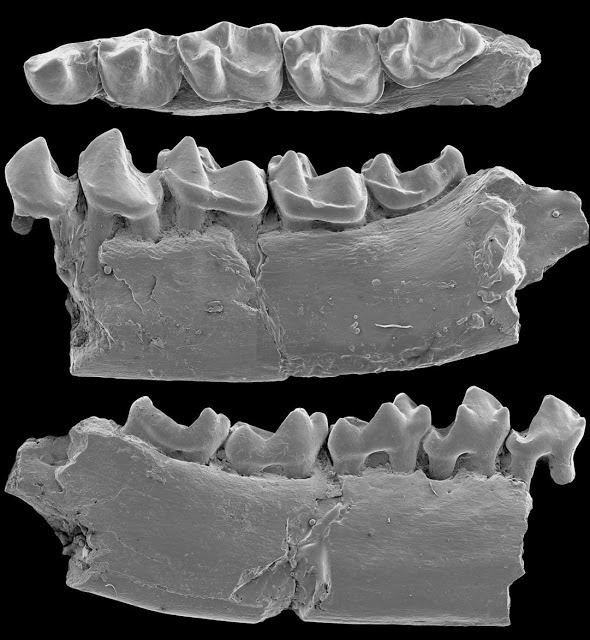
Djebelemur martinezi was originally described from a left dentary (jawbone) with two preserved molars, from the Natural Park of Djebel Chambi in Tunisia, estimated to be about 50 million years old. Since this time a number of other specimens attributable to the species have become available, including a facial fragment with a partial maxila (upper jaw) and numerous isolated teeth.

Lower jaw of Djebelemur martinezi from the Djebel Chambi locality.(A) Fragments of right mandible, whichconsists of three isolated pieces found together and reassembled here: the anterior part of the dentary bears the p3 and m1, and alveoli for p4, p2and c, while the posterior part preserves m3 and a portion of the ascending ramus; m2 was found isolated but in the same small calcareous blocktreated by acid processing; (B) photograph of the proximal part of the right mandible (for p4 and p3, note that their mesialalveolus is slightly offset buccallywith respect to their distal alveolus; the single alveolus for p2 is mesiodistally compressed and oblique, while the alveolus for the canine, althoughonly partially preserved, appears slightly larger, suboval, and more lingually positioned with respect to the main axis of the toothrow). (C–G) noncompositelower toothrow with the mandible, canine (reversed), p2 (reversed), and p4, in occlusal (C), lingual(D), frontal (F), and distal (G) views; (H) left p2 in (from left to right) occlusal, buccal, lingual, distal, and mesial views (not reversed); (I) left canine in (from left to right) occlusal, buccal, lingual, distal, and mesial views (not reversed). The 3D representations have been obtained by X-ray mCT surface reconstruction. The crown and roots of teeth of the mandible have beenvirtually delimited by manual segmentation. Marivaux et al. (2014).

Marivaux et al. conclude from this material that Djebelemur martinezi had a primitive tooth-comb apparatus, and that it should therefore be considered an early member of the Strepsihine lineage, though an analysis of its phylogeny suggests that it branched off before the most recent common ancestor of all modern members of the group. This in turn suggests that the Strepsihines are younger than previously thought, probably originating in the early Eocene. If this is the case, then the Strepsihines are considerably younger as a group than the Adapiformes of Europe, and the may have arisen from a small Adapiforme population that reached Africa from Europe, rather than both groups arising from an more ancient African ancestor – which has implications for the origins of Primates as a whole.

Facial fragment of Djebelemur martinezi from the Djebel Chambi locality.(A–E) Left maxilla preserving P3-M3 andalveoli for P2 and C1, in frontal (A), coronal section (cs) through M1 (B), palatal (C), dorsal (D), and lateral (E) views; (F) left P4 in occlusalview. The 3D representations have been obtained by X-ray mCT surface reconstruction. On the maxilla, the crown androots of teeth have been virtually delimited by manual segmentation. Abbreviations: IOF, infraorbital foramen; of, orbital floor; hp, hard palate; pzm,processuszygomaticus maxillae; ra, root apex; jms, jugo-maxillary suture. Marivaux et al. (2014).

Marivaux et al. also tried to reconstruct the diet of Djebelemur martinezi, based upon analysis of tooth wear and the potential shearing force that could be applied by its jaws. Based upon this they conclude that it was probably an insectivore. The shearing force it could apply would be far in excess of that expected for a frugivore (fruit eater) of similar size, falling comfortably within the range for leaf-eaters and a little on the low side for an insect eater; however leaves require an extended digestive tract to process, and at an estimated 80g Djebelemur martinezi is highly unlikely to have been able to do this. The dental wear seen is also more consistent with insectivory than any other diet.

See also…

Bushbabies (Galagidae) are African nocturnal Primates related to Lorises (Lorisidae). Like the Lorises they are solitary nocturnal foragers living in the tree canopy, but while Lorises are slow, deliberate animals, the Bushbabies often move rapidly through the forest, and are capable of leaping from tree-to-tree like Monkeys...

The Omomyids were a group of Palaeocene-Oligocene Primates similar, and probably related to, the modern Tarsiers. They had large, forward facing, eyes and grasping hands and feet with nails instead of claws. Their teeth sugest that they had a diet of fruit and insects, and their skeltel morphology that they lived in trees and that most species were nocturnal. They appeared in the fossill...

Mouse lemurs are the smallest primates. They are nocturnal animals that resemble Tarsiers or Bush Babies, but are true lemurs, all 27 known species belonging to a single genus Microcebus. Like all modern lemurs they are found only in Madagascar (fossil lemurs are known from Africa, Asia and Europe).


Follow Sciency Thoughts on Facebook.

Tuesday, 22 October 2013

Magnitude 4.5 Earthquake off the coast of Tunisia.

The United States Geological Survey recorded a Magnitude 4.5 Earthquake at a depth of 27.7 km, less than a kilometer offshore of the town of Bekalta on the east coast of Tunisia, slightly before 4.10 pm local time (slightly before 3.10 pm GMT) on Friday 18 October 2013. There are no reports of any injuries arising from this event, but it was felt along the coast of Tunisia as far north as Tunis, 150 km from the epicenter of the quake, and minor damage to buildings was reported in many areas.

Damage to the interior of a building in Monastir, 23 km from the epicenter of the 18 October 2013 Tunisian Earthquake. Centre Sismologique Euro-Méditerranéen.

Tunisia is not a country generally associated with Earthquakes, but is close to an active tectonic margin, with the boundary between the African and Eurasian Plates running along the north coast of the country, then along the south coast of Sicilly. This is a convergent margin, with the two continental masses being pushed together by the northward movement of Africa. This is a convergent margin, with Africa being partially subducted beneath the Eaurasian Plate and fuelling the volcanoes of southern and western Italy, and compression and folding of the southern part of the Eurasian Plate, causing uplift in the Appenines and Alps.

The approximate location of the 18 October 2013 Tunisian Earthquake. Google Maps.


Follow Sciency Thoughts on Facebook.

Tuesday, 26 March 2013

Earthquake off the coast of Tunisia.

On Monday 25 March 2013, slighlty before 11.10 pm local time (slightly before 10.10 pm, GMT) the United States Geological Survey recoreded a Magnitude 4.1 Earthquake at a depth of 15.7 km, 67 km offshore from Monastir on the Tunisian coast. This is a moderately large Earthquake, but some way from land, so it is unlikely to have caused any damage or casualties, and may not have been felt by anyone.

The location of the 25 March Earthquake. USGS.

Tunisia is not a country generally associated with Earthquakes, but is close to an active tectonic margin, with the boundary between the African and Eurasian Plates running along the north coast of the country, then along the south coast of Sicilly. This is a convergent margin, with the two continental masses being pushed together by the northward movement of Africa. This is a convergent margin, with Africa being partially subducted beneath the Eaurasian Plate and fuelling the volcanoes of southern and western Italy, and compression and folding of the southern part of the Eurasian Plate, causing uplift in the Appenines and Alps.


Follow Sciency Thoughts on Facebook