Showing posts with label Lophophorata. Show all posts

Thursday, 4 June 2020

Freshwater Bryozoans from Cuba.

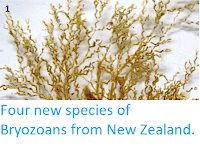
Bryozoans, or Moss Animals, are colonial lophophorates, which is to say animals that feed using a lophophore, a horseshoe-shaped structure bearing ciliated tentacles around the mouth, that form encrusting or weed-like colonies. The individual 'animals' are on average about 0.5 mm in length, and live inside a protective covering from which they extend a crown of cilia-covered tentacles called a lophophore. These are not true individuals though as they develop as buds on the colony and share nutrients; for this reason they are referred to as 'zooids'. Bryozoans are widespread globally, but are often overlooked because they are small and the colonies resemble plants. Members of the Class Phylactolaemata are found only in freshwater environments. Unlike other Bryozoans they do not have separate reproductive zooids not capable of feeding, rather all of the zooids in a colony are capable of feeding and reproducing, being simultaneous hermaphrodites. The colonies can also reproduce asexually, by producing special zooids called statoblasts, which are entirely enclosed within chitinous, bivalved shells, which either remain adhered to the colony or sink to the bottom (or in some cases float, in which case they are known as floatoblasts), remaining dormant through periods of adverse conditions, before opening and growing into new colonies.

In a paper published in the journal ZooKeys on 12 March 2020, Rafael Carballeira of the Departamento de Ciencias da Terra and the Centro de Investigacións Científicas Avanzadas at the Universidade da Coruña, Cosme Romay of the Grupo de Investigación en Bioloxía Evolutiva and Centro de Investigacións Científicas Avanzadas at the Universidade da Coruña, and Atocha Ramos of the Grupo de investigación Química Analítica Aplicada and Centro de Investigacións Científicas Avanzadas at the Universidade da Coruña, report the first known occurence of Freshwater Bryozoans in Cuba.

The freshwater Bryozoan fauna of the insular Caribbean has been mainly studied in the Leeward Islands (Aruba, Bonaire, Klein Bonaire and Curaçao), with three known species from the study of colonies and floatoblasts (statoblast buoyant with the annulus composed of gas chambers): Plumatella agilis, Plumatella casmiana, and Plumatella longigemmis. In addition, Plumatella repens has been reported in Puerto Rico. Unidentified Plumatella colonies and floatoblasts were reported on the islands of Cuba and Trinidad in the 1940s.

Knowledge of the distribution of Freshwater Bryozoans in the Caribbean is scarce despite the great biogeographical interest of this area. It constitutes a complex island system located between two large continental biogeographic regions: Nearctic and Neotropical. 

The La Niña Bonita Reservoir is located in the council of Bauta (Artemisa Province, Cuba). This water body is a freshwater wetland with an area of 12 000 m² and a maximum depth of 10 m. This reservoir dams the Jaimanitas River, with a basin of 9.2 km² dominated by limestone rocks, and is used mainly for irrigation and Fish farming. 

Ciénaga de Zapata Swamp is located in the Zapata Peninsula (Matanzas Province, Cuba). This wetland is the largest (2600 km²) and best conserved marsh swamp in the insular Caribbean, as well as the one with the greatest biodiversity. It has been declared a national conservation area by the government of Cuba and has been internationally recognized as a Ramsar Site. The shallow marshes show an important accumulation of organic matter and the lithology is dominated by limestones and dolomites with seeping underground waters (cenotes). The waters are bicarbonated-calcic with a great spatial heterogeneity depending on the input of groundwater seeps or marine intrusions. Also, there is a great salinisation of groundwater as a consequence of the exploitation of freshwater aquifers.

(A) Location map. (1) La Niña Bonita Reservoir and (2) Ciénaga de Zapata Swamp (B) Aerial photograph of the La Niña Bonita Reservoir (ESRI World Imagery, ArcGIS 10.0) C Aerial photograph of the Ciénaga de Zapata Swamp (ESRI World Imagery, ArcGIS 10.0). Carballeira et al. (2020).

In shallow wetland areas, samples of 2 cm³ of surface sediment were collected in the La Niña Bonita Reservoir and in the Ciénaga de Zapata Swamp. Sediment samples were screened through a 50 μm mesh; the larger fractions were examined under a stereoscopic microscope, and floatoblasts were collected with a pipette. Floatoblasts were treated with 2% sodium hydroxide for 1 minute under agitation at room temperature, then subjected to an ultrasonic bath for 15 seconds, and finally washed in deionised water. Floatoblasts for scanning electron microscopy were mounted on aluminium stubs, sputtered with platinum/palladium (15 nm) for 1 min using a Cressington Sputter Coater 208HR SEM, and studied with a JEOL Field Emission SEM JSM 7200F operated at 15 kV in the University of Coruña’s Research Support Service.

The morphometry of the examined floatoblasts showed that they belong to the species Plumatella repens. The shape of the floatoblast is broadly oval, both valves are equally convex in lateral view, and the floatoblast annulus is smooth, without tubercles. Floatoblast measurements were 318.5–350.2 μm in total length and 217.3–252.6 μm in total width. The fenestra of floatoblasts is rounded oval in dorsal view and oval in ventral view, covered with rounded tubercles and a relatively intense reticulation.

Plumatella repens, floatoblast from La Niña Bonita Reservoir and the Ciénaga de Zapata Swamp (Cuba), scanning electron micrographs: (A) View of dorsal valve. (B) View of ventral valve. (C) Suture between valves is a single cord with a row of low tubercles on either side. (D) Section of the annulus showing the connection between gas chambers, with circular pores with filiform extensions along the border. Scale bars: 50 µm (A), (B); 10 µm (C); 5 µm (D). Carballeira et al. (2020).

The length of the dorsal fenestra is larger than half the total length of the floatoblast. The annulus is smooth, without tubercles, occasionally with moderate nodulation and some large tubercles on the periphery, around the fenestrae especially on the ventral side. The measurements of the dorsal fenestra are 130.9–176.4 μm in length and 105.5–163.7 μm in width, while the ventral fenestra measures 187.5–247.3 μm in length and 141.2–188.7 μm in width. The suture between the valves is a single cord with tubercles on both sides. A section of the annulus shows circular pores with filiform projections connecting the gas chambers.

These new records of Plumatella repens are the first certain record of a Freshwater Bryozoan species in Cuba; only Plumatella sp. was reported on the island previously, without specifying a locality. This extends the distribution range of the species in the Caribbean area, with a single record in Puerto Rico so far. The presence of Plumatella repens on the island of Cuba is consistent with the existence of records of the species in the insular Caribbean and the cosmopolitan distribution of this species.

The ecology of Plumatella repens in Cuba and Puerto Rico is associated with permanent freshwater ecosystems and coastal wetlands with highly mineralized waters caused by the predominant limestone lithology, and influenced by seawater mixing within an oligohaline range (0.5–5‰). The species also experiences a wide range of nutrient concentrations (nitrates, phosphates) and high levels of dissolved organic matter.

See also...

https://sciencythoughts.blogspot.com/2018/12/cellaria-oraneae-new-species-of.htmlhttps://sciencythoughts.blogspot.com/2018/11/beania-serrata-beania-mediterranea-two.html
https://sciencythoughts.blogspot.com/2017/11/bryozoas-from-seamounts-islands-and.htmlhttps://sciencythoughts.blogspot.com/2013/11/two-new-species-of-bryozoans-from-late.html
https://sciencythoughts.blogspot.com/2013/08/four-new-species-of-bryozoans-from-new.htmlhttps://sciencythoughts.blogspot.com/2013/04/a-new-species-of-bryozoan-from-atlantic.html
Follow Sciency Thoughts on Facebook.

Hyoliths from the Early Cambrian Murray Shale of Chilhowee Mountain, Tennessee.

The Hyoliths are an enigmatic group of shelled invertebrates known from the Earliest Cambrian until the End Permian Extinction. They had conical shells with opercula (lids), and sometimes a pair of curved horns called 'helens'. The exact nature of Hyoliths was for a long time considered a mystery, with most palaeontologists considering them to be either a form of Mollusc or an extinct phylum of animals of unknown affinities. However, recent studies of Hyoliths with preserved soft tissues and shell microstrucure has led to the conclusion that they were lophophorate animals closely related to Brachiopods.

In a paper published in the Journal of Paleontology on 2 April 2020, John Peel and Sebastian Willman of the Department of Earth Sciences at Uppsala University and Steven Hageman of the Department of Geological and Environmental Sciences at Appalachian State University, describe a series of Hyloliths from the Early Cambrian Murray Shale of Chilhowee Mountain, Tennessee.

Outcrops of Laurentian Early Cambrian (Cambrian Series 2; roughly 521 to 509 million years ago) strata extend from Alabama and Tennessee to North-East Greenland along the Eastern Seaboard of North America. Traditionally, their age has been determined by occurrences of trilobites indicative of the Dyeran Stage of North American usage (Cambrian Stage 4; roughly 514 to 509 millio years ago), with widespread records of Olenellus and related Trilobites in the literature. By contrast, extensive faunas of older Cambrian Trilobite faunas indicative of the Montezuman Stage (Cambrian Stage 3; roughly 521 to 514 million years ago) are well known from the opposite side of Laurentia, in the western United States. However, fossiliferous Avalonian successions in Rhode Island and Massachusetts, New Brunswick, Nova Scotia, and eastern Newfoundland comprising the Terreneuvian (Cambrian Series 1; roughly 541 to 521 million years ago) and Cambrian Series 2 to Lower Ordovician, are juxtaposed against the Laurentian of the Eastern Seaboard of present-day North America.

Localities and stratigraphy. (1) Peary Land region of North Greenland showing outcrops of the Buen Formation (black) and localities with Montezuman Stage fossil assemblages; (2) Eastern Seaboard of North America with Greenland displaced southward to its approximate position in the Cambrian. NEG indicates Dyeran occurrences in North-East Greenland. (M), (NB + CBI), and (N) locate Avalonian successions in Massachusetts, New Brunswick and Cape Breton Island, and eastern Newfoundland, respectively; (3) early Cambrian stratigraphy in southern Peary Land showing derivation of fossil assemblages with the Buen Formation; (4) early Cambrian stratigraphy at Chilhowee Mountain, Tennessee, indicating location of fossiliferous samples (F) in the Murray Shale (Montezuman Stage) and the established Dyeran Stage faunas of the Shady Dolomite in Virginia. Peel et al. (2020).

The recent description of the Nevadioid Trilobite Buenellus from the upper Murray Shale of Chilhowee Mountain, eastern Tennessee, is significant in providing evidence of the Montezuman Stage in the Laurentian terrane of the eastern United States. Buenellus is otherwise known only from its type locality in the Sirius Passet Lagerstätte of Peary Land, North Greenland.

The Sirius Passet Lagerstätte is the oldest known fossil assemblage within a succession of Montezuman–early Dyeran (Cambrian Stages 3–4) age assigned to the Buen Formation. The Lagerstätte is known only from a single locality, but the siliciclastic sediments of the Buen Formation are otherwise widely distributed in eastern North Greenland. The Buen Formation lies within the transarctic Innuitian Orogen, facing the Arctic Ocean. By contrast, the Murray Shale at Chilhowee Mountain, and other Laurentian outcrops along the Eastern Seaboard between Alabama and North-East Greenland accumulated along the shore of the former Iapetus Ocean. In Cambrian times, however, Laurentia occupied a tropical position, and this Iapetan margin faced to the south.

About 35 Hyolithid specimens preserved in pale buff weathering shale were examined from locality CM3 on Chilhowee Mountain where they occur together with Buenellus chilhoweensis in the upper Murray Shale. The specimens are crushed, but not completely flattened, and some are preserved as external and internal molds. Conchs dominate but most are broken. Opercula occur as isolated fossils, and in rare partially articulated associations with conchs Rare broken fragments of the paired appendages (helens) have been observed as isolated fossils.

The specimens recovered were sorted into four species, one of which was tentatively placed in the genus Burithes, the other three being of uncertain affinities and are instead numbered. None of the material is considered well enough preserved to name a species from.

The species placed in the genus Burithes has a conch with incremental angle 20°–25° and ligula about one-sixth of total length, with a slight longitudinal curvature such that the ventral surface may have been shallowly convex. The width of the ligula is about half its length, but the length increases proportionately with growth Shallow lateral sinuses for the likely passage of helens lie on the dorsal side of the angular transition from the convex dorsal surface to the almost flat ventral surface. The dorsal surface is seemingly uniformly shallowly convex, but the degree of inflation uncertain due to crushing. Ornamentation on the ventral surface consists of fine comarginal growth lines with occasional growth halts that may appear periodic. Ornamentation on the dorsal surface is poorly known, seemingly almost orthocline. Operculum and helens not certainly known, but associated isolated opercula are wider than long, supporting the interpretation that the dorsal surface of the conch was not strongly inflated.

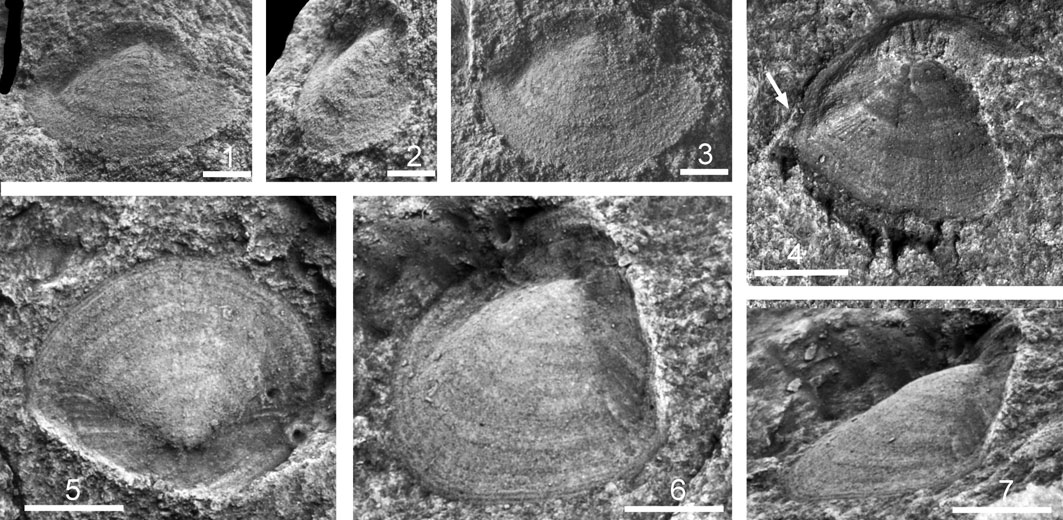
Burithes? sp. Hyolith conchs from the Murray Shale, Chilhowee Mountain, Tennessee. (1) PMU 35718, ventral surface; (2) PMU 35719, ventral surface; (3) PMU 35720, obliquely crushed ventral surface; (4) PMU 35721, central surface, above, with external mold of dorsal surface, below; (6) PMU 35722, crushed, with dorsal surface overlying internal surface of ventral surface with ligula; (7) PMU 35723, ventral surface with characteristic fractures; (8) PMU 35724, ventral surface. Peel et al. (2020).

All specimens are compressed, although a degree of separation between the dorsal and ventral surfaces may be maintained. Crushing has often produced Y–shaped cracks that extend from the ligual margin down the median line as a raised, irregular ridge or angulation to near the apex. The median fracture is commonly expressed as a ridge on the ventral surface, but this is a preservational artifact. However, a broad, rounded ridge in some specimens likely represents compaction around a solid object within the conch interior, possibly an early mineralized burrow or sediment-infilled section of gut.

In terms of its overall shape, the Murray Shale conchs are similar to Burithes erum from the Tommotian of the Anabar Massif of Siberia. Nevadotheca whitei from the Pioche Shale (Cambrian Series 2) of Nevada, the type species of Nevadotheca, differs in having a high, inflated dorsum and narrowly rounded lateral margins. This is also the case in Nevadotheca boerglumensis and Kalaallitia myliuserichseni, described from the early Olenellus Biozone (Dyeran, Cambrian Stage 4) of the Buen Formation of southern Peary Land, North Greenland, but Kalaallitia is distinguished by its fine longitudinal lirae and longer ligula. Opercula referred to these Peary Land species are proportionately longer than Murray Shale specimens, suggesting that the dorsal surface of their conchs was more strongly inflated than in Burithes? sp.

Some researchers have noted some similarity between specimens from the Dyeran of North-East Greenland and Burithes, but the acute dorsum of their material suggested assignment to Grantitheca. In contrast to material from the Murray Shale and Buen Formation, hyoliths from North-East Greenland are preserved mainly as internal molds in limestone or as phosphatic residues from limestones.

The first numbered species 'Hyolithid sp. 1' is known from the illustrated specimens and two additional fragments, is characterized by two or three prominent transverse folds or corrugations on the adapertural part of the shallowly convex ventral surface of the conch and ligula. The incremental angle is about 30°, and the length of the ligula is slightly more than half its width. Lateral sinuses are present at the transition from the shallowly convex ventral surface to the dorsal surface, but the degree of inflation of the latter is not known. Ornamentation consists of fine comarginal growth lines, although these are more strongly developed at the preserved aperture.

Hyolithid sp. 1, PMU 35725: (5) external and (9) internal molds showing prominent corrugation. Peel et al. (2020).

Corrugation of the latest growth stage of the ventral surface and ligula is common in hyolithids, but not with the high degree of emphasis seen in the Murray Shale specimen. Examples have been illustrated in specimens from Siberia referred to Trapezovitus sinscus and Burithes cuneatus, in Nitoricornus wushiensis from the lower Cambrian of Xinjiang, China, and in specimens from New Brunswick.

The second unnamed species, 'Hyolithid sp. 2' is described from three overlapping incomplete specimens in ventral aspect, which Peel et al. suggest may form part of a gut fill or coprolite. One of the specimens preserves the operculum in place. The incremental angle is about 20°, and the ligula is short. The ventral surface is shallowly convex, but the lateral edges are rounded and delimited on their axial edge by a shallow longitudinal furrow. The dorsal surface is not known, but lateral sinuses seem to be well developed The impression of the dorsal exterior of the operculum shows comarginal growth lines and a suggestion of a radial furrow. While similar in shape to other opercula from the Murray Shale, it is too poorly preserved for closer comparison.

Hyolithid sp. 2; (11), (12) PMU 35727 with three fragmentary specimens in ventral aspect, probably within a gut fill, coprolite, or burrow; arrow in (12) locates external mold of operculum shown in detail in (11); (13) PMU 35728, external mold of ventral surface. Scale bars 2 mm.

The third unnamed species, 'Hyolithid sp. 3', is described from a single poorly preserved specimen which has an incremental angle of 15° and appears to have an oxygonal aperture. Adaperturally, shallowly convex comarginal growth lines on the ventral surface are cord-like and laterally discontinuous, resembling the pattern seen in Nitoricornus danianum and ?Crestjahitus danianus from New Brunswick, Canada, whereas the dorsal surface is ornamented with barely discernible fine growth lines.

Hyolithid sp. 3, PMU 35726, dorsal view. Peel et al. (2020).

Three poorly preserved specimens of partially articulated Hyolithid skeletons occur, but several isolated opercula are known. The length of the best-preserved specimen is about four-fifths of its width. Its conical shield is hemispherical in plan view, and the summit lies at about one-quarter of the distance from the adapical margin to the adapertural margin. The folds separating the conical and cardinal surfaces delimit an angle of about 130° in plan view In lateral perspective, the cardinal shield rises high above the summit of the operculum, with the inclination of its adapical margin suggesting that the conch had an amblyogonal margin. The cardinal area is ornamented with radial ridges transverse to the comarginal growth lines present over the entire conch. The latter are most conspicuous on the conical shield where radial ornamentation consists of fine lines.

Hyolithid opercula from the Murray Shale, Chilhowee Mountain, Tennessee. (1)–(3) PMU 35729: (1) oblique apertural, (2) dorso-lateral, and (3) dorsal views. (4) PMU 37730 external mold with arrow indicating lateral sinus for passage of helen; (5)–(7) PMU 35731: (5) dorsal, (6) dorso-lateral, and (7) lateral views. (1)–(3) Scale bars 1 mm; (4)–(7) scale bars 2 mm. Peel et al. (2020).

A second specimen, preserved as an external mold, has a well-defined convex adapical border with prominent coarse ridges between the summit and the adapical margin. A broad shallow sinus in the margin marks the exit point for the helen. A third specimen has a more elliptical shape than the other two specimens and develops a series of short comarginal rugae located medially on the conical shield.

The cardinal surface is proportionately longer in opercula of Nevadotheca boerglumensis and Kalaallitia myliuserichseni from the early Olenellus Biozone at Brillesø, southern Peary Land, and the folds separating the conical and cardinal surfaces delimit an angle of about 90°, much smaller than in the specimens from the Murray Shale. In this respect, the opercula from the Murray Shale more closely resemble the opercula associated with articulated specimens from the Sirius Passet Lagerstätte, but these are too poorly preserved for close comparison. A similar wide angle is seen in Nitoricornus danianum illustrated from New Brunswick.

Articulated Hyolithids from the Sirius Passet Lagerstätte, Buen Formation, Peary Land, North Greenland. (1) MGUH 29260; (2), (4) MGUH 29691: (2) ventral surface with operculum displaced and inverted to show conical surface; (4) enlarged view. (3) MGUH 29258, ventral surface. (1)–(3) Scale bars 2 mm; (4) scale bar 1 mm. Peel et al. (2020)

The Murray Shale Hyolithids are the oldest Hyoliths known from present–day eastern Laurentia but not from eastern North America. Hyoliths considered to be of Terreneuvian and younger age have been reported from Avalonian terranes, although some researchers have referred some of this material to the Montezuman, citing the occurrence of Aimitus and Notabilitus.

Previous work has described Hyolithids and Orthothecids from the Sirius Passet Lagertstätte occurring together with Buenellus higginsi. Orthothecids have not been recognized from the Murray Shale. Although several Hyolithid specimens from the Sirius Passet Lagerstätte preserve the operculum and paired helens together with the conch, their poor state of preservation precludes more precise identification. However, opercula from the Murray Shale are similar in shape to a Sirius Passet operculum and unlike those occurring in the Dyeran Buen Assemblage 2 from southern Peary Land. Variation in the incremental angle of the conch suggests that several taxa may be present in the Sirius Passet articulated material. Some Sirius Passet specimens have an angular dorsum not seen in Murray Shale material and thereby resemble Grantitheca. The articulated specimens are associated with longitudinally ribbed conchs assigned to Trapezovitus and an Orthothecid, but specimens similar to these have not been observed from the Murray Shale.

The Bradoriid Arthropod Indota, represented by Indota tennesseensis in the Murray Shale, has not been described from the Sirius Passet Lagerstätte. Poorly preserved specimens from the upper Buen Formation (Dyeran Stage) have been tentatively referred to the genus, but the assignment has been questioned. Isoxys chilhoweanus from the Murray Shale is similar to Isoxys volucris, which is the most abundant fossil in the Sirius Passet Lagerstätte. 

Two crushed hyolithids from Buen Assemblage 1 at Brillesø, southern Peary Land have been illustrated in association with the Nevadioid Trilibite Limniphacos perspicullum, of presumed Montezuman age. The rugose growth ornamentation of one of these is reminiscent of Hyolithid sp. 1 from the Murray Shale but is much less strongly expressed. Strata within the Buen Formation of probable Montezuman age occur in Hans Egede Land, eastern Peary Land; they are not well known, but unidentifiable hyolith fragments are associated with poorly preserved Trilobites.

See also...

https://sciencythoughts.blogspot.com/2019/09/joania-cordata-argyrotheca-cuneata.htmlhttps://sciencythoughts.blogspot.com/2019/01/alfaites-romeo-new-species-of-hyolith.html
https://sciencythoughts.blogspot.com/2018/12/cellaria-oraneae-new-species-of.htmlhttps://sciencythoughts.blogspot.com/2018/11/beania-serrata-beania-mediterranea-two.html
https://sciencythoughts.blogspot.com/2017/11/bryozoas-from-seamounts-islands-and.htmlhttps://sciencythoughts.blogspot.com/2017/08/a-hydrocarbon-seep-from-late-triassic.html
Follow Sciency Thoughts on Facebook.

Saturday, 26 January 2019

Alfaites romeo: A new species of Hyolith from the Middle Cambrian of the Czech Republic.

The Hyoliths are an enigmatic group of shelled invertebrates known from the Earliest Cambrian until the End Permian Extinction. They had conical shells with opercula (lids), and sometimes a pair of curved horns called 'helens'. The exact nature of Hyoliths was for a long time considered a mystery, with most palaeontologists considering them to be either a form of Mollusc or an extinct phylum of animals of unknown affinities. However, recent studies of Hyoliths with preserved soft tissues and shell microstrucure has led to the conclusion that they were lophophorate animals closely related to Brachiopods.

In a paper published in the European Journal of Taxonomy on 24 January 2019, Martin Valent of the Palaeontological Department at the National Museum in Prague, Oldřich Fatka of the Institute of Geology and Palaeontology at Charles University, and the late Ladislav Marek of the Institute of Geology of the Czech Academy of Sciences (Ladislav Marek died in 1995, but is included as a co-author by Valent and Fatka because he began work on the paper before he died), describe a new species of Hyolith from the Middle Cambrian Buchava Formation of the Skryje-Týřovice Basin in the Barrandian area of the Czech Republic.

The new species is named Alfaites romeo, where 'Alfaites' derives from the Greek letter alpha (Α), which the species resembles, and 'romeo' refers to the character Romeo Montague from Shakespeare's play Romeo and Juliet; Marek originally planned to slit the specimens assigned to the genus into two species, Alfaites romeo and Alfaites juliet, but Valent and Fatka could find no justification for this analysis. The species is described from seven specimens collected by Ladislav Marek and Petr Šlehofer in the 1970s and 1980s. These have almost flat sided shells with rounded lateral edges.

Alfaites romeo. (A)-(B) Holotype (NM L46640). (A) Outer mould of internal side of operculum. (B) Detail of outer mould of internal side of operculum with marked cardinal teeth. (C)–(I) Paratypes. (C) Outer mould of internal side of operculum (NM L46642). (D) Outer mould of external side of operculum (NM L46646). (E) Outer mould of external side of operculum (NM L46641). (F) Outer mould of apertural part of conch – lateral view (NM L46645). (G) Inner mould of apertural part of conch – dorsal view (NM L46645). (H) Subtrigonal cross-section of conch (NM L46643). (I) Outer mould of dorsal side of conch with distinct asymmetrical ribs (NM L46644). Scale bar is 1 mm. Valent et al. (2019).

See also...

https://sciencythoughts.blogspot.com/2018/12/cellaria-oraneae-new-species-of.htmlhttps://sciencythoughts.blogspot.com/2018/11/beania-serrata-beania-mediterranea-two.html
https://sciencythoughts.blogspot.com/2017/11/bryozoas-from-seamounts-islands-and.htmlhttps://sciencythoughts.blogspot.com/2017/08/a-hydrocarbon-seep-from-late-triassic.html
https://sciencythoughts.blogspot.com/2016/10/brachiopods-from-late-cretaceous-of.htmlhttps://sciencythoughts.blogspot.com/2016/09/palaeoconchus-wilsoni-new-species-of.html
Follow Sciency Thoughts on Facebook.

Wednesday, 11 November 2015

Reinterpretation of the Ediacaran Namacalathus as a Lophophorate Animal.

541 million years ago the Cambrian Explosion produced a wide range of sophisticated bilaterally symmetrical organisms with biomineralized skeletons, which apparently all appeared more-or-less simultaneously. In contrast the Ediacaran Fauna, which is found in strata between 550 and 543 million years old in several parts of the world, comprises a number of radially symmetrical or unsymetriacl forms, including about ten biomineralized genera, which are generally thought to have been Poriferans (Sponges), Cnidarians (the group that includes modern Jellyfish, Corals and Sea Anemones) or even colonial microorganisms.

On such Ediacaran fossil is Namacalathus hermanastes, a colonial, reef-dewlling organism discovered in rocks of the Nama Group in Namibia in the 1990s and subsequently reported in the Byng Formation of the Canadian Rocky Mountains, the Birba Formation of Oman, the Kolodzha and Raiga formations of West Siberia and the Anastas’ino Formation of the Altay-Sayan Foldbelt (also Siberia). Namacalathus comprises cup-shaped, stemmed, biomineralized organisms reaching about 5 mm in height, with a hexaradial cross section and apparent budding growth pattern.

In a paper published in the journal Proceedings of the Royal SocietySeries B: Biological Sciences on 4 November 2015, Andrey Zhuravlev of the Department of Biological Evolution at the Lomonosov MoscowState University and Rachel Wood and Amelia Penny of the School of GeoSciences at the University of Edinburgh, discuss the microstructure of the biomineralized cups of a number of exceptionally well-preserved Namacalathus specimens from the Nama Group in Namibia, and discuss the implications of this microstructure for the taxonomic affiliations of Namacalathus.

Zhurayev et al. observe that the exoskeleton of Namacalathus has a triple-layered structure, with two thin inner and outer layers encasing a thicker inner layer comprising irregulatly arranged rod-like crystals. In places dolomite microcrystals have formed within this layer, suggesting that it originally comprised high-magnesium calcite.

Secondary emission SEM image of etched and polished transverse section of Namacalathus hermanastes skeletal wall ultrastructure from the Nama Group, Namibia. Tripartite organization. (M) internal (middle) layer of rod-like microdolomite crystals; (O), external outer foliated layers. (I) inner foliated layers.. Scale bar, 100 mm. Zhurayev et al. (2015).

High-magnesium calcite is found in a wide range of modern and fossil organisms, including Calcareous Algae, Foraminiferans. Sponges, Corals, Annelid Worm Tubes, Molluscs, Brachiopods, Bryozoans, Tentaculitoids (Lophophorate Animals that went extinct in the Jurassic and Tommotiids (small shelly fossils from the beginning of the Cambrian). However a triple-layered laminated microstructure is much rarer, being found only in Molluscs, Brachiopods, Bryozoans, Tentaculitoids and Tommotiids.

The Namacalathus specimens also show a curious pattern of sediment infill, with the sediment around the opening at the top of the cup matching the surrounding sediment, but with sediment with s distinctive texture filling the rest of the shell. This implies a soft tissue barrier to sediment ingress, which has not been directly preserved. This is at odds with a Molluscan origin for the shell, as Molluscs tend to fill their shells, and in the case of filter feeding Molluscs (the only ecological pattern that would be expected in a shelly organism living attached to a reef structure), often have muscular syphons which extend beyond the shell. Lophophorate Animals such as Brachiopods, Bryozoans and the extinct Tentaculitoids, have a different structure, however, with a structure called a lophophore, comprising a number of tentacles used to filter food from the water in a net-like arrangement, which is often held within the shell, with water being pumped in to be strained by the lophophore.

Modern lophophorate animals are all bilaterally symmetrical, whereas Namacalathus appears to have a hexaradial symmetry, which presents a promlem for the interpretation of Namacalathus as a Lophophorate. However Namacalathus appears to have reproduced by budding, with new daughter cups growing from the parent on either side in a symmetrical arrangement. This suggests that the soft tissue of the living animal may have been arranged in a bilaterally symmetrical fashion, possibly with sex organs (or asexual reproductive organs that could potentially have later evolved into sex organs) arranged on either side.

This suggests that Namacalathus may have been a bilaterally symmetrical Lophophorate Animal living within a hexaradiate shell. This shell would have offered little protection against predators (it had six openings around its side as well as the central opening at its top) but with a triple-layered shell presumably supported by tougher organic material, would have been highly resilient to the battering associated with a high-energy environment on a reef top, while the openings in the shell allowed water to pass through and be filtered by the lophophore. The organisms formed bilaterally branching colonies with daughter cups probably sharing a common gut with the parents, a system still found in modern colonial Lophophorates, and which has been suggested as possibly linked to the origin of bilateral symmetry in animals.

Reconstruction of the living Namacalathus. (1) stem; (2) parental cup; (3) daughter cups; (4) hollow ciliated tentacles; (5) spines; (6) lateral lumen; (7) central opening; (8) inner skeletal layer—foliated with columnar microlamellar inflections; (9) internal (middle) skeletal later—organic rich; (10) external outer skeletal layer—foliated with columnar skeletal inflections. John Sibbick in Zhurayev et al. (2015).

See also

http://sciencythoughts.blogspot.co.uk/2015/05/yuganotheca-elegans-early-cambrian.htmlYuganotheca elegans: An Early Cambrian Lophophorate Animal with affinities to Brachiopods and Phoronids.                    Lophophorates are animals which feed using a...

http://sciencythoughts.blogspot.co.uk/2014/09/a-possible-cnidarian-from-late.htmlA possible Cnidarian from the Late Ediacaran of Newfoundland.                                             The fossils of the Ediacaran Period record the first widespread macrofossils in the rock-record. Many of these fossils do not appear to belong to any...
 
http://sciencythoughts.blogspot.co.uk/2014/03/the-first-entoproct.htmlThe first Entoproct?                                     The Lophotrochozoa are a diverse group of Invertebrate animals indicated to have a common ancestry by genetic analysis. The group includes the Annelida, Mollusca, Bryozoa, Cycliophora, Brachiopoda, Entoprocta and Phoronida. Within this group several groups are united by the presence of a crown of tentacles (the Lophophore) surrounding the mouth...
 
 
Follow Sciency Thoughts on Facebook.

Wednesday, 20 May 2015

Yuganotheca elegans: An Early Cambrian Lophophorate Animal with affinities to Brachiopods and Phoronids.


Lophophorates are animals which feed using a filter called a lophophore, which comprises a number of setae covered tentacles, to extract food from water. The group includes the shelled Brachiopods, the worm-like Phoronids, the minute Entoprocts and colonial Bryozoans, and has been shown by molecular and embryonic evidence to be related to the Molluscs and Annelids. Within the Lophophorates the Phoronids and Brachiopods are thought to be closely related, with some studied suggesting that the Phoronids should be regarded as a shell-less subgroup of the Brachiopods.

In a paper published in the journal Scientific Reports on 15 May 2014, a group of scientists led by Zhi-Fei Zhang of the Early Life Institute, StateKey Laboratory of Continental Dynamics and Department of Geology at Northwest University and the Nanjing Institute of Geology and Palaeontology of the Chinese Academy of Sciences, describe a Lophophorate Animal from the Early Cambrian Heilinpu Formation of the Haikou, Erjie, Shankou and Chengjiang areas, around Kunming, in Yunnan Province, China; deposits known as the ‘ChengjiangLagerstätte’ or ‘Chengjiang Fauna’ due to the large number of exceptionally well preserved fossils found there.

The species is described from over 700 specimens, and is given the name Yuganotheca elegans, where ‘Yuganotheca’ means ‘Yugan’s shell’ in honour of the late Yugan Jin for his work on the Brachiopods of the Chengjiang Fauna, and ‘elegans’ means ‘beautiful’ (though this is not specifically explained).

Yuganotheca elegans has a pair of muscular ‘valves’ which encase its lophophore, similar to the shell valves of Brachiopods, but lacking a mineralized shell and possessing a fringe of setae around their matgins. Instead these valves are covered in agglutinated sand particles, a strategy unknown in Brachiopods, but common in Phoronids, which often use agglutinated particles to cover the upper part of their trunks, which must be projected above the sediment when feeding. The arrangement of the lophophore tentacles is different from that seen in Brachiopods, and appears to have been capable of projecting into passing currants, whereas Brachiopods open and shut their shells to pump water through the lophophore. Behind the valves is a muscular collar, then a straight conical tube-like trunk and a long flexible pedicle (tail).

Yuganotheca elegans from the early Cambrian Chengjiang Lagerstätte, Yunnan, China. Arrows point to the borders between the upper pair of valves (Avs), median collar (Mc), lower conical tube (Pc), and pedicle (Pe); M = mouth; Lo = lophophore; Va = visceral area; Dg = the terminal pedicle bulb with adhered grains; Se = setae; Ten = tentacles. (a), Holotype, compare to (b). (c–d),part and counterpart; note the lophophore imprint in (d). (e), compare to (d). (f) complete individual with well-developed pedicle. Zhang et al. (2014).

Some of the specimens show a dark u-shaped structure within the collar area, which Zhang et al. interpret as a an alimentary canal originating from a mouth within the lophophore structure and terminating at an anus on the lateral side of the body, an arrangement similar to that seen in Phoronids.

Yuganotheca elegans from the early Cambrian Chengjiang Lagerstätte, Yunnan, China. Arrows point to the borders between the anterior pair of valves, median collar, lower conical tube, and (in 2a, b, d) pedicle; all scale bars are 5 mm. (a) Nearly complete specimen. (b) Specimen showing the central lumen (Pc) and the terminal bulb (Dg) of the pedicle. (c–d) Specimens showing the oblique growth fila of the lower cone and gut remains; note U-shaped lineation interpreted as the digestive tract marked by left (Lg) and right (Rg) parts; note the putative location of mouth (M) and probable anus (?A). (e) Specimen showing well-preserved ventral mantle canals. (f) Interior dorsal valve. Zhang et al. (2014).

The close relationship between Brachiopods and Phoronids suggested by molecular data has suggested that Brachiopods arose from a Phoronid-like ancestor, although how a shelled Brachiopod (even a vermiform one such as a Lingulid, which have worm-like bodies and phosphatic shells covering only their exposed foreparts) arose from a Phoronid-like animal lacking the bivalved structure which defines Brachiopods has been hard to assess. Yuganotheca elegans appears to bridge this gap, possessing a pair unmineralized valves surrounding the lophophore structure, combined with a mixture of other traits seen in Phoronids and Brachiopods, such as a Phoronid-like U-shaped gut and agglutinated covering and a Lingulid-like pedicle anchoring it to the sediment.

Artistic reconstruction of Yuganotheca elegans with inferred semi-infaunal life position. Dong-Jing Fu in Zhang et al. (2015).

The valves of Yuganotheca elegans show clear affinities with those of Brachiopods, while the elongate pedicle is similar to the tails of Phoronids and Lingulid Brachiopods, but the rigid conical section of the body, which is interpreted as having been used to hold the valves and lophophore above the sediment, is not found in either group. However it is reminiscent of phosphatic tubes produced by some Tommotiids, an enigmatic group of Cambrian fossils, suggesting that these may be relatives of the Phoronid/Brachiopod group.

See also…

 Phoronids are tube-dwelling Lophophorate Worms...

The Lophotrochozoa are a diverse group of Invertebrate animals indicated to have a common ancestry by genetic analysis. The group includes the Annelida, Mollusca, Bryozoa, Cycliophora, Brachiopoda, Entoprocta and Phoronida. Within this group several groups are united by the presence of a crown of tentacles (the Lophophore) surrounding the mouth, which continuously opens and shuts while...
 
Brachiopods (or Lampshells) superficially resemble Bivalve Molluscs, though they are not closely related. They were abundant in the seas of the Palaeozoic, often dominating benthic faunas, but today are comparatively rare, and seldom seem outside the...
 
Follow Sciency Thoughts on Facebook.

Sunday, 6 April 2014

A new species of Phoronid Worm from Tomioka Bay, Japan.

Phoronids are tube-dwelling Lophophorate Worms. They superficially resemble Polychaete Fan-worms, but are in fact more closely related to Brachiopods and Bryozoans. These groups are united by the presence of a crown of tentacles (the Lophophore) surrounding the mouth, which continuously opens and shuts while feeding, snatching planktonic food items which are then consumed. Phoronids are thought to have diverged from other Lophophorate groups as early as the Cambrian, though they have no known fossil record.

In a paper published in the journal ZooKeys on 4 April 2014, Masato Hirose of the International Coastal Research Center at The University of Tokyo, Ryuma Fukiage of the Laboratory of Dead Body Science, also at The University of Tokyo and Toru Katoh and Hiroshi Kajihara of the Department of Natural History Sciences at the Hokkaido University describe a new species of Phoronid Worm from Tomioka Bay in western Kyushu, Japan.

The new species is placed in the genus Phoronis, and given the specific name emigi, in honour of Christian Emig, an expert on Lophophorates. Phoronis emigi was found living in a colony on the sandy bottom of Tomioka Bay, at densities of up to 90 individuals per 100 cm³. Individuals are tube-dwelling worms 4-20 mm in length.

Individual specimen of Phoronis emigi. Hirose et al. (2014).

See also...


Follow Sciency Thoughts on Facebook.

Tuesday, 18 March 2014

The first Entoproct?

The Lophotrochozoa are a diverse group of Invertebrate animals indicated to have a common ancestry by genetic analysis. The group includes the Annelida, Mollusca, Bryozoa, Cycliophora, Brachiopoda, Entoprocta and Phoronida. Within this group several groups are united by the presence of a crown of tentacles (the Lophophore) surrounding the mouth, which continuously opens and shuts while feeding, snatching planktonic food items which are then consumed. This group, the Superphylum Lophophorata, comprises the Bryozoa, Cycliophora, Brachiopoda and Entoprocta. Of these to Phyla, the Brozoa and Entoprocta, form colonies made up of large numbers of connected individuals, called zooids (ecologically but not morphologically similar to Corals). While the two groups are superficially similar, they are considered to have been separate since early in their evolutionary history, due to the different arrangements of their digestive tracts, with the anus of the Brozoans located outside the ring of the lophophore, but that of the entoprocts located within.

The Lophophorate Phyla are believed to have differentiated early in the Cambrian (the shelled Brachiopods becoming a distinctive part of the marine fauna early in the fossil record) and the colonial Bryozoans appear by the early Ordovician. Like many soft bodied groups the Entoprocts lack an extensive fossil record, with the oldest known fossils to date coming from the Jurassic of the UK, so while their relationship to the other Lophoporate and Lophotrichozoan groups is supported by the genetic data, the origin of the group and nature of its earliest members remains obscure.

In a paper published in the journal Nature on 17 January 2013, a group of scientists led by Zhifei Zhang of the Early Life Institute at Northwest University and the Nanjing Institute of Geology and Palaeontology of the Chinese Academy of Sciences describe previously described animal from the Early Cambrian Chengjiang Lagerstätte of Yunnan Province as a possible early Entoproct.

The animal, Cotyledion tylodes, does not obviously resemble the modern Entoprocts, which are small, typically colonial animals (though some solitary forms are known); it has a cup shaped body with a long stalk by which it is attached to the substrate (typically the shell of another animal), and is covered in sclerites (shell elements), whereas Entoprocts are entirely lacking in mineralized tissue. It is also considerably larger than any known Entoproct, and had previously been considered to be a Carpoid Echinoderm (more closely related to Vertebrates than to Lophotrochozoans).

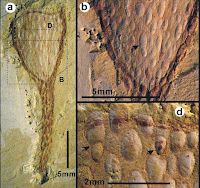
Sclerites on the calyx and stem of the putative Entoproct Cotyledion tylodes from the Cambrian Chengjiang Fauna of Yunnan, China. (a) Entire specimen, dashed boxes indicate positions of (b) and (d), note the seemingly increased arrays of sclerites; (b), details of (a) as indicated; note the elongate sclerites marked by an arrow; (d), Enlargement of (a) as indicated, showing the merged two sclerites indicated by two arrows. Zhang et al. (2013).

However like the modern Entoprocts Cotyledion tylodes has a U-shaped gut, with both the mouth and anus inside the ring of the lophophore, a trait which is considered to be unique to, and indicative of, the Entoprocts.

(c) A laterally compressed specimen of Cotyledion tylodes attached to the gena of a trilobite, showing U-shaped gut with 3-D buccal cavity and enlongate anal tube enclosed inside an apertural cavity; (d), interpretative drawing of the same. The hemispheric buccal cavity with basal mouth (anterior) and elongate anal papillae (posterior) marked with solid arrows and hollow arrows, respectively. Zhang et al. (2013).

While the presence of a shelly exoskeleton made up of numerous sclerites would not be predicted in a fossil relative of the modern Entoprocts by examination of the animals alone, this is a trait thought to have been present in early members of several other Lophotrochozoan groups, notably the Molluscs, Anelids, Brachiopods and Phoronids, so to find such a covering in an Entoproct is not a complete surprise. Cotyledion tylodes also has a larger body and more complex body-plan than any modern Entoproct, but again this is not completely unexpected. Evolution proceeds by simplification as often as by increased complexity, and many Early Cambrian fossils show unexpected features not seen in their modern relatives.

Reconstruction of Cotyledion tylodes in life position. Zhang et al. (2013).


Follow Sciency Thoughts on Facebook.