Showing posts with label Multiple Star Systems. Show all posts

Friday, 1 May 2015

Kepler-432: a Red Giant Star with at least two giant planets.


Stars form from when vast clouds of gas and dust condense under their own gravity and contract into a single body. As this body contracts it eventually becomes so hot and dense that hydrogen atoms begin to fuse to form helium atoms in its core. This produces massive amounts of energy in the form of heat and light, that push against the gravity of the collapsing star, sweeping away any remaining material in the surrounding gas cloud that has yet to accrete onto the star and holding the star itself in a form of stasis; prevented from exploding by its gravity and from collapsing by the energy released by the fusion of hydrogen. Stars can (and do) remain in this state for billions of years, though larger stars, where the gravity is higher and therefore the pressure in the core greater, burn their fuel more quickly. Eventually stars run out of hydrogen and gravity begins to win the battle, and the star begins to collapse again. However this is not the end of the story, since as the hydrogen-depleted star collapses it eventually becomes so dense that it can fuse helium in its core. This releases more energy than the fusion of hydrogen, pushing harder against the gravity and causing the star to swell into a much larger (in terms of volume) body; a Red Giant Star. Such a star will eventually run out of helium as well, and begin to collapse again, though the largest stars can go through successive stages of fusing a whole series of elements before they eventually die.

These giant stars are of interest to planetary scientists because they offer the potential to study planets further out in the stellar system. Most exoplanets are detected by either the gravitational pull they exert upon their parent star, or the light they block when they pass in front of it. However planets further out in a stellar system are unable to produce enough of a gravitational pull to enable detection, and are much less likely to pass in front of their host star when seen from Earth. With giant stars the second of these is less of a problem, since the star itself is a bigger target, so there is more chance of a planet moving in front of it.

In a paper published on the arXiv database at Cornell University Library on 20 April 2015, and accepted for publication in the AstrophysicsJournal, a team of scientists led by Samuel Quinn of the Department of Physicsand Astronomy at Georgia State University describe the discovery of planets around the Red Giant Star Kepler-432.

Kepler-432 was originally designated as an ‘object of interest’ in 2013, and given the designation KOI-1299 (‘Kepler Object of Interest 1299’). It is 870 parsecs (convert to light years) from Earth within the Kepler Field (the field of stars in the sky to which the Kepler Space Telescope permanently pointed), and is calculated to have a mass of 1.32 times that of the Sun but a radius 4.06 times the Sun’s and an effective surface temperature of 4995 K (compared to 5778 K for the Sun). From which it is calculated to be an early-stage Red Giant, about 3.5 billion years old (younger than our Sun, but more massive, giving it a shorter life). This star was observed to be the subject of regular occulations (periods of dimming assumed to be caused by something passing in front of it) occurring every 52.5 days.

As well as the initial observations with the Kepler Space Telescope, Kepler-432 was the subject of follow-up observations with the 3.5 m WIYNtelescope on Kitt Peak in Arizona, the Near InfraRed Camera 2 on the Keck II 10 m telescope at Keck Observatory on Mauna Kea and the TillinghastReflector Echelle Spectrograph on the 1.5-m Tillinghast Reflector at the FredL. Whipple Observatory, also in Arizona.

The first discovery made from these observations was that a close by faint star originally thought to be a background star is in fact a bound companion, calculated to be an M-class Red Dwarf star with a mass 52% of that of the Sun and an effective surface temperature of 3660 K, which orbits the primary star at a distance of about 750 AU (i.e. about 750 times the distance at which the Earth orbits the Sun), completing one orbit in about 15 000 years. Since this is now known to be a two-star system the primary star is designated Kepler-432A and the companion Kepler-432B (when naming bodies in other stellar systems stars are designated with upper case letters and planets lower case letters).

Near InfraRed Camera 2 image of Kepler-432 showing a faint companion star. Image is four arcseconds square (the sky is a sphere comprising 360 degrees, with each degree divided into 60 arcminutes and each arcminute into 60 arcseconds). North is up and east is left (the reverse of what is seen on a ground map, since the viewer is looking up instead of down). Quinn et al. (2015).

The occulating body is calculated to be a planet with a mass equivalent to 5.41 times that of Jupiter and a radius 1.145 times that of Jupiter orbiting Kepler-432A at a distance of 0.301 AU (30.1% of the distance at which the Earth orbits the Sun), with an orbital period of 52.5 days, which is given the designation Kepler-432b. However this planet’s orbit is not completely regular, from which the presence of a second planet is deduced, the gravity of which perturbs the first planet slightly on each orbit. This second planet is calculated to have a mass equivalent to 2.63 times that of Jupiter, and to orbit Kepler-432A at a distance of 1.188 AU, completing one orbit every 411 days. This second planet is given the designation Kepler-432b.

See also…

The Kepler Space Telescope has discovered over 4000 candidate planets, around 40% of which are in systems with multiple planets. Many of the early multiple planet systems discovered contained one or more...
In December 2011 a team lead by Stephane...
Iota Draconis is a K-type orange giant star in the constellation of Draconis, 103 light years from Earth. It has an apparent magnitude of 3.31, making it naked-eye visible. In 2002 a paper in The Astrophysical Journal by a team lead by Sabine Frink of the Center for Astrophysics and Space Sciences at the University of California, San Diego reported the discovery of a...


Follow Sciency Thoughts on Facebook.

Thursday, 5 February 2015

A compact planetary system around an ancient star.


The Kepler Space Telescope has discovered over 4000 candidate planets, around 40% of which are in systems with multiple planets. Many of the early multiple planet systems discovered contained one or more giant planets (planets of similar size to, or larger than, Jupiter), which tend to be easier to detect. More recent discoveries have found a wider range of planets, enabling comparisons to be drawn about the systems that host these planets. All of the giant planets have been found in systems with metal rich stars, indicating that they are relatively young and have formed late in the Universe’s history (all metal in the Universe is thought to have formed in old and dying stars, and as the universe has aged the amount of metal has steadily increased, so that younger stars contain more metal from the outset), but smaller planets have been found around a much wider range of stars, implying that such planets began to form much earlier in the Universe’s 13.8 billion year history.

In a paper published on the arXiv database at Cornell University Library on 26 January 2014 a team of scientists led by Tiago Campante of the School of Physics and Astronomy at the University of Birmingham and the StellarAstrophysics Centre at the Department of Physics and Astronomy at Aarhus University describe a system of planets around the ancient low metal star Kepler 444, which is estimated to be about 11.2 billion years old.

Kepler 444 was formerly designated as KOI 3158 (Kepler Object of Interest 3158, implying the 3158th star in the Kepler field found to have candidate planets), becoming Kepler 444 with the conformation of its planets (Kepler 444 implying the 444th system in the Kepler field with confirmed planets). It also has the catalogue designations HIP 94931, KIC 6278762 and LHS 3450. It is a K-type dwarf star, with about 75% of the mass of the Sun and an effective surface temperature of 5046 K (compared to 5778 K for our Sun).

It is also one of the closest stars in the Kepler study, at a distance of only 116.4 light years, and is part of the Arcturus Stream, a group of ancient stars with similar proper motions; these were formerly thought to have formed outside the Milky Way proper, in a now defunct satellite galaxy, though this is now considered unlikely, with the stars probably originating in the Thick Disk, an area ranging from one to five kiloparsecs of the galactic plane (85% of the galaxy’s stars originate within the Thin Disk, which lies within one kiloparsec of the galactic plane).

Campante et al. followed up the initial Kepler observations of the system with observations from the Keck I telescope and HIRES spectrograph on Mauna Kea, the Robo-AOlaser-adaptive-optics system, the Palomar Observatory 60-inch telescope and the NIRC2 instrument mounted on the Keck II 10-meter telescope.

These observations found a second, dimmer star at a distance of 1.8 arcseconds from Kepler 444 (an arcsecond is one sixtieth of an arcminute, which is one sixtieth of a degree, which is one three hundred and sixtieth of the sky envisioned as a sphere surrounding the Earth). This second star shows a common radial velocity with the primary star, suggesting that it is orbiting Kepler 444 roughly once every 430 years. Data from the HIRES spectograph further suggests that this second body is itself a pair of M-type Red Dwarf stars, the larger of which has an effective surface temperature of 3464 K, the smaller being cooler.

NIRC2 adaptive optics image of Kepler-444. The image was obtained using the K’filter (2:124mm) for a total of 378 s of integration time. Declination and right ascension coordinates (J2000.0) are given alongthe vertical and horizontal axes, respectively. Campante et al. (2015).

The Kepler 444 system had five planetary candidates, all of which were resolved to be true planets rather than background objects with a 99.9% certainty. The planets are all have short orbital periods, implying that they are all close to the star, within 0.06 AU (i.e. 6% of the distance at which the Earth orbits the Sun), and the orbital periods appear to be resonant; which is what would be expected from tightly packed planets.

Next Campante et al. examined the possibility that the planets might orbit one or both of the companions, rather than Kepler 444 itself. Since the data from the Kepler Space Telescope records the amount of dimming that occurs when a planet passes in front of a star, it is possible to calculate the radius of that planet if the brightness of the star is known. This suggests that the planets would have radii of 1.33, 1.64, 1.75, 1.80, and 2.45 times that of the Earth if they are orbiting the companion bodies. Since it would be virtually impossible for planets to retain gaseous envelopes or significant volumes of ice this close to a star, these bodies would have to be rocky in nature, and therefore have significant masses. Attempts to model such a system with bodies of such high masses close together suggested that such a system would be unstable and the planets would be lost within decades or centuries, ruling out this scenario.

This suggests that the five planets are indeed orbiting the K type star, from which their radii can be calculated to be 0.403, 0.497, 0.530, 0.546, and 0.741 times that of the Earth respectively, a much more stable configuration.

Thus the first planet, Kepler 444b (when naming bodies in other star systems planets are given lower case letters and stars upper case letters), will have a radius 40.3% of the Earth’s (roughly comparable with Mercury), and orbit the Keppler 444A (the main star in the system) every 3.6 days, at a distance of 0.04178 AU (4.178% of the average distance between the Earth and the Sun).

The second planet, Kepler 444c will have a radius 49.7% of that of the Earth (comparable to Mars), and orbit Kepler 444A every 4.5 days at a distance of 0.04881 AU.

Kepler 444d will have a radius 53.0% of that of the Earth (again comparable to that of Mars) and orbit Kepler 444A every 6.2 days at a distance of 0.06 AU.

Kepler 444e will have a radius 54.6% of that of the Earth, and orbit Kepler 444A every 7.7 days at a distance of 0.0696 AU.

Finally Kepler 444f will have a radius 74.1% of that of the Earth (intermediate between those of Mars and Venus) and orbit Kepler 444A every 9.7 days at a distance of 0.0811 AU.

Semi-major axes of planets belonging to the highly-compact multiple-planet systems Kepler-444, Kepler-11, Kepler-32, Kepler-33, and Kepler-80. Semi major axes of planets in the Solar System are shownfor comparison. The vertical dotted line marks the semi-major axis of Mercury. Symbol size is proportionalto planetary radius. Note that all planets in the Kepler-444 system are interior to the orbit of the innermostplanet in the Kepler-11 system, the prototype of this class of highly-compact multiple-planet systems.Campante et al. (2015).

Kepler 444 is the oldest star yet found to host planets, the former holder of which title was Kepler 10, at an age of 10.4 billion years. It is considered to be a second generation star (i.e. made of matter that had previously been in only one other star since the origin of the universe), unlike the Sun and most other known planet-hosting stars, which are third generation stars. This means that at the time when the Solar System was forming, the planets of the Kepler 444 system were already older than the Earth is now. The existence of rocky planets this early in the history of the Universe suggests that life may also have originated very early, and that truly ancient ecosystems may exist somewhere in the Universe.

See also…

http://sciencythoughts.blogspot.co.uk/2015/02/follow-up-observations-of-kepler.htmlFollow up observations of Kepler candidate stars.                                                                           The Kepler Space Telescope observed a 115 square degree of space for four years (from May 2009 till May 2013), looking for potential planets around the 150 000 stars in the magnitude range 8-16 within the field. In this time it found a total of 4233 candidate planets, of which 965 have subsequently been confirmed. The conformation of such a planet requires follow up...
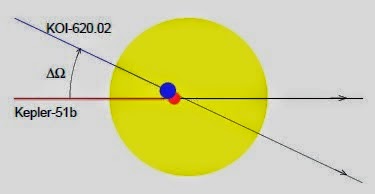
http://sciencythoughts.blogspot.co.uk/2014/07/conformation-of-third-planet-in-kepler.htmlConformation of the third planet in the Kepler-51 System.                                               Kepler-51 is a G-type Yellow Dwarf star 2800 light years from Earth in the constellation of Cygnus. It has a...
Kepler 186f: an Earth-sized planet in the habitable zone of a Red Dwarf star.
One of the key objectives in the search for planets orbiting other stars has been to locate planets in the habitable zones of such stars, i.e. planets on which liquid water could potentially exist. A number of.
Follow Sciency Thoughts on Facebook.

Wednesday, 7 May 2014

Two Hot Jupiters found to be in triple star systems.

The discovery of a large number of Hot Jupiter type planets (large gas giant planets orbiting very close to their parent stars) in recent years has challenged out theories of stellar system formation. In theory gas giant type planets should only be able to form in the outer parts of a star system, beyond the 'snow line' where ice particles can accumulate within a protoplanetary disk. Since such planets could not form close to the stars, it was originally theorized that they must have formed in the outer part of the stellar system and then spiraled inwards for some reason. However this should lead to planets that still orbited in the plane on which the star rotated (plane of the stellar system), whereas many such planets seem to have orbits quite strongly tilted with regard to this plane. This has led to the development of two further theories, firstly that such systems could come about due to disruption of protoplanetary disks by strong magnetic fields from the host star, and the presence of undetected companion stars in the system, able to disrupt protoplanetary disks through gravitational torque.

In a paper published on the arXiv database at Cornell University Library on 30 March 2014, a team of scientists led by Eric Bechter of the Department of Physics at the University of Notre Dame describe the first results of the 'Friends of Hot Jupiters' program, which aims to systematically search for undetected companions to stars with known Hot Jupiters, with an emphasis on looking for dim Red Dwarfs (stars with masses less than 40% of that of the Sun) or Brown Dwarfs (which mass to fuse hydrogen in their cores like true stars, but are massive enough to fuse deuterium) detectable at infrared wavelengths.

Bechter et al. report the existence of new companion stars in two systems; WASP-12 and HAT-P-8, both of which were already known to be binary systems, with remote Red Dwarf companions orbiting the primary star. Both were directly imaged using the Keck II AO system at the W.M. Keck Observatory on Mauna Kea, Hawaii.

The Wasp-12 system was discovered in 2009. The primary star, WASP-12A, is a yellow dwarf star slightly larger than the Sun, roughly 800 light years from Earth in the constellation of Auriga. This is orbited by a planet, WASP-12b (when naming objects in other star systems stars are identified with upper case letters and planets lower case letters) with about 1.41 times the mass of Jupiter orbiting every 1.09 days at a distance of 0.0229 AU (2.29% of the distance at which the Earth orbits the Sun), this planet having an orbit tilted 59° to the plane of rotation of WASP-12A. In 2011 a second star was detected in the WASP-12 system, a red dwarf with approximately 38% of the Sun's mass named WASP-12B.  

Betcher et al. report closer examination of this companion star reveals that it also has a smaller companion, named WASP-12C, a red dwarf with 37% of the Sun's mass. These two stars orbit one-another at a distance of 21 AU.

Keck AO discovery image of WASP-12 B,C taken on 2 February 2012. North is up and east is left (east is reversed in astronomical images compared to standard maps, as the observer is looking up not down). Follow up observations separated by more than one year recovered the companion. Betcher et al. (2014).

The HAT-P-8 system was discovered in 2008. Its primary star, HAT-P-8A, is an F-type yellow-white dwarf star with roughly 1.28 times the mass of our Sun 750 light years from Earth in the constellation Pegasus. This is orbited every 3.08 days by a planet, HAT-P-8b with a mass 1.52 times as large as Jupiter at a distance of 0.487 AU (4.87% of the distance between the Earth and the Sun), the orbit of this planet being at 15° to the plane of the star's rotation. This system was found to have a companion star, HAT-P-8B, in 2011, this being an M-type red dwarf star with a mass 22% that of the Sun's.

Betcher et al. report the discovery of a third star in the system, HAT-P-8C, a smaller red dwarf with roughly 18% of the Sun's mass. This orbits HAT-P-8B at a distance of about 15 AU.

Keck AO discovery images of HAT-P-8 B,C taken on UT 24 June 2012. North is up and east is left. Follow up observations separated by more than one year recover the companion. Betcher et al. (2014).

See also...


KIC 11554435 (or Kepler Input Catalogue 11554435) is a young, sunlike star 652 light years from the Earth. It is thought to be between 200 and 300 million years old with a mass 98% of the Sun's and an effective surface temperature of ~5576 K, as opposed to 5778 K for the Sun. As a young star it rotates considerably faster than the Sun, roughly once every 5.4 days, while the Sun takes slightly under 24.5 days to complete a rotation, and has a high level of starspot activity (the same as sunspot activity but on a different star).


Wasp-12b is a super-Jovian Hot Jupiter type planet (a planet larger than Jupiter orbiting very close to its parent star) 871 light years from Earth in the constellation of Auriga. It orbits Wasp-12A, a G-type yellow dwarf star slightly bigger and hotter than our sun (1.35 × the Sun's mass, with a surface temperature of 6300 K, as opposed...


The HATNet (Hungarian made Automated Telescope Network) project uses eight small (11 cm diameter lens) telescopes located at the  Fred Lawrence Whipple Observatory in Arizona and the Mauna Kea Observatory in Hawaii, to search for exoplanets. Such Earth-based networks are playing an increasingly important role in...


Follow Sciency Thoughts on Facebook.