Showing posts with label Negative Indian Ocean Dipole Phase. Show all posts

Friday, 27 December 2019

Dozens made homeless after landslide hits village in Nyandarua County, Kenya.

About twenty houses have been destroyed and about fifty people made homeless after a landslide hit the village of Gachuha in Nyandarua County, Kenya. Nobody was injured in the incident, but several people report having lost livestock. The incident happened in the afternoon of Friday 27 December 2019, following weeks of heavy rain in the area. Landslides are a common problem after severe weather events, as excess pore water pressure can overcome cohesion in soil and sediments, allowing them to flow like liquids. Approximately 90% of all landslides are caused by heavy rainfall. 

Cleanup operations following a landslide in Gachuha Village, Kenya, on Friday 27 December 2019. The Standard.

The incident occurred after about a month of heavy rains, in one of the area's two annual rainy seasons. This two rainy seasons per year pattern is typical in equatorial countries, with rainy seasons around the equinoxes and dry seasons around the solstices. Upland areas of Kenya have always been prone to landslides, but the problem has become worse in recent years as a rising population has led to more agriculture on hill-slopes, in many areas replacing open woodland where tree roots served to stabilise slopes, and also to more people living in harms ways. 
 
The rains this year are thought to have been made worse by the development of a meteorological phenomenon called a Negative Indian Ocean Dipole. Indian Ocean Dipole Phases are similar to the El Niño/La Niña climatic oscillation that affect the Pacific Ocean. Under normal circumstances equatorial waters off the east coast of Africa and west coast of Indonesia are roughly similar in temperature, however during a Negative Indian Ocean Dipole Phase the waters off the coast of Indonesia become significantly warmer. As the prevailing currents in the area flow west to east, this warm water is then pushed onto the shallower continental shelf of north Australia, where it warms the air over the sea more rapidly, leading to increased evaporation (which fuels rain) and a drop in air pressure over the east Indian Ocean and west Pacific. This in turn drives air currents over the Indian Ocean to flow more strongly west to east, leading to higher rates of  cooling off the coast of Africa (where more water is drawn up from the cool sea depths) and more warming off the coast of Indonesia, fuelling a feedback cycle that tends to remain through the winter season in any year when it forms. This leads to a particularly wet winter across much of Australia, as well as a potentially damaging heatwave in the north, while much of East Africa is at risk of drought (during a Positive Indian Ocean Dipole Phase the reverse happens, with drought in Australia and flooding in East Africa).
 
 Areas of warming and cooling and air flow during a Negative Indian Ocean Dipole Phase. Australian Bureau of Meteorology.
 
See also...
 
https://sciencythoughts.blogspot.com/2019/11/flooding-and-landslides-kill-at-least.htmlhttps://sciencythoughts.blogspot.com/2019/10/family-of-four-feared-dead-after.html
https://sciencythoughts.blogspot.com/2019/02/fisherman-killed-by-crocodile-on-kenyan.htmlhttps://sciencythoughts.blogspot.com/2019/02/schoolgirl-feareddead-after-crocodile.html
https://sciencythoughts.blogspot.com/2018/09/collapse-at-illegal-sand-mine-in-kisumu.htmlhttps://sciencythoughts.blogspot.com/2018/08/kenyan-woman-killed-by-crocodile.html
Follow Sciency Thoughts on Facebook.

Thursday, 19 December 2019

Somalia hit by plague of Locusts.

Somalia and neighbouring parts of Ethiopia are suffering the worst Desert Locust, Schistocerca gregaria, outbreak in 25 years according to the Food and Agriculture Organization. The Insects have already destroyed around 700 km² of crops, and are likely to do considerable further damage, as well as potentially spreading to neighbouring countries such as Kenya, Djibouti, Eritrea, South Sudan and Sudan. The large numbers of Locusts this year are thought to have been triggered by the exceptionally heavy rains across the region, which have brought moist conditions in which the Insects thrive. The outbreak is likely to prove difficult to control as the preferred method of dealing with such events, the spraying the Locusts with insecticide from aircraft, is effectively impossible in politically unstable Somalia.

A Desert Locust, Schistocerca gregaria. Food and Agriculture Organization. 

Desert Locusts typically have two or three generations in a year, but when conditions are favourable then five or more generations can occur. The females lay eggs in an ootheca (egg sack) in soft sand, where they can remain dormant until conditions are favourable or hatch within a few days. Hatchlings can reach maturity in about five weeks, eating as much as one-and-a-half times their body weight each day, when they are potentially able to breed again. 

The adult form of the Desert Locust has two forms, the more usual solitary form, which does not usually move far from the area where they emerge, and a gregarious form, which forms large swarms and can roam long distances. The change from solitary to gregarious Locusts can happen in individuals, which change from one to the other in response to a rise in population density, but the reverse, a change from gregarious to solitary Locusts, can only happen when a new generation reaches maturity.

 Solitary (top) and gregarious (bottom) Desert Locust nymphs. Compton Tucker/NASA/Goddard Space Flight Center/Wikimedia Commons.

The rains this year in East Africa are thought to have been made worse by the development of a meteorological phenomenon called a Negative Indian Ocean Dipole. Indian Ocean Dipole Phases are similar to the El Niño/La Niña climatic oscillation that affect the Pacific Ocean. Under normal circumstances equatorial waters off the east coast of Africa and west coast of Indonesia are roughly similar in temperature, however during a Negative Indian Ocean Dipole Phase the waters off the coast of Indonesia become significantly warmer. As the prevailing currents in the area flow west to east, this warm water is then pushed onto the shallower continental shelf of north Australia, where it warms the air over the sea more rapidly, leading to increased evaporation (which fuels rain) and a drop in air pressure over the east Indian Ocean and west Pacific. This in turn drives air currents over the Indian Ocean to flow more strongly west to east, leading to higher rates of  cooling off the coast of Africa (where more water is drawn up from the cool sea depths) and more warming off the coast of Indonesia, fuelling a feedback cycle that tends to remain through the winter season in any year when it forms. This leads to a particularly wet winter across much of Australia, as well as a potentially damaging heatwave in the north, while much of East Africa is at risk of drought (during a Positive Indian Ocean Dipole Phase the reverse happens, with drought in Australia and flooding in East Africa). 

 Areas of warming and cooling and air flow during a Negative Indian Ocean Dipole Phase. Australian Bureau of Meteorology.

See also...

https://sciencythoughts.blogspot.com/2019/10/danatettix-hoffeinsorum-new-species-of.htmlhttps://sciencythoughts.blogspot.com/2019/02/plagues-of-locusts-from-sudan-and.html
https://sciencythoughts.blogspot.com/2018/11/poecilocloeus-coffeaphilus-new-species.htmlhttps://sciencythoughts.blogspot.com/2017/12/acutogordius-taiwanensis-new-species-of.html
https://sciencythoughts.blogspot.com/2017/06/sphodromerus-carapezzanus-new-species.htmlhttps://sciencythoughts.blogspot.com/2016/01/arulenus-miae-new-species-of-pygmy.html
Follow Sciency Thoughts on Facebook.

Monday, 16 December 2019

Twenty seven known deaths following collapse at unlicensed gold mine in the Democratic Republic of Congo.

Twenty seven people are now known to have died following a collapse at an unlicensed gold min in Haut-Uele Province of the Democratic Republic of Congo on Saturday 14 December 2019. The incident happened at about 5.30 pm local time at Ndiyo, roughly 40 km from the town of Watsa. The miners are understood to have tunnelled about 20 m underground at the site, and rescuers initially thought that the collapse was caused by this activity, but it is now thought to have been the result of a landslide covering the mine, which was itself triggered by days of heavy rain in the area. Landslides are a common problem after severe weather events, as excess pore water pressure can overcome cohesion in soil and sediments, allowing them to flow like liquids. Approximately 90% of all landslides are caused by heavy rainfall. 

Landslip above a gold mine at Ndiyo in Haut-Uele Province, Democratic Republic of Congo. Post Online.

The incidents occurred after about a month of heavy rains, in one of the area's two annual rainy seasons. This two rainy seasons per year pattern is typical in equatorial countries, with rainy seasons around the equinoxes and dry seasons around the solstices. Upland areas of East Africa have always been prone to landslides, but the problem has become worse in recent years as a rising population has led to more agriculture on hill-slopes, in many areas replacing open woodland where tree roots served to stabilise slopes, and also to more people living in harms ways. This years rains have been exceptionally heavy, and fatalities due to similar events have also been reported in other parts of Kenya, Somalia, Ethiopian, South Sudan, Sudan, Tanzania, Uganda, the Republic of Congo, Burundi and the Central African Republic.
 
The rains this year are thought to have been made worse by the development of a meteorological phenomenon called a Negative Indian Ocean Dipole. Indian Ocean Dipole Phases are similar to the El Niño/La Niña climatic oscillation that affect the Pacific Ocean. Under normal circumstances equatorial waters off the east coast of Africa and west coast of Indonesia are roughly similar in temperature, however during a Negative Indian Ocean Dipole Phase the waters off the coast of Indonesia become significantly warmer. As the prevailing currents in the area flow west to east, this warm water is then pushed onto the shallower continental shelf of north Australia, where it warms the air over the sea more rapidly, leading to increased evaporation (which fuels rain) and a drop in air pressure over the east Indian Ocean and west Pacific. This in turn drives air currents over the Indian Ocean to flow more strongly west to east, leading to higher rates of  cooling off the coast of Africa (where more water is drawn up from the cool sea depths) and more warming off the coast of Indonesia, fuelling a feedback cycle that tends to remain through the winter season in any year when it forms. This leads to a particularly wet winter across much of Australia, as well as a potentially damaging heatwave in the north, while much of East Africa is at risk of drought (during a Positive Indian Ocean Dipole Phase the reverse happens, with drought in Australia and flooding in East Africa).
 
Areas of warming and cooling and air flow during a Negative Indian Ocean Dipole Phase. Australian Bureau of Meteorology.
 
The Democratic Republic of Congo one of the world's largest producer of precious metals, but benefits little from the industry. The country has suffered years of political instability and has extremely poor infrastructure, is heavily indebted and has a chronic corruption problem, which means that little of the wealth generated from the industry makes it into government coffers, and that which does is unlikely to be spent on development or other projects likely to benefit the population. These problems are made worse by a series of conflicts in the area, which plays host to rebel groups opposed to the Congolese government and militiamen that fled the 1994 conflict in Rwanda and have never returned. In addition the area has suffered incursions from several neighbouring countries, mostly with an official purpose of defending borders against Congo's instability, but with a strong interest in the mining industry. Militia groups linked to neighbouring states also operate in the area, and again are said to be involved in illegal mining.
 
The lack of government control of the area, and low regard for human life held by many of the groups operating in the area, means that safety precautions at mines in the area are almost non-existent, with many mines simply being large holes dug into poorly consolidated sediments. The area suffers extremely high levels of rainfall (it is the source from which the Congo, Nile and Zambesi rivers originate), and mines can rapidly turn into death-traps as their sides turn to mud and collapse upon the miners.
 
See also...
 
http://sciencythoughts.blogspot.com/2019/10/magnitude-earthquake-in-south-kivu.htmlhttp://sciencythoughts.blogspot.com/2019/10/measles-outbreak-kills-over-4000-in.html
http://sciencythoughts.blogspot.com/2019/10/collapse-at-illegal-gold-mine-in.htmlhttp://sciencythoughts.blogspot.com/2019/07/clash-between-villagers-and-park.html
http://sciencythoughts.blogspot.com/2019/06/collapse-at-gold-mine-kills-at-least-43.htmlhttp://sciencythoughts.blogspot.com/2019/02/sulphuric-acid-spill-kills-at-least.html
Follow Sciency Thoughts on Facebook.

Sunday, 8 December 2019

Flooding and landslides kill at least sixteen in Western Uganda.

At least sixteen people have died in a series of flooding and landslide events in the Bundibugyo District of Western Uganda this weekend, according to the Uganda Red Cross. The incidents happened after weeks of heavy rains left soil in many parts of the area waterlogged, so that when the rains intensified on Saturday 7 December 2019, the ground was unable to soak up the water, causing it to accumulate on the surface and leading to a series of flash floods and landslides. Landslides are a common problem after severe weather events, as excess pore water pressure can overcome cohesion in soil and sediments, allowing them to flow like liquids. Approximately 90% of all landslides are caused by heavy rainfall. Several more people are still missing in the area, with rescuers still searching the landslide sites for more bodies.

 
Flooding in Bundibugyo District, this weekend. Uganda Red Cross.

The incidents occurred after about a month of heavy rains, in one of the area's two annual rainy seasons. This two rainy seasons per year pattern is typical in equatorial countries, with rainy seasons around the equinoxes and dry seasons around the solstices. Upland areas of East Africa have always been prone to landslides, but the problem has become worse in recent years as a rising population has led to more agriculture on hill-slopes, in many areas replacing open woodland where tree roots served to stabilise slopes, and also to more people living in harms ways. This years rains have been exceptionally heavy, and fatalities due to similar events have also been reported in other parts of Kenya, Somalia, Ethiopian, South Sudan, Sudan, Tanzania, the Democratic Republic of Congo, the Republic of Congo, Burundi and the Central African Republic.

The rains this year are thought to have been made worse by the development of a meteorological phenomenon called a Negative Indian Ocean Dipole. Indian Ocean Dipole Phases are similar to the El Niño/La Niña climatic oscillation that affect the Pacific Ocean. Under normal circumstances equatorial waters off the east coast of Africa and west coast of Indonesia are roughly similar in temperature, however during a Negative Indian Ocean Dipole Phase the waters off the coast of Indonesia become significantly warmer. As the prevailing currents in the area flow west to east, this warm water is then pushed onto the shallower continental shelf of north Australia, where it warms the air over the sea more rapidly, leading to increased evaporation (which fuels rain) and a drop in air pressure over the east Indian Ocean and west Pacific. This in turn drives air currents over the Indian Ocean to flow more strongly west to east, leading to higher rates of  cooling off the coast of Africa (where more water is drawn up from the cool sea depths) and more warming off the coast of Indonesia, fuelling a feedback cycle that tends to remain through the winter season in any year when it forms. This leads to a particularly wet winter across much of Australia, as well as a potentially damaging heatwave in the north, while much of East Africa is at risk of drought (during a Positive Indian Ocean Dipole Phase the reverse happens, with drought in Australia and flooding in East Africa).

 Areas of warming and cooling and air flow during a Negative Indian Ocean Dipole Phase. Australian Bureau of Meteorology.

See also...

https://sciencythoughts.blogspot.com/2019/11/landslide-kills-three-children-in.htmlhttps://sciencythoughts.blogspot.com/2019/10/evaluating-attitudes-of-park-rangers.html
https://sciencythoughts.blogspot.com/2019/06/landslides-kill-at-least-six-in-bududa.htmlhttps://sciencythoughts.blogspot.com/2019/02/magnitude-39-earthquake-to-north-of.html
https://sciencythoughts.blogspot.com/2019/01/pregnant-woman-killed-by-crocodile-in.htmlhttps://sciencythoughts.blogspot.com/2018/04/eleven-lions-poisoned-in-ugandan.html
Follow Sciency Thoughts on Facebook.

Friday, 6 December 2019

Landslides kill at least thirty eight in Burundi.

Thirty eight people have now been confirmed dead in three landslides that hit Cibitoke Province in northwest Burundi on Wednesday 4 December 2019. The landslides hit the villages of Gikomero, where three people are known to have died, Rukombe, where thirteen people are known to have died, and Nyempundu, where at least twenty two people have died. All three events happened late at night when people were sleeping in their homes, making them more vulnerable to landslides hitting settlements, after several hours of severe rain in the area.  Landslides are a common problem after severe weather events, as excess pore water pressure can overcome cohesion in soil and sediments, allowing them to flow like liquids. Approximately 90% of all landslides are caused by heavy rainfall. Several more people are still missing in the area, with rescuers still searching the landslide sites for more bodies.

The location of Cibitoke Province. Google Maps.

The incident occurred after about a month of heavy rains, in one of the area's two annual rainy seasons. This two rainy seasons per year pattern is typical in equatorial countries, with rainy seasons around the equinoxes and dry seasons around the solstices. Upland areas of East Africa have always been prone to landslides, but the problem has become worse in recent years as a rising population has led to more agriculture on hill-slopes, in many areas replacing open woodland where tree roots served to stabilise slopes, and also to more people living in harms ways. This years rains have been exceptionally heavy, and fatalities due to similar events have also been reported in other parts of Kenya, Somalia, Ethiopian, South Sudan, Sudan, Tanzania, the Democratic Republic of Congo, the Republic of Congo and the Central African Republic.

The rains this year are thought to have been made worse by the development of a meteorological phenomenon called a Negative Indian Ocean Dipole. Indian Ocean Dipole Phases are similar to the El Niño/La Niña climatic oscillation that affect the Pacific Ocean. Under normal circumstances equatorial waters off the east coast of Africa and west coast of Indonesia are roughly similar in temperature, however during a Negative Indian Ocean Dipole Phase the waters off the coast of Indonesia become significantly warmer. As the prevailing currents in the area flow west to east, this warm water is then pushed onto the shallower continental shelf of north Australia, where it warms the air over the sea more rapidly, leading to increased evaporation (which fuels rain) and a drop in air pressure over the east Indian Ocean and west Pacific. This in turn drives air currents over the Indian Ocean to flow more strongly west to east, leading to higher rates of  cooling off the coast of Africa (where more water is drawn up from the cool sea depths) and more warming off the coast of Indonesia, fuelling a feedback cycle that tends to remain through the winter season in any year when it forms. This leads to a particularly wet winter across much of Australia, as well as a potentially damaging heatwave in the north, while much of East Africa is at risk of drought (during a Positive Indian Ocean Dipole Phase the reverse happens, with drought in Australia and flooding in East Africa).

Areas of warming and cooling and air flow during a Negative Indian Ocean Dipole Phase. Australian Bureau of Meteorology.

See also...
https://sciencythoughts.blogspot.com/2019/10/magnitude-earthquake-in-south-kivu.htmlhttps://sciencythoughts.blogspot.com/2019/10/tanzanian-boy-eaten-by-crocodile-in.html
https://sciencythoughts.blogspot.com/2019/10/measles-outbreak-kills-over-4000-in.htmlhttps://sciencythoughts.blogspot.com/2019/10/collapse-at-illegal-gold-mine-in.html
https://sciencythoughts.blogspot.com/2019/07/clash-between-villagers-and-park.htmlhttps://sciencythoughts.blogspot.com/2019/06/collapse-at-gold-mine-kills-at-least-43.html
Follow Sciency Thoughts on Facebook.

Wednesday, 27 November 2019

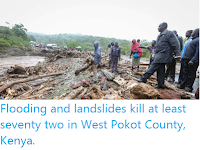
Flooding and landslides kill at least seventy two in West Pokot County, Kenya.

At least seventy two people have died in a series of flash floods and landslides in West Pokot County, Kenya, following heavy rains that began in the area on Friday 22 November 2019. The majority of the deaths are reported to have happened in a series of mudslides triggered by the rains. Landslides are a common problem after severe weather events, as excess pore water pressure can overcome cohesion in soil and sediments, allowing them to flow like liquids. Approximately 90% of all landslides are caused by heavy rainfall. Five people are reported to have died when their car was swept away after a river burst its banks; two pedestrians were also killed in the same event. Another eleven people were killed in a house that was buried by a landslide, while seventeen people were killed in a mudslide in the village of Takmal, and twelve more in landslips in the villages of Parua and Tapach. Fatalities due to similar events have also been reported in other parts of Kenya, Somalia, Ethiopian, South Sudan, Sudan, Tanzania, the Democratic Republic of Congo, the Republic of Congo and the Central African Republic.

Debris left by a flash flood in West Pokot County, Kenya. AP.

Like seasonally dry areas, Kenya is particularly prone to flash floods. This stems from two causes; firstly the arid climate prevents the development of a thick soil layer which would be expected in less dry areas, so that in much of the area (non-porous) bedrock is either exposed or close to the surface, and secondly the hot climate leads to heavy evaporation from nearby seas and oceans, so that if the wind changes direction and brings water-laden air to the area, it brings a lot of precipitation with it. This combination of heavy rainfall and low ground absorbency leads to large amounts of water at the surface, typically moving downhill at some speed.

The incident occurred after about a month of heavy rains, in one of the area's two annual rainy seasons. This two rainy seasons per year pattern is typical in equatorial countries, with rainy seasons around the equinoxes and dry seasons around the solstices. Upland areas of Kenya have always been prone to landslides, but the problem has become worse in recent years as a rising population has led to more agriculture on hill-slopes, in many areas replacing open woodland where tree roots served to stabilise slopes, and also to more people living in harms ways.

 The aftermath of a mudslide in the village of Parua in West Pokot County on 23 November 2019. Reuters.

The rains this year are thought to have been made worse by the development of a meteorological phenomenon called a Negative Indian Ocean Dipole. Indian Ocean Dipole Phases are similar to the El Niño/La Niña climatic oscillation that affect the Pacific Ocean. Under normal circumstances equatorial waters off the east coast of Africa and west coast of Indonesia are roughly similar in temperature, however during a Negative Indian Ocean Dipole Phase the waters off the coast of Indonesia become significantly warmer. As the prevailing currents in the area flow west to east, this warm water is then pushed onto the shallower continental shelf of north Australia, where it warms the air over the sea more rapidly, leading to increased evaporation (which fuels rain) and a drop in air pressure over the east Indian Ocean and west Pacific. This in turn drives air currents over the Indian Ocean to flow more strongly west to east, leading to higher rates of  cooling off the coast of Africa (where more water is drawn up from the cool sea depths) and more warming off the coast of Indonesia, fuelling a feedback cycle that tends to remain through the winter season in any year when it forms. This leads to a particularly wet winter across much of Australia, as well as a potentially damaging heatwave in the north, while much of East Africa is at risk of drought (during a Positive Indian Ocean Dipole Phase the reverse happens, with drought in Australia and flooding in East Africa).

 Areas of warming and cooling and air flow during a Negative Indian Ocean Dipole Phase. Australian Bureau of Meteorology.

See also...

https://sciencythoughts.blogspot.com/2019/10/family-of-four-feared-dead-after.htmlhttps://sciencythoughts.blogspot.com/2019/02/fisherman-killed-by-crocodile-on-kenyan.html
https://sciencythoughts.blogspot.com/2019/02/schoolgirl-feareddead-after-crocodile.htmlhttps://sciencythoughts.blogspot.com/2018/09/collapse-at-illegal-sand-mine-in-kisumu.html
https://sciencythoughts.blogspot.com/2018/08/kenyan-woman-killed-by-crocodile.htmlhttps://sciencythoughts.blogspot.com/2018/04/landslide-kills-four-in-muranga-county.html
Follow Sciency Thoughts on Facebook.