Showing posts with label Noachian. Show all posts

Saturday, 12 August 2023

Evidence of prolonged wet-dry cycling on early Mars.

Mars has an extensive sedimentary record, dating back at least 4.3 billion years, which shows that early Mars had a very difficult climate from today, with permanently wet environments, and possibly even the conditions for life. Whether-or-not this early climate also included areas with episodic or periodic wet intervals has to date, however, been unclear. Such fluctuations in hydrodynamic conditions leave distinctive traces in the sedimentary record, such as cracks, however they are also easily eroded away, and models of the early Martian climate have been ambivalent about the existence of such conditions.

In a paper published in the jornal Nature on 9 August 2023, William Rapin of the Institut de Recherche en Astrophysique et Planétologie at the Université de Toulouse 3, Gilles Dromart of the Laboratoire de Géologie de Lyon Terre, Planètes, Environnement at the École normale supérieure de Lyon, Ben Clark of the Space Science Institute, Juergen Schieber of Indiana University, Edwin Kite of the University of Chicago, Linda Kah of the University of Tennessee, Knoxville, Lucy Thompson of the University of New Brunswick, Olivier Gasnault, Jeremie Lasue, and Pierre-Yves Meslin, also of the Institut de Recherche en Astrophysique et Planétologie at the Université de Toulouse 3, and Patrick Gasda and Nina Lanza of the Los Alamos National Laboratory, report the presence of a well-preserved polygonal mud-crack pattern on strata dated to about 3.6 billion years ago (dating to the Hesperian Eon of Mars), which they believe to be evidence of a wet-dry cycling system, and therefore to provide useful new insight into the early climate of Mars.

NASA's Curiosity Rover has documented hundreds of metres of sediments deposited in lakes., rivers, intermittent lakes, and lake-margin settings within Gale Crater on Mars. The vast majority of these have been smectite (silicone and aluminium rich clay) mudstones, but the rover recently encountered a sulphate-bearing unit, apparently marking a major environmental transition foumd in stratified terrains across Mars. At this horizon the rover found an apparent sulphate evaporite deposit.

Context of observations in Gale crater, Mars. Stratigraphic context (left) of the lower portion of Mount Sharp and map (right) showing Curiosity Rover traverse (white) on the High Resolution Imaging Science Experiment (HiRISE) base map overlaid with Compact Reconnaissance Imaging Spectrometer for Mars (CRISM) S-index, which tracks sulfates (shaded yellow). Red rectangle shows the location of close-up map and detailed stratigraphy. Rapin et al. (2023).

The unit at the base of the sulphate-bearing strata has widespread centimetre-scale polygonal patterns, formed of straight lines intersecting at triple junctions. All observations of this were made within an 18 m interval, with some variations apparently caused by subsequent alteration of the same basic pattern. These polygons appear to persist for tens of centimetres, and can be seen on stepped blocks of sediment. Where visible on bedding plains the polygons are made of raised ridges are about 1 cm high, with the polygons having an average diameter of 4 cm. Junctions have an average angle of 120°. The ridges are made up of aligned nodules, of variable size, and juxtaposed in a variety of ways, and apparently made of calcium sulphate and magnesium sulphate minerals. The sediment in which these ridges are emplaced is generally sulphate-poor, though with some patches with raised calcium sulphate levels.

In situ observations of polygonal ridges. (a) General view of bedrock surrounding the rover on sols 3154 to 3156 showing widespread polygonal ridges. (b) Close-up showing ‘stepped’ exposure of polygons within large bedrock blocks. (c) View of bedrock with polygons and locations of ChemCam analysis on ridge (red rectangle) and Alpha Particle X-Ray Spectrometer analysis on smooth host bedrock (dotted circle). (d) Remote micro-image of cemented ridge with spots analysed by ChemCam (reticles 1 to 5), highlighting details of nodular texture. (e), (f) Bedrock with polygonal pattern (e) and interpretative overlay (f) that shows prominent ridges (solid red lines), less certain ridges (dotted red lines) and cross-cutting later-stage calcium-sulphate-filled veins (white areas). Rapin et al. (2023).

On Earth, polygonal ridge patterns can form on evaporite deposits as a result of subsurface salinity convection, but Rapin et al. believe this to be unlikely, as this generally only occurs on pure salt crusts, and produces polygon patterns with much larger diameters (which would presumably be larger still if they formed under Mars's low gravity conditions). They instead suggest that the more likely explanation is that the ridges formed originally as cracks within a drying sediment, which was then infilled by salt-rich water, which evaporated leaving the nodules, which are more resilient to erosion than the surrounding sediment, leading to raised ridges as this is eroded away. Newly formed desiccation cracks generally have T-junctions between blocks, but where they undergo repeated cycles of wetting and drying, these tend to reform into more even 120° Y-junctions, with about 10 cycles of wetting and frying typically needed on Earth for 120° to be reached, giving a pattern of even hexagons.

Formation model for sulphate-enriched polygonal ridges. (a)–(c) Repeated cycles of desiccation (a), recharge (b) and flooding (c) form a vertically propagating hexagonal pattern of sulphate enrichment. (a) Evaporation (grey arrows) desiccates and cracks near-surface sediment, triggering salt crystallization (red) at and near cracks where the subsurface brine (purple) concentrates. (b) Water recharge heals cracks by sediment hydration. (c) Flooding dissolves excess salts at the surface but subsurface brine and intrasediment sulphate salts are preserved and siliciclastic sediment is deposited on top. (d) Sediment is buried with saturated brine in pore spaces and sulphates are mostly preserved. (e) Later diagenesis partially dissolves intrasediment sulphate salts and late diagenetic fractures are filled with calcium-sulphate (white). (f) Sulphate-cemented polygonal ridges become visible during exhumation as the softer host bedrock is preferentially removed during weathering. Rapin et al. (2023).

The hexagons are located in a sulphate-poor sediment overlaying a sulphate-rich nodular bedrock, making the precipitation of sulphate minerals plausible, although it is unlikely that they originally formed in their current configuration. Most likely, the salts were precipitated in a slurry with sediment particles in original cracks with a T-junction formation, but that then redissolved with each cycle of wetting and re-precipitated with each cycle of evaporation, eventually forming the resilient hexagon-shaped patterns seen today.

Larger colour image of bedrock with polygonal ridges for context. MastCam image and close-ups (a), (b) and (c) with rectangle locations of close-up view. Close-ups (b), (c) show bedrock 10 to 20 meters away where regularly spaced ridges and nodules can be observed supporting lateral extension of the same polygonal pattern although camera resolution prevents detailed geometrical analysis at this distance. Rapin et al. (2023).

The water that caused these patterns was probably brought in by periodic flooding and groundwater recharge, which would have added sediment to the deposits (leading to the depth of strata we see today), while dissolving any surface salts, so that each drying event is likely to have precipitated more salt than its predecessor. This dessication-water recharge cycle is likely to have affected only the upper few centimetres of sediment at any one time, with the hexagons therefore able to move up through the sediment column with repeated cycles. The consistency of the size and shape of the polygons implies a repeated cycle of regular intensity, while the variable size and shape of the nodules within the ridges implies multiple generations of growth.

The repetitive nature of the floods and the limited amount of depth penetration makes it likely that these cycles were seasonal, although a shorter-term cycle cannot be ruled out. The time period over which this cycle occurred is unclear, although the ridges have been identified at multiple points within an 18 m succession, which on a typical Earth floodplain with a sedimentation rate of about 0.01 mm per year, would imply a period of thousands to millions of years, although this might not have been a continuous interval of seasonal flooding; possibly the occurrence of seasonal interludes was itself part of a larger cycle. Individual blocks of polygon propagation are often more than 2 m thick, with no visible boundaries to other polygon-bearing or polygon-free strata, which suggests that if there were longer dry intervals without sedimentation, then little erosion took place in these intervals either. 

The mature hexagon shapes of the polygons indicate they were formed by repeated wet-dry cycles, and the thickness of the strata in which they are found implies that this cycle occurred at least episodically for a very long period of time. Mud crack polygons have also been seen in the underlying Murray Formation, but these typically have a T-junction structure, suggestive of a single drying event, whereas the polygons reported by Rapin et al. appear to be indicative of a repeated wet-dry cycle, which occurred for a sustained period of time on the early surface of Mars. This agrees with models of the early climate of the planet which have suggested that a single event, such as a meteor impact or supervolcano, forming all the water-related features on Mars (one a popular hypothesis) is unlikely. Instead, Mars appears to have had a longer period of Earth-like climate with seasonal flooding events, and evaporite deposits forming in seasonal lakes. 

A climate with wet and dry cycles is considered to be conducive to, and perhaps essential for, the type of prebiotic chemical evolution needed to form the precursors for life. Dessication lowers the amount of water available, thereby increasing the proportion of soluble ingredients within the remaining liquid, raising the rate at which reactions can occur. In particular, nucleotides form more readily from nucleobases in a concentration, and also polymerise to form larger molecules such as DNA or RNA more readily, and amino acids more readily form proteins under such conditions. Dioctahedral smectites, which appear to be ubiquitous clay minerals on the surface of Mars, are capable of tightly adsorbing nucleotides through cation exchange, and have been suggested as having been vital for the formation of the first pre-biotic organic polymers. Thus, seasonal pools on the surface of Mars could have reasonably formed the 'warm little ponds' proposed by Darwin as a location for the appearance of life.

Sediments in Gale Crater have been shown to contain about 500 g of organic material per cubic metre, as well as a variety of other soluble elements. The discovery that this site also once underwent seasonally wet and dry cycles supports the idea that this area was once suitable for prebiotic chemistry, but it is highly unlikely to have been the only place on Mars where such conditions were found, although the discovery does re-enforce the importance of Gale Crater as a site of global importance for understanding the early history of Mars.

The discovery of evidence of wet-dry cycling from a time when organics and volatiles are known to have been accumulating on Mars for over a billion years supports the idea that conditions on Mars during the Noachian–Hesperian transition period may have been favourable for the emergence of life on Mars, possibly more so than the earlier, and apparently wetter, Noachian Eon.

See also...


Follow Sciency Thoughts on Facebook.

Follow Sciency Thoughts on Twitter.


Saturday, 19 November 2022

Understanding the ancient greenhouse climate of Mars.

The surface of Mars today is cold, arid, and heavily oxidised, but covered in surface features that tell of a very different past. The planet is home to hundreds of dry lakes, channels, and other features which must have been laid down in warm, wet conditions. Exactly how this came to be is not completely clear; Mars has always been further from the Sun than the Earth, and the ancient Sun is believed to have been cooler and dimmer than it is today. The most likely explanation is that Mars once had a dense atmosphere, rich in greenhouse gasses such as hydrogen, methane, and carbon dioxide. However, beyond this simple assumption, we know little about the ancient climate of Mars. We do not know whether the features seen on the surface of the planet represent a single warm phase, or whether Mars went through several cycles of warming and cooling, as Earth has done throughout it's history. 

The weathering of minerals on the surface of Mars potentially offer some insight into the ancient climate of the planet. The way in which minerals weather is related to the presence of oxidising chemicals and/or acids at the planet's surface, and on Earth this has been used to interpret ancient climatic conditions. Loosely speaking, the elements calcium, magnesium, sodium, potassium, and manganese are mobile, and tend to be removed from minerals by weathering processes, while the elements titanium, aluminium, and zirconium, are immobile. Over time mobile elements are removed from mineral formations by weathering, while the immobile ones are concentrated by the same processes, forming clays rich in these elements. Many sites on Mars have been shown to have a surface layer of aluminium-rich clays, overlaying a sub-surface layer of iron and magnesium smectites, something which has been interpreted as an weathering-profile, with the iron having been removed from the upper layers. Importantly, iron is usually only a mobile element under reducing conditions, when it becomes soluble in water, potentially providing insights into the ancient climate of Mars. The leaching of iron implies wet, reducing conditions.

The pattern of aluminium-rich clays overlaying iron-rich smectites can be seen at many locations in the Southern Highlands of Mars, although these have not been studied in any detail. Potentially, studies of these deposits could enlighten us about the history of Mars in a number of different ways. These would include determining if the conditions which produced them were global in extent; whether they record a single, or multiple events; and are they all of the same age? 

In a paper published in the journal Communications Earth and Environment on 4 November 2022, Binlong Ye and Joseph Michalski of the Department of Earth Sciences at the University of Hong Kong, Hong Kong, examine 203 exposures, distributed across the Martian surface, at which aluminium- and silicon-rich minerals could be observed overlaying iron- and magnesium-rich minerals, in order to build up a more comprehensive picture of the ancient climate of Mars.

Of the 203 sites Ye and Michalski examined, 54 were new sites, detected during the study. The majority of the sites were in the Mawrth Vallis, Eridania northern basin, Valles Marineris, Nili Fossae, Simois colles/Gorgonum chaos, Noachis Terra and Hellas Basin, at latitudes ranging from 30° north to 40° south. Sites outside this range may exist and not have been observed, or may have been obliterated by polar processes. Other features on Mars which have been associated with an ancient wet climate, such as lake basins or networks of valleys, are also restricted to the range 30° north to 40° south, which might reflect the distribution of ancient rainfall, and are found at altitudes ranging from 3000 m below to 6000 m above the Martian average surface level (lacking sees, Mars has no sealevel). Almost 88% of these exposures are on terrains interpreted as Noachian in age. Of the 203 sites examined, 65 are in units thought to be Early Noachian in age, 85 in units thought to be Middle Noachian in Age, 28 in units thought to be Late Noachian in age, and 18 are in units attributed to the Late Noachian/Early Hesperian transition. Dating based upon the density of craters suggests these sites are between 3970 and 3180 million years old

The relationship between compositional stratigraphy and valley networks and open basin lakes. The green dot represent the presence of weathering profiles in the study. The blue tone indicates the occurrence of the valley network, and the yellow circle represents the location of the open basin lake. Ye & Michalski (2022).

The sites were observed by remote sensing in a wide range of contexts, including impact crater floors, crater rims, crater walls, inter-crater plains and basins, within valley networks, and the knobby terrain of the Eridania deep basin deposits. This method has inherent biases, and is better able to detect steep exposures in dust free regions; it is therefore highly likely that many other similar exposures exist but have been overlooked.

Ye and Michalski combined data on 154 sites studied using the HiRISE  and CRISM instruments on the Mars Reconnaissance Orbiter, and the OMEGA instrument on the Mars Express spacecraft. This data was combined as the HiRISE instrument observes better in the part of the spectrum at which iron minerals are visible, while the CRISM and OMEGA instruments observe better in the part of the spectrum at which aluminium minerals are best detected.

Characteristics of representative geological contacts in martian weathering profiles. HiRISE IRB data (infrared, red, and blue-green) reveal sub-metre compositional differences of geological contacts of weathering profiles in false colour. (a) Mawrth Vallis; (b) Northern Hellas Basin region; (c) Eridania northern basin; (d) Noachis Terra; (e) Nili Fossae region; (f) Terra Tyrrhen; (g) Valls Marineris; (h) Simois colles. Ye & Michalski (2022).

The HiRISE image show contacts between white and red (units in many locations, with the white units always overlaying the red. The contact between the two layers is typically not sharp, and does not follow bedding planes, with the general texture and fabric of the rock being continuous between the two units. Ye and Michalski take this as indicative of iron (the main contributor of red colouration to rocks) having been leached from the upper layers.

On Earth, the crust can be divided into two distinct types, felsic crust, dominated by silicon and aluminium minerals, which makes up the continents, and mafic crust, dominated by iron and magnesium minerals, which makes up the ocean basin. On Mars this differentiation does not exist, with the entire surface of the planet being covered by mafic crust. However, while the long-term differentiation of material that has created the Earth's continental crusts never occurred on Mars, some felsic terrains have been produced in upland areas. Thus, the vast majority of the exposures studied are in mafic terrains, but such exposures within felsic terrains out also to be detectable. 

Such a weathering profiles within felsic terrains were found by Ye and Michalski in the massifs surrounding the Hellas Basin. These massifs are thought to have been formed by uplift or exhumation of the crust following the event which formed the Hellas Basin (actually a giant impact crater) about four billion years ago. The rocks here are very mixed, with a wide variety of lithologies present, but one distinctive rock-type present appears to be anorthasite (calcium-rich plagioclase feldspar) with a high iron content. Where present, this rock-type has a massive structure without bedding planes, probably indicating a plutonic origin. The majority of these rocks appear to be iron-rich silicates, but areas at the top of the massif have absorbance spectra implying the presence of aluminium hydroxides compounds, most likely kaolinite clay, a mineral which on Earth typically forms in hot, moist climates. Similar associations, with felsic terrains having aluminium-clay deposits in their uplands, were also observed in the Xanthe Terra and Noachis Terra regions. 

Example of possible precipitation-driven chemical alteration of felsic materials. (a) The geology context of compositional stratigraphy on the massif of northern Hellas Planitia (66.32 2°E, 25.21°S). MOLA elevation data are draped over THEMIS daytime infrared data (warm colors are at higher elevations and cool colors are at lower elevations). (b) Close-up view of the massif indicates the location of compositional stratigraphy (white arrow). (c) Ratioed CRISM I/F spectra contain aluminium clay minerals, iron/magnesium smectites, and felsic materials. (d) CRISM mineral map shows the distribution of diverse altered minerals: iron/magnesium smectites in red, felsic materials in green and aluminium clay minerals in blue. The different colour arrows show the locations of spectra acquired. Ye & Michalski (2022).

Ye and Michalski considered three possible origin scenarios for these deposits. Firstly, they could all have formed during a single, geologically brief, warm wet episode on ancient Mars. Secondly, Noachian Mars may have had an overall cold and dry climate, but with repeated intervals of warmer, wetter conditions. Such a scenario should, in theory produce some layered deposits in which aluminium rich and iron rich deposits alternate. These would be rarer and harder to find than on the Earth, where sedimentary rock processes are dominated by daily and seasonal water processes, are still likely to be present on Mars even if these events were separated by tens of thousands of years. A third possibility is essentially the same as the second, but in this version the most recent episode will have overwritten earlier events, with available clay always being washed downwards, so that older, lower deposits will contain iron washed down from above.

Hypotheses for the pattern within weathering profiles for aluminium/silicon materials and iron/magnessium clays. A scenario of a single climate transition (left) and another case of multiple repeated climate transitions spread out over geologic time (centre panel). A third hypothesis is that multiple events occur, but the latest event chemically overwrites older weathering profiles as iron migrates downward in the section. The blue tone unit refers to aluminium/silicon (iron-poor) materials, and the warm brown colour indicates the occurrence of iron/magnesium smectites. Ye & Michalski (2022).

Of the 203 profiles studied by Ye and Michalski, 201 showed only a single aluminium-rich layer overlaying iron-rich deposits. However, at the remaining two locations, one on Meridiani Planum and the other in the southern part of Coprates Chasma, iron-rich smectite deposits could be observed overlaying aluminium-rich clay deposits. 

Evidence of multiple pedogenic events in southern Meridiani Planum. (a) The geologic context of weathering profiles on an interfluve in southern Meridiani Planum. MOLA elevation data draped over THEMIS daytime infrared data (warm colours are higher elevation and cool colours are lower elevations). (b) CRISM data extracted from regions of interest are shown as offset ratio spectra compared to laboratory spectra of relevant minerals. (c) A CRISM mineral parameter map shows the distribution of iron/magnesium smectites and aluminium clay minerals (iron/magnesium smectites in red and aluminium clay minerals in blue). (d) 3D view of weathering outcrops is shown in the rectangle of (c) with 5 times vertical exaggeration. The different colour arrows show locations of spectra acquired. (e) Close-up view of HiRISE image shows the morphology and contact of clay-rich outcrops. (f) The subset of HiRISE images exhibits pervasive boxwork veins on the aluminium clay minerals unit. Ye & Michalski (2022).

The example on Meridiani Planum is particularly clear, and close to the area explored by the Opportunity rover. Here, there is an area of intense erosion and impact cratering, where high-standing 'knobs' of material have been left by erosive action. On these knobs two geological units can be observed. The upper of these is a relatively dark unit about 10 m thick, which is spectrally consistent with an iron/magnesium smectite. The lower unit is also massive, but with polygonal fractures (indicative of drying sediment, usually clay) and box-work veins (a feature produced by water percolating through a deposit, dissolving and redepositing minerals), possibly of some sulphate material. This unit is about 80 m thick, and is again comprised principally of iron/magnesium smectite, but with the upper portion apparently being an aluminium-rich clay. This appears to imply at least two phases of deposition, with the lower smectite layer being deposited first, having the soluble metal ions washed out of its upper portion, and then a second smectite layer deposited above it.

The vast majority of the exposures detected show only a single climate transition. However, this does not preclude there having been two or more such transitions, due to the possibility of such events having been over-written by subsequent events. Furthermore, most of the exposures are of a limited size; ideally, to detect repeated climate cycles in the rock record, geologists would look for exposures hundreds or even thousands of metres deep. 

The small size of the majority of the exposures detected also makes it hard to date these exposures using impact crater counting. However, the majority of the profiles are associated with cap units (i.e. the uppermost units in any succession), which gives them wider horizontal exposure, and makes it possible to establish a minimum age by this method.

Using computational stratigraphy to date cap units in the Martian Southern Highlands gives ages of between 3.8 and 3.6 billion years, consistent with previous results. 

The youngest example found by Ye and Michalson is in the floor of the Orson Welles Crater in Xanthe Terra, which is is breached by a series of fissures and graben to the southwest and by the Shalbatana outflow channel to the northeast, and which has been dated to 3.57 billion years before the present, based upon crater density analysis of the rim and ejecta deposits associated with the main crater, or 3.18 billion years, based upon similar analysis of sediments within the crater. The chaotic terrain associated with this crater has several outcrops with aluminium clays overlaying iron/magnesium smectites; notably, the upper layer also appears to contain opaline silica or allophane/imogolite, features that form by the weathering of volcanic ashes in cool environments with a limited water supply. 

The youngest known example of compositional stratigraphy on Mars. (a) The geology context of compositional stratigraphy on the chaotic materials in the Orson Welles crater. MOLA elevation data draped over THEMIS daytime infrared data (warm colours are higher elevations and cool colours are lower elevations). The white arrows indicate the presence of impact ejecta. (b) The CTX shows the overview of layered light-toned compositional stratigraphy. (c) Close-up HiRISE image shows the morphology and texture of compositional stratigraphy. (d) CRISM spectra extracted from regions of interest are shown as offset ratio spectra compared to laboratory spectra of relevant minerals. (e) The CRISM parameter map shows the distribution of alteration minerals, iron/magnessium phyllosilicate in red/yellow and aluminium phyllosilicate in blue. The different colour arrows show locations of spectra acquired. Ye & Michalski (2022).

Ye and Michalski are careful to point out that the age of a deposit and the age of weathering on that deposit are not necessarily the same; thus if a 3.18 billion-year-old deposit shows signs of weathering, then it can be said that the weathering is not older than 3.18 billion-years-old, but no minimum age can be assumed.

The oldest examples in Ye and Michalski's study are apparently rain-weathered pyroclastic-sediments on the flanks of two volcanoes in Thaumasia Planum. These volcanoes have been dated to 3.97 and 3.83 billion-years-old, respectively, and show signs of remnant crustal magnatization, which would indicate a pre-Noachian or early Noachian origin. Again, it is impossible to determine if the weathering is as old as the deposits, but these are the oldest sediments in which this sort of weathering can be seen.

The Orson Welles Crater and Thaumasia Planum deposits provide a time bracket for the deposition of sediments altered by chemical weathering driven by precipitation on Mars. These span the whole of the Noachian and Hesperian periods on Mars.

Exactly how long wet conditions persisted on Mars has been a source of speculation among scientists for many years. A number of methods have been used to approach this, including geomorphic analyses, numerical climate modeling, and  chemical alteration models. Ye and Michalski's results add further information to this debate.

The presence of thick clay-bearing pedogenic profiles is indicative of the presence of water and therefore a climate warm enough to allow liquid water. Ye and Michalski have used remote sensing to detect outcrops of such clays tens of metres thick (smaller deposits would be undetectable using available methods). Such deposits would be considered substantial on Earth, where similar profiles are common, but generally less than a metre thick, although it is quite possible that ancient Earth would have been host to similar massive pedogenic profiles, which have been overlaid by subsequent events.

Clays form on Earth with at a typical rate of about 0.01 mm per year, with the fastest known examples exceeding 0.05 mm per year. Assuming similar rates of formation on Mars, a deposit 120 m thick containing about 15% clay would require less than 40 million years, or 10% of the duration of the Noachian, to form. As few of the clay-profiles discovered exceed 100 m in thickness, and most are in the region of 50-60 m, the time needed to form these deposits is potentially much shorter, perhaps 1-10 million years, only 1-2% of the time-frame within which these deposits are thought to have formed.

The thickness of the deposits and estimated proportion of clay present can provide only a very rough estimate of the duration of weathering events. Rain-driven chemical erosion is caused by the dissolution of cations such as iron or magnesium in water draining through the rock. However, water cannot absorb an infinite amount of such cations; the amount that can be absorbed is determined by the diffusion rate, which in turn relates to temperature. Loosely speaking, the colder it is, the less cations can be absorbed. Another problem is physical erosion; chemically weathered sediments are more prone to disaggregating. These add significant complications to the estimated timeline for the production of weathered clay profiles on Mars, though Ye and Michalski estimate that shorter, warmer, climate excursions would produce thicker clay-deposits than longer-lived, but cooler, excursions.

The rate at which rocks are eroded by water is also dependent on their lithology, permeability, and porosity, which are hard to determine on Mars, although it is likely that many of these deposits were a mixture of volcanic ashes and impact glass. Such volcanic deposits are known to be more prone to chemical alteration by water than other rock-types, which may shorten the time in which these Martian deposits could have formed.

Some of the profiles seen are close to other features associated with running water, such as cross bedding, layered sediments, and channels, which imply they formed as part of a complex pattern of water-rock interactions. The presence of water-deposited sediments is likely to also be indicative of water-related erosion of the parent rocks from which these sediments are derived.

Evidence of sedimentary process on or within weathering profiles on Mars. Layer structures of weathering profiles (a)–(d). Inverted craters (e), (f) and inverted channels on weathering outcrops (g), (h). Ye & Michalski (2022).

Ye and Michalski's Martian global survey has produced over 200 examples of ancient chemical weathering on Mars. The youngest of these appear to be Hesperian in age, although the majority are Noachian, i.e. more than 3.7 billion years old. These profiles range widely in altitude, from 11 km above the Martian average surface level, to 5-6 km below, which appears to support the idea that their formation was driven by top-down water transportation, and was global in extent. 

Almost all of the profiles show only a single transition between climate-states, however, examples of more than one transition are present, and the lack of more widespread multiple transitions can be explained by chemical 're-setting' of the rocks during wet phases. These deposits occur in a wide-variety of mineralogical contexts, suggesting a complex history of water-mineral interactions on Mars.

The most probable origin of these deposits are a series of geologically short-lived (1-10 million years) warm climate excursions driven by reducing greenhouse gasses, such as hydrogen or methane. A wet anoxic environment is ideal for the mobilisation of iron ions in water, while leaving aluminium ions in place, creating the the profiles found by Ye and Michalski. 

The time needed to form the observed profiles is much shorter than the duration of the Noachian, making a single climate transition unlikely. This being the case, the chemical-resetting scenario is the most plausible for the origin of these deposits, which means that each example probably records the last wet interlude in the area where it is found.

Many of the weathering profiles are associated with water-generated sedimentary structures such as degraded impact craters, valley networks, closed-basin lakes, and open-basin lakes. In some cases it appears possible that the weathered profiles have themselves been cut through by water features, although the most plausible scenario is that the features are contemporary in nature, and that most of the weathering profiles are associated with a pulse of valley-network formation in the Late Noachian-Early Hesperian. 

The channels and lakes could have been formed in as little as about a thousand to about a million years, while the weathering profiles are thought to have taken 1-10 million years to form. Thus the weathering profiles widen the interval for the potential presence of water on Mars. Furthermore, although the interval for the formation of each weathering feature is relatively short, the total time in which they could have formed is very long. The presence of top-down weathering profiles in a wide range of geological contexts, apparently formed over a long period of time, suggests multiple formation events over an extended period of Martian history, driven by repeated spikes in the reducing greenhouse gas content of the ancient Martian atmosphere.

See also...

Follow Sciency Thoughts on Facebook.

Follow Sciency Thoughts on Twitter.


Wednesday, 3 March 2021

Looking for evidence of a Martian origin of life.

An origin of Earth life on Mars would resolve significant inconsistencies between the inferred history of life and Earth’s geologic history. Life as we know it utilizes amino acids, nucleic acids, and lipids for the metabolic, informational, and compartment-forming subsystems of a cell. Such building blocks may have formed simultaneously from cyanosulfidic chemical precursors in a planetary surface scenario involving ultraviolet light, wet-dry cycling, and volcanism. However, early Earth was a water world, and the timing of the rise of oxygen on Earth is inconsistent with final fixation of the genetic code in response to oxidative stress. A cyanosulfidic origin of life could have taken place on Mars via photoredox chemistry, facilitated by orders of magnitude more sub-aerial crust than early Earth, and an earlier transition to oxidative conditions. Meteoritic bombardment may have generated transient habitable environments and ejected and transferred life to Earth. The Mars 2020 Perseverance Rover offers an unprecedented opportunity to confirm or refute evidence consistent with a cyanosulfidic origin of life on Mars, search for evidence of ancient life, and constrain the evolution of Mars’ oxidation state over time.

In a paper published on the arXiv database at Cornell University on 4 February 2021, Christopher Carr of the Daniel Guggenheim School of Aerospace Engineering and School of Earth and Atmospheric Sciences at the Georgia Institute of Technology, examines the current evidence for a Martian origin of life on Earth, and ways in which we can look for evidence to support or disprove this hypothesis.

Life as we know it utilises amino acids, nucleic acids, and lipids for the metabolic, informational, and compartment-forming subsystems of a cell. Such building blocks may have formed simultaneously from cyanosulfidic chemical precursors in a planetary surface scenario involving ultraviolet light, wet-dry cycling, and volcanism. This process can be driven by photoredox chemistry with sulphite mediating cycling of ferrocyanide and ferricyanide in combination with ultraviolet irradiation. While this scenario does not rule out other models such as an origin of life at seafloor vents, it plausibly and simultaneously addresses key challenges including formation and concentration of organic building blocks, their polymerisation to yield functional molecules, and compartmentalisation to yield proto-cellular entities.

All life as we know it shares a common ancestor. The most conserved genome regions occur within genes encoding the translation machinery (16S and 23S ribosomal subunits, transfer RNAs), which are themselves RNA machines involved in translating RNAs to polypeptides via the genetic code. These regions have changed little over 4 billion years. The deep evolutionary conservation of these molecular fossils is one piece of evidence for an RNA-Protein world preceding the DNA world. Furthermore, RNA molecules are capable of both storing hereditary information as well as catalyzing reactions, a dual role that may have been critical before the emergence of translation and the fixation of the genetic code. Protocell-like growth and division, for example, mediated by feedstock supply and/or photochemical processes could facilitate compartmentalization, selection, and evolution in the context of an RNA-Protein world.

Genetic evidence suggests that the Last Universal Common Ancestor, which shares many features with modern life and was evolutionarily distant from its origin, inhabited an anoxic, 'geochemically active environment rich in hydrogen, carbon dioxide and iron. However, this setting on its own does not distinguish between sea floor vents and shallow-water hydrothermal habitats, nor between Earth and Mars.

Life as we know it utilises dehydration synthesis to form the metabolic (protein, carbohydrate), informational (nucleic acid), and compartment-forming (lipid) polymers. Driving forces for dehydration include evaporation, sublimation, crystallisation, or formation of hydrated minerals. Surface conditions thus offer plausible mechanisms to concentrate pre-biotic molecules and produce polymers. Dehydration could possibly occur due to nanoconfinement in metal sulphides at alkaline vents, yet, at present, high water activity does not seem consistent with an origin of life.

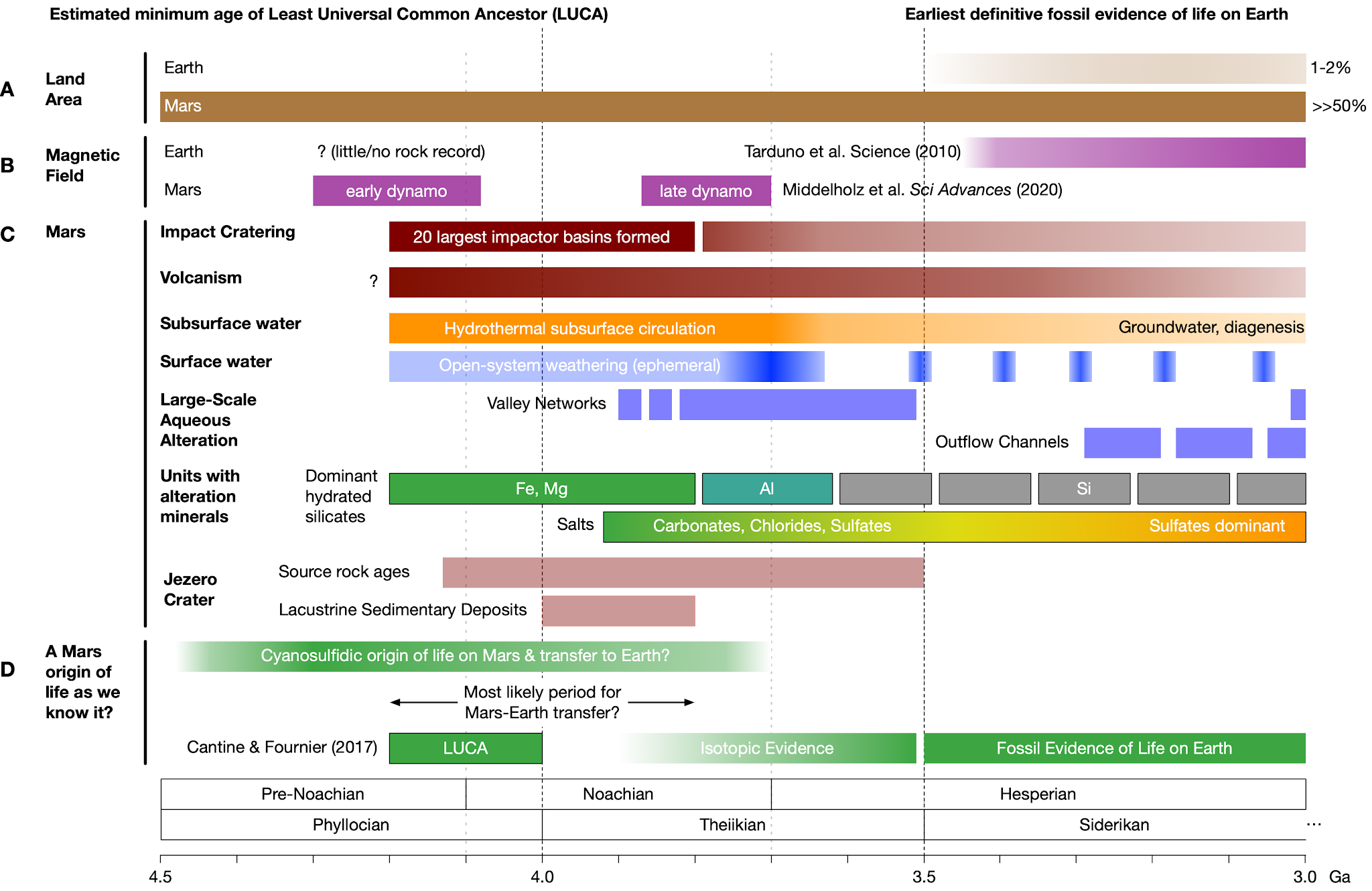
The cyanosulphidic origin theory is compelling, yet current data suggests that the early Earth was a water world with little to no sub-aerial continental crust before 3.5 billion years ago, reaching 1-2% land by 3.0 billion years ago, and 5-8% by 2.5 billion years ago. Consistent with these findings, recent analysis suggests initiation of continental weathering between 3 and 2.5 billion years ago.This would have limited the land area suitable for a cyanosulphidic origin of life to regions such as volcanic island hot spots.

 
Planetary context for a hypothesised cyanosulphidic origin of life on Mars and its transport to Earth via lithopanspermia. The horizonal axis for all panels is billions of years ago. (A) Early Mars had orders of magnitude more land area available to support a cyanosulphidic origin of life. (B) Life arising on early Mars would have been protected by a magnetic field. The lack of a rock record prevents similar knowledge of the early Earth, although it is likely Earth’s dynamo had started by 3.4 to 3.45 billion years ago. (C) Impact cratering on early Mars, especially from about 4.2 to about 3.8 billion years ago, would have provided both habitable environments for life to arise as well as facilitate its transport to Earth via meteoritic ejecta. Volcanism would have played a role in facilitating a cyanosulphidic origin of life in combination with hydrothermal subsurface activity and ephemeral surface waters. The aqueous record of this time and the geochemical transformation of Mars is recorded by the presence of hydrated silicates and salts, with sulphates as a particularly important record of early oxidation on Mars in comparison to Earth, where widespread oxidation occurred over a billion years later. (D) If a cyanosulphidic origin of life occurred on early Mars, such life could have been transferred to Earth around the time of, but not necessarily coincident with, the Last Universal Common Ancestor. For example, the Last Universal Common Ancestor may have existed on Mars and life on Earth could have arrived via multiple transfer events. Carr (2021).

Estimates of the water inventory on Mars at the Noachian/Hesperian boundary (about 3.7 billion years ago) range from tens of meters to about1 km global equivalent layer. The upper bound assumes a putative northern ocean after formation of the Martian dichotomy, e.g. the Borealis basin resulting from a massive impact event at or before 4.2 billion years ago and possibly as old as 4.5 billion years ago. Even in the most extreme scenarios, Mars would have had orders of magnitude more land area than early Earth.

Additional support for a Mars origin of life on Earth comes from amino acids and the evolution of the genetic code itself. In 2017 Matthias Granold, Parvana Hajieva, Monica Ioana Toşa, Florin-Dan Irimie, and Bernd Moosmann, proposed that the genetic code used a simpler set of amino acids and that the final diversification of amino acids happened in response to oxygen, suggesting that the diversification was late, e.g. coincident with the appearance of early local oxygen on Earth. It this hypothesis is correct, it would imply exposure to oxidizing conditions on the early Earth. However, the geologic record has revealed that Earth was largely devoid of oxygen for its first 2+ billion years, and appreciable quantities only accumulated after Cyanobacteria invented oxygenic photosynthesis, resulting in the Great Oxidation Event.

While the Great Oxidation Event occurred around 2.33 billion years ago, evidence for early local oxidative weathering suggests there could have been transient local oxygen pulses at or before 3 billion years ago. Nevertheless, the late diversification is problematic because the root of the Archaeal phylum Euryarchaeota, which arose after the Last Universal Common Ancestor, has been dated to more than 4 billion years ago, and the genetic code must have been fully established before this time including use of selenocysteine by the Last Universal Common Ancestor. Time-calibrated phylogenomics extending this deep into life’s history comes with caveats and wide error bars, yet it highlights a more than 1.5 billion year inconsistency. Thus, the timing of the fixation of the genetic code does not align with the inferred oxidation state of the early Earth. However, on Mars, surface conditions became oxidising much earlier.

Today Mars is dry and cold, yet early Mars was habitable for life as we know it, with significantly more water; availability of the main elements used by life (carbon, hydrogen, nitrogen, oxygen, phosphorus, and sulphur) and energy sources including variable redox states of iron and sulphur minerals are recorded in the stratigraphy of Gale Crater. Widespread clay minerals confirm extensive periods of subsurface water-rock interactions before 3.7 billion years ago, yet also suggest even early Mars had mostly cold and relatively arid surface conditions, which could have aided accumulation of organic molecules through concentration and low hydrolysis rates.

In 2020 Dimitar Sasselov, John Grotzinger, and  John Sutherland delineated a plausible pathway for a cyanosulphidic origin of life on early Mars. They suggest that igneous intrusions, volcanism, or impacts interacting with cyanide salt deposits could have generated the relevant feedstocks to produce nucleotide, amino acid, and lipid precursors. Carr also suggests a Mars cyanosulphidic origin of life could have seeded life on Earth, resolving the inconsistencies previously noted for an Earth origin of life on Earth.

Lightning would have provided hydrogen cyanide, representing a total fixed nitrogen budget on par with that of the early Earth. Meteorite impacts may also have generated hydrogen cyanide and provided phosphate. Sulphite would likely have been available on early Mars as a consequence of volcanic sulphur dioxide, a carbon dioxide atmosphere, and low temperatures; later oxidation would have led to the formation of sulphate minerals, consistent with remote sensing and in situ measurements. The presence of sulphites would also help to explain the relative dearth of carbonates on Mars.

A cyanosulphidic origin of life would produce all the building blocks required for an RNA-protein world. What is still lacking is knowledge about whether ancient Mars, especially before the Noachian-Hesperian boundary, was conducive to the formation, stabilisation, and evolution of an RNA-Protein world and ultimately cellular life.

Angel Mojarro, Lin Jin,  Jack Szostak, James Head, and Maria Zuber evaluated plausible divalent cations (iron, magnesium, and manganese) at different pH conditions and found the lowest rate of metal-catalysed hydrolysis of RNA for magnesium at pH 5.4, rather more acidic than the circumneutral conditions suggested by the cyanosulphidic model. In 2018 team led by Marcus Bray found that iron and manganese can replace the modern role of magnesium for ribosomal RNA folding and translation in anoxic conditions, relevant to early Earth or early Mars. An improved understanding of Mars redox history is necessary to understand the potential origin and evolution of an RNA world on Mars.

For all known life, DNA ultimately replaced RNA as the carrier of hereditary information. However, if an RNA-protein world evolved on Mars, it may still be possible to sample fossilised or extant traces of it in the subsurface, or may find, like all known Earth life, that its role in heredity has been displaced by DNA.

While an oxidising atmosphere on Earth arose due to biological production of oxygen, oxidation on Mars is thought to have resulted from crustal water sequestration as well as photolysis of water and subsequent loss of hydrogen. The present-day surface of Mars is highly oxidising, and this state has likely persisted for billions of years as inferred from manganese hydroxides identified at Gale and Endeavor craters.

On Mars, the transition to more oxidising conditions is recorded by the deposition of sulphates from approximately the Noachian-Hesperian transition (3.7 billion years ago) onward. This is consistent with orbital observations of Noachianaged iron-bearing clay minerals (e.g. associated with surface oxidation) and in situ detection of their purported ferrous smectite precursors. As the full range of sulphate deposits on Mars has yet to be identified, oxidation may also have occurred earlier.

This timing is consistent with a potential role of oxidation in shaping fixation of the genetic code, followed by meteoritic transfer of life to Earth. This resolves the problematic interpretation that the genetic code was not fixed until 1.5 billion years after the timing predicted by genetic evidence and is consistent with the antiquity of antioxidant enzymes and recent work suggesting a potential role for reactive sulphur species in their evolution.

Early nucleic-acid based life would have required phosphate to build informational polymers and store energy. Release rates for phosphate-bearing minerals are estimated to be 45 times higher for Mars compared to Earth, with roughly two times higher equilibrium phosphate concentrations. In contrast, phosphorus availability was limited on the early Earth due to a dearth of oxidising power that limited recycling until the Great Oxidation Event. Cyanide can promote release of phosphate from iron phosphates, enabling generation of organophosphates under desiccating conditions; dry conditions were widespread on early Mars but lacking on early Earth.

The plausibility of lithopanspermia has been theoretically and experimentally tested, including nonsterilising ejection from planetary surfaces as measured in Mars meteorite ALH84001 (below 40°C based on residual magnetisation) and through experimental studies of microbial survival to hypervelocity shock pressures. Modeling suggests that the mass of Mars to Earth viable transfers is greater than 1 000 000 000 tonnes. Recent data supporting a Martian dynamo at 4.5 and 3.7 billion years ago suggests any life being ejected before 3.7 billion years ago would have been afforded protection from space radiation while on Mars, although perhaps not for a few hundred million years (3.4 to 3.45 billion years ago) after its arrival on Earth.

Organisms arriving on Earth, putative chemolithoautotrophs, would have adapted to available redox gradients, including hydrothermal systems. While thermophily near the base of the tree of life was originally interpreted to provide evidence of the vent origin model, it can also be explained by parallel adaptation to high temperatures, such as selection for heat resistant species during Mars-Earth meteoritic transfer, or via subsequent heating of Earth’s oceans during impact events. Reconstructed optimal growth temperature across the tree of life suggest hyperthermophily at the base of the Archaea and Bacteria domains, but a colder optimal growth temperature for the Last Universal Common Ancestor of about 45°C, consistent with non-sterilising temperatures during meteoritic ejection.

What we know about early Mars is consistent with the cyanosulphidic origin of life, and conditions there would have provided orders of magnitude more land area for prebiotic chemistry to cross the threshold to life. The Noachian-Hesperian transition and commensurate changes in surface redox balance on Mars are also consistent with the timing of fixation of the genetic code and the antiquity of antioxidant enzymes. Theoretical and experimental studies of lithopanspermia imply that Earth, Mars, and Venus would have shared viable microbes, if present in ejecta, and subsequent genetic evidence is consistent with this timeline.

Other options are possible: If cyanosulphidic chemistry and the transition to life is a planetary phenomenon, relatively fast and easy given the right conditions, then we may find that such life evolved independently on both early Mars and early Earth, despite the latter’s dearth of sub-aerial crust. If booting up life is harder or rare, this would raise the prior that we may share common ancestry with any life on Mars. Finding no life on Mars would be incredibly revealing, because it would suggest life is a rare event requiring very particular circumstances.

Given the inconsistencies between the inferred history of life as we know it and Earth’s geologic history, it is plausible that life on Earth could have originated on Mars. Such a history, while incredible, is a story of our past that explains the available genetic and geological evidence. It is also testable.

While the Perseverance Rover will focus on habitability and evidence of ancient, and not extant, life, it can seek to confirm or refute conditions consistent with a cyanosulphidic origin of life, as well as seek chemical precursors to life and identify high abundance organics.

Jezero Crater is a 45 km diameter impact crater that once harboured an open-basin lake system recorded by sedimentary deposits, deltas, and other features associated with fluvial activity that may have ended by around the Noachian-Hesperian boundary or earlier. Analysis of the western fan deposit at the crater inlet has identified clay minerals (iron/magnesium smectite) and stratigraphy that likely records an extended history of early Mars, drawn from a watershed much larger than the crater, which includes smectites, olivine, and magnesium-rich carbonate-bearing terrains, among others. Beyond likely having been habitable itself, the Jezero Lake and associated watershed should provide access to samples originating in a diverse set of other potentially habitable environments, and the lacustrine setting implies access to a well-ordered stratigraphic record of the Noachian period on Mars.

Because the fluvial activity associated with lacustrine sedimentary deposits at Jezero Crater likely ended by 3.8 billion years ago, evidence within those deposits of increasing oxidation over time would be consistent with the ancestral relationship scenario. Alternatively, a relatively reducing surface environment up to 3.8 billion years ago would not rule out life as we know it on Mars, but would weaken the case for any ancestral relationship, at least one linked to the Jezero Crater source region. For comparison, sedimentary rocks within Gale Crater, which formed between 3.6 and 3.8 billion years ago, record a mix of oxidation states even within the base of the stratigraphic section, as well as evidence of redox stratification in younger deposits, consistent with an oxidative surface environment by the Noachian-Hesperian boundary or early Hesperian.

If putative ancient life on Mars was exposed to an oxidising surface environment before the earliest evidence of life on Earth, a Mars-Earth transfer is not ruled out. If no part of Mars became oxidizing until significantly after the earliest signs of life on Earth (less than 3.7 billion years ago), or certainly after the earliest unambiguous evidence of fossil life on Earth (3.5 billion years ago), then the window of opportunity to complete fixation of the genetic code on an oxidised Mars prior to a hypothesized Mars-Earth transit would close, and lead to rejection of the hypothesis that oxidising conditions on Mars could explain fixation of the genetic code.

Silica has high preservation potential and hydrated silica deposits have been identified within Jezero crater in association with delta deposits. Organic materials can be concentrated locally and stabilised by adsorbing to silica and the aforementioned clays (iron/magnesium smectite). Lacustrine carbonates in Jezero Crater also offer high preservation potential. A study of amino acid preservation in simulated Mars conditions found the highest preservation in smectites and sulphates.

Extrapolation from modeling of hydrolysis and ancient DNA sequencing projects suggests that 100 base pairs DNA at –60°C could have a half-life over 2 billion years. However, other factors such as naturally-occurring radioisotope decay may limit the decay half-life to perhaps 10 million years. RNA generally has higher hydrolysis rates, although the pH dependence is different. Thus, direct detection of nucleic acid polymers in Noachian-aged terrain is extremely improbable. However, nucleobases, the informational component of nucleic acids, have been identified in meteorites, and thus, at least under cold conditions, nucleobases can survive more than 4 billion years.

Intact nucleic acids and nucleobases can adsorb to silica, and in the relative absence of later aqueous and thermal alterations, nucleobases can be retained. Silica is, in fact, used to isolate cross-linked RNA and proteins to study their interactions. Cross-linking would be expected as part of the diagenesis process, as would be deamination of cytosine to yield uracil. Mars 2020’s instruments are not designed to specifically interrogate uracil, but it could be targeted in returned samples along with other nucleobases.

Lipids are also one of the most geologically stable biomolecules, and are used as a biosignature in studies of Earth life in rocks older than 2 billion years. Studies of Mars-relevant diagenesis reveal caveats. Jonathan Tan and Mark Sephton found that hydrous pyrolysis from 200-280°C for 72 hours significantly degraded lipids, especially with low carbon content, high water-to-rock ratios, and iron-rich minerals, while a team led by Daniel Carrizo demonstrated the potential to detect lipid biomarkers using a tunable Raman laser spectrometer and found that of silica rich vs. iron rich samples tested, the silica rich material enhanced preservation. Thus, silica-rich deposits in Jezero Crater could be targeted in the search for nucleobases and lipids.

Many of the mineral deposits mentioned are expected to be accessible to the Mars 2020 Rover, for example, within the stratigraphy of the western delta deposits. Because Mars lacks a substantial atmosphere, organics within deposits exposed at the surface would be damaged over time by space radiation. To avoid this damage, low exposure ages are desirable. Mudstone on the floor of Gale Crater was found to have a exposure age of 78 ± 30 million years highlighting the potential to utilise wind-driven geomorphological change to obtain samples with potential for complex organic molecules as undegraded by cosmic rays as possible. Thus, it may be feasible to use a similar approach in Jezero Crater, leveraging prior wind analysis and in situ measurements to assess access to low exposure age stratigraphy. Because accessible exposure ages may still be large, drilling, including, in future missions, below the 1-2 meter penetration depth of space radiation, remains critical for accessing undegraded samples.

While the capabilities of the Mars 2020 Rover are unprecedented, and several instruments (SuperCam, SHERLOC, PIXL) will be used to detect or infer the presence of organics and specific chemical moieties, they may lack the ability to uniquely identify specific molecules. Instruments in development could one day target poly-peptides and nucleic acids. 

Mars 2020 is uniquely positioned to seek evidence consistent with a cyanosulphidic origin of life on Mars, search for ancient evidence of life, and constrain the evolution of Mars’ oxidation state over time. Unlike Earth, where ancient rocks are rare, on Mars we can access rocks across nearly the full 4.5 billion year history of that planet. Despite the modern thin (1% that of Earth) atmosphere and cold average surface temperature (–60°C), the subsurface of Mars likely remains habitable. Future missions, with access to special regions, including deep drilling to seek habitable environments in the sub-surface, may be required to target any extant life and unambiguously determine whether life as we know it exists on Mars today and if so, whether it is related to us.

See also...


Follow Sciency Thoughts on Facebook.

Follow Sciency Thoughts on Twitter.