
The first Whale (Cetacean)
fossils appear in the early Eocene of Pakistan and India,. Early groups of Whales such as the Pakicetids, Ambulocetids
and Remingtonocetids were apparently restricted to the Indian continent (which
was an island unconnected to Eurasia in the earliest Eocene). The first group
of Whales to be found on other continent were the Protocetids, which have been recorded from Africa and North and
South America as well as India and Pakistan, and are therefore thought to have
been the first Whales to have been capable of ocean-crossing journeys.
In a paper published in the
journal Palaeontologica Electronica in September 2014, Sunil Bajpai of the
Department of Earth Sciences at the Indian Institute of Technology and HansThewissen of the Department of Anatomy and Neurobiology at Northeast Ohio MedicalUniversity describe two new species of Protocetid Whales from the Eocene Harudi
Formation in Kutch District, Gujarat, both are thought to be about 42 million
years old.
The first new species is named Kharodacetus sahnii, where ‘Kharodacetus’ means ‘Kharoda-Whale’ in
reference to one of the locations that produced specimens assigned to this
genus, and ‘sahnii’ honours the Indian palaeontologist Ashok Sahni. The species
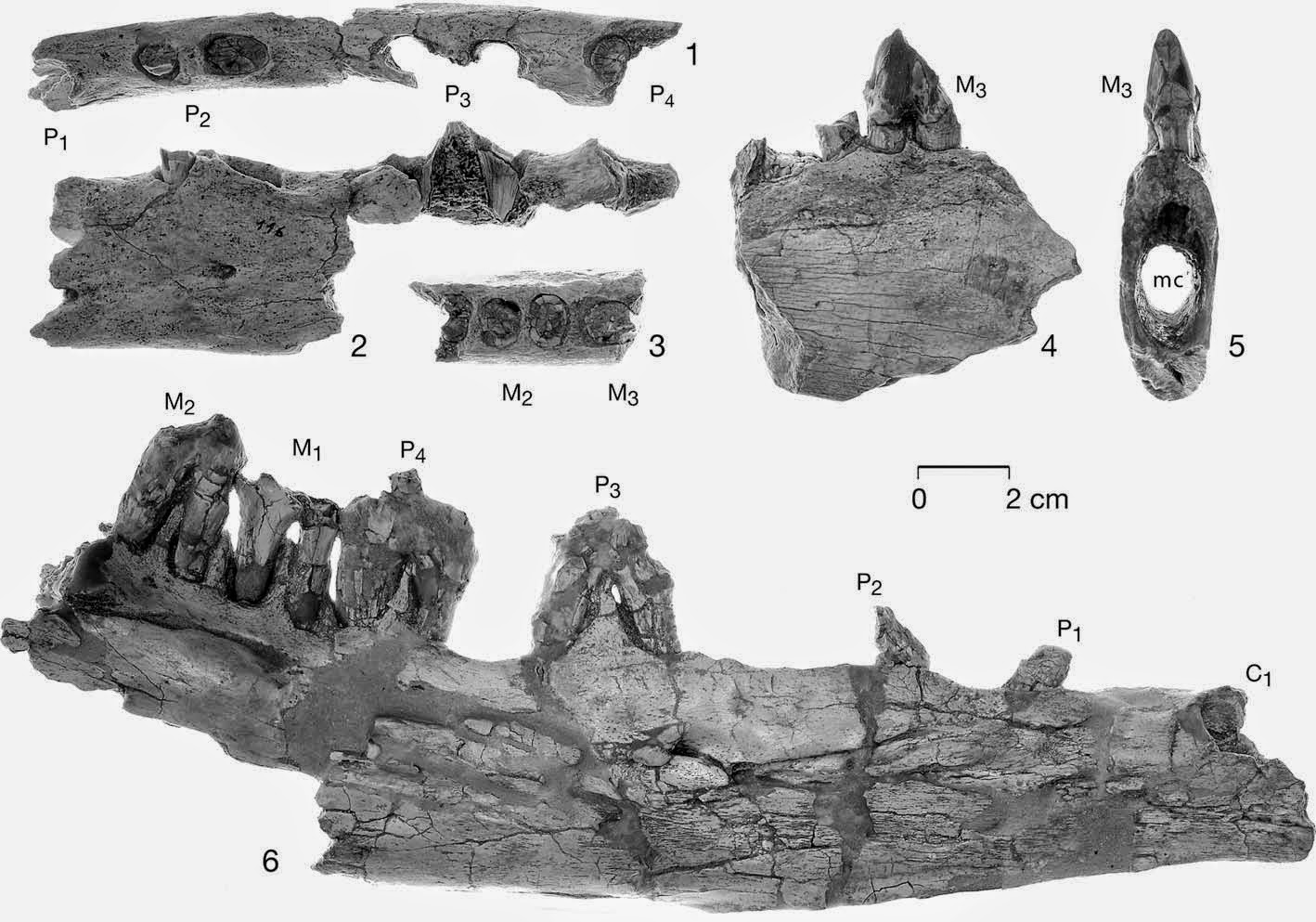
is described from a partial and fragmentary skull plus a detached rostrum and a
partial mandible. Kharodacetus sahnii appears
to have been larger and more robust than any other known Indian Protocetid.

Kharodacetus sahnii. Rostrum
in occlusal, right lateral, and dorsal view (1-3), and mandibles in left
lateral and occlusal view (4-5). Bajpai & Thewissen (2014).
The second new species described
is named Dhedacetus hyaeni, where ‘Dhedacetus’ means ‘Dhedadi-Whale’, in
reference to the village of Dhedadi which is 2.1 km to the west of the site
where the first specimen was found, and ‘hyaeni’
in reference to the Striped Hyenas that lived around the site where the first
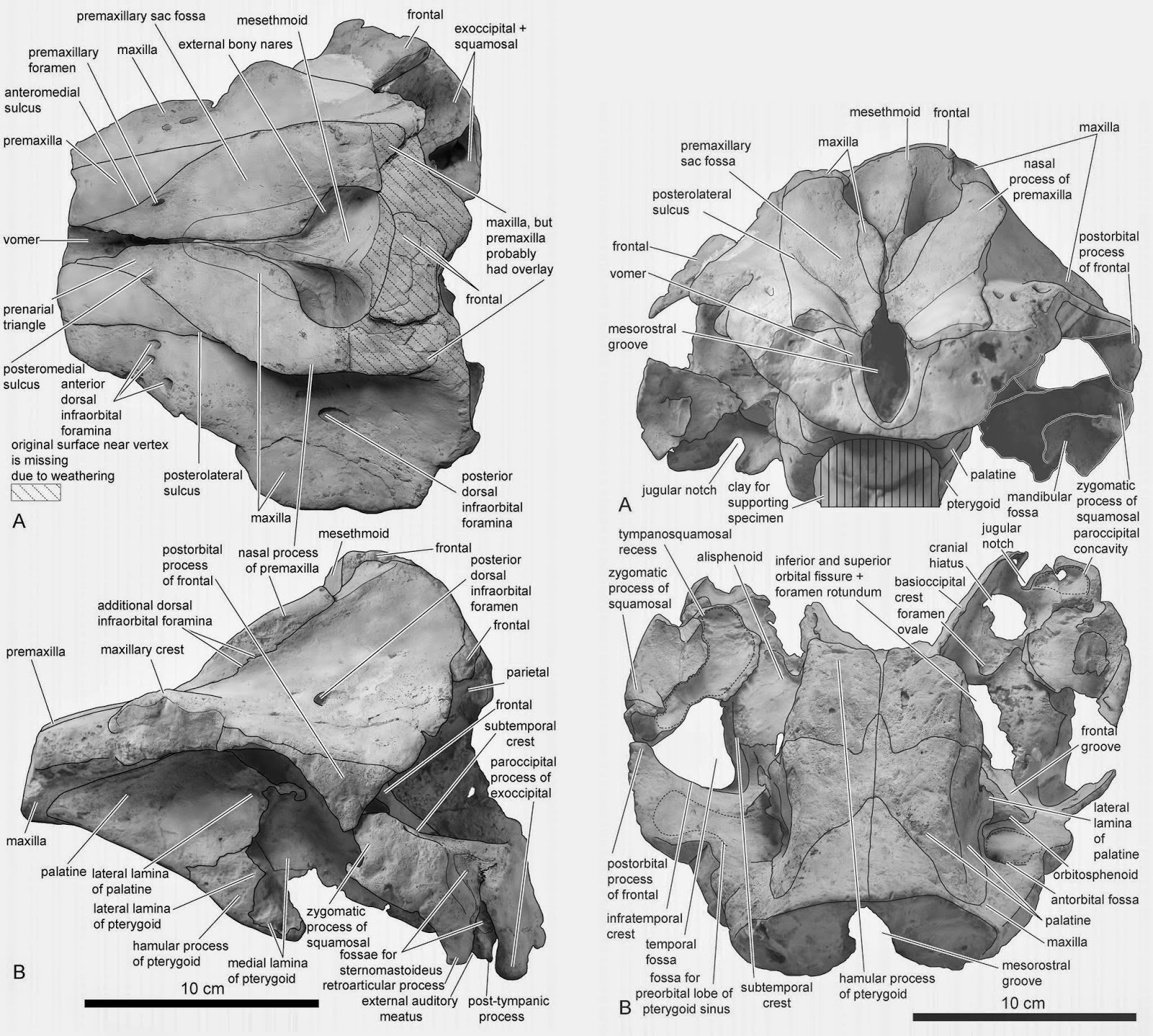
specimen was found. The species is described from a fragmentary partial skull with
29 fragmentary vertebrae and a separate series of 10 caudal (tail) vertebrae.
It is a large Protocetid, but the smallest one yet known from Kutch, and the
only one for which the vertebrae are known.

Dhedacetus hyaeni. Skull. (1-2)
Right lateral view and its outline drawing. (3-4) Ventral view and its outline
drawing. (5) Detail of caudal view of right maxilla with M2 roots, lateral to
left, ventral to top. Abbreviations: alv. edge, edge of alveolar process of M2;
ant. root M2, anterolabial root of M2; bul., bulla; ext. aud., external
auditory meatus; lat. max., broken edge of maxilla lateral to molar roots; nuc.
cr., nuchal crest; occ. con., occipital condyle; pal., palate, medial to teeth;
pos. orb., postorbital process; post. root M2, posterolabial root of M2. Abbreviations
for teeth (I1, C, P4, M2) refer to wns or roots preserved. Scale bar pertains
to 1 through 4. Bajpai & Thewissen (2014).
See also…
The Earliest Whales appeared in what is now Pakistan and India at the eastern margin of the Tethys Sea then spreading along the southern margin of the Tethys...
Dolphins, Delphinidae, are the most diverse group of Whales (or
indeed any form of Marine Mammals) alive today, with 36 described species
including charismatic animals such as Bottlenose Dolphins and Killer Whales.
Historically a large number of fossils have also been...
The Squalodelphinidae are a small group of small to medium-sized
Toothed Whales known from the Miocene of Europe and North and South
America. They are thought to be related to the modern Asian River
Dolphin, Platanista gangetica, which
lacks any close living relatives. The group is not well understood, with most
described specimens being fragmentary in nature.
Follow Sciency Thoughts on
Facebook.


