Showing posts with label Rays. Show all posts

Sunday, 5 July 2020

Unraveling the relationship between Giant Manta Rays and Cleaner Fish.

Seamounts are widely regarded as hotspots of biodiversity due to the unique oceanographic conditions that they generate and have been identified as important staging areas for migrant marine megafauna. While the ecological mechanisms that attract elasmobranchs to seamounts are poorly understood, it has been suggested that they provide refuge, represent social convergence points, act as navigational waypoints, and function as mating, feeding, and nursery grounds for a variety of pelagic species. The Giant Manta Ray, Mobula birostris, is one of two recognised Manta Ray species. Reaching 6.70 m in total (disc) width, the Ray is popular among tourists for its size and approachable behaviour. Recognised from fisheries and by-catch to frequent tropical and subtropical offshore waters circumglobally, Giant Manta Rays mature late, have low fecundity, and are classified as Vulnerable to Extinction by the International Union for the Conservation of Nature and Natural Resources’ Red List of Species. For the past two decades, Giant Manta Rays have been observed by SCUBA divers on Monad Shoal, which is a shallow coastal seamount in the Central Visayas of the Philippines, where they interact with Blue Streaked Cleaner Wrass, Labroides dimidiatus, and Moon Wrasse, Thalassoma lunare. Rays, including Giant Manta Rays, are known to host Metazoan parasites, and it is proposed that they visit a cleaning station at this site to control infection.

In a paper published in the journal Marine Biology on 7 April 2020, Calum Murie of the School of Environmental Sciences at the University of Liverpool, the Underwater Africa Foundation, and the Department of Biological Sciences at the University of Chester, Matthew Spencer also of the School of Environmental Sciences at the University of Liverpool, Simon Oliver, also of the Department of Biological Sciences at the University of Chester, and of the Thresher Shark Research and Conservation Project, show that Giant Manta Rays interact with cleaners at a seamount in the Philippines and investigate the cleaner–client association.

A Giant Manta Ray, Mobula birostris, at a cleaning station at Hin Daeng off the coast of Thailand. Jon Hanson/Flikr/Wikimedia Commons.

Batoid rays infected with parasites suffer a variety of health consequences. These include skin lesions, necrosis, anaemia, respiratory disease, and chronic Bacterial and Viral infections that have been reported as lethal in some species. Ectoparasitic infections in captive Elasmobranchs cause behavioural modifications such as rubbing against the structures of enclosures and interacting with Cleaner Fish.

The cleaning system is a classic model of cooperative behaviour among species in which Cleaner Fish remove ectoparasites and dead or infected tissue from the surface, gills, and sometimes the mouth of client Fish. Interactions with Cleaner Fish appear to improve the health of teleost clients by reducing their ectoparasite loads, but the benefit of these interactions is less understood amongst Elasmobranchs. Clients will often ‘pose’ near cleaning stations to solicit ‘services’ from Cleaner Fish. There are approximately 130 species of marine cleaners, with ectoparasitic infection being the most likely proximate cue for clients seeking their services. The Blue Streaked Cleaner Wrasse, Labroides dimidiatus, is an obligate cleaner that preferentially feeds on Gnathiid Isopod larvae that are known to infect the gills of Reef Manta Rays. Labroides dimidiatus prefer large clients and interact with Manta Rays at spatially diverse locations across the globe. The Moon Wrasse, Thalassoma lunare, which is less understood as a cleaner species, also provides cleaning services for Manta Rays. Moon Wrasse are facultative cleaners wherein only juveniles clean whilst contemporaneously exploiting alternative food sources.

A Blue Streaked Cleaner Wrasse, Labroides dimidiatus, in the Coral Sea off the coast of Australia. Rick Stuart-Smith/Reef Life Survey.

Cleaners may maximize the profitability of their energy return by selectively foraging on areas of clients where specific types of parasites can be found. When investigating how cleaners forage on Elasmobranchs, it has been shown that Labroides dimidiatus and Thalassoma lunare spent more time inspecting areas of Thresher Sharks, Alopias pelagicus, that were infected by ectoparasitic Digeneans, Paronatrema spp., compared to areas that are known to harbour other types of parasites. They concluded that cleaners may optimise their foraging by selecting areas of a client’s body that are most likely to produce the highest energy reward per unit effort. A cleaner’s foraging behaviour is, therefore, likely to be driven by the quality of the food patch in relation to the ease with which food may be obtained there. Since specific types of parasites infect specific patches of an Elasmobranch’s body, it can be predicted that cleaners will show preferences for foraging in some patches over others.

A Moon Wrasse, Thalassoma lunare, on the Great Barrier Reef, Australia. Leonard Low/Flikr/Wikimedia Commons.

Murie et al. quantified behavioural interactions between Giant Manta Rays and Cleaner Wrasse from remote video observations to address the following hypotheses: (1) the dynamics of the Cleaner–Manta system are driven by environmental factors; and (2) Cleaner Wrasse preferentially forage on specific areas of a Manta Ray’s body. The Cleaner–Manta association is discussed in relation to other known cleaner–client systems in the marine environment.

Monad Shoal is a seamount in the Central Visayan Sea, near Malapascua Island, Cebu, the Philippines. The top of the mount (15–25 m) is formed by a shallow plateau of low-profile Acropora that is fringed on all sides by a Coral Reef which crests and sheers down 250 m to the valley below. An array of cleaning stations lines the southern face of the mount, one of which (Station A) is frequented by Giant Manta Rays.

SCUBA divers initially deployed remote video cameras at five cleaning stations (A–E) on Monad Shoal during a pilot study which ascertained that Station A was the only location on the seamount where Giant Manta Rays could be observed interacting with Cleaner Fish. A total of 1171.45 h of video observations were subsequently recorded from a fixed point on Station A between April 2011 and June 2013, during three field expeditions spanning 262 days over 20 months. A Sony Handycam® HDR-SR8, housed in an Amphibico Elite housing and fitted with a 120° wide-angle lens, with focal range locked to 0.3 m, was pre-set to record for 360 continuous minutes for all camera deployments. The camera was retrieved at the end of each deployment period, and the video data downloaded for analysis.

Environmental data including tidal conditions, water temperature, and the in situ current strength were documented for each camera deployment. Temperature was measured in situ to the nearest degree Celsius using the readouts of a dive computer at the time of the camera deployment. Current strength was measured from a submerged windsock that was fixed to the substrate in the camera’s field of view. Tides were estimated from Admiralty predictions for Bogo Bay, the Philippines.

Murie et al. took still images of the video recordings when a Manta Ray was positioned directly above the camera to capture its ventral surface. They then entered the still images into a photo bank that considered patterning in the manta’s ventral markings to identify a new individual, or a match to an individual that had been previously observed at Station A. Due to the camera’s field of view, it was not always possible to capture the entire ventral surface for each Manta Ray so some mantas could not be individually identified.

To investigate whether cleaners forage selectively on Giant Manta Rays, it was assumed that different areas of a client’s bodyscape host different types of parasites and that some areas represent higher quality food patches for cleaners than others. Eight food patches were outlined on a sketch of a Giant Manta Ray and categorised as ‘gills’, ‘pelvis’, ‘dorsal head’, ‘ventral head’, ‘pectoral’, ‘ventral body’, ‘dorsal body’, and tail. These were then used to document cleaner interactions for each event. The pelvic and tail patches included the cloaca and tail, respectively, the pectoral patch incorporated both pectoral fins, the gill patch included both sets of gill openings, and the head patch consisted of the cephalic lobes, the eyes, and the mouth. The Ray’s dorsal surface was split into two patches, the boundary of which followed the underside of the Ray’s superbranchial region.

The food patches onto which locations of cleaning interactions were mapped during the analysis of the video recordings. Murie et al. (2020).

Cleaning interactions were characterised by a cleaner’s mouth making discernible physical contact with a Manta Ray and were termed ’bites’. Bite locations were individually mapped onto the sketch according to their associated cleaner species, Labroides dimidiatus or Thalassoma lunare, and treated separately in the analyses. Bites were used as a proxy for parasite removal. The number of cleaning inspections may be underestimated because Cleaner Fish activity behind a Manta Ray could not be observed on the video recordings.

Nine Mantas (M2–M10) were first recorded in 2011, four of which were observed revisiting the site in 2012 (M5, M7, M8, M9). Six Mantas (M11–M16) were first observed in 2012, two of which (M12, M13) were observed revisiting the site in 2013. One Manta (M9) was observed every year (2011–2013). Across all observations four Manta Rays were only seen on a single occasion. The remaining eleven had an average return rate of 5.64  across the three observation years.

Comparisons between models of Giant Manta Ray visits showed that the minutes observed, and the minutes after the high tide explanatory variables should be omitted from the final model. Manta Ray visits to the cleaning station varied throughout the year, occurring most frequently between April and September, with visits rare during March and July. Visits were most likely to occur during warmer temperatures and in the afternoon. Visits were also most likely to occur when the current was strong (over 1.5 metres per second) or weak (about 0.2–0.4 metres per second), but they were rare when the current was mild (about 1 metres per second).

There were 32 recorded cleaning events by 11 identifiable Mantas for which all data was available. These events lasted between 41 and 2976 seconds and involved between 1 and 22 discernible cleaning interactions. Comparisons between single-term deletions of the model for cleaning interactions indicated that all of the explanatory variables should remain in the final model.

The rate of interactions varied between individual Manta Rays, with some (for example M8) receiving much more attention from cleaners than others. The current strength was found to constrain the number of interactions a Manta Ray received, and higher water temperatures had a weakly positive effect, The minute after 05:00 had a weak negative effect, and the day of the year had a weakly positive effect.

Single-term deletions of the model for patch preferences by cleaner species indicated that the interaction between the patch and species should be omitted from the final fitted model.

After controlling for differences in patch area and comparing each patch to the ‘dorsal head’, cleaners showed preferences for certain patches. Both species targeted the gills, which received the largest absolute number of cleaning interactions, with both cleaner species also showing a preference for the pelvis. The pectoral fins received large absolute numbers of cleaning interactions by Labroides dimidiatus, which resulted in a slight preference for this patch by this species despite its large value for patch proportion. Thalassoma lunare’s preference for the ventral body could not be estimated since no cleaning interactions were recorded in this patch for this species, even though this parameter was structurally identifiable in the analysis.

While the cleaner–client system amongst reef Teleosts has received considerable attention, the spatially and taxonomically diverse associations between cleaners and Elasmobranchs are less understood. This study represents the first attempt to quantify interactions between Giant Manta Rays
and cleaner wrasse in the natural environment and supports knowledge of the importance of cleaning stations to marine ecosystems.

Our observations of giant manta rays were most likely to occur in the afternoon on a seasonal basis between the months of April and September. Giant Manta Rays’ large body size and planktivorous diet make ocean productivity a key factor in determining their movements and seasonal shifts in food availability encourage them to undertake substantial migrations. Giant Manta Rays are known to frequent cleaning stations in Mozambique, Ecuador, and Indonesia during the austral winter, and their seasonal fidelity to these sites has largely been attributed to increases in local productivity that is driven by oceanographic processes, including currents. It is possible that Giant Manta Rays have limited movements on a regional scale in Murie et al.'s study area and that they are only in the vicinity of Monad Shoal when seasonal oceanographic processes promote shifts in productivity and the consequent availability of food. They may partition their time to converge on Station A during the afternoon when food is scarce and/or when hydrodynamic conditions facilitate cleaning. Similar temporal trends for Giant Manta rays visiting cleaning stations have been observed in Indonesia where they are known to move offshore to forage nocturnally in deep waters after they clean. Mantas’ movements and use of our study area may be part of a strategy that considers both temporal variations in food availability and cleaner services without being mutually exclusive. 

The overall occurrence of Giant Manta Ray cleaning events was strongly influenced by the state of the current on the seamount. Certain hydrodynamic conditions may generate sufficient water flow and lift for Giant Mantas to ‘hover’ over specific topographical features. In Mozambique, Reef Manta Rays are known to clean during moderate strength currents because these conditions are favourable for hovering over cleaning stations. Hovering may facilitate Giant Mantas’ interactions with cleaners since cleaning typically occurs near spatially finite structures that are known as ‘focal points’. Hovering is also likely to be an energetically efficient strategy that makes Giant Manta Rays more accessible to cleaners and, therefore, more attractive as clients. However, even though hydrodynamic flow may provide lift and facilitate a Giant Manta’s hovering behaviour over a cleaning station, cleaning events were not observed on Monad Shoal when the current was strong. Cleaners are known to seek refuge and conserve their energy during strong currents, which stalls the provision of cleaning services for their clients. The reduced availability of cleaners may have decreased the likelihood of a Giant Manta Ray visiting the site during these periods in spite of the energetic benefits provided by strong currents. 

Reef Teleost clients are known to show preferences for specific services that are offered by specific cleaners at specific stations. A client’s fidelity to individual cleaners may be driven by the type and quality of service on offer (parasite removal, wound healing, tactile stimulation), or other clients competing for the same resources. Many of the individual mantas that we observed on Station A had open wounds from bite marks and dismembered cephalic lobes, presumably from encounters with predators and/or fishing gear. Giant Manta Rays’ fidelity to this site may be indicative of a lack of competition from other Elasmobranch clients, and/or specialist wound healing and parasite removal services that are on offer at this particular location.

Higher temperatures were found to influence the frequency with which Giant Manta Rays visited Station A and were also associated with an increase in the frequency of their interactions with cleaners. Digenean Flatworms (Phylum Platyhelminthes) that are known to infect the cloacas of Elasmobranchs on Monad Shoal are typically dioxenous, parasitising two hosts during their life cycle. During reproduction, oviparous Digeneans release their fertilised eggs into the water column where they hatch to produce miracidia. The miracidia swim to find an intermediate Mollusc host where they grow through several life stages until they eventually emerge as cercaria larvae. Larvae live freely in the water column before they attach to their terminal host, which they locate from host-derived chemical or mechanical cues, or shadows. Attachment typically occurs during seasonal epizootic events, which are characterised by cool (roughly 25 °C) or warm (roughly 32 °C) water conditions and may coincide with a time when hosts are particularly vulnerable to infection. 

Murie et al.'s conjecture for further study that the seasonality with which Giant Manta Rays visit Monad Shoal might coincide with ectoparasite attachment events in the area, leading to heightened parasitism and a greater need for interacting with cleaners.

Since Cleaner Fish tend to modify their foraging patterns in response to variations in the quantity and quality of a food resource, Giant Manta Rays with the highest parasite loads are more likely to be attractive clients. Labroides dimidiatus typically favours larger clients with high ectoparasite infections, and a client’s body size has been positively correlated with ectoparasite abundance. The number of cleaning interactions (per unit time) varied substantially among individual Mantas across our observations. Although Murie et al were not able to quantify body size, it is possible that larger Mantas received more attention from cleaners than smaller ones.

Cleaning interactions were patch-specific, suggesting that the cleaners forage selectively across a Giant Manta Ray’s bodyscape. Ectoparasites that attach to Elasmobranchs are site specific and typically infect the same sites across different host species. Platyhelminthes parasitise most Elasmobranchs, and Paronatrema spp. found in and around the cloaca of pelagic Thresher Sharks, Alopias pelagicus, that regularly visit our study site are thought to be the primary driver for cleaners preferentially foraging on their pelvis. Monogenean Flatworms are similarly known to infect the cloaca of Manta Rays in Mozambique, and Gnathiid Isopods, which are a primary food source for the Blue Streaked Cleaner Wrasse, infect their buccal cavities. While it was not possible to verify whether Manta Rays visiting Monad Shoal are infected by Gnathiids, Digeneans, or Monogeneans, Murie et al.'s observations suggest that either parasitic abundance is highest in and around the cloaca and gills, or that Cleaner Fish are selecting parasites, mucus, and/or dead tissue there because they are accessible.

Many large marine organisms visit cleaning stations to have parasites removed and giant manta rays appear to regularly visit cleaning stations on inshore reefs. The Rays may visit cleaning stations to benefit from feeding opportunities nearby or they may migrate inshore to clean after they forage in deep-water. Giant Manta Rays are thought to have limited regional connectivity and so the low number of absolute visits that we recorded either suggests that the habitat no longer supports their requirements, or that they are in regional decline. Cleaning interactions are both spatially and taxonomically diverse and cleaners’ selective foraging on Giant Manta Ray clients demonstrates a level of preference for areas of a Manta’s body where specific types of parasites might be found. Future identification and quantification of parasite loads on Giant Manta Rays would offer further evidence that Elasmobranch clients provide high-quality food patches for cleaners at seamounts. Cleaning stations are key points of convergence for Giant Manta Rays and they may only frequent specific cleaning stations so these spatially finite habitats should be carefully managed.

See also...

https://sciencythoughts.blogspot.com/2019/10/lessiniabatis-aenigmatica-new-species.htmlhttps://sciencythoughts.blogspot.com/2019/09/pseudobatos-buthi-new-species-of.html
https://sciencythoughts.blogspot.com/2019/08/dipturus-lamillai-new-species-of-long.htmlhttps://sciencythoughts.blogspot.com/2019/05/identifying-sharks-and-rays-from-waters.html
https://sciencythoughts.blogspot.com/2018/01/neotrygon-indica-new-species-of-maskray.htmlhttps://sciencythoughts.blogspot.com/2017/12/neotrygon-vali-new-species-of-maskray.html
Follow Sciency Thoughts on Facebook.

Sunday, 19 May 2019

Identifying Sharks and Rays from the waters around Sri Lanka using samples from local fish markets.

Sri Lanka is considered to be one of the world's biodiversity hotspots, with many rare and unique organisms found on the island and in the waters which surround it. However, whilst the island was surveyed extensively during the nineteenth and early twentieth centuries, it has been largely neglected by scientists and conservationists in recent years, particularly during the thirty year civil conflict which ended in 2009, a period during which the development of molecular techniques revolutionised our understanding of taxonomy. Sharks and Rays are a unique group of Marine Vertebrates which play an important role in community structures in all the world's oceans. Unfortunately in recent years almost all species of Sharks and Rays have undergone dramatic population declines in recent years, a decline driven principally by overfishing, though marine pollution and climate change have also played a part, something which makes surveying populations of these creatures a priority.

In a paper published in the journal Zootaxa on 12 April 2019, Daniel Fernando, Rosalind Brown, Akshay Tanna, and Ramajeyam Gobiraj of the Blue Resources Trust, Hannah Ralicki  and Elizabeth Jockusch of the Department of Ecology and Evolutionary Biology at the University of Connecticut, David Ebert of the Pacific Shark Research Center at Moss Landing Marine Laboratories, the Department of Ichthyology at the California Academy of Sciences, and the South African Institute for Aquatic Biodiversity, Kirsten Jensen of the Department of Ecology and Evolutionary Biology and the Biodiversity Institute at the University of Kansas, and Janine Caira, also of the Department of Ecology and Evolutionary Biology at the University of Connecticut, describe the results of a survey of the Sharks and Rays present in the waters around Sri Lanka, based upon examination of specimens from local Fish Markets at fifteen locations around the island.

Fernando et al. visited fifteen Fish Markets in four provinces of Sri Lanka; Puttalam, Baththalangunduwa Island, Palkanththura, and Pukulam in North Western Province, Vankalai, Gurunagar, Erinchamman Kovilady, Supparmadam, Kottadi, and Munai, in Northern Province, Mutur, Valaichchenai Fisheries Harbour, and Valaichchenai Landing Site in Eastern Province, and Peliyagoda, and Negombo in Western Province, during March 2018. Whole specimens were measured, sexed and photographed before being sampled for genetic analysis; genetic samples from frozen and smoked Shark meat were also included in the study, though any specimen from which genetic material could not be maintained, including whole specimens, was excluded from the study. A total of 34 Shark and Ray species were identified.

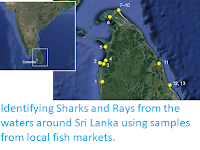
Map indicating collecting localities. North Western Province: Puttalam (1); Baththalangunduwa Island (2); Palkanththura (3); Pukulam Landing Site (4). Northern Province: Vankalai (5); Gurunagar Market (6), Jaffna; near Erinchamman Kovilady Market, Supparmadam Market, Kottadi Market, and Munai Market (7)–(10), Point Pedro. Eastern Province: Mutur Landing Site (11), Mutur; Valaichchenai Fisheries Harbour and Main Landing Site Valaichchenai (12), (13), Valaichchenai. Western Province: Peliyagoda Fish Market (14), Colombo; Negombo Fish Market (15), Negombo. Fernando et al. (2019).

The first species recorded is the Ocellated Eagle Ray, Aetobatus ocellatus, which was found at Palkanththura and Pukulam in North Western Province and Munai and Vankalai in Northern Province. These Rays were found to be close genetically to members of the same species from Malaysian Borneo. The species has not previously been recorded from Sri Lanka, though specimens of the Spotted Eagle Ray, Aetobatus narinari, previously collected from Sri Lanka almost certainly should be re-assigned to this species, as Aetobatus narinari is now considered to be restricted to the Atlantic.

Ocellated Eagle Ray, Aetobatus ocellatus, (A) imature male, and (B) mature female. Fernando et al. (2019).

Next a series of specimens of an unidentified species of Stingray, Brevitrygon sp., which was found at Palkanththura in North Western Province, Munai and Erinchamman Kovilady in Northern Province, and Mutur in Eastern Province. This is thought to be a new, previously undescribed species, though Fernando et al. refrain from describing it as such pending further research. They also note that previous records of the Scaly Whipray, Himantura imbricata, from Sri Lanka may in fact be this species.

 
Brevitrygon sp., maturing male. Fernando et al. (2019).

The next species described is the Fine-spotted Leopard Whipray, Himantura tutuli, which was found at Palkanththura, Pukulam, Baththalangunduwa Island, and Puttalam in North Western Province, and Munai and Kottadi in Northern Province. Fernando et al. note that this species was described from the coast of Tanzania, while the Reticulate Whipray, Himantura uarnak, has been described from Sri Lanka previously. However, the samples collected for this study, along with previously collected specimens from Sri Lanka and Borneo assigned to Himantura uarnak proved to be genetically closer to Himantura tutuli.

 Fine-spotted Leopard Whipray, Himantura tutuli, immature male specimen, detail of scapular denticles inset. Fernando et al. (2019).

Next Fernando et al. record a single, immature specimen of the Honeycomb Whipray, Himantura undulata, from Munai in Northern Province. They note that the species is not universally accepted, and are cautious about including it on their list without any adult specimens, though the specimen did closely resemble a juvenile specimen assigned to the same species from Borneo.

Honeycomb Whipray, Himantura undulata, immature male specimen, detail of scapular denticles inset. Fernando et al. (2019).

The next species recorded is the Arabic Whipray, Maculabatis arabica, of which a single specimen was found at Pukulam in the North Western Province. This specimen was another juvenile, and could not be identified by morphology alone, but was confidently assigned to the species by genetic analysis. This is the first time this species has been recorded in Sri Lanka.

 Arabic Whipray, Maculabatis arabica, immature female, detail of scapular denticles inset. Fernando et al. (2019).

Next Fernando et al. record four specimens of the Whitespotted Whipray, Maculabatis gerrardi, from Pukulam and Puttalam in North Western Province and Munai and Kotaddi in Northern Province. These specimens comprise two adults and two juveniles, all of which are morphologically and genetically consistent with members of the species found in Borneo.

Whitespotted Whipray, Maculabatis gerrardi, mature female, detail of scapular denticles inset. Fernando et al. (2019).

Next seven specimens of the Indian-Ocean Maskray, Neotrygon indica, are recorded from Pukulam in North Western Province, Kottadi, Erinchamman Kovilady, and Vankalai in Northern Province and Mutai in Eastern Province. These resemble the Blue-spotted Maskray, Neotrygon kuhlii, physically, but are gentically distinct. Fernando et al. assign these specimens to Neotrygon indica on the basis that that species was separated from Neotrygon kuhlii purely on genetic differences, and that it was described from the Gulf of Mannar, tha body of water which separates Sri Lanka from India, and which was the source for the Sri Lankan specimens, even though they did not have access to the genetic data used to define Neotrygon indica

Indian-Ocean Maskray, Neotrygon indica, mature male specimen. Fernando et al. (2019).

Next Fernando et al. record three specimens of the Broad Cowtail Stingray, Pastinachus ater, from Munai and Kottadi in Northern Province. These specimens conform closely to specimens of the same species from Indonesian Borneo. This species has not been recorded in Sri Lanka before, but specimens have previously been assigned to the Cowtail Stingray, Pastinachus sephen, a species which is not now thought to be found east of Pakistan.


Broad Cowtail Stingray, Pastinachus ater, mature male specimen. Fernando et al. (2019).

Five specimens of Jenkins' Stingray, Pateobatis jenkinsii, were found at markets in Puttalam in North Western Province, Munai in Northern Province, and Mutur and in Eastern Province. These specimens conform physically to the reference specimen used, which came from Vietnam, but were significantly different genetically. Since the species was originally designated from Orissa State in India, Fernando et al. provisionally assign the Sri Lankan specimens to the it, while raising queries about the Vietnamese specimen, which will merit further investigation.


Jenkins' Stingray, Pateobatis jenkinsii, mature female specimen. Fernando et al. (2019).

Next Fernando et al. report a partial specimen of the Mangrove Whipray, Urogymnus granulatus, from Puttalam in North Western Province. This specimen comprises only the left portion of the disk, though this conformed to the spot and denticle pattern expected for the species, and was genetically close to a reference specimen from Australia. A juvenile previously collected from Valaichchenai Fisheries Harbour in Eastern Province and provisionally assigned to the species was also included in the genetic study and found to belong to Urogymnus granulatus.

 Mangrove Whipray, Urogymnus granulatus, portion of disc of large specimen. Fernando et al. (2019).

Next Fernando et al. report five specimens that probably belong to the Longtail Butterfly Ray, Gymnura poecilura, from Palkanththura and Puttalam in North Western Province, Jaffna in Northern Province, and Mutur in Eastern Province. These specimens were found to be genetically close, but not identical, to a specimen from the Gulf of Oman, so two Indian specimens were added to the study; however, while the Sri Lankan specimens were found to be very similar to one of these, the other was quite distinct genetically. Fernando et al. .provisionally assign the Sri Lankan specimens to Gymnura poecilura while treating the anomalous Indian specimen as a potential member of a new species, but consider both to be in need of further investigation.

Longtail Butterfly Ray, Gymnura poecilura, (A) female, (C) immature male. Fernando et al. (2019).

A single specimen of the Javanese Cownose Ray, Rhinoptera javanica, was found at Erinchamman Kovilady in Northern Province. This conformed morphologically with specimens from Vietnam and was close - but not identical - to them genetically. Since the name Rhinoptera javanica is currently in use for Cownose Rays from Sri Lanka, Fernando et al. assign this specimen to that species, though they note that of the ten currently described species of Cownose Ray (Rhinoptera spp.), only seven were included in the study, leading to the possibility that the specimen could be closer to one of the three remaining species genetically.


Javanese Cownose Ray, Rhinoptera javanica, (E) immature male, (F) dorsal fin and base of tail (lateral view), (G) tooth plates of upper jaw, (H) tooth plates of lower jaw. Fernando et al. (2019).

Four specimens of the Stepnose Guitarfish, Acroteriobatus variegatus, were found Mutur in Eastern Province. These conform quite closely to both morphologically and genetically to a specimen of the same species from South Africa. This is the first time the species has been recorded from Sri Lanka, though since the species was first described from the Indian side of the Gulf of Mannar, its presence here is unsurprising and had been predicted. 

 
Stepnose Guitarfish, Acroteriobatus variegatus, immature male. Fernando et al. (2019). 

A frozen Guitarfish obtained from Peliyagoda Fish Market in Colombo in Western Province appears to be a specimen of the Bengal Guitarfish, Rhinobatos annandalei, morphologically, although no specimen was available for genetic comparison; since five other species of Guitarfish, Rhinobatos spp., found in the Indian Ocean were included in the study, and the specimen did not appear to belong to any of them, therefore Fernando et al assign this specimen to Rhinobatos annandalei.


Bengal Guitarfish, Rhinobatus annendalei, female. Fernando et al. (2019).

Two specimens of an unknown Electric Ray, Narcine sp., were found at Munai and Kottadi in Northern Province. These had large brown spots on their dorsal surface, something only previously observed in two Electric Rays, the Indonesian Numbfish, Narcine baliensis, and the Chinese Numbfish, Narcine lingula, but these specimens do not resemble either of those. Only three species of Narcine were available for genetic comparison, and the specimens clearly did not belong to any of them, so they are provisionally recorded as members of a new, as yet undescribed, species.

Unknown Electric Ray, Narcine sp., maturing male. Fernando et al. (2019).

Three species of an unknown Torpedo Ray, Torpedo sp., were found at Munai and Kottadi in Northern Province. These had a pale reticulated pattern similar to that seen in the Gulf Torpedo, Torpedo sinuspersici, but with smaller reticulations. These specimens were closer to Torpedo sinuspersici than to any other Torpedo species included in the study, but were sufficiently different that Fernando . consider it likely that these specimens also represent a new species.

Unknown Torpedo Ray, Torpedo sp., immature male. Fernando et al. (2019).

One specimen morphologically consistent with the Graceful Shark, Carcharhinus amblyrhynchoides, was found at Erinchamman Kovilady in Northern Province, though it was genetically different from a specimen from Malaysian Borneo. Since Carcharhinis amblyrhynchoides is usually considered to be present in the waters around Sri Lanka, and indeed throughout the Indian Ocean, the specimen is assigned to that species, though again it clearly needs further investigation.

Two specimens of the Blacktip Shark, Carcharhinus limbatus, were found at Mutai and Kottadi in Northern Province. These were both morphologically and genetically similar to a specimen from Australia also included in the study, though Fernando et al. note that populations of Blacktip Sharks from the Indian and Pacific oceans are known to be distinct from those in the Atlantic, and that the species is therefore in need of revision. A specimen of dried Shark meat from was also found to belong to this species by genetic analysis.

Blacktip Shark, Carcharhinus limbatus, female in lateral view. Fernando et al (2019).

Another specimen of dried Shark meat was found to be genetically similar to a specimen of the Grey Reef Shark, Carcharhinus amblyrhynchos, from Malaysian Borneo, while another could be assigned to the genus Carcharhinus, but not to a specific species.

A head thought to have come from a Sharptooth Lemon Shark, Negaprion acutidens, was found in two pieces in a cooler at Munai Market in Northern Province. This was found to be genetically identical to an Australian specimen of the same species. Fernando et al. not that a second species of this genus, the Lemon Shark, Negaprion brevirostris, has been reported from Sri Lanka in the past, but that this species is now considered to be restricted to the Atlantic, so these reports probably refer to Nagprion acutidens as well.

A specimen which could be assigned to the Milk Shark, Rhizoprionodon acutus, on the basis of morphological inspection, was found at Erinchamman Kovilady Market in Northern Province. However this 'species' is currently considered to be a species cluster made up of at least four, as yet undescribed, cryptic species (species identical morphologically, but which are reproductively isolated). The Sri Lankan specimen was found to be genetically similar to a specimen from Oman, rather than specimens from Senegal, Malaysian Borneo, and Australia.

Milk Shark, Rhizoprionodon acutus, mature female in lateral view. Fernando et al. (2019).

Three specimens of the Grey Sharpnose Shark, Rhizoprionodon oligolinx, were found at Supparmadam and Kottadi markets in Northern Province. These were found to be both morphologically and genetically very close to a specimen from Malaysian Borneo.

Grey Sharpnose Shark, Rhizoprionodon oligolinx, maturing male in lateral view. Fernando et al. (2019).

A frozen Shark from Negombo Market in Western Province was identified morphologically as a specimen of the Whitetip Reef Shark, Triaenodon obesus, and was confirmed to belong to this species by genetic comparison to a specimen from Indonesian Borneo.

Two immature Sharks found frozen at Valaichchenai Fisheries Harbour in Eastern Province were found to be genetically nearly identical to a specimen of the Tiger Shark, Galeocerdo cuvier, from the Gulf of California.

A specimen of the Snaggletooth Shark, Hemipristis elongata, was found at Mutur in Eastern Province. This specimen was found to be morphologically and genetically very similar to another specimen of the species from Indonesian Borneo.

Snaggletooth Shark, Hemipristis elongata, (A) immature male in lateral view, (B) pectoral fins of the same in ventral view, (C) head of same in ventral view, (D) upper teeth of same. Fernando et al. (2019).

Fernando were particularly interested in Sharks from Mutur in Eastern Province as a specimen of the Dwarf False Catshark, Planonasus parini, had previously been reported from the area, a species previously only reported from the waters around Socotra. Fortunately on the second day at the market one of the fishing crews returned with a small Shark caught as bycatch, which turned out to be a specimen of the Pygmy False Catshark, Planonasus indicus, only the second specimen of this species ever recorded, and listed in the formal description of that species by Ebert et al. (2018).

 Pygmy False Catshark, Planonasus indicus, mature female in lateral view. Fernando et al. (2019).

Fernando et al. report finding a specimen of a Winghead Shark, Eusphyra sp., at Palkanththura in  North Western Province. They note that there is only one currently recognised species in this genus, Eusphyra blochii, but that this specimen differed considerably genetically from a specimen of that species from Australia. They also observe that a second species of Wingtip Shark was described by Theodor Edvard Cantor in 1837 from the Bay of Bengal as Zygaena laticeps, which has later been thought to be a junior synonym of Eusphyra blochii (i.e. a second name given to an already described species, and therefore invalid). Fernando et al. suggest that this second species is in fact valid, but its assignation to a new genus is wrong, and therefore refer to their specimen as Eusphyra laticeps.


Winghead Shark, Eusphyra laticeps, mature male in lateral view. Fernando et al. (2019).

Fernando et al. report finding seven specimens of what appeared to be the Bigeye Houndshark, Iago omanensis, from Mutur in Eastern Province and Peliyagoda Fish Market in Western Province. These were quite morphologically different, and since the species is now thought to be another species cluster, it was thought possible they represented different species. However all were found to be very closely related to one-another genetically, as well as to a specimen from India. They therefore provisionally assign these specimens to Iago omanensis, although they note that this species is badly in need of revision.

Bigeye Houndshark, Iago omanensis, female in lateral view. Fernando et al. (2019).

Three specimens which appeared on examination to be Bramble Sharks, Echinorhinus brucus, from Mutur in Eastern Province, were found to be genetically distinct from that species, but genetically identical to a specimen from the Gulf of Oman, currently considered to be an undescribed species of Echinorhinus. Fernando et al. also observe that this undescribed species appears to be more closely related to the Prickly Shark, Echinorhinus cookei, even though this species is not easily confused with the Bramble Shark.

 Echinorhinus sp., female specimen in lateral view. Fernando et al. (2019).

Three Bluntnose Sixgill Sharks, Hexanchus griseus, were found at Mutur in Eastern Province. These proved to be more-or-less identical genetically to one another, and very close to a reference specimen from the Caribbean.

Bluntnose Sixgill Shark, Hexanchus griseus, immature male in lateral view. Fernando et al. (2019).

A single small specimen of the Longfin Mako Shark, Isurus paucus, was found at Valaichchenai Fisheries Harbour in Eastern Province. This was found to be morphologically and genetically nearly identical to a specimen from Taiwan.

A specimen of dried Shark meat obtained from commercial seafood supplier Arunalu was found to be genetically similar to a specimen of the Shortfin Mako Shark, Isurus oxyrinchus, from Vietnam.

Six specimens of an unknown Bamboo Shark, Chiloscyllium sp., were found at Munia, Kottadi, and Vankalai in Northern Province. These physically resembled the Carpet Shark, Chiloscyllium arabicum, but proved to be genetically different from it and the five other named and two unnamed species of Chiloscyllium used for comparison, being closest to a specimen of Hasselt's Bamboo Shark, Chiloscyllium hasselti, from Indonesian Borneo, but not close enough to this to be considered part of the same species. Fernando et al. note that Guido Dingerkus and Terry DeFino described a new species of Bamboo Shark physically identical to Chiloscyllium arabicum from India in 1983, as Chiloscyllium confusum, a name which is now considered to be a junior synonym of Chiloscyllium arabicum  and therefore invalid. They raise the possibility that the Sri Lankan specimens could belong to that species, but note that Dingerkus and DeFino differentiated Chiloscyllium confusum on the basis that it had unmarked brown juveniles, unlike any other species in the genus, whereas juveniles of the Sri Lankan species have distinctive brown bands and saddles, which would appear to rule out this hypothesis.


Bamboo Shark, Chiloscyllium sp., mature male in lateral view.

Six specimens of an unknown, short-snouted Gulper Shark, Centrophorus sp., were found at Mutur in Eastern Province. These did not conform morphologically or genetically to any species of Gulper Shark included in this study, though they did somewhat resemble the Dwarf Gulper Shark, Centrophorus atromarginatus, a species of which no genetic material is available. The Dwarf Gulper Shark is found from the Gulf of Aden to Japan (potentially including Sri Lanka, though the species has never been reported there), and is considered to be morphologically variable, so the differences between the Sri Lankan specimens and descriptions of this species could be natural variation, but including the specimens in a wide-ranging, morphologically variable species for which there is no genetic material would be problematic.

 
Gulper Shark, Centrophorus cf. atromarginatus, female in lateral view. Fernando et al. (2019). 
 
Fernando et al. also report finding a second species of Gulper Shark at Mutur, which appeared to be morphologically and genetically identical to specimens of the Southern Dogfish, Centrophorus zeehaani, from Portugal and Australia. However Centrophorus zeehaani has recently been reclassified as a junior synonym of the Little Gulper Shark, Centrophorus uyato, so this specimen should probably be referred to that species.
 
 Little Gulper Shark, Centrophorus uyato, female in lateral view. Fernando et al. (2019).

Two specimens of the Roughskin Dogfish, Centroscymnus owstonii, were found at Mutur in Eastern Province. These were morphologically consistent with a reference specimen from Portugal, with one specimen being genetically identical to that specimen and the other very close. This is the first time this species has been recorded in Sri Lanka, or the northern Indian Ocean.


Roughskin Dogfish, Centroscymnus owstonii, mature male in lateral view. Fernando et al. (2019).

Fernando et al. observe that the level of diversity found in the study was surprising, given the relatively short time spent gathering samples (typically one-to-two days at each site), with five apparently new species discovered and a number of others which had not previously been reported in Sri Lanka nearby; indeed the diversity revealed by this study far exceeds that found by similar studies carried out in southern India, an area that would be expected to have a similar marine fauna.

See also...


https://sciencythoughts.blogspot.com/2018/12/carcharhinus-melanopterus-leucism-in.htmlhttps://sciencythoughts.blogspot.com/2018/08/tourist-killed-by-shark-on-red-sea.html
https://sciencythoughts.blogspot.com/2018/05/teenager-bitten-by-shark-off-florida.htmlhttps://sciencythoughts.blogspot.com/2018/04/massive-ghost-net-seen-with-thousands.html
https://sciencythoughts.blogspot.com/2018/04/edinburgh-schoolboy-attacked-by-shark.htmlhttps://sciencythoughts.blogspot.com/2018/02/woman-bitten-by-shark-in-botany-bay-new.html
Follow Sciency Thoughts on Facebook.