Showing posts with label Requiem Sharks. Show all posts

Tuesday, 22 September 2020

Tourist attacked by Shark off Florida Keys.

A tourist has been attacked by a Shark while snorkeling in the Florida Keys on the morning of Sunday 20 September 2020, according to the Monroe County Sheriff's Office. Charles Eddy, 30, was bitten on the shoulder by a 2.8-3.0 m Shark shortly after entering the water from a vessel close to Sombrero Key Light, offshore of Vaca Key. He received what have been described as 'severe' injuries, and was airlifted to the Ryder Trauma Center in Maimi. The Shark is believed to have been a Bull Shark, Carcharhinus leucas, a species noted for its aggresive behaviour, as several boaters had reported seeing a similar-sized member of this species in the area shortly before the attack.

 
A Bull Shark, Carcharhinus leucas, in the Bahamas. Albert Kok/Wikimedia Commons.

Despite their fearsome reputation, attacks by Sharks are relatively rare. Most attacks on Humans by Sharks are thought to be mistakes, made by species that feed principally on Marine Mammals (which we superficially resemble when we enter the water), gaining the majority of their nutrition from the thick adipose (fat) layers of these animals (which we lack). Due to this, when Sharks do attack Humans these attacks are often broken off without the victim being consumed. Such attacks frequently result in severe injuries, but are seldom immediately fatal, with victims likely to survive if they receive immediate medical attention.

Bull Sharks, Carcharhinus leucas, are a form of Requiem Shark, Carcharhinidae, reaching about four metres in length at their largest. They have a reputation for aggressive behaviour, and are one of the species most prone to attacking Humans, though this is not because they are more hostile towards us than other Shark species, but because they inhabit environments where they are more likely to encounter us, favouring shallow inshore waters, and sometimes entering freshwater systems, which most Sharks shun (Bull Sharks have been encountered in the Mississippi River as far inland as southern Illinois). These Sharks are also territorial, and may lash out if they feel their territory is being invaded.

See also...


Follow Sciency Thoughts on Facebook.


Monday, 5 August 2019

Sharks and Rays from the Eocene of Madagascar.

Modern Madagascar is considered one of the world's biodiversity hotspots, with a unique flora and fauna shaped by a long isolation from other landmasses. The history of Madagascar's wildlife is therefore of great interest to naturalists, but sadly, while the island has an excellent Cretaceous fossil record, post-Cretaceous fossils are very rare on the island, so most of what we know about the origins of the island's unique terrestrial biota is based upon genetic studies using molecular clock techniques to estimate times of divergence of Madagascar's organisms from their relatives elsewhere. For the island's marine fauna this is more complicated still, as such organisms are less isolated, making molecular techniques less useful. Some Miocene marine strata have been known on the northwest of the island since the 1920s, and have produced a range of Shark, Bony Fish, Crocodile, Turtle, Marine Mammal and Invertebrate fossils, and recently Eocene exposures have also been discovered, producing similar fossils.

In a paper published in the journal PLoS One on 27 February 2019,  Karen Samonds of the Department of Biological Sciences at Northern Illinois University, Tsiory Andrianavalona of Mention Bassins Sédimentaires Evolution Conservation at the Université d’Antananarivo, Lane Wallett of the Department of Integrative Physiology and Neuroscience at Washington State University, Iyad Zalmout of the Department of Paleontology at the Saudi Geological Survey, and David Ward of the Department of Earth Sciences at The Natural History Museum describe a series of Eocene Shark and Ray fossils collected from two sites on the northeastern coast of Madagascar.

All of the specimens were collected from an exposure of Tertiary sediments from the Mahajanga Basin along the northwest shores of Madagascar. Sediment samples were collected from two locations, Ampazony, approximately 15 km northeast of Mahajanga, and Katsepy, west of Mahajanga across the Betsiboka River, and sieved for Shark teeth and other fragments.

Map showing location of study localities: Ampazony and Katsepy, northwestern Madagascar. Also indicated is the port city of Mahajanga. Elevation model from Aster Global Digital Elevation Model. Samonds et al. (2019).

The first Shark species recorded is Nebrius blankenhorni, a form of Nurse Shark, Ginglymostomatidae, previously recorded from the mid to late Eocene of Egypt and the middle Eocene of Togo. A single anterolateral tooth of this species was found, measuring 5.5 mm in total height, 7.9 mm in mesiodistal width, and is 6.0 mm in labiolingual thickness. The crown compromises most of the tooth. It is broad labially, asymmetrical labiolingually and mediolaterally with strongly serrated cutting edges on both mesial and distal of the apex of the crown. The distal cutting edge is concave, the mesial slightly convex. A large labial apron (almost a tongue) tapers to overhang base of root. The lingual face possesses a less pronounced protuberance, ending at base of root. The root is broad laterally but thin vertically; the basal face is broad and flat, and possesses a central foramen.

Nebrius blankenhorni, anterolateral tooth in labial (A), basal (B), and lateral views. Samonds et al. (2019).

The second species recorded is Brachycarcharias koerti, a form of Sand Shark, Odontaspididae, known from the middle Eocene phosphates of Togo, the middle Eocene of of Ameki, southern Nigeria, middle Eocene sediments of North and South Carolina, USA, and possibly the Lisbon Formation of Andalusia, Alabama. Three left upper lateral teeth of this species was found, though only two are described. The first is 21.8 mm in total height, 16.4 mm in mediolateral width, and 6.4 mm in anteroposterior thickness. The tooth crown is tall and gracile but corroded by ongoing weathering. The crown is narrow and slim, the root lobes form a 'V' shape. The lateral cusps are small, conical, multiple on the mesial root. There is a pronounced nutrient groove. Its relative size and narrow crown suggest that it is a tooth from a juvenile individual.. The second tooth is 16.9 mm in total height, 17.4 mm in mediolateral width, and 6.1 mm in anteroposterior thickness.

Brachycarcharias koerti, left upper anterior tooth in labial (D) and lingual views (E). Samonds et al. (2019).

The next species recorded is Galeocerdo eaglesomei, a form of Requiem Shark, Carcharhinidae, known from the middle-to-late Eocene of Nigeria, Togo, Morocco, Egypt, Texas, and North Carolina, and possibly the Oligocene of Pakistan. 31 teeth of this species were found, these having broad, triangular blades and serrations on the mesial and distal cutting edges with a distally-bent cusp. The mesial heel is concave, the distal heel is convex. The distal heel is longer than the mesial, possessing finer serrations and a shorter cutting edge. The serrations are simple, never compound. The root has higher lingual face; the labial surface is concave. A strong nutritive groove bisects the lingual aspect of the root.


Galeocerdo eaglesomei, upper anterior tooth in labial (I) and lingual views (J). Samonds et al. (2019).

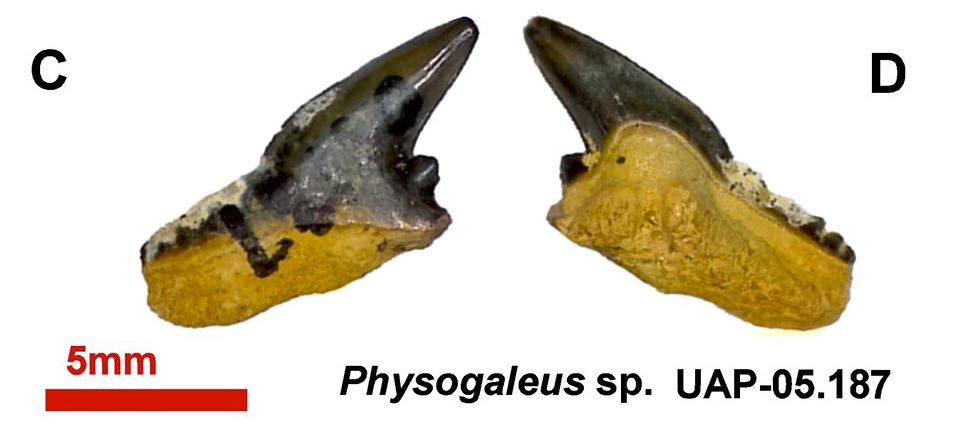
Two teeth are recorded from an unknown species of Physogaleus, a type of Requiem Shark, Carcharhinidae, known from Palaeocene-Miocene deposits in Africa, Europe, Central Asia, India, North and Central America. One of these appears to be a lower anterolateral tooth, the other has a more gereralised morphology.


Physogaleus sp., lower anterolateral tooth in labial (C) and lingual views (D). Samonds et al. (2019).

Samonds et al. describe a new species of Carcharhinus, the extant genus of Requiem Shark, Carcharhinidae, that includes Reef Sharks, Silky Sharks, and Bull Sharks, from twelve teeth found at Ampazony. This is named as Carcharhinus underwoodi in honour of Charlie Underwood of the Department of Earth and Planetary Sciences at Birkbeck College, University of London, for his work on fossil Sharks and Rays in general and Carcharhiniform Sharks in particular. This is the oldest described species in the genus, although there are some isolated teeth assigned to the genus but not a species from the Early Eocene of Jamaica that are thought to be slightly older. The crown of these teeth is roughly triangular with a slightly distally directed cusp. The labial crown surface is flat to slightly convex with no obvious basal ledge. There are serrae becoming more finely serrate towards the tip. The distal cutting edge of the cusp is slightly convex and lightly serrated. At the base of the cusp the edge curves abruptly through an angle of 50˚ to form a rounded notch. The distal base of the crown bears ten serrae becoming smaller towards the root/crown junction. On the lingual surface the root occupies the basal 45% of the tooth with a prominent protuberance divided by a distinct nutritive groove and a slit-like centrally placed foramen.

Carcharhinus underwoodi, upper anterior tooth in lingual (G) and labial views (H). Samonds et al. (2019).

Samonds et al. also a tooth from a second, undescribed, species of Carcharhinus. These differ from Carcharhinus underwoodi in having evenly spaced serrae on the mesial cutting edge and a pronounced distal notch. The labial aspect of the crown is slightly convex with a distally directed cusp and virtually no basal ledge. The cutting edge is continuous and serrated. The mesial cutting edge is convex with serrae increasing in size towards its midpoint where there are 3 serrae/mm and disappearing on the slightly upturned tip of the cusp. The distal cutting edge of the cusp is also convex and faintly serrated. At its base, there is a sharp angle where the distal crown slopes toward the tooth edge. The cutting edge of the shoulder bears seven serrae decreasing in size basally. The lingual root is low, with a small protuberance with a wide nutritive groove.

Carcharhinus sp., tooth in lingual (S) and labial views (T). Samonds et al. (2019).

The next species recorded is Rhizoprionodon ganntourensis, another species of Requiem Shark, Carcharhinidae. Members of the genus Rhizoprionodon are still alive today, and are known as Sharpnose Sharks or Milk Sharks. Rhizoprionodon ganntourensis is known from Middle Eocene deposits globally, and do not differ significantly from their Recent counterparts. They exhibit gynandric heterodonty, lower teeth of adult males having somewhat sigmoid apically curved crowns.

Rhizoprionodon ganntourensis, tooth in lingual (A) and labial views (B). Samonds et al. (2019).

Two teeth are recorded from an unknown species of Hammerhead Shark, Sphyrna sp., a genus that dates back to the Palaeocene. These teeth resemble Sphyrna teeth from the Eocene of Morocco, which also have not been assigned to a species. These teeth has a distally directed cusps, a complete cutting edge and distal heel. The shoulder is rounded and smooth. The root possesses a rectilinear basal margin and distinct nutrient groove.

Sphyrna sp., tooth in labial (E) and lingual views (F). Samonds et al. (2019).

A total of 632 individual teeth and tooth plates assigned to the Eagle Ray genus Myliobatis were collected, making them the most common vertebrate remains from the Ampazony locality, though due to the fragmentary nature of much of this material it is not assigned to species level. Eagle Rays are common in Eocene deposits, although the Malagasy material is unusual in showing a lack of diversity; typically Eocene deposits contain members of other genera such as Aetobatis, Rhinoptera, Leidybatis and Burnhamia, though none of the Ampazony material could be assigned to any of these genera.

Myliobatis sp., tooth in occlusal (G) basal (H), and lateral views (I), and in section (J). Samonds et al. (2019).

Four Stingray tail spines were also found; it is not possible to assign such spines to a specific genus based upon their morphology, so they are simply recorded as Myliobatiformes, though given the lack of diversity seen in the specimens, Samonds et al. suggest that they are likely to have come from Myliobatis sp..

Myliobatidae indet., tail spine. Samonds et al. (2019).

A single tooth of a Whiptail Stingray, Dasyatidae, was also found. This is 2.2 mm wide, and is too corroded to warrant a detailed description. There is a labial visor and a distinct medial lingual ridge flanked laterolingually by marginal hollows. The labial face is tabulate and lightly ornamented. Remains of a lingually displaced bilobed root are present.

Dasyatidae indet., tooth in lingual view. Samonds et al. (2019).

Finally 19 rostral spines of a Sawfish, Pristis sp., are recorded. Only one is well preserved, and is 22.8 mm in length, 8.8 mm in anteroposterior thickness and 5.3 mm in mediolateral dimensions. The spines are relatively long, with narrow anterior tip and pronounced groove on the posterior edge. Growth bands are visible in lateral and cross section. Spines of Pristis are known from the Palaeocene onwards, and are not really assignable to species level. Despite this, many authors refer Eocene specimens to Pristis lathami, though Samonds et al. refrain from this.

Pristis sp., rostral spine in lateral (O, P), and basal views (Q). Samonds et al. (2019).

The dating of the Ampazony sediments is somewhat uncertain, as there have been no biostratigraphically useful microfossils found to date, however, the macrofossil assemblage strongly suggests a middle-to-late Eocene origin. The Katsepy strata include nummulitic limestones (limestones made up of the tests of the giant Foraminiferan Nummulites), which also suggests a middle-to-late Eocene origin, though this is not conclusive. The Sharks and Rays of these deposits show clear affinities to those of African assemblages from the same interval, despite Madagascar’s isolation in the Southern Ocean in the Eocene.

See also...

https://sciencythoughts.blogspot.com/2019/06/mollisquama-mississippiensis-new.htmlhttps://sciencythoughts.blogspot.com/2019/06/american-tourist-killed-in-shark-attack.html
https://sciencythoughts.blogspot.com/2019/06/icelandic-fishermen-fired-for-cruelty.htmlhttps://sciencythoughts.blogspot.com/2019/06/teenager-injured-by-shark-in-north.html
https://blogger.googleusercontent.com/img/b/R29vZ2xl/AVvXsEiYveBMb9KTSl03W77GarWsL50VkfUNiJdjpEU1XrwH9SqVj01guu0rraiIFNa1Qo2wRT4_kxR-6XK_qsTUgA4O1zlfNKOUQ8UNUQMBxtZJLWhiYlnb2yP5zDNqCbm8oRZ9NdHWoJ8GUYA/s200/Sphyrna+mokarran+Pregnant+Great+Hammerhead+found+dead+on+Captiva+Island%252C+Florida..pnghttps://sciencythoughts.blogspot.com/2019/05/californian-man-killed-by-shark-off.html
Follow Sciency Thoughts on Facebook.

Sunday, 19 May 2019

Identifying Sharks and Rays from the waters around Sri Lanka using samples from local fish markets.

Sri Lanka is considered to be one of the world's biodiversity hotspots, with many rare and unique organisms found on the island and in the waters which surround it. However, whilst the island was surveyed extensively during the nineteenth and early twentieth centuries, it has been largely neglected by scientists and conservationists in recent years, particularly during the thirty year civil conflict which ended in 2009, a period during which the development of molecular techniques revolutionised our understanding of taxonomy. Sharks and Rays are a unique group of Marine Vertebrates which play an important role in community structures in all the world's oceans. Unfortunately in recent years almost all species of Sharks and Rays have undergone dramatic population declines in recent years, a decline driven principally by overfishing, though marine pollution and climate change have also played a part, something which makes surveying populations of these creatures a priority.

In a paper published in the journal Zootaxa on 12 April 2019, Daniel Fernando, Rosalind Brown, Akshay Tanna, and Ramajeyam Gobiraj of the Blue Resources Trust, Hannah Ralicki  and Elizabeth Jockusch of the Department of Ecology and Evolutionary Biology at the University of Connecticut, David Ebert of the Pacific Shark Research Center at Moss Landing Marine Laboratories, the Department of Ichthyology at the California Academy of Sciences, and the South African Institute for Aquatic Biodiversity, Kirsten Jensen of the Department of Ecology and Evolutionary Biology and the Biodiversity Institute at the University of Kansas, and Janine Caira, also of the Department of Ecology and Evolutionary Biology at the University of Connecticut, describe the results of a survey of the Sharks and Rays present in the waters around Sri Lanka, based upon examination of specimens from local Fish Markets at fifteen locations around the island.

Fernando et al. visited fifteen Fish Markets in four provinces of Sri Lanka; Puttalam, Baththalangunduwa Island, Palkanththura, and Pukulam in North Western Province, Vankalai, Gurunagar, Erinchamman Kovilady, Supparmadam, Kottadi, and Munai, in Northern Province, Mutur, Valaichchenai Fisheries Harbour, and Valaichchenai Landing Site in Eastern Province, and Peliyagoda, and Negombo in Western Province, during March 2018. Whole specimens were measured, sexed and photographed before being sampled for genetic analysis; genetic samples from frozen and smoked Shark meat were also included in the study, though any specimen from which genetic material could not be maintained, including whole specimens, was excluded from the study. A total of 34 Shark and Ray species were identified.

Map indicating collecting localities. North Western Province: Puttalam (1); Baththalangunduwa Island (2); Palkanththura (3); Pukulam Landing Site (4). Northern Province: Vankalai (5); Gurunagar Market (6), Jaffna; near Erinchamman Kovilady Market, Supparmadam Market, Kottadi Market, and Munai Market (7)–(10), Point Pedro. Eastern Province: Mutur Landing Site (11), Mutur; Valaichchenai Fisheries Harbour and Main Landing Site Valaichchenai (12), (13), Valaichchenai. Western Province: Peliyagoda Fish Market (14), Colombo; Negombo Fish Market (15), Negombo. Fernando et al. (2019).

The first species recorded is the Ocellated Eagle Ray, Aetobatus ocellatus, which was found at Palkanththura and Pukulam in North Western Province and Munai and Vankalai in Northern Province. These Rays were found to be close genetically to members of the same species from Malaysian Borneo. The species has not previously been recorded from Sri Lanka, though specimens of the Spotted Eagle Ray, Aetobatus narinari, previously collected from Sri Lanka almost certainly should be re-assigned to this species, as Aetobatus narinari is now considered to be restricted to the Atlantic.

Ocellated Eagle Ray, Aetobatus ocellatus, (A) imature male, and (B) mature female. Fernando et al. (2019).

Next a series of specimens of an unidentified species of Stingray, Brevitrygon sp., which was found at Palkanththura in North Western Province, Munai and Erinchamman Kovilady in Northern Province, and Mutur in Eastern Province. This is thought to be a new, previously undescribed species, though Fernando et al. refrain from describing it as such pending further research. They also note that previous records of the Scaly Whipray, Himantura imbricata, from Sri Lanka may in fact be this species.

 
Brevitrygon sp., maturing male. Fernando et al. (2019).

The next species described is the Fine-spotted Leopard Whipray, Himantura tutuli, which was found at Palkanththura, Pukulam, Baththalangunduwa Island, and Puttalam in North Western Province, and Munai and Kottadi in Northern Province. Fernando et al. note that this species was described from the coast of Tanzania, while the Reticulate Whipray, Himantura uarnak, has been described from Sri Lanka previously. However, the samples collected for this study, along with previously collected specimens from Sri Lanka and Borneo assigned to Himantura uarnak proved to be genetically closer to Himantura tutuli.

 Fine-spotted Leopard Whipray, Himantura tutuli, immature male specimen, detail of scapular denticles inset. Fernando et al. (2019).

Next Fernando et al. record a single, immature specimen of the Honeycomb Whipray, Himantura undulata, from Munai in Northern Province. They note that the species is not universally accepted, and are cautious about including it on their list without any adult specimens, though the specimen did closely resemble a juvenile specimen assigned to the same species from Borneo.

Honeycomb Whipray, Himantura undulata, immature male specimen, detail of scapular denticles inset. Fernando et al. (2019).

The next species recorded is the Arabic Whipray, Maculabatis arabica, of which a single specimen was found at Pukulam in the North Western Province. This specimen was another juvenile, and could not be identified by morphology alone, but was confidently assigned to the species by genetic analysis. This is the first time this species has been recorded in Sri Lanka.

 Arabic Whipray, Maculabatis arabica, immature female, detail of scapular denticles inset. Fernando et al. (2019).

Next Fernando et al. record four specimens of the Whitespotted Whipray, Maculabatis gerrardi, from Pukulam and Puttalam in North Western Province and Munai and Kotaddi in Northern Province. These specimens comprise two adults and two juveniles, all of which are morphologically and genetically consistent with members of the species found in Borneo.

Whitespotted Whipray, Maculabatis gerrardi, mature female, detail of scapular denticles inset. Fernando et al. (2019).

Next seven specimens of the Indian-Ocean Maskray, Neotrygon indica, are recorded from Pukulam in North Western Province, Kottadi, Erinchamman Kovilady, and Vankalai in Northern Province and Mutai in Eastern Province. These resemble the Blue-spotted Maskray, Neotrygon kuhlii, physically, but are gentically distinct. Fernando et al. assign these specimens to Neotrygon indica on the basis that that species was separated from Neotrygon kuhlii purely on genetic differences, and that it was described from the Gulf of Mannar, tha body of water which separates Sri Lanka from India, and which was the source for the Sri Lankan specimens, even though they did not have access to the genetic data used to define Neotrygon indica

Indian-Ocean Maskray, Neotrygon indica, mature male specimen. Fernando et al. (2019).

Next Fernando et al. record three specimens of the Broad Cowtail Stingray, Pastinachus ater, from Munai and Kottadi in Northern Province. These specimens conform closely to specimens of the same species from Indonesian Borneo. This species has not been recorded in Sri Lanka before, but specimens have previously been assigned to the Cowtail Stingray, Pastinachus sephen, a species which is not now thought to be found east of Pakistan.


Broad Cowtail Stingray, Pastinachus ater, mature male specimen. Fernando et al. (2019).

Five specimens of Jenkins' Stingray, Pateobatis jenkinsii, were found at markets in Puttalam in North Western Province, Munai in Northern Province, and Mutur and in Eastern Province. These specimens conform physically to the reference specimen used, which came from Vietnam, but were significantly different genetically. Since the species was originally designated from Orissa State in India, Fernando et al. provisionally assign the Sri Lankan specimens to the it, while raising queries about the Vietnamese specimen, which will merit further investigation.


Jenkins' Stingray, Pateobatis jenkinsii, mature female specimen. Fernando et al. (2019).

Next Fernando et al. report a partial specimen of the Mangrove Whipray, Urogymnus granulatus, from Puttalam in North Western Province. This specimen comprises only the left portion of the disk, though this conformed to the spot and denticle pattern expected for the species, and was genetically close to a reference specimen from Australia. A juvenile previously collected from Valaichchenai Fisheries Harbour in Eastern Province and provisionally assigned to the species was also included in the genetic study and found to belong to Urogymnus granulatus.

 Mangrove Whipray, Urogymnus granulatus, portion of disc of large specimen. Fernando et al. (2019).

Next Fernando et al. report five specimens that probably belong to the Longtail Butterfly Ray, Gymnura poecilura, from Palkanththura and Puttalam in North Western Province, Jaffna in Northern Province, and Mutur in Eastern Province. These specimens were found to be genetically close, but not identical, to a specimen from the Gulf of Oman, so two Indian specimens were added to the study; however, while the Sri Lankan specimens were found to be very similar to one of these, the other was quite distinct genetically. Fernando et al. .provisionally assign the Sri Lankan specimens to Gymnura poecilura while treating the anomalous Indian specimen as a potential member of a new species, but consider both to be in need of further investigation.

Longtail Butterfly Ray, Gymnura poecilura, (A) female, (C) immature male. Fernando et al. (2019).

A single specimen of the Javanese Cownose Ray, Rhinoptera javanica, was found at Erinchamman Kovilady in Northern Province. This conformed morphologically with specimens from Vietnam and was close - but not identical - to them genetically. Since the name Rhinoptera javanica is currently in use for Cownose Rays from Sri Lanka, Fernando et al. assign this specimen to that species, though they note that of the ten currently described species of Cownose Ray (Rhinoptera spp.), only seven were included in the study, leading to the possibility that the specimen could be closer to one of the three remaining species genetically.


Javanese Cownose Ray, Rhinoptera javanica, (E) immature male, (F) dorsal fin and base of tail (lateral view), (G) tooth plates of upper jaw, (H) tooth plates of lower jaw. Fernando et al. (2019).

Four specimens of the Stepnose Guitarfish, Acroteriobatus variegatus, were found Mutur in Eastern Province. These conform quite closely to both morphologically and genetically to a specimen of the same species from South Africa. This is the first time the species has been recorded from Sri Lanka, though since the species was first described from the Indian side of the Gulf of Mannar, its presence here is unsurprising and had been predicted. 

 
Stepnose Guitarfish, Acroteriobatus variegatus, immature male. Fernando et al. (2019). 

A frozen Guitarfish obtained from Peliyagoda Fish Market in Colombo in Western Province appears to be a specimen of the Bengal Guitarfish, Rhinobatos annandalei, morphologically, although no specimen was available for genetic comparison; since five other species of Guitarfish, Rhinobatos spp., found in the Indian Ocean were included in the study, and the specimen did not appear to belong to any of them, therefore Fernando et al assign this specimen to Rhinobatos annandalei.


Bengal Guitarfish, Rhinobatus annendalei, female. Fernando et al. (2019).

Two specimens of an unknown Electric Ray, Narcine sp., were found at Munai and Kottadi in Northern Province. These had large brown spots on their dorsal surface, something only previously observed in two Electric Rays, the Indonesian Numbfish, Narcine baliensis, and the Chinese Numbfish, Narcine lingula, but these specimens do not resemble either of those. Only three species of Narcine were available for genetic comparison, and the specimens clearly did not belong to any of them, so they are provisionally recorded as members of a new, as yet undescribed, species.

Unknown Electric Ray, Narcine sp., maturing male. Fernando et al. (2019).

Three species of an unknown Torpedo Ray, Torpedo sp., were found at Munai and Kottadi in Northern Province. These had a pale reticulated pattern similar to that seen in the Gulf Torpedo, Torpedo sinuspersici, but with smaller reticulations. These specimens were closer to Torpedo sinuspersici than to any other Torpedo species included in the study, but were sufficiently different that Fernando . consider it likely that these specimens also represent a new species.

Unknown Torpedo Ray, Torpedo sp., immature male. Fernando et al. (2019).

One specimen morphologically consistent with the Graceful Shark, Carcharhinus amblyrhynchoides, was found at Erinchamman Kovilady in Northern Province, though it was genetically different from a specimen from Malaysian Borneo. Since Carcharhinis amblyrhynchoides is usually considered to be present in the waters around Sri Lanka, and indeed throughout the Indian Ocean, the specimen is assigned to that species, though again it clearly needs further investigation.

Two specimens of the Blacktip Shark, Carcharhinus limbatus, were found at Mutai and Kottadi in Northern Province. These were both morphologically and genetically similar to a specimen from Australia also included in the study, though Fernando et al. note that populations of Blacktip Sharks from the Indian and Pacific oceans are known to be distinct from those in the Atlantic, and that the species is therefore in need of revision. A specimen of dried Shark meat from was also found to belong to this species by genetic analysis.

Blacktip Shark, Carcharhinus limbatus, female in lateral view. Fernando et al (2019).

Another specimen of dried Shark meat was found to be genetically similar to a specimen of the Grey Reef Shark, Carcharhinus amblyrhynchos, from Malaysian Borneo, while another could be assigned to the genus Carcharhinus, but not to a specific species.

A head thought to have come from a Sharptooth Lemon Shark, Negaprion acutidens, was found in two pieces in a cooler at Munai Market in Northern Province. This was found to be genetically identical to an Australian specimen of the same species. Fernando et al. not that a second species of this genus, the Lemon Shark, Negaprion brevirostris, has been reported from Sri Lanka in the past, but that this species is now considered to be restricted to the Atlantic, so these reports probably refer to Nagprion acutidens as well.

A specimen which could be assigned to the Milk Shark, Rhizoprionodon acutus, on the basis of morphological inspection, was found at Erinchamman Kovilady Market in Northern Province. However this 'species' is currently considered to be a species cluster made up of at least four, as yet undescribed, cryptic species (species identical morphologically, but which are reproductively isolated). The Sri Lankan specimen was found to be genetically similar to a specimen from Oman, rather than specimens from Senegal, Malaysian Borneo, and Australia.

Milk Shark, Rhizoprionodon acutus, mature female in lateral view. Fernando et al. (2019).

Three specimens of the Grey Sharpnose Shark, Rhizoprionodon oligolinx, were found at Supparmadam and Kottadi markets in Northern Province. These were found to be both morphologically and genetically very close to a specimen from Malaysian Borneo.

Grey Sharpnose Shark, Rhizoprionodon oligolinx, maturing male in lateral view. Fernando et al. (2019).

A frozen Shark from Negombo Market in Western Province was identified morphologically as a specimen of the Whitetip Reef Shark, Triaenodon obesus, and was confirmed to belong to this species by genetic comparison to a specimen from Indonesian Borneo.

Two immature Sharks found frozen at Valaichchenai Fisheries Harbour in Eastern Province were found to be genetically nearly identical to a specimen of the Tiger Shark, Galeocerdo cuvier, from the Gulf of California.

A specimen of the Snaggletooth Shark, Hemipristis elongata, was found at Mutur in Eastern Province. This specimen was found to be morphologically and genetically very similar to another specimen of the species from Indonesian Borneo.

Snaggletooth Shark, Hemipristis elongata, (A) immature male in lateral view, (B) pectoral fins of the same in ventral view, (C) head of same in ventral view, (D) upper teeth of same. Fernando et al. (2019).

Fernando were particularly interested in Sharks from Mutur in Eastern Province as a specimen of the Dwarf False Catshark, Planonasus parini, had previously been reported from the area, a species previously only reported from the waters around Socotra. Fortunately on the second day at the market one of the fishing crews returned with a small Shark caught as bycatch, which turned out to be a specimen of the Pygmy False Catshark, Planonasus indicus, only the second specimen of this species ever recorded, and listed in the formal description of that species by Ebert et al. (2018).

 Pygmy False Catshark, Planonasus indicus, mature female in lateral view. Fernando et al. (2019).

Fernando et al. report finding a specimen of a Winghead Shark, Eusphyra sp., at Palkanththura in  North Western Province. They note that there is only one currently recognised species in this genus, Eusphyra blochii, but that this specimen differed considerably genetically from a specimen of that species from Australia. They also observe that a second species of Wingtip Shark was described by Theodor Edvard Cantor in 1837 from the Bay of Bengal as Zygaena laticeps, which has later been thought to be a junior synonym of Eusphyra blochii (i.e. a second name given to an already described species, and therefore invalid). Fernando et al. suggest that this second species is in fact valid, but its assignation to a new genus is wrong, and therefore refer to their specimen as Eusphyra laticeps.


Winghead Shark, Eusphyra laticeps, mature male in lateral view. Fernando et al. (2019).

Fernando et al. report finding seven specimens of what appeared to be the Bigeye Houndshark, Iago omanensis, from Mutur in Eastern Province and Peliyagoda Fish Market in Western Province. These were quite morphologically different, and since the species is now thought to be another species cluster, it was thought possible they represented different species. However all were found to be very closely related to one-another genetically, as well as to a specimen from India. They therefore provisionally assign these specimens to Iago omanensis, although they note that this species is badly in need of revision.

Bigeye Houndshark, Iago omanensis, female in lateral view. Fernando et al. (2019).

Three specimens which appeared on examination to be Bramble Sharks, Echinorhinus brucus, from Mutur in Eastern Province, were found to be genetically distinct from that species, but genetically identical to a specimen from the Gulf of Oman, currently considered to be an undescribed species of Echinorhinus. Fernando et al. also observe that this undescribed species appears to be more closely related to the Prickly Shark, Echinorhinus cookei, even though this species is not easily confused with the Bramble Shark.

 Echinorhinus sp., female specimen in lateral view. Fernando et al. (2019).

Three Bluntnose Sixgill Sharks, Hexanchus griseus, were found at Mutur in Eastern Province. These proved to be more-or-less identical genetically to one another, and very close to a reference specimen from the Caribbean.

Bluntnose Sixgill Shark, Hexanchus griseus, immature male in lateral view. Fernando et al. (2019).

A single small specimen of the Longfin Mako Shark, Isurus paucus, was found at Valaichchenai Fisheries Harbour in Eastern Province. This was found to be morphologically and genetically nearly identical to a specimen from Taiwan.

A specimen of dried Shark meat obtained from commercial seafood supplier Arunalu was found to be genetically similar to a specimen of the Shortfin Mako Shark, Isurus oxyrinchus, from Vietnam.

Six specimens of an unknown Bamboo Shark, Chiloscyllium sp., were found at Munia, Kottadi, and Vankalai in Northern Province. These physically resembled the Carpet Shark, Chiloscyllium arabicum, but proved to be genetically different from it and the five other named and two unnamed species of Chiloscyllium used for comparison, being closest to a specimen of Hasselt's Bamboo Shark, Chiloscyllium hasselti, from Indonesian Borneo, but not close enough to this to be considered part of the same species. Fernando et al. note that Guido Dingerkus and Terry DeFino described a new species of Bamboo Shark physically identical to Chiloscyllium arabicum from India in 1983, as Chiloscyllium confusum, a name which is now considered to be a junior synonym of Chiloscyllium arabicum  and therefore invalid. They raise the possibility that the Sri Lankan specimens could belong to that species, but note that Dingerkus and DeFino differentiated Chiloscyllium confusum on the basis that it had unmarked brown juveniles, unlike any other species in the genus, whereas juveniles of the Sri Lankan species have distinctive brown bands and saddles, which would appear to rule out this hypothesis.


Bamboo Shark, Chiloscyllium sp., mature male in lateral view.

Six specimens of an unknown, short-snouted Gulper Shark, Centrophorus sp., were found at Mutur in Eastern Province. These did not conform morphologically or genetically to any species of Gulper Shark included in this study, though they did somewhat resemble the Dwarf Gulper Shark, Centrophorus atromarginatus, a species of which no genetic material is available. The Dwarf Gulper Shark is found from the Gulf of Aden to Japan (potentially including Sri Lanka, though the species has never been reported there), and is considered to be morphologically variable, so the differences between the Sri Lankan specimens and descriptions of this species could be natural variation, but including the specimens in a wide-ranging, morphologically variable species for which there is no genetic material would be problematic.

 
Gulper Shark, Centrophorus cf. atromarginatus, female in lateral view. Fernando et al. (2019). 
 
Fernando et al. also report finding a second species of Gulper Shark at Mutur, which appeared to be morphologically and genetically identical to specimens of the Southern Dogfish, Centrophorus zeehaani, from Portugal and Australia. However Centrophorus zeehaani has recently been reclassified as a junior synonym of the Little Gulper Shark, Centrophorus uyato, so this specimen should probably be referred to that species.
 
 Little Gulper Shark, Centrophorus uyato, female in lateral view. Fernando et al. (2019).

Two specimens of the Roughskin Dogfish, Centroscymnus owstonii, were found at Mutur in Eastern Province. These were morphologically consistent with a reference specimen from Portugal, with one specimen being genetically identical to that specimen and the other very close. This is the first time this species has been recorded in Sri Lanka, or the northern Indian Ocean.


Roughskin Dogfish, Centroscymnus owstonii, mature male in lateral view. Fernando et al. (2019).

Fernando et al. observe that the level of diversity found in the study was surprising, given the relatively short time spent gathering samples (typically one-to-two days at each site), with five apparently new species discovered and a number of others which had not previously been reported in Sri Lanka nearby; indeed the diversity revealed by this study far exceeds that found by similar studies carried out in southern India, an area that would be expected to have a similar marine fauna.

See also...


https://sciencythoughts.blogspot.com/2018/12/carcharhinus-melanopterus-leucism-in.htmlhttps://sciencythoughts.blogspot.com/2018/08/tourist-killed-by-shark-on-red-sea.html
https://sciencythoughts.blogspot.com/2018/05/teenager-bitten-by-shark-off-florida.htmlhttps://sciencythoughts.blogspot.com/2018/04/massive-ghost-net-seen-with-thousands.html
https://sciencythoughts.blogspot.com/2018/04/edinburgh-schoolboy-attacked-by-shark.htmlhttps://sciencythoughts.blogspot.com/2018/02/woman-bitten-by-shark-in-botany-bay-new.html
Follow Sciency Thoughts on Facebook.