
An archaeological site which recorded 46 000 years of continuous occupation in the western Pilbara region of Western Australia, and considered to be sacred by the local Puutu Kunti Kurrama and Pinikura peoples, was destroyed by blasting at the Brockman 4 Iron Ore Mine on Sunday 24 May 2020. The site, which was located on the west Hamersley Plateau, was destroyed legally by the mine's owners, Rio Tinto, who had gained permission under Section the 1972 Aboriginal Heritage Act in 2013. Since this permission was granted an excavation at the site led by Michael Slack of the Centre for Excellence for Australian Biodiversity and Herritage in 2014 had discovered that the site was considerably older than previously assumed, and that it had been continuously occupied through the Last Glacial Maximum, between 23 000 and 19 000, when most archaeological sites in the Australian interior were abandoned due to a drying climate. Attempts to have the site protected by since this excavation have been refused by Rio Tinto on the basis that a permission to blast given under the terms of the 1972 Aboriginal Heritage Act cannot be withdrawn once granted. The legislation is now considered to be obsolete by almost all political parties in Western Australia, due to the heavy prioritization given to the interests of the mining industry over those of Aboriginal Groups, and a draft version of an updated version of the bill was expected to be brought before the Western Australian Parliament this year, prior to being released for public comment. However, this process was delayed due to the current coronavirus pandemic.

The Juukan Gorge archaeological site in Western Australia in 2013. Puutu Kunti Kurrama and Pinikura Aboriginal Corporation.
Archaeological excavations at the Juukan Gorge had uncovered a number of highly significant and unique artefacts, including several grinding and pounding stones thought to be the oldest known from Australia, a sharpened bone tool dated to 28 000 years ago, again making it the oldest known bone tool from Australia, and a belt made from Human braded hair which has been dated to about 4000 years ago, and shown to contain hair from a number of individuals related to the modern Puutu Kunti Kurrama and Pinikura peoples, as well as a broad variety of stone tools. A full report on the excavation is due to be released by Michael Slack's team later this year.
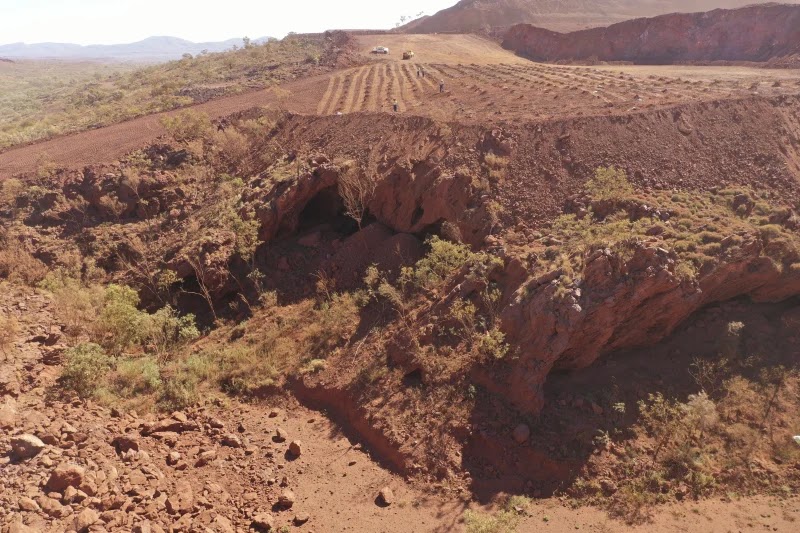
The Juukan Gorge archaeological site on 15 May 2020; the surrounding site has been cleared but this is prior to the blasting which eventually destroyed the site. Puutu Kunti Kurrama and Pinikura Aboriginal Corporation.
See also...





Follow Sciency Thoughts on Facebook.


