Showing posts with label Pilbara. Show all posts

Tuesday, 22 August 2023

Planigale kendricki & Planigale tealei: Two new species of Dasyurid Marsupial from the Pilbara Region of Western Australia.

Among Mammals, the most diverse groups tend to be those which feed on Insects. In Australia, about a quarter of all land Mammals belong to the Dasyuridae, which ate insectivorous and sometimes carnivorous Marsupials. The genus Planigale currently contains four species of Shrew-like insectivorous Marsupials, weighing between 3 and 17 g, which are found across most of the continent, with a fifth species on the island of New Guinea, although molecular studies have suggested that the genus probably contains more diversity than is reflected in this classification. Australia's indigenous Mammals have suffered greatly since the arrival of Europeans, with sharp declines in their numbers still being seen even in parts of the continent with few Human visitors, which makes having an accurate inventory of Australian Mammal species essential to conservation efforts.

The four currently described species of Planigale from Australia, Planigale gilesiPlanigale maculataPlanigale ingrami, and Planigale tenuirostris, are widely distributed in northern and eastern Australia. None of these species are considered to be threatened, but the two most widespread species, Planigale ingrami, and Planigale tenuirostris, have been shown to contain very high levels of genetic diversity, which may indicate that they are actually multiple species with much smaller ranges, and therefore potentially at conservation risk. 

The last major revision of the genus Planigale was carried out in 1976 by zoologist Michael Arche, but since that time genetic methods have become available, with several studies having suggested that there might be one or two undescribed species belonging to the genus present in the Pilbara Region of northerm Western Australia.

In a paper published in the journal Zootaxa on 14 August 2023, Linette Umbrello of the School of Biology and Environmental Science at the Queensland University of Technology, and Collections and Research at the Western Australian Museum, Norah Cooper, also of Collections and Research at the Western Australian Museum, Mark Adams of the Department of Biological Sciences at the University of Adelaide, and the Evolutionary Biology Unit at the South Australian Museum, Kenny Travouillon, again of Collections and Research at the Western Australian Museum, Andrew Baker, also of the School of Biology and Environmental Science at the Queensland University of Technology, and of the Biodiversity and Geosciences Program at Queensland Museum, Mike Westerman of the Department of Environment and Genetics at La Trobe University, and Ken Alpin, again of Collections and Research at the Western Australian Museum, and of the Australian Museum Research Institute at the Australian Museum, formally describe two new species of Planigale from the Pilbara Region.

The approximate distributions of the four currently recognised species of Australian Planigale with Pilbara distributions indicated with arrows. Umbrello et al. (2023).

The first new species described was originally identified as a candidate species in the first ever genetic study of the group, published 1995, in which a team led by Jodie Painter of La Trobe University used the mitochondrial cytichrome b gene to determine the relationships between different species within the genus Planigale. At the time. the candidate species, identified only as Planigale 1, was known from only a single specimen, which was one of only two specimens from Pilbara included in the study (the other specimen was also identified as a new species, Planigale 2, but was later found to belong to a separate genus), but subsequent genetic studies have consistently recovered this species as a separate clade.

Umbrello et al. formally name Planigale 1 as Planigale kendricki, in honour of Peter Kendrick, in recognition of his major contribution to the understanding of the vertebrate fauna of north-western Australia. Planigale kendricki is large for a species of Planigale, with a maximum recorded weight of 12.5 g and a maximum recorded length of 74 mm (excluding the tail). Females are smaller than the males, with a maximum recorded weight of 9.5 g and a maximum recorded length of 69 mm. It is more reddish than other species of the genus, with its back and flanks covered by a thick coat of orange-tan fur with patches of dark brown, while the hair of the underside is grey, changing to yellow or even brown at the tips.

Planigale kendricki. Note the rufous, orange-tan colouration of the fur and the orange eye ring.  Roy Teale in Umbrello et al. (2023).

Planigale kendricki is found across the Pilbara and the surrounding area of northern Western Australia, including the Cape range Peninsula, Ashburton and Gascoyne regions, with specimens reported from the Great Sandy Desert and Little Sandy Desert, Lake Auld, and Mandora near Eighty Mile Beach. It appears to favour areas with exposed bedrock, including sandy plains, scree slopes and rocky creek beds. 

Proposed distribution of Planigale kendricki inferred from specimens at the western Australian Museum (blue dots) that were examined during this study. the border of the Pilbara region is shown by the dashed line in inset A. Umbrello et al. (2023).

The second new species was first identified as a candidate species in a study led by Mark Blacket of La Trobe University and published in 2000, in which a much larger selection of Planigale specimens were examined, and a phylogeny for the genus developed using the 12S rrNA gene sequence. Blacket et al. identified this candidate species as Planigale Mt Tom Price, in reference to the area where it was discovered. This species was also recovered by subsequent genetic studies in 2009, 2016, and 2020, which looked at different gene sets.

Umbrello et al. formally name Planigale Mt Tom Price as Planigale tealei, in honour of Roy Teale, for his support for the work of the Western Australian Museum over many decades, and for collecting many of the specimens on which the description of the species is based. Planigale tealei is small for a species of Planigale, with a maximum male size of 6.1 g and 62.5 mm in length (excluding the tail), and a maximum female size of 4.7 g and 60 mm in length. Its back and sides are covered with a thick, greyish brown coat, paler on the flanks, and pale on the underside.

Planigale tealei (WAM M62896). Linette Umbrello in Umbrello et al. (2023).

Planigale tealei appears to be largely restricted to the Pilbara Region, with very few records outside of the area. It us usually encountered on cracked clay soils in areas with plenty of exposed rocky outcrops, preferring more clay-rich soils.

Proposed  distribution  of Planigale  tealei  inferred  from  specimens  (pink  triangles)  in  the western  Australian Museum that were examined during this study, including southern locality of Waldburg Station. the border of the Pilbara is shown by a dotted line in Inset A. Umbrello et al. (2023).

See also...

Follow Sciency Thoughts on Facebook.

Follow Sciency Thoughts on Twitter.


Tuesday, 26 May 2020

Juukan Gorge archaeological site in Western Australia destroyed by mine expansion.

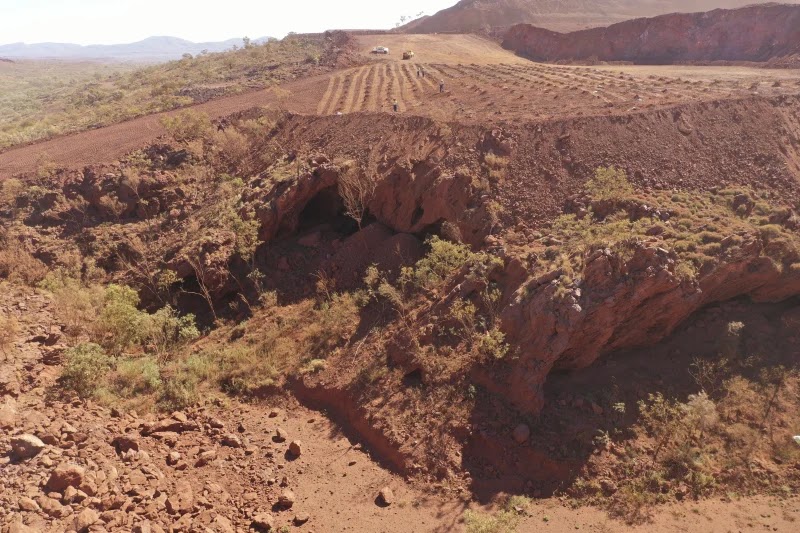
An archaeological site which recorded 46 000 years of continuous occupation in the western Pilbara region of Western Australia, and considered to be sacred by the local Puutu Kunti Kurrama and Pinikura peoples, was destroyed by blasting at the Brockman 4 Iron Ore Mine on Sunday 24 May 2020. The site, which was located on the west Hamersley Plateau, was destroyed legally by the mine's owners, Rio Tinto, who had gained permission under Section the 1972 Aboriginal Heritage Act in 2013. Since this permission was granted an excavation at the site led by Michael Slack of the Centre for Excellence for Australian Biodiversity and Herritage in 2014 had discovered that the site was considerably older than previously assumed, and that it had been continuously occupied through the Last Glacial Maximum, between 23 000 and 19 000, when most archaeological sites in the Australian interior were abandoned due to a drying climate. Attempts to have the site protected by since this excavation have been refused by Rio Tinto on the basis that a permission to blast given under the terms of the 1972 Aboriginal Heritage Act cannot be withdrawn once granted. The legislation is now considered to be obsolete by almost all political parties in Western Australia, due to the heavy prioritization given to the interests of the mining industry over those of Aboriginal Groups, and a draft version of an updated version of the bill was expected to be brought before the Western Australian Parliament this year, prior to being released for public comment. However, this process was delayed due to the current coronavirus pandemic.

The Juukan Gorge archaeological site in Western Australia in 2013. Puutu Kunti Kurrama and Pinikura Aboriginal Corporation.

Archaeological excavations at the Juukan Gorge had uncovered a number of highly significant and unique artefacts, including several grinding and pounding stones thought to be the oldest known from Australia, a sharpened bone tool dated to 28 000 years ago, again making it the oldest known bone tool from Australia, and a belt made from Human braded hair which has been dated to about 4000 years ago, and shown to contain hair from a number of individuals related to the modern Puutu Kunti Kurrama and Pinikura peoples, as well as a broad variety of stone tools. A full report on the excavation is due to be released by Michael Slack's team later this year.

The Juukan Gorge archaeological site on 15 May 2020; the surrounding site has been cleared but this is prior to the blasting which eventually destroyed the site. Puutu Kunti Kurrama and Pinikura Aboriginal Corporation.

See also...

https://sciencythoughts.blogspot.com/2018/08/deciphering-imput-of-neanderthal-and.htmlhttps://sciencythoughts.blogspot.com/2017/11/reassessing-aitape-skull_22.html
https://sciencythoughts.blogspot.com/2016/03/identifying-archaic-human-dna-in-gene.htmlhttp://sciencythoughts.blogspot.com/2013/08/mining-company-fined-for-desecrating.html
https://sciencythoughts.blogspot.com/2012/05/what-killed-australian-thylacine.htmlhttp://sciencythoughts.blogspot.com/2011/11/fishermen-targeting-tuna-in-east-t.html
Follow Sciency Thoughts on Facebook.

Monday, 16 April 2018

Western Australian teenager released from hospital two weeks after being stung by Irukandji Jellyfish.

A teenage girl from Western Australia has been released from hospital two weeks after being stung by an Irukandji Jellyfish, Carukia barnesi. Hannah Mitchell, 14, was swimming with a friend off Goodwyn Island in the Dampier Archipelago off the Pilbara Coast on Sumday 1 April 2018, when she was stung on the arm by the Jellyfish. She did not immediately realise the seriousness of the sting, as there were a number of biting Sea Lice (biting Copepods in the Family Caligidae) in the area, however she soon began to suffer stomach cramps and within 40 minutes was suffering convulsions and vomiting blood. She was rushed to a hospital in Karratha by her family, from where she was airlifted to Perth and placed in an induced coma for two days.

Hannah Mitchell receiving treatment for the sting of a Irukandji Jellyfish in a Perth hospital. Casey Mitchell/ABC News.

The Irukandji Jellyfish is a form of Box Jellyfish, Cubozoa, found along the northern coast of Australia, which has both a particularly potent sting and a very small size, making it particularly dangerous to swimmers. The Jellyfish are typically about 5 mm across, though they can reach as much as 30 mm, with tentacles between 5 and 50 mm in length. The sting of these Jellyfish is particularly potent, and can cause muscle aches, back pain, nausea, headaches, chest and abdominal pains, sweating, high blood pressure, difficulty breathing, and in extreme cases death.

An Irukandji Jellyfish, Carukia barnesi. University of California Museum of Paleontology.

See also...

http://sciencythoughts.blogspot.co.uk/2018/03/warning-issued-to-tourists-after-box.htmlhttp://sciencythoughts.blogspot.co.uk/2016/07/jellyfish-damage-to-farmed-salmon-on.html
http://sciencythoughts.blogspot.co.uk/2014/11/scavengers-on-jellyfish-carcasses-on.htmlhttp://sciencythoughts.blogspot.co.uk/2014/06/a-new-species-of-jellyfish-from-north.html
http://sciencythoughts.blogspot.co.uk/2013/10/jellyfish-force-closure-of-swedish.htmlhttp://sciencythoughts.blogspot.co.uk/2013/06/the-mysterious-ebb-and-flow-of.html
Follow Sciency Thoughts on Facebook.

Monday, 30 December 2013

Worker killed at mine in Pilbara Region, Western Australia.

A worker has been killed and a second injured in an incident at the Fortescue Metals Group's Christmas Creek Mine in the Pilbara Region of Western Australia. The incident happened in the mine's heavy vehicle workshop during maintenance work on a surface mining vehicle. Details of the incident have not yet been released, though it is understood the dead worker was a 23 year old contractor and the second is being treated for leg injuries.

The Christmas Creek Mine. Fortescue Metals Group.

The Christmas Creek Mine is an open pit mine located about 60 km South West of Nullagine and 1200 km northeast of Perth. As well as producing iron ore it also produces silica, aluminium and phosphorous minerals. The ore is processed on site then shipped by rail to Herb Elliott Port.

This is the second fatality at the Christmas Creek Mine this year, after a 26-year-old contractor from New Zealand was killed at the site on 14 August. The Department of Mines and Petroleum has ordered Fortescue Metals to tighten its safety procedures following this latest incident, and in particular to improve the supervision of outside contractors working at the site.


Follow Sciency Thoughts on Facebook.
 

Friday, 16 August 2013

Worker killed at Western Australia ore mine.

A worker was killed at the Christmas Creek Iron Ore Mine in the Pilbara Region of Western Australia, in an incident on Wednesday 14 August 2013. The man has been named as Kurt Williams, a 26-year-old electrician from Aukland, New Zealand, a contractor working for Crushing Services International at the mine, which is operated by the Fortescue Metals Group. The precise details of the incident are not yet clear, but it is reported that Williams was carrying out maintenance work on crushing machinery at night when he was killed. Operations at the mine have been suspended pending an enquiry into the incident, which is the first fatal accident at a mine in Western Australia in nearly two years, which will be carried out by the Department of Mines and Petroleum in Perth.

Areal photograph of the Christmas Creek Mine. Fortescue Metals Group.

The Christmas Creek Mine is an open pit mine located about 60 km South West of Nullagine and 1200 km northeast of Perth. As well as producing iron ore it also produces silica, aluminium and phosphorous minerals. The ore is processed on site then shipped by rail to Herb Elliott Port.

The Electrical Trades Union had previously raised concerns about practices employed by Crushing Services at mines in Western Australian, particularly the carrying out of maintenance work on live machinery at night by lone workers.

Kurt Williams with his girlfriend Peta Demeza. New Zealand Herald.

Tuesday, 18 September 2012

A new species of Scorpion from Western Australia.

Scorpions are distinctive predatory Arachnids, with an instantly recognizable bodyform. They have eight walking legs plus a pair of grasping claws and a long, flexible tail ending in a venomous stinger; some species are capable of killing a human being with their sting. They are found on every continent, though many islands, including the British Isles and New Zealand, do not have natural populations of Scorpions (though introduced Scorpions, escaped from the pet trade, are becoming more common in these places). The fossil record of Scorpions dates back to the Silurian, 430 million years ago.

In a paper published in the American Museum Novitates on 25 June 2012, Erich Volschenk of Phoenix Environmental Sciences and the Department of Terrestrial Zoology at the Western Australian Museum and the School of Animal Biology at the University of Western Australia, Mark Harvey, also of the Department of Terrestrial Zoology at the Western Australian Museum and the School of Animal Biology at the University of Western Australia and Lorenzo Prendini of the Division of Invertebrate Zoology at the American Museum of Natural History, describe a new species of Scorpion from Barrow Island and the Pilbara bioregion of Western Australia.

The new scorpion is named Urodacus butleri, in honour of the Australian naturalist and broadcaster William Henry, “Harry,” Butler. It is a 7.75-9.30 mm Scorpion, extremely dark in colour, with a smooth carapace. It was found at a number of sites on Barrow Island and the neighboring Pilbara Region of Western Australia. All the specimens were captured on sandy substrates using UV lamps (Scorpions fluoresce under UV light); the animals appear to be adapted for excavating burrows in the sand.

Urodacus butleri, male (top) and female (bottom). Scale bar is 10 mm. Volschenk et al. (2012).

Map showing locations where Urodacus butleri was found. Volschenk et al. (2012).


Follow Sciency Thoughts on Facebook.