Showing posts with label Titan. Show all posts

Wednesday, 10 January 2024

The floating snows of Titan.

The thick methane and nitrogen atmosphere of Saturn's moon Titan allows a wide range of photochemical reactions (light-induced chemical reactions) to occur in its reaches, leading to the creation of a wide range of organic molecules, with 17 of these identified instrumentally to date. These molecules eventually form complex refractory organic particles, which make the atmospheric hazes of Titan. Since such molecules are heavier than methane and nitrogen, they will eventually sink down through the atmosphere, undergoing a severe drop in temperature as they do so, which will cause them to condense into liquids or ices, forming stratospheric clounds, and eventually falling to the surface. 

NASA's Dragonfly Mission is intended to reach Titan in 2034, and to explore the surface of the moon, particularly the largely dry equatorial region (Titan is the only body in the Solar System other than the Earth on which river and lake systems have been observed, although these are comprised of a mixture of ethane, methane, and nitrogen, rather than water). It is therefore vital for scientists designing instruments for the mission to have some idea about the materials likely to be found on the surface of Titan, and what phases (i.e. liquid or solid) they are likely to be in.

The Cassini Mission revealed two puzzles about the surface of Titan. Firstly, the surface of the moon's lakes are remarkably smooth, with waves rarely reaching more than a few millimetres in height. Secondly, transient 'floating islands' of bright material have been observed on two of the largest lakes, Ligeia Mare and Kraken Mare. The lack of significant waves could be a result of a lack of winds in the polar regions of Titan, of might be caused by a layer of floating sediment.

In a paper published in the journal Geophysical Research Letters on 4 January 2024, Xinting Yu of the Department of Physics and Astronomy at the University of Texas at San Antonio, Yue Yu of the Department of Earth and Planetary Sciences at the University of California Santa Cruz, and the Department of Astronomy at the University of Geneva, Julia Garver of the Department of Physics at the University of California Santa Cruz, Xi Zhang, also of the Department of Earth and Planetary Sciences at the University of California Santa Cruz, and Patricia McGuiggan of the Department of Materials Science and Engineering at Johns Hopkins University, explore how the snows of Titan are likely to behave when falling onto the surface of the moon's lakes.

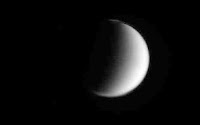
The moon Titan, with it's surface largely obscured by a petrochemical haze. NASA.

Seventeen hydrocarbon and nitrile species have been identified in the atmosphere of Titan; methane, ethane, ethylene, acetylene, propane, propene, allene, propyne, diacetylene, benzene, hydrogen cyanide, cyanoacetylene, acetonitrile, propionitrile, acrylonitrile, cyanogen, and dicyanoacetylene. Of these, acetylene, diacetylene, allene, propyne, benzene, hydrogen cyanide, cyanoacetylene, acetonitrile, propionitrile, acrylonitrile, cyanogen, and dicyanoacetylene, are likely to fall as solid snows, while propane, propene, methane and ethane fall as liquid rains. Only ethylene is likely to remain a gas under all conditions present on Titan. 

The liquid in the lakes of Titan is thought to be mostly comprised of three substances, methane, ethane, and nitrogen, all of which are non-polar. Propane, propene, ethane and ethane falling as liquid rain would be readily absorbed into bodies of liquid with such a composition. The substances falling as solid snow would have a more limited solubility in the lakes, which would lead over time to the lakes becoming saturated in such substances. Once this happens, any new snow falling onto the lake would remain in a solid state, either floating on the surface or sinking and forming a lake-bed sediment.

All of the potential ices have a higher density that a methane-ethane-nitrogen mixture, and would therefore tend to sink. However, the density of ices can be lowered by the presence of pore-spaces. All ices will contain some pore spaces, but not necessarily enough to lower the density sufficiently to float in any given liquid.

The most abundant liquid in the lakes of Titan is thought to be methane, which is also the liquid with the lowest density. For any ice to be able to float on the lakes of Titan, it must therefore float on liquid methane. The most likely ices to be able to do this are acetylene, allene, and propyne, potentially floating with pore spaces making up 25%-35% of the total volume. The needed pore space would rise to more that 50% for substances such as cyanogen.

Data on the porosity of crystalline ices suggests that a porosity of about 35% is the maximum for most substances. Amorphous ices can achieve porosities of 40%-50%, but the temperature on Titan is to warm for any of the substances being examined to form amorphous ices. However, the data on the porosity of organic crystalline ices has mostly been collected by freezing gases onto a cold substrate in a vacuum chamber, which is likely to result in a different porosity than that achieved by snow formation in an atmosphere. The porosity of snow on Earth is typically 40-50%, but can rise as high as 90%, so if snow on Titan has similar porosity, it is possible that a wide range of substances could float.

Particles may also float on top of liquids due to capillary forces, even if they are denser than the liquids. On Titan, particles with volumes of 0.1 μm-10 μm are quite likely to be supported on lake surfaces by capillary forces, though for larger particles, the angle of contact between the particle and the liquid surface becomes important, and the necessary angle would depend on the nature of the liquid. For lakes dominated by liquid methane and nitrogen, this would make little difference, and particles larger than 10 μm are likely to become wetted rapidly, but on any body of water dominated by ethane, acetylene and hydrogen cyanide ices might float. The proportion of ethane needed for acetylene ices to float is probably too high for this to be an issue on Titan, but hydrogen cyanide could in theory float on a lake with 30% ethane, which is not thought impossible.

At 86 K (the minimum likely surface temperature on Titan, the bulk liquids of the lakes should be well mixed. However, it is likely that the surface layers of these bodies contains a higher proportion of liquids with lower surface tensions, in which case capillary force-induced floating is highly unlikely.

Radar images of the surface of Titan have suggested that the surface of the lakes are very smooth, with bright (i.e. more reflective to radar) transient surface features. It is possible that the lakes are generally lacking in waves, and that rare waves show up as more reflective surfaces. It is also possible that the lakes are covered by a thin layer of particulate matter, suppressing wave formation, and that transient large clumps of matter form reflective surfaces.

Observations suggest that the transient reflective surface features last for between a couple of hours and several weeks. This is more consistent with these features than a wave-origin. If these objects were masses of porous snow, then it would be reasonable to expect the underlying liquid to seep in over time, filling the pore spaces and causing them to sink. Therefore, for patches of floating snow to persist for any length of time, it will be necessary for new material to be replenishing the snow at a rate at least equal to that at which it is sinking, since it is unlikely that the particles contain sufficient closed pore spaces to prevent liquids entering. Evidence suggests that the lake beds of Titan are comprised of insoluble hydrocarbons and nitriles, which fits with the idea of snows which eventually sink.

Particles larger than 10 μm but smaller than 1 mm are likely to sink rapidly on Titan, but particles of a few mm in size, with a high proportion of pore space could survive much longer, potentially for more than an Earth day. Such particles could form the observed floating islands on the lakes of the moon. 

If floatation on the lakes is achieved through capillary forces, then particles would remain on the surface for much longer, potentially never sinking, however, given the available data, this seems highly unlikely to be the case.

Yu et al. note that all of these calculations are based upon the idea that the lakes of Titan are relatively calm, and that the presence of any strong currents would alter the situation significantly, although the observed calm surfaces of the lakes means that this also is unlikely.

See also...


Follow Sciency Thoughts on Facebook.

Follow Sciency Thoughts on Twitter.


Thursday, 17 December 2020

Working towards a fuller understanding of icy satellite seafloors, interiors, and habitability.

The icy satellites of the Solar System’s giant planets are key astrobiological targets. Featuring known or suspected subsurface oceans, likely situated atop rocky interiors, these moons may therefore harbour chemoautotrophic habitable environments at their seafloors, where liquid water, biochemically vital elements (such as carbon, hydrogen, oxygeb, sulphur, nitrogen, and phosphorus), and energy sources may be present together. Indeed, the detection of silicate grains in Enceladus’ plumes provides strong evidence for rock–water interactions within that diminutive moon, and invoking a wet, porous, permeable, and unconsolidated rocky interior accounts for the sustained presence of a subsurface ocean there. Given that life on Earth may have originated at sites of serpentinization where seawater and basalt interacted, it stands to reason that we look to these ocean worlds to better understand how life might arise generally.

In a white paper published on the arXiv database at Cornell University on 19 June 2020, Paul Byrne of North Carolina State University, Andrew Dombard of the University of Illinois at Chicago, Catherine Elder of the Jet Propulsion Laboratory at Caltech, Steven Hauck of Case Western Reserve University, Mohit Melwani Daswani, also of the Jet Propulsion Laboratory, Paul Regensburger of the University of Oregon, and Steven Vance, again of the Jet Propulsion Laboratory, lay out potential future research into the Solar System's icy satellites, and their seafloors, interiors, and habitability.

This focus on icy satellite astrobiology underpins a major part of NASA’s spacecraft exploration strategy. For example, the upcoming Europa Clipper mission will characterize the potential habitability of that satellite by measuring physical and chemical properties of the ice shell and subsurface ocean. The Discovery-class Trident mission concept would, if selected, verify the existence of an extant liquid water ocean beneath Triton’s icy surface. And the Outer Planets Assessment Group report Scientific Goals for Exploration of the Outer Solar System notes 'Determining the presence and natures of sub-surface oceans, especially whether liquid water is in direct contact with rock interiors as is suspected at Enceladus and Europa, is crucial to understanding the evolution and potential habitability of these bodies and how materials are processed within them'.

Alas, these deep interiors are not directly accessible, and so considerable inferences must be made about conditions there. The rocky seafloors within these satellites range from tens (e.g. Enceladus) to several hundreds (e.g. Ganymede) of kilometres below their icy surfaces; far below the deepest oceans on Earth. Further, beneath those cold carapaces are unique rocky worlds in their own right, perhaps considerably different to those of the inner Solar System with which we are much more familiar. Yet these deep rocky layers are responsible, at a minimum, for a source of heat to the base of these oceans from radiogenic decay and/or tidal dissipation. Characterising the properties of and processes operating within these deep interiors, including their composition, rheology, and melting behavior, as well as the propensity for, and styles of, mantle convection, magmatism, and tectonics, is essential for understanding the evolution of these bodies and their potential physical and chemical interactions with the oceans that lie above them. The inaccessibility of these deep interiors and the sparse geophysical data available for them severely limits our grasp of ocean world habitability.

 
The interior structures of select icy satellites, to scale. Clockwise from top left: Ganymede, Titan, Enceladus, and Europa. The state of Europa's core (molten or solid) is uncertain; the interior structure of water and ice layers within Ganymede is representative only. Note that the Titan atmosphere is shown for completeness, but without its own interior structures (e.g. haze layers). Byrne et al. (2020).

One approach has been to anticipate that geophysical processes at the seafloors of these worlds are similar in nature to those that support chemoautotrophic environments on Earth. Although not an explicit assumption, perhaps, illustrations of these rock–water interfaces in NASA press releases for instance often feature hydrothermal vent systems at mid-ocean ridges on Earth. But on Earth, these systems are augmented by the presence of fractures and the ultimate engine of such activity is plate tectonics.

 
Artist's impressions of the interiors of Europa (left) and Enceladus (right). Hydrothermal vents feature on both the Europan and Enceladan seafloors (labled 'white smokers' for the latter). Although there appears to be some form of hydrothermal circulation at the Enceladan seafloor, the style of such behaviour is unknown, and there is as yet no evidence for hydrothermal vents within Europa. Byrne et al. (2020).

To illustrate this point, a 100 km-deep ocean (or mix of ice and liquid water layers) within an icy world for which the surface gravitational acceleration is roughly 1–2 meters per second, conditions eminently applicable to Europa, Titan, and Ganymede, results in pressures of order 100 megapascals at the seafloor. When compared with typical rock failure strengths (about 10 megapascals), it naturally follows that fracturing will be inhibited. The reality is probably more complicated, with any pores at the seafloor likely water filled and thus the rock there at hydrostatic pressure and so relatively weak. Even so, within a few hundred meters below the seafloor, as conditions tend towards lithostatic pressure, the stresses needed to drive frictional sliding may quickly exceed any available driving mechanism.

Even our current estimates of ocean compositions rely on the assumed but unknown composition of the rocky interior (typically based on approximately 4.5 billion-year-old meteorites) and efficient water–rock interaction that has thermodynamically equilibrated the water layer with the underlying rock. However, as Byrne et al. discuss, water–rock interaction may be severely limited in these environments, precluding the nutrient and redox cycling necessary to maintain metabolic processes in a light-starved ocean. As a result, commonly held expectations based on direct analogy to the bottom of Earth's oceans for the physical and chemical processes within these larger icy worlds are, at best, equivical.

It is possible, however, that even with high pressure limiting the fracturing and frictional sliding of rock, other geological processes may be at work within icy satellites. Magma ascent is typically thought of as taking place through fracture networks acting as conduits through otherwise intact and impermeable rock. But the migration of magma at depth from the zone of partial melting (say, at the top of a mantle plume) to the base of the brittle lithosphere is in fact accommodated by corrosive etching through the upper mantle. High lithostatic pressures clearly do not preclude such processes on Earth, and so perhaps silicate melt within the rocky interiors of ocean worlds could corrode all the way to the rock–water interface, erupting at the seafloor.

Yet predicting whether melting of these rocky interiors even took place in the first place requires a leap in our understanding of where heat is actually generated in icy satellites, which is intimately tied to the interior’s rheological properties. The rheological properties, in turn, directly control how and where tidal energy is dissipated in Europa and Enceladus, and possibly also Ganymede and Titan. Establishing if seafloor volcanism has operated on ocean world seafloors bears implications for the geological and geophysical condition there (e.g. in terms of topography), as well as for mineral and nutrient exchange between the interior and the ocean.

Those dark, cold seafloors might also still show evidence of impact bombardment, especially if the water/ice overburden is sufficiently thin. The transient crater of an Orientale-basin scale impact (i.e., forming an approximately 900 km-diameter impact feature) temporarily excavates to depths of hundreds of kilometres, enough to reach through Europa’s ocean and resulting in a cratered landscape at least at large scales. Yet even smaller impactors, likely to have punctured Europan ice shell at intervals of tens to hundreds of millions of years, could have deposited material onto the seafloor. The presence of such impact-generated topography, in turn, suggests that mechanical weathering, aided by water–rock interactions and even by mass wasting (e.g., submarine landslides), may shape these ocean floors.

Taken together, the silicate cores of icy worlds may not be geologically dead, but any activity there could be very episodic, with short-lived volcanic, tectonic, or mass-wasting phenomena separated by extended periods of quiescence. Such a scenario of punctuated geological activity has major implications for the supply of nutrients to icy satellite seafloors, and the prospect for these environments remaining habitable over extended periods of time (i.e., tens to hundreds of millions of years). It is clear, therefore, that more careful consideration of possible processes at work on icy satellite seafloors is clearly needed, and that at present we have an incomplete basis for evaluating the habitability of these worlds.

It is critical that the planetary science community explicitly considers the rocky interiors and rock–water interfaces in current and future studies of ocean worlds. To do so successfully requires true interdisciplinarity, whereby scientists with backgrounds encompassing expertise in fracture mechanics, marine geophysics, volcanism, geochemistry and ocean chemistry, and biology (among others) are brought together. Byrne et al. thus encourage the planetary science community to take a holistic view of these worlds by closely integrating multiple disciplines, especially by encluding workers from the Earth marine geoscience community.

To do so, expanded NASA support for interdisciplinary meetings and funding opportunities, such as, for instance, the Habitable Worlds and Exoplanet Research programs, will allow for increased interactions between scientists who might not otherwise have the opportunity or ability to collaborate. Such programs are suitable vehicles for supporting analytical, numerical, and laboratory investigations of key outstanding science questions for ocean world interiors, including but not limited to: The prospect for, and type(s) of, geological activity within and at the surface of the rocky portions of icy satellites, and whether that activity has any counterpart on Earth or elsewhere in the Solar System; the nature and rates of chemical reactions at silicate-high-pressure ice boundaries, such as at the seafloorof Titan and possibly Ganymede; and the duration of any redox reactions at icy satellite seafloors, and thus whether chemoautotrophic environments in these settings are sustainable over geological timespans.

Similarly, interdisciplinary conference sessions and thematic workshops will further help foster existing and new collaborations between nominally disparate fields within the geosciences, especially if held as part of larger meetings such as the annual American Geophysical Union Fall Meeting or the European Geosciences Union General Assembly, Nasa-suported efforts that focus at least in part on the rock-water environment would be a major step towards a fuller understanding of the habitability of ocean worlds.

Another crucial component of advancing our understanding of the habitability of ocean worlds is to consider their deep interiors as the rocky planetary bodies they are. Indeed, Ganymede’s silicate interior and Titan’s rock-rich layers are both as large the Moon, an impact-bombarded body that experienced considerable volcanic and tectonic activity during its first billion years or so. Understanding both the geological histories of the surfaces of these rocky bodies (e.g., volcanism, tectonics, impact cratering, mass wasting, weathering by tidal currents, etc.) and the thermochemical evolution of their interiors is essential. Byrne et al. therefore advocate for the Decadal Survey to emphasise fundamental research into the operations of planetary interiors with the conditions and properties of the deep interiors of ocean worlds, building on, but expanding beyond, the better-understood parameter space of the inner Solar System worlds.

Additionally, planned and future spacecraft missions, even if focused primarily on the surfaces of icy satellites, should treat the rock–water/high-pressure ice interface as a fundamental science objective. For instance, although Europa Clipper will mainly assess the habitability of Europa via detailed examination of its ice shell to understand how chemical reactants at the surface might mix into the interior, measurements of anomalous accelerations of the spacecraft could reveal local gravity anomalies at the rock–water interface, the magnitude of which may offer insight into the heat flow from the silicate core. The finding of locally elevated heat flows, or even evidence for topography, on the Europan seafloor would dramatically enhance our view of that environment and its geological properties. Geophysical measurements conducted on the surface of the Enceladan ice shell would similarly return critical insights into the interior structure of that moon. Expanding the goals of surface-focussed missions to an icy satellite(s) to include the ocean floor would readily lead to a fuller assessment of ocean world habitability than is possible with observations of the icy shell alone.

Finally, and as Byrne et al. discuss, fully characterising icy satellite habitability requires drawing on perspectives spanning the gamut of planetary science, geoscience, and beyond. Studies of scientific teams have repeatedly demonstrated the importance of an integrated approach, whereby team members with diverse expertise develop synergies between their specialties and resources that result in an end product greater than the sum of its parts. Sociological studies demonstrate that groups fostering strong connections across discipline boundaries are more innovative, leading to higher-impact outcomes that endure. Byrne et al. strongly encourage the Decadal Survey to consider the state of the profession, and the issues of equity, diversity, inclusion and accessibility, not as seperable issues, but as critical steps on the pathway to understanding ocean worlds specifically and the entire Solar System more generally. 

See also...


Follow Sciency Thoughts on Facebook.

Follow Sciency Thoughts on Twitter.


Friday, 12 August 2016

Liquid-filled canyons detected on Titan.

Saturn's moon Titan is known to have three small seas in its North Polar Region, Kraken, Ligeia, and Punga Mare, in which the Cassini Space Probe has been able to confirm the presence of liquid hydrocarbons by using synthetic aperture radar which produced a reflection from both the surface and floor of the ocean. Much of the surface of Titan is also known to be covered by an extensive network of channels and canyons that resemble similar structures carved by water on Earth, though the Cassini Probe has been unable to detect any liquid in these narrower structures using synthetic aperture radar.

In a paper published in the journal Geophysical Research Letters on 9 August 2016,  Valerio Poggiali of the Dipartimento di Ingegneria dell’Informazione, Elettronica e Telecomunicazioni at the Sapienza Università di Roma, Marco Mastrogiuseppe and Alexander Hayes of the Cornell Center for Astrophysical Science at Cornell University, Roberto Seu, also of the Dipartimento di Ingegneria dell’Informazione, Elettronica e Telecomunicazioni at the Sapienza Università di Roma, Sam Birch, also of the Cornell Center for Astrophysical Science at Cornell University, Ralph Lorenz of the Institute for Geophysics at the University of Texas at Austin, Cyril Grima of the The Johns Hopkins University Applied Physics Laboratory and Jason Hofgartner, also of the Cornell Center for Astrophysical Science at Cornell University, describe the discovery of liquid in two canyon systems in the North Polar Region of Titan using Ku band (λ = 2.17 cm) radar altimeter nadir observations.

The northern polar area of Titan and Vid Flumina drainage basin. (left) On top of the image, the Ligeia Mare; in the lower right the North Kraken Mare; the two seas are connected each other by a labyrinth of channels. On the left, near the North pole, the Punga Mare. Red arrows indicate the position of the two flumina significant for this work. At the end of its mission (15 September 2017) the Cassini RADAR in its imaging mode (SAR+ HiSAR) will have covered a total area of 67% of the surface of Titan. (right) Highlighted in yellow are the half-power altimetric footprints within the Vid Flumina drainage basin and the Xanthus Flumen course for which specular reflections occurred. At 1400 km of spacecraft altitude, the Cassini antenna 0.35° central beam produces footprints of about 8.5 km in diameter (diameter of yellow circles). It is easy to note that we do not have a specular reflection at each intersection of the altimetric track with the channels. This is mainly due to the very limited area covered by the Fresnel zone (~250 m) and to the 0.6 s of the Burst Repetition Interval of the radar. The result is that in some cases the Fresnel zone just missed the strong reflection from the liquid coming from nadiral direction. Poggiali et al. (2016).

The Ku band (λ = 2.17 cm) radar altimeter nadir observation has previously been used to detect liquids on Earth, when the probe flew by Earth in 1999, and was able to detect the dammed Paranaiba River in Brazil. The method works by detecting backscatter - the level of smoothness of a surface - which can indicate whether it is a liquid or a solid. The floors of canyons around the equatorial region of Titan were found to have relatively radar bright surfaces, which is likely to indicate dry river beds or similar, with course gravels or cobble-sized rocks. In contrast two areas studied in the North Polar Region, the Vid Flumina and Xanthus Flumen, did not appear to have a refracting bottom to its canyons at all, but instead a smooth surface similar to the nearby Ligeia Mare.

Radargram and results. ( I) Each column of the radargram represents an incoherently averaged echo received during the T91 flyby from the region hosting Ligeia Mare and channels. Pixel intensity indicates the received backscatter as function of time. The surface of Ligeia Mare is dotted because of the peculiar design of the T91 flyby, which consisted in an alternated acquisition of echoes from a nadir and a slight off-nadir antenna pointing geometry. Arrows indicate specular reflections from the main trunk (feature g) of Vid Flumina and from two of its tributary branches (features e and f). (middle, II) Titan’s heights given by the Cassini Processing of Altimetric Data (CPAD) are reported as relative to a 2575 km sphere, centered at Titan’s center of mass. Observations featuring specular reflections from the liquid are indicated with progressive letters from north to south; the position of Ligeia Mare can be recognized by the extremely flat region extending from about 140 to 440 km along track; Vid Flumina hydrographic basin interests an area ranging from about 440 to 680 km along track. The altimetry profile shown here is useful to give an idea of the geomorphologic shape of the area and highlines the relative flatness of the surface, whose greatest elevation difference between higher and lower points is about 630 m. This profile has been produced by means of a centroid tracker, which is a leading edge estimator based on the Offset Centre of Gravity algorithm. In particular, we used the I moment tracker, which sets the altimetric echo two-way travel time by computing the centroid of the observed power distribution, as described by the first moment of the echo with respect to time. For all the echoes relative to channels, the centroid has been computed only on that portion of the signal reflected from the liquid. Poggiali et al. (2016).

Both of these geographical features had canyons with smooth bottoms, which had elevations apparently the same as that of the nearby Ligeia Mare, despite considerable differences in the topology of the surrounding area. This appears to suggest the presence of a liquid in the bottom of the channels at the same level as that in the sea. The studied area of the Xanthus Flumen is close to the Ligeia Mare, flowing into Puget Sinus, an arm of the northern part of the sea, but the studies areas of the Vid Flumina are some distance away. This for of structure, with inciced channels running a considerable distance from the sea but with a similar water level is more consistant with a fjord structure, in which a pre-existing channel eroded by past activity is flooded by an arm of the sea, than with a river, which flows down to the sea from a source at a higher altitude (although some smaller channels around the Vid Flumina did appear to have a liquid surface at a higher level, possibly indicating flow into the lower channels and then the sea).

See also...

http://sciencythoughts.blogspot.co.uk/2015/04/methane-storms-as-possible-cause-of.htmlMethane storms as a possible cause of Titan’s equatorial dune fields.                  Observations by the Cassini Space Probe have revealed vast dune fields, similar to those observed in the great sandy deserts of...

NASA scientists have released an image of a 400 km long river on Saturn's moon Titan, imaged by the Cassini Space Probe during a flyby on 26 September 2012. The river meanders for some...

The Cassini Space Probe was launched on 15 October 1997 from Cape Canaveral Air Force Station and entered orbit around Saturn on 30 June...


Follow Sciency Thoughts on Facebook.

Sunday, 19 April 2015

Methane storms as a possible cause of Titan’s equatorial dune fields.


Observations by the Cassini Space Probe have revealed vast dune fields, similar to those observed in the great sandy deserts of Earth, stretching around the equator of Saturn’s moon Titan. Surprisingly these appear to be formed by the actions of winds blowing west-to-east, while surface winds in the equatorial region of Titan, as on Earth, appear to blow overwhelmingly in an east-to-west direction.

In a paper published in the journal Nature Geoscience on 13 April 2015 and on the arXiv database at Cornell University Library on 14 April 2015, Benjamin Charnay of the Virtual Planetary Laboratory at the University of Washington and the Laboratoire de Météorologie Dynamique, Erika Barth and Scot Rafkin of the Southwest Research Institute, Clément Narteau of the Institut de Physique du Globe de Paris at the Université Paris-Diderot, Sébastien Lebonnois also of the the Laboratoire de Météorologie Dynamique, Sébastien Rodriguez of the Laboratoire Astrophysique, Instrumentation et Modélisation at the Université Paris-Diderot, Sylvain Courrech du Pont of the Laboratoire de Matière et Systèmes Complexes at the Université Paris-Diderot and Antoine Lucas also of the Laboratoire Astrophysique, Instrumentation et Modélisation at the Université Paris-Diderot describe a model of dune formation on Titan which invokes methane storms originating in the moon’s troposphere as a cause of dune formation.

Map of Titan’s dune orientation; radar-measured dune orientation vectors, showing the global eastward propagation and the divergence from the equator for latitudes higher than 10˚. Charnay et al. (2015).

Five kilometres above the surface of Titan, the winds of the moon’s troposphere flow in a constant west-to-east direction, making them an obvious candidate to explain any surface features flowing in a similar direction. However the troposphere of Titan is separated from the lower atmosphere by a boundary layer about 2 km above the moon’s surface, apparently preventing any direct influence on ground features by this layer.

Titan has a weather system driven by its methane cycle in much the same way that the Earth’s weather is driven by water. This results in frequent methane precipitation (rainfall) and even flowing rivers on the surface of the moon, the only place in the Solar System other than Earth where such activity has been discovered. However the equatorial region of Titan is apparently methane-arid, with few cloud systems observed and generally clear skies.

In September 2009 a massive storm with an upper atmospheric limit 10-30 km above the surface with a width of about 2000 km was observed to develop on Titan, coincident with the moon’s equinox. Climate simulations suggest that convergent atmospheric currents might cause similar storms to develop on the moon each equinox, i.e. twice a Titan year, which since a year on Titan is 29.5 Earth Years, would be every 14.75 of our years (14 years and 9 months). The storm travelled about 4000 km during the time it was observed; and a 2000 km storm travelling 4000 km could be expected to affect about 20% of Titan’s equatorial belt, suggesting that at least 40% of this belt could be influenced by such storms each year.

Charnay et al.’s model suggests that such storms could generate downdafts reaching down to the surface, possibly associated with precipitation. Downdrafts created by storms in the upper atmosphere will move in the direction of the layer that generates them regardless of prevailing conditions at the surface, generating winds known as gust fronts at their leading edges. The model suggests that this could lead to west-to-east winds with wind speeds of up to 10 meters per second maintained for up to nine hours. This is far in excess of normal east-to-west wind speeds at ground level in the equatorial region of Titan, thought to average around 0.5 meters per second and seldom to exceed one meter per second.

2D (altitude/longitude) simulation of the evolution of a storm under Titan’s conditions at equator during equinox. (a), (b), (c) and (d) are taken 1h, 1h40, 10h35 and 12h30 after the start of the simulation, respectively. The initial wind profile was derived from the Titan Institute Pierre Simon Laplace Global Climate Model. The initial methane humidity corresponds to a convective available potential energy of 500 J/kg. Colour bars indicate the mixing ratio of condensed methane in g/kg. The wind vectors are scaled to the axis. A reference vector of 10 m/s for zonal wind is shown. In (c) and (d), the vertical wind component is reduced by 80 % to better see the gust front. Charnay et al. (2015).

Since saltation, the movement of small particles at the surface by atmospheric currents, is driven by wind-speed (i.e. stronger winds can move more and bigger particles further), it is quite possible that infrequent strong winds can play a larger role in the formation of dunes (or other surface features) than weaker prevailing winds. The nature of the particles comprising the dunes in Titan’s equatorial region is unknown, but if a particle size of 300 μm (0.3 mm) is assumed then a windspeed of 0.9 meters per second would be needed to move particles by saltation, which the climate model used suggests may be exceeded by east-to-west winds for only 0.06% of the time, leading to a westward sand flux of 0.0015 square meters per year. Since the model includes sustained wind-speeds but not stronger gusts, Charnay et al. increased the wind-speed by 20% in their calculations, resulting in an annual westward sand transport of 0.018 square meters per year. This compares with a predicted eastward sand flux of 0.15 square meters per year, 2.7 times the larger figure derived for the westward flux, suggesting that episodic tropical storms could dominate sand transport and dune formation in this region. Were the particles to be larger than 300 μm (which does not seem unlikely) then there would be a much higher impact on the amount of sand moved by general circulation than by storm events (i.e. the larger the grain size the more the transportation of particles would be dominated by storm events).

See also…

NASA scientists have released an image of a 400 km long river on Saturn's moon Titan, imaged by the Cassini Space Probe during a flyby on 26 September 2012. The river meanders for some...

New Cassini Images of Titan, Tethys and Methone.

The Cassini Space Probe was launched on 15 October 1997 from Cape Canaveral Air Force Station and entered orbit around Saturn on 30 June 2004. It...


Dione is was discovered in 1684 by the Genovan (coming from the Republic of Genova, part of modern Italy) astronomer Giovanni Domenico Cassini, the forth moon of Saturn to be discovered.


Follow Sciency Thoughts on Facebook.

Wednesday, 12 December 2012

Cassini Probe finds 400 km river on Titan.


NASA scientists have released an image of a 400 km long river on Saturn's moon Titan, imaged by the Cassini Space Probe during a flyby on 26 September 2012. The river meanders for some distance across a flat plane before entering the Kraken Mare, a sea of hydrocarbons (probably methane and ethane) near to the moon's north pole described as being intermediate in size between the Caspian and the Mediterranean on Earth.

Titan is the only place in the Solar System, other than the Earth, where a cycle of liquid evaporation and precipitation is known to form a system of rivers and sea, though ancient sedementological structures suggest that Mars once had rivers of running water, and rivers of what appear to be sulphurous lava have been sighted on Jupiter's moon Io, though these last are thought to be fed by volcanic eruptions rather than rain.

Left: Cassini image of the new river on Titan. NASA/JPL.


Follow Sciency Thoughts on Facebook.


Friday, 25 May 2012

New Cassini Images of Titan, Tethys and Methone.

The Cassini Space Probe was launched on 15 October 1997 from Cape Canaveral Air Force Station and entered orbit around Saturn on 30 June 2004. It has been sending back data on and images of the planet, its moons and its ring system ever since. This month it has produced a number of new images of three of Saturn's moons, Titan, Tethys and Methone.

Titan is the largest moon of Saturn, and the second largest in the Solar System (after Jupiter's moon Ganymede). It is the only moon in the Solar System with a dense atmosphere and has a volume 17% larger than that of Mercury. On 14 January 2005 the Huygens Probe, which had been launched from Cassini, landed on the surface of Titan, beaming bake images of a world with lakes and rivers of hydrocarbons at the surface.

Image of Titan taken by Cassini on 17 May from a distance of 2 592 461 km, and received on Earth on 18 May. NASA/JPL/Space Science Institute.

Image of Titan taken by Cassini on 21 May from a distance of 283 125 km, and received on Earth on 22 May. NASA/JPL/Space Science Institute.

Image of Titan taken by Cassini on 21 May from a distance of 253 205 km, and received on Earth on 22 May. NASA/JPL/Space Science Institute.

Image of Titan taken by Cassini on 22 May from a distance of 124 753 km, and received on Earth on 22 May. NASA/JPL/Space Science Institute.

Image of Titan taken by Cassini on 22 May from a distance of 153 964 km, and received on Earth on 22 May. NASA/JPL/Space Science Institute.

Image of Titan taken by Cassini on 22 May from a distance of 205 137 km, and received on Earth on 22 May. NASA/JPL/Space Science Institute.

Tethys is the 5th largest moon of Saturn and the 16th largest moon in the Solar System. This makes it the smallest large moon in the Solar System, having a greater mass than all the smaller moons combined. It has an icy, crater covered, surface and a low density, causing scientists to believe it is largely made of ice.

Image of Tethys taken by Cassini on 20 May from a distance of 53 810 km, and received on Earth on 21 May. NASA/JPL/Space Science Institute.

Image of Tethys taken by Cassini on 20 May from a distance of 53 968 km, and received on Earth on 21 May. NASA/JPL/Space Science Institute.

Image of Tethys taken by Cassini on 20 May from a distance of 54 203 km, and received on Earth on 21 May. NASA/JPL/Space Science Institute.

Image of Tethys taken by Cassini on 20 May from a distance of 54 613 km, and received on Earth on 21 May. NASA/JPL/Space Science Institute.

Image of Tethys taken by Cassini on 20 May from a distance of 54 758 km, and received on Earth on 21 May. NASA/JPL/Space Science Institute.

Image of Tethys taken by Cassini on 20 May from a distance of 54 997 km, and received on Earth on 21 May. NASA/JPL/Space Science Institute.

Image of Tethys taken by Cassini on 20 May from a distance of 55 458 km, and received on Earth on 21 May. NASA/JPL/Space Science Institute.

Image of Tethys taken by Cassini on 20 May from a distance of 57 981 km, and received on Earth on 21 May. NASA/JPL/Space Science Institute.

Image of Tethys taken by Cassini on 20 May from a distance of 61 730 km, and received on Earth on 21 May. NASA/JPL/Space Science Institute.

Image of Tethys taken by Cassini on 20 May from a distance of 61 849 km, and received on Earth on 21 May. NASA/JPL/Space Science Institute.

Image of Tethys taken by Cassini on 20 May from a distance of 93 995 km, and received on Earth on 21 May. NASA/JPL/Space Science Institute.

Image of Tethys taken by Cassini on 20 May from a distance of 127 872 km, and received on Earth on 21 May. NASA/JPL/Space Science Institute.

Image of Tethys taken by Cassini on 20 May from a distance of 53 808 km, and received on Earth on 21 May. NASA/JPL/Space Science Institute.

Methone is a minor moon of Saturn that was discovered by the Cassini Probe in 2004. It is smooth and egg-shaped, with an average radius of 1.6 km.

Image of Methone taken by Cassini on 20 May, and received on Earth on 21 May. NASA/JPL/Space Science Institute.


Follow Sciency Thoughts on Facebook.

Friday, 9 September 2011

Saturn's moon Dione found to have an atmosphere.

Dione is was discovered in 1684 by the Genovan (coming from the Republic of Genova, part of modern Italy) astronomer Giovanni Domenico Cassini, the forth moon of Saturn to be discovered.

Dione orbits Saturn every 66 hours, at a distance of 377 000 km. It has a diameter of 1122 km, making it the fifteenth largest moon in the solar system. Its surface is made up of water ice, but planetary scientists calculate it is to massive to be icy throughout so it probably has an icy interior.

An image of Dione taken by the Cassini Space Probe.

In the 12 August edition of the journal Geophysical Research Letters contains a paper by a team lead by Sven Simon of the Institute of Geophysics and Meteorology at the University of Cologne, in which they announce the discovery of an atmosphere on Dione. This atmosphere was (unusually) not discovered by direct imaging but rather by its effect on the magnetic field of Saturn. As Dione moves through this field it creates a bow-wave ahead of itself, indicative of the presence of charged particles, particles which indicate the presence of an atmosphere, through in all probability a very thin one. This study gives no indication as to what the make-up of the atmosphere might be.

Dione is the third moon of Saturn where an atmosphere has been discovered.

Titan, Saturn's largest moon has long been known to have a thick, dense, atmosphere. This was first theorized by Josep Comas Solà, a Spanish astronomer at the Fabra Observatory in Barcelona in 1907, and confirmed in 1944 by Gerald Kuiper at the Yerkes Observatory. The atmosphere was studied directly by the Voyager Space Probes in the early 1980s and penetrated by the Huygens Probe, launched from the Cassini Spacecraft, in 2005. The atmosphere is 1.45 times as dense as that of Earth, and 1.19 times as massive. It is comprised mainly of nitrogen, with a small amount of methane; this methane content is about 1.6% of the total above a height of 32 km, increasing to 4.9% at 8 km, a concentration which remains constant to ground level.

Video taken during the Huygens Probe's decent into the atmosphere of Titan.

In 2010 NASA announced the discovery of a thin atmosphere on Rhea, the second largest moon of Saturn. This atmosphere is comprised of oxygen (60%) and carbon dioxide (40%). The oxygen content of the atmosphere is thought to be the result of the electrolysis of water ice on the surface of the moon, but the origin of the carbon dioxide is less clear; possibly the result of outgassing from somewhere inside the moon.

Video of the surface of Rhea from the Cassini Space Probe.

See also Running water on present day Mars? Pluto gains a fourth moon and Saturn on Sciency Thoughts YouTube.