Showing posts with label Snow. Show all posts

Wednesday, 10 January 2024

The floating snows of Titan.

The thick methane and nitrogen atmosphere of Saturn's moon Titan allows a wide range of photochemical reactions (light-induced chemical reactions) to occur in its reaches, leading to the creation of a wide range of organic molecules, with 17 of these identified instrumentally to date. These molecules eventually form complex refractory organic particles, which make the atmospheric hazes of Titan. Since such molecules are heavier than methane and nitrogen, they will eventually sink down through the atmosphere, undergoing a severe drop in temperature as they do so, which will cause them to condense into liquids or ices, forming stratospheric clounds, and eventually falling to the surface. 

NASA's Dragonfly Mission is intended to reach Titan in 2034, and to explore the surface of the moon, particularly the largely dry equatorial region (Titan is the only body in the Solar System other than the Earth on which river and lake systems have been observed, although these are comprised of a mixture of ethane, methane, and nitrogen, rather than water). It is therefore vital for scientists designing instruments for the mission to have some idea about the materials likely to be found on the surface of Titan, and what phases (i.e. liquid or solid) they are likely to be in.

The Cassini Mission revealed two puzzles about the surface of Titan. Firstly, the surface of the moon's lakes are remarkably smooth, with waves rarely reaching more than a few millimetres in height. Secondly, transient 'floating islands' of bright material have been observed on two of the largest lakes, Ligeia Mare and Kraken Mare. The lack of significant waves could be a result of a lack of winds in the polar regions of Titan, of might be caused by a layer of floating sediment.

In a paper published in the journal Geophysical Research Letters on 4 January 2024, Xinting Yu of the Department of Physics and Astronomy at the University of Texas at San Antonio, Yue Yu of the Department of Earth and Planetary Sciences at the University of California Santa Cruz, and the Department of Astronomy at the University of Geneva, Julia Garver of the Department of Physics at the University of California Santa Cruz, Xi Zhang, also of the Department of Earth and Planetary Sciences at the University of California Santa Cruz, and Patricia McGuiggan of the Department of Materials Science and Engineering at Johns Hopkins University, explore how the snows of Titan are likely to behave when falling onto the surface of the moon's lakes.

The moon Titan, with it's surface largely obscured by a petrochemical haze. NASA.

Seventeen hydrocarbon and nitrile species have been identified in the atmosphere of Titan; methane, ethane, ethylene, acetylene, propane, propene, allene, propyne, diacetylene, benzene, hydrogen cyanide, cyanoacetylene, acetonitrile, propionitrile, acrylonitrile, cyanogen, and dicyanoacetylene. Of these, acetylene, diacetylene, allene, propyne, benzene, hydrogen cyanide, cyanoacetylene, acetonitrile, propionitrile, acrylonitrile, cyanogen, and dicyanoacetylene, are likely to fall as solid snows, while propane, propene, methane and ethane fall as liquid rains. Only ethylene is likely to remain a gas under all conditions present on Titan. 

The liquid in the lakes of Titan is thought to be mostly comprised of three substances, methane, ethane, and nitrogen, all of which are non-polar. Propane, propene, ethane and ethane falling as liquid rain would be readily absorbed into bodies of liquid with such a composition. The substances falling as solid snow would have a more limited solubility in the lakes, which would lead over time to the lakes becoming saturated in such substances. Once this happens, any new snow falling onto the lake would remain in a solid state, either floating on the surface or sinking and forming a lake-bed sediment.

All of the potential ices have a higher density that a methane-ethane-nitrogen mixture, and would therefore tend to sink. However, the density of ices can be lowered by the presence of pore-spaces. All ices will contain some pore spaces, but not necessarily enough to lower the density sufficiently to float in any given liquid.

The most abundant liquid in the lakes of Titan is thought to be methane, which is also the liquid with the lowest density. For any ice to be able to float on the lakes of Titan, it must therefore float on liquid methane. The most likely ices to be able to do this are acetylene, allene, and propyne, potentially floating with pore spaces making up 25%-35% of the total volume. The needed pore space would rise to more that 50% for substances such as cyanogen.

Data on the porosity of crystalline ices suggests that a porosity of about 35% is the maximum for most substances. Amorphous ices can achieve porosities of 40%-50%, but the temperature on Titan is to warm for any of the substances being examined to form amorphous ices. However, the data on the porosity of organic crystalline ices has mostly been collected by freezing gases onto a cold substrate in a vacuum chamber, which is likely to result in a different porosity than that achieved by snow formation in an atmosphere. The porosity of snow on Earth is typically 40-50%, but can rise as high as 90%, so if snow on Titan has similar porosity, it is possible that a wide range of substances could float.

Particles may also float on top of liquids due to capillary forces, even if they are denser than the liquids. On Titan, particles with volumes of 0.1 μm-10 μm are quite likely to be supported on lake surfaces by capillary forces, though for larger particles, the angle of contact between the particle and the liquid surface becomes important, and the necessary angle would depend on the nature of the liquid. For lakes dominated by liquid methane and nitrogen, this would make little difference, and particles larger than 10 μm are likely to become wetted rapidly, but on any body of water dominated by ethane, acetylene and hydrogen cyanide ices might float. The proportion of ethane needed for acetylene ices to float is probably too high for this to be an issue on Titan, but hydrogen cyanide could in theory float on a lake with 30% ethane, which is not thought impossible.

At 86 K (the minimum likely surface temperature on Titan, the bulk liquids of the lakes should be well mixed. However, it is likely that the surface layers of these bodies contains a higher proportion of liquids with lower surface tensions, in which case capillary force-induced floating is highly unlikely.

Radar images of the surface of Titan have suggested that the surface of the lakes are very smooth, with bright (i.e. more reflective to radar) transient surface features. It is possible that the lakes are generally lacking in waves, and that rare waves show up as more reflective surfaces. It is also possible that the lakes are covered by a thin layer of particulate matter, suppressing wave formation, and that transient large clumps of matter form reflective surfaces.

Observations suggest that the transient reflective surface features last for between a couple of hours and several weeks. This is more consistent with these features than a wave-origin. If these objects were masses of porous snow, then it would be reasonable to expect the underlying liquid to seep in over time, filling the pore spaces and causing them to sink. Therefore, for patches of floating snow to persist for any length of time, it will be necessary for new material to be replenishing the snow at a rate at least equal to that at which it is sinking, since it is unlikely that the particles contain sufficient closed pore spaces to prevent liquids entering. Evidence suggests that the lake beds of Titan are comprised of insoluble hydrocarbons and nitriles, which fits with the idea of snows which eventually sink.

Particles larger than 10 μm but smaller than 1 mm are likely to sink rapidly on Titan, but particles of a few mm in size, with a high proportion of pore space could survive much longer, potentially for more than an Earth day. Such particles could form the observed floating islands on the lakes of the moon. 

If floatation on the lakes is achieved through capillary forces, then particles would remain on the surface for much longer, potentially never sinking, however, given the available data, this seems highly unlikely to be the case.

Yu et al. note that all of these calculations are based upon the idea that the lakes of Titan are relatively calm, and that the presence of any strong currents would alter the situation significantly, although the observed calm surfaces of the lakes means that this also is unlikely.

See also...


Follow Sciency Thoughts on Facebook.

Follow Sciency Thoughts on Twitter.


Monday, 9 April 2018

Avalanche kills skier near Aspen, Colorado.

A skier has died in an avalanche in the Maroon Bowl near Aspen, Colorado, on Sunday 8 April 2018. The skier has been identified as John Galvin, 57, who had been a member of the Mountain Rescue Aspen team for over 30 years, who was caught by the avalanche at about 2.00 pm while ascending a slope using ski skins, and was swept into am area of woodland where they struck a tree and died. A second skier who was caught in the same avalanche escaped and raised the alarm.

Photograph of Maroon Bowl taken on 8 April 2018. Arrow shows the location of the fatal avalanche. Art Burrows/Aspen Times.

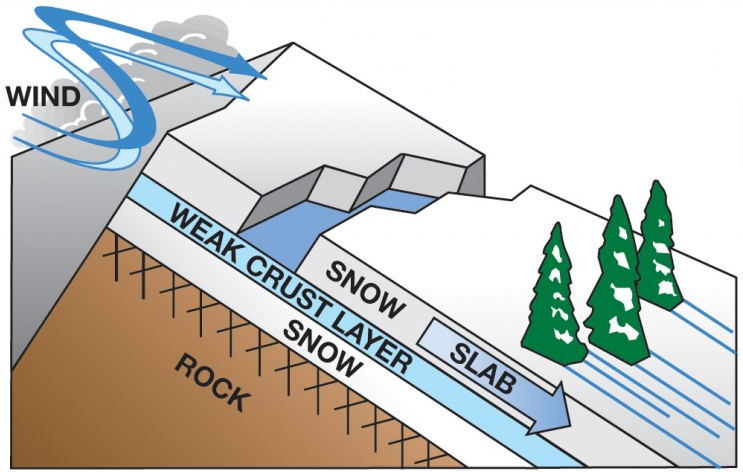
Avalanches are caused by the mechanical failure of snowpacks; essentially when the weight of the snow above a certain point exceeds the carrying capacity of the snow at that point to support its weight. This can happen for two reasons, because more snow falls upslope, causing the weight to rise, or because snow begins to melt downslope, causing the carrying capacity to fall. Avalanches may also be triggered by other events, such as Earthquakes or rockfalls. Contrary to what is often seen in films and on television, avalanches are not usually triggered by loud noises. Because snow forms layers, with each layer typically occurring due to a different snowfall, and having different physical properties, multiple avalanches can occur at the same spot, with the failure of a weaker layer losing to the loss of the snow above it, but other layers below left in place - to potentially fail later.


 Diagrammatic representation of an avalanche, showing how layering of snow contributes to these events. Expedition Earth.

Western North America have seen a number of avalanche related incidents this winter, largely due to high levels of snowfall. This is, in turn caused by warmer conditions over the Pacific, which leads to higher rates of evaporation over the ocean, and therefore higher rates of precipitation over North America, which falls as snow in cooler upland regions. There are further concerns that as the climate warms in the coming months, the thawing of this snow will lead to further dangerous avalanches.

See also...

http://sciencythoughts.blogspot.co.uk/2017/12/explosion-injures-worker-at-collorado.htmlhttp://sciencythoughts.blogspot.co.uk/2017/05/sinkhole-swallows-car-in-denver-colorado.html
http://sciencythoughts.blogspot.co.uk/2015/06/police-vehicle-swallowed-by-sinkhole-in.htmlhttp://sciencythoughts.blogspot.co.uk/2014/05/three-feared-dead-after-colorado.html
http://sciencythoughts.blogspot.co.uk/2014/05/oil-spill-near-la-salle-colorado.htmlhttp://sciencythoughts.blogspot.co.uk/2013/11/two-workers-killed-by-gas-at-colorado.html
Follow Sciency Thoughts on Facebook.

Friday, 6 April 2018

Woman being treated in hospital after avalanche in Alberta, Canada.

A woman is being treated in hospital after being buried by a landslide near Lake Louise in Alberta, Canada, at about 5.00 pm local time on Thursday 5 April 2017. The woman, who was with two companions at the time of the incident, was buried for about 15 minutes before she could be located, and is suffering from hypothermia as a result. The Royal Canadian Mounted Police were advised of the incident by an emergency beacon on a GPS unit, and were able to arrange for the woman to be airlifted to a hospital quickly.

The approximate location of Lake Louise, Alberta, where a woman was hospitalised following an avalanche on 5 April 2018. Google Maps.

Avalanches are caused by the mechanical failure of snowpacks; essentially when the weight of the snow above a certain point exceeds the carrying capacity of the snow at that point to support its weight. This can happen for two reasons, because more snow falls upslope, causing the weight to rise, or because snow begins to melt downslope, causing the carrying capacity to fall. Avalanches may also be triggered by other events, such as Earthquakes or rockfalls. Contrary to what is often seen in films and on television, avalanches are not usually triggered by loud noises. Because snow forms layers, with each layer typically occurring due to a different snowfall, and having different physical properties, multiple avalanches can occur at the same spot, with the failure of a weaker layer losing to the loss of the snow above it, but other layers below left in place - to potentially fail later.
 Diagrammatic representation of an avalanche, showing how layering of snow contributes to these events. Expedition Earth.

Northwestern North America have seen a number of avalanche related incidents this winter, largely due to high levels of snowfall. This is, in turn caused by warmer conditions over the Pacific, which leads to higher rates of evaporation over the ocean, and therefore higher rates of precipitation over North America, which falls as snow in cooler upland regions. There are further concerns that as the climate warms in the coming months, the thawing of this snow will lead to further dangerous avalanches.

See also...

http://sciencythoughts.blogspot.co.uk/2018/03/climber-injured-in-avalanche-in-alberta.htmlhttp://sciencythoughts.blogspot.co.uk/2016/05/canadian-city-evacuated-due-to-forest.html
http://sciencythoughts.blogspot.co.uk/2014/05/worker-killed-by-bear-at-alberta-oil.htmlhttp://sciencythoughts.blogspot.co.uk/2013/11/athabasca-river-polluted-by-mine-runoff.html
http://sciencythoughts.blogspot.co.uk/2013/04/plains-midstream-canada-charged-over.htmlhttp://sciencythoughts.blogspot.co.uk/2012/07/dinosaur-skeleton-vandalized-in-alberta.html
Follow Sciency Thoughts on Facebook.

Wednesday, 4 April 2018

Norwegian man dies in Swedish avalanche.

A Norwegian man has died in an avalanche on Mount Kebnekaise, Sweden's highest mountain, on Tuesday 3 April 2018. The man, who has not been named but is described as having been in his sixties, was caught in the avalanche at about 2.00 pm local time, between Sielmatjåkka Peak and the Nallostugan Mountain Lodge, and pronounced dead in hospital later, despite being dug out promptly and given immediate first aid.

The approximate location of Mount Kebnekaise, Sweden's highest mountain. Google Maps.

Avalanches are caused by the mechanical failure of snowpacks; essentially when the weight of the snow above a certain point exceeds the carrying capacity of the snow at that point to support its weight. This can happen for two reasons, because more snow falls upslope, causing the weight to rise, or because snow begins to melt downslope, causing the carrying capacity to fall. Avalanches may also be triggered by other events, such as Earthquakes or rockfalls. Contrary to what is often seen in films and on television, avalanches are not usually triggered by loud noises. Because snow forms layers, with each layer typically occurring due to a different snowfall, and having different physical properties, multiple avalanches can occur at the same spot, with the failure of a weaker layer losing to the loss of the snow above it, but other layers below left in place - to potentially fail later.

Diagrammatic representation of an avalanche, showing how layering of snow contributes to these events. Expedition Earth.

See also...

http://sciencythoughts.blogspot.co.uk/2014/09/magnitude-47-earthquake-in-dalarna.htmlhttp://sciencythoughts.blogspot.co.uk/2014/07/the-origin-of-lake-vattern.html
http://sciencythoughts.blogspot.co.uk/2013/12/at-least-twelve-dead-as-cyclone-bodil.htmlhttp://sciencythoughts.blogspot.co.uk/2013/10/jellyfish-force-closure-of-swedish.html
http://sciencythoughts.blogspot.co.uk/2013/08/swedish-miners-rescued-from-underground.htmlhttp://sciencythoughts.blogspot.co.uk/2012/08/earthquake-beneath-kattegat-sea.html
Follow Sciency Thoughts on Facebook.

Sunday, 1 April 2018

Spanish skiers killed by Avalanche in Switzerland.

Three Spanish skiers have died and two more have been admitted to hospital with injuries following an Avalanche in the Swiss canton of Valais on Saturday 31 March 2018. The party were apparently trying to cross the Aletsch Glacier near Fiesch when they were hit by the event. Rescue efforts were hampered by snow and poor visibility on the day of the event, with the bodies not being discovered until the following morning.

The Aletsch Glacier in Canton Valais, Switzerland, the largest glacier in the Alps. Google Maps.

Avalanches are caused by the mechanical failure of snowpacks; essentially when the weight of the snow above a certain point exceeds the carrying capacity of the snow at that point to support its weight. This can happen for two reasons, because more snow falls upslope, causing the weight to rise, or because snow begins to melt downslope, causing the carrying capacity to fall. Avalanches may also be triggered by other events, such as Earthquakes or rockfalls. Contrary to what is often seen in films and on television, avalanches are not usually triggered by loud noises. Because snow forms layers, with each layer typically occurring due to a different snowfall, and having different physical properties, multiple avalanches can occur at the same spot, with the failure of a weaker layer losing to the loss of the snow above it, but other layers below left in place - to potentially fail later.

 Diagrammatic representation of an avalanche, showing how layering of snow contributes to these events. Expedition Earth.

The Alps have seen a number of avalanche related incidents this winter, largely due to high levels of snowfall. This is, in turn caused by warmer conditions over the Atlantic, which leads to higher rates of evaporation over the ocean, and therefore higher rates of precipitation over Europe, which falls as snow in cooler regions such as the Alps, where the moist air meets cold air fromt the east.  

See also...

http://sciencythoughts.blogspot.co.uk/2018/03/avalanche-feared-to-have-killed-four.htmlhttp://sciencythoughts.blogspot.co.uk/2018/02/father-and-daughter-killed-by-avalanche.html
http://sciencythoughts.blogspot.co.uk/2017/12/avalanches-kill-three-in-switzerland.htmlhttp://sciencythoughts.blogspot.co.uk/2017/08/eight-missing-after-landslide-in.html
http://sciencythoughts.blogspot.co.uk/2014/11/at-least-four-killed-by-landslides-in.htmlhttp://sciencythoughts.blogspot.co.uk/2012/02/zurich-shaken-by-mild-earthquake.html
Follow Sciency Thoughts on Facebook.

Wednesday, 21 March 2018

German skier killed and Canadian injured by avalanche in French Alps.

A German skier has died after being caught in an avalanche while skiing near Grenoble in the French department of Isèreon Sunday 18 March 2018. The unnamed 25-year-old man was one of a party of five who were caught in the event when the snow gave way downslope of them. A second skier, Katie Combaluzier, 24, from Toronto, who was studying medicine in Dublin, suffered a fractured spine and other injuries in the same incident.

Katie Combaluzier, 24, from Toronto, injured by an avalache in the French Alps on 18 March 2018. CBC News.

Avalanches are caused by the mechanical failure of snowpacks; essentially when the weight of the snow above a certain point exceeds the carrying capacity of the snow at that point to support its weight. This can happen for two reasons, because more snow falls upslope, causing the weight to rise, or because snow begins to melt downslope, causing the carrying capacity to fall. Avalanches may also be triggered by other events, such as Earthquakes or rockfalls. Contrary to what is often seen in films and on television, avalanches are not usually triggered by loud noises. Because snow forms layers, with each layer typically occurring due to a different snowfall, and having different physical properties, multiple avalanches can occur at the same spot, with the failure of a weaker layer losing to the loss of the snow above it, but other layers below left in place - to potentially fail later.
 
Diagrammatic representation of an avalanche, showing how layering of snow contributes to these events. Expedition Earth.

The Alps have seen a number of avalanche related incidents this winter, largely due to high levels of snowfall. This is, in turn caused by warmer conditions over the Atlantic, which leads to higher rates of evaporation over the ocean, and therefore higher rates of precipitation over Europe, which falls as snow in cooler regions such as the Alps, where the moist air meets cold air fromt the east.

See also...

http://sciencythoughts.blogspot.co.uk/2018/03/avalanche-kills-at-least-four-in-french.htmlhttp://sciencythoughts.blogspot.co.uk/2018/02/father-and-daughter-killed-by-avalanche.html
http://sciencythoughts.blogspot.co.uk/2017/03/rhinoceros-killed-by-poachers-at-french.htmlhttp://sciencythoughts.blogspot.co.uk/2016/05/magnitude-41-earthquake-in-indre-et.html
http://sciencythoughts.blogspot.co.uk/2015/12/magnitude-30-earthquake-in-brittany.htmlhttp://sciencythoughts.blogspot.co.uk/2014/04/magnitude-49-earthquake-in-southern.html
Follow Sciency Thoughts on Facebook.

Sunday, 18 March 2018

Avalanche feared to have killed four skiers in Swiss Alps.

The bodies of two skiers have been recovered from under about six meters of snow, and a further two are missing, following an avalanche in the Vallon d'Arbi area near Riddes in the District of Martigny of Canton Valais in Switzerland on Friday 16 March 2018. All four skiers are said to be aged between 20 and 25 and from the Alsace Region of France.

The scene of an avalanche in Vallon d'Arbi on 16 March 2018. Valais Canton Police.

Avalanches are caused by the mechanical failure of snowpacks; essentially when the weight of the snow above a certain point exceeds the carrying capacity of the snow at that point to support its weight. This can happen for two reasons, because more snow falls upslope, causing the weight to rise, or because snow begins to melt downslope, causing the carrying capacity to fall. Avalanches may also be triggered by other events, such as Earthquakes or rockfalls. Contrary to what is often seen in films and on television, avalanches are not usually triggered by loud noises. Because snow forms layers, with each layer typically occurring due to a different snowfall, and having different physical properties, multiple avalanches can occur at the same spot, with the failure of a weaker layer losing to the loss of the snow above it, but other layers below left in place - to potentially fail later.

 Diagrammatic representation of an avalanche, showing how layering of snow contributes to these events. Expedition Earth.

The Alps have seen a number of avalanche related incidents this winter, largely due to high levels of snowfall. This is, in turn caused by warmer conditions over the Atlantic, which leads to higher rates of evaporation over the ocean, and therefore higher rates of precipitation over Europe, which falls as snow in cooler regions such as the Alps, where the moist air meets cold air fromt the east. This situation is likely to get worst this week after a significant cold front from the east brought plunging temperatures across Europe this week, which is expected to be replaced by a new wet front from the west over the weekend, depositing precipitation as more snow across the now cooler continent. 

See also...

http://sciencythoughts.blogspot.co.uk/2018/02/father-and-daughter-killed-by-avalanche.htmlhttp://sciencythoughts.blogspot.co.uk/2017/12/avalanches-kill-three-in-switzerland.html
http://sciencythoughts.blogspot.co.uk/2017/08/eight-missing-after-landslide-in.htmlhttp://sciencythoughts.blogspot.co.uk/2014/11/at-least-four-killed-by-landslides-in.html
http://sciencythoughts.blogspot.co.uk/2012/02/zurich-shaken-by-mild-earthquake.html
Follow Sciency Thoughts on Facebook.