Showing posts with label Trichoptera. Show all posts

Sunday, 17 July 2022

Notalina (Neonotalina) ralphi: A new species of Long-horned Caddisfly from Brazil

Caddisflies, Trichoptera, are a widespread and numerous (over 12 000 described species) group of Insects closely related to the Lepidoptera (Butterflies and Moths). Like Butterflies and Moths, Caddisflies undergo a complete metamorphosis upon reaching maturity, with a long-lived caterpillar-like larvae, and a shorter-lived flying adult stages (which typically lives one-to-two weeks). However, unlike the larvae of Butterflies and Moths, Caddisfly larvae are entirely aquatic, with only the winged adults emerging above the water surface. Most larval Caddisfly inhabit cases which they make out of silk, which some species are noted for covering with small stones, pieces of plant matter, shells or other matter they find in their environment. The larvae may be herbivorous or carnivorous, adult Caddisfly generally do not eat at all. Long-horned Caddisflies, Leptoceridae, are the second most numerous group of Caddisflies, with about 2200 described species grouped into four subfamilies the Grumichellinae, the Leptocerinae, the Leptorussinae, and the Triplectidinae. The tropical Southern Hemisphere genus Notalina is placed within the Subfamily Triplectidinae, and is itself divided into two subgenera, Notalina (Notalina), which is found in Austalasia and Notalina (Neonotalina) from South America.

In a paper published in the journal ZooKeys on 11 July 2022, Erica Silva Pereira of the Programa de Iniciação Científica and the Divisão do Curso em Entomologia at the Instituto Nacional de Pesquisas da Amazônia, Ian Oliveira of the Laboratório de Entomologia Aquática at the UniversidadeFederal da Bahia, Gleison Robson Desidério, also of the Divisão do Curso em Entomologia at the Instituto Nacional de Pesquisas da Amazônia, Adolfo Calor, also of the Laboratório de Entomologia Aquática at the Universidade Federal da Bahia, and Neusa Hamada, once again of the Divisão do Curso em Entomologia at the Instituto Nacional de Pesquisas da Amazônia, describe a new species of Notalina (Neonotalina) from Brazil.

The new species is described from specimens collected using Malaise traps close to rivers in the Cerrado (Brazilian savanna) biome in Brazil's Federal District, and Tocatins and Bahia states. It is named Notalina (Neonotalina) ralphi, in honour of Ralph Holzenthal of the University of Minnesota, for his work on Neotropical Caddisflies and support for new entomologists.

Notalina (Neonotalina) ralphi, lateral view. Silva Pereira et al. (2022).

See also...

Follow Sciency Thoughts on Facebook.

Follow Sciency Thoughts on Twitter. 


Monday, 3 January 2022

Byrsopteryx inti, Byrsopteryx mamaocllo, & Byrsopteryx mancocapac: Three new species of Microcaddisflies from Peru.

Caddisflies, Trichoptera, are a widespread and numerous group of Insects closely related to the Lepidoptera (Butterflies and Moths). Like Butterflies and Moths, Caddisflies undergo a complete metamorphosis upon reaching maturity, with a long-lived caterpillar-like larvae, and a shorter-lived flying adult stages (which typically live one-to-two weeks). However, unlike the larvae of Butterflies and Moths, Caddisfly larvae are entirely aquatic, with only the winged adults emerging above the water surface. Most larval Caddisfly inhabit cases which they make out of silk, which some species are noted for covering with small stones, pieces of plant matter, shells or other matter they find in their environment. The larvae may be herbivorous or carnivorous, adult Caddisfly generally do not eat at all. They have a fossil record dating back to the Triassic, with about 12 000 living species described. Of these, the most diverse subgroup are the Hydroptilidae, or Microcaddisflies, with about 2500 described living species, although this is probably an underestimation of the size of this group, as these Insects are often overlooked in surveys due to their small size.

In a paper published in the journal PeerJ on 24 December 2021, Allan Santos of the Departamento de Zoologia at the Universidade Federal do Estado do Rio de Janeiro, and Daniela Maeda Takiya of the Departamento de Zoologia at the Universidade Federal do Rio de Janeiro, describe three new species of Microcaddisflies from Cusco and Puno provinces, Peru.

All three species belong to the genus Byrsopteryx, a distinctive group of Microcaddisflies, restricted to the Americas, which can be distinguished by a pattern of white dots on a black or dark coloured background. Unlike other Microcaddisflies, Byrsopteryx spp. tend to be active in the daytime, making the conventional way method of capturing samples (nocturnal light traps) useless. Instead, these Insects can be found running fast over rocks or large leaves of riparian vegetation under bright sunlight, in a zigzag or in a more erratic way, flying away when disturbed. Thus, members of the genus Byrsopteryx are generally best collected aspirators or directly with a finger moistened in alcohol, though they can occasionally be collected with Malaise traps.

 
Collecting localities of specimens of new Byrsopteryx species described. (A) Tributary of Río Araza, Cusco, Peru. (B) Pennsylvania trap being set up by Allan Santos near Puente Saucipata, close to a tributary of Río Araza, Cusco, Peru. (C) Tributary of Río Araza, near Puente La Cigarra, Cusco, Peru. (D) Stream near Quincemil, Cusco, Peru. Santos & Takiya (2021).

The first new species is named Byrsopteryx inti, in reference to the Inca Sun God, Apu Inti, and the area where the species was discovered would have been at the centre of the Inca Empire. The species is described from six male secimens, all collected by a stream that forms a tributary of the Río Araza, about 19 km to the west of the town of Quincemil in Cusco Province, Peru.

 
Byrsopteryx inti, adult. (A) Holotype male (pinned), lateral habitus. (B) Live adult on a rocky surface. Santos & Takiya (2021).

These Microcaddiflies are dark brown in colour with numerous white hairs, and two distictive white spots on each wing. They range from 2.4 to 2.6 mm in length. This species also has a distinctive dom-like structure on the forewing, formed by a thickening of the wing membrane, something not seen preciously in any Caddisfly, but present n two of the new species described by Santos and Tayika.

 
Byrsopteryx inti, male wings (paratype). (A) Forewing, showing semi-dome process. (B) Forewing. (C) Hind wing. Santos & Tayika (2021).

The second new species described is named Byrsopteryx mamaocllo, in reference to the Inca fertility goddess Mama Ocllo, the daughter of Apu Inti and Mama Quilla, who, along with her brother and husband Manco Capac, founded Cusco and guided the people, enabling the beginning of the Inca civilization. This species is described from a range of male, female, and larval specimens collected in Cusco and Puno provinces, Peru.

 
Byrsopteryx mamaocllo, adult. (A) Holotype male (pinned), dorsal habitus. (B) Live adult in a small pit over rocky surface. Santos & Tayika (2021).

Males of this species are 2.6-3.0 mm long and dark brown in colour, with numerous white hairs and wingspots close to the margins of the wings. They share the dome-like structure seen on the wings of Byrsopteryx inti. Females are slightly larger, at 2.8-3.8 mm long, and have a similar colouration to the males, but lack the wing-dome structures.

 
Byrsopteryx mamaocllo, male wings (paratype). (A) Forewing, showing semi-dome process. (B) Forewing. (C) Hind wing. Santos & Takiya (2021).

The final instar larvae (i.e. the final stage of the larvae, before they metamorphose into adults) of Byrsopteryc mamacllo are 1.8-2.5 mm long, with head that is dark brown, but lacks pigment around the eyes, a dark brown sclerotized thorax, and a white, slightly compressed abdomen with sclerotized tergites (dorsal plates) on some segments.

 
Byrsopteryx mamaocllo, larva. (A) Lateral habitus with case. (B) Lateral habitus without case. (C) Dorsal habitus. (D) Operculum, dorsocaudal view. Santos & Takiya (2021).

The final new species described is named Byrsopteryx mancocapac, in reference to Manco Capac, the son of Inti and Mama Quilla, who, along with Mama Ocllo, his sister and wife, was sent to Earth to begin a civilization. This species is described from adult male and larval specimens collected in Cusco and Puno provinces, Peru.

 
Byrsopteryx mancocapac, adult. (A) Paratype male (pinned), dorsal habitus. (B) Live adult on a rocky surface. Santos & Takiya (2021).

The males of this species are 2.6-3.6 mm long and dark brown in colour, which a dense covering of black hairs. They have three pairs of white spots on their wings, and lack the wing-domes seen in the other two new species. The final instar larvae are 2.0-3.8 mm long, with heavily sclerotized brown heads and thoraxes, and slightly compressed abdomens with lightly sclerotized tergites on some segments.

 
Byrsopteryx mancocapac, larva. (A) Lateral habitus with case. (B) Lateral habitus without case. (C) Dorsal habitus. (D) Operculum, dorsocaudal view. Sanros & Takiya (2021).

See also....


Follow Sciency Thoughts on Facebook.

Follow Sciency Thoughts on Twitter. 


Sunday, 16 December 2018

Austaulius haustrum: A new species of Necrotaulid Caddisfly from the Early Jurassic of Lyme Regis, England.

Caddisflies, Trichoptera, are a widespread and numerous (over 12 000 described species) group of Insects closely related to the Lepidoptera (Butterflies and Moths). Like Butterflies and Moths, Caddisflies undergo a complete metamorphosis upon reaching maturity, with a long-lived caterpillar-like larvae, and a shorter-lived flying adult stages (which typically lives one-to-two weeks). However, unlike the larvae of Butterflies and Moths, Caddisfly larvae are entirely aquatic, with only the winged adults emerging above the water surface. Most larval Caddisfly inhabit cases which they make out of silk, which some species are noted for covering with small stones, pieces of plant matter, shells or other matter they find in their environment. The larvae may be herbivorous or carnivorous, adult Caddisfly generally do not eat at all. They have a fossil record dating back to the Triassic.

The Necrotauliidae are a curious group of Caddisflies known from the Triassic and Jurassic of Europe, Asia and Australia. Their wing venetion sugests that they are members of the Trichoptera, but they have a number of un-Caddifly-like characteristics, including scales on their wings, a trait generally associated with the Lepidoptera. As such their is some dispute about the classification of this group, with some palaeoentomologists regarding them as early members of the Lepidoptera, others as a stem group from which both the Lepidoptera and the Trichoptera are descended, and while most experts do accept them to be Caddisflies, they differ in whether they are a distinct group that branched off early in the history of the Trichoptera, or a polyphyletic assemblage of early Caddisflies from which the more modern groups are descended.

In a paper published in the journal Psyche on 9 May 2018, Richard Kelly of the School of Earth Sciences at the University of Bristol, and the Department of Natural Sciences at the National Museum of Scotland, Andrew Ross, also of the Department of Natural Sciences at the National Museum of Scotland, and of the Department of Earth Sciences at the Natural History Museum, and Robert Coram, also of the School of Earth Sciences at the University of Bristol, and of British Fossils, describe a new species of Necrotaulid Caddisfly from the Early Jurassic of Lyme Regis, England, as part of a review of the Necrotaulid Caddisflies of the Triassic and Jurassic of England.

The new species is placed in the genus Austaulius, which is created by the authors of the paper to include a number of previously described species, including the Australian Prorhyacophila colliveri (now Austaulius colliveri), which as the oldest described species assigned to the new genus is taken as its type species, the name 'Austaulius' referring to this, and given the specific name haustrum, in reference to the mouthparts of the species, which form a sucking proboscis. The species is described from a single specimen collected from Monmouth Beach at Lyme Regis. This specimen has both forewings and a partial hind wing, as well as the thorax, head, some antennomeres, some leg segments, the maxillary and labial palps, and the haustellum.

Austaulius haustrum from Monmouth Beach, Lyme Regis, Dorset. Bottom left figure is the right forewing of the specimen flipped so the costal margin is on top. Scale bars are 1 mm. Kelly et al. (2018).

See also...

https://sciencythoughts.blogspot.com/2016/10/palaeopsilotreta-xiai-caddisfly-from.htmlhttps://sciencythoughts.blogspot.com/2014/06/a-metriorhynchid-crocodylomorph-tooth.html
https://sciencythoughts.blogspot.com/2013/09/a-caddisfly-from-middle-jurassic-of.htmlhttps://sciencythoughts.blogspot.com/2013/08/a-pliosaur-from-jurassic-coast-of-dorset.html
https://sciencythoughts.blogspot.com/2013/03/landslip-at-bowleaze-cove-dorset.htmlhttps://sciencythoughts.blogspot.com/2012/08/monmouth-beach-lyme-closed-due-to.html
Follow Sciency Thoughts on Facebook.

Wednesday, 19 October 2016

Palaeopsilotreta xiai: A Caddisfly from Cretaceous Burmese Amber.

Caddisflies, Trichoptera, are an ancient Insect group with a fossil record dating back to the Triassic. However, as with many Insect groups, the majority of these specimens are compression fossils, which tend to preserve only the wings, useful for determining the presence of a group and even differentiating species, but telling us little about the actual Insects. This makes amber deposits, which often preserve whole Insects trapped in resin excreted by Trees, particularly interesting to palaeoentomologists (scientists who study fossil Insects), as these deposits show the whole morphology of the Insects, enabling information about their biology and ecology to be inferred.

In a paper published in the journal Cretaceous Research on 29 September 2016, Wilfried Wichard of the Institute of Biology at the Universityof Koeln, and Bo Wang of the State Key Laboratory of Palaeobiologyand Stratigraphy at the Nanjing Institute of Geology and Palaeontology and the Key Laboratory of Zoological Systematics and Evolution at the Institute of Zoology of the Chinese Academy ofScience, describe a new species of Caddisfly from Burmese Amber collected from a mine near the village of Noije Bum in Kachin State, Myanmar.

The new species is named Palaeopsilotreta xiai, where 'Palaeopsilotreta' means 'Ancient Psilotreta', PsilotretaI being a modern genus that the specimen closely resembles, and 'xiai' honours Xia Fangyuan of the Lingpoge Amber Museum for his work on Burmese Amber. The species is described from three male specimens, essentially similar to members of the modern genus Psilotreta, excepting their remarkable antennae, which are bipectinate along much of their length; that is to say they have a double row of rami (comb-like structures) on the antennae, with a pair of rami arising from each of the antennae joints.

Palaeopsilotreta xiai, first specimen. Wichard & Wang (2016).

Branching, comb-like or feathery structures on the antennae of Insects are generally associated with an improved sense of smell. Such structures are most common in Moths and Beetles and are typically found in species where the male locates females by following a pheromone scent she emits, and in such species it is usually only the males that have such antenae. No Caddisfly with bipectinate antennae has previously been recorded, though there are several species with pectinate antennae (i.e. antennae that have a single row of rami) known from modern Vietnam. Curiously, all of these modern Vietnamese species are known from their males only (i.e. no females have been found for any of these species), so it is unknown if the females of these species have simple or pectinate antennae, a situation also seen in Palaeopsilotreta xiai, which is described from male specimens only.

Second specimen of Palaeopsilotreta xiai. Wichard & Wang (2016).

Due to the close resemblance of Palaeopsilotreta xiai to the modern genus Psilotreta, it is considered to be a member of the same family, the Odontoceridae, a group with a fossil record that previously only extended back to the Eocene. Amber from the Noije Bum Mine is encased in a volcanoclastic matrix (i.e. a sediment of volcanic origin, typically an ashfall or lahar deposit), which has been dated to 98.8 million years ago using uranium-lead dating of zircon crystals (zircon is a mineral formed by the crystallization of cooling lavas; when it forms it often contains trace amounts of uranium, which decays into - amongst other things - lead at a known rate; since lead - which has a much lower melting point - will not have crystalized out of the original lava as the zircon formed, it is possible to calculate the age of a zircon crystal from the ratio between these elements.); it is assumed that the amber is slightly, but not significantly, older than the matrix, making the amber a little under 100 million years old.

See also...

http://sciencythoughts.blogspot.co.uk/2013/09/a-caddisfly-from-middle-jurassic-of.htmlA Caddisfly from the Middle Jurassic of Inner Mongolia.                                            Caddisflies (Trichoptera) are a widespread and numerous (over 12 000 described species) group of Insects closely related to the Lepidoptera (Butterflies and Moths). Like Butterflies and Moths...
Follow Sciency Thoughts on Facebook.

Saturday, 7 September 2013

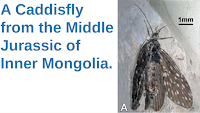
A Caddisfly from the Middle Jurassic of Inner Mongolia.

Caddisflies (Trichoptera) are a widespread and numerous (over 12 000 described species) group of Insects closely related to the Lepidoptera (Butterflies and Moths). Like Butterflies and Moths, Caddisflies undergo a complete metamorphosis upon reaching maturity, with a long-lived caterpillar-like larvae, and a shorter-lived flying adult stages (which typically lives one-to-two weeks). However, unlike the larvae of Butterflies and Moths, Caddisfly larvae are entirely aquatic, with only the winged adults emerging above the water surface. Most larval Caddisfly inhabit cases which they make out of silk, which some species are noted for covering with small stones, pieces of plant matter, shells or other matter they find in their environment. The larvae may be herbivorous or carnivorous, adult Caddisfly generally do not eat at all. They have a fossil record dating back to the Triassic.

In a paper published in the journal Fossil Record on 20 February 2013, Yan Gao, Yunzhi Yao and Dong Ren of the Key Lab of Insect Evolution and Environmental Changes at Capital Normal University in Beijing, describe a new species of Caddisfly from the Middle Jurassic Jiulongshan Formation at Daohugou Village in Inner Mongolia.

The new species is named Pulchercylindratus punctatus, where 'Pulchercylindratus' means 'beautiful cylinder' and 'punctatus' means spotted. The species is described from three specimens, a complete male and two partial fossils of indeterminate sex. The complete specimen is 10.47 mm in length.

Pulchercylindratus punctatus, photograph (top) and line drawing (bottom). Gao et al. (2013).


Follow Sciency Thoughts on Facebook.