Showing posts with label Tuco-tucos. Show all posts

Saturday, 16 March 2024

Ctenomys uco: A new species of Tuco-tuco from Mendoza Province, Argentina.

Tuco-tucos, Ctenomys spp., are a large group of burrowing Rodents found in South America from southern Peru to the southern tips of Chile and Argentina. There are currently 68 living members of the genus, eleven of which have beed described in the last decade, during which time the application of genetic analysis to phylogenetic studies has led to the genus being divided into eight well-supported species groups, as well as several other groups with less clear relationships. The Ctenomys mendocinus species group has been the subject of several recent studies, which have led to several new species being erected, as well as a number of previously described species having been recognised as populations of other species, and several lineages identified which appear to be as yet undescribed species. One such population is found in northwestern Mendoza Province, Argentina, with populations at Tupungato and the Valley of Arenales which were previously thought to belong to the species Ctenomys mendocinus having been identified as genetically distinct, although the morphological distinctness of these Tuco-tucos has not been assessed.

In a paper published in the journal Vertebrate Zoology on 8 March 2024, Raquel Alvarado-Larios of the Laboratorio de Filogeografía at the Instituto Argentino de Investigaciones de las Zonas Áridas, Pablo Teta of the División Mastozoología at the Museo Argentino de Ciencias Naturales 'Bernardino Rivadavia', Pablo Cuello, also of the Laboratorio de Filogeografía at the Instituto Argentino de Investigaciones de las Zonas Áridas, Pablo Jayat of the Unidad Ejecutora Lillo and the Departamento de Ciencias Básicas y Tecnológicasat the Universidad Nacional de Chilecito, Andrea Tarquino-Carbonell, again of the Laboratorio de Filogeografía at the Instituto Argentino de Investigaciones de las Zonas Áridas, Guillermo D’Elía of the Instituto de Ciencias Ambientales y Evolutivas and the Colección de Mamíferos at the Universidad Austral de Chile, and Paula Cornejo and Agustina Ojeda, again of the Laboratorio de Filogeografía at the Instituto Argentino de Investigaciones de las Zonas Áridas, formally describe the Mendoza Tuco-tuco as a new species, based upon genetic and morphological data.

The new species is named Ctenomys uco, in reference to the Valle de Uco, the region in which the new species was discovered. It is a small Tuco-tuco, reaching 215-263 mm in length, with a drab or dusky drab coat, lighter on the flanks and underside, with the underside sometimes also having a brownish tinge. 

External appearance of Ctenomys uco. (A) CMI 7712 (holotype), from Cajón de Arenales, Tunuyán, Mendoza, Argentina; (B) CMI 7737, from Finca Caicayén II, Tupungato, Mendoza, Argentina. Alvarado-Larios et al. (2024).

While the populations assigned to Ctenomys uco were formerly assigned to Ctenomys mendocinus, but a genetic study based upon the mitochondrial cytochrome b gene found that not just were these populations distinct from Ctenomys mendocinus, but also that they aren't particularly closely related, with Ctenomys uco instead forming a sister species to Ctenomys fochi, and these two together forming the sister taxon to a clade which includes Ctenomys verzi, Ctenomys mendocinus, and Ctenomys flamarioni, as well as two as yet un-named lineages.

Ctenomys uco is known from only two locations, 39 km appart, but Tuco-tucos have been reported elsewhere in the region, which are likely to belong to the same species, for which reason Alvarado-Larios et al. decline to make a detailed assessment of the species distribution or conservation status at this time. The species seems to be solitary in nature, and lives in an environment between the Low Monte and the Southern Andean Steppe at altitudes of 1000 and 2710 m above sealevel. One of the known populations lives largely within vineyards, digging burrows at the foot of vines.

Views of the landscapes at the two known localities of Ctenomys uco. (A )Mendoza, Tunuyán, Cajón de Arenales (type locality), (B) Mendoza, Tupungato, vineyards of Finca Caicayén II (note the burrows at the lower right corner on this photograph). Alvarado-Larios et al. (2024).

The region is close to the Andes, and has a temperate climate with harsh winters, hot summers with cool nights. The mean annual temperature varies between about 10°C and about 15°C, with an average of about 300 mm of rain each year, most of which falls in winter.

See also...

Friday, 15 May 2015

Ateuchus cujuchi: A new species of Scarab Beetle from Rodent burrows in Bolivia.


Tuco-tucos, Ctenomys spp., are small South American Rodents which live their entire lives underground within underground burrow systems, never venturing to the surface. Studies of other Rodents with similar lifestyles, such as the Pocket Gophers of North America, have found that their burrows tend to form unique ecosystems with distinctive faunas of Insects and other small invertebrates.

In a paper published in the journal Zootaxa on 8 April 2015, François Génier of the Canadian National Collection of Insects, Arachnids andNematodes at Agriculture and Agri-Food Canada, describes a new species of Scarab Beetle discovered during an investigation into the fauna of Tuco-tuco burrows at low elevation in Santa Cruz de la Sierra province, Bolivia.

The new Beetle is placed in the genus Ctenomys, and given the specific name cujuchi, a local name for Tuco-tucos. These are glossy black Scarab Beetles 4.3-6.0 mm in length, with coarsely punctate pygidia (dense patterns of pits on their backs between the heads and wings).

Ateuchus cujuchi in (1) dorsal and (2) ventral views. Génier(2015).

See also…

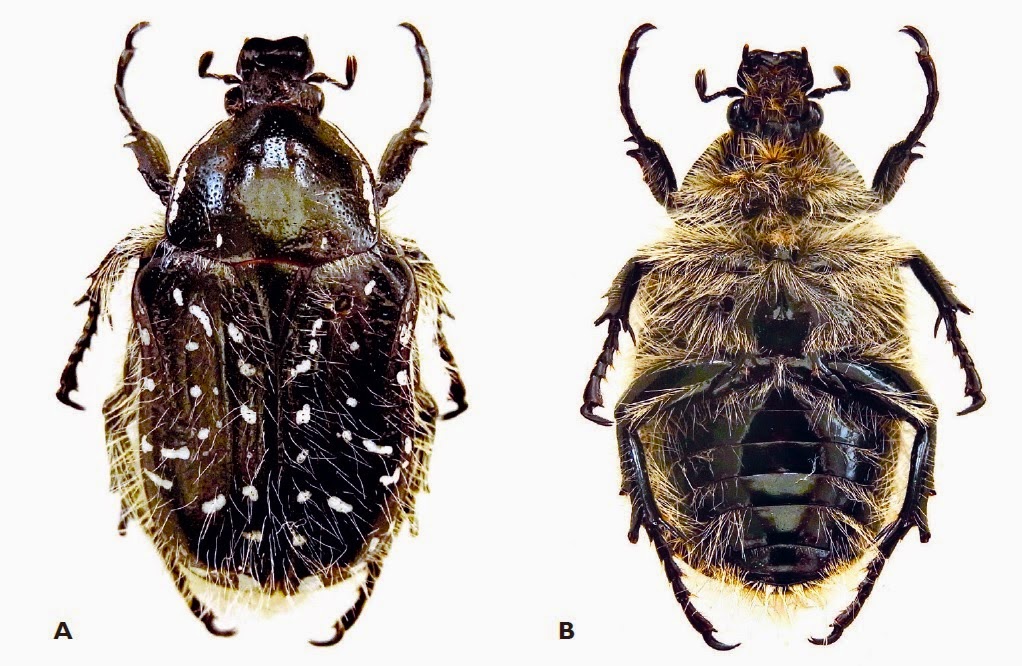
There are currently eight species of Scarab Beetles in the genus Scapanoclypeus, which is known from Namibia and western South Africa. They are...
http://sciencythoughts.blogspot.co.uk/2014/08/a-new-species-of-scarab-beetle-from.html A new species of Scarab Beetle from the Elandsberg Mountains of the Western Cape, South Africa.                                                         Scarab Beetles of the genus Trichostetha occur across southern Africa, reaching their greatest diversity in...
http://sciencythoughts.blogspot.co.uk/2013/10/a-new-species-of-scavenger-scarab.html A new species of Scavenger Scarab Beetle from the Early Cretaceous of Liaoning Province, China.                                               Scavenger Scarab Beetles (Hybosoridae) are small (5-7 mm), oval Scarab Beetles, with enlarged mandibles and mouthparts. They are typically carrion feeders, with some species favouring vertebrate dung. They are not a large group of Beetles, with only about 600 species... 
 
Follow Sciency Thoughts on Facebook.