Showing posts with label Argentina. Show all posts

Wednesday, 13 May 2026

Three fatalities in Hantavirus outbreak on Dutch cruise ship.

Three people have died and a further five people have been infected in an outbreak of Hantavirus on the Dutch cruise ship MV Hondius, according to a press release issued by the World Health Organization on 8 May 2026. The disease, which is caused by the Virus Orthohantavirus andesense, is a zoonotic disease (disease with a reserve in a wild Animal population which sometimes spreads to Humans) causing a hemorrhagic or pulmonary fever. It is not easily passed from Human-to-Human, but can do so when people are living together in close conditions in an environment such as a cruise ship.

The outbreak is thought to have begun with an 70-year-old male Dutch national who boarded the ship at Ushuaia, on the Argentinian part of Tierra del Fuego, on 1 April 2026, after spending three months touring Argentina, Chile, and Uruguay. This patient developed symptoms at sea, and died on 11 April before the ship reached any port. He is considered a probable case, as no microbiological tests were carried out. 

The MV Hondius, a 106.7 m Polar Class 6 vessel, designed for luxury touring in polar regions with a minimal environmental impact, which was hit by Hantavirus outbreak in April and May 2026. Oceanwide Expeditions.

The second patient to develop the disease was the original patient's 69-year-old widow, who had been travelling with the first patient and joined the ship with him. She developed gastrointestinal symptoms at sea, and left the ship when it arrived at Saint Helena on 24 April, and flew to Johannesburg the following day, where she boarded a flight to Amsterdam, where her condition deteriorated rapidly, causing her to be removed from the plane and moved to a local hospital, where she died on 26 April. She was confirmed as being infected with Orthohantavirus andesense by polymerise chain reaction testing carried out by the South African National Institute for Communicable Diseases.

The third patient, another adult male, started to show symptoms on 24 April, and was evacuated from the ship when it put into Ascension Island on 27 April. This patient was also airlifted to Johannesburg, where he is being treated in an intensive care unit. This patient was also confirmed as being infected with Orthohantavirus andesense by polymerise chain reaction testing.

A fourth patient, and adult female German national, developed a fever on 28 April, while the ship was sailing between Ascension Island and the Cape Verde islands, and died of pneumonia on 2 May, before the ship made it to port. This patient was later confirmed to have died of Hantavirus by post-mortem examination.

The fifth patient, the ship's doctor, began to develop symptoms on 30 April, and was confirmed as having Hantavirus by polymerise chain reaction testing when the ship reached Cape Verde on 6 May, and was airlifted to the Netherlands, where he is currently being treated in an isolation unit. 

The sixth patient, a guide employed on the ship, reported mild respiratory and gastrointestinal symptoms on 27 April. He was also diagnosed with Hantavirus infection by polymerise chain reaction testing when the ship reached Cape Verde and airlifted to the Netherlands.

A seventh patient, who disembarked from the ship at St Helena on 22 April and flew home to Switzerland via South Africa and Qatar, began to show symptoms on 1 May. He immediately self-reported to medical authorities in Switzerland, and is now being treated in an isolation unit there.

An eighth patient, who disembarked from the ship at Tristan da Cunha in the South Atlantic on 14 April, began to show symptoms on 28 April. He is now being treated in isolation, although results of testing for the Virus have yet to be returned.

A ninth patient with Hantavirus-like symptoms was evacuated at Cape Verde and airlifted to Germany, but was later found not to be infected.  Efforts are still being made to trace 32 other patients who disembarked at Saint Helena and dispersed to a variety of countries before the nature of the outbreak was understood. After leaving Cape Verde the ship sailed to the Canary Islands, where it was met by medical personnel from the World Health Organization and a variety of countries, where both passengers and crew were screened for the Virus before being allowed to travel on to their home countries, where they will be required to undergo a period of isolation. A skeleton crew and medical personnel remained on the ship while it was sailed to the Netherlands to be thoroughly disinfected. 

Stops made by the MV Hondius during the outbreak. On 11 May, the ship was en route to Rotterdam. Wikipedia.

A flight attendant on the Johannesburg-Amsterdam flight from which the second patient was removed also later developed symptoms, and was admitted to a hospital in Amsterdam. Two Singaporean nationals who had been on the ship and subsequent flight from Saint Helena to Johannesburg were tested for the Virus after one developed Hantavirus-like symptoms, but neither was found to be infected. Attempts are still being made to trace passengers from both fights.

Hantavirus infections are caused by triple single-stranded negative-sense RNA Viruses of the genus Orthohantavirus. These Viruses are typically found in Rodents, with 28 species known, each of which infects a different species of Rodent. These Viruses occasionally jump species and infect Humans, where they break down into two groups, Old World Hantaviruses, which can cause a hemorrhagic fever accompanied by a severe kidney infection, and New World Hantaviruses, which cause a severe respiratory disease.


Structure of the Andes Hantavirus. Lexi Schoonover/Hope College/Wikimedia Commons.

The Andes Hantavirus, Orthohantavirus andesense, is found in Long-tailed Pygmy Rice Rats, Oligoryzomys longicaudatus, a wild Rodent found in the southern Andes of Chile and Argentina, where it does not appear to produce any symptoms. It can be transmitted to Humans through the inhalation of  aerosols that contain rodent saliva, urine, or feces, through the consumption of contaminated food, or by being bitten or scratched by a Rat.

A Long-tailed Pygmy Rice Rat, Oligoryzomys longicaudatus, the wild vector of the Andes Hantavirus. Yamil Hussain/Wikimedia Commons.

There is no effective treatment or vaccine for Hantavirus, and the disease is best prevented by using cleanliness and good hygiene to keep Rodents from entering Human dwellings or workplaces. If this fails a pest control consultant should be used to remove the Rodents. Placing infected patients in intensive care with fluids and, if necessary, artificial respiration, can help, but even with these precautions about 30% of patients typically die. Patients who have been infected with the disease and survive are generally immune to further infections with the same Virus.

See also...


Saturday, 16 March 2024

Ctenomys uco: A new species of Tuco-tuco from Mendoza Province, Argentina.

Tuco-tucos, Ctenomys spp., are a large group of burrowing Rodents found in South America from southern Peru to the southern tips of Chile and Argentina. There are currently 68 living members of the genus, eleven of which have beed described in the last decade, during which time the application of genetic analysis to phylogenetic studies has led to the genus being divided into eight well-supported species groups, as well as several other groups with less clear relationships. The Ctenomys mendocinus species group has been the subject of several recent studies, which have led to several new species being erected, as well as a number of previously described species having been recognised as populations of other species, and several lineages identified which appear to be as yet undescribed species. One such population is found in northwestern Mendoza Province, Argentina, with populations at Tupungato and the Valley of Arenales which were previously thought to belong to the species Ctenomys mendocinus having been identified as genetically distinct, although the morphological distinctness of these Tuco-tucos has not been assessed.

In a paper published in the journal Vertebrate Zoology on 8 March 2024, Raquel Alvarado-Larios of the Laboratorio de Filogeografía at the Instituto Argentino de Investigaciones de las Zonas Áridas, Pablo Teta of the División Mastozoología at the Museo Argentino de Ciencias Naturales 'Bernardino Rivadavia', Pablo Cuello, also of the Laboratorio de Filogeografía at the Instituto Argentino de Investigaciones de las Zonas Áridas, Pablo Jayat of the Unidad Ejecutora Lillo and the Departamento de Ciencias Básicas y Tecnológicasat the Universidad Nacional de Chilecito, Andrea Tarquino-Carbonell, again of the Laboratorio de Filogeografía at the Instituto Argentino de Investigaciones de las Zonas Áridas, Guillermo D’Elía of the Instituto de Ciencias Ambientales y Evolutivas and the Colección de Mamíferos at the Universidad Austral de Chile, and Paula Cornejo and Agustina Ojeda, again of the Laboratorio de Filogeografía at the Instituto Argentino de Investigaciones de las Zonas Áridas, formally describe the Mendoza Tuco-tuco as a new species, based upon genetic and morphological data.

The new species is named Ctenomys uco, in reference to the Valle de Uco, the region in which the new species was discovered. It is a small Tuco-tuco, reaching 215-263 mm in length, with a drab or dusky drab coat, lighter on the flanks and underside, with the underside sometimes also having a brownish tinge. 

External appearance of Ctenomys uco. (A) CMI 7712 (holotype), from Cajón de Arenales, Tunuyán, Mendoza, Argentina; (B) CMI 7737, from Finca Caicayén II, Tupungato, Mendoza, Argentina. Alvarado-Larios et al. (2024).

While the populations assigned to Ctenomys uco were formerly assigned to Ctenomys mendocinus, but a genetic study based upon the mitochondrial cytochrome b gene found that not just were these populations distinct from Ctenomys mendocinus, but also that they aren't particularly closely related, with Ctenomys uco instead forming a sister species to Ctenomys fochi, and these two together forming the sister taxon to a clade which includes Ctenomys verzi, Ctenomys mendocinus, and Ctenomys flamarioni, as well as two as yet un-named lineages.

Ctenomys uco is known from only two locations, 39 km appart, but Tuco-tucos have been reported elsewhere in the region, which are likely to belong to the same species, for which reason Alvarado-Larios et al. decline to make a detailed assessment of the species distribution or conservation status at this time. The species seems to be solitary in nature, and lives in an environment between the Low Monte and the Southern Andean Steppe at altitudes of 1000 and 2710 m above sealevel. One of the known populations lives largely within vineyards, digging burrows at the foot of vines.

Views of the landscapes at the two known localities of Ctenomys uco. (A )Mendoza, Tunuyán, Cajón de Arenales (type locality), (B) Mendoza, Tupungato, vineyards of Finca Caicayén II (note the burrows at the lower right corner on this photograph). Alvarado-Larios et al. (2024).

The region is close to the Andes, and has a temperate climate with harsh winters, hot summers with cool nights. The mean annual temperature varies between about 10°C and about 15°C, with an average of about 300 mm of rain each year, most of which falls in winter.

See also...

Thursday, 22 February 2024

The oldest known rock art in Patagonia, and what it tells us about the people who made it.

Patagonia lies at the southern tip of the Americas, and was one of the last areas to have been settled by Humans, who did not arrive there until the end of the Pleistocene. The area has a unique environment, which would have presented challenges to the people settling there. It also has a climate particularly suitable for the preservation of archaeological remains, making it particularly interesting to archaeologists. The area has extensive rock art, but to date little of this has been accurately dated.

In a paper published in the journal Science Advances on 14 February 2024, Guadalupe Romero Villanueva of the Instituto Nacional de Antropología y Pensamiento Latinoamericano, Marcela Sepúlveda of the Department of Social Sciences at the Universidad de Tarapacá, José Cárcamo-Vega of the Laboratorio de Espectroscopía Vibracional at the Universidad de Chile, Alexander Cherkinsky of the Center for Applied Isotope Studies at the University of Georgia, María Eugenia de Porras of the Instituto Argentino de Nivología, Glaciología  y  Ciencias  Ambientales, and Ramiro Barberena of the Centro de Investigación, Innovación y Creación at the Universidad Católica de Temuco, and the Instituto Interdisciplinario  de  Ciencias Básicas at the Universidad Nacional de Cuyo, present dates for four pieces of rock art from the Cueva Huenul 1 archaeological site in Neuquén Province, in the northern part of Argentinian Patagonia, and discuss the implications of this for the early peopling of the region.

The Cueva Huenul 1 archaeological site is located a kilometre above sealevel, to the east of the Andes amid the inland deserts of northern Patagonia. The Andes present a major topographic barrier, preventing the prevailing westerly winds from carrying moisture from the Pacific to the South American Arid Diagonal, where the Cueva Huenul 1 site is located. Precipitation in the region is between 150 mm and 200 mm each year, 75% of which falls in the winter. Rainfall tends to be higher in the west, closer to the Andes, and dryer to the east. with more abundant vegetation in areas with higher rainfall.

Location  of  Cueva Huenul 1,  other  sites  with  rock  art  in  northern  Neuquén  Province (Argentina),  and  palaeoecological  sites  from  northwestern  Patagonia. María Eugenia de Porras in Villanueva et al. (2024).

The Cueva Huenul 1 site is a cave with a habitable area of 620 m³, formed by the erosion of ignimbrites of the Tilhué Formation beneath an overlying basalt layer of the El Puente Formation, which have not eroded and now form the ceiling of the cave. Excavations within this cave have produced over 5500  lithic artifacts, principally flaked stone objects, and 8800 bone specimens, mostly Guanaco, Lama guanicoe. The site also has a long, and well-defined dating sequence, spanning 12 000 years, with a number of discrete phases of activity identified. The microenvironment within the cave appears to have remained stable and dry over this period, allowing for the excellent preservation of items such as Animal dung, and plant remains. 

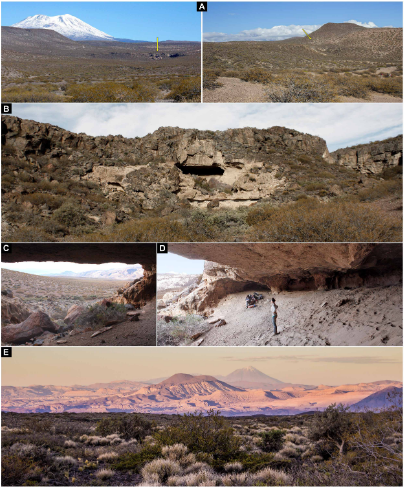
Cueva Huenul 1 environment and landscape. (A) emplacement of Cueva Huenul 1 (yellow arrow) in a volcanic landscape within the Monte desert. (B) to( D) Views of the cave’s geology and topography. (E) View from Cueva Huenul 1 of the volcanic landscape of northwestern Patagonia. Guadalupe Romero Villanueva in Villanueva et al. (2024).

Notably, the Cueva Huenul 1 site has yielded a remarkable quantity of art-related materials, including  perforated  shell  beads, decorated Guanaco bones, and pyro- engraved  gourds. Also found inside the cave was a pit-structure containing a large number of twigs from the desert shrub Senna  aphylla, which have been stained with red ochre. A large amount of pigments, of various colours and in varying states of preparation.

Cueva Huenul 1 site plan and special findings. (A) excavation units at ch1. (B and C) General and detailed view of pit structure filled with vegetal remains of Senna  aphylla stained with red ochre. (D) Pyro-engraved gourd. (E) Perforated shell bead. (F) decorated guanaco (Lama guanicoe) bone. (G) Pigments. each image has an individual metric scale. Guadalupe Romero Villanueva and Ramiro Barberena in Villanueva et al. (2024).

The site has a panoramic view of the surrounding landscape, although it is not visible from any other known archaeological site in the region, nor can any such site be seen from the cave. Other sites in the region include a series of smaller caves and rockshelters, most of which only appear to have been used within the last 2000 years. Some of these, such as El Ciénego and Paso de las Tropas, also have rock art, although it is less diverse in technical style and less formalised than the art at Cueva Huenul 1. The Cueva Yagui site, to the north of Cueva Huenul 1, also records a long timeline, in this case about 8 500 years, and appears to have been more intensely occupied, on the basis of stone tools, abundant ceramics, and faunal remains, with this occupation being particularly intense over the past 2000 years. Both the stratigraphic sequences and the styles of rock art suggest that Cueva Huenul 1, Cueva Yagui, and other sites appear to have been linked.

Cueva Huenul 1 hosts one of the most impressive collections of rock art in northwestern Patagonia, with central portion of the cave’s internal wall and part of the ceiling covered by 895 discrete pieces of rock art, which have been grouped into 466 identifiable motifs. Most of these motifs are geometric shapes rather than pictures, with strokes, dots, circles, and lines being common, and parallel lines, reticulates, polygons, and cruciforms also present, as well as some Human silhouettes and a face, and silhouettes of Guanaco and Choique, Rhea pennata, and some representations of dynamic group  activities. A range of colours are used in the cave art, although a haematite-derived red is the most common, along with different hues of white, yellow, and black.

Examples of the rock art of Cueva Huenul 1. Each tracing has a 10cm scale bar. Guadalupe Romero Villanueva in Villanueva et al. (2024).

A large number of motifs are superimposed over earlier artworks, and there appear to be three distinct degrees of weathering, as well as distinct artistic phases. The majority of the art is presumed to be of Late Holocene origin, based upon similarities to styles of art used at other localities. However, the long history of occupation at the site combined with presence of a clear artistic sequence, raises the possibility that some art at the site may be much older.

Four artworks at the Cueva Huenul 1 site were chosen to be dated. These were all classified as 'comb-shapes' based upon a shared basic morphology of a perpendicular horizontal line with several parallel vertical lines extending downwards from it. Within this simple pattern, however, the comb motifs can be divided into simple and complex forms. Three of the motifs examined, UT3- M48, UT5- S4- M7, and UT3- M37, were of the simple type, while the fourth, UT5-S2-M19, was of the complex form. All of the comb motifs are executed in a reddish black pigment. Most are isolated from other artworks, although one (UT5-S2-M19) is part of a complex series of superimposed images from different periods. 

Dated rock art paintings from Cueva Huenul 1. (A) Motif Ut3- M37. (B) Motif Ut3- M48. (C) Motif Ut5- S4- M7. Guadalupe Romero Villanueva in Villanueva et al. (2024).

By careful examination of the motifs, Villanueva et al. were able to establish that there was no potentially contaminating organic matter  either  on,  within,  or  below  the  paint  layer. Three layers were found to be present, the bedrock, the pigment layer, and an overlying layer of translucent particles forming a patina. The pigment layer was identified spectrographically as amorphous carbon; this was found not to contain any significant amount of phosphates, making it unlikely it was derived from carbonized bone.

Dated rock art motif UT5- S2- M19 from Cueva Huenul 1. (A) Original photograph and digital enhancement with DStretch of the complete rock art panel. (B) Original photograph and digital enhancement with DStretch of the dated black comb-shaped motif. (C) digital tracing of the complete rock art panel showing the dated black comb-shaped motif underlaying a series of superimpositions. Guadalupe Romero Villanueva in Villanueva et al. (2024).

Further examination of the samples by Scanning Electron Microscopy and Energy Dispersive X-Ray Analysis demonstrated the presence of plant cells within the pigment layer of all four examined motifs, as well as a composition consistent with a carbonaceous material mixed into an aluminosilicate matrix (i.e. a mixture of charcoal and clay), with the overlying layer of material rich in calcium and sulphur, probably indicating some form of salt. The precise origin of the wood used to make the charcoal was impossible to determine, although it is likely to have been one of the woody shrubs known to have been growing in the region in the Middle Holocene, such as Prosopis spp., Larrea sp., or Schinus sp..

Cross section microphotography of sample CH1-AMS1 embedded in resin showing three differentiated layers. From the bottom, the layers which can be distinguished are; the bedrock support, the black pictorial layer, and a thin layer of patina or varnish. Marcela Sepúlveda and Guadalupe Romero Villanueva in Villanueva et al. (2024).

Based upon this, Villanueva et al. conclude that the black pigment was formed by the incomplete burning of Plant matter, something which should lead a carbon¹⁴ signature. Since there are no long-lived trees in the region, material from which can give misleading date information, the charcoal can be assumed to have come from a short-lived woody C₃ shrub and/or a Cactus (which have their own Crassulacean acid metabolism resulting in a distinctive carbon isotope signature). It was possible to recover sufficient carbon from three of the motifs to be confident that the isotope signature recovered was accurate, while one sample, taken from motif UT5-S2-M19, yielded a much lower amount of carbon, raising concerns that contamination from later sources (this is the motif which is partially overlain by later artworks), leading to this data being excluded from the remainder of the study. The remaining three motifs were found to be between 7728 and 7565 years old (UT3- M48), between 6271 and 6239 years old (UT5- S4- M7), and between 5643 and 5629 years old (UT3- M37).

As well as the dates obtained for the rock art motifs, Villanueva et al. obtained 16 dates from archaeological remains at the site, in order to build up a stratigraphic sequence. This led them to conclude that there had been four stages of occupation at the site, over a period of about 18 000 years. 

The first phase is calculated to have lasted approximately 4683 years, from about 17 407 to about 12 934 years before the present. During this phase the cave was occupied by Giant Sloths, with no signs of Human activity. 

The second phase is calculated to have lasted approximately 1620 years, from about 11 721 to about 10 162 years before the present, and shows evidence of the first Human activity in the area, including Guanaco bones with cut marks, hearths with charcoal, and a grass bedding structure. 

There is then a significant hiatus in activity, with the third phase starting about 8171 years ago and lasting for approximately 3246 years, till about 5074 years before the present. This phase includes the emergence of rock art at the site, with all three dates obtained for the comb motifs falling within this interval, as well as the ochre covered Plant remains. Assuming that the average Human generation time was about 25 years, this would suggest a cultural tradition using similar symbolism which lasted for about 130 generations. 

The final phase of activity at the cave includes much more intensive activity, includuing the majority of the rock art, as well as cultural similarities to other sites in the region, and spans about 1500 years in the Late Holocene.

Climatically, the area had a sharper east-west variation in moisture during the Late Pleistocene and Early Holocene, until about 10 000 years ago, with the western Andes being wetter than today, while the eastern Andes were drier. The region to the east of the Andes, inclding the Cueva Huenul 1 site, was significantly more arid than today between about 10 400 and 9 400 years ago. From about 10 000 years ago onwards both the Andes and Eastern Patagonia became extremely arid.

The area reached peak aridity in the Middle Holocene, with widespread deserts and only patchy, fragmented areas of habitable land, which could have acted as stepping stones for the first Humans entering the environment. Large areas would have either too dry for occupation, or too unstable to be entered on more than a temporary basis. Nevertheless, Humans did enter the landscape during this time, probably relocating frequently, and needing to maintain social contact over large distances, while at the same time coming up with innovative technologies for subsistence.

By assembling a comprehensive database of radiocarbon dates for Human activity across the South American Arid Diagonal region, Villanueva et al. conclude that during the period 14 000 to 10 400 years before present the first Human population appeared and rapidly grew, expanding to occupy new niches. From about 10 800 to 7000 years ago a period of cultural stasis appeared, combined with a slowly declining population. The oldest rock art at Cueva Huenul 1 is slightly less that 8000 years old, coinciding with the later part of this period of apparent cultural stasis. The population is also thought to have remained fairly static or shrank across South America between about 9000 and about 5500 years ago. 

This suggests that during the Middle Holocene northwestern Patagonia was probably home to a small and scattered population of highly mobile hunter-gatherers, coping with an extremely arid climate with occasional wetter spells. This population was static or shrinking slightly, widely scattered, and having to cope with frequent but unpredictable extreme weather conditions.

The dating of the comb motifs in the rock art of Cueva Huenul 1 gives a date for the origins of rock art in northwestern Patagonia. The repeated nature of these motifs makes it unlikely that these marks were random, with similar marks being repeated several times over a period of about 3000 years, suggesting it was linked to a system for passing information between generations.

Transmission of knowledge can become linked to particular sites, which eventually become key locations for a culture, where people meet to re-enforce cultural identities and maintain extended social networks. Villanueva et al.  suggest that Cueva Huenul 1 first became such a culturally important site during the Late Pleistocene, being used regularly over a period of about 1400 years across the End Pleistocene and Early Holocene. Visits to the site continued into the Middle Holocene, though the behaviour of the visitors changed, with the appearance of activities such as marking the walls. During this phase, there is little sign of non-ritual activities, such as food-processing or tool-making. Villanueva et al. suggest that the transition of the space to a ritual centre where these profane activities were not carried out probably implies that the site was not, as previously assumed, abandoned for long periods during the Middle Holocene, but rather underwent a change of purpose connected to its new, sacred status. 

Villanueva et al. suggest the emergence of sites such as Cueva Huenul 1 which helped hold widely scattered cultures together would have been key to Human survival in the arid landscape of northwestern Patagonia. The emergence or rock art was probably a way of re-enforcing knowledge transfer across generations, building upon an earlier oral tradition. 

The population of many areas in South America apparently struggled to cope with conditions in the Middle Holocene, as increasing aridity fragmented the available liveable spaces, leading to a slowly dwindling population. The first rock art at Cueva Huenul 1 coincides with this period, possibly aiding social cohesion and helping  people to survive a particularly harsh period, before populations began to recover between 7000 and 5000 years ago. 

The dating of the rock art at Cueva Huenul 1 gives an insight into the context in which such art first appeared in Patagonia. Here, a style of art appears around 8000 years ago and persists for over 3000 years. This happened at a time when the climate was much drier and less predictable than today, at a time when Human populations were at best maintaining stasis, and were probably suffering frequent crashes. It this marginal, sparsely populated environment the rock art apparently helped to preserve collective knowledge across multiple generations. 

See also...

Monday, 5 February 2024

Patagomaia chainko: A large Therian Mammal from the Late Cretaceous of southern Patagonia.

Our typical perception of Mesozoic Mammals is of small, Shrew-like creatures, which were probably nocturnal in habit. However, recent discoveries have revealed a more diverse range of ecological strategies, including swimming, gliding, and burrowing Mammals, as well as species growing as large as a small Dog. The majority of known fossil Therian Mammals from the Late Cretaceous come from the Laurasian continents of the Northern Hemisphere, which has led to the assumption that this is where these Mammals originated, and that they subsequently radiated into the Southern Hemisphere following the End Cretaceous extinction. This has been contradicted by both genetic and palaeontological evidence that some Therian lineages diversified in the Southern Hemisphere prior to the End of the Cretaceous.

In a paper published in the journal Scientific Reports on 3 February 2024, Nicolás Chimento of the Laboratorio de Anatomía Comparada y Evolución de los Vertebrados at the Museo Argentino de Ciencias Naturales 'Bernardino Rivadavia', and the Consejo Nacional de Investigaciones Científicas y Técnicas, Federico Agnolín, also of the Laboratorio de Anatomía Comparada y Evolución de los Vertebrados at the Museo Argentino de Ciencias Naturales 'Bernardino Rivadavia', and of the Fundación de Historia Natural 'Félix de Azara' at the Universidad Maimónides, and the Consejo Nacional de Investigaciones Científicas y Técnicas, Jordi García‑Marsà, again of the Laboratorio de Anatomía Comparada y Evolución de los Vertebrados at the Museo Argentino de Ciencias Naturales 'Bernardino Rivadavia', and the Consejo Nacional de Investigaciones Científicas y Técnicas, Makoto Manabe of the Japanese National Museum of Nature and Science, Takanobu Tsuihiji  of the Department of Earth and Planetary Science at the University of Tokyo, and Fernando Novas, once again of the Laboratorio de Anatomía Comparada y Evolución de los Vertebrados at the Museo Argentino de Ciencias Naturales 'Bernardino Rivadavia', and the Consejo Nacional de Investigaciones Científicas y Técnicas, describe a new species of Therian Mammal from the lower Maastrichtian Chorrillo Formation of Santa Cruz Province, Argentina.

The new species is named Patagomaia chainko, where 'Patagomaia' is a combination of 'Patagonia' the region of Argentina where the fossil was found, and 'maia', the Greek word for 'mother', and 'chainko', means 'large bone' in the Aonikenk language, which is indigenous to eastern Patagonia. The species is described from two specimens, the first comprising the distal end of the left ulna, two fragments of the preacetabular wing of the left ilium, the acetabular region of the left hemipelvis, a fragment of the ischial blade, the proximal end of the right femur; the distal end of the left femur, the proximal end of the left tibia, and other indeterminate bone fragments, while the second comprises a partial left acetabulum and ischium and an incomplete right femoral shaft.

Images of Patagomaia chainko holotype remains, MPM-PV-23365: (a) fragments of the left pelvis; (b) silhouette and skeletal scheme with details of the preserved bones; (c) distal end of the left ulna; (d) proximal end of the right femur and distal end of the left femur; e, proximal half of the left tibia. Scale bar is 20 mm. Chimento et al. (2024).

A number of features of the femur and associated bones are indicative of Patagomaia chainko having been a Therian Mammal (the group which includes both the Eutherians, or Placental Mammals, and the Metatherians, or Marsupial Mammals), and not in other Mammalian groups present in the Late Cretaceous, such as the Monotremes, Multituberculates, Morganucodontans, and Docodontans. However, it was not possible to place the species precisely within a phylogenetic analysis, as most fossils from the period are known only from teeth and cranial remains.

Simplified time-calibrated cladogram showing the phylogenetic affinities of Patagomaia chainko, geographic location and palaeohistological images. The simplified cladogram shows our interpretation unifying three analyses conducted. Map showing the fossil locality. The specimen was recovered at the new site located at S 50° 30′ 39.888″ and W 72° 33′ 18.035″, close to the Isasicursor 2 site (marked with a red star) in the Maastrichtian Chorillo Formation. Transverse section of the femur (left) showing the External Fundamental System (white arrowheads); and tibia (right) in polarized light with lambda compensator. Abbreviations: ER, Erosion room; PFB, parallel-fibered bone tissue; TB, trabecular bone; VC, vascular canal. Scale bar is 0.75 mm. Chimento et al. (2024).

Patagomaia chainko is estimated to have had a mass of between 2.6 kg and 26 kg in life, with an  average estimate of 14 kg. Whilst this is far from huge,  even the smallest estimate would have made it one of the largest known Mesozoic Mammals, most of which were smaller than 1 kg, and the average size estimate would have made it larger than the estimated sizes of the two largest previously described Mesozoic Mammals, the Early Cretaceous Chinese Eutriconodont, Repenomamus, which has an estimated mass of 10 kg, and the Late Cretaceous Gondwanatherian, Vintana, which has an estimated mass of 8.9 kg.

Most Late Cretaceous Mammals from the Northern Hemisphere have a mass of less than 100 g, with less than 1% of described species estimated to have been larger than 1 kg. In Patagonia 17 Mammalian taxa have previously been described, belonging to a variety of taxa, including the Monotremata, Gondwanatheria and Meridiolestida, with eight species calculated to have exceeded 1 kg in mass. This implies ecological pressures were present in Patagonia which favoured the evolution of larger species at least 5 million years before the End Cretaceous Extinction. 

See also...

Monday, 22 January 2024

Amasa parviseta: A new and highly invasive species of Ambrosia Beetle from Australia, South America, and Europe.

Ambrosia Beetles are one of the most diverse groups of Bark Beetles, with over 1300 described species in 43 genera, found throughout the world's tropical and temperate regions. The biology of these Beetles enables them to colonise new areas rapidly, with many species considered to be highly invasive pests, causing significant economic and ecological damage in forests, orchards, nurseries as well as urban and suburban gardens. This is because the Beetles bore into the wood of trees and cultivate gardens of Fungus, feeding on an ambrosia produced by the Fungus rather than the wood of the tree. This means that, unlike most wood-boring Insects, they are not tied to a single species of tree, although some species and genera are restricted to a single family of hosts. The reproductive cycle of the Beetles also favours dispersal, with diploid females mating with haploid males within their birth tree before dispersing to new trees to lay eggs. 

The taxonomy of Ambrosia Beetles can be challenging, due to the small size of these Insects, and their wood boring lifestyle, which means both that they are out of sight and that they are not under any evolutionary pressure to become visually distinct. Members of the genus Amasa can be distinguished from other genera by their truncated abdomens and elytra (wing cases) which have a distinct declivity (downward fold) at the rear. However, telling species apart can be difficult, particularly as most species are known only from a single, or very small number of, specimen(s) held in widely distributed collections. There are currently 47 species of Amasa, from across tropical Asia and Oceania; two species from Madagascar have been assigned to the species, but this is probably erroneous. 

In 2011 a species of Amasa found infesting a Eucalyptus grandis plantation in São Paulo State,  Brazil, was provisionally identified as Amasa truncata, a widespread invasive species, although further investigation led to the conclusion that this was a morphologically similar, but unknown, species. This new Beetle was reported from Minas Gerais State in Brazil as well as in neighbouring Uruguay in 2015. In 2016 it was reported from Valparaíso in Chile, and by 2018 it had reached Argentina.

Similar specimens found in Cádiz, Spain, in 2009, were initially identified as Amasa  resecta, but again were later shown not to belong to this species. In 2018 the same species was found in Antibes,  France, and in 2019 in Lisbon,  Portugal. A genetic analysis of specimens collected in France found them to be 100% identical to members of an unknown species from New South Wales.

In a paper published in the journal Zootaxa on 12 January 2024, Miloš Knížek of the Forest Protection Service at the Forestry and Game Management Research Institute, and Sarah Smith of the Department of Entomology at Michigan State University, formally describe the unknown Amasa species based upon specimens from Australia, South America, and Europe.

The new species is named Amasa parviseta, where 'parviseta' means 'small hairs' as the hairs on the elytral  declivity is almost hairless, with only a few microscopic hairs. The new species is described on the basis of specimens from New South Wales, the Australian Capital Territory, and Queensland in Australia, Alpes-Maritimes Department in France, Galicia in Spain, São Paulo State in Brazil, and Tacuarembó Department in Uraguay. It is also thought to be present in Corsica, Portugal, Minas Gerais, Argentina, and Chile.

Amasa parviseta paratype female from Ponteverda Spain (Miloš Knížek collection) (1) habitus dorsal view; (2) habitus lateral view; (3) elytral declivity part; (4) elytral declivital face; (5) lateral detail of elytral declivity with microscopic hair-like setae visible on the lateral edge of the declivity and on the apices of tubercles on the declivital face. Antonín Knížek in Knížek & Smith (2024).

Females of Amasa parviseta are 2.38–3.00 mm long and light brown in colour, with slightly darker elytra. Males are unknown. The species was found on Eucalyptus trees and in Eucalyptus leaf litter; some were captured in traps in mixed Eucalyptus and Pine woodland. 

See also...