Showing posts with label Mendoza Province. Show all posts

Saturday, 16 March 2024

Ctenomys uco: A new species of Tuco-tuco from Mendoza Province, Argentina.

Tuco-tucos, Ctenomys spp., are a large group of burrowing Rodents found in South America from southern Peru to the southern tips of Chile and Argentina. There are currently 68 living members of the genus, eleven of which have beed described in the last decade, during which time the application of genetic analysis to phylogenetic studies has led to the genus being divided into eight well-supported species groups, as well as several other groups with less clear relationships. The Ctenomys mendocinus species group has been the subject of several recent studies, which have led to several new species being erected, as well as a number of previously described species having been recognised as populations of other species, and several lineages identified which appear to be as yet undescribed species. One such population is found in northwestern Mendoza Province, Argentina, with populations at Tupungato and the Valley of Arenales which were previously thought to belong to the species Ctenomys mendocinus having been identified as genetically distinct, although the morphological distinctness of these Tuco-tucos has not been assessed.

In a paper published in the journal Vertebrate Zoology on 8 March 2024, Raquel Alvarado-Larios of the Laboratorio de Filogeografía at the Instituto Argentino de Investigaciones de las Zonas Áridas, Pablo Teta of the División Mastozoología at the Museo Argentino de Ciencias Naturales 'Bernardino Rivadavia', Pablo Cuello, also of the Laboratorio de Filogeografía at the Instituto Argentino de Investigaciones de las Zonas Áridas, Pablo Jayat of the Unidad Ejecutora Lillo and the Departamento de Ciencias Básicas y Tecnológicasat the Universidad Nacional de Chilecito, Andrea Tarquino-Carbonell, again of the Laboratorio de Filogeografía at the Instituto Argentino de Investigaciones de las Zonas Áridas, Guillermo D’Elía of the Instituto de Ciencias Ambientales y Evolutivas and the Colección de Mamíferos at the Universidad Austral de Chile, and Paula Cornejo and Agustina Ojeda, again of the Laboratorio de Filogeografía at the Instituto Argentino de Investigaciones de las Zonas Áridas, formally describe the Mendoza Tuco-tuco as a new species, based upon genetic and morphological data.

The new species is named Ctenomys uco, in reference to the Valle de Uco, the region in which the new species was discovered. It is a small Tuco-tuco, reaching 215-263 mm in length, with a drab or dusky drab coat, lighter on the flanks and underside, with the underside sometimes also having a brownish tinge. 

External appearance of Ctenomys uco. (A) CMI 7712 (holotype), from Cajón de Arenales, Tunuyán, Mendoza, Argentina; (B) CMI 7737, from Finca Caicayén II, Tupungato, Mendoza, Argentina. Alvarado-Larios et al. (2024).

While the populations assigned to Ctenomys uco were formerly assigned to Ctenomys mendocinus, but a genetic study based upon the mitochondrial cytochrome b gene found that not just were these populations distinct from Ctenomys mendocinus, but also that they aren't particularly closely related, with Ctenomys uco instead forming a sister species to Ctenomys fochi, and these two together forming the sister taxon to a clade which includes Ctenomys verzi, Ctenomys mendocinus, and Ctenomys flamarioni, as well as two as yet un-named lineages.

Ctenomys uco is known from only two locations, 39 km appart, but Tuco-tucos have been reported elsewhere in the region, which are likely to belong to the same species, for which reason Alvarado-Larios et al. decline to make a detailed assessment of the species distribution or conservation status at this time. The species seems to be solitary in nature, and lives in an environment between the Low Monte and the Southern Andean Steppe at altitudes of 1000 and 2710 m above sealevel. One of the known populations lives largely within vineyards, digging burrows at the foot of vines.

Views of the landscapes at the two known localities of Ctenomys uco. (A )Mendoza, Tunuyán, Cajón de Arenales (type locality), (B) Mendoza, Tupungato, vineyards of Finca Caicayén II (note the burrows at the lower right corner on this photograph). Alvarado-Larios et al. (2024).

The region is close to the Andes, and has a temperate climate with harsh winters, hot summers with cool nights. The mean annual temperature varies between about 10°C and about 15°C, with an average of about 300 mm of rain each year, most of which falls in winter.

See also...

Wednesday, 15 January 2020

Magnitude 5.0 Earthquake in Mendoza Province, Argentina.

The United States Geological Survey recorded a Magnitude 5.0 Earthquake at a depth of 32.9 km in Mendoza Province, Argentina, slightly before 2.40 pm local time (slightly before 11.40 am GMT) on Wednesday 15 January 2020. There are no reports of any damage or injuries relating to this event, but people have reported feeling it in the area around the city of Mendoza as well as in Santiago in Chile. 

 The approximate location of the 15 January 2020 Mendoza Earthquake. USGS.

Mendoza Province is located on the eastern margin of the Andes Mountains, one of the most tectonically active mountain ranges in the world, and the plains to the east of these mountains. The Andes are being formed as the Nazca Plate to the west is subducted beneath the South American Plate. This causes quakes in a number of ways. Firstly there is friction between the two plates as the Nazca Plate passes under South America. Then there is crumpling and upthrust of the South American as it is pushed from the west by the Nazca Plate and from the east by the expansion of the Atlantic. Finally there is volcanic activity in the Andes, as lighter minerals in the Nazca Plate are melted by the heat of the Earth's interior, then rise up through the overlying South American Plate to form volcanoes. 

 The subduction of the Nazca Plate beneath the South American Plate, and how it causes Earthquakes and volcanoes. Pacific Earthquake Engineering Research Center.

This means that Earthquakes, even large events, are quite common in the area, but since the province is on the eastern margin of the Andes, such quakes usually happen at considerable depth (the margin between the Nazca and South American plates is angled downwards, so that maximum seismic activity happens close to the surface on the coast of Chile and deep within the Earth beneath eastern Argentina), so that much of the energy from the quake is dissipated before it reaches the surface.

Witness accounts of Earthquakes can help geologists to understand these events, and the structures that cause them. The international non-profit organisation Earthquake Report is interested in hearing from people who may have felt this event; if you felt this quake then you can report it to Earthquake Report here.
 
See also...
 
https://sciencythoughts.blogspot.com/2018/03/magnitude-47-earthquake-in-san-juan.htmlhttps://sciencythoughts.blogspot.com/2017/01/magnitude-48-earthquake-in-mendoza.html
https://sciencythoughts.blogspot.com/2016/11/magnitude-64-earthquake-in-san-juan.htmlhttps://sciencythoughts.blogspot.com/2015/10/eruption-on-mount-copahue.html
https://sciencythoughts.blogspot.com/2015/10/deadly-earthquake-in-salta-province.htmlhttps://sciencythoughts.blogspot.com/2014/06/magnitude-49-earthquake-in-southern-la.html
Follow Sciency Thoughts on Facebook.

Sunday, 22 January 2017

Magnitude 4.8 Earthquake in Mendoza Province, Argentina.

The United States Geological Survey recorded a Magnitude 4.8 Earthquake at a depth of 22.4 km in Mendoza Province, Argentina, at about 6.30 am local time (about 9.30 am GMT) on Saturday 21 January 2017. There are no reports of any damage or injuries relating to this event, but people have reported feeling it in the cities of Mendoza and San Rafael.

The approximate location of the 21 January 2017 Mendoza Earthquake. USGS.

Mendoza Province is located on the eastern margin of the Andes Mountains, one of the most tectonically active mountain ranges in the world, and the plains to the east of these mountains. The Andes are being formed as the Nazca Plate to the west is subducted beneath the South American Plate. This causes quakes in a number of ways. Firstly there is friction between the two plates as the Nazca Plate passes under South America. Then there is crumpling and upthrust of the South American as it is pushed from the west by the Nazca Plate and from the east by the expansion of the Atlantic. Finally there is volcanic activity in the Andes, as lighter minerals in the Nazca Plate are melted by the heat of the Earth's interior, then rise up through the overlying South American Plate to form volcanoes. 

The subduction of the Nazca Plate beneath the South American Plate, and how it causes Earthquakes and volcanoes. Pacific Earthquake Engineering Research Center.

This means that Earthquakes, even large events, are quite common in the area, but since the province is on the eastern margin of the Andes, such quakes usually happen at considerable depth (the margin between the Nazca and South American plates is angled downwards, so that maximum seismic activity happens close to the surface on the coast of Chile and deep within the Earth beneath eastern Argentina), so that much of the energy from the quake is dissipated before it reaches the surface. 

Witness accounts of Earthquakes can help geologists to understand these events, and the structures that cause them. The international non-profit organisation Earthquake Report is interested in hearing from people who may have felt this event; if you felt this quake then you can report it to Earthquake Report here.

See also...
 
http://sciencythoughts.blogspot.co.uk/2016/11/magnitude-64-earthquake-in-san-juan.htmlhttp://sciencythoughts.blogspot.co.uk/2015/10/eruption-on-mount-copahue.html


http://sciencythoughts.blogspot.co.uk/2015/10/deadly-earthquake-in-salta-province.htmlhttp://sciencythoughts.blogspot.co.uk/2014/06/magnitude-49-earthquake-in-southern-la.html
http://sciencythoughts.blogspot.co.uk/2013/11/magnitude-55-earthquake-in-mendoza.htmlhttp://sciencythoughts.blogspot.co.uk/2013/10/magnitude-46-earthquake-in-eastern.html
Follow Sciency Thoughts on Facebook.

Tuesday, 5 April 2016

Notocolossus gonzalezparejasi: A new Titanosaur from Argentina.

Titanosaurs were a group if exceptionally large Sauropod Dinosaurs that dominated many faunas in the Southern Hemisphere during the Cretaceous. The group includes the largest known Dinosaurs, with species such as Argentinosaurus and Puertasaurus thought to have weighed close to 90 tonnes. However the group was quite diverse, and also contained many smaller species, as well as both long and short-necked forms, suggesting a wide range of ecological specialisations.

In a paper published in the journal Scientific Reports on 18 January 2016, Bernardo González Riga of the Laboratorio de Dinosaurios at the Universidad Nacional de Cuyo and the Consejo Nacional de Investigaciones Científicas y Técnicas, Matthew Lamanna of the Section of Vertebrate Paleontology at the Carnegie Museum of Natural History, Leonardo Ortiz David, also of the Laboratorio de Dinosaurios at the Universidad Nacional de Cuyo and the Consejo Nacional de Investigaciones Científicas y Técnicas, Jorge Calvo of the Centro Paleontológico Lago Barreales at the Universidad Nacional del Comahue, and Juan Coria, again of the Laboratorio de Dinosaurios at the Universidad Nacional de Cuyo describe a new species of Titanosaur from the Late Cretaceous Plottier Formation of southern-most Mendoza Province in northern Argentina.

The new species is named Notocolossus gonzalezparejasi, where 'Notocolossus' means 'Southern Colossus' and 'gonzalezparejasi' honours Jorge González Parejas for his help and legal advice on the Dinosaurs of Mendoza Province and the preservation of the sites that produce them. The species is described from a fragmentary specimen comprising two vertebrae, the right humerus and part of the pubis. A second specimen is also described, comprising seven partial vertebrae and the right hind foot and ankle.

Geographic provenance and speculative reconstruction of the gigantic Titanosaurian Sauropod Dinosaur Notocolossus gonzalezparejasi. (a) Type locality of Notocolossus (indicated by star) in southern-most Mendoza Province, Argentina. (b) Reconstructed skeleton and body silhouette in right lateral view, with preserved elements of the holotype in light green and those of the referred specimen in orange. Scale bar is 1 m. González Riga et al. (2016).

The humerus is the longest and widest recorded in any Titanosaurian Dinosaur (or anything else) at 1760 mm in length, 720 mm wide at its proximal end and 250 mm wide at its midshaft, suggesting that this is one of the largest, if not the largest, Dinosaurs to have lived (many Titanosaurs are known only from partial specimens, so not all have described humeri). 

Appendicular skeletal morphology of Notocolossus gonzalezparejasi. (a) Right humerus of the holotype in anterior view. Proximal end of the left pubis of the holotype in lateral (b) and proximal (c) views. Right tarsus and pes of the referred specimen in (d) proximal (articulated, metatarsus only, dorsal [= anterior] to top), (e) dorsomedial (articulated), and (f) dorsal (disarticulated) views. Abbreviations: I–V, metatarsal/digit number; 1–2, phalanx number; ast, astragalus; cbf, coracobrachialis fossa; dpc, deltopectoral crest; hh, humeral head; ilped, iliac peduncle; of, obturator foramen; plp, proximolateral process; pmp, proximomedial process; rac, radial condyle; ulc, ulnar condyle. Scale bars, 20 cm (a–c), 10 cm (d–f). González Riga et al. (2016).

Preserved feet in Sauropods are extremely rare, and this is only the sixth Titanosaur foot described. This makes it difficult to assess trends within the group with confidence, however the discovery a foot in what is the potentially the largest known species is significant. The foot of Notocolossus gonzalezparejasi shows a number of notable differences to the feet of smaller Titanosaur species, most notably that its digits are all approximately the same length, rather than increasing in length and decreasing in robustness from centre to edge.

See also...

http://sciencythoughts.blogspot.co.uk/2014/10/a-new-titanosaur-from-middle-cretaceous.htmlA new Titanosaur from the Middle Cretaceous of southwest Tanzania.      Titanosaurs were the dominant group of Sauropod Dinosaurs throughout the Cretaceous, becoming more numerous and diverse as the period went on as...
Titanosaurs were a group of Sauropod Dinosaurs that became the predominant large herbivores during the last 30 million years of the Cretaceous. They were a diverse group, and included several truly gigantic species, which are thought to have been the largest...
http://sciencythoughts.blogspot.co.uk/2014/07/a-new-species-of-titanosaur-from-late.htmlA new species of Titanosaur from the Late Cretaceous of northwestern Madagascar.  Titanosaurs were the dominant group of Sauropod Dinosaurs in many Late Cretaceous faunas. The group included the very largest Sauropods, and therefore also the very largest known land animals of any type. Titanosaur remains were first found in Madagascar in the 1890s, though the first species from Madagascar, Rapetosaurus krausei, was not formally described until...
Follow Sciency Thoughts on Facebook.

Sunday, 7 June 2015

Redescription of a Thalattosuchian Crocodyliform from the Jurassic-Cretaceous boundary of Patagonia.


Purranisaurus potens is known from a single partial specimen from the left margin of the Arroyo del Cajón Grande in southeast Malargüe Department, Mendoza Province, in the Neuquún Basin of west-central Argentina. It was first described in 1948 as a Plesiosaur, then reclassified as a Nothosaur in 1967. Since this time it has generally been considered to be a Metriorhynchid Thalattosuchian, a sort of Mesozoic Marine Crocodyliform, and a close relationship to two Chilean species, Metriorhynchus  casamiquelai and Metriorhynchus westermanni, and it has been suggested that the three species be placed in a single genus, though these analyses have been based upon photographs and descriptions from the original papers describing the specimen, rather than re-examination of the material.

In a paper published in the Journal of Vertebrate Paleontology on 20 February 2015, Yanina Herrera, Zulma Gasparini and Marta Fernández of the División Paleontología Vertebrados at the Museo de La Plata at the Universidad Nacional de La Plata redescribe the Purranisaurus potens, following repreparation of the original specimen at the Museo de La Plata during which more of the skull was exposed from the matrix.

The single known specimen of Purranisaurus potens comprises a three-dimensionally preserved skull with damage to the orbital region (area around the eyes) caused by post-mortem compression, as well as a partial left lower jaw. The original description also included several ribs and vertebrae, however these could not be located and appear to have been lost.

Purranisaurus potens in left lateral view. (A) Photograph; (B) line interpretation. Abbreviations: eor, external otic recess; fr, frontal; gd, nasal gland duct; j, jugal; la, lacrimal; ls, laterosphenoid; mx, maxilla; na, nasal; or, orbit; pa, parietal; pfr, prefrontal; po, postorbital; pro, prootic; q, quadrate; sq, squamosal; sqs, squamosal flat surface. Scale bar equals 10 cm. Herrera et al. (2015).

Based upon the new description Herrera et al. were able to re-analyse the phylogenetic position of Purranisaurus potens. This new analysis suggests that the species belongs firmly within the Geosaurine group of Metriorhynchids, and shows no close relationship with Metriorhynchus  casamiquelai and Metriorhynchus westermanni, and the true relationships of these two species remains unclear, with Herrera et al.’s analysis suggesting they occupy a basal position within the Geosaurinae, and are not closely related to other members of the genus Metriorhynchus.

Strict consensus topology of the unordered phylogenetic analysis. Herrera et al. (2015).

See also…

The Rosso Ammonitico Veronese is a red nodular limestone found on the Trento Plateau in northern Italy, and Middle to Late Jurassic in age. It is noted for its numerous Ammonite fossils, but also produces occasional Marine Reptiles, notably Thalattosuchian Crocodylomorphs and Plesiosaurians. The earliest recorded discovery of such a Reptile is a...


The Thalattosuchians were a group of marine Crocodiliformes (the group of Archosaurs that includes modern Crocodiles and a diverse range of Mesozoic animals) that were found in seas around the world from the Early Jurassic to the Early Cretaceous. They...

Follow Sciency Thoughts on Facebook.

Sunday, 17 November 2013

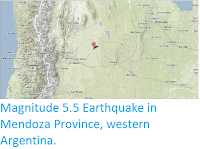
Magnitude 5.5 Earthquake in Mendoza Province, western Argentina.

The United States Geological Survey recorded a Magnitude 5.5 Earthquake at a depth of 19.3 km in Mendoza Province, eastern Argentina, slightly before 3.20 am local time (slightly before 6.20 am GMT) on Friday 15 November 2013. This was a large quake, and potentially quite dangerous, however it occurred in the arid and sparsely populated northeast of the province, and there are no reports of any damage or casualties.

The approximate location of the 15 November 2013 Mendoza Province Earthquake. Google Maps.

Mendoza Province is located on the eastern margin of the Andes Mountains, one of the most tectonically active mountain ranges in the world, and the plains to the east of these mountains. The Andes are being formed as the Nazca Plate to the west is subducted beneath the South American Plate. This causes quakes in a number of ways. Firstly there is friction between the two plates as the Nazca Plate passes under South America. Then there is crumpling and upthrust of the South American as it is pushed from the west by the Nazca Plate and from the east by the expansion of the Atlantic. Finally there is volcanic activity in the Andes, as lighter minerals in the Nazca Plate are melted by the heat of the Earth's interior, then rise up through the overlying South American Plate to form volcanoes.


Follow Sciency Thoughts on Facebook.