Showing posts with label Yamagata Prefecture. Show all posts

Sunday, 11 March 2018

Macrobiotus shonaicus: A new species of Tardigrade from Japan.

Tardigrades, or Water Bears, are a distinctive group of small (usually less than 1 mm) invertebrates related to Arthropods, Nematodes and Velvet Worms. They have a simple segmented body with four pairs of limbs, and are remarkably resilient to environmental stress, being able to withstand extremely high and low temperatures, complete desiccation and even exposure to vacuum. To date about 1200 species of Tardigrade have been described, from marine, freshwater and terrestrial environments. Of these 167 have been recorded in Japan, including 26 species first described from the nation.

In a paper published in the journal PLoS One on 28 February 2018, Daniel Stec of the Institute of Zoology and Biomedical Research at Jagiellonian University, Kazuharu Arakawa of the Institute for Advanced Biosciences at Keio University, and Łukasz Michalczyk, also of the Institute of Zoology and Biomedical Research at Jagiellonian University, describe a new species of Tardigrade from Yamagata Prefecture in Japan.

The new species is placed in the genus Macrobiotus and given the specific name shonaicus, in reference to the Shōnai Region of Yamagata Prefecture, where it was discovered. Adults of this species range from 318 to 743 μm in length and are yellowish in colour, whereas juveniles are white. This species has a granular surface on its limbs, slender claws and three bands of teeth.

Macrobiotus shonaicus. (A) Specmen in dorso-ventral projection (preserved in Hoyer's medium, and imaged using phase contrast light microscopy); (B) specimen in dorsal view Scanning Electron Microscope image). Scale bars in μm. Stec et al. (2018).

See also...

http://sciencythoughts.blogspot.co.uk/2017/09/bryodelphax-kristenseni-new-species-of.htmlhttp://sciencythoughts.blogspot.co.uk/2017/08/estimating-possibility-of-all-life.html
http://sciencythoughts.blogspot.co.uk/2017/06/macrobiotus-polypiformis-new-species-of.htmlhttp://sciencythoughts.blogspot.co.uk/2017/02/ovatiovermis-cribratus-luolishanid.html
http://sciencythoughts.blogspot.co.uk/2016/05/milnesium-swansoni-new-species-of.htmlhttp://sciencythoughts.blogspot.co.uk/2015/06/quisarctus-yasumurai-new-species-of.html
Follow Sciency Thoughts on Facebook.

Wednesday, 31 January 2018

Warning issued after seismic activity beneath Mount Zaō, Japan.

The Japan Meteorological Agency has issued a warning for people to keep away from the  Mount Zaō volcanic complex, which straddles the border between Yamagata and Miyagi prefectures on Honshū Island, Japan, after a series of small seismic tremors were detected beneath the area on Tuesday 30 January 2018, as well as a slight swelling of the ground. The tremors are thought to have been caused by the movement of hot water and volcanic gas, which could indicate that the volcano is about to erupt.

The  Mount Zaō volcanic complex on Honshū Island, Japan. Kyodo News Agency.

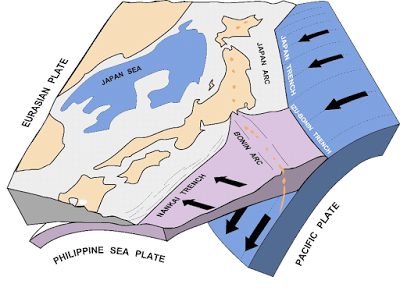
Japan has a complex tectonic situation, with parts of the country on four different tectonic plates. Kyushu Island lies at the northeast end of the Ryukyu Island Arc, which sits on top of the boundary between the Eurasian and Philippine Plates. The Philippine Plate is being subducted beneath the Eurasian Plate, in the Ryukyo Trench, to the Southeast of the Islands. As it is drawn into the interior of the Earth, the tectonic plate is partially melted by the heat of the Earth's interior, and liquid magma rises up through the overlying Eurasian Plate to form the volcanoes of the Ryukyu Islands and Kyushu.

The movement of the Pacific and Philippine Plates beneath eastern Honshu. Laurent Jolivet/Institut des Sciences de la Terre d'Orléans/Sciences de la Terre et de l'Environnement.

See also...

http://sciencythoughts.blogspot.co.uk/2018/01/eruption-on-mount-kusatsu-shirane-kills.htmlhttp://sciencythoughts.blogspot.co.uk/2018/01/magnitude-48-earthquake-beneath-chiba.html
http://sciencythoughts.blogspot.co.uk/2017/10/eruption-on-mount-shinmoedake-kyushu.htmlhttp://sciencythoughts.blogspot.co.uk/2017/10/magnitude-60-earthquake-off-east-coast.html
http://sciencythoughts.blogspot.co.uk/2017/09/magnitude-46-earthquake-beneath-saitama.htmlhttp://sciencythoughts.blogspot.co.uk/2017/08/eleven-injured-by-landslide-in-gifu.html
Follow Sciency Thoughts on Facebook.