Showing posts with label Tardigrades. Show all posts

Wednesday, 3 June 2020

Cyaegharctus kitamurai: A new species of Marine Tardigrade from a submarine cave in the Ryukyu Archipelago, Japan.

Tardigrades, or Water Bears, are a distinctive group of small (usually less than 1 mm) invertebrates related to Arthropods, Nematodes and Velvet Worms. They have a simple segmented body with four pairs of limbs, and are remarkably resilient to environmental stress, being able to withstand extremely high and low temperatures, complete desiccation and even exposure to vacuum. Marine Tardigrades, specifically Arthrotardigrades, exhibit remarkable morphological diversity. The Styraconyxidae is one of the Arthrotardigrade families and it is currently comprised of 38 species and subspecies placed withingten genera: Angursa (eight species), Bathyechiniscus (one species), Lepoarctus (one species), Paratanarctus (one species), Pleocola (one species), Raiarctus (five species), Rhomboarctus (three species), Styraconyx (15 species and subspecies), Tetrakentron (one species), and Tholoarctus (three species and subspecies). In addition to these ten genera, an undescribed genus related to Styraconyx and Tetrakentron has been reported from a submarine cave in Japan, although no formal description of that species has ever been made and two voucher micrographs of a specimen used for a molecular phylogenetic study have been published.

In a paper published in the journal Zoosystematics and Evolution on 23 March 2020, Shinta Fujimoto of the Research Center for Marine Biology at Tohoku University, and Naoto Jimi of the Japanese National Institute of Polar Research formerly describe this submarine cave-dwelling Tardigrade.


Specimens were collected from Daidokutsu, a submarine cave off Iejima Island in the Okinawa Islands, part of the Ryukyu Archipelago, Japan, by Koshin Yasumura and Shinta Fujimoto in 2013 and 2019. For extraction of meiofauna, the cave sediment samples were stirred with tap water and the supernatants were concentrated using a 30 μm opening mesh net to separate coarse sediment and to wash away seawater. Subsequently, the meiofauna and fine sediment were separated using LUDOX HS-40 colloidal silica and a 32 μm opening mesh net. The type material was sorted under a stereomicroscope and fixed in 2–4% buffered formaldehyde. Specimens for light microscopy were mounted in distilled water for brief observation and mounted in glycerol. Differential interference contrast microscopy was conducted using an Olympus BX53 and phase contrast microscopy was conducted using an Olympus BX41. One specimen for scanning electron microscopy was post-fixed in 2% OsO₄ for 2 hours, dehydrated through a series of ethanol and acetone washes, critical point dried, osmium coated, and observed using a JEOL JSM-7001F Schottky Emission Scanning Electron Microscope. Type material was deposited in the Zoological Collection of Kyoto University. Adobe Illustrator CS6 and Photoshop CS6 were used to prepare figures and to obtain morphometric data.

The species is placed in a new genus, named Cyaegharctus, which is a combination of 'Cyäegha-', a deity of darkness and caves in the writings of Eddy Bertin, and '-arctus', a Latinised Greek word meaning 'bear', commonly used as a suffix when naming Tardigrades, and given the specific name kitamurai, in honour of Akihisa Kitamura of Shizuoka University, who has been studying Daidokutsu Cave and its Bivalve assemblage. The species is described from four specimens, three adult females and a juvenile, all collected from Daidokutsu Cave.

The holotype of Cyaegharctus kitamurai (when describing a new species one specimen is designated the holotype; all future specimens determined to belong to the same species as this holotype therefore bellong to the species) is an adult female with a dorso-ventrally flattened body 202 μm in length and 117 μm wide at level of leg III. The cephalic region (head) has an unpaired median cirrus (tendril), paired internal cirri, paired external cirri, paired lateral cirri, paired primary clavae (clublike structures), paired secondary clavae and an antero-ventral directed mouth. Paired spine-like cirri (38 μm) on cirrophores (stalks) arise from round lateral processes at level between legs III and IV. A rosette-like gonopore (genital opening) is 9 μm anterior to anus. There are four pairs of legs, each with an usual leg sensory organ on the dorsal side of the femur’s proximal portion, a pocket organ on the dorsal side of femur’s distal margin and four digits terminating in claws. 

Drawings of Cyaegharctus kitamurai, holotype KUZ Z2624. (A) Habitus (ventral view). (B) Leg IV pocket organ. Abbrreviations: an, anus; bt, buccal tube; ca, cavity; cE, cirrus E; db, dense body; ec, external cirrus; go, female gonopore; ic, internal cirrus; lc, lateral cirrus; mc, median cirrus; pc, primary clava; pl, placoid; op, opening; sc, secondary clava; soₗ, ₗᵥ legs I and IV sensory organs; sr, seminal receptacles; ss, stylet support; st, stylet. Fujimoto & Jimi (2020).

Fixation of specimens using formaldehyde seems to have introduced an artefact in the cuticle, i.e. the detached (or loose) outer epicuticle. When the specimens were sorted in distilled water before fixation, the outer epicuticle did not look loose at 63× magnification (all four specimens) and also at 400× magnification (only observed for KUZ Z2627) as it would appear in Tholoarctus. Although these are only brief observations and Fujimoto and Jimi did not conduct any experiment to test this artefact, they consider the outer epicuticle’s detached state as an artefact and excluded this character state from the diagnoses of this genus and species.

The adult female paratype KUZ Z2625 revealed the presence of a cuticular ring surrounding the rosette gonopore and the presence of the spine-like leg III sensory organs with no subdivisions. In the adult female paratype KUZ Z2626, the legs I–III sensory organs, claws and peduncles were orientated better than the holotype and the other paratype for observation. However, the pocket organs were not recognised for this specimen, probably due to the excessively-squeezed state.
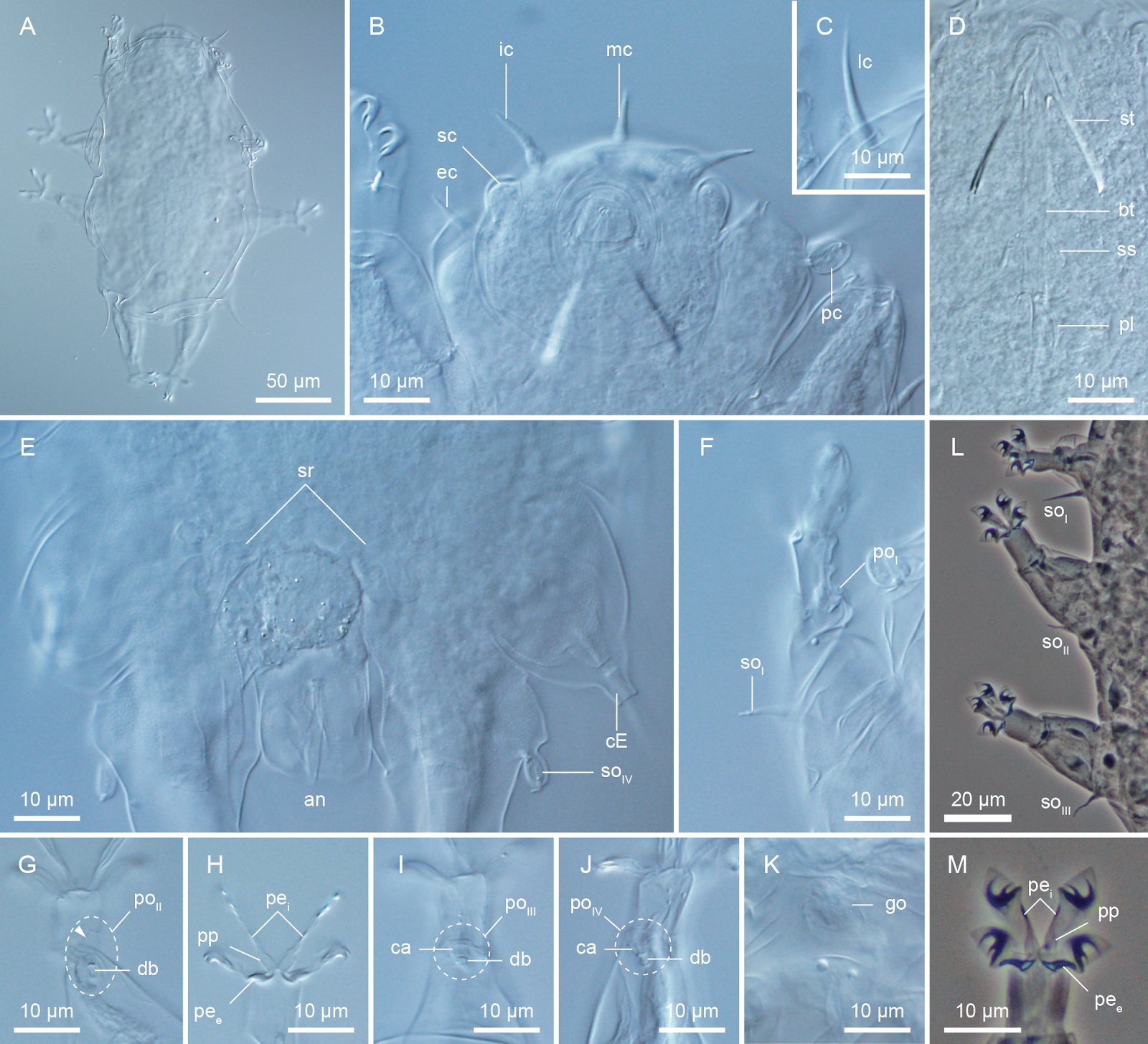
DIC and PhC micrographs of Cyaegharctus kitamurai, adult female. (A) Habitus (dorsal view), (B) cephalic region (ventral view), (C) lateral cirrus. (D) buccal apparatus, (E) caudal region (ventral view) (epicuticle pillars visible), (F) leg I sensory organ and pocket organ, (G) leg II pocket organ (arrowhead indicates protruding portion), (H) leg II digits and claws, (I) leg III pocket organ, (J) leg IV pocket organ, (K) female gonopore, (L) legs I–III sensory organs, (M) leg III digits and claws. (A)–(J) holotype KUZ Z2624, (K) paratype KUZ Z2625, (L), (M) paratype KUZ Z2626. Abbreviations: an, anus; bt, buccal tube; ca, cavity; cE, cirrus E; db, dense body; ec, external cirrus; go, gonopore; ic, internal cirrus; lc, lateral cirrus; mc, median cirrus; pc, primary clava; peᵢ,ₑ, peduncles of internal and external digits; pl, placoid; poₗ–ₗᵥ, legs I–IV pocket organs; pp, proximal pad; sc, secondary clava; soₗ–ₗᵥ, legs I–IV sensory organs; sr, seminal receptacles; ss, stylet support; st, stylet. Fujimoto & Jimi (2020).

The scanning electron micrographs of a four claw juvenile confirmed the results of light microscopy and also provided further detail. However, this scanning electron micrograph specimen also seems to have its outer epicuticle detached. If the outer epicuticle is attached to the underlying layer, a pattern is recognised on the surface of the body due to the pillar layer, but no such indentations were found, suggestive of the detached state of the outer cuticle. The proximal part of each leg has an inflated appearance not recognised in light microscopy. The view of the cephalic region revealed the three-dimensional morphology and the arrangement of the cephalic appendages and also confirmed the presence of terminal pores on the cephalic cirri and the primary clavae. The conical shape of the secondary clavae seems not as evident as in light microscopy probably due to the overlying outer epicuticle. The large anus is not on the ventral surface and rather direct posteriorly. The leg sensory organs were recognised and those of legs I and IV revealed to have terminal pores. The pocket organs were recognised on all legs, however, with slightly different degrees of protruded appearances. The protruded state might be an artefact caused during specimen preparation since specimens on microscope slides do not always have these appearances or the pocket organs are capable of moving. In the latter case, since no muscles seem to be attached to the structures, a passive movement is likely. Regarding claw/digit morphology, the peduncles (internal structures) were not recognised but the three hooks of the internal claws and the single-pointed external claws were recognised.

Scanning electron micrographs of Cyaegharctus kitamurai, four-claw juvenile paratype KUZ Z2627. (A) Habitus (lateral view), (B) cephalic region (frontal view), (C) cephalic region (ventral view), (D) anus, (E) leg I sensory organ, (F) leg II sensory organ, (G) leg III sensory organ, (H) leg IV sensory organ, (I) leg IV pocket organ, (J) leg III digits and claws. Abbreviations: ah, accessory hook; an, anus; cE, cirrus E; ec, external cirrus; fe, femur; ic, internal cirrus; lc, lateral cirrus; mc, median cirrus; pc, primary clava; ph, primary hook; poₗ, ₗᵥ, legs III and IV pocket organs; pp, proximal pad; sc, secondary clava; sh, secondary hook; soₗ–ₗᵥ, legs I–IV sensory organs; ti, tibia. Fujimoto & Jimi (2020).

Fujimoto and Jimi consider the dense body inside the pocket organs of Cyaegharctus kitamurai to be related to the van der Land’s body, often situated at the base of the primary clavae and leg IV sensory organs and suggest that the pocket organs are chemoreceptors. However, only one previous study, in 1981, investigated the function and ultrastructure of Arthrotardigrade sensory organs by transmission electron microscopy and, with our poor knowledge on Arthrotardigrade sensory organs, this remains a matter of speculation. Another possibility for the new structure is a secretory organ. However, no gland was recognised in its vicinity and there is no evidence supporting this hypothesis. To understand the true functions and evolutionary significance of the pocket organs, comparative ultrastructure studies of Arthrotardigrades (including Cyaegharctus kitamurai) are necessary.

See also...

https://sciencythoughts.blogspot.com/2018/11/macrobiotus-hannae-new-species-of.htmlhttps://sciencythoughts.blogspot.com/2018/09/bryodelphax-arenosus-new-species-of.html
https://sciencythoughts.blogspot.com/2018/03/macrobiotus-shonaicus-new-species-of.htmlhttps://sciencythoughts.blogspot.com/2017/09/bryodelphax-kristenseni-new-species-of.html
https://sciencythoughts.blogspot.com/2017/08/estimating-possibility-of-all-life.htmlhttps://sciencythoughts.blogspot.com/2017/06/macrobiotus-polypiformis-new-species-of.html
Follow Sciency Thoughts on Facebook.

Sunday, 4 November 2018

Macrobiotus hannae: A new species of Tardigrade from Podlasie Province, Poland.

Tardigrades, or Water Bears, are a distinctive group of small (usually less than 1 mm) invertebrates related to Arthropods, Nematodes and Velvet Worms. They have a simple segmented body with four pairs of limbs, and are remarkably resilient to environmental stress, being able to withstand extremely high and low temperatures, complete desiccation and even exposure to vacuum. To date about 1200 species of Tardigrade have been described, from marine, freshwater and terrestrial environments, with about a dozen more being described each year.

In a paper published in the Turkish Journal of Zoology on 28 March 2018, Bernadeta Nowak and Daniel Stec of the Institute of Zoology and Biomedical Research at Jagiellonian University, describe a new species of Tardigrade from Podlasie Province in northern Poland.

The new species is named Macrobiotus hannae, in honour of Hanna Tutaj, a PhD student at the Institute of Environmental Sciences at Jagiellonian University. The species is described from 139 individuals and 146 eggs, raised in culture from an initial sample collected from some ground-covering Moss in a deciduous forest in Podlasie Province. Adults of this species ranged from 341 to 760 μm in length, were white in colour and hermaphroditic. Juveniles are transparent and eggs white.

Macrobiotus hannae in dorsoventral view. Scale bar is 50 μm. Nowak & Stec (2018). 

The new species is very similar in appearance to the previously described Macrobiotus joannae, which was first identified in Australia in 1983, and has subsequently been reported in Russia and Italy, though the two species could be distinguished using genetic methods. This leads Nowak and Stec to question whether the European reports of Macrobiotus joannae are in fact erroneous, and are really specimens of Macrobiotus hannae.

See also...

https://sciencythoughts.blogspot.com/2018/09/bryodelphax-arenosus-new-species-of.htmlhttps://sciencythoughts.blogspot.com/2018/03/macrobiotus-shonaicus-new-species-of.html
https://sciencythoughts.blogspot.com/2017/09/bryodelphax-kristenseni-new-species-of.htmlhttps://sciencythoughts.blogspot.com/2017/08/estimating-possibility-of-all-life.html
https://sciencythoughts.blogspot.com/2017/06/macrobiotus-polypiformis-new-species-of.htmlhttps://sciencythoughts.blogspot.com/2017/02/ovatiovermis-cribratus-luolishanid.html
Follow Sciency Thoughts on Facebook.

Tuesday, 25 September 2018

Bryodelphax arenosus: A new species of Tardigrade from Borneo.

Tardigrades, or Water Bears, are a distinctive group of small (usually less than 1 mm) invertebrates related to Arthropods, Nematodes and Velvet Worms. They have a simple segmented body with four pairs of limbs, and are remarkably resilient to environmental stress, being able to withstand extremely high and low temperatures, complete desiccation and even exposure to vacuum. To date about 1200 species of Tardigrade have been described, from marine, freshwater and terrestrial environments. To date only a single Tardigrade has been described from Borneo, despite this landmass being the world's third largest landmass and an area of extremely high biodiversity.

In a paper published in the Raffles Bulletin of Zoology on 26 June 2018, Piotr Gąsiorek of the Institute of Zoology and Biomedical Research at Jagiellonian University described a new species of Tardegrade from the Bako Peninsula of Sarawak in Malaysian Borneo.

The new species is placed in the genus Bryodelphax, and given the specific name arenosus, meaning 'sandy'; the species was found dwelling in moss growing on a tree in an area of coastal lowland rainforest with sandy soil - something unusual in rainforests. The species is described from fifteen adult female specimens, no males were located leading Gąsiorek to speculate that the species may be parthenogenetic (able to reproduce without males, by development of unfertilized eggs). The specimens ranged from 543 μm to 648 μm in length, and are yellowish and pearly opalescent in colour. The species lacked any visible eyes.

Bryodelphax arenosus, dorsal view. Gąsiorek (2018).

See also...

https://sciencythoughts.blogspot.com/2018/03/macrobiotus-shonaicus-new-species-of.htmlhttps://sciencythoughts.blogspot.com/2017/09/bryodelphax-kristenseni-new-species-of.html
https://sciencythoughts.blogspot.com/2017/08/estimating-possibility-of-all-life.htmlhttps://sciencythoughts.blogspot.com/2017/06/macrobiotus-polypiformis-new-species-of.html
https://sciencythoughts.blogspot.com/2017/02/ovatiovermis-cribratus-luolishanid.htmlhttps://sciencythoughts.blogspot.com/2016/05/milnesium-swansoni-new-species-of.html
Follow Sciency Thoughts on Facebook.

Sunday, 11 March 2018

Macrobiotus shonaicus: A new species of Tardigrade from Japan.

Tardigrades, or Water Bears, are a distinctive group of small (usually less than 1 mm) invertebrates related to Arthropods, Nematodes and Velvet Worms. They have a simple segmented body with four pairs of limbs, and are remarkably resilient to environmental stress, being able to withstand extremely high and low temperatures, complete desiccation and even exposure to vacuum. To date about 1200 species of Tardigrade have been described, from marine, freshwater and terrestrial environments. Of these 167 have been recorded in Japan, including 26 species first described from the nation.

In a paper published in the journal PLoS One on 28 February 2018, Daniel Stec of the Institute of Zoology and Biomedical Research at Jagiellonian University, Kazuharu Arakawa of the Institute for Advanced Biosciences at Keio University, and Łukasz Michalczyk, also of the Institute of Zoology and Biomedical Research at Jagiellonian University, describe a new species of Tardigrade from Yamagata Prefecture in Japan.

The new species is placed in the genus Macrobiotus and given the specific name shonaicus, in reference to the Shōnai Region of Yamagata Prefecture, where it was discovered. Adults of this species range from 318 to 743 μm in length and are yellowish in colour, whereas juveniles are white. This species has a granular surface on its limbs, slender claws and three bands of teeth.

Macrobiotus shonaicus. (A) Specmen in dorso-ventral projection (preserved in Hoyer's medium, and imaged using phase contrast light microscopy); (B) specimen in dorsal view Scanning Electron Microscope image). Scale bars in μm. Stec et al. (2018).

See also...

http://sciencythoughts.blogspot.co.uk/2017/09/bryodelphax-kristenseni-new-species-of.htmlhttp://sciencythoughts.blogspot.co.uk/2017/08/estimating-possibility-of-all-life.html
http://sciencythoughts.blogspot.co.uk/2017/06/macrobiotus-polypiformis-new-species-of.htmlhttp://sciencythoughts.blogspot.co.uk/2017/02/ovatiovermis-cribratus-luolishanid.html
http://sciencythoughts.blogspot.co.uk/2016/05/milnesium-swansoni-new-species-of.htmlhttp://sciencythoughts.blogspot.co.uk/2015/06/quisarctus-yasumurai-new-species-of.html
Follow Sciency Thoughts on Facebook.

Saturday, 30 September 2017

Bryodelphax kristenseni: A new species of Tardigrade from the Sierra Nevada de Santa Marta Mountains of Colombia.

Tardigrades, or Water Bears, are a distinctive group of small (usually less than 1 mm) invertebrates related to Arthropods, Nematodes and Velvet Worms. They have a simple segmented body with four pairs of limbs, and are remarkably resilient to environmental stress, being able to withstand extremely high and low temperatures, complete desiccation and even exposure to vacuum. To date about 1200 species of Tardigrade have been described, from marine, freshwater and terrestrial environments. Of these, less than 250 have been described from South America, the majority of these from Chile, Argentina and Brazil. 

In a paper published in the journal ZooKeys on 27 September 2017, Oscar Lisi of the Grupo de Investigación MIKU at the Universidad del Magdalena, and the Dipartimento di Scienze Biologiche, Geologiche e Ambientali at the Università di Catania, Anisbeth Daza and Rosana Londoño, also of the Grupo de Investigación MIKU at the Universidad del Magdalena, and Sigmer Quiroga of the Programa de Biología at the Universidad del Magdalena, describe a new species of Tardegrade from the Sierra Nevada de Santa Marta Mountains of Colombia.

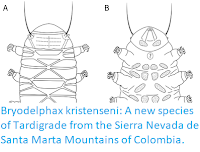
The new species is placed in the genus Bryodelphax, and given the specific name kristenseni, in honour of Reinhardt Møbjerg Kristensen, of the Natural History Museum of Denmark and University of Copenhagen, for his work on Tardigrade taxonomy. The species is described from eleven specimens collected from Lichen, Moss and Liverworts at two locations in the Sierra Nevada de Santa Marta Mountains. These range from 106 to 131 μm in length, are apparently eyeless and covered in armoured plates.

Drawings of the dorsal (A) and ventral (B) plates arrangement of Bryodelphax kristenseni. Lisi et al. (2017).

See also...

http://sciencythoughts.blogspot.co.uk/2017/08/estimating-possibility-of-all-life.htmlhttp://sciencythoughts.blogspot.co.uk/2017/06/macrobiotus-polypiformis-new-species-of.html
http://sciencythoughts.blogspot.co.uk/2017/02/ovatiovermis-cribratus-luolishanid.htmlhttp://sciencythoughts.blogspot.co.uk/2016/05/milnesium-swansoni-new-species-of.html
http://sciencythoughts.blogspot.co.uk/2015/06/quisarctus-yasumurai-new-species-of.htmlhttp://sciencythoughts.blogspot.co.uk/2014/05/a-new-species-of-tardigrade-from-latvia.html
Follow Sciency Thoughts on Facebook.

Wednesday, 30 August 2017

Estimating the possibility of all life being wiped-out by astrophysical events on Earth or an Earth-like exoplanet.

People have speculated about the possibility of life on other planets for almost as long as they have been aware that other planets exist. With increasing technological capabilities, it is thought that we will be able to look for life on other planets within the next few decades. Before this is done, however. It is sensible to attempt to estimate how widespread life might be in the Universe, and where it is most likely to be found. There are two factors which affect this, namely the origin of life on planets, and its disappearance. We know that life arose on Earth between 4.0 and 4.5 billion years ago, though we do not fully understand how it occurred, hampering attempts to estimate how likely the same thing is to occur somewhere else. We also know that the history of life on Earth has been subject to a series of major extinction events, at least one of which is attributed to an astrophysical event (the End Cretaceous Extinction, which is widely thought to have been caused by the impact of a large extra-terrestrial body into the Yucatan Peninsula in Mexico. There has also been significant speculation about other astrophysical events causing extinction events, though as yet no evidence for this has been found, and the likelihood of such events happening at all is unclear.

In a paper published in the journal Scientific Reports on 14 July 2017, David Sloan and Rafael Alves Batista of the Department of Physics at the University of Oxford and Abraham Loeb of the Astronomy Department at Harvard University discuss the possibility of a number of astrophysical events causing extinction events of sufficient magnitude to wipe out all life on an Earth-like planet.

In order to do this, they examined the energy levels needed to wipe out the toughest known group of organisms on Earth, Tardigrades, which are far more likely to survive any such events than more delicate organisms such as Humans, and which could potentially evolve into a range of new organisms occupying other ecological roles in the aftermath of a major extinction event. Tardigrades have been shown to survive temperatures between −272 °C and 150 °C, and can survive sustained periods of time at −20 °C. They can survive exposure to the vacuum of space, and are found living at the bottom of the Marianas Trench, where the pressure reaches about 1200 atmospheres. They can also survive exposure to radiation levels of ∼5000–6200 Gy (enough energy to endow every kilogram of matter with 5000-6200 Joules of energy). 

Firstly, Sloan et al. examined the possibility of a large impact event wiping out all life on Earth. While this is thought to have been the trigger mechanism for the End Cretaceous Extinction, and large impacts have the capability to cause an impact winter, lethal to large terrestrial animals and very bad news for anything dependent on photosynthesis, either by itself or its food, that cannot survive without any energy input for at least several years, it is far less threatening to marine organisms, particularly those which form part of the food-chains based upon chemosynthesis found around deep sea vents. In order to wipe out Tardigrades and other organisms at the bottom of the ocean trenches, Sloan et al. estimate that an asteroid would have to have a mass in excess of 1700 billion  megatonnes (note that this is significantly larger than the estimated size needed for an impactor to completely remove the Earth’s atmosphere, as it requires far more energy to heat water than air; a smaller impact could potentially remove Earth’s atmosphere but not its oceans, enabling a new atmosphere to form from the evaporation of the upper layers of the oceans).

 An artist's impression of a gigantic asteroid impacting an Earth-like planet. Don Davis/NASA.

The Solar System currently contains seventeen known asteroids larger than this limit, plus several Dwarf Planets. It is thought that there were more such bodies in the early Solar System, and that at least one body did impact the Earth (leading to the formation of the Moon), but the majority these are thought to have disappeared early in the history of the system (a period called the Early Bombardment), and Sloan et al. calculate that the possibility of such an impact happening to Earth later in the history of the Solar System (or to any Earthlike planet in a reasonably similar system) is in fact vanishingly small, even over periods of billions of years.

Secondly Sloan et al. consider the possibility of life on Earth being wiped out by a nearby supernova. Supernovae are spectacular events, occuring at the end of the life of massive stars, which generate sufficient gravity to fuse elements heavier than boron, then are blown apart by the energy released. The release of energy from a giant star exploding is, fairly obviously, quite significant, and has been suggested several times as potential trigger for extinction events. However most of the energy from such an event is released in a spherical shockwave, which quickly dissapates as the wave expands.

An artist's impression of an Earth-like planet being destroyed by a supernova. NASA.
 
Sloan et al. calculate that in order for a supernova to exterminate all life on Earth, it would have to occur within 0.04 parsecs (0.13 light years) from us, less than a thirtieth of the distance to the current nearest star, Proxima Centuri. The nearest star thought to be large enough to undergo a supernova at the end of its life, IK Pegasi, is about 45 Parsecs (147 light years) away. While the stars do move, and at different points in time other stars are likely to have been closer than Proxima Centuriet al. do note that stars are more densily packed towards the core of the Galaxy, and that there the risk of a supernova occuring close to a planet with life on would be somewhat higher; they estimate that a life-bearing planet in sich a situation would have a 1% chance of being completey sterilized by a supernova during the course of its life.

Next Sloan et al  consider the possibility of Earth, or an Earth-like planet being knocked out of its orbit by the tidal influence of a passing star. This is another theoretical possibilty that has been proposed in the past, both by serious scientists and science fiction writers, but which has not previouslt been analysed statistically. Sloan et al. calculate that at the density of stars in our part of the galaxy, there is a one in 300 000 000 chance of this happening for each billion years of a planet's life, but that in the more densely packed galactic core this will rise to 1 in 1 000 000 per billion years of an Earth-like planet's life.

Sloan et al. do note that one astrophysical event is almost certainly likely to wipe out life on Earth in the end, that being the eventual death of out star, the Sun. At the end of its life the Sun is expected to expand significantly as it uses up its hydrogen reserves, the fusion of which prevents it from collapsing to far under its own gravity, and contracts till it is sufficiently dense to begin fusing helium, at which point it will release more energy from each fusion event, and expand significantly. This may result in the Sun expanding sufficiently to engulph the Earth, or to steralize its surface. Alternatively, if the Sun does not expand this far, it will eventually run out of fuel completely and cool, causing Earth to freeze irreperably, again killing any surviving life.

 The surface of a future Earth is likely be sterilized by an expanding, superheated Sun. Alamy.

However there is a third (albeit rather unlikely) scenario, in which an expanding Sun pushes the Earth out of its orbit, causing it to become a rogue planet, drifting through space without an accompanying star. While this would clearly be cataclismic to life on the planet's surface, Sloan et al. suggest that life around hydrothermal vents, now at the bottom of a shrunken ocean burried beneath a thick ice cap, could potentially survive for a few tens of millions of years, with a (very) slight chance that the drifting planet might be captured by another star in this time, enabling life tore-emerge.

See also...

http://sciencythoughts.blogspot.co.uk/2017/06/macrobiotus-polypiformis-new-species-of.htmlhttp://sciencythoughts.blogspot.co.uk/2017/04/gobekli-tepe-does-ancient-anatolian.html
http://sciencythoughts.blogspot.co.uk/2016/08/could-there-have-been-life-on-ancient.htmlhttp://sciencythoughts.blogspot.co.uk/2016/07/using-hypothetical-ninth-planet-to.html
http://sciencythoughts.blogspot.co.uk/2016/05/multicellular-eukaryotic-organisms-from.htmlhttp://sciencythoughts.blogspot.co.uk/2016/05/milnesium-swansoni-new-species-of.html
Follow Sciency Thoughts on Facebook.

Friday, 30 June 2017

Macrobiotus polypiformis: A new species of Tardigrade from the Ecuadorian Pacific coast.

Tardigrades, or Water Bears, are a distinctive group of small (usually less than 1 mm) invertebrates related to Arthropods, Nematodes and Velvet Worms. They have a simple segmented body with four pairs of limbs, and are remarkably resilient to environmental stress, being able to withstand extremely high and low temperatures, complete desiccation and even exposure to vacuum. To date about 1200 species of Tardigrade have been described, from marine, freshwater and terrestrial environments. Of these, only 227 have been described from South America, the majority of these from Chile, Argentina and Brazil. Ecuador is a large country in the northwest of South America, with a range of environments that can broadly be grouped into the western coastal lowlands, the central Andes Mountains, and the Amazon Basin in the east; yet to date only a single species of Tardigrade from Ecuador.

In a paper published in the European Journal of Taxonomy on 7 June 2017, Milena Roszkowska of the Department of Animal Taxonomy and Ecology at the Adam Mickiewicz University in Poznań, Marta Ostrowska of the Department of Avian Biology and Ecology, also at the Adam Mickiewicz University in Poznań, Daniel Stec of the Department of Entomology at Jagiellonian University, Karel Janko of the Laboratory of Fish Genetics at the Institute of Animal Physiology and Genetics of the Academy of Sciences of the Czech Republic, and Łukasz Kaczmarek, again of the Department of Animal Taxonomy and Ecology at the Adam Mickiewicz University in Poznań, describe a new species of Tardigrade from Manabí Province on the Ecuadorian Pacific coast.

The new species is named Macrobiotus polypiformis, in reference to processes found on the eggs of the species, which resemble the polyps of Cnidarians. The species is described from 96 specimens collected from a patch of Moss growing on a concrete wall, plus eggs and 36 second generation individuals obtained by culturing some of the original specimens in spring water. 

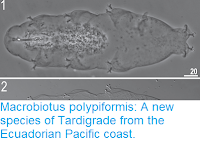
Macrobiotus polypiformis, dorso-ventral projection. (1) Taken using an Olympus BX41 phase contrast microscope. (2) Taken using an Olympus BX63 differential interference contrast microscope. Seen in DIC. Scale bars in μm. Rozkowska et al. (2017).

Adult individuals of the new species are 237–375 μm in length and white in colour, although they became transparent when fixed in Hoyer’s medium for viewing under a microscope. The mouth is surrounded by a ring of small pores, and has three rows of teeth, though only one of these could be seen under a light microscop.

Egg of Macrobiotus polypiformis. Rozkowska et al. (2017).  

 See also...


http://sciencythoughts.blogspot.co.uk/2016/05/milnesium-swansoni-new-species-of.html
http://sciencythoughts.blogspot.co.uk/2017/02/ovatiovermis-cribratus-luolishanid.html

http://sciencythoughts.blogspot.co.uk/2014/05/a-new-species-of-tardigrade-from-latvia.html
http://sciencythoughts.blogspot.co.uk/2015/06/quisarctus-yasumurai-new-species-of.html

Follow Sciency Thoughts on Facebook.