Tuesday, 28 April 2015

Afghanistan landslide kills at least 52.

Fifty two people have been confirmed dead after a landslide struck a remote village in the Khawahan District in Badakhshan Province in northeastern Afghanistan, close to the border with Tajikistan, early on Tuesday 28 April 2015. The deaths of twenty five women, twenty two children and seven men have been confirmed, though as ninety seven houses have been buried it is likely that the death toll will rise sharply.

The approximate location of the 28 April 2015 Badakshan landslide. Google Maps.

Landslides are a common problem in the northeast of Afghanistan, particularly in the moonsoon season and during the spring thaw, both of which are prone to causing flooding. Landslides are a common problem after severe weather events, as excess pore water pressure can overcome cohesion in soil and sediments, allowing them to flow like liquids. Approximately 90% of all landslides are caused by heavy rainfall. Badakhstan is thought to be particularly prone to such events, both because it is extremely mountainous, and because it is one of the poorest and least developed in Afghanistan, with little infrastructure to provide protection against geohazards or provide support when they occur.

The situation has been made worse during the prolonged conflicts with first Soviet occupiers and then American led Western forces, which led to the collapse of the coal mining industry in the province, causing people to turn to wood as a fuel for cooking and heating homes. This has in turn led to severe deforestation in many areas, worsening the risk of landslides as the tree root system, which helps to stabilize soils on steeply inclined hillsides, starts to break down.

See also...

The United States Geological Survey recorded a Magnitude 5.8 Earthquake at a depth of 97.2 km in southern Badakshan Province, Afghanistan...


Seventy three people are known to have died and around 200 more are still missing following a series of flash floods in the Guzargah-e-Nur District of Baghlan Province, Afghanistan, overnight between Friday 6...

It is feared that over 2500 people may have died following two landslides in Badakhshan Province in northeast Afghanistan on the morning of Friday 2...


Follow Sciency Thoughts on Facebook.

Resurrecting the Unfortunate Dragon.


In the early 1860s a 5 m Plesiosaur was excavated from the Early Jurassic Blue Lias Formation at Street-on-the-Fosse in Somerset. This was subsequently described as Plesiosaurus megacephalus, and placed on public display at the Bristol City Museum and Art Gallery, where it remained until 24 November 1940, when along with many other artefacts stored in the museum, it was destroyed in an air raid during the Second World War, and apparently lost to science.

However prior to its destruction several plaster castes of the specimen were made, three of which survive today in the collections of the Natural History Museum in London, the Geology Museum at Trinity College Dublin and the British Geological Survey at Keyworth in Nottingham, and several other specimens from a variety of other Early Jurassic sights around England have been nominated as potential members of the species.

In a paper published in the journal Palaeontologica Electronica in April 2015, Adam Smith of the Nottingham Natural History Museum formally redescribes the species from the available material, designating a neotype specimen and evaluating which specimens that have been referred to the species should in fact be referred to it.

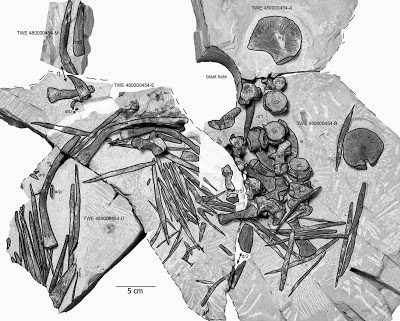
Historical photograph of the holotype skeleton of ‘Plesiosaurus’megacephalus. Photograph taken from glass plate negative in the Bristol City Museum & Art Gallery, originally published by Swinton (1948). Length of skeleton equals 4960 mm. Smith 2015.

In the 1860s little was known about Plesiosaurs, and the generic name ‘Plesiosaurus’ was applied to all specimens discovered. Since then it has become understood that these were a large and diverse group of creatures, and split into several families and numerous genera. The generic name ‘Plesiosaurus’ is now known to be quite inappropriate for the Street-on-the-Fosse specimen, as it was a member of the family Rhomaleosauridae. It has also been referred to as a member of the genera Rhomaleosaurus, Thaumatosaurus and Eurycleidus, though Smith does not feel that any of these designations are correct, instead creating a new generic name, Atychodracon, meaning ‘Unfortunate-Dragon’, in reference to the destruction of the original specimen.

In addition to the original Street-on-the-Fosse specimen, a second partial specimen from the same location has been referred to the species, as have two specimens from Barrow-upon-Soar in Leicestershire (one more-or-less complete and another partial and somewhat poorly preserved), and a complete specimen from Wilmcote in Warwickshire. Smith excludes the Warwickshire specimen from the species, believing it instead to represent a member of a new, undescribed species, but includes all the other specimens.

In zoological nomenclature a type specimen, or holotype, is designated when a new species is described, so that other specimens thought to belong to the same species can be compared to it. In the event that this type specimen is lost or destroyed the International Commission on ZoologicalNomenclature allows the designation of a new specimen as a neotype, so long as it is possible to confirm that it belongs to the same species as the original specimen. The plaster castes and photographs of the missing Bristol specimen of Atychodracon megacephalus provide a good reference point for establishing such a neotype, and Smith therefore designates the more complete of the Leicestershire specimens to be the neotype of the species.

See also…

The Plesiosaurs were Mesozoic marine reptiles that arose in the Late Triassic or Early Jurassic and persisted till the Late Cretaceous. They were related to modern lizards and snakes, but were fully aquatic, the largest species reaching 15 m in length. All species seem to have been strict carnivores, and at least...
 
http://sciencythoughts.blogspot.co.uk/2013/08/a-pliosaur-from-jurassic-coast-of-dorset.htmlA Pliosaur from the Jurassic Coast of Dorset. The Pliosaurs were Mesozoic marine reptiles that arose in the Late Triassic or Early Jurassic and persisted till the Late Cretaceous. They were related to modern lizards and snakes, but were fully aquatic, the largest species reaching 15 m in length. All species seem to have been strict carnivores, and at least one species gave birth to live young. Plesiosaurs are thought to have been fully aquatic from their first appearance; they are...
http://sciencythoughts.blogspot.co.uk/2013/08/new-species-of-placodont-from-middle.htmlNew species of Placodont from the Middle Triassic of the Netherlands.                            Placodonts were a group of Sauropterygian Reptiles (a group related to Snakes and Lizards that includes the better known Pliosaurs and Plesiosaurs which survived to the end of the Mesozoic) from the mid-to late Triassic. They were large animals, ranging one to...
Follow Sciency Thoughts on Facebook.

Determining the Habitable Zone of 70 Virginis.


70 Viriginis is a G-type Yellow Dwarf Star about 59 light years from Earth in the constellation of Virgo. It is calculated to have a mass 109% of that of the Sun, but radius 194% of the Sun’s, and a lower temperature, 5393K, compared to 5778K for the Sun, from which it is calculated to be somewhat older, approximately 7.77 billion years (compared to about 5.0 for the Sun). This star hosts one of the first discovered exoplanets, 70 Virginis b, asuperjovian planet in a short (116 days) but highly eccentric orbit discovered in 1996.

In a paper published on the arXiv database at Cornell University Library on 15 April 2015 and submitted for publication in The Astrophysical Journal, Stephen Kane of the Department of Physics & Astronomy at San Francisco State University, Tabetha Boyejian of the Departmentof Astronomy at Yale University, Gregory Henry of the Center of Excellence in Information Systems at Tennessee State University, Katherina Feng of the Departmentof Astronomy and Astrophysics and Center for Exoplanets & Habitable Worlds at Pennsylvania State University and the Department of Astronomy & Astrophysics at the University of California, Santa Cruz, Natalie Hinkal, also of the Department of Physics & Astronomy at San Francisco State University, Debra Fischer, also of the Department of Astronomy at Yale University, Kaspar von Braun of Lowell Observatory, Andrew Howard of the Institute for Astronomy at the University of Hawaii and Jason Wright, also of the Department of Astronomy and Astrophysics and Center for Exoplanets & Habitable Worlds at Pennsylvania State University, present a fresh study of the 70 Virginis system using new data from the Cente rfor High Angular Resolution Astronomy (CHARA array) at Georgia State University and the HIRES echelle spectrometer on the 10.0m Keck I telescope, which they combine with previously acquired data on the system from the Hamilton Echelle Spectrograph on the 3.0m Shane Telescope at Lick Observatory and the ELODIE spectrograph on the 1.93m telescope at Observatoirede Haute-Provence, which they use to build a model of the Habitable Zone of the system, and calculate the possibility of an Earth-sized planet remaining in a stable orbit within it.

Kane et al. derive a ‘conservative’ habitable zone for the 70 Virginis system with an inner boundary at 1.63 AU from the star (i.e. 1.63 times the average distance at which the Earth orbits the Sun) and an outer boundary at 2.92 AU from the star, and an ‘optimistic’ habitable zone with an inner boundary at 1.29 AU and an outer boundary at 3.08 AU.

A top-down view of the 70 Virginissystem showing the extent of the Habitable Zone calculated using the stellar parameters established with the CHARA, HIRES, Hamilton Echelle and ELODIE data. The conservative Habitable Zone is shown as light-gray and optimistic extension to the Habitable Zone is shown as dark-gray. The revised Keplerian orbit of the known planet is overlaid as a continuous dark line. Kane et al. (2015).

Next Kane et al. attempted to calculate the possibility of an Earth-sized planet remaining in a stable orbit within this habitable zone. In order to do this they calculated the stability of planets at the inner and outer margins of the conservative and optimistic Habitable Zones (i.e. 1.29 AU, 1.63 AU, 2.92 AU and 3.08 AU), since if these orbits are stable then intermediate orbits, fully within the Habitable Zone, ought to be available.

These calculations revealed that while it was possible for an Earth-sized planet to remain in a stable orbit within the habitable zone, the gravitational influence of the known planet, 70 Virginis b, would make it impossible for such a planet to remain in a stable orbit in the same orbital plane as the larger body. This is problematic if we consider the Solar System to be a typical planetary system, as all the planets in the Solar System orbit in approximately the same plane, and models of Solar System formation suggest that this was the way in which they formed, apparently ruling out other configurations. However other stellar systems have been discovered in which not all the planets orbit in the same plane, indicating that such an outcome is not impossible.

Kane et al. calculate that an Earth-sized planet orbiting 70 Virginis at a distance of 1.29 AU would need to have an orbit tilted at an angle of at least 24˚ to that of 70 Virginis b to remain stable. Such a planet at 1.63 AU would need to be tilted at 25˚ to remain stable, one at 2.92 at 10˚ and one at 3.08 AU at 3˚. This is roughly linear, with hypothetical planets further from 70 Virginis b able to adopt less inclined orbits due to the reduced influence of its gravity, though the planet at 1.63 was more affected than that at 1.29 AU, due to its being closer to being in a resonant orbit (planets in resonant orbits pass one-another regularly on their orbital cycle, typically with the inner planet completing two orbits for one of the outer planet or some similar arrangement; such resonant orbital arrangements are extremely stable, but orbits close to resonant arrangements are highly unstable, with the smaller body typically being either pushed into the stable arrangement or ejected from the system completely).

See also…

The Kepler Space Telescope has discovered over 4000 candidate planets, around 40% of which are in systems with multiple planets. Many of the early multiple planet systems discovered contained one or more...
 
 
The Kepler Space Telescope observed a 115 square degree of space for four years (from May 2009 till May 2013), looking for potential planets around the 150 000 stars in the magnitude range 8-16 within the field. In this time it found a total of 4233 candidate planets, of which 965 have subsequently been confirmed. The conformation of such a planet requires follow...
 
http://sciencythoughts.blogspot.co.uk/2014/07/conformation-of-third-planet-in-kepler.htmlConformation of the third planet in the Kepler-51 System.                                               Kepler-51 is a G-type Yellow Dwarf star 2800 light years from Earth in the constellation of Cygnus. It has a...
Follow Sciency Thoughts on Facebook.

Thousands dead as Magnitude 7.8 Earthquake strikes Nepal.

Over 4500 people have been confirmed dead after an Earthquake measured as a Magnitude 7.8 event at a depth of 15 km by the United States Geological Survey struck the Lamjung District of Nepal slightly before midday local time (slightly after 6.10 am GMT) on Saturday 25 April 2015. The initial event has been followed by a number of severe aftershocks, including a Magnitude 6.6 quake that arrived about 35 minutes after the initial event.

Collapsed buildings in Kathmandu on Monday 27 April 2015. Danish Siddiqui/Reuters.

The quake is reported to have caused severe damage in eleven of of the 75 districts of Nepal, an area home to about two million people, with another 28 districts, with a population of about six million people, also affected. In addition to the known dead over 8000 people have been reported to be injured, however aid agencies working in the country fear that disruption to infrastructure may be the main danger from the event, with many people sleeping in the open due to collapsed or unsafe buildings, and severe disruption to power and water supplies as well as communication networks. Agencies are already reporting cases of diarrhea, which can spread rapidly in the absence of proper sanitation and is often the major killer in the aftermath of natural disasters.

Rescue workers looking for survivors in Khathmandu. Niranjan Shrestha/AP.

Outside Nepal the event was felt across much of the Himalayan region, and fatalities have been reported in India, China and Bangladesh. A number of foreign nationals are known to be among the dead in Nepal, with many countries reporting citizens still missing in the country. Eighteen people, including local guides and foreign tourists were killed by an avalanche that struck Everest Base Camp, and many people were trapped on the mountain itself for several days as rescue helicopters were diverted to deal with higher priority problems, though evacuations of trapped climbers have now reportedly begun.

Rescue workers treating an injured Sherpa at Everest Base Camp following the 25 April Avalanche. AFP.

Nepal is located entirely within the Himalayas, a range of mountains formed by uplift associated with the collision between the Indian and Eurasian tectonic plates. The Indian Plate is moving northwards at a rate of 5 cm per year, causing it to impact into Eurasia, which is also moving northward, but only at a rate of 2 cm per year. When two tectonic plates collide in this way and one or both are oceanic then one will be subducted beneath the other (if one of the plates is continental then the other will be subducted), but if both plates are continental then subduction will not fully occur, but instead the plates will crumple, leading to folding and uplift (and quite a lot of Earthquakes). The collision of the Indian and Eurasian plates has lead to the formation of the Himalayan Mountains, the Tibetan Plateau, and the mountains of southwest China, Central Asia and the Hindu Kush.

Animation showing how the collision of the Indian and Eurasian Plates has lead to uplift in the Himalayas. Tectonics Observatory.

See also...

Fifteen people injured following Magnitude 5.4 Earthquake in Khyber Pakhtunkhwa Province, Pakistan.

The United States Geological Survey recorded...


Eight people are known to have died and at least three more are missing after two landslides in Nepal on Monday 25 August 2014. The first incident happened at Baramchi in Sindhupalchowk District, where...


Eight people are known to have died and many more are missing following a massive landslide near Jure in the Sindhupalchowk District of Nepal on Saturday 2 August 2014. At least forty people...


Follow Sciency Thoughts on Facebook.

Monday, 27 April 2015

Seeking Earth’s earliest fossils.


In the nineteenth century the origin of life seemed an intractable problem for palaeontologists, with large complex animal fossils appearing in the Cambrian explosion, but scientists having access to neither examples of earlier fossils nor the means with which to examine them. However from the early twentieth century onwards improvements in microscopy and petrography led to the discovery of a range of putative fossils of microscopic organisms, with the oldest dating back to almost 3.5 billion years ago. The search for the earliest life has concentrated on looking for simple cyanobacteria-like fossils, which our understanding of modern microbiology leads us to believe may be the earliest forms to appear likely to have left recognizable fossils. However comparison with the fossil record of larger organisms suggests that this may not be best approach; nothing we know about modern biology would have prepared us for the existence of Sauropod Dinosaurs, yet we have found numerous specimens in the fossil record and have little difficulty in recognising them as true fossils.

In a paper published in the Proceedings of the National Academy ofSciences of the United States of America on 21 April 2015, Martin Brasier of the Department of Earth Sciences at the University of Oxford, Jonathan Antcliffe of the Department of Zoology at the University of Oxford and the School of EarthSciences at the University of Bristol, Martin Saunders of the Centre for Microscopy Characterisation and Analysis at The University of Western Australia and David Wacey of the Centre for Microscopy Characterisation and Analysis and AustralianResearch Council Centre of Excellence for Core to Crust Fluid Systems at The University of Western Australia and the School of Earth Sciences at the University of Bristol revisit two ancient deposits associated with putative microfossils, the 1.88 billion year old Gunflint Chert and the 3.46 billion year old Apex Chert, as well as examining a new possible source of such material, the 3.43 billion year old Strelley Pool Sandstone.

The Gunflint Chert is found at Schreiber Beach by Lake Superior in Ontario, Canada. It comprises an ancient shoreline laid down over an eroded Archean Lavabed during a marine transgression (period of rising sealevels). During this transgression boulders on this shore were draped with layers of carbonaceous chert and dolomitic carbonate, and then overlaid with banded ironstone. The chert layers of these deposits are noted for the presence of numerous tubular filaments, described as the a fossil Oscillatoriacean Cyanobacteria, Gunflintia.

Typical preservation of 1.88-Ga filamentous microfossil Gunflintia within the chert of the Gunflint Formation, Schreiber Beach, Ontario.Optical images of a 30-μm thin section through a stromatolitic microbial mat, showing carbonaceous filaments of Gunflintia (white arrow points to exampleswith septate appearance) plus rounded vesicles of cyst-like Huroniospora (black arrow). Brasier et al. (2015).

Although the Gunflintia fossils were originally interpreted as septate tubes, similar to modern Cyanobacteria, it is now thought likely that the divisions observed could be a taphonomic artefact, produced by decay processes within nonseptatetubular sheaths. Brasier et al. examined both newly made thin sections of the chert (i.e. slices of rock cut very thin to enable examination under a light microscope) and three-dimensional FIB-SEM models (computer generated models based upon serial Scanning Electron Microscope images) of the same, and found that while apparent septation was visible in the light microscope preparations, it could not be seen in the FIB-SEM models, and conclude that these septa are in fact an artefact.

The filamentous Gunflintia fossils are often surrounded by a second fossil-type, rounded cells with excystment-like openings, which have been named Huroniospora. These fossils may represent heterotrophic organisms feeding on the Gunflintia filaments, or possibly some form of spore or cyst, which may relate to the life-cycle of Gunflintia, or represent an entirely separate organism.

3D reconstructions from FIB-SEM sequential slicing of pyritized Gunflintia filaments (various colours) showing clusters of tubular sheaths bearing small epiphytic cells (orange/red). Brasier et al. (2015).

A third type of fossil is also present in the Gunflint Chert, to which Brasier et al. pay particular attention. Eosphaeratyleri comprises small spherical fossils 28–32 μm in diameter, which appear to have a thick walled inner sphere within a thin walled outer sphere. Each such body is surrounded by up to 15 smaller tubercle-like spheroids, though there seems to be no pattern in the way these are arranged. Examination of one of these fossils in a FIB-SEM reconstruction recovered a 30 μm outer sphere and a 20 μm inner sphere surrounded by ~10 1-7 μm spheroids in a regular pattern, each separated by about 5μm from its neighbours.

Exceptional preservation and novel morphology of 1.88-Ga complex carbonaceous microfossil Eosphaera tyleri from the Gunflint Chert, Schreiber Beach, Ontario. (A) Four levels of optical focus through a thin section in non-stromatolitic microfabric, showing a well-preserved Eosphaera complete with inner sphere (red arrow) and outer sphere (green arrow) plus several rounded tubercles (e.g., yellow arrow) within the intervallar space. (B−E) The 3D reconstructions (from FIB-SEM sequential slicing) of a different Eosphaera specimen. Note the thicker and more robust inner sphere (red, 20 μm across) with linear rupture (beneath white arrow), thinner and more membranous outer sphere (green, 30 μm across), and about 10 hollow, spherical to elliptical cell-like tubercles (various colours including yellow, 1–5.8 μm)plus two external tubercles (blue, is less than 7 μm; pale green at left, 1.8 μm). (B and C) Viewed from centre of specimen visualizing approximately half the organism; (D and E) Viewed from outside the specimen showing both inner and outer spheres (D) or just the inner sphere (E), plus tubercle locations. Scale bar is 10 μm.). Brasier et al. (2015).

This regularity, which was not observed in previous light-microscopy based studies, strongly supports the idea that Eosphaera tyleri is of biological origin, although different from any living micro-organism. Brasier et al. suggest three possible explanations for this. Firstly, Eosphaera tyleric ould be a member of an extant group such as the Cyanobacteria, which inhabited an ecological niche available to such organisms but now no longer available, due to the evolution of more sophisticated competitors such as Eukaryotes (organisms with cells that have true nuclei). Secondly Eosphaera tyleri may represent an extinct group of organisms otherwise unknown in the fossil record with a lifestyle unlike any known organism. Thirdly, it may be a symbiotic organism, with a large host cell and either the inner sphere or the surrounding cells or both representing symbiotic organisms. This is at first sight a slightly exotic explanation, but is a stage predicted in the evolution of Eukaryotic cells, and could therefore potentially be found in the early fossil record.

The Apex Chert comprises chert inclusions in the 3.46 billion year old Apex Basalt of the Warrawoona Group, Western Australia. This is interpreted to be one of the oldest known silica-rich hydrothermal systems, and is associated with other interesting deposits, such as pumices with putative biological signals. The Apex Chert has produced putative microfossils assigned to eleven species, considered to be similar to Cyanobacteria, though not formally assigned to any group. These specimens have widely been accepted as the oldest known cellular fossils, though older biomarkers (chemical traces thought to have been produced by the actions of living organisms) are known.

Apex chertputative fossil holotypes and paratypes, reimaged from the type thin sections, plus newly discovered comparable microstructures from sample CHIN-03. Archaeoscillatoriopsis disciformis holotype (A) plus comparable examples from CHIN-03 (B and C). Primaevifilum delicatulum holotype (D) plus comparable examplesfrom CHIN-03 (E and F). Archaeoscillatoriopsis grandis paratype (G) plus comparable examples from CHIN-03 (H and I). Brasier et al. (2015).

The original description of the Apex Chert locality interpreted the cherts as having formed on a wave influenced beach or stream system with hydrothermal input. However Brasier et al. re-examined and remapped this locality, and came to the conclusion that the deposits represent a subsurface hydrothermal vein system, possibly as much as 100 m bellow the ground. This is a highly unlikely environment for a Cyanobacteria-like organism as Cyanobacteria, and therefore presumably other organisms with a similar lifestyle, are dependent on light for photosynthesis, and therefore cannot survive in an underground environment.

Brasier et al. next inspected the fossils themselves for mineralogical composition. The original material from which the fossils had been described was mounted in thick preparations and stored at the Natural History Museum in London. These proved to be unsuitable for mineralogical analysis, but a new sample of the material, CHIN-03, from which new specimens were obtained comparable to the original material. The original descriptions of the Apex Chert material suggested that it comprised carbonaceous cell walls with interior spaces infilled with silica. However after examining the new material Brazier et al. conclude that the ‘fossils’ are in fact vermiform aggregates of plate-like aluminosilicate grains, and therefore pseudofossils of non-biologiacal origin.

Nanoscale structure and chemistry of a vermiform pseudofossil comparable to Archaeoscillatoriopsis grandis from populations in the Apex Chert dyke (microfossil site, sample CHIN 03). (A and B) Optical photomicrographs of Archaeoscillatoriopsis grandis before and after extraction of an ultrathin wafer for analysis by Tunnelling Electron Microscope (TEM). Position of wafer indicated by red dashed line in (B). Thin black lines in (B) separate images taken at different focal depths. (C) Bright-field TEM image showing an overview of the pseudofossil (left margin denoted by dashed red line) below the surface of the thin section. It comprises plate-like phyllosilicate grains (dark grey, spikey in cross section at top of image), minor quartz (q), and significant carbon (pale grey/white; four examples arrowed). (D) Bright-field TEM image of the blue-boxed area indicated in (C) showing the thin plate-like morphology of the phyllosilicates (dark grey) and the interleaving of carbon (light gray) between the phyllosilicate grains. Arrow points to a small hole within the carbon. (E) Bright-field TEM image and (F−J) false-colour energy-filtered TEM elemental maps of the yellow-boxed region indicated in (C). Carbon (yellow) is clearly interleaved between platy phyllosilicate grains (red) and shows no resemblance to cellular compartments. Minor iron (green) is also present, closely associated with carbon along many grain boundaries (I). This suggests that carbon and iron followed the same grain boundary conduits to enter the vicinity of the vermiform pseudofossil. The three-color overlay (J) most clearly demonstrates the distribution of quartz (blue), phyllosilicate (pink), and carbon (yellow) in this pseudofossil. (K and L) Selected area electron diffraction patterns from the regions of the TEM wafer indicated in E. DP1 is consistent with the [001] zone axis pattern from a 2:1 phyllosilicate. DP2 shows a pattern of ring arcs, representative of a set of closely aligned grains of a 2:1 phyllosilicate with the beam incident parallel to the {00l} plane. Brasier et al. (2015).

The Strelley Pool Sandstone is a 3.43 billion-year-old quartz sand from Western Australia deposited during the oldest known marine transgression. The grains are held in a chert matrix made up of multiple lamina (layers) implying chert deposition was episodic. As well as the sand grains, trapped within these chertlaminae are clasts of older black sandstone, grains of rounded pyrite and carbonaceous items which Brasier et al. regard as candidate microfossils.

These candidate fossils comprise clusters of elliptical or rounded bag-shaped bodies, as well as isolated coccoidal (spherical) and tubular cells. These bare similarities to cells found in the later Gunflint and Rhynie Cherts (the latter from the Devonian of Scotland) and preserved cells from modern beach-rock deposits from around hydrothermal springs in New Zealand.

Optical images of a sheath-like microfossil candidate preserved within dripstone-like chert fabrics of the 3.43-Ga Strelley Pool Sandstone of Western Australia. (A) A small cavity (C) formed beneath a quartz sand grain (Q) crossed by a distinct dark tube (white arrow) that takes the form of a hollow, carbonaceous sheath-like structure. (B and C) Detail of the structure, showing two images taken at different focal depths illustrating a hollow and silica-filled construction provided with a rounded cross section. All images are plain polarized light micrographs. Brasier et al. (2015).

The presence of pyrite nodules in the deposits suggests that they were laid down in an anoxic environment, while the nature of the silica films suggests that they were formed during periods of aerial exposure (i.e. silica-rich water dried out leaving a mineral film over the sand grains during periods of exposure to the atmosphere, possibly during periods of tidal exposure). The quartzite (sand) grains are translucent, which suggests that they were laid down in a photic environment (i.e. exposed to light), which is consistent with the intertidal interpretation of the environment.

Working from this environmental interpretation, Brasier et al. suggest that the living organisms are likely to have carried out a form of anaerobic photosynthesis, similar to that seen in modern Purple Sulphur Bacteria. However they also note the cell walls seen in the Strelly Pool fossils are much thicker than seen in modern Proteobacteria (the group that includes both Cyanobacteria and Sulphur Bacteria), suggesting that either they are members of an extinct group, which coated their cells in a thick layer of exopolymers, or they are members of an extant group (such as the Proteobacteria) showing a novel morphology in response to an environment no longer found (anoxic intertidal sands).

See also…

http://sciencythoughts.blogspot.co.uk/2014/04/a-new-species-of-cyanobacteria-from.htmlA new species of Cyanobacteria from Chirripó Mountain in central Costa Rica. Cyanobacteria are filament-forming photosynthetic Bacteria found across the globe and with a fossil record dating back over 3.5 billion years. They are thought to have been the first organisms on Earth to obtain carbon through photosynthesis, and it is also thought that the...
http://sciencythoughts.blogspot.co.uk/2014/01/examining-ordovician-stromatolite-with.htmlExamining an Ordovician Stromatolite with a tool to look for life on Mars.                                    The potential of there being life on Mars has been a stalwart of popular fiction for over a century, though to date no signs of actual life have been discovered. Recent discoveries of geological structures on Mars that indicate the presence of large bodies of open...
http://sciencythoughts.blogspot.co.uk/2012/02/cooking-primordial-soup-did-first-life.htmlCooking the primordial soup; did the first life emerge in volcanic pools?                             The blood plasma and lymph of modern animals is similar in chemical composition to seawater, strongly supporting the idea that animal life began in the oceans, but the liquid inside our cells has a quite different chemistry, suggesting that cells themselves first...

Follow Sciency Thoughts on Facebook.

Imaging the potential protoplanet in the Gomez’s Hamburger system.


Many young stars are surrounded by extensive disks of dust and gas. These disks are thought to be where planets are formed, and are therefore known as protoplanetary disks. Recent discoveries of large planets orbiting young stars at tens or even hundreds of AU (i.e. tens or hundreds of times the distance at which the Earth orbits the Sun) has led astronomers to speculate that such planets could form in the outer parts of protoplanetary discs as a result of gravitational instabilities in the rotating disk. However direct evidence of this process is hard to come by.

Gomez’s Hamburger (or IRAS 18059-3211) is a young A-type star (a star with 1.4 to 2.1 times the mass of the Sun) approximately 900 light years from Earth in the constellation of Sagitarius. It is known to be surrounded by an extensive protoplanetary disk, with an estimated mass equivalent to between 2% and 30% of that of the Sun, which is seen almost edge on when viewed from the Earth. This has previously been shown to have a dense area located about 330 AU to the south of the central star (as seen from Earth), which has a mass of at least that of Jupiter, and which has been speculated to be a protoplanet forming through the collapse of a gravitational instability.

In a paper published in the journal Astronomy & Astrophysics on 13 April 2015, and on the online arXiv database at Cornell University Library on 10 April 2015, a team of scientists led by Oliver Berné of the Université deToulouse and the Centre national de la recherche scientifique present the results of a series of observations of Gomez’s Hamburger made with the VISIR (VLT Imager and Spectrometer for mid-Infrared) spectrograph at the Very Large Telescope (VLT), which provide insight into the structure of the disk and the potential protoplanet.

Molecules will absorb light as energy across a broad part of the spectrum, but can only absorb a finite amount of light before being forced to re-emit some of this energy. However this energy is not released in random bursts, but radiated at specific frequencies determined by the atoms present in the molecule, which atoms are bound to which other atoms, and even which isotopes of each element are present. This gives each molecule its own unique spectrographic signature, which can be used by astronomers to detect different molecules in distant objects such as protoplanetary disks.

Berné et al. observed the disk of Gomez’s Hamburger with filters for specific molecules, notably PAHs (Poly Aromatic Hydrocarbons), and combined the new data with previously obtained data on the system obtained by the Submillimeter Array (SMA), which looked at the spectra for 12CO and 13CO (Carbon Monoxide molecules containing the isotopes 12Carbon and 13Carbon.

VLT-VISIR 8.6 μm (PAH1 filter) image of GoHam in colour, the scale is in Jy/arcsec2. In contours : velocity integrated 12CO(2-1) emission observed with the SMA. Berné et al.(2015).

The edge on disk of Gomez’s Hamburger was clearly resolved at PAH wavelengths, with the two halves of the disk separated by a broad, dark like calculated to be about 375 AU thick. This is because PAHs are escaping from the surface of the disk, making them visible above and below it, but are not clearly visible within the disk where they are hidden by other molecules. The radius of the disk seen at PAH wavelengths is about 750 AU, much smaller than that observed at CO wavelengths, about 1650 AU, but the PAH emissions could be seen far higher above the disk than the CO emissions, about 770 AU as opposed to about 450 AU.

VLT-VISIR 8.6 μm (PAH1 filter, same as left panel) in colour. Contours show the emission of 13CO (2-1) emanating from fromGoHam b after subtraction of the best fit disk model. This region also corresponds to the local decrease of mid-IR emission seen in the VISIR image. Berné et al. (2015).

The putative protoplanet, Gomez’s Hamburber b, or GoHam b for short (when naming bodies in other stellar systems stars are given an upper case letter and planets a lower case letter) was detected in these observations as an area or denser material with a radius of about 155 AU, and a mass of between 0.8 and 11.4 times that of Jupiter (depending on the density of the dust in this region, which cannot be directly measured).

VLT-VISIR 11.2 μm (PAH2 filter) image of GoHam in colour, the scale is in Jy/arcsec2. Berné et al. (2015).

An area of slightly denser gas and dust over 100 AU across is of course a long way short of being a planet. Nevertheless Berné et al. feel that a planet beginning to form on the edge of the disk is the most likely explanation for this structure. Another possibility might be a spiral arm within the disk (such structures have been seen within other protoplanetary disks), though a single spiral arm observable at only one place within the disk would be difficult to explain, as such arms usually come in groups and are usually extensive. Alternatively it could be an asymmetric horseshoe structure, which have also been observed in some protoplanetary disks, but previously observed horseshoe structures have comprised denser areas of dust only, whereas the Gomez’s Hamburger structure appears to contain both dust and gas.

See also…

http://sciencythoughts.blogspot.co.uk/2015/03/the-outer-disk-of-t-chamaeleontis.htmlThe outer disk of T Chamaeleontis.                   T Chamaeleontis is a T Tauri star (a very young star which has not yet...
The Keplerian Disk of Class I Protostar L1489 IRS.
Recent studies of the Keplerian Disks around other Protostars with the Submillimeter Array (SMA) have suggested that in the early Class 0 Protostar stage little rotation occurs within the Keplerian Disk and the rate of infalling (i.e. the rate at which material falls from the Disk onto the Protostar) is high. In late Class 0...

Protoplanetary disks around Class I Protostars in the ρ Ophiuchi Star Forming Region.
Stars are thought to form from the aggregation of material from vast clouds of molecules known as Stellar Nurseries or Star Forming Regions. The...
Follow Sciency Thoughts on Facebook.