Showing posts with label Amber. Show all posts

Saturday, 13 April 2024

A hitchhiking Pseudoscorpion from Chiapas Amber.

Phoresis is an interaction in which an Animal hitches a ride on another Animal purely for the purpose of transport. This is found in a variety of Animal groups, but is particularly common in Mites and Pseudoscorpions. Unusually for an Animal behaviour, phoresis has a fairly long fossil record, with the oldest known example being a Mite found attached to an early Orthopteran Insect from from the Carboniferous Tupo Formation of China, and the oldest known example involving a Pseudoscorpion coming from Cretaceous Burmese Amber.

In a paper published in the journal Historical Biology on 7 April 2024, Víctor Córdova-Tabares of the Universidad Autónoma del Estado de Morelos and the Departamento de Zoología at the Escuela Nacional de Ciencias Biológicas, Francisco Riquelme, also of the Universidad Autónoma del Estado de Morelos, and Gabriel Villegas-Guzmán, Javier Víctor, and Emilio Estrada Ruiz, also of the Departamento de Zoología at the Escuela Nacional de Ciencias Biológicas, describe an example of phoresis from Mexican Chiapas Amber, in which a Pseudoscorpion is attached to a Crane Fly.

Chiapas Amber comes from the Simojovel, Totolapa, and Estrella de Belén localities in the Chiapas Highlands of southern Mexico, with the Simojovel site being the main centre of commercial amber extraction. The amber comes from a series of limestone, sandstone, siltstone, shale, and lignite beds of Late Oligocene to Early Miocene age, referred to as either the Simojovel Formation or the La Quinta Formation. The amber here is thought to have derived from a type of Leguminous tree of the genus Hymenaea; resin-producing trees belonging to this genus are also thought to have been responsible for Dominican Amber, which is of approximately the same age as Chiapas Amber, and are still found today across the Neotropics. 

The Amber-Lagerstätte from Chiapas in southern Mexico: Simojovel, Totolapa, and Estrella de Belén, Late Oligocene to Early Miocene. Schematic map showing the location of the Montecristo mines in Simojovel. Córdova-Tabares et al. (2024).

The specimen described is a piece of amber from the Montecristo Mine at Simojoval in the Colección de Artrópodos Fósiles of the Escuela Nacional de Ciencias Biológicas. The Pseudoscorpion involved is assessed to belong to the genus Hysterochelifer, which has four extant species, but differs from these in the structure of its chelicerae. It is therefore assigned to a new species, Hysterochelifer manpauch, becoming the designated holotype of that species. The specific name 'manpauch' derives from the Tzotzil ‘man pauch’, meaning a person who works with amber.

Hysterochelifer manpauch. (A) Holotype CAF-1 (phoront) and CAF-2 (carrier), general view. (B) CAF-1 in dorsal view; (C) CAF-1 in a closer view. Legs in Roman numerals, abbreviations ab, abdomen; c, carapace; che, chelicera; gt, genitalia pa, patella. Córdova-Tabares et al. (2024).

The Pseudoscorpion is attached to the trochanter (second segment) of the foreleg of a Cranefly assigned to the species Trentepohlia immemorata, one of two species of this genus previously described from Chiapas Amber.

The Pseudoscorpion genus Hysterochelifer belongs to the family Cheliferidae, which is distinguished by having  a well-developed venom apparatus in both chelal fingers. The family dates back to the Middle Cretaceous, with the oldest specimen coming from Cenomanian Archingeay Amber, which comes from the Charente Maritime district of south-western France. A protonymph (hatchling) assigned to the Cheliferidae has previously been described from Chiapas Amber, but this is the first adult specimen. 

Pseudoscorpions attached as phoronts to other Insects have previously been described from both  Baltic and Dominican amber, most commonly targetting Dipterans (True Flies) or Wasps. Living Pseudoscorpions will attach to a variety of organisms, including Vertebrates such as Birds and Mammals, but generally prefer Insects or larger Arachnids, and in particular Beetles. Beetles tend to have fairly specific environmental requirements, as do Pseudoscorpions, so a Pseudoscorpion attaching to a Beetle has a good chance of being carried to a suitable new environment. Flies are more tolerant in their environmental needs, typically settling on a wide range of surfaces, making them less ideal carriers. 

See also...

Monday, 8 April 2024

Nannotanyderus granieri: A new species of Primitive Crane Fly from Early Cretaceous Lebanese Amber.

Primitive Crane Flies, Tanyderidae, are a widely distributed group of mostly aquatic True Flies, Diptera, generally thought to be a relict group. There are 39 living species in ten genera found around the globe, with 34 fossil species dating as far back as the Early Jurassic, which show a greater morphological diversity than is found in the group today. Larval Primitive Crane Flies are typically found in aquatic or semi-aquatic environments, such as wet sandy soil and the outer layers of submerged rotting logs in streams. Adults vary between about 5 mm and about 35 mm in length, and typically have a mottled pattern on their wings, conspicuous mouthparts, and elongated cervical (neck) sclerites.

In a paper published in the journal Carnets Geol. on 1 April 2024, Dany Azar and Sibelle Maksoud of the State Key Laboratory of Palaeobiology and Oil Stratigraphy at the Nanjing Institute of Geology and Palaeontology, and the Natural Sciences Department at the Lebanese University, Di-Ying Huang, also of the State Key Laboratory of Palaeobiology and Oil Stratigraphy at the Nanjing Institute of Geology and Palaeontology, Mounir Maalouf, also of the Natural Sciences Department at the Lebanese University, and Chen-Yang Cai, again of the State Key Laboratory of Palaeobiology and Oil Stratigraphy at the Nanjing Institute of Geology and Palaeontology, describe a new species of Primitive Crane Fly from Early Cretaceous Lebanese Amber.

The new species is placed in the genus Nannotanyderus, which contains six previously described species from the Early Jurassic to Early Cretaceous of Germany, England, Kazakhstan, Mongolia, and Lebanon, and given the specific name granieri, in honour of Bruno Granier, whose research has significantly advanced the dating of amber outcrops in Lebanon. The species is described from a single female specimen, preserved in a piece of amber from the Bqaatouta outcrop in Caza District, which also includes a Spider and a male Chironomid Dipteran.

Nannotanyderus granieri, holotype, female, specimen number BKT-11A.  (A) Habitus, right lateral side. (B) Habitus, left lateral side. (C) Head photomicrograph with confocal microscope. (D) Wing photomicrograph with confocal microscope. (E) Female terminalia, photomicrograph with confocal microscope. (F) Female terminalia, photomicrograph with compound microscope. Scale bars are 500 µm (A), (B), & (D), 100 µm (C), and 50 µm (E) & (F). Azar et al. (2024).

Nannotanyderus granieri is tiny compared to modern Primitive Crane Flies, measuring only 1571 µm in length. making it the smallest known member of the Tanyderidae (the next smallest, measuring only 1890 µm, is Nannotanyderus ansorgei, also from Lebanese Amber). It lacks an elongated neck, but does have well-developed mouthparts, with sclerotized maxillae longer than the head.

See also...

Saturday, 18 November 2023

Baskintoconops maaloufi: A new species of Biting Midge from Early Cretaceous Lebanese Amber.

Biting Midges, Ceratopogonidae, are a highly diverse group of True Flies, Diptera, found in all terrestrial environments today, and with a substantial fossil record. Female Biting Midges require a protein meal before laying their eggs, and many obtain this by taking blood or haemolymph from a living Animal (giving them the group its common name) although others visit carrion or obtain nectar or pollen from Plants. Males do not bite. The fossil record of the group dates back to the Early Cretaceous, from when eight genera are known, including six genera and thirty species from Lebanese and Jordanian amber.

In a paper published in the European Journal of Taxonomy on 15 November 2023, Agata Pielowska-Ceranowska of the Laboratory of Evolutionary Entomology and Museum of Amber Inclusions at the University of Gdańsk, Dany Azar of the State Key Laboratory of Palaeobiology and Stratigraphy at the Nanjing Institute of Geology and Palaeontology of the Chinese Academy of Sciences, and the Department of Biology at the Lebanese University, and Jacek Szwedo, also of the Laboratory of Evolutionary Entomology and Museum of Amber Inclusions at the University of Gdańsk, describe a new species of Biting Midge from the Baskinta (Qanat Bakish) amber outcrop in Lebanon, the first member of the group from this location.

The new species is described from a single female specimen. The wing venation is deemed sufficiently unique for it to be placed in a new genus, which is named Baskintoconops, in reference to the village of Baskinta where it was found, and given the specific name maaloufi, in honour of Mounir and Ramy Maalouf, who collected the specimen. The specimen is 0.86 mm long, with a wing length of 0.5 mm. It has reniform (kidney shaped) eyes and elongated, needle-like mouthparts, and antennae  divided into  15  antennomeres.

Baskintoconops  maaloufi,  holotype  (QBC-13D).  (A)  General  view.  (B)  Compound  eye  and  right  antenna.  (C)  Anterior  portion  of  body,  left  lateral  view.  (D) Head and mouthparts, right lateral view. Pielowska-Ceranowska et al. (2023).

Baskintoconops maaloufi represents the seventh genus and thirty-first species of Biting Midge from Early Cretaceous Lebanese Amber, showing that the group was already diverse and successful by the time these deposits were formed. It has been suggested that this early radiation of the group in the Early Cretaceous was due to the adaptation to feeding on the blood of Vertebrates, though there is no direct evidence for this. The amber-producing Early Cretaceous deposits of Lebanon have yielded the tracks and teeth of a variety of Dinosaurs, although these seem like poor targets for a biting Insect without very specialised mouthparts. These deposits have also produced fossils of both Birds and Pterosaurs, which had thinner skins and seem more plausible food sources, and are known to have been close to water, which might plausibly have attracted Mammals into the area, providing another group of potential blood-doners.

See also...

Online courses in Palaeontology

Follow Sciency Thoughts on Facebook.

Follow Sciency Thoughts on Twitter.


Thursday, 16 February 2023

Neoponera vejestoria: A Ponerine Ant from Miocene Dominican Amber, and its implications for the evolution of the ecological niches occupied by Ants in the Greater Antilles.

The makeup of modern ecological communities is determined by three factors, speciation, migration, and extinction. The first two of these can be largely understood through the examination of extant species, but our knowledge of past extinction events is entirely derived from the fossil record. Extinction events can create opportunities for surviving species to adapt into vacant niches, but can also lead to the vanishing of those niches, and of co-dependent niches and the organisms that occupy them. Island ecosystems are particularly vulnerable to extinction events, and their ecological communities are therefore particularly prone to being modified in this way. This makes the fossil history of island ecosystems, which are likely to have been shaped by numerous extinction events. of particular interest to evolutionary ecologists, although very few islands have fossil deposits that record past faunas in sufficient detail to be useful.

The island of Hispaniola in the Greater Antilles is home to 126 indigenous Ant species, drawn from a wide range of Neotropical groups which occupy different ecological roles. The island is also home to an excellent Fossil Lagerstätte, the Dominican Amber deposits, from which over 1100 species of Early Miocene Insects, including 86 species of Ants. The fauna recorded in this amber deposit is very similar to that of the modern Neotropics, with 84 of the described Ant species being placed in extant Neotropical genera. However, about a third of the genera found in the fossil fauna, while still present in the wider Neotropics, are absent from not just Hispaniola, but the wider Greater Antilles island group, implying that they have suffered local extinctions over the 16 million years since the amber was deposited. The ancient and modern faunas were studied by biologist Edward O. Wilson in the 1980s, who concluded that larger species and those with more specialize ecologies were more likely to have gone extinct. Since Wilson carried out his study, considerably more has been learned about both the fossil and living Hispaniolan Ant faunas, but Wilson's observations remain unchallenged.

In a paper published in the journal BMC Biology on 8 February 2023, Gianpiero Fiorentino of the Federated Department of Biological Sciences at the New Jersey Instituteof Technology, John Lattke of the Departamento de Zoologia at the Universidade Federal Do Paraná,  Adrian Troya of the Departamento de Biología at the Escuela Politécnica Nacional, Christine Sosiak, also of the Federated Department of Biological Sciences at the New Jersey Institute of Technology, Minsoo Dong of the Applied Biology Program at Kangwon National University, and Phillip Barden, again of the Federated Department of Biological Sciences at the New Jersey Institute of Technology, and of the Division of Invertebrate Zoology at the American Museum of Natural History, describe a new species of Ponerine Ant from Miocene Dominican Amber, and discuss its implications for the evolution of the ecological niches occupied by Ants in the Greater Antilles.

The new species is assigned to the Subfamily Ponerinae, one of the largest and most diverse Ant families, both in ecological and morphological terms, and to the genus Neoponera, which is one of the more diverse genera of Neotropical Ponerine Ants, with 58 extant species, divided among seven species groups. The majority of Neoponera species are arboreal in habit, which is unusual in Ponerine Ants, although the genus is quite ecologically variable, with individual species having lifestyle strategies which vary from generalist ground-dwelling hunters, to specialist Termite raiders, to mutuaslistic relationships with certain Trees, which they protect from herbivores in return for food and nesting spaces. Despite this ecological adaptability, the genus Neoponera does not appear to do well in island ecosystems, with a few species in the Lesser Antilles but none in the Greater Antilles or on other Neotropical islands.

The new species is named Neoponera vejestoria, where 'vejestoria' derives from the Spanish 'vejestorio' meaning an old person or thing. The new species is placed in the genus Neoponera on the basis of its eyers, which are convex eyes placed at about head mid-length (found in all members of the genus), its well developed aroliae (a lobe on the leg to which the pretarsus attaches, again well developed in all members of the genus), and its slit-shaped propodeal spiracle (breathing opening, found in most members of the genus). It resembles members of the foetida and aenescens species groups, being assigned to the former group on the basis of its well developed malar carinae (ridges on its 'cheeks') and the positioning of its eyes.

Photomicrographs of Neoponera vejestoria (Holotype, MNHNSD FOS 18.01). (A) Head in frontal view. (B) Body in dorsal view. (C) Body in lateral view. Scale bars: (A) 1 mm; (B), (C) 2 mm. Fiorentino et al. (2023).

Based upon its morphology, Neoponera vejestoria is thought to have been a ground-dwelling generalist predator. It is the first known fossil species within the genus Neoponera, as well as the first known fossil member of the Pachycondyla genus group of Ponerine Ants from the Neotropics. It is also the largest predatory Ant known from the island of Hispaniola, either in the Miocene Amber deposits or today, although it would only be considered a medium-sized compared to a wider sampling of Ants; most modern Ants on Hispaniola are quite small, and while the size-range present in the Miocene Ants is larger, none of them are exceptionally large.

Neoponera vejestoria (Holotype BALDR0443): (A) Lateral view of mesosoma; (B) Dorsal view of posterior mesosoma and propodeum; (C) Lateral view of gaster; (D) Ventral view of mesosoma; (E) Metatarsi 1-5; (F) Arolium and metatarsal claws; (G) Metapleural gland. Scale bars: (A) 2 mm, (B) 1 mm, (C) 2 mm, (D) 2 mm, (E) 0.25 mm, (F) 0.125 mm, (G) 0.25 mm. Fiorentino et al. (2023).

Living Ponerine Ants are less morphologically variable and, on average, smaller than fossil species. This is less true if only Ants from Hispaniola are considered, where the largest Ponerine Ants other than Neoponera vejestoria, livening or fossil, all belong to the genus Odontomachus, which is the only Ant genus on the island today containing medium-sized species. However, it is likely that the Dominican Amber deposits do not represent the full range of Miocene Ants on the island, and that other larger Ants may have existed on the island at that time.

Computerized tomographic reconstruction of Neoponera vejestoria to illustrate difficult to view characters. (A) Head in front view; (B) Profile view of mesosoma and gaster; Dorsal view of head, posterior mesosoma, and propodeum as a computerized tomographic reconstruction (C) and as a photograph of the fossil (D). Fiorentino et al. (2023).

Fiorentino et al.'s study suggests that the fauna of Hispaniola has been shaped not just by the extinction of lineages of Ants, but also the loss of the ecological niches which they once occupied. Predatory Ants on the island have always tended to be on the small side, but the range of sizes was clearly greater in the Early Miocene than it is today. Furthermore, Ants with more specialized feeding strategies, such as the Blind Army Ants of the genus Neivamyrmex, the Trap-jaw Ants, Acanthognathus spp., and the subterranean predatory Ants, Acanthostichus spp., have also died out on the island. The discovery that the island was once occupied by the Ponerine Ant Neoponera vejestoria provides further evidence of the modification of the island's ecological community through the extinction of certain ecological traits. Neoponera vejestoria is at least a third larger than any living predatory Ant on the island, which is a conspicuous difference in size, and likely to have been a ground-nesting generalist predator, which is not in itself unusual.

Artistic reconstruction of Neoponera vejestoria. Minsoo Dong in Fiorentino et al. (2023).

The Ant fauna of the Miocene of the island of Hispaniola is likely to be severely under-represented in Dominican Amber. The amber was formed from a resin extruded by a Leguminous Tree, and therefore best preserves the Insects which lived on, or at least visited the canopy of these trees, as well as, to a lesser extent, species which lived on the ground beneath. Insects which lived elsewhere on the island are highly unlikely to have been preserved at all. This could well imply that the Miocene size-range of Ants on the island was wider than has been preserved in the fossil record. Other lineages of larger Ants besides Neoponera appear to have been lost on Hispaniola, such as the large-bodied genus Paraponera, which is found in Dominican amber, but absent from the Caribbean region today.

Mammals, and other Vertebrates, often face selective pressures against larger sizes when groups become isolated on islands, but this is much harder to demonstrate in Insects, although it has previously been demonstrated in Carabid Beetles on European islands.

Excluding Neoponera vejestoria, the largest Ant species found on Hispaniola in both the Miocene and modern faunas belong to the genus Odontomachus. These Ants are ground dwelling generalist predators, something they share with Ants of the genus Neoponera. Today, these two Ant genera are seldom encountered on the same island, with Odontomachus being found on Hispaniola and the other islands of the Greater Antilles, as well as Cocos, Barbados, and Tobago, while Neoponera is only found on the island of Margarita. Fiorentino et al. therefore consider it possible that the two types of Ant compete for similar niches, which may have been a driver of the extinction of Neoponera on Hispaniola.

The discovery of Neoponera in Dominican Amber highlights the fact that these deposits still have much to tell us about the Miocene fauna of Hispaniola, and the way in which the island's ecology has changed over time, despite over five decades of study on the subject.

Neoponera vejestoria is clearly a distinct species, but nevertheless is morphologically very similar to extant species in the same genus, something which has been observed in other Ants from Miocene Dominican Amber. Most modern members of the genus Neoponera inhabit specialist niches, and the group is predominantly arboreal today, but some members are still ground-dwelling generalist predators, and it has previously been suggested that this is likely to be the ancestral state for the genus, a hypothesis supported by the discovery of Neoponera vejestoria, although the alternative hypothesis, that Neoponera vejestoria had secondarily adopted a ground-dwelling generalist lifestyle as an adaptation to island life, cannot be excluded.

The discovery of Neoponera vejestoria also sheds light on the history of the wider  Pachycondyla genus group (which includes Pachycondyla, Neoponera, and Dinoponera, among others), which are important members of Neotropical ecosystems, being the first fossil Ant confidently placed within the group, and the first fossil member of an extant genus in the group. Other fossils have previously been referred to this group, but none of them with confidence, and  Fiorentino et al. suggest that all of these specimens need re-examination, to shed better light on the history of the group. Molecular clock estimates of the age of the genus Neoponera have suggested that it first appeared between 26 and 12 million years ago, while the foetida species group has been thought to be no more than 12 million years old. A better understanding of the fossil record of the Pachycondyla genus group would clearly lead to better calibration of these molecular estimates.

The discovery of Neoponera vejestoria provides a rare example of island extinction in the fossil record. This is almost certainly linked to the body size of the species, which is likely to have placed it at greater risk of extinction in an island ecosystem. As the ecological niche occupied by Neoponera vejestoria is still in existence, this demonstrates that a large size in itself is a threat to Ant species on islands.

See also...

Follow Sciency Thoughts on Facebook.

Follow Sciency Thoughts on Twitter.


Saturday, 29 January 2022

An Aphidlion preserved in Baltic Amber along with several Aphids.

The term 'Aphidlion' refers to the larvae of some Neuropteran Insects (Lacewings) which are specialised for hunting Aphids. They are related to Antlions, which are also the larvae of Neuropteran Insects, and which hunt Ants, but unlike Antlions, which are ambush specialists, they are free-ranging raptorial predators which actively hunt down their prey. The term Aphidlion is applied to the larvae of two different Neuropteran groups, the Green Lacewings, Chrysopidae, and the Brown Lacewings, Hemerobiidae, which were one thought to be sister groups but are currently thought to be only distantly related within the Neuroptera as a whole (it is also sometimes used for the larvae of Ladybird Beetles, which also feed on Aphids, but this usage for a very different group is confusing, and best avoided). 
Like other Lacewing larvae, Aphidlions are voracious predators with highly specialised feeding apparatus, with the upper and lower jaws fused to form a pair of feeding stylets, which are used to first inject their prey with venom, then digestive juices, and finally to suck out the prey's dissolved tissues. The stylets of Aphidlions tend to be simple and curved, unlike those of Antlions, which bear teeth, or the larvae of Mantis, Bearded, and Lance Lacewings, which have straight stylets. In addition, the body of Aphidlions is rather spindle-shaped compared to other Lacewing larvae.
Their ability to consume large numbers of Aphids in a relatively short period of time makes Aphidlions an important part of modern ecosystems, and has made them attractive to farmers and horticulturalists as a biological means of controlling Aphid populations, with several species used in this way. Aphidlions are also known in the fossil record, as inclusions in Cretaceous and Eocene ambers, although they are not as numerous as adult Lacewings. Based upon the morphology of these fossil Aphidlions, it is assumed that their ecological role is as ancient as the group (Neuropteran Insects formed a major part of Mesozoic ecosystms, ans were formerly far more numerous and diverse than they are today), although this is very hard to prove from isolated individuals.

In a paper published in the journal Palaeobiodiversity and Palaeoenvironments on 25 January 2022, Joachim Haug of the Biocenter and GeoBio-Center at Ludwig-Maximilians-Universität München, Christine Kiesmüller of Cytology and Evolutionary Biology at the University of Greifswald, Gideon Haug, also of the Biocenter at Ludwig-Maximilians-Universität München, Carolin Haug, again of the Biocenter and GeoBio-Center at Ludwig-Maximilians-Universität München, and Marie Hörnig, also of Cytology and Evolutionary Biology at the University of Greifswald, report the discovery of an Aphidlion along with several Aphids in a single piece of Eocene Baltic Amber, strongly supporting the idea that the ecological association between these groups existed by this time.

The amber used in the study was purchased from a dealer, Jonas Damzen, of Vilnius, Lithuania, and now resides in the Palaeo-Evo-Devo Research Group Collection of Arthropods at Ludwig-Maximilians-University of Munich. Baltic ambers predominantly come from the Blue-Earth Formation of Russia's Kaliningrad Peninsula. The age of Baltic Amber is not completely resolved, but most palaeontologists believe it to be of Late Eocene origin, making it between 38 and 34 million years old.

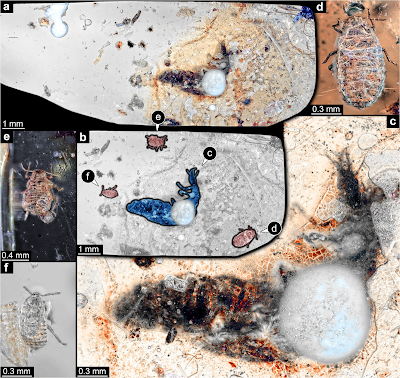
The amber piece described by Haug et al. contains a number of inclusions, including several Insect exuviae (shed skins), all to deformed to be identified, a large elongate Insect, which Haug et al. identify as an Aphidlion, and three smaller Insects with prominent Hemipteran-type beaks, which Haug et al. identify as Aphids.

 
Specimen PED 0229, Baltic amber. (a) Overview of the entire amber piece. (b) As in (a), colour-marked. (c) Aphidlion in dorso-lateral view. (d) Aphid specimen 1 in dorsal view. (e) Aphid specimen 2 in dorsal view. (f) Aphid specimen 3 in dorsal view. Haug et al. (2022).

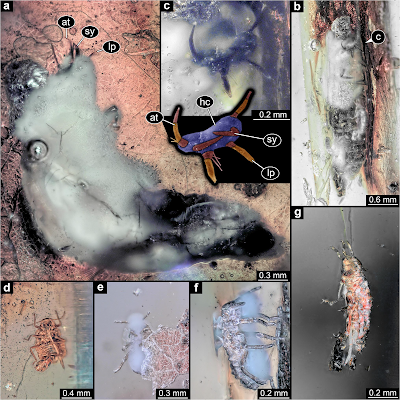
Many details on the larger Insect are concealed, but it is elongate, with a distinct head and body, and the head bears three sets of paired structures, iterpreted as antennae, stylets and labial palps. The antennae are elongate and split into three sections, a short wide base, a long, narrow middle section and an tapering tip. The stylets are simple and curved, lacking any teeth, as would be predicted for an Aphidlion. The labial palps have two distinct elements, with the proximal (base) element being obscured and the distal element being club shaped.

 
Specimen PED 0229, Baltic amber, continued. (a)-(c) Aphidlion. (a) In ventro-lateral view. (b) In (largely) ventral view; note that the head is seen in anterior view. (c) Close-up of head in frontal view (top), same image colour-marked (bottom). (d) Aphid specimen 2 in ventral view. (e) Aphid specimen 3 in ventral view. (f) Aphid specimen 3 in lateral view. (g) Close-up of aphid 2 in lateral view. Abbreviations: at, antenna; hc, head capsule; lp, labial palp; sy, stylet. Haug et al. (2022).

This specimen is too obscured to be identified to species level, but can be identified as an Aphidlion based upon its short antennae, prominent labial palps, and sickle-shaped mandibles. These traits are also found in some Beetle larvae, but these would be expected to have some other features, such as paired maxillary palps, which are absent in the specimen. The general morphology of both the specimen's body and it's appendages also match that of the Aphidlion-larvae of a Brown Lacewing, Hemerobiidae.

The three Aphids are roughly similar in form, but differ in size, with the largest specimen being about 1 mm in length, and the other two only 0.6 mm. The bodies of these specimens are differentiated into heads and trunks, with the heads wider than they are long, and partly covered by the forward part of the trunk. They have prominent antennae protruding antero-laterally from the head, and mouth parts modified to form an elongate beak. The front three segments of the trunk are prominent, each being longer than the head and supporting a pair of 'z' shaped legs. The segments of the posterior part of the trunk are less clearly defined, but there appear to be 9-10, terminating with a compound structure of several segments. 

The similar appearance of the three Aphid specimens suggests that they belong to the same species, with the larger specimen probably being a later instar (developmental stage separated by a moult) than the two smaller specimens. Aphids are very common in Baltic Amber, although it is difficult to differentiate the long winged developmental stages to species level. Based upon the general form of these specimens, Haug et al. suggest that they might belong to the genus Germaraphis.

The amber piece appears to contain the Aphidlion-larvae of a Brown Lacewing, a group which today specialise in predating soft-bodied prey, particularly Aphids. Brown Lacewings are common in the fossil record, and are often found in environments which also support aphids, and preserved larvae are much less common than adults (excluding specimens preserved in amber, most Lacewing fossils are isolated wings, which the larvae lack), and a direct association between these Insects and Aphids in the pasr has been hard to prove. The specimen examined by Haug et al. shows the co-existence of a Brown Lacewing Aphidlion and several Aphids, showing that they were present in the same environment, and therefore that a predator-prey relationship was highly likely, at least as far back as the Eocene.

See also...


Online courses in Palaeontology. 

Follow Sciency Thoughts on Facebook.

Follow Sciency Thoughts on Twitter.


Monday, 10 January 2022

Ajkaelater merkli: A new species of Click Beetle from Late Cretaceous Hungarian amber.

Beetles, and Insects in general, are hyperdiverse modern organisms which play key roles in almost all modern ecosystems. They a have long fossil record, which are considered to be key to understanding the emergence and development of the various Beetle groups. However, compression fossils tend to preserve relatively little detail in Beetles, limiting their use to palaeontologists. Preservation in amber, on the other hand, often produces excellent fossil Beetles with detailed anatomical features preserved in three dimensions. However, the vast majority of the known Insect-producing amber deposits are less than 65 million years old, making Mesozoic amber deposits particularly valued, both for their rarity and for the information they provide. Important Cretaceous amber deposits are found in Lebanon, Israel, Jordan, France, England, Spain, the US, Canada, Russia and Myanmar, with the Burmese, Lebanese, Spanish and French ambers being particularly noted for the abundance of the Insect fossils they produce.

In a paper published in the journal Scientific Reports on 7 January 2022, Márton Szabó of the Department of Paleontology and Geology at the Hungarian Natural History Museum and the Department of Palaeontology at Eötvös Loránd University, Robin Kundrata and Johana Hoffmannova of the Department of Zoology at Palacky University, Tamás Németh of the Department of Zoology and Ecology at the Hungarian University of Agriculture and Life Science, Emese Bodor, also of the Department of Palaeontology and of the Institute for Geological and Geochemical Research at Eötvös Loránd University, Imre Szenti of the Department of Applied and Environmental Chemistry at the University of Szeged, Alexander Prosvirov of the Department of Entomology at Moscow State University, Ákos Kukovecz, also of the Department of Applied and Environmental Chemistry at the University of Szeged, and Attila Ősi, again of the Department of Palaeontology at Eötvös Loránd University, describe a Click Beetle, Elateridae, from Late Cretaceous Hungarian amber.

Amber is found in Hungary in the alluvial floodplain deposits of the Csehbánya Formation near Iharkút and the Ajka Coal Formation southeast of the city Ajka in the Bakony Mountains in southwestern Hungary, both of which deposits are Santonian in age (86.3-83.6 million years old). The ambers of the Csehbánya Formation are typically found as very small particles, and no significant inclusions have been found in them to date, whereas the ambers of the Ajka Coal Formation frequently contain preserved organisms.

 
Ajka location and geology, and the here examined amber inclusion. (a) Location of Ajka in western Hungary, with the location of the Ajka coal beds. (b) Simplified geological section of the Ajka Subbasin. (c) Ajkaite specimen containing the holotype of Ajkaelater merkli, under polarized light microscope. Scale bars: (a) 3 km; (b) 1 km; (c) 1 mm. Szabó et al. (2022).

The Ajka Coal Formation comprises an alternation of coal beds, carbonaceous to argillaceous pelitic sediments with interbedded molluscan lumachelles, marls, and sandstone beds representing a lacustrine-palustrine sequence. It is over a hundred metres thick in places, and produces a range of fossils including Plants, Molluscs, and Vertebrates. A variety of Arthropod fossils have been reported from amber from the Ajka Coal Formation, but to date only two species of Ceratopogonid Flies have been described to date.

Click Beetles are a large Beetle group related to the Fireflies and Soldier Beetles. They have elongate bodies, and a 'clicking mechanism' comprising a prosternal process which can be rapidly slid into their mesosternal cavity, producing an audible click and propelling them rapidly into the air, in a jump which enables them to escape predators. There are over 11 000 described species of extant Click Beetles, plus 261 fossil species in 99 genera. The group are commonly found as inclusions in amber, probably due to their habit of boring into the bark of trees, though few species preserved in this way have been described, implying that there are probably many more fossil species to be formally discovered; only three Cretaceous Click Beetles have been described from amber deposits, all from Kachin State in Myanmar. 

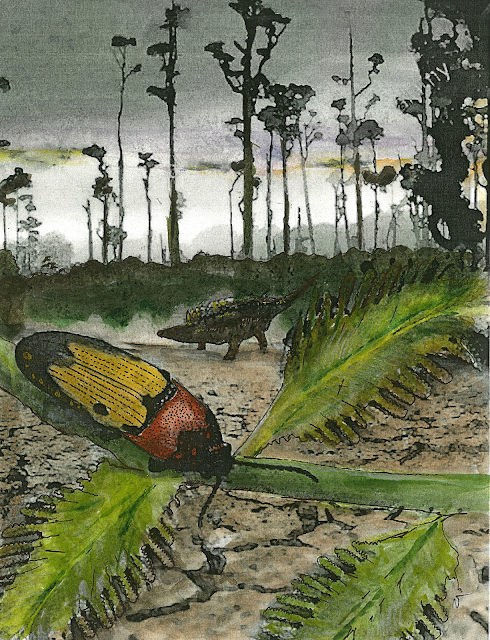
The new species is named Ajkaelater merkli, where 'Ajkaelater' implies 'Ajka Click Beetle' and 'merkli' honours the late Ottó Merkl, a leading Hungarian entomologist, World renowned expert On Darkling Beetles, Tenebrionidae, and the long-term curator of the Coleoptera Department of the Hungarian Natural History Museum. The species is described from a single, fragmentary Beetle, of indeterminate sex, which lacks a head, from a piece of dark red amber. The specimen is not naked-eye visible, and was only revealed when the amber was subjected to micro‑computed tomography.

 
Ajkaelater merkli, holotype (MTM PAL 2021.50.1.). (a) Dorsal view; (b) ventral view; (c) right lateral view. Scale bar: 1 mm. Szabó et al. (2022).

The specimen is about 6.5 mm long and 2 mm wide, and has an oblong-oval shape with subparallel, slightly convex sides. The head is missing, but part of one antennae is preserved. The pronotum (forward part of the thorax, in front of the part of an Insect to which the wings and legs are attached) is slightly wider than it is long, and is widest at its posterior angle. The elytra (wing-cases) are oblong-oval in shape.

Ajkaelater merkli is the first fossil Beetle described from Hungary (other fossil Beetles are known from the Miocene and Pliocene of Hungary, but have not been formally described). It is also the first Mesozoic Click Beetle reported from mainland Europe; some have been reported from the UK, but all other Mesozoic representatives of the group are from East or Central Asia, where the group is thought to have originated in the Triassic or Early Cretaceous. It is also the first Click Beetle reported from Santonian deposits anywhere in the world.

The larvae of modern Click Beetles are typically saproxylic, living in rotting wood, or sometimes leaf litter, organic rich soils or sometimes Mosses. All of these environments are likely to have been present when the Ajka Coal Formation was laid down, in a network of swampy forests and shallow lakes, making it likely that the larvae of these Beetles were already living in a way similar to their modern descendants.

 
Artistic reconstruction of Ajkaelater merkli in the swampy Ajka coal area in the Santonian western Hungary, with Hungarosaurus in the background. Szabó et al. (2022).

See also...


Online courses in Palaeontology. 

Follow Sciency Thoughts on Facebook.

Follow Sciency Thoughts on Twitter.