Showing posts with label Hungary. Show all posts

Saturday, 1 November 2025

Archaeologists uncover seventh century iron sabre at tomb in Hungary.

Archaeologists from the Hungarian National Museum in Budapest and the Szent István Király Museum in Székesfehérvár have uncovered a rare seventh century iron cavalry sabre, among other grave goods, while excavating what is believed to be the tomb of an Avar warrior. The tomb, which is near Székesfehérvár, was detected in satellite images by the 'Cemeteries from Space' program, a collaboration between several Hungarian museums which uses satellite and other remote sensing images to look for signs of ancient activity in croplands and other areas where they might not be obvious to people standing on the ground.

A seventh century cavalry sabre unearthed at a tomb in Hungary. The sword is corroded, but still intact. Szent István Király Museum.

The tomb is thought to have dated to between 670 and 690, and had been partially looted, but still contained grave goods including the sword, some silver belt fittings, gilded metal ornaments for braiding into hair, earrings made from glass beads, a long knife, and arrowheads. Other artefacts likely to have been present, such as the shafts of the arrows, and a leather belt for the silver fittings, and probably a leather quiver for the arrows, had decayed away. The skeleton of the warrior appears to have been damaged during the looting process, particularly around the chest area.

The remains of a Avar warrior unearthed in a seventh century tomb near Székesfehérvár in Hungary. Szent István Király Museum.

The Pannonian Avars occupied a large area of Central Europe during the sixth to ninth centuries, forming a state known as the Avar Khaganate, which at its peak stretched from Czechia to eastern Ukraine. Unfortunately, most of what we know about the Avars today comes from Byzantine sources, a civilisation with which their relations were not always good. Byzantine records suggest that they had migrated from Central Asia, and were probably related to the nomadic Avars of that region. They may have had a Turkic or Mongolian ruling class, or have fled Central Asia to avoid domination by such a group. Genetic studies of remains from Avar graves in Europe have confirmed a genetic relationship to the Avars of Central Asia, with both groups originating in northeast Asia. However, they were not related to the Avars of the Caucasus Region, who appear to have been a separate group. Such studies have also suggested that women left their parents households to join those of their husbands, which would imply a patrilineal society.  From the middle of the eighth century the Pannonian Avars began to lose territory in the west to the expanding Frankish Kingdom, with chiefdoms incorporated into that state being Christianised and losing their cultural distinctiveness. From the beginning of the ninth century, invading Bulgars from the east also began to seize territory from the Pannonians, eventually leading to the end of the Khaganate as a distinct political entity.

A piece of gilded metal, interpreted as an ornament which would have been worn on a hair braid, from the tomb of a seventh century Avar warrior near Székesfehérvár in Hungary. Szent István Király Museum.

See also...

Sunday, 22 December 2024

A woman buried with weapons in tenth century Hungary.

The concept of 'warrior women' has fascinated historians, archaeologists, and the wider public for a long time. Many examples of potential 'warrior women' from archaeological sites have been put forward over the years, in the form of women buried with weapons and/or armour. However, gender assignment is often difficult in archaeological contexts, as is determining the relationship between the individuals within graves and the goods buried with them, particularly when the remains are fragmentary. Where a person is buried with a single weapon or piece of armour this is as likely to be a talismanic object or mark of social status as it is an indicator of their ever having held a military role.

A number of female burials with weapons have been reported in Hungary's Carpathian Basin, dating from the Sarmatian Period (1st–5th centuries AD), the Gepid Period (second half of the 5th century–567 AD), the Langobard Period (510–568 AD), and the Avar Period (ca. 567–9th century AD). However, typically only a single arrowhead, small piece of chainmail, or similar isolated item has been found in the grave, which is significantly less than is found in male 'warrior burials' from the same cultures, making it unlikely that these represent female warriors.

The Maygars, or Hungarians, migrated from the steppes of Eurasia to the Lower Danube region around 830 AD, subsequently reaching the Carpathian Basin by the late nineth or early tenth century. They soon came to control the area, forming the Kingdom of Hungary at the end of the tenth century. During this time, Hungarian mounted archers gained a fearsome reputation, both within the Carpathian Basin and in conflicts across much of the rest of Europe. Hungarian warrior burials are common from this period, with warriors found buried with a range of weapons including axes, spears, sabres, swords, and swords with sabre hilts, as well as composite bows, arrows, quivers, and bow-cases. Archery equipment is far more ubiquitous in these graves. However, our understanding of these burials is limited by the preservational conditions in the Carpathian Basin, which mean that in most cases only inorganic parts of weapons and equipment have survived, and an apparent lack of any correlation between the presence and quantity of grave goods and the social status of the person they are buried with.

In a paper published in the journal PLOS One on 26 November 2024, a team of archaeologists led by Balázs Tihanyi of the Department of Biological Anthropology and the Department of Archaeology at the University of Szeged, and the Department of Archaeogenetics at the Institute of Hungarian Research, describe a woman buried with weapons from the tenth century Sárrétudvari–Hízófóld Cemetery in Hajdú-Bihar County, Hungary.

Map of Hungary showing the location of the Sárrétudvari–Hízófóld archaeological site. Luca Kis in Tihanyi et al. (2024).

The Sárrétudvari–Hízófóld Cemetery, close to the village of Sárrétudvari in Hajdú-Bihar County, was excavated in 1983-85, and has since been effectively destroyed as an archaeological site by intensive agriculture. The site contained a small number of burials dating back to the Bronze Age, and 262 graves dating from the tenth century AD. The skeletons of 263 individuals were recovered from the 262 graves excavated, with another two individuals identified but two fragmentary to be recovered. Of these individuals, 101 were identified as sub-adults, and 162 as adults. 

An initial assessment of the individuals from the Sárrétudvari–Hízófóld Cemetery, based upon morphological examination of their skulls and post-cranial skeletons, determined that 70 were female and 85 were male, with the remainder impossible to classify. A subsequent analysis based upon examination of the pelvis only (thought to be a more reliable technique) determined that 52 of the skeletons were female and 69 were male, with a larger proportion of undiagnosable remains. 

The majority of the graves have west-east orientation (i.e. head to the west, feet to the east), although some are orientated north-south, and a smaller number south-north. Most of the individuals were buried flat on their backs in an extended position, although two had bent knees. 

A wide range of grave goods were buried with the individuals in the Sárrétudvari–Hízófóld Cemetery. These include items of jewellery such as penannular hair rings, earrings, strings of beads, bracelets, and finger rings, clothing elements such as belt buckles, bell buttons, and broaches which would have been used to secure dresses, knives, fire-lighting tools, and riding-related items, such as stirrups, bits, fragments of saddle, and even horse bones. Notably, 58 of the individuals were burried with weapons, a far higher proportion than is seen in other known cemetery-sites in the Carpathian Basin in the same period. These weapons include sabres and axes, as well as many archery-related items, such as arrowheads, traces of quiver, and antler bow plates.

One of these armed burials was  Grave No. 63, located at the western end of the cemetery, which contained an individual buried with a southwest-northeast orientation, lying on its side, with knees bent. This individual was buried with a range of grave goods, including a silver penannular hair ring near the left part of the occipital bone, three bell buttons (one positioned beneath the skull, another beneath the right clavicle, and the third close to the knees), a string of beads near the left clavicle, including faience beads with blue eye-shaped inlays, yellow and white semiprecious stone beads, and segmented glass beads in various colours, an 'armour-piercing' arrowhead found at the distal end of the grave pit (several iron fragments possibly belonging to further arrowheads were also found in the soil of the grave), fragmented iron parts of a quiver situated near the left side of the skeleton from the shoulder to the toes, and an antler bow plate with convex sides and peaked ends located near the hip and the left hand, which was possibly being gripped by the individual when buried.

Artifacts found in grave No. 63: 91) arrowhead; (2) bell button; (3) silver penannular hair ring; (4) a string of beads; (5) fragments of bell buttons; and (6) antler bow plate. Zoltán Faur & Luca Kis in Tihanyi et al. (2024).

The individual from Grave No. 63 (SH-63) has a skull with a reasonably well-preserved cranium, but lacking most of the face, of which only the mandible, fragments of the two maxillae, and the left zygomatic bone remain. More than 50% of the post-cranial skeleton is present, but the bones of the spine, sternum, and pelvis are mostly represented by bone fragments. SH-63 has been determined to be an adult on the basis that all of the bones which would be expected to have fused in an adult individual are fused, and the thinness of the bones has been taken as an indication that this was an older individual, although it was not possible to make a more precise age estimation.

The skeletal remains discovered in grave No. 63. (A) Photo indicating the current state of preservation of the bones; and (B) Photo of the burial No. 63 in situ. Luca Kis & Ibolya Nepper in Tihanyi et al. (2024).

The poor preservation of the skeleton. and in particular the pelvis, of SH-63 made it difficult to determine the individual's sex by morphological means. The skull did appear to show some feminine traits, but this was not deemed sufficient to assign a sex to the skull by previous studies. Tihanyi et al. were able to extract genetic from a tooth, one humorous, and the petrosal process of the temporal bone. All three of these indicate that the individual was female, the sample from the pars pretrosa with sufficient confidence to rule out the possibility of the individual being male.

Cranial features used for sex determination showing feminine characteristics. (A) A very small mastoid process; (B) A smooth frontal contour with little or no projection of the glabellar area; (C) Complete absence of nuchal crest with a smooth external occipital surface; and (D) A smooth mental eminence with slight projection above the surrounding bone. Luca Kis in Tihanyi et al. (2024).

Examination of the skeleton of SH-63 revealed a number of signs that the individual was suffering from osteoporosis, notably bone fragility, traces of a reduced trabecular system in the vertebrae, an increased diameter of the medullary cavity in the long bones, thinning of cortical bone in both the skull and postcranial elements, and several antemortem bone fractures. Since osteoporosis is a condition which predominantly affects older women, this could be another indication that SH-64 was female, although Tihanyi et al. are careful to note that the observed conditions are only indicators of the disease, not enough for an absolute diagnosis. Previous studies of skeletons at Sárrétudvari–Hízófóld have found six other possible cases of osteoporosis, five affecting skeletons confidently assigned as female, and one affecting an individual of unknown sex. No instances of confidently male skeletons with symptoms of osteoporosis have been found.

The skeleton shows a number of signs of injuries having been suffered in life. These include a possible two-part neck fracture to the right humerus, an injury most commonly associated with an accidental fall onto an outstretched arm. Such injuries are most commonly seen in adolescents and the elderly, with older women suffering from osteoporosis being particularly vulnerable. 

Changes observed on the proximal end of the right humerus, at the level of the surgical neck. (A) Lateral and anterior views; (B) Anterior and medial views; and (C) Medial and posterior views. Luca Kis in Tihanyi et al. (2024).

Another fracture is present on the right scapula, with two parts of the bone having apparently healed without rejoining, producing new secondary facets which faced one-another. The left scapula also shows signs of a fracture, although in this case it appears to have healed more normally. Fractures to the scapula are unusual, and are generally associated with older individuals, as in younger people the scapula tends to be well-protected by overlaying muscle. Again, such injuries are generally associated with falls, and an individual with osteoporosis would be more vulnerable to such injuries.

Changes observed on the lateral margin of the right scapula. (A) The two separate bone fragments of the lateral margin (anterior view). Note: the glenoid cavity is in the upper left corner of the photo; and (B) The margins of the two bone fragments forming a secondary facet. Luca Kis in Tihanyi et al. (2024).

Signs of traumatic injury in life are quite common in male skeletons from Sárrétudvari–Hízófóld, but relatively unusual in females, suggesting the two sexes had very different lifestyles. Multiple injuries, and in particular injuries to the arms, are particularly common on male skeletons buried with weapons or riding equipment. Thus, although the injuries to SH-63 are consistent with a diagnosis of osteoporosis, they are also typical of the injuries seen in individuals buried with weapons and riding equipment. 

Interestingly, SH-63 also showed asymmetry in the development of the tendon and muscle attachments, with the right side being more developed than the west, sugesing a lifetime spent carrying out activities which promoted such asymmetric development. This has previously been recorded in male skeletons from Sárrétudvari–Hízófóld, and has been theorised to be associated with practice with weapons. 

The way in which SH-63 was buried is also interesting. The southwest-northeast orientation of the grave is at odds with the majority of the graves at Sárrétudvari–Hízófóld, but it is by no means unique; there are several other graves with this orientation, the majority of which are at the western end of the cemetery, where SH-63 was found. Notably, most of these other southwest-northeast orientated graves also contain weapons. SH-63 is also one of two individuals buried on one side with flexed knees at Sárrétudvari–Hízófóld; all others being buried on their backs with limbs extended. The other such individual, SH-69, has previously been determined to have been female, and was buried with a silver penannular hair ring, two bronze finger rings, and a knife, but no weapons or other potential military equipment. Some previous studies of other sites from the same period within the Carpathian Basin have suggested that bodies buried in a flexed position tend to have less grave goods than those in an extended position, and it has been proposed that such individuals may have been slaves. However, Tihanyi et al. could find no study which has caried out a systematic analysis of this phenomenon, and suggest instead that is may relate in some way to the sex of the individuals buried this way, although, since the majority of female burials are also on their backs in an extended position, it is unclear how.

(A) Silhouette of the skeleton of SH-63; (B) Illustration of the burial based on archaeological, anthropological, and archaeogenetic data. Luca Kis in Tihanyi et al. (2024).

Thus individual SH-63 appears potenrially to have been a woman both buried with, and practiced in the use of weapons, who developed a number of traumatic injuries later in life, either due to this unconventional lifestyle or to the onset of osteoperosis, or some combination of both. However, Tihanyi et al. are careful to point out that the poor preservation of SH-63 means that this interpretation cannot be taken as proven.

See also...

Saturday, 23 March 2024

Saprolegnia velencensis: A new species of Oomycete Water Mold from a Hungarian Lake.

Oomycetes are a curious group of multicellular aquatic Eucaryotes. They resemble Fungi in their morphology, and were previously thought to belong to this group, but genetic phylogeny has demonstrated that they in fact Stramenopile, members of the group which also contains Brown Algae, Diatoms, and a variety of single-celled organisms. All known Oomycetes are either saprotrophic (obtaining energy from the chemical breakdown of organic matter) or pathogenic (infecting living organisms). Members of the genus Saprolegnia, sometimes known as Cotton Molds, are primarily saprotrophs, but many species are also opportunistic pathogens, causing patches of cottony growth on Fish or other infected organisms. The taxonomy of these organisms has traditionally relied upon morphology, which is problematic as they are both variable in habit within species and similar to one-another in overall form; the advent of genetic tools has simplified this considerably. 

In a paper published in the journal PLoS One on 20 March 2024, Viktória Verebély, Noémi Erdei, Tímea Hardy, and Edit Eszterbauer of the Hungarian Veterinary Medical Research Institute, describe a new species of Saprolegnia from Lake Velence in Hungary.

Lake Velence is the third largest lake in Hungary, with a surface area of 24.5 km² and a maximum depth of 1.4 km. The large surface area and shallow depth of this lake means that it is easily warmed by the Sun, with summer temperatures typically reaching 26–28˚C, which makes it one of the warmest lakes in Europe. It is also chemically distinctive, with a high pH (typically between 7.8 and 9.2) and a high dissolved salt level.

Lake Velence, Hungary. Wikimedia Commons.

The new species is described upon the basis of two strains cultivated from samples collected from a sailing port near the town of Velence at the northeastern end of the lake. These were provisionally identified as belonging to a new species on the basis of their morphology, but this was confirmed by genetic analysis.

The new species is named Saprolegnia velencensis, where 'velencensis' means 'from Velence'. It produces colourless, transparent, and smooth hyphae, slightly over 13 μm in width, with moderate branching and few septae. Few oogonia (female spore-producing bodies) are produced, these being spherical with slightly pitted walls, and supported on short necks. More abundant are gemmae, masses of cells which can detach and go on to form a new colony. These are typically elongate, and form chains, with the terminal gemmae having a thicker, club-like structure. Sporangia (asexual bodies which produce motile spores called 'zoospores' are also quite common, and also tend to be elongate in form.

Morphological characteristics of Saprolegnia velencensis. (A) and (A inset) Immature oogonia; (B) gemma chains; (C) zoosporangia with papilla; (C inset) mature zoosporangia; (D) secondary cysts; (D inset) zoospores. Scale bars are 20 μm, except for (B) which is 50 μm. Verebély et al. (2024).

Because Saprolegnia velencensis was cultivated from collected water samples, it is unclear if this species has the capacity to be pathogenic. Most Saprolegnia infections found in Fish are actually caused by a single species, Saprolegnia parasitica, although Fish populations can also be badly impacted by two other species, Saprolegnia australis and Saprolegnia ferax, both of which infect Fish eggs, with Saprolegnia ferax also known to infect the eggs of Amphibians, and to have played a role in the population collapse of several Amphibian species around the globe.

Schematic line drawings of Saprolegnia velencensis. (A) Immature oogonia; (B) secondary cysts; (C)–(D) zoosporangia; (E) intercalary gemma; (F) branched gemma; (G) segmented hypha. Scale bar is 20 μm. Verebély et al. (2024).

The discovery of a novel species of Saprolegnia in Lake Velence may relate to the lake's distinctive physical and chemical properties, although the relationship between water chemistry and the ability of Oomycetes to survive and thrive is unclear. Some studies have suggested that zoosporangia production may be suppressed in hard water, although studies in Egypt have indicated that Saprolegnia spp. are more affected by temperature than salinity. In South Korea, these Water Molds have been found to be more abundant in the winter than the summer, and studies have shown that different species are variable in their ability to cope with different water temperatures. Other studies have suggested that variations in water temperature and chemistry may in fact be affecting Bacteria which can suppress the growth of Water Molds, rather than the Molds directly.

See also...

Monday, 10 January 2022

Ajkaelater merkli: A new species of Click Beetle from Late Cretaceous Hungarian amber.

Beetles, and Insects in general, are hyperdiverse modern organisms which play key roles in almost all modern ecosystems. They a have long fossil record, which are considered to be key to understanding the emergence and development of the various Beetle groups. However, compression fossils tend to preserve relatively little detail in Beetles, limiting their use to palaeontologists. Preservation in amber, on the other hand, often produces excellent fossil Beetles with detailed anatomical features preserved in three dimensions. However, the vast majority of the known Insect-producing amber deposits are less than 65 million years old, making Mesozoic amber deposits particularly valued, both for their rarity and for the information they provide. Important Cretaceous amber deposits are found in Lebanon, Israel, Jordan, France, England, Spain, the US, Canada, Russia and Myanmar, with the Burmese, Lebanese, Spanish and French ambers being particularly noted for the abundance of the Insect fossils they produce.

In a paper published in the journal Scientific Reports on 7 January 2022, Márton Szabó of the Department of Paleontology and Geology at the Hungarian Natural History Museum and the Department of Palaeontology at Eötvös Loránd University, Robin Kundrata and Johana Hoffmannova of the Department of Zoology at Palacky University, Tamás Németh of the Department of Zoology and Ecology at the Hungarian University of Agriculture and Life Science, Emese Bodor, also of the Department of Palaeontology and of the Institute for Geological and Geochemical Research at Eötvös Loránd University, Imre Szenti of the Department of Applied and Environmental Chemistry at the University of Szeged, Alexander Prosvirov of the Department of Entomology at Moscow State University, Ákos Kukovecz, also of the Department of Applied and Environmental Chemistry at the University of Szeged, and Attila Ősi, again of the Department of Palaeontology at Eötvös Loránd University, describe a Click Beetle, Elateridae, from Late Cretaceous Hungarian amber.

Amber is found in Hungary in the alluvial floodplain deposits of the Csehbánya Formation near Iharkút and the Ajka Coal Formation southeast of the city Ajka in the Bakony Mountains in southwestern Hungary, both of which deposits are Santonian in age (86.3-83.6 million years old). The ambers of the Csehbánya Formation are typically found as very small particles, and no significant inclusions have been found in them to date, whereas the ambers of the Ajka Coal Formation frequently contain preserved organisms.

 
Ajka location and geology, and the here examined amber inclusion. (a) Location of Ajka in western Hungary, with the location of the Ajka coal beds. (b) Simplified geological section of the Ajka Subbasin. (c) Ajkaite specimen containing the holotype of Ajkaelater merkli, under polarized light microscope. Scale bars: (a) 3 km; (b) 1 km; (c) 1 mm. Szabó et al. (2022).

The Ajka Coal Formation comprises an alternation of coal beds, carbonaceous to argillaceous pelitic sediments with interbedded molluscan lumachelles, marls, and sandstone beds representing a lacustrine-palustrine sequence. It is over a hundred metres thick in places, and produces a range of fossils including Plants, Molluscs, and Vertebrates. A variety of Arthropod fossils have been reported from amber from the Ajka Coal Formation, but to date only two species of Ceratopogonid Flies have been described to date.

Click Beetles are a large Beetle group related to the Fireflies and Soldier Beetles. They have elongate bodies, and a 'clicking mechanism' comprising a prosternal process which can be rapidly slid into their mesosternal cavity, producing an audible click and propelling them rapidly into the air, in a jump which enables them to escape predators. There are over 11 000 described species of extant Click Beetles, plus 261 fossil species in 99 genera. The group are commonly found as inclusions in amber, probably due to their habit of boring into the bark of trees, though few species preserved in this way have been described, implying that there are probably many more fossil species to be formally discovered; only three Cretaceous Click Beetles have been described from amber deposits, all from Kachin State in Myanmar. 

The new species is named Ajkaelater merkli, where 'Ajkaelater' implies 'Ajka Click Beetle' and 'merkli' honours the late Ottó Merkl, a leading Hungarian entomologist, World renowned expert On Darkling Beetles, Tenebrionidae, and the long-term curator of the Coleoptera Department of the Hungarian Natural History Museum. The species is described from a single, fragmentary Beetle, of indeterminate sex, which lacks a head, from a piece of dark red amber. The specimen is not naked-eye visible, and was only revealed when the amber was subjected to micro‑computed tomography.

 
Ajkaelater merkli, holotype (MTM PAL 2021.50.1.). (a) Dorsal view; (b) ventral view; (c) right lateral view. Scale bar: 1 mm. Szabó et al. (2022).

The specimen is about 6.5 mm long and 2 mm wide, and has an oblong-oval shape with subparallel, slightly convex sides. The head is missing, but part of one antennae is preserved. The pronotum (forward part of the thorax, in front of the part of an Insect to which the wings and legs are attached) is slightly wider than it is long, and is widest at its posterior angle. The elytra (wing-cases) are oblong-oval in shape.

Ajkaelater merkli is the first fossil Beetle described from Hungary (other fossil Beetles are known from the Miocene and Pliocene of Hungary, but have not been formally described). It is also the first Mesozoic Click Beetle reported from mainland Europe; some have been reported from the UK, but all other Mesozoic representatives of the group are from East or Central Asia, where the group is thought to have originated in the Triassic or Early Cretaceous. It is also the first Click Beetle reported from Santonian deposits anywhere in the world.

The larvae of modern Click Beetles are typically saproxylic, living in rotting wood, or sometimes leaf litter, organic rich soils or sometimes Mosses. All of these environments are likely to have been present when the Ajka Coal Formation was laid down, in a network of swampy forests and shallow lakes, making it likely that the larvae of these Beetles were already living in a way similar to their modern descendants.

 
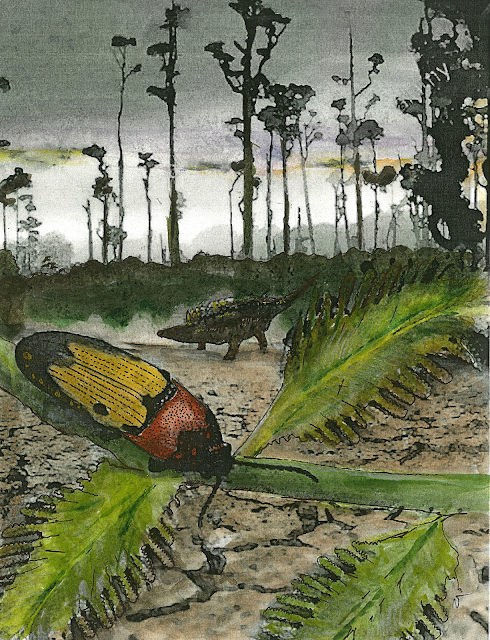
Artistic reconstruction of Ajkaelater merkli in the swampy Ajka coal area in the Santonian western Hungary, with Hungarosaurus in the background. Szabó et al. (2022).

See also...


Online courses in Palaeontology. 

Follow Sciency Thoughts on Facebook.

Follow Sciency Thoughts on Twitter.


Thursday, 19 March 2020

Andrias scheuchzeri: A Giant Salamader from the Miocene of southwestern Hungary.

The Cryptobranchids are Giant Salamanders, which can reach over 1.5 m in their total length. Fossil evidence in Asia and North America suggest that the evolutionary history of Cryptobranchidae extends back to Palaeocene, with their fossils being known later from Europe, Asia and North America. The extant species of this family (Cryptobranchus alleganiensis, Andrias davidianus, and Andrias japonicus) range over the cool temperate zones of China, Japan and North America. Within these distribution zones the animals generally prefer clear, oligotrophic (low nutrient) streams and rivers with rocky bed and steep banks. In contrast, late Oligocene to late Pliocene representatives of Andrias occurred in large ponds or lakes as well. Their fossils have been unearthed at Vertebrate sites in Germany (Upper Oligocene of Rott, Middle Miocene of Öhningen, Middle and Upper Miocene of Wartenberg, Upper Miocene of Reisenburg and Upper Pliocene of Willershausen) the Czech Republik (Lower Miocene of Břeštany) and Austria (Upper Miocene of Götzendorf, Brunn-Vösendorf and Mataschen), with all European Miocene Giant Salamanders currently assigned to a single species, Andrias scheuchzeri. 

In a paper published in the journal PalZ on 12 December 2019, Zoltán Szentesi of the Department of Paleontology and Geology at the Hungarian Natural History Museum, Krisztina Sebe of the Department of Geology and Meteorology at the University of Pécs, and Márton Szabó, also of the Department of Paleontology and Geology at the Hungarian Natural History Museum, and of the Department of Palaeontology at Eötvös Loránd University, describe a series of specimens assigned to Andrias scheuchzeri, from the Pécs-Danitzpuszta sand pit in the Mecsek Mountains of southwestern Hungary.

The Pécs-Danitzpuszta sand pit lies in southwest Hungary, on the southeastern margin of the Mecsek Mountains, at the eastern boundary of the city of Pécs, and exposes deposits of the late Miocene Lake Pannon. This brackish lake evolved from the Central Paratethys and existed throughout the late Miocene and the early Pliocene, from 11.6 to about 4.5 million years ago.

Geological setting of the Pécs-Danitzpuszta sand pit. (a) Location of the site, with published Miocene fossil sites with Andrias scheuchzeri in the Pannonian Basin. Blue patch indicates the extent of Lake Pannon around the time of sediment accumulation at Danitzpuszta (about 9.5 million years ago). (b) Simplified geological map of the area. Legend: T, Triassic; J, Jurassic; K, Cretaceous; M1-2, Lower–Middle Miocene; M3, Upper Miocene; Q, Quaternary rocks. (c) Panorama of the western wall of the sand pit. Bagger in centre for scale. (d) Steeply dipping limonitic sands in the northern part of (c). Note people for scale. Szentesi et al. (2019).

In the Danitzpuszta sand pit two different types of lacustrine deposits are exposed. The succession is heavily deformed due to intra- and post-Pannonian movements, thus the boundary between the two rock types is vertical, and younging is both towards the south and upwards. The older deposits are greyish white calcareous marls, exposed in (sub)vertical layers in the northern wall of the sand pit. Stratigraphically they belong to the Tótkomlós Calcareous marl Member of the sublittoral, open-water Endrőd Formation. They show a relatively sharp but conformable boundary with the overlying sands.

Based on the Mollusc association belonging to the Lymnocardium schedelianum sublittoral Mollusc biozone of Lake Pannon, these marl beds can be dated to 11–10 million years ago. The younger sediments are limonitic, yellow, coarse-grained, gravelly sands, now exposed in the long western wall of the sand pit, which were worked by the mine during the time it was active. The sands were derived from the denudation of the older Miocene and basement rocks of the mountains and are classified into the Kálla Formation. Within the sands, bedding dip gradually decreases upwards and towards the south, pointing to ongoing tectonic activity—uplift of the mountains—during sedimentation. The Mollusc assemblage found in the sands suggests an age of 9.5–10.0 million years for this deposit.

The sand pit is a famous Vertebrate locality in the region because of the large number of fossils found in the limonitic (iron-rich) sands. Remains are dominated by Fish (Bony Fish, Sharks, and Rays), Reptiles (mostly Turtles) and various aquatic and terrestrial Mammal remains. A considerable portion of them, e.g. those of euhaline (saltwater) taxa, must have been reworked from slightly older sediments of Badenian (16.3-12.8 million years old) and Sarmatian (12.6-11.6 million years old) age. However, partially articulated skeletons have also been found in the sand pit, which indicate that at least some of the fossils belonged to animals which lived during the accumulation of the exposed sediments. Cryptobranchidae fossils were collected in the described Vertebrate-bearing limonitic sands. by multiple collectors between 2006 and 2018.

The material examined comprises two left and two right fragmentary maxillae (upper jaw bones), eight left and eight right dentaries (lower jaw bones), four fragmentary atlases (first vertebrae), three fragmentary trunk vertebrae, one left ilium (part of the pelvis), and one left femur (thighbone). 

Maxillae of Andrias scheuchzeri from Pécs-Danitzpuszta. Left maxilla (a), (b) PTE-5152, right maxilla (c), (d) MBFSZ V.2019.97.1. (a), (c) ventromedial view; (b), (d) dorsal view. Szentesi et al. (2019).

The specimens share several characteristics with all crown Cryptobranchids, including large body size; massive bones; bilateral asymmetric kinetics of the lower jaw; and a trochanter fused with the proximal head of the femur. The rough inner surface of pars facialis (with ridges and depressions), the strong curvature of dentaries, and the arrangement and features of the teeth, characters typical for Andrias. The strongly curved maxillae with narrow and long teeth pedicels; the well-ossified, strongly curved dentaries with thick cortex, the mediumsized medullary cavities surrounded with smaller cavities; the amphicoelous atlas with large processus odontoideus and a larger central foramen among several small foramina ventrally; the dumbbell-shaped, amphicoelous trunk vertebrae with short neural spine suggest these fossils belong to the species Andrias scheuchzeri. The anatomical features of the ilium are the same as Urodeles, while the size of this bone suggests that this bone also belongs to the species Andrias scheuchzeri.

Left dentary of Andrias scheuchzeri (a)-(f) PTE-5148, from Pécs-Danitzpuszta. (a) lingual view; (b) labial view; (c) medial view; (d) dorsal view; (e) ventral view; (f: medial view. Szentesi et al. (2019).

The robust, strongly curved, low maxilla differs from that of Andrias matthewi (a species known from the Miocene of North America). The densely situated, high tooth pedicels of the maxillae and the strongly curved dentaries with deep sulcus dentalis also relate these specimens to Andrias scheuchzerii. The dentary differs from Ukrainasurus hypsognatus (a species known from the Miocene of Ukraine) and Andrias davidianus (the living Chinese Giant Salamander) in its more robust structure of the corpus dentalis. It is less robust labiolingually in cross-section than  Zaissaurus beliajevae (Palaeogene of the Zaisan Basin in Central Asia) and Aviturus exsecratus (from the Palaeocene of Mongolia). In cross-section view, the bone tissue of the dentary differs from that of Andrias davidianus and Ukrainasurus hypsognatus in the thick cortical bone and the significantly smaller cavities, from that of the Zaissaurus beliajevae in more numerous and denser medullary cavities, and also from that of Aviturus execratus in significantly less numerous and larger medullary cavities. The prominent and wide processus odontoideus of the atlas, the dumbbel-lshaped centrum of vertebrae, the vertebrae less massive than in Andrias matthewi, the foramen central significantly smaller than in vertebrae of Ukrainasurus hypsognatus. and the massive, short neural spine, ending in cartilage also refer to a close affinity with Andrias scheuchzeri. When comparing the fossil skeletal elements from Pécs-Danitzpuszta with those of recent Giant Salamanders, no significant differences can be observed.

Dentaries of Andrias scheuchzeri from Pécs-Danitzpuszta. Right dentaries: (a), (b) JAM T/2019.4.1., (c) MBFSZ V.2019.100.1., (d) MBFSZ V.2019.101.1., (h) MBFSZ V.2019.110.1.; left dentaries: (e) MBFSZ V.2019.103.1., (f) MBFSZ V.2019.107.1., (g) MBFSZ V.2019.108.1.. (a), (c)–(h) lingual view; (b) posterior view. Szentesi et al. (2019).

A considerable portion of the vertebrate remains at the Pécs-Danitzpuszta site is reworked from older, Middle Miocene (Badenian and Sarmatian) sediments. The diverse Chondrichthyan fauna is typical for the Badenian of Europe. Partially articulated Bony Fish skeletons (e.g. a yet unidentified species of Latid Perch, Fish which primarily live in freshwater) are evidently coeval with the sediment, i.e. late Miocene. The numerous Reptilian remains are mostly freshwater or terrestrial forms, but have been identified so far very approximately, at a level not sufficient to assign an age to them. The extraordinarily abundant marine Mammal fauna includes predominantly Cetaceans (Whales and Dolphins) and Sirenians, plus, in smaller quantities, Pinnipeds (Seals), identified taxa are of Badenian and Sarmatian age. Diverse terrestrial Mammalian remains include Hipparions, Proboscideans, Rhinocerotids, Tapirs, Suids and Ruminants (Bovids, Tragulids and Cervids). Most of them represent a typical early Pannonian (11.6-9.0 million year old) assemblage, a so-called Hipparion fauna. However, a small sized Deinothere (cf. Prodeinotherium bavaricum) is likely to be indicative of fossils from older (Badenian and/or Sarmatian) sediments, showing that this is also an issue with terrestrial taxa from Pécs-Danitzpuszta. Therefore, although the Andrias fossils were found in Upper Miocene (lower Pannonian/lower Tortonian) sands, their Late Miocene age is not unambiguous. This question can be discussed considering the ecological requirements of the taxon and using analogous finds of similar age.

Atlases of Andrias scheuchzeri from Pécs-Danitzpuszta. (a)–(c) JAM 2006.236.93., (d), (e) MBFSZ V.2019.111.1. (a), (d) ventral view; (b), (e) anterior view; (c) posterior view. Szentesi et al. (2019).

Cryptobranchids occur exclusively in humid areas, with mean annual precipitations exceeding 900 mm. Climatic analysis, based on fossil flora, estimated a mean annual precipitation of around 1000 mm for the deposition time of the Danitzpuszta sediments. Macrofloral remains at Danitzpuszta indicate expressedly thermophilous vegetation, where the prevalence of Lauraceae (Laurels) and other thermophilous elements in the vegetation excludes freezing temperatures. These climatic conditions made the early late Miocene of the southern Pannonian Basin suitable for Giant Ssalamanders.

Trunk vertebrae of Andrias scheuchzeri from Pécs-Danitzpuszta. (a)–(d) JAM T/2019.2.1., e.g. JAM T/2019.3.1. (a) Left lateral view; (b), (f) anterior view; (c), (g) ventral view; (d) posterior view; (e) right lateral view. Szentesi et al. (2019).

A further environmental prerequisite for the presence of Cryptobranchids is considered to be increased relief due to regional uplift, which produces the necessary habitats, mountain valleys for the Giant Salamanders. Uplift of the Mecsek Mountains during the early Late Miocene is unambiguously indicated by the upwards gradually decreasing bedding dip, i.e. syn-tectonic deposition in the sands containing the Andrias bones. Steep topography was proposed based on the event-like input of coarse clastic sediments, sand and gravel, with redeposited Pannonian littoral Mollusks into the open-water calcareous marl succession underlying the sands. Increased relief is shown by vegetation types linked to various elevations from lakeshore to upland. The appearance of the fossil-bearing sands above the carbonate-dominated lacustrine succession itself refers to increased activity of watercourses and to the resulting denudation and clastic input into the lake. Direct evidence for the existence of freshwater habitats, namely swamps is provided by the massive occurrence of Myrica lignitum (a type of Bayberry) leaves among the fossil flora. Shoot fragments of Glyptostrobus europaeus (a type of Cypress), another typical swamp plant, were interpreted as having been transported from a distance into Lake Pannon and thus indicate that freshwater wetlands were present further away on the mainland. 

Left ilium (a)–(c) JAM 2006.185.47. and left femur (d)–(f) JAM T/2019.1.1. of Andrias scheuchzeri from Pécs-Danitzpuszta. (a) Lateral view; (b) medial; (c) ventral view; (d) dorsal view; (e) ventral view; (f) posterior view. Szentesi et al. (2019).

Thus, although their exact age cannot be indisputably identified, based on the listed climatic and topographic arguments the Andrias fossils can be coeval with the host sediments. Moreover, the Giant Salamanders live in streams, i.e. in high-energy sedimentary environments, so the partially eroded surface of the bones does not necessarily indicate their post-depositional transport. The preservation of bones found at the Pécs-Danitzpuszta site is also comparable to that of in situ Andrias bones from molasse deposits. The presence of Andrias in the Mecsek Mountains during the late Miocene would fit into and confirm the view of the early late Miocene palaeogeography as having a relief more rugged and a climate more humid and mild than today.

The nearest sites with Andrias fossils are located along the western margin of the Pannonian Basin. In the Styrian Basin in Austria, Andrias scheuchzeri vertebrae and a maxilla were found in the lower Upper Miocene (uppermost MN7/8) clay pit of Mataschen, at the foot of the Eastern Alps. Two other sites (Brunn-Vösendorf and Götzendorf/Sandberg) are located more to the north, in the Vienna Basin. A vertebra and a humerus were reported from the 'Congeria beds' of Brunn-Vösendorf, again next to the Eastern Alps. This site has a late Miocene age as well and is correlated to the middle MN9 zone. The third location, Götzendorf/Sandberg, lies just west of the Leitha Mountains and provided a rich herpetofauna, including several bones of both adult and juvenile Andrias scheuchzeri recovered from deposits of a side-branch of the Late Miocene paleo-Danube. The small Mammal taxa of the outcrop indicate the upper MN9 zone and chronologically the locality is indirectly dated to about 10 Ma based on the close similarity of the evolutionary stage of the small Mammal fauna to that of radiometrically dated faunas in Turkey and Germany. All three listed Andrias locations are of early late Miocene age, similarly to the Danitzpuszta sands. They lie next to elevated topography, be it the Alps or the lower Leitha Mountains, like Danitzpuszta lies at the foot of the Mecsek Mountains. Therefore, the Pécs-Danitzpuszta site is a further, fourth locality in the Pannonian Basin where Giant Salamanders could find their habitats in the late Miocene. The distribution of late Miocene sediments of various ages shows that the Mecsek Mountains formed an island in Lake Pannon from the beginning of the Late Miocene to about 8-7 million years ago. This island had dimensions of at least 70 × 15 km during the early Late Miocene, an extent large enough to develop a well-developed drainage network and to provide habitat for the Andrias.

Reconstruction of the late Miocene freshwater environment of Pécs-Danitzpuszta and the Andrias scheuchzeri. Márton Szabó in Szentesi et al. (2019).

Cryptobranchids (Megalobatrachidae indet.) have also been mentioned from the Pliocene of southwest Hungary, from the sites Csarnóta 2 and Beremend 26, in the Villány Hills, about 30 km south of the Mecsek Mountains. Szentesi et al. investigated these small amphicoelous vertebrae, deposited in the collection of the Hungarian Natural History Museum, but did not confirm their attribution to the family Cryptobranchydae, as neither their shape, nor their small size (under 3 mm) supports the original identification. Therefore, the remains from Pécs-Danitzpuszta are the only Giant Salamander fossils known from Hungary so far.

Based on cranial and postcranial bones, giant salamanders were present in the Miocene of the Mecsek Mountains in southern Hungary. The studied fossils are attributed to the species Andrias scheuchzeri. 

The fossils of Andrias from Pécs-Danitzpuszta are isolated, incomplete and mostly eroded, suggesting pre-depositional transport. The most frequent bones are the massive dentaries (especially its anterior part), whilst the more vulnerable maxilla, vertebrae and elements of the appendicular skeleton are significantly rare.

Giant Salamanders lived on an island within the Central Paratethys in the Middle Miocene or within the brackish Lake Pannon in the Late Miocene. Although their exact age cannot be indisputably identified, the Andrias fossils can be coeval with the Upper Miocene host sediments. Arguments supporting suitable conditions for Giant Salamanders in the early late Miocene of the southern Pannonian Basin are the mild and humid climate and the presence of freshwater wetlands on the dryland indicated by the fossil flora, the syn-depositional uplift of the mountains providing for a rugged topography and the intense clastic sediment input into Lake Pannon indicative of a fluvial network on the Mecsek Island and of sufficient precipitation. Even if the fossils are reworked from older sediments, their age cannot be older than Badenian (Langhian).

See also...

https://sciencythoughts.blogspot.com/2018/07/andrias-davidianus-how-failure-to.htmlhttps://sciencythoughts.blogspot.com/2018/01/phosphotriton-sigei-mummified.html
http://sciencythoughts.blogspot.co.uk/2014/12/a-new-species-of-salamander-from-early.htmlhttps://sciencythoughts.blogspot.com/2014/04/a-paedomorphic-salamader-from-ouachita.html
https://sciencythoughts.blogspot.com/2013/08/a-new-species-of-crested-newt-from.htmlhttp://sciencythoughts.blogspot.co.uk/2013/06/stomach-contents-in-jurassic-salamanders.html
Follow Sciency Thoughts on Facebook.