Showing posts with label Andaman Islands. Show all posts

Tuesday, 2 April 2024

Crotalaria andamanica: A new species of Rattlepod from the Andaman and Nicobar Islands.

Rattlpods, Crotalaria spp., are a group of Leguminous Plants found throughout the tropics, though the majority are found in Africa (about 400 of about 700 known species). Their common name derives from the seed pods of the Plant, within which the seeds become loose as the pot matures and dries, so that the pod can be shaken to produce a rattling noise. Most Rattlepods are found growing wet grasslands, floodplains, and on swamp and river margins, though some species are found in drier environments. Several species of Rattlepod are cultivated, either as ornamentals or food crops. To date, 102 species of Rattlepod have been described from India, 10 of them from the Andaman and Nicobar Islands.

In a paper published in the journal Taiwania on 5 March 2023, Fouziya Saleem of the Andaman and Nicobar Regional Centre of the Botanical Survey of India, and Mansarovar Global University, Lal Ji Singh, also of the Andaman and Nicobar Regional Centre of the Botanical Survey of India, and Arun Pandey, also of Mansarovar Global University, describe a new species of Rattlepod from the Andaman and Nicobar Islands.

The new species is described on the basis of a specimen found growing at Tugapur on Middle Andaman Island by Fouziya Saleem in December 2021. It is given the name Crotalaria andamanica, where 'andamanica' refers to the area where it was found. 

Crotalaria andamanica: (A) Habit; (B) Standard petal; (C) Wing petals; (D) Keel; (E)-(F) Flower; (G) Leaf (Dorsal); (H) Leaf (Ventral); (I)-(J) Stipules; (K) Stem with hairs; (L) Calyx with intact androecium and gynoecium; (M)-(N) Calyx; (O) Geniculate Style and Stigma; (P) Bracteole; (Q)-(R) Pod; (S) Seeds. Fouziya Saleem in Saleem et al. (2024).

Crotalaria andamanica is a prostrate herbaceous plant, reaching about 1.5 m in height, with frequently branching stems with terminal racemes of yellow flowers. Leaves are approximately oval in shape and up to 2 cm long. Seed pods are 6-8 mm in length, and contain 15-16 seeds. The entire plant is covered in hairs.

Crotalaria andamanica: (A) Habit; (B) Flower; (C)-(D) Pod. Fouziya Saleem in Saleem et al. (2024).

Crotalaria andamanica was found growing at three different locations on Middle and South Andaman Islands, growing on gravelly soils in open wastelands, which were also home to Creeping Tick Trefoil, Desmodium triflorum, Morning Glory, Ipomoea spp., Sensitive Plant, Mimosa pudica, Nutsedges, Cyperus spp., and Jack-in-the-bush Plants, Chromolaena odorata.

Map of Andaman and Nicobar Islands showing Distribution of the newly described species Crotalaria andamanica. Saleem et al. (2024).

See also...


Saturday, 30 March 2024

Solva andamanensis: A new species of Wood Soldier Fly from Andaman Island.

Wood Soldier Flies, Xylomyidae, are a little studied group of Dipteran (True) Flies found across Asia, Australia, and Oceana. These Flies spend the majority of their lives in a larval state, beneath the bark of dead trees. There are currently 143 described species of Wood Soldier Fly, nine of which have been described since 2011, with many areas never sampled for their presence. The phylogenetic positioning of these Flies was uncertain for a long time, but modern genetic methods have shown that they form a sister group to the True Soldier Flies, Stratiomyidae.

In a paper published in the Journal of the Entomological Research Society on 27 March 2024, Debdeep Pramanik, Atanu Nascar, and Dhriti Banerjee of the Zoological Survey of India, present the results of the first survey for Wood Soldier Flies carried out in the Andaman Islands, including a description of a new species.

Pramanik et al. carried out sweep netting in the Sabari and Yeratta forests in North & Middle Andaman District on Andaman Island between 7 and 26 September 2024. During these surveys they recovered two species of Wood Soldier Fly, the previously described Solva javana, which is otherwise known only from the island of Java, over 2000 km to the southeast, and a new, previously undescribed species.

The new species is named Solva andamanensis, where 'andamanensis' means 'from Andaman'. It is described from six adult Flies, all male. These are between 5.0 mm and 5.5 mm in length, with a forewing length of between 4.6 mm and 4.8 mm, and a yellow and black body pattern with white hairs in places.

Field photograph of Solva andamanensisPramanik et al. (2024).

See also...

Wednesday, 22 May 2019

Magnitude 5.6 Earthquake to the north of Great Andaman Island.

The United States Geological Survey recorded a Magnitude 5.6 Earthquake at a depth of 10.0 km a little over 30 km to the north of Great Andaman Island, slightly before 3.10 am local time (slightly before 0.40 am GMT) on Wednesday 22 May 2018. There are no reports of any damage or injuries associated with this event, though people have reported feeling in in Port Blair, the capitol of the Andaman and Nicobar Islands, which is around 250 km to the south of the Earthquake's epicentre.
 
The approximate location of the 22 May 2019 Nicobar Islands Earthquake. USGS.
 
The Nicobar Islands sit on the Burma (or Burmese) Plate, a small tectonic plate which underlies part of the eastern Indian Ocean and the western part of Sumatra. To the west of the Nicobar Islands this plate is being subducted beneath the Indian Plate, but to the east the situation is more complex. The Burma Plate is being pushed northward relative to the Eurasia and the Sunda Plate (which underlies eastern Sumatra, Java, southern Southeast Asia, most of Borneo and the western Philippines) by the northward movement of the Indian Plate. There is also an area of seafloor spreading beneath the Andaman Sea (separating the Andaman and Nicobar Islands from Southeast Asia), which in turn causes stresses within the Burma Plate, leading to a zone of faulting upon which the Andaman and Nicobar Islands are situated.
 
(Left) The movement of the Burma and surrounding plates. Sheth et al. (2011.(Right) Tectonic stresses within and around the Burma Plate. Renjith (2013).

Witness accounts of Earthquakes can help geologists to understand these events, and the structures that cause them. The international non-profit organisation Earthquake Report is interested in hearing from people who may have felt this event; if you felt this quake then you can report it to Earthquake Report here.
 
See also...
 
http://sciencythoughts.blogspot.com/2019/05/magnitude-43-earthquake-to-east-of.htmlhttps://sciencythoughts.blogspot.com/2018/10/eruptions-on-barren-island.html
https://sciencythoughts.blogspot.com/2018/02/magnitude-56-earthquake-in-andaman.htmlhttps://sciencythoughts.blogspot.com/2017/02/ongoing-eruptions-on-barren-island.html
http://sciencythoughts.blogspot.co.uk/2015/06/eruption-on-barren-island.htmlhttp://sciencythoughts.blogspot.co.uk/2014/04/the-age-of-barren-island.html
Follow Sciency Thoughts on Facebook.

Friday, 26 October 2018

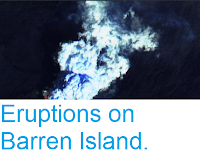
Eruptions on Barren Island.

Barren Island, an uninhabited volcanic island belonging officially to India's Andaman Islands (making it India's only active volcano), began erupting on, or shortly before, 25 September 2018, when the Middle InfraRed Observation of Volcanic Activity (MIROVA) monitoring system, which uses data from the Moderate-Resolution Imaging Spectroradiometer (MODIS) system on the Terra (EOS AM) and Aqua (EOS PM) satellites detected a thermal anomaly on the northwest flank of the cone, interpretted as a recent lava flow. Since then images from the Sentinal Satetellite system have shown lava flows reaching the sea on the island, and a visit to the volcano by a boat from tour company Andaman Aquaholics has directly witnessed this flow.

Eruption on Barren Island on 23 October 2018, as imaged by the Sentinal Satellite system. European Space Agency.

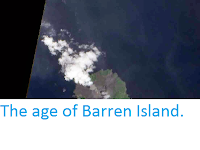
Barren Island is about 100 km to the east of the main Andaman Island group and about 450 km west of the coast of southern Myanmar. The island is about 3 km in diameter and rises 354 m above sea level. It is the only active volcano in the region, though it forms part of a group with a number of dormant volcanoes including Narcondam Island and Alcock and Sewell seamounts.

 Lava flow on Barren Island on 20 October 2018. Andaman Aquaholics.

The volcanoes sit on the Burma (or Burmese) Plate, a small tectonic plate underlying the Andaman Islands, part of the eastern Indian Ocean and the western part of Sumatra. To the west of the Andaman Islands this plate is being subducted beneath the Indian Plate, but to the east the situation is more complex. The Burma Plate is being pushed northward relative to the Eurasia and the Sunda Plate (which underlies eastern Sumatra, Java, southern Southeast Asia, most of Borneo and the western Philippines) by the northward movement of the Indian Plate, but there is an area of seafloor spreading beneath the Andaman Sea (separating the Andaman Islands from Southeast Asia), which in turn causes stresses within the Burma Plate, leading to a zone of faulting upon which the volcanic islands and seamounts are situated.

(Left) The movement of the Burma and surrounding plates. Sheth et al. (2011) (Right) Tectonic stresses within and around the Burma Plate. Renjith (2013).

See also...

https://sciencythoughts.blogspot.com/2018/02/magnitude-56-earthquake-in-andaman.htmlhttps://sciencythoughts.blogspot.com/2017/02/ongoing-eruptions-on-barren-island.html
http://sciencythoughts.blogspot.co.uk/2015/06/eruption-on-barren-island.htmlhttp://sciencythoughts.blogspot.co.uk/2014/04/the-age-of-barren-island.html
http://sciencythoughts.blogspot.co.uk/2013/10/eruptions-on-barren-island.html
Follow Sciency Thoughts on Facebook.

Thursday, 15 February 2018

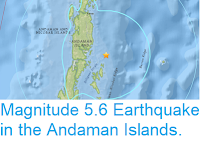
Magnitude 5.6 Earthquake in the Andaman Islands.

The United States Geological Survey recorded a Magnitude 5.6 Earthquake at a depth of 69.4 km roughly 25 km to the east of Andaman Island, slightly before 8.10 am local time (slightly before 2.40 am GMT) on Tuesday 13 February 2018. There are no reports of any damage or injuries associated with this event, though it was felt on Andaman Island. 

The approximate location of the 13 February 2018 Andaman Earthquake. USGS.

The Andaman Islands sit on the Burma (or Burmese) Plate, a small tectonic plate which underlies part of the eastern Indian Ocean and the western part of Sumatra. To the west of the Andaman Islands this plate is being subducted beneath the Indian Plate, but to the east the situation is more complex. The Burma Plate is being pushed northward relative to the Eurasia and the Sunda Plate (which underlies eastern Sumatra, Java, southern Southeast Asia, most of Borneo and the western Philippines) by the northward movement of the Indian Plate. There is also an area of seafloor spreading beneath the Andaman Sea (separating the Andaman Islands from Southeast Asia), which in turn causes stresses within the Burma Plate, leading to a zone of faulting upon which the Andaman Islands are situated.

(Left) The movement of the Burma and surrounding plates. Sheth et al. (2011) (Right) Tectonic stresses within and around the Burma Plate. Renjith (2013).


Witness accounts of Earthquakes can help geologists to understand these events, and the structures that cause them. The international non-profit organisation Earthquake Report is interested in hearing from people who may have felt this event; if you felt this quake then you can report it to Earthquake Report here.

See also...

http://sciencythoughts.blogspot.co.uk/2017/02/ongoing-eruptions-on-barren-island.htmlhttp://sciencythoughts.blogspot.co.uk/2015/06/eruption-on-barren-island.html
http://sciencythoughts.blogspot.co.uk/2014/04/the-age-of-barren-island.htmlhttp://sciencythoughts.blogspot.co.uk/2013/10/eruptions-on-barren-island.html
Follow Sciency Thoughts on Facebook.

Sunday, 12 November 2017

Musa paramjitiana: A new species of Banana from the Andaman Islands.

Bananas, Musa spp., are large fruiting Monocots which grow wild across tropical areas of Africa, Asia, Australia and the islands of the Pacific and Indian Oceans. They are shrub- or tree sized plants, but lack any woody tissue, and are sometimes referred to as giant herbs for this reason. The fruits of wild Bananas are packed full of seeds, making them an un-attractive proposition for hungry Humans; commercially grown varieties tend to be sterile hybrids that lack seeds.

In a paper published in the Nordic Journal of Botany on 5 December 2016, Lal Ji Singh of the Botanical Survey of India, describes a new species of Banana from the Andaman Islands.

The new species is named  Musa paramjitiana, in honour of Paramjit Singh of the Botanical Survey of India, for his work on the taxonomy of Flowering Plants. It is a robust Banana, reaching 7.0 to 10.5 m in height.and 100–130 cm in diameter at the base. Flowers are orange and born in October to December, the fruit are thick and reach 8.5-13.5 cm in length, with apricot or orange-pink pulp, and a distinctive sweet and sour taste.

Musa paramjitiana, (A)–(D) inflorescence, (E)–(F) leaf sheath. Singh (2017).

Musa paramjitiana was found growing only at two locations, on North and Middle Andaman Islands, with 6-18 plants growing at each site. It grows close to stream banks in mixed lowland forest, an environment which is rapidly disappearing in the Andaman Islands. For this reason Singh recommends that the species be regarded as Critically Endangered under the terms of the the International Union for the Conservation of Nature's Red List of Threatened Species.

Musa paramjitiana, (K)–(L) infructescence with persistent bracts, (M) single fruit hand, (N)–(Q) fruits, (R)–(S) seeds, (T) seedlings. Singh (2017).

See also...

http://sciencythoughts.blogspot.co.uk/2017/09/thismia-nigricoronata-new-species-of.htmlhttp://sciencythoughts.blogspot.co.uk/2017/09/gelidocalamus-xunwuensis-new-species-of.html
http://sciencythoughts.blogspot.co.uk/2017/08/coelogyne-putaoensis-new-species-of.htmlhttp://sciencythoughts.blogspot.co.uk/2017/08/zingiber-alba-new-species-of-ginger.html
http://sciencythoughts.blogspot.co.uk/2017/04/heliconia-berguidoi-new-species-of.htmlhttp://sciencythoughts.blogspot.co.uk/2017/01/habenaria-yookuaaensis-new-species-of.html
Follow Sciency Thoughts on Facebook.