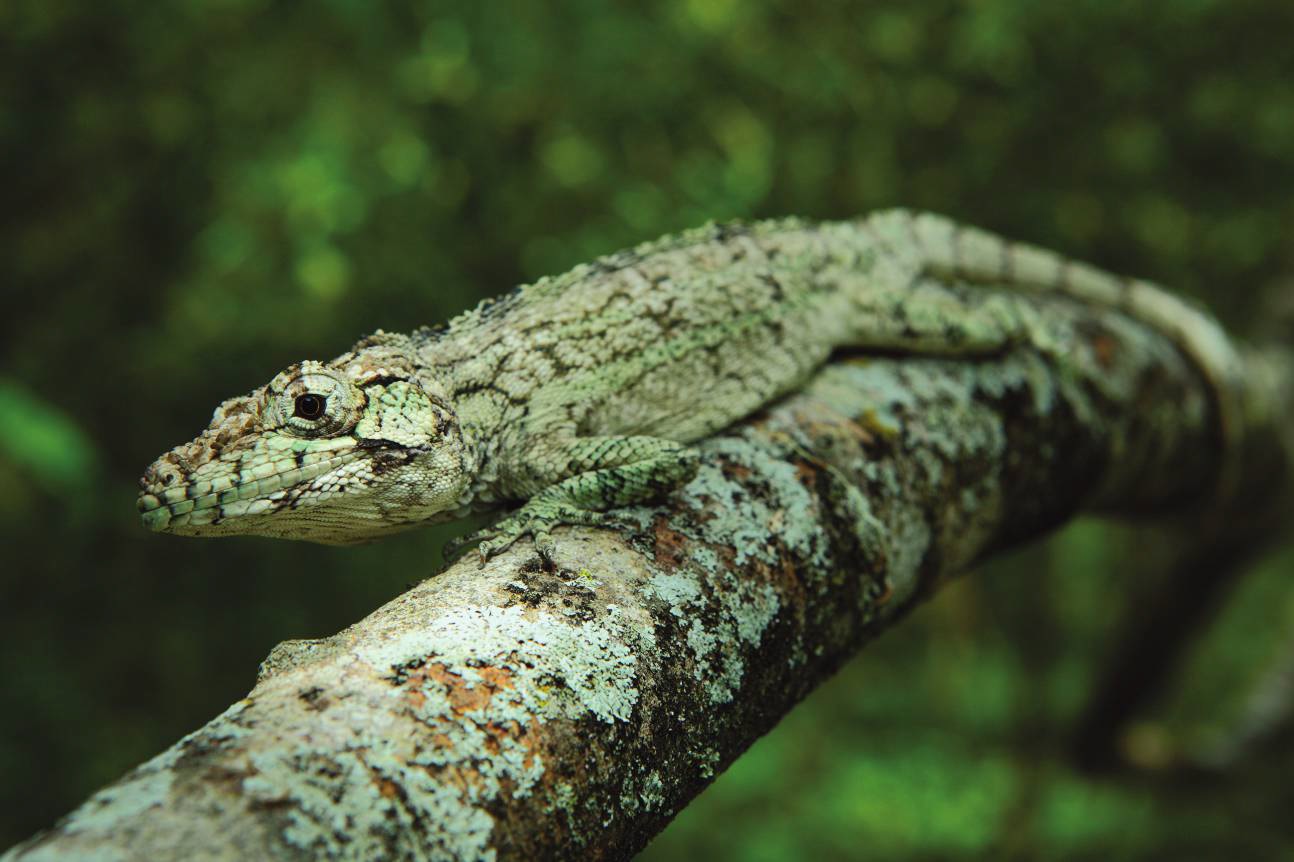
Anoles are small Iguanid Lizards found in the Southern United States, Mexico, Central America, the Caribbean, and South America as far south as Paraguay. They are excellent climbers, with adhesive pads on their feet similar to those seen in Geckos., but unlike Geckos are typically active during the day, when they are active predators of Insects and smaller Vertebrates, though some species will also eat fruit, flowers and nectar. Many species of Anole can change their colour to blend in with their background, and all can shed their tails to escape predators. Anoles are highly territorial, with both males and females having territories, though those of the males are larger and typically overlap with those of several females. Most Anoles have a large dewlap (a throat flap erected by a piece of cartilage in the neck), which tends to be brightly coloured and patterned both at (Human) visible wavelengths and in the near ultra-violet. The genus Anolis is the largest genus of terrestrial Vertebrates, with over 425 species, though most of this diversity is found in the Caribbean, where the Lizards have undergone multiple adaptive radiations. Each Island has its own set of Lizards, which tend to be most closely related to other Lizards on the same island, but a series of similar
morphotypes, each adapted to a different ecological role, has appeared
repeatedly on different islands.
In a paper published in the journal ZooKeys on 1 November 2018, Mario Yánez-Muñoz of the Unidad de Investigación at the Instituto Nacional de Biodiversidad, Carolina Reyes-Puig, also of the Unidad de Investigación at the Instituto Nacional de Biodiversidad, and of the Instituto de Zoología Terrestre and Museo de Zoología at the Universidad San Francisco de Quito, Juan Pablo Reyes-Puig, again of the Unidad de Investigación at the Instituto Nacional de Biodiversidad, and of the Fundación Red de Protección de Bosques and the Fundación Oscar Efrén Reyes, Julián Velasco of the Museo de Zoología ‘Alfonso L. Herrera’ at the Universidad Nacional Autónoma de México, and Fernando Ayala-Varela and Omar Torres-Carvajal of the Museo de Zoología at the Pontificia Universidad Católica del Ecuador, describe a new cryptic species of Anolis from southwestern Colombia and northwestern Ecuador.
Cryptic species are species that closely resemble other species, and cannot be separated by simple, non-invasive examination. While taxonomists have known about cryptic species for a long time, it was not realised how numerous such species were until taxonomists began to use genetics to determine relationships between species, about twenty years ago. The presence of cryptic species can have a profound influence on conservation efforts, as ‘species’ thought to be wide ranging with large populations and broad environmental tolerances can turn out to be complexes of closely related but reproductively isolated species, each with a smaller population and distribution, and narrower range of environmental tolerances.
The new species is named Anolis dracula, in reference to the Dracula Reserve in Carchi Province, Ecuador, which lies at the heart of the species range; the reserve in turn takes its name from the Dracula Orchids which it was set up to protect (some, but not all, Dracula Orchids are blood red). The species is found in Carchi and Imbabura provinces in Ecuador, and in Nariño Department, Colombia, with a total range of about 1582 km² in evergreen low montane forest at altitudes of between 1187 and 2353 m above sea level. The species appears tolerant of disturbance, and as well as being found in mature forests was found in secondary forest (forest in the process of regrowing after disturbance), pasture, and along the edge of roads. Anolis dracula is a large Anole Lizard distinguishable from closely related species in the same area only by genetic analysis, examination of the skull or examination of the male’s penis. The males tend to be dark brown with black, light brown and green bands, while the females are green with pink, turquoise or cream bands, but all can change colour to better blend in with their background or express their emotional state.

Cryptic species are species that closely resemble other species, and cannot be separated by simple, non-invasive examination. While taxonomists have known about cryptic species for a long time, it was not realised how numerous such species were until taxonomists began to use genetics to determine relationships between species, about twenty years ago. The presence of cryptic species can have a profound influence on conservation efforts, as ‘species’ thought to be wide ranging with large populations and broad environmental tolerances can turn out to be complexes of closely related but reproductively isolated species, each with a smaller population and distribution, and narrower range of environmental tolerances.
The new species is named Anolis dracula, in reference to the Dracula Reserve in Carchi Province, Ecuador, which lies at the heart of the species range; the reserve in turn takes its name from the Dracula Orchids which it was set up to protect (some, but not all, Dracula Orchids are blood red). The species is found in Carchi and Imbabura provinces in Ecuador, and in Nariño Department, Colombia, with a total range of about 1582 km² in evergreen low montane forest at altitudes of between 1187 and 2353 m above sea level. The species appears tolerant of disturbance, and as well as being found in mature forests was found in secondary forest (forest in the process of regrowing after disturbance), pasture, and along the edge of roads. Anolis dracula is a large Anole Lizard distinguishable from closely related species in the same area only by genetic analysis, examination of the skull or examination of the male’s penis. The males tend to be dark brown with black, light brown and green bands, while the females are green with pink, turquoise or cream bands, but all can change colour to better blend in with their background or express their emotional state.

Colour variation in Anolis dracula. From top to bottom: Male, male, female, subadult male. Mario Yánez-Muñoz in Yánez-Muñoz et al (2018).
See also...


Follow Sciency Thoughts on Facebook.