Showing posts with label Iguanid Lizards. Show all posts

Saturday, 2 February 2019

Calumma roaloko: A new species of Chameleon from Madagascar.

The island of Madagascar has long been seen as a biodiversity hotspot, with a high number of endemic species (species found nowhere else). However, studies over the past two decades have shown that this biodiversity has been considerably underestimated for many groups, as better biological surveying has revealed both a large number of cryptic species (species which resemble other species so closely that they cannot be told apart by simple physical examination) and species with limited ranges or secretive habits that had been overlooked by earlier surveys. Among Vertebrates this newly discovered biodiversity has been particularly notable in three groups, the Primates (Lemurs), Anurans (Frogs), and Squamates (Snakes and Lizards).

In a paper published in the journal Zoosystematics and Evolution on 19 October 2018, David Prötzel of the Zoologische Staatssammlung München, Shea Lambert of the Department of Ecology and Evolutionary Biology at the University of Arizona, Tucson, Ginah Tsiorisoa Andrianasolo of the Mention Zoologie et Biodiversité Animale at the Université d’Antananarivo, Carl Hutter of the Biodiversity Institute and Department of Ecology and Evolutionary Biology at the University of Kansas, Kerry Cobb of the Department of Biological Sciences at Auburn University, Mark Scherz, also of the Zoologische Staatssammlung München, and of the Zoologisches Institut at the Technische Universität Braunschweig, and Frank Glaw, again of the Zoologische Staatssammlung München, describe a new species of Chameleon from Madagascar.

Chameleons are an exclusively Old World group of Iguanid Lizards closely related to the Agamids (or Dragon Lizards) which are also found only in the Old World, the two groups together being referred to as the Acrodonta. They are noted for their ability to change colour, though this ability is not found in all species. Chameleons also have highly specialised feet, with five toes arranged into two opposing groups, to aid movement in trees (where most species are found), highly modified eyes, which can be pivoted seperately, and a sticky tongue that can be launched as a projectile at prey items (usually Insects), which are then drawn back into the mouth.

The new species is placed in the endemic Malagasy genus Calumma, and given the specific name roaloko, which means 'two colours' in Malagasy, in reference to the patterning of the males of the species, which have a bright green upper side and a white underside (females are a drab brown all over). The species is described from five specimens, an adult male and an adult female, plus two subadult males and a subadult female. The adult male is 93.7 mm in length, the female 85.5 mm. Both sexes have a soft appendage on their snout, with the males having an indigo stripe that runs from this through the eye to the back of the head.

In-life photos of four specimens of Calumma roaloko; (a) subadult male; (b) adult male; (c) subadult male; (d) adult female. Prötzel et al. (2018).

All of the specimens were collected at an altitude of 1100 m above sea level in a fragment of rainforest close to the Analamazaotra Special Reserve and Andasibe-Mantadia National Park, and within an area called the Réserve de Ressources Naturelles du Corridor Ankeniheny-Zahamena, one of a series of newly protected area of rainforest fragments, currently administered by several local councils, but which it is planned to add to the country's national parks system. The fragment of rainforest in which the Chameleons was found currently measures less than 300 km³ and is considered to be shrinking. Calumma roaloko could potentially be found in neighbouring forest fragments, including those within the longer standing Analamazaotra and Andasibe-Mantadia national parks, or the privately run  Réserve de Vohimana, all of which contain larger areas of forest. However, since the species has not yet been located outside its original forest fragment, Prötzel et al. suggest that it should be classified as Endangered under the terms of the International Union for the Conservation of Nature’s Red List of Threatened Species.

 Posed photos of a subadult male specimen of Calumma roaloko; (a) Indigo coloration on the rostral appendage and head scalation is apparent; (b) portrait of the same specimen.

See also...

https://sciencythoughts.blogspot.com/2018/11/anolis-dracula-new-cryptic-species-of.htmlhttps://sciencythoughts.blogspot.com/2017/06/brachylophus-gau-new-species-of-south.html
https://sciencythoughts.blogspot.com/2016/12/sceloporus-goldmani-new-populations-of.htmlhttps://sciencythoughts.blogspot.com/2016/10/jeddaherdan-aleadonta-agamid-lizard.html
https://sciencythoughts.blogspot.com/2016/08/anolis-landestoyi-chameleon-like-anole.htmlhttps://sciencythoughts.blogspot.com/2016/04/tropidurus-sertanejo-new-species-of.html
Follow Sciency Thoughts on Facebook.

Monday, 12 November 2018

Anolis dracula: A new, cryptic, species of Anole from Colombia and Ecuador.

Anoles are small Iguanid Lizards found in the Southern United States, Mexico, Central America, the Caribbean, and South America as far south as Paraguay. They are excellent climbers, with adhesive pads on their feet similar to those seen in Geckos., but unlike Geckos are typically active during the day, when they are active predators of Insects and smaller Vertebrates, though some species will also eat fruit, flowers and nectar. Many species of Anole can change their colour to blend in with their background, and all can shed their tails to escape predators. Anoles are highly territorial, with both males and females having territories, though those of the males are larger and typically overlap with those of several females. Most Anoles have a large dewlap (a throat flap erected by a piece of cartilage in the neck), which tends to be brightly coloured and patterned both at (Human) visible wavelengths and in the near ultra-violet. The genus Anolis is the largest genus of terrestrial Vertebrates, with over 425 species, though most of this diversity is found in the Caribbean, where the Lizards have undergone multiple adaptive radiations. Each Island has its own set of Lizards, which tend to be most closely related to other Lizards on the same island, but a series of similar morphotypes, each adapted to a different ecological role, has appeared repeatedly on different islands.

In a paper published in the journal ZooKeys on 1 November 2018, Mario Yánez-Muñoz of the Unidad de Investigación at the Instituto Nacional de Biodiversidad, Carolina Reyes-Puig, also of the Unidad de Investigación at the Instituto Nacional de Biodiversidad, and of the Instituto de Zoología Terrestre and Museo de Zoología at the Universidad San Francisco de Quito, Juan Pablo Reyes-Puig, again of the Unidad de Investigación at the Instituto Nacional de Biodiversidad, and of the Fundación Red de Protección de Bosques and the Fundación Oscar Efrén Reyes, Julián Velasco of the Museo de Zoología ‘Alfonso L. Herrera’ at the Universidad Nacional Autónoma de México, and Fernando Ayala-Varela and Omar Torres-Carvajal of the Museo de Zoología at the Pontificia Universidad Católica del Ecuador, describe a new cryptic species of Anolis from southwestern Colombia and northwestern Ecuador.

Cryptic species are species that closely resemble other species, and cannot be separated by simple, non-invasive examination. While taxonomists have known about cryptic species for a long time, it was not realised how numerous such species were until taxonomists began to use genetics to determine relationships between species, about twenty years ago. The presence of cryptic species can have a profound influence on conservation efforts, as ‘species’ thought to be wide ranging with large populations and broad environmental tolerances can turn out to be complexes of closely related but reproductively isolated species, each with a smaller population and distribution, and narrower range of environmental tolerances.

The new species is named Anolis dracula, in reference to the Dracula Reserve in Carchi Province, Ecuador, which lies at the heart of the species range; the reserve in turn takes its name from the Dracula Orchids which it was set up to protect (some, but not all, Dracula Orchids are blood red). The species is found in Carchi and Imbabura provinces in Ecuador, and in Nariño Department, Colombia, with a total range of about 1582 km² in evergreen low montane forest at altitudes of between 1187 and 2353 m above sea level. The species appears tolerant of disturbance, and as well as being found in mature forests was found in secondary forest (forest in the process of regrowing after disturbance), pasture, and along the edge of roads. Anolis dracula is a large Anole Lizard distinguishable from closely related species in the same area only by genetic analysis, examination of the skull or examination of the male’s penis. The males tend to be dark brown with black, light brown and green bands, while the females are green with pink, turquoise or cream bands, but all can change colour to better blend in with their background or express their emotional state.

Colour variation in Anolis dracula. From top to bottom: Male, male, female, subadult male. Mario Yánez-Muñoz in Yánez-Muñoz et al (2018).

See also...

https://sciencythoughts.blogspot.com/2018/05/pristimantis-erythros-new-species-of.htmlhttps://sciencythoughts.blogspot.com/2017/12/trachemys-medemi-new-species-of-slider.html
https://sciencythoughts.blogspot.com/2017/10/atractus-cerberus-atractus-esepe.htmlhttps://sciencythoughts.blogspot.com/2017/09/bryodelphax-kristenseni-new-species-of.html
https://sciencythoughts.blogspot.com/2017/09/nipponnemertes-incainca-new-species-of.htmlhttps://sciencythoughts.blogspot.com/2017/07/parachemmis-julioblancoi-new-species-of.html
Follow Sciency Thoughts on Facebook.

Saturday, 3 December 2016

Sceloporus goldmani: New populations of Goldman's Bunchgrass Lizard discovered in Mexico.

Spiney Lizards, Sceloporus, are among the most numerous and commonly seen Iguanid Lizards in North and Central America. However while some species are extremely common and widespread, others have much more localized populations and lower mumbers, making them vulnerable to extinction. Goldman's Bunchgrass Lizard, Sceloporus goldmani, is known only from two areas in the arid grasslands of northwest Mexico, one straddling the border between Nuevo León and San Luis Potosi states and the second in southern Coahuila State. However no Lizards have been seen at the second site for some years and the grassland there has largely been converted to agricultural land. Due to the small area inhabited by the species and its decreasing range it is currently considered to be Endangered under the terms of the International Union for the Conservation of Nature’s Red List of Threatened Species.

In a paper published in the journal Revista Mexicana de Biodiversidad on 31 October 2016, Rubén Alonso Carbajal-Márquez of the Departamento de Conservación de la Biodiversidad at the Unidad Chetumal and Conservación de la Biodiversidad del Centro de México and Gustavo Ernesto Quintero-Díaz, also of Conservación de la Biodiversidad del Centro de México and of the Centro de Ciencias Básicas of the Universidad Autónoma de Aguascalientes, describe four new, previously undescribed, populations from Mexico.

Dorsal view of male (A) and female (B) specimens of Sceloporus goldmani. Carbajal-Márquez & Quintero-Díaz (2016).


Carbajal-Márquez and Quintero-Díaz were unable to locate the species at either of the previous known locations, however they did locate the Lizards at four locations where it had not previously been recorded, in San Luis Potosi, Aguascalientes, Jalisco and Zacatecas states.

Locations where Sceloporus goldmani was found; the most southerly points represent new records from San Luis Potosi, Aguascalientes, Jalisco and Zacatecas states. Points in the center and north represent the previously known locations in Coahuila, Nuevo León and San Luis Potosi states. The ploted area represents the range recorded on the International Union for the Conservation of Nature’s Red List of Threatened Species.

 See also...

http://sciencythoughts.blogspot.co.uk/2016/08/anolis-landestoyi-chameleon-like-anole.htmlhttp://sciencythoughts.blogspot.co.uk/2016/04/tropidurus-sertanejo-new-species-of.html
http://sciencythoughts.blogspot.co.uk/2015/07/babibasiliscus-alxi-casquehead-lizard.htmlhttp://sciencythoughts.blogspot.co.uk/2015/01/a-new-species-of-twig-anole-from-panama.html
http://sciencythoughts.blogspot.co.uk/2014/11/four-new-species-of-treerunner-from.htmlhttp://sciencythoughts.blogspot.co.uk/2013/06/two-new-species-of-woodlizard-from.html
Follow Sciency Thoughts on Facebook.

Sunday, 28 August 2016

Anolis landestoyi: A Chameleon-Like Anole Lizard from Hispaniola.

The Anole Lizards of the Greater Antilles islands are considered a classic example of island biogeography. Easch Island has its own set of Lizards, which tend to be most closely related to other Lizards on the same island, but a series of similar morphotypes, each adapted to a different ecological role, has appeared repeatedly on different islands. Larger islands support a greater number of species and morphotypes, with the largest island, Cuba, supporting a number of morphotypes not seen on any of the smaller islands, such as the semi-aquatic stream-dwelling Anolis vermiculatus, the long-legged karst-dwelling Anolis bartschi and several large, slow-moving, Chameleon-like species.

In a paper published in The American Naturalist on 17 June 2016, Luke Mahler of the Department of Ecology and Evolutionary Biology at the University of Toronto, Shea Lambert of the Department of Ecology and Evolutionary Biology at the University of Arizona, Anthony Geneva of the Department of Organismic and Evolutionary Biology and Museum of Comparative Zoology at Harvard University, Julienne Ng of the Department of Ecology and Evolutionary Biology at the University of Colorado–Boulder, Blair Hedges of the Center for Biodiversity at Temple University, Jonathan Losos, also of the Department of Organismic and Evolutionary Biology and Museum of Comparative Zoology at Harvard University and Richard Glor of the Herpetology Division at the Biodiversity Institute and Department of Ecology and Evolutionary Biology at the University of Kansas, describe a new species of Chameleon-like Anole from Hispaniola Island in the Greater Antilles.

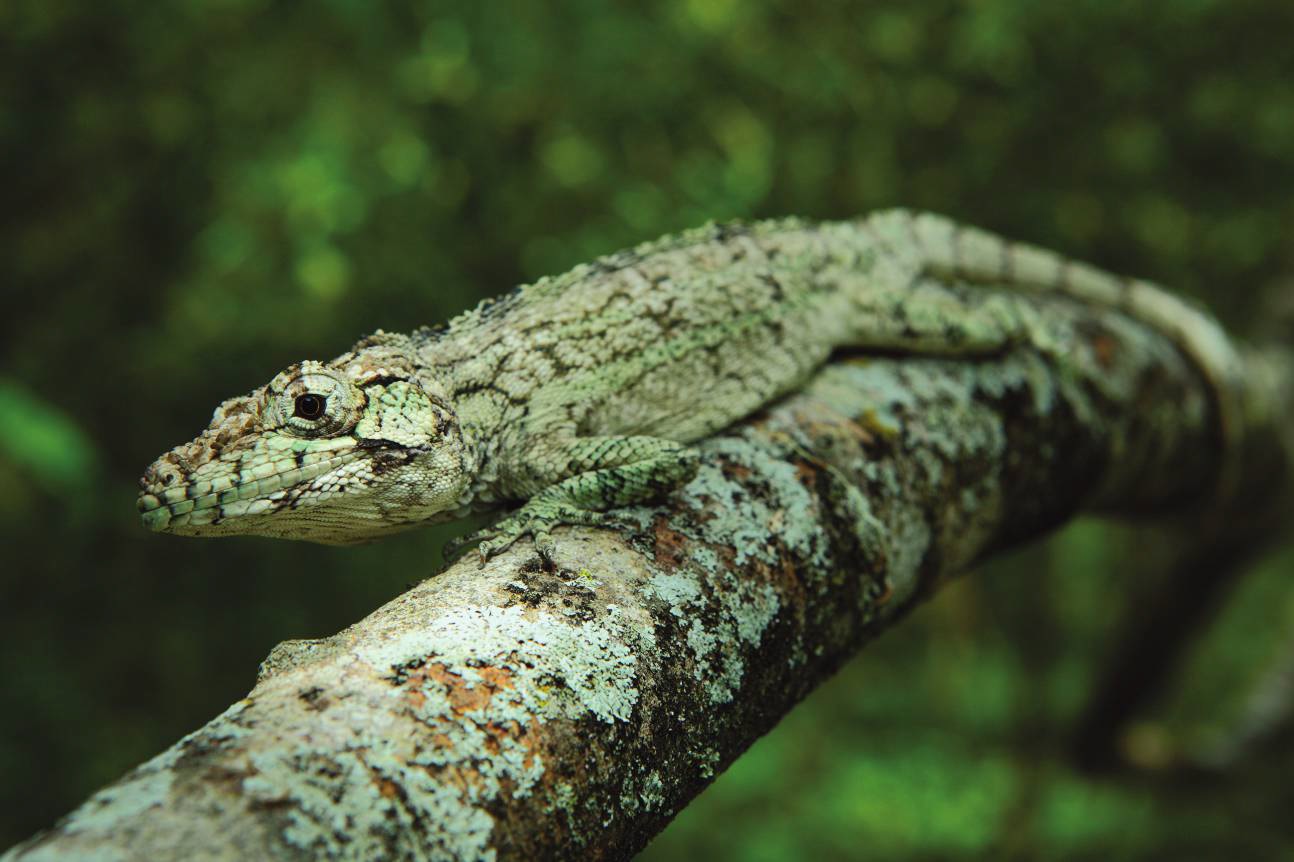
The new species is named Anolis landestoy, in honour of the honoring Dominican naturalist Miguel Landestoy, who first observed the species and realized its significance. Anolis landestoy is a large (up to 135 mm) Anole Lizard wth green lichenate markings, short limbs and tail and a and large bluish dewlap with dark reticulations. It appears similar to the Chameleon-like Anoles of Cuba, though a genetic analysis revealed it to be more closely related to other Anoles on Hispaniola.

Anolis landestoyi in natural habitat. Miguel Landestoy in Mahler et al. (2016).

The discovery of Anolis landestoy lends further weight to the idea that similar morphotypes of Anole Lizards have repeatedly evolved on different islands in response to similar evolutionary pressures. Cuba, the largest of the Greater Antilles islands is home to several, closely related, Chameleon-like Anole Lizards, and now Hispaniola, the second largest island in the group, has been shown to be home to a single, unrelated, Chameleon-like Anole.

See also...

http://sciencythoughts.blogspot.co.uk/2016/04/tropidurus-sertanejo-new-species-of.htmlTropidurus sertanejo: A new species of Ground Lizard from Bahia State, Brazil. Ground Lizards of the genus Tropidurus are found across tropical and subtropical South America. They are ground dwelling Iguanas, favouring open habitats, closely related to the Marine Iguanas of the...
http://sciencythoughts.blogspot.co.uk/2015/01/a-new-species-of-twig-anole-from-panama.htmlA new species of Twig Anole from Panama. Anoles are small Iguanid Lizards found in the Southern United States, Mexico, Central America and the Caribbean. Twig Anoles, Norops spp., form a distinct cluster of medium sized Anole Lizard species within the genus Norops. There are currently eight...
http://sciencythoughts.blogspot.co.uk/2014/11/four-new-species-of-treerunner-from.htmlFour new species of Treerunner from northern South America.                               Treerunners of the genus Plicaare Iguanid Lizards found in South America east of the Andes. They are medium sized, conspicuous Lizards that are active in the daytime, living in small colonies on rock outcrops or trees, and therefore are well represented in museum collections, as they tend to attract the attention of...
Follow Sciency Thoughts on Facebook.

Sunday, 17 April 2016

Tropidurus sertanejo: A new species of Ground Lizard from Bahia State, Brazil.

Ground Lizards of the genus Tropidurus are found across tropical and subtropical South America. They are ground dwelling Iguanas, favouring open habitats, closely related to the Marine Iguanas of the Galapagos Islands. The group are quite variable, with Lizards with a wide range of sized placed within the genus, and many species showing a wide range of colours. These Lizards tend to be sexually dimorphic (males and females are not the same), with the sexes having different markings in most species and males usually larger than the females.

In a paper published in the American Museum Novitates on 20 February, André Carvalho of the Richard Gilder Graduate School and Division of Vertebrate Zoology (Herpetology) at the American Museum of Natural History, Marco Sena of the Departamento de Zoologia at the Universidade de São Paulo, Pedro Peloso, also of the Division of Vertebrate Zoology (Herpetology) at the American Museum of Natural History and of the Museu Paraense Emílio Goeldi, Fabio Machado of the Departamento de Genética e Biologia Evolutiva at the Universidade de São Paulo, Rachel Montesinos, also of the Departamento de Zoologia at the Universidade de São Paulo, Hélio Silva of the Departamento de Biologia Animal at the Universidade Federal Rural do Rio de Janeiro, Gwyneth Campbell, again of the Division of Vertebrate Zoology (Herpetology) at the American Museum of Natural History and Miguel Rodrigues, again of the Departamento de Zoologia at the Universidade de São Paulo, describe a new species of Tropidurus  from the caatinga drylands of Bahia State in Brazil.

The new species is named Tropidurus sertanejo, 'sertanejo' being a Portuguese word meaning 'rural' which is applied in particular to people from the sertão, the dry caatinga areas of northeastern Brazil. The species is described from 25 specimens (five adult males, five adult females and fifteen juveniles) collected from two sites, one in the Reserva Particular do Patrimônio Natural Fazenda Pé da Serra in the Municipality of Ibotirama and the second within the Municipality of Caetité. The Lizards are light brown in colour with pale salmon spots, a lighter underside and a bronze sheen on the head. The species is small compared to most other members of the genus, with adult males ranging from 166.4-197.9 mm in length and adult females from 138.9-147.9 mm in length.

Female specimen of Tropidurus sertanejo from the Reserva Particular do Patrimônio Natural Fazenda Pé da Serra, Serra do Arame. Carvalho et al. (2016).

See also...

http://sciencythoughts.blogspot.co.uk/2015/07/babibasiliscus-alxi-casquehead-lizard.htmlBabibasiliscus alxi: A Casquehead Lizard from the Early Eocene of Wyoming.   Casquehead Lizards, Corytophanidae, are a group of Iguanid Lizards found from the tropical forests of southern Mexico, through Central America to the northwest of South America. They belong to a group of Iguanians, the Pleurodonta, found today...

http://sciencythoughts.blogspot.co.uk/2015/01/a-new-species-of-twig-anole-from-panama.htmlA new species of Twig Anole from Panama. Anoles are small Iguanid Lizards found in the Southern United States, Mexico, Central America and the Caribbean. Twig Anoles, Norops spp., form a distinct cluster of medium sized Anole Lizard species within the genus Norops. There are currently eight...


http://sciencythoughts.blogspot.co.uk/2014/11/four-new-species-of-treerunner-from.htmlFour new species of Treerunner from northern South America.                               Treerunners of the genus Plicaare Iguanid Lizards found in South America east of the Andes. They are medium sized, conspicuous Lizards that are active in the daytime, living in small colonies on rock outcrops or trees, and therefore are well represented in museum collections, as they tend to attract the attention of...
Follow Sciency Thoughts on Facebook.
 

Thursday, 30 July 2015

Babibasiliscus alxi: A Casquehead Lizard from the Early Eocene of Wyoming.


Casquehead Lizards, Corytophanidae, are a group of Iguanid Lizards found from the tropical forests of southern Mexico, through Central America to the northwest of South America. They belong to a group of Iguanians, the Pleurodonta, found today almost exclusively in the Americas, with non-American members of the group known only from the islands of Madagascar and Fiji, and studies of the group taking into account relationships between modern species and their biogeographical distribution suggest that they probably originated in the American tropics. However a single fossil specimen of a Casquehead Lizard is known from the Early Eocene of Central Europe, suggesting that their ancient distribution might have been somewhat different from that seen today.

In a paper published in the journal PLoS One on 1 July 2015, Jack Conrad of the Department of Anatomy at the New York Institute of Technology College of Osteopathic Medicine and the Department of Vertebrate Paleontology at the American Museum of Natural History describes a new species of Casquehead Lizard from the late Early Eocene Bridger Formation of Uinta County in Wyoming (about 48 million years old).

The new species is named Babibasiliscus alxi, where ‘Babi-’ means ‘older male cousin’ in the language of the Shoshone people who inhabited the region where the fossil was discovered, and ‘-basiliscus’ (Basiliscus) is the name of a modern genus of Casquehead Lizards, while ‘alxi’ honours John Alexander, who discovered the specimen from which the species was described. The single known specimen comprises a nearly complete skull with articulated jaws plus the first two vertebrae, undistorted or compacted, but with the premaxilla, posterior half of the frontal, parietal, postfrontals, postorbitals, squamosals, supratemporals, supraoccipital, dorsal half of each quadrate, and the anterior tips of both dentaries lost to erosion.

Babibasiliscus alxi: Photographs in (A) right lateral, (B) dorsal, and (C) ventral views. Digital reconstructions derived from High Resolution X-ray Computerised Tomography in (D) left lateral view and (E) transverse section. The vertical red line in (D) indicates the plane of section in (E). Conrad (2015).

A phylogenetic analysis of Casquehead Lizards including Babibasiliscus alxi places it firmly within the modern group, closely related to the living genus Laemanctus. Wyoming is considerably outside the range of modern Casquehead Lizards, with a strongly seasonal climate, typically including heavy winter snowfall. However during the Eocene global climates are known to have been considerably warmer than today, and both Babibasiliscus alxi from Wyoming and Geiseltaliellus maarius from the Eocene of Central Europe are interpreted as having lived in tropical forests not dissimilar from those inhabited by modern Casquehead Lizards.

Phylogeny of Corytophanids and distribution of the group. (A) Time-calibrated phylogeny of the Corytophanid genera with representative illustrations of their skull morphologies. Conrad (2015).

Modern Iguanians are divided into two groups, the Chamaeleontiformes, comprising the Chameleons, Agamas, and their relatives, which are found in the Old World, and the Pleurodonta, comprising the Iguanas, Basilisks, Anoles, Fence Lizards, and their relatives, which are found in the Americas (with the exception of the Opluridae which are found in Madagascar and the genus Brachylophus from Fiji). However the earliest Iguanians are found in Cretaceous deposits dating to before the separation of North America and Eurasia, with the majority of species found in Asia, suggesting this is where the group originated. By the Eocene Iguanians were divided into the modern groups Chamaeleontiformes and Pleurodonta, though with specimens from both groups found on both sides of the Atlantic, and in particular many species of Pleurodonts found in the Old World. It is therefore thought that the modern distribution of the groups reflects a relict distribution shaped by post-Eocene cooling rather than the modern groups having derived from isolated populations after the separation of the continents. Conrad suggests that this interpretation can also be applied to the modern Casquehead Lizards, with the group distributed across tropical forests in what is now the Northern Hemisphere temperate zone during the Eocene (when they were probably excluded from the far hotter tropics), and subsequently having withdrawn to the Neotropics during later Cainozoic cooling.

See also…

Anles are small Iguanid Lizards found in the Southern United States, Mexico, Central America and the Caribbean. Twig Anoles, Norops spp., form a distinct cluster of medium sized Anole Lizard species within the genus Norops. There are currently eight...


Treerunners of the genus Plica are Iguanid Lizards found in South America east of the Andes. They are medium sized, conspicuous Lizards that are active...


Western Europe is thought to have had a diverse Squamate (Snake and Lizard) fauna during the Miocene, but to have largely lost this during the cooling climate of the Plio-Pleistocene, during which...


Follow Sciency Thoughts on Facebook.