The development of spines in Trilobites reflects an evolutionary arms race over most of the Palaeozoic. This is particularly signposted by a palpable bloom of spiny Trilobites from the late Silurian to the end of the Devonian. Spines are present among the earliest Trilobites at the base of Cambrian Stage 3, but these include genal spines and more or less pronounced pleural spines only (as in genera such as Eofallotaspis, Fallotaspis or Archaeaspis). All of these are best regarded as representing part of a beneficial cover by the dorsal exoskeleton in species that needed to perform a more or less distinct inclination of the body along the length axis to allow pronounced enrolment, in some species possibly combined with improved stability on a soft substrate. Early Cambrian Trilobites generally retained such a 'primordial' organisation and spinosity. However, small to medium-sized spines on the occipital ring, axial rings or the lateral and posterior margins of the pygidium developed progressively, apparently as a response to environmental factors, and all of them were nearly upright to more or less gently rearwardly directed. It is generally accepted that new selective pressures from predators prompted animals to craft innovative protective devices, which in several species included longer and more strongly curved spines.
The localities/areas from which the commercially traded specimens are originating is generally kept confidential. The specimens are collected from two different areas. The main excavating site lies near the western margin of Jbel Ougnate, eastern Anti-Atlas, in the vicinity of Jbel Ba Haddou near Tizi n’Tfarkhin, and most of the specimens on the fossil market with slightly scratched surfaces seem to originate from this area. A second site with quarries exists near Tizi n’Izem, near the northern edge of Jbel Ougnate.

Geological map of the Jbel Ougnate region, eastern Anti-Atlas, based on the official Todrha Ma’der map sheet of the Service Géologique du Maroc, Rabat, with location of the Kingaspidoides spinirecurvatus sampling localities near Tizi n’Tfarkhin and Tizi n’Izem and other renowned fossil localities of Cambrian Trilobites in the region. Insert shows lithostratigraphical and biostratigraphical units for the relevant stratigraphic interval. Cambrian Stage 4–Wuliuan boundary not precisely correlatable into West Gondwana. Geyer et al. (2020).
The strata in which the specimens occur comprise an interval that belongs to the regional upper part of the Bréche à Micmacca Member which forms the lower part of the Jbel Wawrmast Formation. Due to regional differences in subsidence, the Bréche à Micmacca Member is particularly thickly developed in the Jbel Ougnate area, which in turn has provided favourable conditions for fossilization. This led to the establishment of several quarries in which Cambrian Trilobites are recovered for commercial use, such as near Tarhoucht, or near Tizi n’Tfarkhin. However, these quarries are established in the lower and middle part of the Bréche à Micmacca Member, which belongs to the Morocconus notabilis Biozone. This part of the succession is rich in large specimens of Acadoparadoxides species (such as Acadoparadoxides briareus and Acadoparadoxides levisettii) as well as species of Hamatolenus (such as Hamatolenus vincenti and Hamatolenus marocanus), which are frequent objects on the fossil market. The fossils from these strata are characterized by the ochre or red-brown colour of the objects on a yellow sandstone matrix due to the shell substance being largely leached. In contrast, Trilobite specimens from the upper part of the Bréche à Micmacca Member in general and of Kingaspidoides spinirecurvatus in particular, are preserved in thin limestone beds with the cuticle preserved as black phosphatized shell. This part of the member belongs to the Ornamentaspis frequens Biozone although the boundary to the underlying Morocconus notabilis Biozone is difficult to determine with certainty and does not correlate with the change in preservation.
The limestone beds of the upper part of the Bréche à Micmacca Member that bear the specimens are typical for the carbonate layers that mark the top of shallowing upward cycles and characterize a maximum flooding interval, with some of the beds overgrown by microbial mats. These uppermost Bréche à Micmacca Member carbonates are usually developed as medium-grey shell hash beds with packstone to wackestone signature, which yield either complete, or more often fragmented, Trilobite sclerites, but also Brachiopod shells and several other fossil remains such as Hyoliths, Helcionelloids, and Echinoderm ossicles. Others are completely devoid of fossils. The Trilobite, Brachiopod, and Hyolith sclerites in the lower beds are secondarily phosphatized in a style that allowed preservation of fine details on the surfaces, whereas the phosphatization leads to homogeneous layers without preservation of internal details of the cuticle and shell, respectively. However, in the Tizi n’Tfarkhin area and several other localities, the Trilobites in the limestone beds frequently represent complete exoskeletons. A particularly spectacular assemblage of at least seven exoskeletons or sclerites which are mostly enrolled is present in the Bommel collection. Detailed analysis of the specimens has revealed that they are indeed a carefully prepared natural assemblage and not artificially combined.
The new species of Trilobite is placed in the genus Kingaspidoides, which is characterised by a distinct reduction of the glabellar and genal convexity toward a Kingaspis-like aspect of the dorsal surface of the cephalic cuticle, whereas internal moulds show distinct axial furrows, well defined glabellar frontal margins and fixigenae which are domed independently from the glabellar convexity. Despite the numerous specimens of Kingaspidoides species known from the Moroccan Atlas ranges, well preserved pygidia were unknown from the Moroccan material. Well preserved pygidia of Kingaspidoides are known from Kingaspidoides frankenwaldensis from the Franconian Forest, Germany, and particularly from the Scanian Kingaspidoides nordenskioeldi. These pygidia reconfirm the volucent type of pygidial morphology.
It is given the name Kingaspidoides spinirecurvatus, presumably in reference to its highly curved spines, though this is not acually stated. Kingaspidoides spinirecurvatus has a moderately elevated glabella (enlarged bump at the centre of the head) of comprising about 80% of the cephalic (head) length (excluding the spine) and 35–40% of the cranidial width across centre of palpebral lobes, the frontal lobe of glabella has indistinct arcuation of the anterior margin; lateral glabellar furrows on segment through segment 4 are indistinct on the exterior of the cuticle; the occipital ring is extended into a long and dorsally curved spine; the palpebral lobes are relatively short (roughly one-quarter of the cephalic length), poorly defined from fixigenae on the exterior of the cuticle; the anterior area is convex on the sagittal line, strongly deflected ventrally; the anterior border furrow is obsolescent. The thorax of adult individuals composed of about 14 segments; these have axial rings with low median nodes; segment 8 has a long, curved median spine on the axial ring, recurved forward to almost meet with occipital spine when thorax performs a concave curvature. The surface of cuticle is smooth.

Kingaspidoides spinirecurvatus, paratypes, cluster of at least eight specimens prepared from a single slab, with sizes ranging from about 27–36 mm length of an outstretched dorsal carapace. (a)–(c) BOM 1152a, complete dorsal exoskeleton, dorsal, oblique lateral and anterior views. (d), (e), (h) BOM 1152c, enrolled dorsal exoskeleton, oblique posterodorsal, lateral and oblique lateral views. (f) BOM 1152d, enrolled dorsal exoskeleton, dorsal view of cephalon. (g) BOM 1152f, incomplete dorsal exoskeleton, anterior view of cephalon. (i) BOM 1152d, 1152a, 1152b, and 1152e, dorsal exoskeletons. From Ornamentaspis frequens Biozone, Jbel Wawrmast Formation, upper Bréche à Micmacca Member, Jbel Ougnate region, eastern Anti-Atlas, Morocco, most probably from sample locality near Tizi n’Tfarkhin. Geyer et al. (2020).
Kingaspidoides spinirecurvatus is hitherto known from a number of specimens on the fossil market, sold under various names, mostly as 'Kingaspis sp.' or 'Kingaspidoides sp.'. Three specimens were recognized in 1988 from small fragments of cranidia from the Tizi n’Izem locality of the Jbel Ougnate region, eastern Anti-Atlas that showed the unique occipital spine with its anterior curvature, but were excluded from a formal description by Gerd Geyer in 1990 because of expected subsequent better preserved and more conclusive material. Another fragment of a specimen was found from the scree unequivocally coming from the upper part of the Bréche à Micmacca Member or the lowest Tarhoucht Member of the Bou Tiouit section near Tarhoucht, thus roughly coeval with the material from the Tizi n’Izem section. Unfortunately, these specimens have been lost during relocation of samples.

Kingaspidoides spinirecurvatus. (a)–(c), (e)–(h) Holotype, FG 688, complete exoskeleton with slightly concave flexure; a dorsal view; (b) oblique lateral view with spine configuration and comparatively well-defined palpebral lobes; (c) anterior view; (e), (f) dorsolateral and lateral views illustrating fulcral points and well developed facets on thoracic pleura; (g) oblique posterior view showing posterior part of the thorax and damaged, slightly ventrally inclined pygidium; (h) oblique lateral view of middle and posterior part of the thorax and pygidium with slightly broadened axial ring of thoracic segment 8 and subequal curvature of axial spine. From Ornamentaspis frequens Biozone, Jbel Wawrmast Formation, upper part of Bréche à Micmacca Member, sample locality near Tizi n’Tfarkhin, Jbel Ougnate region, eastern Anti-Atlas, Morocco. (d) Paratype, Collection Gérard Barbe, CGB T. 41, detail of glabella showing finely punctate surface and lateral glabellar furrows, oblique anterolateral view; from unknown locality, Jbel Ougnate region, eastern Anti-Atlas, Morocco. All scale bars 5 mm. Geyer et al. (2020).
The species is easily recognized by the two recurved spines on the occipital ring and thoracic segment 8, which unequivocally distinguish it from all other species of the genus Kingaspidoides. This configuration of the spines is also unknown from all species of the closely related genera, such as Ornamentaspis, Kymataspis, Ellipsostrenua, or Cambrosaurura.
Commercial exploitation of the species started in the 1990s, and a number of specimens were offered and sold on the fossil market. However, the species remained relatively rare, and most specimens were damaged, incomplete and/or partly faked. Commercially traded specimens are almost exclusively prepared mechanically from relatively thin, partly nodular limestone beds by means of chisels, needles and vibrotools, which cause considerable scratching of the shell and split-off particles. The conspicuous occipital and axial spines break off during preparation and are glued to the rest of the carapace at the end of the preparation process, sometimes replaced by spines that originate from other specimens, even other Trilobite species or other materials. In a number of cases, the spines are mounted in a wrong direction on the rest of the exoskeleton so that the occipital spine or the axial spine appears to curve rearward.
The specimens known of Kingaspidoides spinirecurvatus are all preserved in carbonate horizons of variable lithology, but generally slightly argillaceous or with considerable clay content. The cuticle is preserved as a black phosphatized coat. This preservation is typical for skeletal fossils from the uppermost part of the Bréche à Micmacca Member and the lower part of the Tarhoucht Member of the Jbel Wawrmast Formation in a number of sections in the eastern Anti-Atlas, and differs considerably from the normal preservation of skeletal fossils of the Jbel Wawrmast Formation, which are generally preserved as orange to brownish coatings resulting from the weathered calcareous substance of the shells and cuticles in the yellowish-green fine-grained sandstones of the lower and middle parts of the Bréche à Micmacca Member.

Kingaspidoides spinirecurvatus. (a)–(e) Slightly enrolled dorsal carapace, different views illustrating the spatial arrangement of genal spines, occipital spine and axial spine on thoracic segment 8. (f), (h), (i) Dorsal carapace with strongly inclined posterior part of thorax and attached pygidium, different views to illustrate the direction of macrospines. All specimens from Ornamentaspis frequens Biozone, Jbel Wawrmast Formation, upper part of Bréche à Micmacca Member, sample locality near Tizi n’Tfarkhin, Jbel Ougnate region, eastern Anti-Atlas, Morocco. (g), (j), (k) Collection Gérard Barbe, CGB T. 41, dorsal carapace with inclined posterior part of thorax; (g) oblique anterolateral view of uncoated specimen; (j) posterolateral view showing eyes and palpebral lobes elevated above librigenal platform and considerable gap between axial rings of thoracic segments (8) and (9), specimen coated with ammonium chloride; (k) dorsal view of specimen with considerably tapering glabella and shallow lateral glabellar furrows, specimen coated with ammonium chloride; from unknown locality, Jbel Ougnate region, eastern Anti-Atlas, Morocco. (l)–(o) Paratype, Collection Devoille, DEV C 15.2b, outstretched dorsal exoskeleton with slight double curvature; (l) anterior view; (m) lateral view showing differences in the sagittal width of the axial rings and facets of pleurae; n posterior view showing distinctly segmented pygidium without lateral and posterior borders; o dorsal view; from unknown locality, Jbel Ougnate region, eastern Anti-Atlas, Morocco. All scale
bars 5 mm except for (n) which is 1 mm. Geyer et al. (2020).
Typical carbonate beds from which the specimens of Kingaspidoides spinirecurvatus are recovered are slightly nodular and contain a plethora of Trilobite and Brachiopod sclerites, with an unusually high number of articulated specimens. The limited, but occasionally evident fracturing of these sclerites indicates deposition under high energy conditions, but with only a very limited transport distance. Nevertheless, these conditions appear to be limited to only a few localities, with fracturing of fossil shells and sclerites being a general condition in nearby locations of the same beds.
Spiny Trilobites occur particularly frequently in Devonian strata of the Moroccan Anti-Atlas, with a number of species having spines curved in a way that is difficult to understand in terms of their functional morphology. One example for such spines that serve as an organized device is Koneprusia dahmani, which has rearwardly curved genal and occipital spines as well as long dorsally directed spines on the axial rings, but also extended pleural spines which are distinctly curved towards the axis rather than in a rearward direction. However, this entire set of spines forms a spiny cage, which unmistakably was aimed at repelling attacks of possible aggressors. A similar strategy can be postulated for the quite different spine apparatus developed in Dicranurus monstrosus. This species is equipped with a pair of almost spirally coiled occipital spines, as well as abaxially directed genal spines and pleural spines pointing in different directions, but progressively rearward in the posterior thoracic segments.

Spine apparatuses in Devonian Trilobites. (a)–(c) Koneprusia dahmani. (a), (b) Dorsal exoskeleton, lateral and anterior views; Timrhanrhart Formation, upper Emsian, Devonian, Oufaten, Anti-Atlas, Morocco. (c) Holotype, UA13428, oblique anterodorsal view showing differences in spine arrangement between anterior and mid to posterior thoracic segments; Timrhanrhart Formation, upper Emsian, Devonian, northeast of Jbel Gara el Zguilma, Anti Atlas, Morocco. (d), (f) Cyphaspis heisingi, holotype, IRSNB a13011, nearly complete dorsal carapace, Assa Formation, Pragian, Mdâour el Kbîr, Anti-Atlas, Morocco; oblique lateral and lateral views illustrating the position and direction of macrospine on thoracic segment 6. (e) Cyphaspis ihmadii, holotype, IRSNB a13021, nearly complete dorsal carapace, Bou Dîb Formation, Givetian, Issoumour 2 section, Anti-Atlas, Morocco; lateral view illustrating the position and direction of macrospine on thoracic segment 6. All scale bars 5 mm. Geyer et al. (2020).
A special case of axial spine armour is developed in such species as Psychopyge praestans and Psychopyge hammerorum. Well preserved specimens of these species show that not all axial rings bear distinct spines. Axial rings with long rearwardly directed spines are separated by two or even three segments lacking axial spines. In addition, a conspicuously rearwardly curved occipital spine is followed by three non-spinose axial rings, and segment 4 with only a relatively small axial spine that corresponds spatially with the tip of the occipital spine.
Psychopyge praestans, UA13369, nearly complete dorsal exoskeleton, oblique lateral (a) and lateral (b) views illustrating rhythmic differentiation of axial spines on the thorax. Supposedly topotypic specimen from Timrhanrhart Formation, upper Emsian, Devonian, northeast of Jbel Gara el Zguilma, Anti-Atlas, Morocco. Geyer et al. (2020).
More stunning, however, are trilobites with few, but well developed, spines that apparently cannot be considered as a near-optimal solution for a defensive strategy and are far from forming an apparatus. Such morphotypes include numerous species of Cyphaspis, such as Cyphaspis smeenki, Cyphaspis ihmadii, and Cyphaspis eberhardiei, all with only two long genal spines and a single long, curved axial spine on segment 6 or 7, respectively. With 12–14 thoracic segments in total, these species are reminiscent of the morphology of the Cambrian species Kingaspidoides spinirecurvatus.
Kingaspidoides spinirecurvatus is characterized by a long occipital spine and a long axial spine on segment 7 or 8, both of ca. two-thirds the cephalic length or up to cephalic length, and both being curved anteriorly. The occipital spine is usually slightly less curved and generally describes an arc of roughly one-third of a circle, the axial spine is usually slightly more strongly bent and describes an arc in the order of 40 percent of a circle. On a stretched-out individual, these spines are generally subvertically oriented. They do not suggest an obvious purpose because the distance between them and their positions on the exoskeleton appear to be unsuitable for an effective protective function. However, Kingaspidoides spinirecurvatus is frequently found in various types of enrolment, ranging from specimens with the cephalon slightly inclined against the thorax to specimens with (in lateral view) a concave curvature of the thorax to a near-spherical enrolment. In these inclined or enrolled postures, it becomes obvious that the long extended genal spines play a role in the functional significance of the spine apparatus.

Kingaspidoides spinirecurvatus. Reconstruction of spine positions and directions during different modes of inclination of dorsal exoskeleton. (a) Lateral view of body during moderate inclination of cephalon in respect to thoracopygon. (b) Lateral view of body during double curvature of thorax along longitudinal axis. (c) Lateral view of body during nearly complete enrolment. Geyer et al. (2020).
If the cephalon is inclined at 20° and more against the thorax, the tips of the genal spines reach back to the level of the macrospinose segments 7 or 8 and form a lateral barrier in the anterior part of the thorax. The efficacy of this lateral protective structure is slightly enhanced by a notable adaxial curvature of the genal spines’ distal portions.
A concave curvature of the Trilobite body is commonly believed to represent a resting stage. Rusophycus-type traces result from this situation during the lifetime of the animals and provide evidence for short-distance burrowing activities. In Kingaspidoides spinirecurvatus, this posture of the body moves the occipital spine back, with its terminal part being directed more perpendicularly to the length axis. The long axial spine with its pronounced curvature, in contrast, is moved forward so that its tip approaches the rearwardly inclined occipital spine. The genal spines are directed posterodorsally and cannot be deemed helpful for protection in this situation.
In a strongly enrolled position, each thoracic segment is inclined at an angle similar to that of its neighbouring segments, whereas the anterior thoracic segments are inclined at a higher angle to the cephalon. Due to the relatively large cephalon, the animals were not able to perform a complete spherical enrolment, and near-completely enrolled specimens are very rare. One specimen that comes close to the maximum enrolment of the species is known and provides insight into the direction of the spines and the positions of their tips in that posture. In this case, the occipital spine, the genal spines, and the macro-axial spine present different angles with respect to the various axes. However, if the centre of the enrolled body is taken as a reference point, the tips of the spines form (in lateral view) a series separated by similar angles of 70–80° from each other. The spaces between the resulting equidistant positions of the spines are smaller than the average size of supposed predators from this interval in the Cambrian so that this posture could act as a simple barrier. This appears to be the best possible mechanical solution of a defensive structure against a large predator, being composed solely of four spines, and being based on parsimonious, economic material input with few adaptive characters.
It needs to be emphasized that another specimen of Kingaspidoides spinirecurvatus shows a modified version of post-mortem configuration in which the small pygidium forms a flap underneath the posterior thoracic segments. Such a configuration is known from several other Ellipsocephaloid Trilobites, such as Hamatolenus (Myopsolenus) magnus, and Ellipsocephalus hoffii from the Wuliuan of Bohemia.
In conclusion, the presence of two anteriorly curving long spines on the occipital ring and on a posterior thoracic segment, in combination with long, straight (in lateral aspect) genal spines provide a solution for a simple protective system that works under different situations of inclination of the body, in Trilobites with a relatively low number of thoracic segments and a small pygidium. The curvature of the occipital spine has to be forward to enable a considerable concave curvature of the thorax to have the spine directed dorsally. The curvature of the axial spine is necessary to maintain a protective device during strong enrolment.
That the morphology of Kingaspidoides spinirecurvatus is a possible and extreme response to supposed predatorial stress can be deduced from additional species/forms of Kingaspidoides and related genera in the Jbel Wawrmast Formation of the Moroccan Anti-Atlas. The period of deposition of this formation obviously formed a temporal and spatial playground for different morphological experiments. Most of the common species of Kingaspidoides do not have long genal, occipital, or axial spines. Such a typical morphology is developed in Kingaspidoides angustigena and Cambrosaurura usitata from the Morocconus notabilis Biozone of the Jbel Ougnate region of Morocco, with only relatively short genal spines, a small occipital node, and minute axial nodes, which grow in size in segments 7–9 or 10. Sometimes these nodes are extended into minute spines that cause the axial rings to break off when the rock is split. Rare findings show that Kingaspidoides angustigena had a single medium-sized axial spine on thoracic segment 8, at apparently the same position as the long axial spine in Kingaspidoides spinirecurvatus, in addition to the medium-sized or long occipital spine that is more often preserved One example of character alteration is shown by extremely diverging and broadened genal spines in Kingaspidoides sp A, which could be considered as an adaptation to fine-grained and very soft substrate. However, the specimens of this species are found in rocks that do not indicate a pronounced soupy substrate present during deposition.
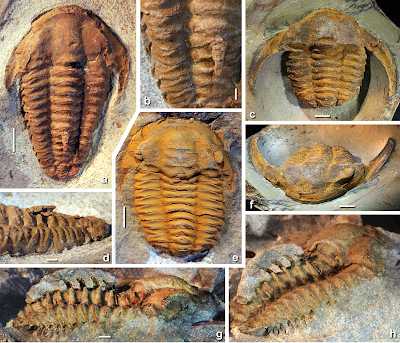
(a), (b), (d) Kingaspidoides angustigena, BOM 1543, nearly complete dorsal exoskeleton with slightly detached librigenae; (a) dorsal view; (b), (d) dorsal and lateral view of middle and posterior parts of the thorax showing moderately large axial spine on thoracic segment 8; note short and mostly split-off posterior parts of axial rings in thoracic segments 1 through 7, suggesting a considerable ability for concave flexure in this part of the thorax; Morocconus notabilis Zone, Jbel Wawrmast Formation, Bréche à Micmacca Member, Jbel Ougnate region, eastern Anti-Atlas, Morocco, probably from near Tarhoucht. (c), (f) Kingaspidoides sp. A, BOM 1430, nearly complete dorsal exoskeleton with slightly detached librigenae, partially enrolled, dorsal (c) and oblique anterior views; note broadened and obliquely abaxially directed genal spines; Morocconus notabilis Biozone, Jbel Wawrmast Formation, Bréche à Micmacca Member, Jbel Ougnate region, eastern Anti-Atlas, Morocco, probably from near Tarhoucht. (e) Kingaspidoides cf. laetus, BOM 1436, nearly complete dorsal exoskeleton with posterior thoracic segments and pygidium ventrally curved, dorsal view; librigenae with relatively short and slender genal spines; axial rings of anterior thoracic segments 1–4 narrow to allow concave flexure of the carapace in this region, axial rings of thoracic segments 7–9 with axial node (mostly broken off); Morocconus notabilis Biozone, Jbel Wawrmast Formation, Bréche à Micmacca Member, Jbel Ougnate region, eastern Anti-Atlas, Morocco, probably from near Tarhoucht. (g), (h) Kingaspidoides sp. B, BOM 1726, nearly complete dorsal exoskeleton, lateral and oblique posterolateral views showing moderately long, dorsally directed axial spines on thoracic segments 2 through 5, whereas spines are not developed on the axial rings posterior to segment 5; probably from Morocconus notabilis Zone, Jbel Wawrmast Formation, Bréche à Micmacca Member, from Anti-Atlas, Morocco, most probably from Jbel Ougnate region. All scale bars 5 mm. Geyer et al. (2020).
Although the morphologies of the cranidium in Kingaspidoides spp. and closely related genera such as Ornamentaspis, Cambrosaurura, and Kingaspis are often difficult to distinguish at the species level, the thoraces of the species often show pronounced differences. Similar thoracic characters occur in several combinations in different genera, which indicates a mosaic pattern induced by rapid diversification in the Ellipsocephaloid clade.
See also...