Showing posts with label Armored Catfish. Show all posts

Wednesday, 6 September 2017

Pseudacanthicus pirarara: A new species of Pleco from the Rio Xingu Basin of Brazil.

Armoured Catfish, Loricariidae, are large Catfish that have bodies covered with extensive bony scales and mouth parts modified to form suckers that are found in most freshwater ecosystems in South America. They are widely traded in the aquarium trade as 'Plecs' or 'Plecos', with stripey forms known as 'Tiger Plecos', and a number of species are known in the aquarium trade that have not yet formally been described in the scientific literature. Members of the genus Pseudacanthicus are found in French Guiana, Guyana, Suriname and northern Brazil. They are distinguished by a series of keels along their body, formed by rows of scales with sharp points. 

In a paper published in the Journal of Fish Biology on 24 October 2016, Carine Chamon of the Laboratório de Ictiologia Sistemática at the Universidade Federal do Tocantins, and Leandro Souza of the Laboratório de Ictiologia de Altamira at the Universidade Federal do Pará, describe a new species of Pseudacanthicus from the Rio Xingu Basin of Brazil.

The new species is named Pseudacanthicus pirarara, where 'pirarara' is a name commonly applied to red tailed Catfish in Brazil. The species is described from 43 specimens, ranging from 55.7 to 310 mm in length, and have distinctive orange-to-red fins and tail. The Fish was found in the Rio Xingu and a number of its tributaries, generally found in main river channels at depths of up to 15 m. They are carnivorous, feeding mainly on small invertebrates.

Pseudacanthicus pirarara in natural habitat at Gorgulho da Rita. Chamon & Souza (2016).

See also...

http://sciencythoughts.blogspot.co.uk/2017/03/qarmoutus-hitanensis-marine-catfish.htmlhttp://sciencythoughts.blogspot.co.uk/2016/12/panaqolus-tankei-new-species-of-tiger.html
http://sciencythoughts.blogspot.co.uk/2014/09/a-new-species-of-armoured-catfish-from.htmlhttp://sciencythoughts.blogspot.co.uk/2014/05/a-new-species-of-armored-catfish-from.html
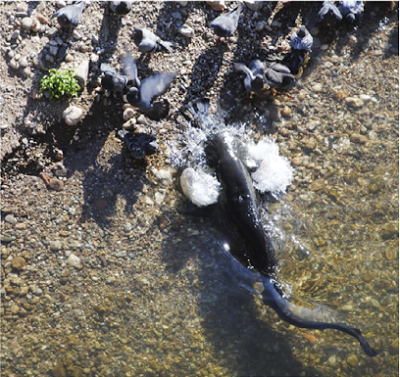
http://sciencythoughts.blogspot.co.uk/2014/01/terrestrial-hunting-in-european-catfish.htmlhttp://sciencythoughts.blogspot.co.uk/2013/12/a-new-species-of-catfish-from-minas.html
Follow Sciency Thoughts on Facebook.

Monday, 26 December 2016

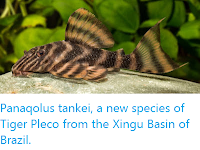
Panaqolus tankei, a new species of Tiger Pleco from the Xingu Basin of Brazil.

Armoured Catfish, Loricariidae, are large Catfish that have bodies covered with extensive bony scales and mouthparts modified to form suckers that are found in most freshwater ecosystems in South America. They are widely traded in the aquarium trade as 'Plecs' or 'Plecos', with stripey forms known as 'Tiger Plecos', and a number of species are known in the aquarium trade that have not yet formally been described in the scientific literature.

In a paper published in the journal PLoS One on 9 November 2016, Christian Andreas Cramer of the Center for Human Genetics at Philipps-University Marburg and the Laboratório de Ictiologia e Pesca at the Universidade Federal de Rondónia and Leandro Melo de Sousa of the Laboratório de Ictiologia at the Universidade Federal do Pará describe a new species of Armoured Catfish from the Xingu Basin of Pará State in Brazil.

The new species is placed in the genus Panaqolus, and given the specific name tankei, in honour of the aquarist Andreas Tanke, for his dedication to the study of Plecs of the genus Panaqolus, andfor being the first person to breed the new species in captivity. The species is small-to-medium sized for a Loricariid, with the largest recorded individual measuring 83 mm in length. The species has a yellowish brown base colouration with darker stripes.

Live coloration of Panaqolus tankei, from the region of Vitória do Xingu (live aquarium specimen). Ralf Heidemann in Cramer & de Sousa (2016).

The species is found on the lower Xingu River, downstreamBeloMonte Waterfalls, typically being found associated with sunken trees and wood. A major hydroectric power plant is currently beinf constructed on the middle reaches of the Xingu, and what effect this will have on the many Catfish species found in the river, the majority of which have very limited distributions, is unclear.

Typical habitat of Panaqolus tankei. Riverbank in Lower Xingu. Cramer & de Sousa (2016).

See also...

http://sciencythoughts.blogspot.co.uk/2014/09/a-new-species-of-armoured-catfish-from.htmlhttp://sciencythoughts.blogspot.co.uk/2014/05/a-new-species-of-armored-catfish-from.html
http://sciencythoughts.blogspot.co.uk/2013/12/a-new-species-of-catfish-from-minas.htmlhttp://sciencythoughts.blogspot.co.uk/2013/11/two-new-species-of-armored-catfish-from.html
http://sciencythoughts.blogspot.co.uk/2013/06/a-new-species-of-armored-catfish-from.htmlhttp://sciencythoughts.blogspot.co.uk/2012/03/new-species-of-armored-catfish-from.html
Follow Sciency Thoughts on Facebook.

Tuesday, 23 September 2014

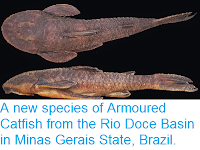
A new species of Armoured Catfish from the Rio Doce Basin in Minas Gerais State, Brazil.

Armoured Catfish (Loricariidae) are distinctive Catfish (Siluriformes) with bodies covered in bony armoured plates found only in South America. They are a diverse group, with a high number of species, many of which have very limited distributions, and several new species are described every year. They are popular in the aquarium trade, where they are known as ‘Plecs’.

In a paper published in the journal ZooKeys on 15 September 2014, Fábio Roxo and Gabriel Silva of the Laboratório de Biologia e Genéticav de Peixes at the Departamento de Morfologia at the Universidade Estadual Paulista, Cláudio Zawadzki of the Núcleo de Pesquisasem Limnologia, Ictiologia e Aquicultura at the Departamento de Biologia at the Universidade Estadual deMaringá and Claudio Oliveira, also of the Laboratório de Biologia e Genéticav de Peixes, describe a new species of Armoured Catfish from the Rio Doce Basin in Minas Gerais State, Brazil.

The new species is placed in the genus Neoplecostomus, and given the specific name doceensis, meaning ‘from Doce’.Neoplecostomusdoceensis reaches slightly over 100 mm in length. It is brownish when preserved in alcohol, but as the species is described entirely from museum specimens, the original colour is unknown. It is distinguished from other members of the same genus by two fleshy flaps between the lower jaws. This is present in older males of some other species, but is found in all specimens of Neoplecostomusdoceensis.

Neoplecostomusdoceensis, male specimen, 101.1 mm long, from the affluent of Rio Gualaxo do Norte, Rio Doce Basin, municipality of Ouro Preto, Minas Gerais State, Brazil. Roxo et al. (2014).

Neoplecostomusdoceensis, same specimen as above, arrow showing the developed papillae between dentaries. Roxoet al. (2014).

Neoplecostomusdoceensis is described from specimens collected from the Rio Gualaxo do Norte, Rio Gualaxo do Sul, Rio José Pedro, Rio Piranga, Rio Manhuaçu, Rio Suaçuí Pequeno and Rio Xopotó, all within the Rio Doce Basin in Minas Gerais State, Brazil. All were in areas of clear water with rocky or sandy bottoms, and often rocky outcrops forming small waterfalls. The Rio Doce Basin is a drainage system covering 83 400 km² in Minas Gerais and Espirito Santo states in southeastern Brazil.

Map showing the type localitieswhereNeoplecostomusdoceensiswas collected in the Rio Doce Basin (green highlighted drainages).

Neoplecostomusdoceensis is most closely related to other members if the same genus from streams in the Rio Grande Basin, which drains into the Atlantic Ocean. Roxoet al. suggest that the species was probably separated from its closest relatives by uplift in the Serra do Espinhaço about 3.5 million years ago, due to the reactivation of ancient faults in the area.

See also…

http://sciencythoughts.blogspot.co.uk/2014/05/a-new-species-of-armored-catfish-from.html A new species of Armored Catfish from Pará State, Brazil.                                            Armored Catfish, Loricariidae, are large river-dwelling Fish native to Central and South America. They are...
http://sciencythoughts.blogspot.co.uk/2013/12/a-new-species-of-catfish-from-minas.html  A new species of Catfish from Minas Gerais State in southeast Brazil.                         Armored Catfish, Loricariidae, are large river-dwelling...
http://sciencythoughts.blogspot.co.uk/2013/11/two-new-species-of-armored-catfish-from.html Two new species of Armored Catfish from Columbia.                                                Armored Catfish, Loricariidae, are large river-dwelling Fish native to Central and South America. They are...
Follow Sciency Thoughts on Facebook.

Tuesday, 6 May 2014

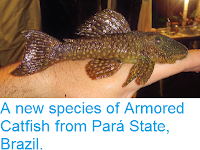
A new species of Armored Catfish from Pará State, Brazil.

Armored Catfish, Loricariidae, are large river-dwelling Fish native to Central and South America. They are covered in plate-like bony scales, and have distinctive 'suckermouths' used to attach themselves to a substrate in fast flowwing waters while still breathing. They are the largest group of Catfish, with over 680  described species and a fossil record that dates back to the Miocene. They are known in the aquarium trade as 'plecs'.

In a paper published in the journal ZooKeys on 29 April 2014, Gabriel de Souza da Costa e SilvaFábio Fernandes RoxoRicardo Britzke and Claudio Oliveira of the Laboratório de Biologia e Genética de Peixes at the Departamento de Morfologia at the Instituto de Biociências at the Universidade Estadual Paulista "Júlio de Mesquita Filho", describe a new species of Armored Catfish from the Rio Tapajós and Rio Tracuá in Pará State, Brazil.

The new species is placed in the genus Pseudancistrus and given the specific name zawadzkii, in honour of Cláudio Henrique Zawadzki, of the Universidade Estadual de Maringá, an expert on Catfish.  Pseudancistrus zawadzkii is a 128.7−87.5 mm dark greenish-brown Armoured Catfish with yellow spots. It has a distinctive 'mustache' of odontodes (a form of scale structurally similar to a tooth, with a pulp cavity and dentine and enamel layers, but found outside the mouth and not used as a tooth) on either side of the snout. Such structures are usually for sensory purposes in Fish; just as human teeth can be notoriously sensitive to the wrong things being placed in our mouths, the tooth-like structures of some fish can be used to probe sediments or scent the water for desired foodstuffs.

Pseudancistrus zawadzkii, female specimen. Silva et al. (2014).

Pseudancistrus zawadzkii was found living living around the confluence of the Rio Tapajós and Rio Tracuá in Pará State, Brazil; an area of fast flowing, clear waters with numerous waterfalls and rocky islands.

Map showing the two locations (black circle and red square) where Pseudancistrus zawadzkii was found living. Silva et al. (2014).

See also...


Follow Sciency Thoughts on Facebook.

Sunday, 8 December 2013

A new species of Catfish from Minas Gerais State in southeast Brazil.

Armored Catfish, Loricariidae, are large river-dwelling Fish native to Central and South America. They are covered in plate-like bony scales, and have distinctive 'suckermouths' used to attach themselves to a substrate in fast flowwing waters while still breathing. They are the largest group of Catfish, with over 680  described species and a fossil record that dates back to the Miocene. They are known in the aquarium trade as 'plecs'.

In a paper published in the journal ZooKeys on 4 July 2013, Gabriel de Souza da Costa e Silva, Fábio Fernandes Roxo and Claudio Oliveira of the Laboratório de Biologia e Genética de Peixes at the  Departamento de Morfologia at the Universidade Estadual Paulista describe a new species of Armored Catfish from the Rio Paraíba do Sul basin in Minas Gerais State in southeast Brazil.

The new species is placed within the genus Pareiorhina, which was first described in 1947 by William Gosline of the Department of Zoology and Entomology at the Univetsity of Hawaii, and contained only a single species until 2003, since when three further species have been described. The new species is given the specific name Pareiorhina hyptiorhachis, where 'hyptiorhachis' means 'having a ridge upon its back', referring to a ridge on the back of the Fish that runs from behind the dorsal fin to the top of the tail, and which distinguishes it from other Fish in the same genus.

The species is described entirely from specimens preserved in alcohol in the collections of the Laboratório de Biologia e Genética de Peixes de Botucatu and the Museu de Ciências e Tecnologia at the Pontifícia Universidade Católica do Rio Grande do Sul, collected between 2001 and 2011, but not previously recognized as a separate species.

Pareiorhina hyptiorhachis, specimen collected from the Ribeirão Fernandes, a tributary of Rio Pomba, in June 2011. Da Costa e Silva et al. (2013).

See also Two new species of Armored Catfish from ColumbiaA new species of Armored Catfish from Peru and New species of Armored Catfish from Ecuador.

Follow Sciency Thoughts on Facebook.
Sunday, 24 November 2013

Two new species of Armored Catfish from Columbia.

Armored Catfish, Loricariidae, are large river-dwelling Fish native to Central and South America. They are covered in plate-like bony scales, and have distinctive 'suckermouths' used to attach themselves to a substrate in fast flowwing waters while still breathing. They are the largest group of Catfish, with over 680  described species and a fossil record that dates back to the Miocene. They are known in the aquarium trade as 'plecs'.

In a paper published in the journal Zootaxa on 26 April 2013, Donald Taphorn of Belleville Illinois, Jonathan Armbruster of Department of Biological Sciences at Auburn University, Francisco Villa-Navarro of the Grupo de Investigación en Zoología at the Facultad de Ciencias at the Universidad del Tolima and Keith Ray, also of the Department of Biological Sciences at Auburn University, describe two new species of Armored Catfish in the genus Ancistrus as part of a wider study into the genus in Panama, Colombia and Venezuela.

The first new species described is named Ancistrus tolima, where 'tolima' refers to both to Yulima, a Pijao princes who was murdered by the Spanish conquistadores, and to the Department of Tolima in Columbia, where the Fish was discovered. Ancistrus tolima is a 26-77 mm dark olive or brown Catfish with light green or yellow spots. It was found living in shallow streams with little vegetation and a sand or gravel bottom in the Upper Magdalena River drainage system.

Live specimen of Ancistrus tolima. Taphorn et al. (2013).

The second new species is named Ancistrus vericaucanus, meaning 'true inhabitant of the Cauca'; another species has previously been named Ancistrus caucanus (inhabitant of the Cauca), however this species is now known to be restricted to the Magdalena River drainage and is not found in the Cauca River. Ancistrus vericaucanus is 47-72 mm Armored Catfish. The species is described from specimens collected in November 2006 and preserved in alcohol; the original colour of these specimens is unclear.

Specimen of Ancistrus vericaucanus, preserved in alcohol. Taphorn et al. (2013).


Follow Sciency Thoughts on Facebook.
Wednesday, 19 June 2013

A new species of Armored Catfish from Peru.

Armored Catfish, Loricariidae, are large river-dwelling Fish native to Central and South America. They are covered in plate-like bony scales, and have distinctive 'suckermouths' used to attach themselves to a substrate in fast flowwing waters while still breathing. They are the largest group of Catfish, with over 680  described species and a fossil record that dates back to the Miocene. They are known in the aquarium trade as 'plecs'.

In a paper published in the journal Zootaxa on 19 April 2013, Norma Salcedo of the Grice Marine Laboratory at the College of Charleston describes a new species of Armored Catfish from clear water tributaries of the Río Huallaga near Tingo María in the Departament of Huánuco, Peru.

The new species is named Loraxichthys lexa, where 'Loraxichthys' means the 'Lorax's fish', a reference to the Lorax, a character in a book by Dr Suess, and 'lexa' is in honour of Alexandra Keane a sustainability activist, currently a Political Sciences student at the College of Charleston. The species is based upon specimens collected by the Catherwood Foundation Peruvian-Amazon Expedition, in 1955, and labeled as Chaetostoma marmorescens, a species which it only superficially resembles.

Loraxichthys lexa is a  robust Catfish, extremely flattened and covered in conspicuous bony plates except on the snout, which reaches about 50 mm in length. The colour of the specimens when alive is unknown. 

Loraxichthys lexa, male specimen in (A) lateral, (B) dorsal and (C) ventral view. Salcedo (2013).

At the time when the specimens were collected the area where the fish was collected the area was forested and sparsely populated, though it belonged to Sindicato Monzón and areas were beginning to be cleared for banana plantations. 


Follow Sciency Thoughts on Facebook.

Sunday, 25 March 2012

New species of Armored Catfish from Ecuador.

Armored Catfish, known in the aquaria trade as 'plecs' are freshwater Catfish from South America, noted for their sucker-like mouthparts and thick, armored scales. There are over 700 species, making them the largest group of Catfish, though the exact number of species is unclear, due both to a steady stream of new discoveries, and a series of taxonomic disputes about which species are valid.

In a paper published in the journal Zootaxa on 22 March 2012, Milton Tan and Jonathan Armbruster, both of the Department of Biological Sciences at Auburn University, describe a new species of Armored Catfish from the Río Santa Rosa in Ecuador.

The new species is named Cordylancistrus santarosensis, the Santa Rosa Armored Catfish. It is roughly 70 mm long, and distinguished by having armored plates on its snout, but not the flanks of its head; most closely related fish having either armored or unarmored heads. It is known from a single location on the Río Santa Rosa.

Cordylancistrus santarosensis. Tan & Armbruster (2012).

Map of the freshwater basins of northeast South America, showing the location where Cordylancistrus santarosensis was found. Tan & Armbruster (2012).