Showing posts with label Austral Islands. Show all posts

Sunday, 26 December 2021

Gallirallus astolfoi: An extinct Rail from Rapa Iti, French Polynesia.

Rapa Iti, the southernmost inhabitable island in French Polynesia, is a volcanic caldera with a subtropical climate and a surface area of 38 km² and a highest point 650 m above sealevel, lying within the Austral Islands, a group of eight volcanic islands to the south of the Society Islands. It is thought to have been reached by Polynesian settlers between 1100 and 1200 AD, with the first Europeans arriving in 1791. Before these events, the island's ecology was dominated by Birds, with no native Mammals or terrestrial Reptiles. Today, little of this original Birdlife remains. The Rapa Fruitdove, Ptilonopus huttoni, still remains, but is Critically Endangered, while the Rapa Shearwater, Puffinus myrtae, is now found only on offshore islets.

The remainder of Rapa Iti's indigenous Birdlife is known only from archaeological remains. One such is a left tarsometatarsus discovered during an archaeological dig in Tangarutu Cave on Rapa Iti, by Alan Tennyson of the Museum of New Zealand Te Papa Tongarewa and Atholl Anderson of the Department of Archaeology and Natural History at the Australian National University, and initially described by them as a 'Gallirallus-type Rail'.

In a paper published in the journal Taxonomy on 20 December 2021, Rodrigo Salvador, also of the Museum of New Zealand Te Papa Tongarewa, along with Atholl Anderson and Alan Tennyson, formally describes the tarsometatarsus as that of a new, previously unknown, species of extinct Rail.

The new species is named Gallirallus astolfoi, in reference to Astolfo, a fictional paladin in the Italian epic poem Orlando Furioso, who was banished to a remote island by the sorceress Alcina. The tarsometatarsus is identified as that as a member of the Family Rallidae within the Order Gruiformes by the presence of two open tendinal canals, one distal foramen, and the tendinal bridge. It is assigned to the genus Gallirallus on the basis of a corpus tarsometatarsi much wider than it is deep, an unenclosed medial sulcus hypotarsi, a fossa parahypotarsalis medialis shallow at the proximal end, a short, shallow fossa metatarsi I, a crista plantaris mediana which slopes gradually to the hypotarsus, a trochlea metatarsi tertii which is sloped toward medial trochlea at its distal end, and a cotyla medialis with a  rectangular proximal aspect with a flat dorsal margin.
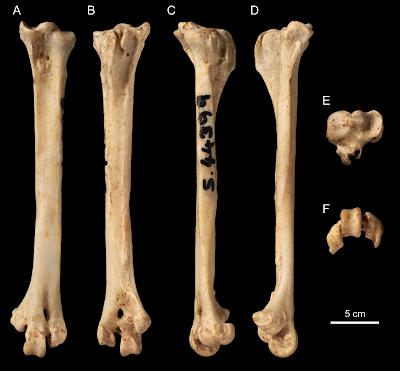
 
Left tarsometatarsus (holotype, NMNZ S.044399) of Gallirallus astolfoi in different views: (A) anterior, (B) caudal, (C) lateral, (D) medial, (E) proximal, (F) distal. Salvador et al. (2021).

The tarsometatarsus is identified as that of a new species because it is considerably smaller than that of other members of the genus Gallirallus, with a proportionately much narrower and shallower shaft, giving it a more delicate appearance.

Gallirallus astolfoi is the fourth species of extinct Bird from Rapa Iti, a pattern repeated across the Pacific, where many species of indigenous Birds, and in particular Rails, became extinct after Humans, and Human associated Animals. In French Polynesia these losses have been linked to predation of adult Birds, eggs, and nestlings by Humans, Rats, and Cats, and to environmental modification by Humans and Goats. On Rapa Iti Rats are known to have arrived with Polynesian settlers, while Europeans brought with them Cats, Goats, Cattle, Pigs, and Dogs. 

The single remaining bone of Gallirallus astolfoi is insufficient to tell if the species was hunted by Humans, but the fact that it was found in a cave that was inhabited by Humans, alongside Fish remains that were almost certainly brought there by Humans for consumption, and the remains of six other species of Birds, makes it highly likely that this was the case.

The fact that Gallirallus astolfoi was smaller than flying members of the genus, and found on a remote island, makes it highly likely that the species was flightless, something very common in Rails (only two of the 30 or so described species of Gallirallus are widespread, flying, Birds, the remainder are flightless and endemic to islands).

See also...


Follow Sciency Thoughts on Facebook.

Follow Sciency Thoughts on Twitter.


Thursday, 18 December 2014

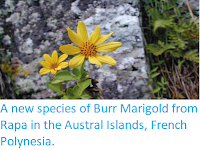
A new species of Burr Marigold from Rapa in the Austral Islands, French Polynesia.


The Austral Islands are a group of eight volcanic islands to the south of the Society Islands in the southern Pacific Ocean. Rapa is the second largest of these, covering about 40 km2, and reaching about 650 m above sea-level. The island is generally rugged with many steep basalt cliffs, and a small area of cloud forest on the top of its highest peak, Mont Perau. It is also extremely remote, being nearly 1200 km southeast of Tahiti, 3700 km northeast of the north island of New Zealand, and 8500 km southwest of the Baja Peninsula in Mexico. As such it has a high rate of endemism among its plants and animals, with 238 native (i.e. not introduced by man) plants (152 flowering plants plus 86 ferns) including 85 species found only in the Austral Islands (65 flowering plants plus 20 ferns) and 73 are found only on the island of Rapa (53 flowering plants plus 20 ferns), though many of these are threatened by introduced animals, most notably Cows and Goats.

In a paper published in the journal PhytoKeys on 3 October 2014, Vicki Funk of the US National Herbarium in Washington DC and Kenneth Wood of the National TropicalBotanical Garden in Hawai’i describe a new species of Burr Marigold from Rapa. The species is was discovered by a National Geographic Society expedition to the island in March-April 2002, which included scientists from the New York Botanical Garden, the Délégationà la Recherche de la Polynésie Française and the National Tropical Botanical Garden. This expedition was originally planned to last for a month, but a delayed supply ship trapped the scientists for two months. The leader of this expedition, Timothy Motley of the New York Botanical Garden subsequently died, and the whereabouts of the majority of the specimens collected by the first expedition is unknown. A second expedition visited the island in December 2002 and collected more specimens, which were sent to the Paris Herbarium, however these also appear to have been lost.

The new species is placed in the genus Rapa, and given the specific name meyeri, in honour of Jean-Yves Meyer of the Délégation à la Recherche de la PolynésieFrançaise, for his research on the plants of Rapa and work on preserving the islands biodiversity. The species is a small sub-shrub reaching 25 cm tall with 3-4 branches reaching about 8 cm. It has fleshy, toothed leaves and yellow flowers. The species was found growing high on a cliff, and could be collected only by rope.

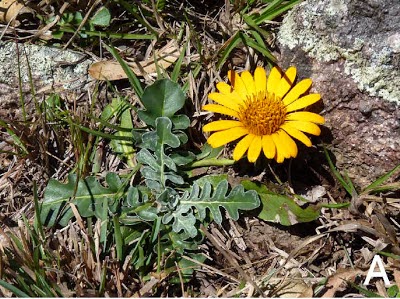
Bidens meyeri: Close up of a flowering plant, note the gloved finger holding the plant. Jean-Yves Meyer in Funk & Wood (2014).

Bidens meyeri is considered to be Critically Endangered under the terms of the International Union for the Conservation of Nature’s Red List of Threatened Species, as it is known from only two specimens growing on a single ledge on a northeast facing cliff 272 m above sea-level. The cliff had several small ledges with granular soil, and patches of steep slope with patches of low forest and shrubland. This environment is threatened by potential fires, habitat degradation, feral goats and competition with introduced plants.

Jean-Yves Meyer climbing with Bidens in his teeth, note yellow flowering plant on the cliff face just above his left hand. Ron Englund in Funk & Wood (2014).

See also…

Living in limestone habitats requires special adaptations from plants; as such areas tend to have thin layers of alkaline soil over porous bedrock, leading to frequent periods of aridity. Since exposed limestones are most frequently found in upland areas surrounded by areas of lowlands with different environmental conditions, the...

Hawkweeds (Hieracium spp.) are herbaceous flowering plants in the Aster Family (Asteraceae), closely related to Dandelions. There are numerous species in Europe, Africa, Asia, and North and South America, though the precise number of species is open to dispute, as most Hawkweeds are triploid (have three sets of chromosomes, which means that they cannot reproduce sexually (which requires an even number of chromosomes sets, which can then...

http://sciencythoughts.blogspot.co.uk/2012/09/new-species-of-daisy-from-brazil.html New species of Daisy from Brazil.                 Daisies of the genus Trichocline are found across southern South America, with a single species from Australia. They are small perennial herbs with red, yellow, orange, or rarely white flowers found on sandy or rocky grasslands, shrublands, or human-modified areas such as roadsides with exposed soil, mostly at high...


Follow Sciency Thoughts on Facebook.