Showing posts with label Sikkim. Show all posts

Friday, 3 July 2026

Manis pentadactyla: The Chinese Pangolin confirmed to be living in Pakyong District, Sikkim.

Pangolins are solitary, nocturnal, and generally cryptic Mammals, found across Africa and Asia. They feed on Ants and Termites, and have a covering of scales, made from fused hairs, which are their main defence against predators, rolling into a ball with these forming the outer covering. There are eight recognised species of Pangolin, four in Africa and four in Asia, two of which are listed as Vulnerable under the terms of the International Union for the Conservation of Nature's Red List of Threatened Species, three as Endangered, and three as Critically Endangered. One of these Critically Endangered species is the Chinese Pangolin, Manis pentadactyla, which is found across parts of Nepal, Bhutan, northern India, Bangladesh, Myanmar, China, and Taiwan. In India it is known to be present in Arunachal Pradesh, Meghalaya, Nagaland, Manipur, Tripura, Mizoram, and Assam, with occasional reports of its presence in Sikkim and West Bengal, although none of these have been confirmed.

In a paper published in the Journal of Threatened Taxa on 26 June 2026, Prashanti Pradhan of the Sikkim Alpine University, and the Assam Downtown University, Jampal Dorjee Bhutia, also of the Sikkim Alpine University, and Prem Kumar Chhetri and Bharat Kumar Pradhan of the Forest & Environment Department of the Government of Sikkim, document the first confirmed sighting of the Chinese Pangolin in Pakyong District, Sikkim, and provide photographic evidence to support this.

Pradhan et al.'s report is based upon a Pangolin which was found in Barapathing Village in Pakyong District on 31 March 2024. Barapathing Village is located at an altitude of between 1150 and 1700 m in an area where subtropical to temperate broad-leaved forests are being encroached upon by agricultural land and Human settlements, with anthropogenic pressures increasing due to the construction of the 717B National Highway, and associated infrastructure. 

The Pangolin was found by a local villager wandering within their backyard, and apparently lost and looking for food. The villager, who was unfamiliar with the species, attempted to drive the Pangolin away, though it was unperturbed by this, and apparently tolerant of Humans, potentially indicating that it had been living in a Human-dominated environment for some time. The Pangolin was eventually allowed to settle in a room, while the resident called the Barapathing Territorial Range Forest & Environment Department, who collected the Animal and relocated it to a subtropical forest downstream of the village.

Chinese Pangolin, Manis pentadactyla, inside the home of a villager in Barapathing, where it remained until the arrival of the rescue unit of the Barapathing Territorial Range Forest & Environment Department. Sangita Ruchal in Pradhan et al. (2026).

The rescued Animal was identified as a Chinese Pangolin, Manis pentodactyla, on the basis of its distinct morphological characteristics, such as overlapping keratinous scales, an elongated snout, and robust body form. The photographic evidence collected by Pradhan et al. constitutes evidence that this species is present in the Pakyong District of Sikkim. Local people were able to identify the Animal as a Pangolin using the Nepali word 'Saalak', but reported that they had never seen one so close to a Human habitation before.

The photographs and a description of the Animal were later sent to Vikram Aditya, the principal scientist at the Centre for Wildlife Studies in Bengaluru, Karnataka State, and a member of the International Union for the Conservation of Nature's Pangolin Specialist Group, who confirmed the diagnosis of this being a Chinese Pangolin.

The Chinese Pangolin after being rehabilitated into the forest. Prem Kumar Chettri in Pradhan et al. (2026).

Pangolins are threatened by habitat loss and fragmentation, driven by deforestation, forest fires, and road development, across their range. Sikkim has had one of the greatest expansions of its road network of any state in India during the last decade, with a major road upgrading project close to the village of Barapathing, which is likely to have contributed to both habitat destruction and a greater rate of Human encounters for Pangolins in the area. 

Animals can sometimes survive in altered landscapes by adapting their behaviour, however, this can lead them vulnerable to additional hazards, such as increased hunting. The hunting and trafficking of Pangolins is known to be a hazard for Pangolins in Sikkim, in 2021 a group of five people was arrested trying to smuggle a dead Pangolin from Sikkim into Bhutan, and when questioned they confessed the Animal had been killed in a wildlife sactuary in Sikkim. They also hinted at there being an international wildlife trafficking network operating across the eastern Himalayan region. 

Pradhan et al. suggest that there is an urgent need for a baseline ecological study on Chinese Pangolins in Sikkim, in order to better understand the threats linked to development-related habitat fragmentation, illegal hunting and transboundary trafficking, and to enable the development of a conservation plan for the species in the state, 

See also...

Sunday, 24 May 2020

Landslide kills woman in Sikkim State, India.

A 50-year-old woman has died and another two people have been injured after their house was destroyed by a landslide in the village of Upper Lingchom in the North Sikkim District of Sikkim State, India, on Sunday 24 May 2020. The landslide is reported to have come after days of heavy rain in the area, associated with Cyclone Amphan, made landfall in West Bengal and Bangladesh on Wednesday on Wednesday 20 May, causing over a hundred fatalities. Landslides are a common problem after severe weather events, as excess pore water pressure can overcome cohesion in soil and sediments, allowing them to flow like liquids. Approximately 90% of all landslides are caused by heavy rainfall. 

The scene of a landslide that killed a woman in North Sikkim on Sunday 24 May 2020. Point Media Siliguri/Facebook.

Tropical storms, called Cyclones in the Indian Ocean and South Pacific, are caused by solar energy heating the air above the oceans, which causes the air to rise leading to an inrush of air. If this happens over a large enough area the inrushing air will start to circulate, as the rotation of the Earth causes the winds closer to the equator to move eastwards compared to those further away (the Coriolis Effect). This leads to tropical storms rotating clockwise in the southern hemisphere and anticlockwise in the northern hemisphere. These storms tend to grow in strength as they move across the ocean and lose it as they pass over land (this is not completely true: many tropical storms peter out without reaching land due to wider atmospheric patterns), since the land tends to absorb solar energy while the sea reflects it.

Despite the obvious danger of winds of this speed, which can physically blow people, and other large objects, away as well as damaging buildings and uprooting trees, the real danger from these storms comes from the flooding they bring. Each drop millibar drop in air-pressure leads to an approximate 1 cm rise in sea level, with big tropical storms capable of causing a storm surge of several meters. This is always accompanied by heavy rainfall, since warm air over the ocean leads to evaporation of sea water, which is then carried with the storm. These combined often lead to catastrophic flooding in areas hit by tropical storms. 

See also...

http://sciencythoughts.blogspot.com/2020/05/cyclone-amphan-kills-at-least-87-in.htmlhttps://sciencythoughts.blogspot.com/2020/05/avalanche-kills-two-indian-soldiers-in.html
https://sciencythoughts.blogspot.com/2020/03/three-killed-after-landslide-hits-car.htmlhttps://sciencythoughts.blogspot.com/2016/08/thousands-evacuated-after-landslide.html
https://sciencythoughts.blogspot.com/2013/10/magnitude-53-earthquake-in-sikkim-state.htmlhttps://sciencythoughts.blogspot.com/2013/09/family-of-five-killed-by-landslide-in.html
Follow Sciency Thoughts on Facebook.

Thursday, 14 May 2020

Avalanche kills two Indian soldiers in Sikkim.

Two Indian soldiers have been killed after being caught in a avalanche while on a snow clearing patrol in Sikkim State on Thursday 14 May 2020. Lieutenant Colonel Robert T A and Sapper Sapala Shanmukha Rao were part of a patrol of eighteen soldiers who were caught in the avalanche in the Lugnak La Pass, about 5000 m above sealevel when they were caught by the avalanche. The other members of the patrol have been evacuated safely and are unhurt. Avalanches are a particular hazard in the high Himalayas at this time of year, as the spring thaw starts to weaken layers of snow that have built up over the long winter.

Lieutenant Colonel Robert T A, killed in an avalanche in Sikkim State, India, on 14 May 2020. Maram Naga/Facebook.

Avalanches are caused by the mechanical failure of snowpacks; essentially when the weight of the snow above a certain point exceeds the carrying capacity of the snow at that point to support its weight. This can happen for two reasons, because more snow falls upslope, causing the weight to rise, or because snow begins to melt downslope, causing the carrying capacity to fall. Avalanches may also be triggered by other events, such as Earthquakes or rockfalls. Contrary to what is often seen in films and on television, avalanches are not usually triggered by loud noises. Because snow forms layers, with each layer typically occurring due to a different snowfall, and having different physical properties, multiple avalanches can occur at the same spot, with the failure of a weaker layer losing to the loss of the snow above it, but other layers below left in place - to potentially fail later.

Diagrammatic representation of an avalanche, showing how layering of snow contributes to these events. Expedition Earth.

See also...

https://sciencythoughts.blogspot.com/2020/03/three-killed-after-landslide-hits-car.htmlhttps://sciencythoughts.blogspot.com/2016/08/thousands-evacuated-after-landslide.html
https://sciencythoughts.blogspot.com/2013/10/magnitude-53-earthquake-in-sikkim-state.htmlhttps://sciencythoughts.blogspot.com/2013/09/family-of-five-killed-by-landslide-in.html
https://sciencythoughts.blogspot.com/2011/09/himilayan-earthquake-18-september-2011.html
Follow Sciency Thoughts on Facebook.

Wednesday, 11 March 2020

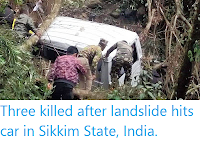
Three killed after landslide hits car in Sikkim State, India.

Three people have died and several more have been injured after a landslide hit a car in East Sikkim District, Sikkim, on Tuesday 10 March 2020. The incident happened at about 1.45 pm local time, with the landslide hitting the vehicle and knocking it into a ravine. The dead have been identified as driver Suraj Chhetri from Sikkim, and passengers Jharna Saha, 54, and Hrishpriya Ghose, 13, both tourists from West Bengal, the injured as Taposh Saha, 46, Narayan Ghosh, 52, Kunjala Shah, 35, Debjani Saha, Mithu Ghosh, Rhishi Ghosh, 8, and Raja Saha, also tourists from West Bengal.

Vehicle knocked from a road into a ravine by a landslide on 10 March 2020. The Telegraph.

Sikkim is located in the Indian Himalayas, and area notorious for landslides, though the majority of these occur in the Monsoon Season, and are caused by the relentless heavy rains of that season. Landslides are a common problem after severe weather events, as excess pore water pressure can overcome cohesion in soil and sediments, allowing them to flow like liquids. Approximately 90% of all landslides are caused by heavy rainfall. However, the spring period is not associated with such heavy rains, and the problems they bring. This time of year does have its own problems though, as it is the season during which the ice and snow of water melts. This can lead to flood events even without rainfall, as well as the destabilisation of slopes where soft sediments have previously been held in place by frozen pore water, leading to landslides.

See also...

https://sciencythoughts.blogspot.com/2016/08/thousands-evacuated-after-landslide.htmlhttps://sciencythoughts.blogspot.com/2013/10/magnitude-53-earthquake-in-sikkim-state.html
https://sciencythoughts.blogspot.com/2013/09/family-of-five-killed-by-landslide-in.htmlhttps://sciencythoughts.blogspot.com/2011/09/himilayan-earthquake-18-september-2011.html
Follow Sciency Thoughts on Facebook.

Monday, 13 January 2020

Cuon alpinus: Understanding the distribution of Dholes in northeast India.

The Dhole, or Asian Wild Dog, Cuon alpinus, is an Endangered social carnivore found in forested landscapes of South and Southeast Asia. Historically widespread across Asia, the species’ range has contracted by about 80%. The current distribution extends across most of South and Southeast Asia and parts of China but is largely restricted to protected areas. The protected forest landscapes south of the River Ganges in India are a stronghold for the species, with the largest Dhole population. However, the species has undergone local extirpation across parts of its former range as a result of declines of prey species, loss of habitat and, potentially, disease. Information on Dholes in northeast India in particular is limited, despite the fact that this landscape shares continuous forest with Myanmar and Southeast Asia, forming an important part of the species' global range.

A Dhole, or Asian Wild Dog, Cuon alpinus. David Raju/Wikimedia Commons.

In a paper published in the journal Orynx on 23 October 2019, Priya Singh of Researchers for Wildlife Conservation at the National Centre for Biological Sciences, and the School of Natural Resources and Environment at the University of Florida, Arjun Srivastha of the Department of Wildlife Ecology and Conservation at the University of Florida, and David Macdonald of the Wildlife Conservation Research Unit at the University of Oxford, provide a compilation of dhole presence records from across northeast India using data extracted from multiple sources.

Current knowledge of Dholes in north-east India is restricted to landscapes north of the River Brahmaputra. This is primarily because of the paucity of baseline ecological data from the region, given its undulating terrain, difficulty of access, wet climatic conditions, and socio-political insurgencies.

Using data from camera-trap surveys Singh et al. examine factors influencing fine-scale site-use by Dholes in Dampa Tiger Reserve in Mizoram State. They discuss the implications of their results for Dhole conservation in northeast India, where the focus of wildlife managers is directed mainly towards population recoveries of and local recolonisation by the Tiger, Panthera tigris. They further provide recommendations for management interventions that could facilitate conservation of Dholes in this hitherto neglected landscape.

Dampa Tiger Reserve lies in the Indo-Myanmar Biodiversity Hotspot. The reserve is contiguous with the Chittagong Hill Tract region of Bangladesh to the west. The core area of the Reserve covers 500 km², and the multi-use buffer covers an area of 488 km². The Lushai Hills traverse the reserve, with altitudes of 250-1100 m. Mean annual rainfall is 2000-2500 mm. The Reserve supports a high diversity of Carnivores, including, in addition to the Dhole, four species of Felids and two species of Ursids. In the course of the study Singh et al. also recorded the Elephant, Elephas maximus, Gaur, Bos gaurus, Sambar, Rusa unicolor, Red Serow, Capricornis rubidus, Muntjac, Muntiacus muntjak, and Wild Pig, Sus scrofa.

Northeast India, with the Dampa Tiger Reserve in Mizoram and locations where the Dhole, Cuon alpinus, has been recorded, with corresponding reliability scores. Singh et al. (2019).

Singh et al. compiled Dhole presence records for nine northeastern states: Arunachal Pradesh, Assam, Manipur, Meghalaya, Mizoram, Nagaland, Sikkim, Tripura, and West Bengal. They searched for records from 1990 onwards in newspaper reports, scientific articles, grey literature (including species checklists), and reports by Forest Department personnel, local informants and naturalists working in the region. For each record they noted the type of evidence (direct/indirect), the date of the sighting, the administrative status of location (protected/non-protected), and the source person or reference. They assigned reliability scores for each record, from 1 to 5, with 1 being most reliable, and 5 least reliable.

From December 2014 to March 2015, Singh et al. deployed 79 pairs of Cuddeback Ambush IR camera traps across 80 km² in the northeast of Dampa Tiger Reserve’s core area. At each station they placed two cameras facing each other, about 30 cm above the ground, on either side of forest trails or on riverbeds. Mean inter-trap distance was 1.02 km, with traps remaining active for an average of 64 days. Although the stations were intended to photograph wild Felids, they also photographed other Carnivores. Dholes generally use forest trails and riverbeds for movement, marking territories and hunting, and our sampling design therefore incorporated areas used by the species.

Singh et al. obtained presence records from 80 locations for 1990-2018, of which we considered 41 records from 2010–2018 with reliability scores of 1-3. In the case of multiple records for the same site, they considered the most recent record with the highest reliability score. Most records were from Arunachal Pradesh (14) and Assam (8), with five records from Mizoram and Nagaland, four from West Bengal, three from Meghalaya and two from Sikkim. There were no recent records of Dholes from Manipur and Tripura. A total of 5033 camera trap-days in Dampa Tiger Reserve generated 500 photoencounters of Dholes, comprising 92 detections (one per 24 hour duration) across 33 sites. 

Singh et al. found photo-capture frequencies of key prey species: Sambar (236), Muntjac (145), Wild Pig (92); to be positive influences, as were the distance to reserve boundary, and photo-capture frequencies of Forest Department personnel, while photo-capture frequencies of other humans were  negative influences on site-use by Dholes.

There are records of Dholes across several areas of northeast India, including in unprotected areas. Previous global assessments indicated that the species faced near or complete local extirpation to the south of the River Brahmaputra, something refuted by Sigh et al.'s findings from Dampa Tiger Reserve. Corroborating current knowledge from other landscapes, showed a positive relationship between Dhole site-use and Sambar presence. Across their extant distribution, the range of Dholes overlaps with that of Tigers and Leopards, Panthera pardus. Wildlife managers in this region and elsewhere subscribe to unsubstantiated notions that dhole presence impedes colonisation by Tigers, and consequently treat Dholes as a problem species. On the contrary, Tigers, Leopards and Dholes can co-exist provided protected areas support adequate densities of medium- to large-sized prey species.

Dampa Tiger Reserve is an important refuge for Dholes in northeast India. It supports large tracts of inviolate protected spaces, and habitat connectivity with forested landscapes of the Chittagong Hill Tract region to the west, Mamit Forest Division to the north and Thorangtlang Wildlife Sanctuary to the south. Singh et al's camera-trap data indicate the presence of a guild of large herbivores in the Reserve, with at least five prey species of medium and large ungulate herbivores, facilitating the long-term persistence of dholes there. The findings re-emphasise the importance of protected areas, which can serve as source sites for sustaining Dhole populations across the region.

In areas with low prey densities, carnivores may have significant dependence on livestock, and are consequently stigmatised. There is a strong negative relationship between Dholes and livestock owners in Arunachal Pradesh and other locations in the region. Given that Dholes also occur outside protected areas in this region, they are potentially vulnerable to retributory killing. Negative interactions between people and Dholes necessitate interventions to reduce poaching and facilitate recovery of prey, especially for species such as Sambar that are impacted by low recovery rates following prolonged poaching. Singh et al.'s findings need to be augmented with a systematic survey across the locations they identified, specifically in the states of Mizoram and Nagaland, to facilitate a pan-northeast India strategy for Dhole conservation.

See also...
https://sciencythoughts.blogspot.com/2019/08/leopard-attack-thwarted-by-dog-in.htmlhttps://sciencythoughts.blogspot.com/2019/08/camper-attacked-by-wolf-in-banff.html
https://sciencythoughts.blogspot.com/2018/07/worker-at-western-australian-gold-mine.htmlhttps://sciencythoughts.blogspot.com/2016/08/cynarctus-wangi-new-species-of.html
https://sciencythoughts.blogspot.com/2016/07/photogrammetry-as-tool-in-morphometric.htmlhttps://sciencythoughts.blogspot.com/2016/04/lycaon-pictus-african-hunting-dogs.html
Follow Sciency Thoughts on Facebook.

Saturday, 4 May 2019

Gliophorus glutinosus: A new species of Waxy Cap Mushroom from Sikkim.

Waxy Cap Mushrooms, Hygrophoraceae, are fleshy, often edible Mushrooms that form mycorrhizal associations (associations between Fungi and Plants in which the Fungus receives sugars produced by the Plant and the Plant receives nutrients obtained from the soil from the Fungus) with a variety of forest trees, including both Broadleaved and Coniferous species; each species of Fungus typically forms associations with a single species of tree. These Fungi are found in woodland around the world, from tropical forests to the boreal forests of the subpolar regions. Members of the genus Gliophorus are noted for the production of rather slimey Mushrooms.

In a paper published in the journal MycoKeys on 21 December 2018, Dyutiparna Chakraborty and Kanad Das of the Botanical Survey of India, and Alfredo Vizzini of the Department of Life Sciences and Systems Biology at the University of Torino, describe a new species of Gliophorus from Sikkim State in northeast India.

The new species is named Gliophorus glutinosus, where 'glutinosus' means 'glutinous'. This species produces small mushrooms, 5-20 mm in diameter, convex in shape with a small central depression, and greyish or brownish orange in colour, on stipes (stems) up to 60 mm high. The species was found growing in a mixed deciduous woodland in Sikkim's South District. at an altitude of 1962 m above sealevel.

Gliophorus glutinosus, Mushrooms in natural habitat. Chakraborty et al. (2018).

See also...

https://sciencythoughts.blogspot.com/2019/02/lactifluus-bicapillus-new-species-of.htmlhttps://sciencythoughts.blogspot.com/2018/02/hygrophorus-yadigarii-new-species-of.html
https://sciencythoughts.blogspot.com/2018/01/laccaria-squarrosa-new-species-of.htmlhttps://sciencythoughts.blogspot.com/2017/09/gymnopilus-swaticus-new-species-of.html
https://sciencythoughts.blogspot.com/2017/06/gondwanagaricites-magnificus-new.htmlhttps://sciencythoughts.blogspot.com/2016/03/helvella-sublactea-new-species-of.html
Follow Sciency Thoughts on Facebook.

Sunday, 14 August 2016

Thousands evacuated after landslide dams river in Sikkim, India,

Thousands of people have been forced to evacuate their homes in Sikkim and West Bengal after a landslide blocked the River Kanaka in the Dzongu Forest in East Sikkim District, above the Teesta Low Dam Project, threatening the towns of Teesta, 29 Mile, Dikchu, Makha, Singtam and Rangpo on Saturday 13 August 2016. The landslide dam is about 50 m wide, and has created a new dam lake which has submerged the Kanka Bridge and parts of the villages of Mentyam and Lingthem, as well as about 300 m of roads.

Cloud of duct created by the 13 August 2016 River Kanaka landslide. Voice of Sikkim.

The River Kanaka is a tributary of the River Teesta which joins it above the Teesta Low Dam Project, a hydroelectric dam operated by the state-owned National Hydroelectric Power Corporation Ltd. The dam reservoir has been emptied as a precaution, though dams of this type are not intended to stop sudden floods of this kind.

The flow of the Kanaka River in Upper Dzongu from Singhik view point, before and after the 13 August 2016 landslide. Darjeelig News.

August is peak monsoon season in East Sikkim District, with rainfall for the month averaging 574 mm. Landslides are a common problem after severe weather events, as excess pore water pressure can overcome cohesion in soil and sediments, allowing them to flow like liquids.

 Debris from the 13 August 2016 Kanaka River landslide. Village of Mentyam in the foreground. Voice of Sikkim.

Monsoons are tropical sea breezes triggered by heating of the land during the warmer part of the year (summer). Both the land and sea are warmed by the Sun, but the land has a lower ability to absorb heat, radiating it back so that the air above landmasses becomes significantly warmer than that over the sea, causing the air above the land to rise and drawing in water from over the sea; since this has also been warmed it carries a high evaporated water content, and brings with it heavy rainfall. In the tropical dry season the situation is reversed, as the air over the land cools more rapidly with the seasons, leading to warmer air over the sea, and thus breezes moving from the shore to the sea (where air is rising more rapidly) and a drying of the climate. This situation is particularly intense in South Asia, due to the presence of the Himalayas. High mountain ranges tend to force winds hitting them upwards, which amplifies the South Asian Summer Monsoon, with higher winds leading to more upward air movement, thus drawing in further air from the sea.  

Diagrammatic representation of wind and rainfall patterns in a tropical monsoon climate. Geosciences/University of Arizona.

See also...

http://sciencythoughts.blogspot.co.uk/2016/08/ninety-one-confirmed-deaths-in-bihar.htmlNinety-one confirmed deaths in Bihar flooding.                                                Ninety-one people have been confirmed dead in flooding in Bihar State this Monsoon Season. Twenty eight of these deaths have been recorded in Purnea...

http://sciencythoughts.blogspot.co.uk/2016/07/woman-killed-by-landslide-in-guwahati.htmlWoman killed by landslide in Guwahati, Assam.                                                            A woman has been killed by a landslide in the Chandmari District of Guwahati, in Assam State, India, on Wednesday 20 July 2016. Malati Das was killed when her home was engulfed by a...
http://sciencythoughts.blogspot.co.uk/2016/01/landslide-kills-one-in-darjeeling.htmlLandslide kills one in Darjeeling District, West Bengal State, India.                                        One person has died and another five have been treated for injuries following a landslide at Bhotey Bhir in Darjeeling District, West Bengal State, India...
Follow Sciency Thoughts on Facebook.