Showing posts with label Bohemia. Show all posts

Sunday, 27 December 2020

Using X-ray computed tomographic reconstruction to understand the Dřevíč Lead Amulet.

Various magical items and practices have been used for protection from potential misfortune since time immemorial. Diseases, poisonous animals, wars and natural disasters could not only jeopardise but also quickly end a human life. The use of magic for protection and deliverance from diseases has, therefore, been widespread from the earliest times. People in the ancient Greco-Roman world, as well as those in later medieval times, felt exposed to innumerable dangers. Thus, they invoked diverse higher powers (such as Yahweh, Christ or Abraxas) to obtain protection through them. A favourite and widespread ‘safety device’ were amulets, small objects destined for personal protection to be worn close to one’s body, which were believed to have magical or miraculous power to protect their owners or to treat various illnesses. Amulets were in demand for every imaginable situation in life. Most frequently, they were used to cure diseases and injuries and to drive away dangerous beasts and demons,which were often held responsible for various health difficulties. Charms encouraging good luck, power or prosperity are usually differentiated as talismans. Diverse objects may have fulfilled the function of a protective charm, including simple natural materials (e.g. shells, herbs and gemstones). The application of an amuletwas often accompanied by uttered prayers or incantations.

In later times, we encounter a large number of amulets from ancient Mediterranean regions (Egypt, Greece, Asia Minor, Palestine, Italy) containing prayers and incantations written on small papyrus sheets or on small plates of precious kinds of metal, especially golden and silver plates or engraved on gems. In ancient times, these magical objects (except the gems) were usually inscribed and then folded or rolled to be worn in a capsule as a piece of jewellery around the neck. This magical protective practice did not become extinct with the ascension of Christianity. Instead, it survived and continued to be adapted to contemporary beliefs.

From late Antiquity and the Christian Middle Ages, several dozens of lead amulets have also survived and been found in the archaeological record in Central and Northern Europe. These date fromthe 11th to 15th centuries AD and were inscribed with prayers whose magical repertoire is enriched with passages taken from the Bible and ecclesiastical liturgy. There have only been a few scattered finds of such objects in the last 150 years, but the number has been considerably increasing in recent years due to the use of metal detectors in archaeological surveys. In general, amulets are folded down to a portable size, sometimes as small as a thumbnail, and contain an inscription with prayers, blessings and/or incantations for protecting an individual from various negative influences. Finds from grave contexts, as well as instructions in medieval manuscripts, suggest that they were worn on the body, mostly in a pouch around the neck. Once folded, they could not be opened and read again without being irreparably damaged, so their continuous efficacy came from the material and invisible presence of the powerful words alone. Nevertheless, over the past decades, a number of these surviving amulets have been unfolded and their formerly hidden texts transcribed, shedding some light on the compositional schemes and typical elements of this Christian form of written magic.

The Dřevíč hillfort located on a plateau in Central Bohemia (50 km to the northwest of Prague, Czech Republic) is an important archaeological multicultural site. Its significance for the wider territory is indicated by numerous finds. These finds prove the continued existence of activities and/or settlements in the location, dating from the Early Stone Age until the Late Middle Ages, including a particularly important stage in the Early Middle Ages. The Archaeological Department of the T. G. Masaryk Museum in Rakovník is carrying out regular monitoring  and exploration of this cultural monument. On 24 May 2014, a survey with the use of metal detectors was undertaken on the northwestern hillfort slope. Among other small finds, a small rounded block made of corroded lead was discovered, where original state of the amulet with remaining soil is depicted. Immediately after its unearthing, the artefact did not attract much attention, since, following iron, lead is probably the most common metal present on the Dřevíč location, not only in the form of firearm projectiles but also in the form of various ingots and fractions of raw material.

In accordance with standard archaeological practice, the object was carefully cleaned with water, and it appeared to be made from a folded lead sheet. This sheet was heavily corroded and damaged on the outside, nearly 85% of the top layer had disappeared on one side and 40% on the other side. Some other small fragments were removed during further cleaning. But surprisingly, the engraved late Carolingian minuscule script began to appear.

Subsequently, an essential part of the text could be deciphered which hinted the object’s nature. The second line of the text contains the words callidi diaboli... (‘crafty/tricky/deceitful/scheming devil’), which suggested that it might be amedieval Christian text. Obviously, it attracted attention about artefact classification and dating, as it had no known analogy in the territory of today’s Czech Republic so far. Based on later research, it was clarified that similar artefacts have been discovered in graves in the territory of Germany (mainly Saxony-Anhalt) and identified as medieval Christian amulets. This discovery was followed by research into the origin and age of the object as well as by research into the possibilities of reading the remaining text which was most likely concealed inside.

The revisionary field survey carried out during the ongoing deforestation showed that we can assume the previous existence of a forest path passing across the slope, heading southwest towards the foot of the hillfort. In an analogy with amulets found in the territory of Germany, we assume that the object could have been shifted by erosion from its original location, probably in the context of a grave or settlement in the hillfort, or was lost, thrown away or deposited after usage closer to its finding place.

Any possible decoration of the outer faces of the amulet (parallels from Central Germany often show crosses or other apotropaic symbols) was lost due to massive corrosion. As these faces were partially lost, some fragments of the Latin text originally hidden inside of the amulet came to the surface on both sides of the amulet. These engravings made it clear that the object contained a Christian magical text as well as a cruciform sigil for protective and/or healing purposes and was probably meant to be worn on the body.

In a paper published in the journal Archaeological and Anthropological Sciences on 7 January 2020, Daniel Vavřík of the Institute of Theoretical and Applied Mechanics of the Czech Academy of Sciences, Konrad Knauber of the Department of Prehistoric Archeology at Heidelberg University, Daniela Urbanová of the Department of Classical Studies at Masaryk University, Ivana Kumpová, also of the Institute of Theoretical and Applied Mechanics of the Czech Academy of Sciences, and Kateřina Blažková and Zdeněk Šámal of the Archaeological Department of the T. G. Masaryk Museum, present the results of a study which used X-ray computed tomographic reconstruction to better understand the Dřevíč Lead Amulet.

 
Photograph of the lead amulet shortly after discovery. Vavřík et al. (2020).

The visible parts of the text can be translated only partially, …dei contra fraud(em)/callidi diaboli… ‘…God against the maliciousness of the scheming/deceitful devil…’ …riskas (=arescas?) ‘… may you wither! (?)’ …adiuro albis qu(i) ‘I implore (you) albis who…’ (per patrem et filiu)m et spiritum sanc(tum)… ‘(through the Father, Son) and Holy Spirit…’. These short passages of the text in combination with the object’s shape, size and materiality allowed us to classify the Dřevíč find as belonging to a group of similar Christian lead amulets from the eleventh to thirteenth centuries mainly found in Central Germany and Southern Scandinavia. According to palaeographical analysis, the amulet may be dated to the first half of the twelfth century.

 
Photograph of the amulet from both sides. The words callidi diaboli are recognizable on the right, in the second line. Vavřík et al. (2020).

Information about the amulet’s fabrication can be concluded from outside observation. The folded amulet measures 34 × 43 × 3.8 mm (max.), while its weight is around 40 g. It was made from a lead sheet with a thickness of 0.5 mm. The sheet was inscribed on one side and then folded so that eight layers could be identified, the unfolded sheet measured approximately 120 × 80 mm.

 
Transcription of the visible text. Vavřík (2020).

After its inscription, the lower part of the text side was folded in half horizontally onto the upper part. In the second step, the left and the right side of the sheet were again folded in half towards the middle and again unto each other, so that the now closed amulet looked like a small book in codex format.

 
Photograph of the amulet showing its folding layers. Vavřík et al. (2020).

In comparison with amulets already unfolded in the past, it thus became evident that, in the case of Dřevíč, much important information was still inaccessible. This includes, for example, the name of the protected person, further details about the nature of the addressed condition and its causing entities, the formulae used to banish them and the heavenly forces employed. However, these are surely present in other parts of the text. Because of the rareness of the amulet (it is the first leaden sample from medieval Bohemia) and the risk of irrevocable damage and the potential loss of the text-bearing surface caused by mechanical opening, a non-invasive method of accessing the hidden inscription was sought.

The only solution seemed to be the exposure and reading of the entire inscription by tomographic measurement. This measurement was the only way to read, without damaging the artefact, the entire text concealed within the folded lead sheet. Doing so could clarify the specific purpose of the artefact, provide information on its owner and make it possible to determine the amulet’s connection to the period context of magic objects and incantations.


Schematic illustration of the amulet folding: (a) unfolded sheet with optically visible text, sheet is divided into 8 parts (pages) marked by letters A–H according to folding scheme; (b) folded up along horizontal centerline; (c) sides bent towards vertical centerline; (d) and (e) final folding along vertical centerline; (f) and (g) top part of the sheet virtually removed with text partially visible in accordance with present condition. Vavřík et al. (2020).

X-ray computed tomographic reconstruction gives us insight about the three-dimensional inner structure of the investigated object from a series of two-dimensional radiographic images (projections) taken during rotation of the investigated object in relation to the imaging line consisting of an X-ray tube and X-ray imaging detector. The reconstruction itself is ordinarily performed by utilizing a well-known filtered back projection algorithm. VG Max software (was used for this purpose. As a result of the computed tomographic reconstruction, a 3D matrix of the voxels (volumetric pixels) is obtained. Each voxel represents the calculated density of the object at a specific point. Inspection of the volume is usually done by going through and viewing its planar cross sections (slices thereafter). Each selected slice has a coordination system identical with the global one by default, but it can be changed to have a slice crossing the volume at arbitrary angles. A related visualisation of the reconstructed data was also done using VG Max software it this work.

In general, the parameters of the tube have to be chosen in accordance with the X-ray attenuation of the object. Only a very small portion of the incident X-rays pass through the investigated amulet due to its high X-ray attenuation. Therefore, the maximal possible tube voltage and current have to be selected to produce a reasonable signal in the X-ray images, the signal-to-noise ratio has to be high enough to allow recognition of the features searched (the hidden inscription). High tube voltage leads to the intensive scattering of X-rays, resulting in blurred projections. Moreover, high tube current leads to a large emission spot on the tube target and, thus, a decrease in image resolution. As a result, computed tomographic measurement is quite challenging for such dense materials as lead.

For CT measurement, a multipurpose Twinned Orthogonal Adjustable Tomographlocated at the Centre Telč  of the Institute of Theoretical and Applied Mechanics was primarily used.

 
Amulet fixed inside a Plexiglas tube installed on a rotation stage between the X-ray tube and detector. The detector right behind the stage is covered by steel sheets to reduce the scattering effect. A tin filter cutting-off low-energy photons is mounted onto the X-ray tube head in front of the sample at left. The distance between the tube and detector is minimized to have the maximal possible photon flux within a given magnification. Vavřík et al. (2020).

Generally, the Twinned Orthogonal Adjustable Tomograph employs the principal arrangement normally used for scientific/technical purposes, the object is mounted on a rotation stage, lying between the tube and detector, which has a stable position during the computed tomographic measurement. The position of the detector and stage can be set in the accordance with actual requirements. This solution allows selecting the projection magnification of the object by changing the ratio between ‘tube-object’ versus ‘tube-detector’ distances. It is worth mentioning that the lead shielding of the computed tomographic scanner cabinet at Centre Telč is comparable to the amulet’s thickness. (Besides the shielding, X-ray intensity decreases with the square of its distance).

A Perkin-Elmer flat panel detector (410 × 410 mm, 0.2 mm pixel pitch) was used for imaging. Various tube and geometrical parameters of the computed tomographic scanner were tested, from which a tube voltage of 240 kVand 0.8 mAwere chosen as a trade-off between image resolution and the signal obtained. Such high tube power represents a tube spot size of about 0.2 mm; it implies an X-ray image resolution around 0.1 mm. The projection magnification given by the computed tomographic scanner geometry was set at 8×, which resulted in a 25 μm image pixel size. Quite a long exposure time of 3 times 3 seconds for one projection was needed to have a reasonable signal behind the amulet. The scattering effect was reduced by utilizing a 3.6 mm tin filter in front of the tube and a 1 mm steel filter placed onto the detector. The full tomographic data set covered by 1200 projections represented almost 5 hours for acquisition, including the time needed for the detector read-out. The visible halo phenomenon on the right comes from the Xray photons scattering.

 
Frontal and lateral views of the reconstructed volume. Vavřík et al. (2020).

Looking into the reconstructed volume, it appears almost as like the amulet was made from one solid block of lead. This means that the lead sheets are visible as separated only partially due to the intensive scattering of X-rays and due to compression of the amulet after its folding. Identification of the individual pages of the amulet regarding its folding scheme was therefore not possible. This makes reading the unattached amulet harder, compared to another artefact where the silver sheet is not itself attached. Nevertheless, single inscribed letters are manifested as voids in this slice (in the longitudinal slice as well). The visibility/contrast of such voids (and other fine features) is improved if the scattering phenomenon is reduced. signal outside of the amulet body is fitted by the appropriate polynomial surface for each horizontal slice and if this surface is subtracted from the original data.

 
(a) Horizontal slice taken directly from the reconstructed volume, halo phenomena from the scattering; (b) frontal slice from the same volume, position related to the horizontal slice is emphasized by the yellow line; (c) longitudinal slice, position in the frontal slice marked by the red line; (d) horizontal slice after scattering suppression and virtual amulet straightening, voids related to the letters become clearly visible; (e) text fragments appear clearer in the frontal slice after processing; (f) amulet straightening illustrated in the longitudinal slice, scattering suppressed. Vavřík et al. (2020).

Looking at the frontal slice passing the dashed red line in the horizontal slice, some letters becomes visible. However, the identification of whole words is relatively unsure, because the bending of the writing surface is not parallel to any tomographic slice due to the deformation of the amulet. This problem can be partially resolved thanks to morphological data processing, the reconstructed amulet was virtually straightened. The text afterward became much more easily recognisable. Virtual amulet straightening was done thanks to the identification of the amulet’s outside faces, each slice was shifted and rotated to be symmetric with the central frontal plane. It was not possible to fully straighten the amulet’s shape, since it is not simple and fully convex. Both scattering reduction and virtual amulet straightening were done utilizing proprietary software based on MATLAB scripting. 

The next step was the identification of the amulet pages within the reconstructed volume. It was necessary to go through and look for text fragments in individual frontal slices, respecting that text orientation changes in accordance with the folding scheme. Moreover, it was necessary to slightly change the spatial orientation of the frontal slice to follow the local orientation of the amulet page. After many hours of checking the visible text fragments, the amulet was virtually unfolded. An additional high-pass filter was applied on the amulet pages to suppress variations of the reconstructed density caused by the geometry of the folded lead sheet. Note that the slice spatial orientation for each page was selected to maximize the visible text, i.e. other text can be shown by changing the slice positions. 

 
Virtually unfolded amulet, Centre Telč data. Vavřík et al. (2020).

It was found that the letters on the bottom part have a very low contrast, as the amulet is 20% thicker there than on the top part. Therefore, a complementary tomographic measurement was performed at the Development Center X-Ray Technology Fraunhofer-Entwicklungszentrum Röntgentechnik (Fürth, Germany), where a technical computed tomographic scanner with a much more powerful tube was available (designed for the investigation of car engines). The disadvantage of this tube for Vavřík et al.'s purposes was its relatively large spot size of 0.5 mm, which leads to the image resolution being 2.5× worse in comparison with the measurement realized at Centre Telč.

The Fraunhofer-Entwicklungszentrum Röntgentechnik scanner has a fixed tube-detector distance of 2000 mm with a variable tube-object distance, allowing it to change projection magnification. A Perkin-Elmer flat panel detector (387 × 387 mm, 0.2 mm pixel pitch) was used for imaging, and the following scanner parameters were chosen: tube voltage at 586 kV and current at 1.19 mA; exposure time of 3 times 0.8 seconds; filter composed of 3 mm tin and 3 mm copper sheets in front of the tube and 0.5 mm copper placed on the detector. In total, 2000 projections were acquired at a geometrical magnification of 1.4×. The reconstructed volume was processed in the same manner as the Centre Telč measurement. The slice spatial orientation for each page was selected to specifically show the text at the bottom.

 
Virtually unfolded amulet, Fraunhofer-Entwicklungszentrum Röntgentechnik data. Vavřík et al. (2020).

Once the amulet was unfolded, the identification of the whole text was simplified. Vavřík et al. can document the process of text searching on page A. When some text fragment is found, the missing letters are found by looking at slices above and below. A slight slice spatial tilting is also applied for this purpose.

 
An example of the text identification: (a) pax et pat is visible in the first line; (b) the missed letter r is recognizable, pax et patr in field A is completed; (c) text fragment um Roszmyc in the second line; (d) previously missed letters completing the words into (t)uum Roszmycil. Vavřík et al. (2020).

Combining both Centre Telč and Fraunhofer-Entwicklungszentrum Röntgentechnik measurements, the bigger part of the remaining text could be identified. Generally, the text interpretation and the identification of single letters are often possible only if the context is taken into account. 

 
Facsimile of the whole identifiable text. Vavřík et al. (2020).

The text reading and interpretation are complicated due to several factors. The letters do not have enough contrast in many cases. Also, their position and form can be shifted from the original state through the folding process, and some words are evidently missed, especially in areas around folding bends or where the material is heavily cracked and corroded. Moreover, some unusual word forms, magic formulas, and symbols were found which are difficult to interpret. For these reasons, Vavřík et al. assume that a full-text interpretation would still remain questionable in parts, even if the amulet was physically unfolded in the future.

The following reading is based on a combination of the measurement results from both Telč and Fürth. Passages in bold script are optically recognizable on the outsides of the amulet. All italic letters are derived from the tomographic slices only, sometimes with only parts of the letters recognizable. They are given in their most probable determination as far as possible, even if the resulting word is not (yet) interpretable.

The following emended text illustrates how it was written on the originally unfolded lead sheet:

1   | pax et patrocinium Sacr[o]sancte crucis super famulum |
2   | [t]uum Roszmycil dei contra fraude[m] callidi diaboli † [− − -] Vas † Rubi |
3   | es † Riskme [..] Valentine † R[isk]as † Riskas † Tr[isk]as † Rubeam |
4   | Mariam † [−−-]r[.]am † Lina[..] † Adiuro albis qu[i] uocaris diabolus |
5   | uel satanas per patrem et fil[iu]m et spiritum sanct[u]m Et per |
6   | posse me uos angelorum // [.]erpert[ua]m signatum |
7   | in dies [−−-] diaboleum // prophe[−−-] et De[−−-]
8   | [− − -]on ce[− − -]on[− − -] // ina [− − -]cet ullo |
9   | [− − -]set eius [− − -] non [− − -]sinium |
10 | noceatis fe[− − -]bent [− − -]
11 | cruem cio[− − -]e[− − -] aliter |
12 | in est [− − -]s[− − -] in se |
13 | [− − -] AMen |

The amulet features the drawing of a cross in a rectangular field in lines 6–8, with the following syllables written in its four courners: iot | heh | ioh | heh.

The phrase pax et patrocinium (line 1) seems to belong to sacr[o]sanct(a)e crucis. Neither phrase had yet been known from surviving amulets nor manuscript formulae, but the invocation of the Holy Cross (usually sanct(a)e crucis) is common. Instead of the barely determinable sacr[o]-, Vavřík et al. initially thought of an interspersed sup[er?], which might have been a transcription error (in copying from a manuscript model) and a duplication of the next passage (such errors commonly appear in amulets due to poor writing skills and small font sizes). Super famulum tuum Roszmycil dei (lines 1–2) is a combination of the common titulations of the person to be protected as famulus/a dei or famulus/a tuus/a (referring to God). Roszmycil is a medieval Latin transcription of a Czech name‚ Rozmysl (analogous to Přemysl), meaning ‘he who contemplates’. Both name components are well attested for in the old Czech language of the twelfth century. The Bohemian place name, Rozmyšl is accounted for in 1314 and is also mentioned as a personal name in the Dictionary of Ancient Polish Names. 

The following section of single words interspersed with crosses (lines 2–4) may have been derived from one or more pre-existing list(s) of divine names and powerful words. In it, Saint Valentine and probably Mother Mary are addressed to aid the bearer. Vas, meaning ‘vessel’, might refer to a particular organ or to the human body as a whole (cf. ne vas corrumpatis christianitatis in Carmian Burana 54, an exorcism in the form of a song). Rubies, as well as Rubeam in the sense of ‘reddening’, may refer to an inflammation, which is implored to vanish through the unusual expression Riskas, employed twice and set together with the similar sounding but completely unintelligible Triskas to build a magical tricolon spell (like the more common variants on, e.g. agla and pax). It may have been derived from arescas (‘you shall dry out‘), which figures in a curative spell in an eleventh/twelfth century manuscript from Maria Laach. The same manuscript also features an amulet recipe against the ‘Devil’s Arrow’ (Contra sagittam diaboli) with the passage riscas rubries riscas melones, meaning ‘dry out reddening, dry out swelling’. The most explicit conjuration follows in line 4 with the formula adiuro, which should forbid the evil entity from harming the amulet bearer. Its object albis refers to a mysterious, but originally not necessarily evil, being of Germanic mythology. Parallels are well attested from contemporary lead amulets and manuscript charms, but the beings are designated mostly by the gendered and pluralised terms eluos aut eluas or in similar forms.

The closest parallel to Dřevíč is the amulet of Halberstadt (dated to 1142), where the shortened name of the being was originally reconstructed as ‘Alber’ (a probably fictitious name form perhaps given in reverence to the dwarf Alberich from the medieval Nibelungen saga), but it may now accordingly be transcribed as alb(is). Like in most other amulets, these ‘elves’, who are thought to cause illnesses, are at the same time characterized as demonic beings (e.g. demones sive albes) and are thus subjected to a Christian interpretation, in this case as diabolus or satanas (lines 4–5).

After the invocation of the Holy Trinity against the albis, the text is severely damaged and unreadable, but the next words Et per (line 5) suggest that further celestial entities are addressed to give power to the banishment of the demonic being. The insecure reading posse me uos angelorum may refer, in abbreviated form, to the potestas, ‘might’ of the angels and/or to a host of them as in the invocation from Halberstadt: (et)//p(er) om(ne) s ang(e)los (et) arca(n)/g(e)los. In the visible parts of the text, though, there is no evidence for the use of scribal abbreviations or nomina sacra. All securely determinable words appear to be written out to the letter. In fact, the scan shows that the ‘m’ of famulum at the end of line 1 is subscribed rather than abbreviated. After angelorum, the text is interrupted by the cross sigil featuring in its four corners the words iot | heh | ioh | heh. This is most probably a latinised and faulty spelling of the Hebrew letters יהוה for the name of God, the so-called Tetragrammaton, which is often used in various spells and magical signs for its apotropaic power. The next words on the right of the sigil probably read [p]erpertuam (sic!) signatum, ‘eternally marked’, and may refer back to the mentioning of the Holy Cross from the first line as well as to the central cruciform sigil, similar to a passage from the amulet of Elbeu (signaculo sancte crucis).

The increasing denseness of the folding towards the centre results in poor resolution of the tomographical scan after the middle of the inscription. At least 13 lines in total, considerably sloping to the right towards the bottom, can be safely determined. Due to this fact, as well as the missing context and the loss of one third of the lower half of the writing surface through corrosion of the outermost folding layers, it is not possible to make any coherent sense of the lower half of the inscription. Some words, though, can be identified and may compare to textual sequences known from closely related amulets. In line 7, prophetae is mentioned, probably adding to the number of celestial helpers. Line 8, ending with -cet ullo, may refer to the prohibition (licet ullo, ‘none is allowed’?) of an explicitly stated malevolent action not to be undertaken by the albis. Together with non […] noceatis in lines 9–10, it may belong to a longer list of prohibitions, common also in early medieval exorcism, protecting the bearer by individually naming various body parts and/or various circumstances. The phrase non noceatis appears in lead amulets from Schleswig (Germany), Romdrup, and Blæsinge (Denmark) as part of such formulae. In the Blæsinge find, this part reads […] ut non noceatis istam famulum Dei, neque in oculis, neque in membris, neque in medullis, nec in ullo compagine membrorum eius […], ‘…that you should not harm this servant of God, neither in his eyes nor in his limbs nor in his bone marrow, and not in any ligaments of his limbs…’. The use of the plural form in addressing a singular demonic being might, again, hint at the ignorant copying of an extant recipe by a lesser trained scribe. The word cruem (=cruorem) (line 11), ‘blood’, was probably mentioned as part of such a list alongside other parts of the body to be purified from demonic influence, though the scanning is too blurred to be sure. The last and closing word of the inscription in line 13, though, is clear. It is AMen (written with a capital M), which figures not only in the three amulets mentioned above but, as the standard conclusion of a prayer, in a greater number of finds from Southern Scandinavia as well as Central Germany.

Vavřík et al. therefore tentatively translate the inscription in the amulet as 'Peace and protection of the most venerable cross over your servant Rozmysl, (servant) of God against the maliciousness of the scheming devil […] vessel † reddening […] (Saint) Valentine † dry out […], inflammation! Mary(?) […] I implore you, elf, who you are called devil or Satan, through the Father and the Son and the Holy Spirit and through […] of the angels […] eternally(?) marked in the days […] devilish […] prophets […] not any […] but his […] you shall not harm […] the blood(?) […] otherwise […] is not […] in it […] Amen.'

The combination of X-ray computed tomography in conjunction with advanced data processing, including the virtual straightening of the amulet and suppressing scattering and high-pass filtering, allowed the virtual unfolding of the amulet and a transcription of the identified letters into readable text. However, identification of the orientation and position of the individual text fragments was a long and laborious process. 

The decipherable text reveals previously unknown components but may in other parts be compared to high medieval amulets and corresponding manuscript recipes. This fits well with the palaeographic assessment of the script as a characteristic late Carolingian minuscule, dating the time of the amulet’s fabrication around the first half of the twelfth century.

The slightly insecure and uneven handwriting without abbreviations and the various spelling and syntax errors suggest that the author was not very skilled in Latin and probably did not have much scribal training either. However, the unevenness of the letters may partially be attributed to the use of lead as an uncommon writing material with its own characteristics. The Dřevíč lead amulet is at present a unique find in Bohemia and attests the wider spread of the still lesser known medieval practice of Christian magic and popular belief. Though a considerable part of it remains yet unreadable, the evidence for the rare name form albis is remarkable. The appearance of ‘elves’ instead of figures from the Slavic tradition at the very periphery of German(ic) mythology (probably due to the use of a pre-existing charm written in the west) is also remarkable. The Czech name of the amulet’s owner and the appearance of several other textual elements hitherto unknown or not before documented in the practical application is also completely unique. The magic formula with adiuro (adiuro albis […] per patrem [...]) used in this medieval amulet is one of the oldest verbal components featuring in various spell techniques, attested since Greek (in the form of ἐξορκίζω) and Roman antiquity from diversemagical texts (curses, amulets, exorcisms). This specific form of employing a higher power in controlling a subordinate entity survived from paganism into Christian times and remained an integral part of the magical traditions, employed, to a different end, in such diverse contexts as the ecclesiastical rites of exorcism and consecration and late medieval and renaissance scholarly and demonic magic. These were often performed orally together with a set of accompanying procedures. As evidenced through the surviving amulets, this formula could also be materialised to work continuously in the hope of keeping a
person safe from all kinds of evil.

See also...


Follow Sciency Thoughts on Facebook.

Follow Sciency Thoughts on Twitter. 


Sunday, 14 June 2020

Early ontogenetic growth stages of Orthoceratoid Cephalopods from the Middle Ordovician of Bohemia.

Knowledge of the morphology of initial chambers and early ontogenetic characters is of key importance for the understanding of phylogenetic pathways and affinities of individual Cephalopod groups. However, the embryonic development is insufficiently known in some important groups. This is particularly the case in the phylogenetically earliest (Early and Middle Ordovician) Orthoceratoids, a group from which the Bactritoids, Ammonoids, and Coleoids originated. In fact, only a handful of specimens representing apical-most parts of Orthoceratoid phragmocones are known. Stratigraphically earliest are Bactroceras angustisiphonatum, from the uppermost Floian–lowermost Dapingian stages of Svalbard, and Arionoceras? sp., from the Floian? Stage of Peru. Stratigraphically younger are the Darriwilian Bactroceras sandbergeri, from the Prague Basin, Central Bohemia, Orthoceras sp., from the Kunda region of Estonia and Archigeisonoceras sp., from the Swedish island of Öland.

In a paper published in the journal Acta Palaeontologica Polonica on 14 May 2020, Martina Aubrechtová of the Institute of Geology and Palaeontology at the University in Prague, Vojtěch Turek of the National Museum Prague, and Ondřej Zicha of BioLib significantly expand the above records by describing 18 more apices of Middle Ordovician Orthoceratoids.

Two of the new specimens were identified in the historical collections of the National Museum in Prague; the remainder of the material was recently collected by Ondřej Zicha, from an area around the city of Rokycany in the Plzeň Region of Western Bohemia, and the territories of Beroun and Prague.

Position of Ordovician rocks of the Prague Basin within the Bohemian Massif and the localities from which the specimens originate. (1) Praha-Šárka cihelna (brickyard); (2) Praha-Šárka; (3) Praha-Hanspaulka; (4) Malé Přílepy; (5) Lhotka u Berouna; (6) Těškov; (7) Mýto-Svatoštěpánský rybník; (8) Rokycany-Díly; (9) Volduchy. Aubrechtová et al. (2020).

Aubrechtová et al. compare the morphology of the Bohemian specimens with that of other known Ordovician Orthoceratoid apices from elsewhere and discuss their relevance for reconstructing reproductive strategies in early Paleozoic Orthoceratoids.

The specimens originate from the early–mid Darriwilian Šárka Formation and the late Darriwilian part of the Dobrotivá Formation of the Prague Basin.

Eighteen specimens were investigated in this study, sixteen of which originate from the Šárka Formation. NM L 46566 was collected by František Hanuš in the 1930’s at the locality of Praha-Šárka cihelna (brickyard). NM L 46565 originates from the collection of Celda Klouček from the locality of Praha-Šárka. The remaining specimens were recently collected by Ondřej Zicha in the area of the city of Rokycany at the following localities: Mýto (Svatoštěpánský rybník-Teletník; MWB S 06761, 06765), Mýto (Svatoštěpánský rybník-Kařízek; MWB S 06762), Rokycany-Díly (MWB S 06759, 06763), Těškov (MWB S 06760, 06764), and Volduchy (MWB S 06823–06828); one specimen comes from the locality of Praha-Hanspaulka NM L 59577).

Two specimens from the Dobrotivá Formation (NM L 59578, 59872) were found by Ondřej Zicha at localities of Lhotka u Berouna and Malé Přílepy.

All specimens from the Šárka Formation are preserved in 3D in siliceous, originally carbonaceous, nodules. The specimens are mostly preserved as counterparts but internal moulds or their fragments are also present. The specimens are not deformed or recrystallized with the exception of NM L 46566, which is entirely in-filled with brown-orange carbonate crystals. NM L 59578 from the Dobrotivá Formation is preserved 3D in a grey-coloured sandy nodule; NM L 59872 is embedded in a dark-grey silicified nodule.

Measurements were performed using either a handheld calliper or an Olympus SZH10 microscope with an integrated scale (angles of expansion of the shells were not precisely measurable in short fragments). Latex casts were prepared from selected counterparts of specimens. Specimens were coated in ammonium chloride, and photographed with Canon EOS 6D and SONY ILCE-7RM3 digital cameras. The specimen of Bactroceras sandbergeri, NM L 10331, with preserved initial chamber was studied for comparisons.

Thirteen of the new specimens were also referred to the species Bactroceras sandbergeri.

The first of these, MWB S 06759, is a part and counterpart of an embryonic portion of the shell with the initial chamber. The total length of the specimen is 2.7 mm. The subspherical initial chamber (i.e. the first phragmocone chamber) is bean-shaped in median section, 2.5 mm in diameter and 0.9 mm in length (shape ratio 0.36). The second phragmocone chamber is 2.1 mm in basal diameter and 1.8 mm in length. The diameter of the initial chamber exceeds that of the second phragmocone chamber (constriction ratio 0.84). The phragmocone is circular in cross-section. The marginal (ventral) siphuncle is weathered out and a cavity is left. The cavity appears at about the mid-length of the initial chamber. The caecum is cylindrical, 0.3 mm in diameter; its apical end clearly bends towards the inside of the initial chamber at about its mid-length. The external surface as shown by the latex cast of the counterpart is smooth. The specimen is accompanied by another Orthoceratoid shell ornamented with transverse lirae, an indeterminate Hyolith, the Trilobite Ormathops and the Brachiopod Euorthisina sp

Apical shell parts of the Orthoceratoid Bactroceras sandbergeri, Middle Ordovician, lower Darriwilian Stage, Šárka Formation, Czech Republic. (A) MWB S 06759, Rokycany-Díly, internal mould in ventral view (A₁), with accompanying Trilobite Ormatops sp., Brachiopod Euorthisina sp., and indeterminate Hyolith; detail (A₂), note the decrease of apical angle at second phragmocone chamber; latex cast of counterpart in ventral view (A₃). (B) MWB S 06764, Těškov, internal mould in lateral view, venter on right hand-side (initial chamber bent towards dorsum), initial and second phragmocone chamber preserved as counterpart. (C) MWB S 06760, Těškov, latex casts of both sides of counterparts (C₁), (C₂), note suspicious surface structures. (D) NM L 59577, Praha-Hanspaulka, latex cast of counterpart. Aubrechtová et al. (2020).

The second specimen, MWB S 06760, is a counterpart of a shell and the third septum of the phragmocone showing the position of the siphuncle. The specimen shows an imprint of the initial chamber. The total length of the specimen is 5.2 mm. The initial chamber (first phragmocone chamber) was bean- shaped in median section, 2.5 mm in diameter and 1.2 mm in length (shape ratio 0.48). The diameter of the initial chamber exceeds that of the second phragmocone chamber (basal diameter of the second phragmocone chamber was 2.2 mm, constriction ratio 0.88). The phragmocone is circular in cross-section. The specimen is accompanied by the Hyolith Bactrotheca teres and other indeterminate invertebrate fragments.

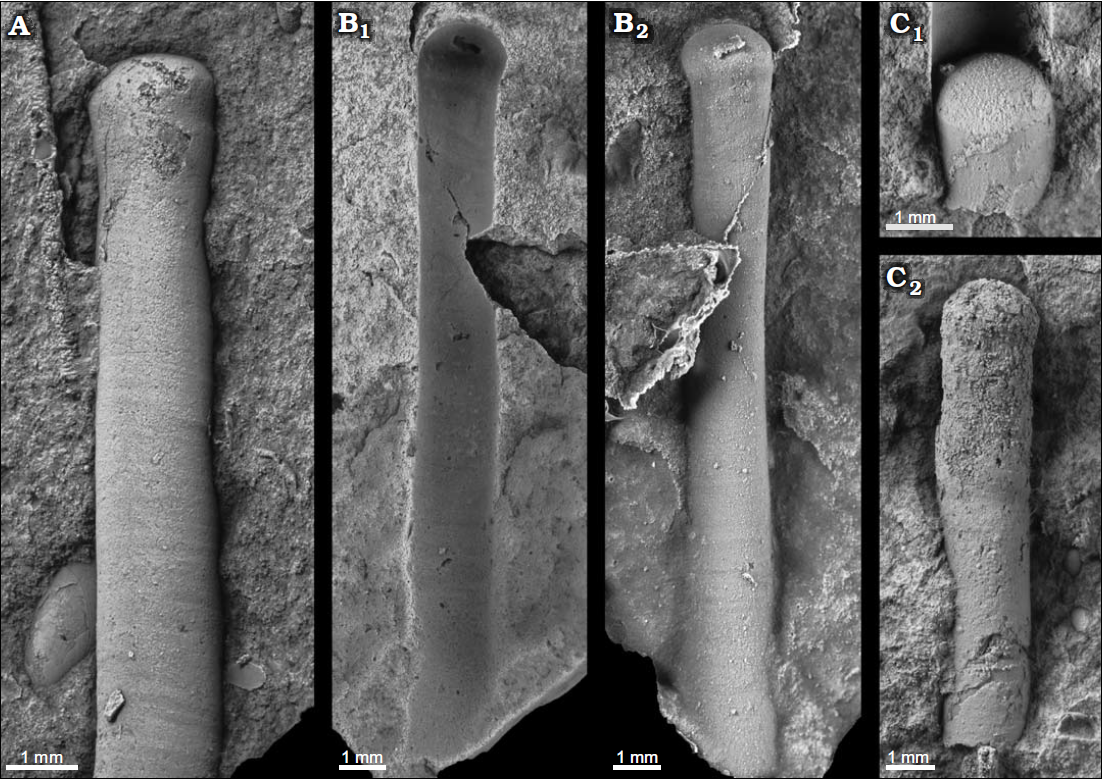
The third specimen, MWB S 06761, is a fragment of a counterpart of a juvenile shell. The total length of the specimen is 13.1 mm. The initial chamber (first phragmocone chamber) is bean-shaped in median section, 2.2 mm in diameter and 1.1 mm in length (shape ratio 0.5). The diameter of the initial chamber exceeds that of the second phragmocone chamber (basal diameter of the second phragmocone chamber was 2 mm, constriction ratio 0.91). The phragmocone has a maximum diameter of 2.5 mm and expands very slowly (angle of expansion 2°). The phragmocone is circular in cross-section. The external surface is smooth. The specimen is accompanied by a Hyolith and other indeterminate invertebrate fragments.

The fourth specimen, MWB S 06762, is a fragment of a counterpart of a juvenile shell. The total length of the specimen is 20 mm. The initial chamber is bean-shaped in median section, 2.5 mm in diameter and 1.6 mm in length (shape ratio 0.64). The diameter of the initial chamber exceeds that of the second phragmocone chamber (basal diameter of the second phragmocone chamber was 2.3 mm, constriction ratio 0.92). The phragmocone expands very slowly. The phragmocone is circular in cross-section. The external surface is smooth.

Apical shell of the Orthoceratoid Bactroceras sandbergeri; Middle Ordovician, lower Darriwilian Stage, Šárka Formation, Czech Republic. (A) MWB S 06761, Mýto-Svatoštěpánský rybník, latex cast of one of counterparts in lateral view, note fine, obliquely transverse surface ornamentation. (B) MWB S 06762, Mýto-Svatoštěpánský rybník, counterpart (B₁) and its latex cast (B₂), in lateral view (initial chamber bent towards dorsum). (C) MWB S 06763, Rokycany-Díly, internal mould in lateral view, single (adoral-most) phragmocone chamber showing ventrally situated siphuncle (C₁), latex cast of the second counterpart (C₂). Aubrechtová et al. (2020).

The fifth specimen, MWB S 06763, is a fragment of a counterpart of a juvenile shell with one phragmocone chamber preserved adorally. The total length of the specimen is 10.4 mm. The initial chamber is bean-shaped in median section, 2 mm in dorso-ventral diameter and 1.3 mm in length (shape ratio 0.65). The diameter of the initial chamber exceeds that of the second phragmocone chamber (basal diameter of the second phragmocone chamber is 1.8 mm, constriction ratio 0.9). The phragmocone has a maximum dorso-ventral diameter of 2.3 mm and expands very slowly. The phragmocone is circular in cross-section. The septum of the adoralmost phragmocone chamber displays the submarginal (subventral) siphuncle, which has a circular cross-section and a diameter of 0.25 mm. The external shell surface is smooth. The specimen is accompanied by the Bellerophontid Tropidodiscus pusillus, the Trilobite Pricyclopyge cf. binodosa and an indeterminate Bivalve.

The sixth specimen, MWB S 06764, is a fragment of a counterpart of a juvenile shell with one phragmocone chamber preserved adorally. The total length of the specimen is 3.5 mm. The initial chamber is bean-shaped in median section, very short, 2.6 mm in dorso-ventral diameter and 1.4 mm in length (shape ratio 0.54). The diameter of the initial chamber exceeds that of the second phragmocone chamber (basal diameter of the second phragmocone chamber was 2.2 mm, constriction ratio 0.85). The phragmocone has a maximum dorso-ventral diameter of 2.2 mm and expands very slowly; it is circular in cross-section. The length of the adoralmost phragmocone chamber is 1.2 mm. The siphuncle is narrow, submarginal (ventral) with a circular cross-section. The external shell surface is smooth. The specimen is accompanied by the Bellerophontid Tropidodiscus pusillus.

The seventh specimen, NM L 59577, is a counterpart of an embryonic shell with the initial chamber. The adoral part of the shell is very slightly bent. The total length of the specimen 4.5 mm. The initial chamber (first phragmocone chamber) is bean-shaped in median section, 2.0 mm in diameter and 1.2 mm in length (shape ratio 0.6). The diameter of the initial chamber exceeds that of the second phragmocone chamber (basal diameter of the second phragmocone chamber is 1.7 mm, constriction ratio 0.85). The phragmocone is circular in cross-section. No shell ornamentation is discernible. The nodule containing this specimen also yielded the rare Graptolite Dichograptus? leptotheca.

The eigth specimen, MWB S 06823, represents the third phragmocone chamber (estimated based on the shell diameter and length of this chamber) and the adapical part of the living chamber. The phragmocone has a minimum dorsoventral diameter of 1.8 mm, a minimum lateral diameter of 1.6 mm and expands very slowly; it is slightly compressed in cross-section. The length of the third phragmocone chamber is 2.7 mm. The siphuncle is narrow, submarginal (ventral) with a circular cross-section; its diameter at the foramen of the adapical septum is 0.25 mm. The specimen is accompanied by undetermined Hyoliths and the Bellerophontid Tropidodiscus pusillus.

Apical and juvenile shell parts of Orthoceratid Cephalopods; Middle Ordovician, Darriwilian Stage, Šárka and Dobrotivá formations, Czech Republic. (A) Bactroceras sandbergeri, MWB S 06823, Volduchy, third phragmocone chamber (estimated based on shell diameter) and adjacent part of body chamber. (B) Orthoceratida indet. sp. 4, MWB S 06827, Volduchy, counterpart of initial chamber and adjacent part of phragmocone and one corroded phragmocone septum; note longitudinal striae. (C) Orthoceratida indet sp. 5, NM L 59872, Malé Přílepy, counterpart (C₁), latext cast (C₂); note longitudinal striae. Aubrechtová et al. (2020).

The three remaining specimens MWB S 06824–06826 from the locality Volduchy are juvenile shell fragments that morphologically correspond to the above described specimens. However, their preservation hinders precise measurements.

MWB S 06759, 06763, and 06764 are shell fragments of larger individuals as indicated by the absence of living chambers. By contrast, specimen MWB S 06823 probably represents the shell of an early juvenile individual. The rest of the specimens (counterparts) do not show any internal structures and therefore can represent both complete shells of freshly hatched individuals, or adapical parts of later growth stages.

The specimens unequivocally belong to Bactroceras sandbergeri because they exhibit short, bean-shaped in median section, rather large and constricted initial chambers. These characters correspond in all aspects to the only apex previously known from the species.The only difference concerns the caecum, which is slightly more curved in MWB S 06759 than in the original specimen.

In Bactroceras the apicalmost chamber is known also in Bactroceras angustisiphonatum, where it is, however, much smaller in size (1.3 mm in height, 1 mm in diameter, shape ratio 1.3), less constricted (constriction ratio 0.95) and more ovoid in shape.

Of all known Ordovician Orthoceratoids, the shape of the initial chamber of Bactroceras sandbergeri is most similar to that of Orthoceras sp. The latter is, however, much smaller in diameter, the caecum is much shorter and the siphuncle has a ventro-central position. Compared to Bactroceras sandbergeri, the initial chamber of Archigeisonoceras sp. is smaller and only very slightly constricted; the caecum is bent inwards and relatively long but expands inside the initial chamber.

One specimen, NM L 59578, is referred to Bactroceras sp., i.e. assigned to the genus Bactroceras, but not a species. This specimen is a fragment of an adapical part of a juvenile phragmocone with visible concave side of one septum. The length of the specimen is 3.5 mm. The phragmocone has a maximum diameter of 2.5 mm and expands at a very low angle (which cannot be precisely measured). The phragmocone is circular in cross-section. The septal foramina of the single visible septum is circular in cross-section, c. 0.1 mm in diameter and submarginal in position. The external surface of the shell is smooth.

The narrow, submarginal siphuncle of NM L 59578 indicates the specimen should be assigned to the genus Bactroceras. However, the preservation of the specimen does not permit determination to the species level.

NM L 59578 represents the first record of Bactroceras from the late Darriwilian Dobrotivá Formation of the Prague Basin.

Specimen NM L 46566 is considered to have come from an unknown Orthoceratid species, identified as Orthoceratida indet. sp. 1. The specimen is a part and a counterpart of a phragmocone with the initial chamber. Adapical third of the phragmocone is longitudinally broken off and infilled with a brownish carbonate mineral; the broken portion was reconstructed using a latex cast prepared from the counterpart. The total length of the specimen is 46.8 mm. A weakly sinuous line along the contact of the fossil and the surrounding rock indicates the presence of a low annulation on the surface of the shell. The surface is, however, slightly corroded and does not show any other ornamentation. The initial chamber is egg-shaped, very slightly asymmetric from one side, 3 mm in diameter and 3.1 mm in length (shape ratio c. 1). The diameter of the initial chamber exceeds that of the adjacent phragmocone chamber (basal diameter of the second phragmocone chamber is 2.6 mm, constriction ratio 0.87). The first, straight and directly transverse, suture is faintly indicated. The phragmocone is circular in cross-section with a maximum diameter of c. 7 mm and expands with an angle of 6°.

The initial chamber of the specimen stands out among other apical shell parts known from Ordovician Orthoceratids in its large size reaching 3 mm in diameter and 3.1 mm in length. It may resemble the initial chamber described in Arionoceras?, which is ovoid in shape; the latter is, however, smaller in dimensions, more distinctly constricted and has a greater angle of expansion (13°).

The Bohemian specimen more likely belongs to one of the Middle Ordovician Orthoceratid species described by Joachim Barrande, in which early ontogenetic stages are not yet known. Unfortunately, the collection of Joachim Barrande contains either fragmentary material, or specimens representing only late ontogenetic stages. Moreover, the preservation of the specimen studied here does not show the character of the siphuncle and ornamentation is only slightly indicated, which prevents the specimen from being more precisely identified.

Apical shell parts of three indeterminate Orthoceratid Cephalopods; Middle Ordovician, lower Darriwilian Stage, Šárka Formation, Czech Republic. (A) Orthoceratida indet. sp. 1, NM L 46566, Praha-Šárka cihelna (brickyard), part (A₁) and latex cast of the counterpart (A₂), detail of latex cast (A₃), note large size of egg-shaped initial chamber. (B) Orthoceratida indet. sp. 3, NM L 46565, Praha-Šárka, single (adoralmost) phragmocone chamber showing centrally situated siphuncle (B₁), counterpart with one adoral septum (B₂), latex cast of counterpart showing transverse surface ornamentation (B₃).  (C) Orthoceratida indet. sp. 2, MWB S 06765, Mýto-Svatoštěpánský rybník, detail of adoralmost septum with hyposeptal cameral deposits around the subcentral siphuncle (C₁), the second counterpart (C₂), note the absence of cameral deposits at septum situated more apically than in (C₁), latex cast of the previous associated with Bellerophontid Tropidodiscus pusillus. Aubrechtová et al. (2020).

Another specimen, MWB S 06765, is considered to belong to another unknown species, identified as Orthoceratida indet. sp. 2. This specimen consists of two counterparts of a phragmocone composed of two dislocated fragments. In each of the two counterparts there is one septum preserved. The rest of the shell was reconstructed from a latex cast. Total combined length is 15.3 mm (apical fragment 9.1 mm and adoral fragment 6.2 mm). The initial chamber is eggshaped, 2 mm in dorso-ventral diameter and 2 mm in length (shape ratio 1). Its diameter very slightly exceeds that of the adjacent phragmocone chamber (basal diameter of the second phragmocone chamber is 1.9 mm, constriction 0.95). The phragmocone is circular in cross-section. The siphuncle is 0.25 mm in diameter (corresponding shell diameter 23 mm) and sub-central in position (shifted slightly towards the venter, situated 10 mm from the ventral side of the shell wall, 13 mm from the dorsal). The phragmocone has a maximum diameter of 25 mm and expands slowly with an angle of 3°. The convex side of the adoralmost preserved septum shows massive hyposeptal deposits surrounding the siphuncle. In outline, these bilaterally symmetrical deposits resemble a figure '8'; they are more massive ventrally than dorsally. The external surface of the shell is smooth. The adoral phragmocone fragment shows two straight and slightly oblique suture lines spaced 1.8 mm apart (at a corresponding shell diameter 25 mm). The specimen is accompanied by a small Lingulate Brachiopod and the Bellerophontid Tropidodiscus pusillus.

The initial chamber of MWB S 06765 classified by Aubrechtová et al. as Orthoceratida indet. sp. 2 differs from Orthoceratida indet. sp. 1 in being smaller in dimensions, less ovoid and less constricted. Hyposeptal cameral deposits are present. The only known Cephalopod from the Ordovician of Bohemia comparable in shape and position of deposits is Orthoceras bonum. However, this species was previously speculated to represent an Actinoceratid or alternatively a Pseudorthoceratid, none of which exhibit the initial chamber morphology described above in MWB S 06765.

Specimen NM L 46565, a juvenile shell, from the Praha-Šárka locality of the Šárka Formation, is identified as Orthoceratida indet. sp. 3. This specimen is a counterpart of a juvenile shell with only the adoralmost septum preserved; the initial chamber is broken off. Total length is 25 mm. Minimum preserved diameter of the phragmocone is 1.7 mm, the maximum diameter is 4.5 mm; the phragmocone is circular in cross-section. The siphuncle is narrow, 0.7 mm in diameter (at maximum shell diameter) and central in position. The phragmocone expands with an angle of 7°. The external shell surface shows irregular, fine and straight transverse ornamentation; in the adapical and middle parts of the specimen the ornamentation is accentuated and regularly developed.

NM L 46565 has an angle of expansion comparable to Orthoceratida indet. sp. 1 but the former must have had a much smaller initial chamber. In its small size, NM L 46565 resembles Orthoceratida indet. sp. 2 but the latter has a lower angle of expansion. Based on the comparisons to Orthoceratida indet. sp. 2, the initial chamber in NM L 46565 probably did not exceed 1.9 mm in diameter.

Two specimens MWB S 06827, and 06828), counterparts of juvenile shell parts from the Volduchy locality of the Šárka Formation are identified as exceed 1.9 mm in diameter. Orthoceratida indet. sp. 4. MWB S 06827 is a counterpart of the embryonic shell including the initial chamber. The length of the specimen is 3.2 mm. The initial chamber (first phragmocone chamber) is bean-shaped in median section, 1.8 mm in diameter. The phragmocone is constricted at a distance of 1.3 mm from the tip of the initial chamber and at 1.5 mm of shell diameter. This constriction is assumed to correspond to the position of the first phragmocone septum; the shape ratio of the initial chamber is then 0.72 and constriction ratio 0.83. The phragmocone is circular in cross-section. Longitudinal, faintly sinuous shell ornamentation; it disappears at the adoral part of the specimen where it is replaced by slightly oblique transverse sculpture.

Finally, specimen NM L 59872, an embryonic shell, from the Malé Přílepy locality of the Dobrotivá Formation, is identified as Orthoceratida indet. sp. 5. This specimen is a counterpart of an embryonic shell. Total length is 3.3 mm. Shell diameter is 1.8 mm along the specimen length; no marked constriction is discernible on the phragmocone. The phragmocone is circular in cross-section. The external shell surface at its apical part shows fine longitudinal structures, while in the adoral part, transverse lirae are observed.

The size and shape of the initial chamber in NM L 59872 is very similar to that in MWB S 06827 assigned above to Orthoceratida indet. sp. 4. The preservation of both specimens is, however, too fragmentary to allow more precise comparisons and unequivocal taxonomic classification.

Previous studies on the early ontogeny in Ordovician Orthoceratoids have focused on general patterns in the embryonic shell size distribution among individual groups of Cephalopods and trends in the morphology of these shell parts over longer time periods. The size of embryonic shell has been used to estimate egg and hatchling size. In early Palaeozoic Nautiloid Cephalopods, the timing of hatching can be determined using the criteria that apply in the Recent Nautilus (except for the nepionic constriction which is not known in early Palaeozoic Cephalopods with certainty). In contrast, there are varying opinions regarding the recognition of the hatching phase and the size of embryonic shells in Orthoceratoid Cephalopods. For this purpose, changes in septal spacing, apical angle and ornamentation have been used. Previous studies have concluded that Orthoceratoid embryonic shells probably consisted of the initial chamber, one or two phragmocone chambers and the living chamber The view assuming a direct ontogenetic development of early Orthoceratoids is followed by the present authors, as well. An alternative hypothesis supposed that Orthoceratoid embryonic shell had consisted only from the first, sub-sphaerical chamber, while the adjacent cylindrical part of the shell was considered to represent the larval stage.

With the exception of Bactroceras angustisiphonatum and Orthoceras sp., the late Early–Middle Ordovician Orthoceratoid initial chambers are relatively large in dimensions; the morphology of adjacent parts of the shell, including the living chamber, imply the presence of relatively large embryonic shells. In contrast to that, Late Ordovician and especially younger, Silurian, orthoceratoid initial chambers and embryonic shells generally have smaller sizes. This apparent shift in the size of initial chambers and embryonic shells in Orthoceratoids from the Middle Ordovician onwards, have been recorded previously. It has been assumed that this reflects the gradual decreasing of egg and hatchling size and to indicate changes in reproductive strategies (towards larger amounts of smaller juveniles) and life modes (towards planktotrophy and pelagic lifestyles) in Orthoceratoids and their descendants, i.e., Bactritoids, Ammonoids, and Coleoids.

Drawings of known embryonic shells with initial chambers of Ordovician Orthoceratoids. Dotted lines indicate the assumed position of the siphuncle in Arionoceras? sp. and Orthoceratida indet. sp. 2. In Orthoceratida indet. sp. 2, note a sketch of hyposeptal cameral deposits. The stratigraphic position of Bactroceras angustisiphonatum and Arionoceras? sp. is either uppermost Lower Ordovician, or lowermost Middle Ordovician. Orthoceratidae gen. et sp. indet B is likely to be conspecific with Transorthoceras osmundsbergense. Aubrechtová et al. (2020).

However, two Ordovician Orthoceratoids, Bactroceras angustisiphonatum and Orthoceras sp. contradict the above trend in being considerably smaller in dimensions than other Middle Ordovician Orthoceratoids. In both taxa, this may reflect the shell sizes of stratigraphically early Orthoceratoids. Sea-water temperatures have to be taken into account, as well, and studies on fossil Cephalopods have indicated that the cooling of climates/position in high palaeolatitudes induced an increase in the size of embryonic shells. In contrast, warming of climates/position in lower palaeolatitudes was reportedly accompanied by a decrease in these sizes.

The only initial chamber of Bactroceras sandbergeri previously known was figured by Joachim Barrande in 1868. The initial chamber is rather different in appearance from initial chambers of other Ordovician Orthoceratoids. Based on the collection of eleven additional, newly obtained specimens it can be confirmed that this is not the result of any deformation or growth anomaly: the initial chamber of Bactroceras sandbergeri is sub-sphaerical (bean-shaped in median section), relatively large and short and constricted at the first phragmocone septum. Several well preserved counterparts of initial chambers definitely confirm the absence of a cicatrix, a systematically and phylogenetically important feature. These specimens also indicate that the sculpture of the embryonic and early juvenile shell in Bactroceras is smooth but can also exhibit fine longitudinal or obliquely transverse striae. Unfortunately, Barrande’s original specimen is preserved only as a corroded internal mould and therefore cannot show the character of ornamentation or prove the absence of a cicatrix with certainty.

Two specimens (NM L 10331 and MWB S 06759) preserve the caecum, which is long and tubular, moderately (MWB S 06759) to strongly (NM L 10331) bent laterally and inward. It remains close to the shell wall or in close contact with it throughout its length. The long, inward bent caecum in Bactroceras and also in Archigeisonoceras may have enhanced buoyancy control and migration potential of the hatchlings.

The morphological variability of the initial chamber of Bactroceras is low The angle of expansion changes in earliest ontogeny, the shell diameter at the first septum is slightly larger than that at the second septum. The shell starts to expand regularly only at about the mid-way between the second and third septum (NM L 10331, MWB S 06759). In some Nautiloids and Bactritoids the change of juvenile shell expansion indicates the hatching phase. If the same were true for Bactroceras, then its egg would have been ovoid and c. 3 mm in length.

Another interesting fact is the pronounced difference of apex morphology between the two species of Bactroceras in which the early growth stage is known. Besides the contrasting dimensions, the initial shell of Bactroceras angustisiphonatum is ovoid in shape and less constricted than the sub-sphaerical initial chamber of Bactroceras sandbergeri. Such a difference within a single genus has not yet been documented in exocochleate Cephalopods. This may call into question the congenerity of the two species which are otherwise closely similar in other morphological traits of their shells.

The eighteen specimens studied by Aubrechtová et al. significantly expand the rather sporadic record of the earliest growth stages of Ordovician Orthoceratoids. The initial chamber of Bactroceras sandbergeri, one of the stratigraphically oldest known Orthoceratoids, is now known in twelve specimens in total. It is large and very short, sub-sphaerical (bean-shaped in median section) and constricted at the first phragmocone septum. The absence of the cicatrix can now be definitely confirmed. The dimensions of the specimens point to a low morphological variability in both shape and size of juvenile growth stages of the species. The caecum (observed in the type specimen and one additional specimen) is long, tubular and bent inwards (dorsally). A slight decrease in the angle of expansion of the embryonic shell has been observed halfway between the second and third suture, or at the third suture. This may indicate the boundary between embryonic and post-embryonic stages.

The recently obtained specimen of Bactroceras sp. marks the first confirmed occurrence of this genus in the upper Darriwilian Dobrotivá Formation. The specimen thus fills the gap between verified Middle and Upper Ordovician occurrences of Bactroceras in the Prague Basin.

Bactroceras shows a marked intrageneric difference in the shape and size of initial chamber: in Bactroceras angustisiphonatum the initial chamber is ovoid and 2–2.5 times smaller compared to that in Bactroceras sandbergeri.

Three other orthoceratid specimens described by Aubrechtová et al. are variable in their embryonic shell sizes. Orthoceratida indet. sp. 1 with the diameter of 3 mm and height 3.1 mm is the largest initial chamber known from Ordovician Orthoceratids. The initial chamber in Orthoceratida indet. sp. 2 is similar in shape to the former species but is one-third smaller; an adoral septum of the phragmocone shows hyposeptal cameral deposits. Orthoceratida indet. sp. 3 differs from Orthoceratida indet. sp. 2 in the smaller dimensions of its apical shell part and from MWB S 06765 in having a higher angle of expansion. Orthoceratida indet. sp. 4 from the Šárka Formation and Orthoceratida indet. sp. 5 from the Dobrotivá Formation are very similar in the size and shape of their initial chambers; their incomplete preservation, however, hinders the possibility to determine whether the two specimens represent the same species.

The comparably large-sized Cephalopod embryonic growth stages with voluminous initial chambers described by Aubrechtová et al. from the Darriwilian Stage of Bohemia confirm the presence of a functional phragmocone (i.e., capable of buoyancy regulation) in phylogenetically early Orthoceratoids. The initial chambers and reconstructed embryonic shells are mostly larger than those known from the Late Ordovician and especially Silurian strata. This may be a reflection of previously reported shifts in reproductive strategies and modes of life in early Palaeozoic Orthoceratoid Cephalopods towards gradual decreasing of egg and hatchling sizes, larger amounts of smaller juveniles, juvenile planktotrophy and pelagic lifestyles. Additionally, the influence of palaeoclimatic conditions and sea-water temperatures is implied.

See also...

https://sciencythoughts.blogspot.com/2020/02/sepiella-japonica-paternity-testing.htmlhttps://sciencythoughts.blogspot.com/2020/02/evidence-for-predation-of-soft-bodied.html
https://sciencythoughts.blogspot.com/2019/10/eromangateuthis-soniae-large-fossil.htmlhttps://sciencythoughts.blogspot.com/2019/08/washington-woman-hospitalised-by.html
https://sciencythoughts.blogspot.com/2019/07/royal-canadian-mounted-police.htmlhttps://sciencythoughts.blogspot.com/2019/06/architeuthis-dux-giant-squid-captured.html
Follow Sciency Thoughts on Facebook.