Showing posts with label Calhoun County. Show all posts

Friday, 24 April 2020

Tornadoes and flooding kill at least seven in Texas, Oklahoma, and Louisiana.

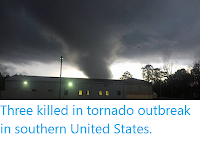
At least seven people have died and many more have been injured as tornadoes and severe storms swept across the southern United States on Wednesday 22 and Thursday 23 April 2020. At least three people died and more than twenty were injured when a tornado hit the town of Onalaska in Polk County, Texas, destroying 46 houses and damaging 245 more. Two people died in the city of Madill in Marshall County, Oklahoma, which is reported to have suffered severe damage after being hit by a tornado. In Louisiana a man is reported to have died after falling into a drainage ditch in the city of Mansfield in DeSoto Parish, and a woman is reported to have died in a storm in the town of Lecompte in Rapids Parish. Elsewhere the city of Adel in Cook County, Georgia, is reported to have suffered damage to a number of properties after being hit by a tornado, as is the city of Tallahassee, in Leon County, Florida. In Alabama two emergency workers are reported to have been injured by a falling tree in the city of Anniston in Calhoun County, while attempting to rescue a homeowner trapped by an earlier treefall. Around 150 000 homes and businesses across the southern US are reported to be without electricity due to fallen power lines.

A tornado over the city of Madrill, Oklahoma, at about 5.00 pm local time on Wednesday 22 April 2020. NBC.

Tornadoes are formed by winds within large thunder storms called super cells. Supercells are large masses of warm water-laden air formed by hot weather over the sea, when they encounter winds at high altitudes the air within them begins to rotate. The air pressure will drop within these zones of rotation, causing the air within them so rise, sucking the air beneath them up into the storm, this creates a zone of rotating rising air that appears to extend downwards as it grows; when it hits the ground it is called a tornado.

Tornado damage in Woodworth, Louisiana. USA Today.

Tornadoes can occur anywhere in the world, but are most common, and most severe, in the area of the American mid-west known as 'Tornado Ally', running from Texas to Minnesota, which is fuelled by moist air currents from over the warm enclosed waters of the Gulf of Mexico interacting with cool fast moving jet stream winds from the Rocky Mountains. Many climatologists are concerned that rising temperatures over the Gulf of Mexico will lead to more frequent and more severe tornado events.

Simplified diagram of the air currents that contribute to tornado formation in Tornado Alley. Dan Craggs/Wikimedia Commons/NOAA.

See also...

https://sciencythoughts.blogspot.com/2020/04/tornadoes-kill-at-least-eight-in.htmlhttps://sciencythoughts.blogspot.com/2020/03/homes-destroyed-and-people-treated-for.html
https://sciencythoughts.blogspot.com/2019/12/three-killed-in-tornado-outbreak-in.htmlhttps://sciencythoughts.blogspot.com/2019/11/condominium-complex-evacuated-after.html
https://sciencythoughts.blogspot.com/2019/10/thousands-left-wthout-electricity-after.htmlhttps://sciencythoughts.blogspot.com/2019/10/florida-fish-and-wildlife-conservation.html
Follow Sciency Thoughts on Facebook.

Wednesday, 1 June 2016

Sclerangia floridana: A new species of Coral from the Miocene of Florida.

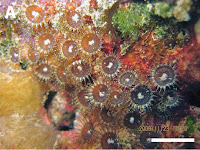
Scleractinian Corals (or Stoney Corals) are colonial or singular Cnidarians that secrete calcium carbonate skeletons, with some colonial forms producing extensive reef systems, each individual polyp sitting in its own cup on the larger colonial strcture, and forming the dominant group of reef-building organisms in modern oceans. They appeared in the Middle Triassic, from an uncertain ancestor (earlier groups of reef-building Corals having gone extinct at the end of the Permian), and by the beginning of the Jurassic were already forming extensive reefs. However not all Sclerctinians are reef-builders, many species are solitary, or form small colonies on rocks or the shells of other animals.

In a paper published in the journal Paleontological Contributions on 30 April 2015, Rosemarie Baron-Szabo of the Department of Invertebrate Zoology at the Smithsonian Institution and the Senckenberg Research Institute, and Stephen Cairns, also of the Department of Invertebrate Zoology at the Smithsonian Institution, describe a new species of Scleractinian Coral from the Miocene Chipola Formation of Calhoun County, Florida.

The new species is named Sclerangia floridana, where 'Sclerangia' means 'hard-container' in reference to the corallite cups) and 'floridana' refers to the state of Florida. The species is described from a series of specimens in the collection of the Smithsonian Institution orginally described as Thysanus vaughani in 1972, but now recognized to be a separate species. Sclerangia floridana is a colonial Coral buding from the outside of the corallite cups. All specimens comprised small colonies growing on the surface of Gastropod (Snail) shells alongside Sipunculid Worms.

 Sclerangia floridana, Miocene, Chipola Formation, Calhoun County, Florida, United States; upper surface of largest colony (1) and close-up of (2); (3-5) smaller colonies. Scale bars: (1, 4) = 2.5 mm; (2, 3, 5) = 2 mm. Baron-Szabo & Cairns (2015).

See also...

http://sciencythoughts.blogspot.co.uk/2014/12/a-new-species-of-soft-coral-from.htmlA new species of Soft Coral from the Republic of Congo.                                                    Soft Corals (Octocorals) of the genus Alcyonium form encrusting, lobed colonies on shallow rocky surfaces in tropical waters. These Corals typically have...
The Abrolhos Bank is an area of the Brazilian continental shelf to the south of Bahia State, noted for its large and rich coral reef fauna and unique...
Zoanthids are unusual Corals with similarities to both the reef-forming calcareous skeleton excreting Scleractinian Corals and the larger, free living Sea Anemones. Most species are colonial, with...
Follow Sciency Thoughts on Facebook.