Showing posts with label Chalk. Show all posts

Tuesday, 12 December 2023

Homes evacuated following major landslide on the Isle of Wight.

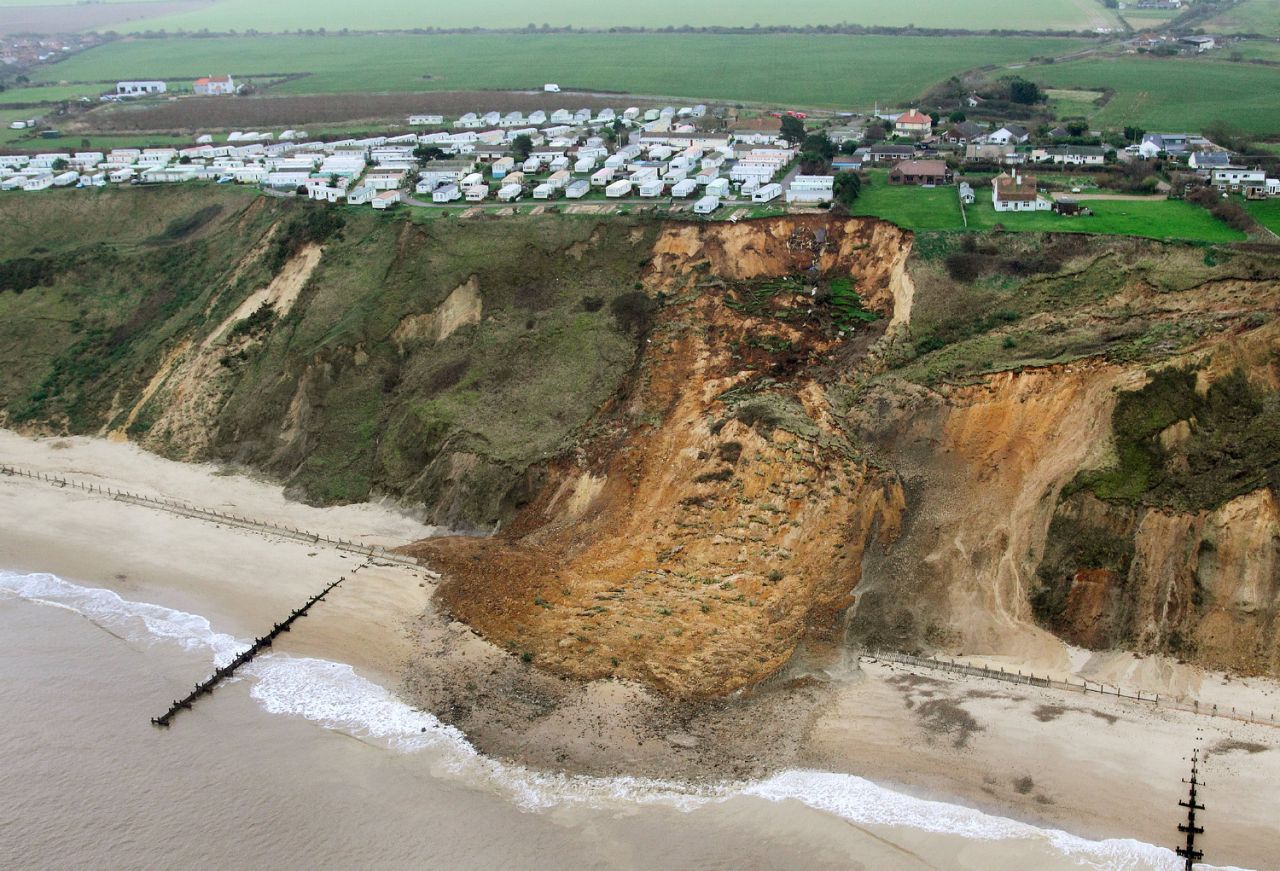
Residents of 20 homes on the south coast of the Isle of Wight, England, have been evacuated following a massive landslip on Sunday 10 December 2023. The event happened at about 9.30 pm local time, on cliffs in the village of Bonchurch on the eastern fringe of the town of Ventnor, which fractured causing the cliff face to retreat by about 20 m. Inspections by the Isle of Wight Council suggest that fractures in the rock extend some way beyond the area which has collapsed already, making it highly likely that further collapses will occur.

A landslip in the village of Bonchurch on the Isle of Wight. Island Echo.

The landslip is thought to be linked to the exceptionally high levels of rain on the island this year, with 110 mm of rain falling in August, 64 mm in September, 250 mm in October and 200 mm in November. The cliffs at Bonchurch are made of chalk, a soft form of limestone through which water permeates slowly, and which will eventually become waterlogged and prone to collapse after extended periods of rain.

See also...

Follow Sciency Thoughts on Facebook.

Follow Sciency Thoughts on Twitter.


Tuesday, 27 October 2020

Sinkhole opens new housing development in Maidstone, England.

Residents of a new housing development at Maidstone in Kent, southern England, have expressed concern after a sinkhole opened up near their properties on Sunday 25 October 2020. The sinkhole does not directly impact the homes, but is in an area earmarked for further house-construction, raising doubts about such development. This is the latest in a series of sinkhole incidents in the Maidstone area, including one which opened up beneath a reservoir used to provide water for domestic use in September, which required a major re-routing of water suplies in the area, in order to ensure that residents were not left without water.

 
A sinkhole near to a new housing development in Maidstone, Kent, southern England. Kent Online.

Sinkholes are generally caused by water eroding soft limestone or unconsolidated deposits from beneath, causing a hole that works its way upwards and eventually opening spectacularly at the surface. Where there are unconsolidated deposits at the surface they can infill from the sides, apparently swallowing objects at the surface, including people, without trace.

 
Typical sinkhole formation processes. Southwest Florida Water Management District.

Much of Kent lies on chalk, soft Cretaceous limestone, which is particularly prone to sinkhole formation. This chalk is typically overlain by Palaeocene and Eocene clay deposits, which seal the chalk off from the surface, offering a measure of protection against erosion, but this can be disturbed by Human activities, such as road or house building, enabling water from rainfall to seep through to the soft chalk, and leading to sinkhole formation.

 
A geological map of Kent. Kent Geologists' Group.

See also...


Follow Sciency Thoughts on Facebook.

Follow Sciency Thoughts on Twitter


Saturday, 11 January 2020

Caravans left balancing in cliff edge following landslip at Trimingham on the Norfolk Coast, England.

A row of caravans at a clifftop resort at Trimingham on the Norfolk Coast of England has left teetering on a cliff edge following a landslip on Monday 6 January 2020. Nobody was injured in the incident, but one woman had to be evacuated from a caravan she was occupying; the incident would probably have been much more dangerous if it had occurred in summer when the area is packed with tourists. Work has begun to drag the caravans away from the cliff edge.

Caravans balancing on a cliff edge following a landslide at Trimingham on the Norfolk Coast, England. SWNS.

The cliffs at Trimingham are considered to be geologically important, being the youngest exposure of the Cretaceous Chalk exposed in England. Like much of the Norfolk coast the area is prone to coastal erosion, as the North Sea batters at the base of the cliffs,  wearing away the rocks at the base and undermining the rocks above. Because of the value of the cliffs at Trimingham, measures have been taken to protect them, with wooden sea baffles installed to protect the cliffs from the worst action of the sea. 

 Part of the sea baffle at Trimingham. The Norfolk Project.

However, these sea defences may have made the area more prone to other forms of clff collapse, leading to a sudden large collapse, as seen this week, rather than an ongoing gradual process. All cliffs are fundamentally unstable structures, with a tendency to bow out and collapse. This is because the rocks at a cliff lack other rocks to one side; burried rocks are pushed down by the weight of rock above, but are generally held in place by the rocks all around them. If the rock to one side is missing, or even under less presure, then they will tend to be pushed in that direction.

Cliff collapse at Trimingham this week, covering the protective sea baffle. BBC News.

In addition the cliffs at Trimingham are made of chalk, a form of soft porous limestone. This is eroded over time by acid in rainwater (most rainwater is slightly acidic, though pollution can make this worse), and can collapse suddenly. This can be triggered by human activity, such as pumping water out (which causes the water to flow, facilitating acid dissolution of the limestone), but is essentially a natural process. Heavy rainfall will also speed up such erosion, again by causing water to flow through the rock, facilitating acid dissolution.

The cliffs at Trimmingham are, like many of England's coastal cliffs, of great interest to fossil hunters for the material they produce, predominantly Oysters and Brachiopods. However the Coastguard are urging people to keep away from the cliffs this week, due to the danger of further collapses.

See also...

https://sciencythoughts.blogspot.com/2019/11/people-warned-to-keep-away-from-maer.htmlhttps://sciencythoughts.blogspot.com/2019/05/sinkhole-opens-up-on-bronkham-hill-in.html
https://sciencythoughts.blogspot.com/2019/03/waening-issued-after-cliff-collapse-at.htmlhttps://sciencythoughts.blogspot.com/2018/10/fossil-collector-injured-by-landslide.html
https://sciencythoughts.blogspot.com/2018/08/rockfall-kills-nine-year-old-girl-at.htmlhttps://sciencythoughts.blogspot.com/2017/05/section-of-beach-closed-off-following.html
Follow Sciency Thoughts on Facebook.

Friday, 10 May 2019

Sinkhole opens up on Bronkham Hill in Dorset, England.

A large sinkhole has opened up on Bronkham Hill near Dorchester in Dorset, England. The hole was first observed in February 2019, when it was the size of a dinner plate, prompting Dorset Council to call in a team of geologists, who concluded that the visible hole was located above a much larger void, and had the potential to open up to be about 30 m across and 15 m deep. This conclusion led to the closure of a coastal path which passed the hole. Since that time the hole has widened to the predicted size, and a safety barrier placed around it, though it is thought unlikely that the hole will grow any more, and the path has now been re-opened.

The Bronkham Hill sinkhole on 8 May 2019. Dorset Council.

Sinkholes are generally caused by water eroding soft limestone or unconsolidated deposits from beneath, causing a hole that works its way upwards and eventually opening spectacularly at the surface. Where there are unconsolidated deposits at the surface they can infill from the sides, apparently swallowing objects at the surface, including people, without trace.

(Top) Map of South Dorset showing the location of Bronkham Hill. Google Maps. (Bottom) North south cross-section and relief map of the same area. Holiday (2018).

Bronkham Hill forms a part of the South Dorset Ridgeway, a line of hills caused by a series of faults in the geology of the area (seen on the left in the cross-section above) which expose different rock layers at the surface, leading to different rates of erosion, and therefore different ground levels (hills and valleys). At Bronkham the hill is comprised largely of Cretaceous chalk (the white layer overlaying the green on the left in the cross-section), a soft, permeable limestone absent from the coastal exposures of the region, where harder Jurassic limestones make up the cliffs of the Jurassic Coast. This chalk is easily eroded by (slightly acidic) rainwater, opening up voids in the hillside, which form sinkholes. The area is also home to numerous ancient buried holes, formed by meltwater from glaciers filtering through the rock during the Pleistocene, which can lead to the rapid appearance of large sinkholes as holes formed by modern processes link up with these more ancient voids.

Old sinkholes on Bronkham Hill. Nigel Mykura/BBC.

See also...

https://sciencythoughts.blogspot.com/2019/03/waening-issued-after-cliff-collapse-at.htmlhttps://sciencythoughts.blogspot.com/2017/12/magnitude-19-earthquake-off-coast-of.html
https://sciencythoughts.blogspot.com/2017/05/section-of-beach-closed-off-following.htmlhttps://sciencythoughts.blogspot.com/2017/04/three-year-old-boy-rescued-from.html
https://sciencythoughts.blogspot.com/2015/11/magnitude-11-earthquake-in-somerset.htmlhttps://sciencythoughts.blogspot.com/2015/01/second-hampshire-earthquake-in-three.html
Follow Sciency Thoughts on Facebook.

Tuesday, 6 November 2018

Flats evacuated after sinkhole opens close to residential block in St Albans, England.

All the residents of a twenty one flat residential block in St Albans, England, have been evacuated after a sinkhole opened up next to an external wall on Tuesday 6 November 2018. Emergency services were called to the building after a member of the public noticed the hole, which is about six metres across and about three metres deep, at about 5.50 GMT, and at 6.45 the decision was taken to evacuate the building. The residents have been warned to expect to be out of the property for at least two weeks.

Sinkhole adjacent to a residential building in St Albans, England, on 6 November 2018. Hertfordshire Fire and Rescue.

Sinkholes are generally caused by water eroding soft limestone or unconsolidated deposits from beneath, causing a hole that works its way upwards and eventually opening spectacularly at the surface. Where there are unconsolidated deposits at the surface they can infill from the sides, apparently swallowing objects at the surface, including people, without trace.

he approximate location of the 6 November 2018 St Albans sinkhole. Google Maps.

The precise cause of this particular sinkhole is unclear, but similar holes in the same area in the past have been linked to old old chalk mines. Chalk is a particularly soft form of limestone, and particularly prone to dissolution in water, and the old mineworkings provide both a conduit through which water can flow, and a series of voids into which groundfalls can subside should any further dissolution occur.

See also...

https://sciencythoughts.blogspot.com/2018/04/thaumetopoea-processionea-warnings.htmlhttps://sciencythoughts.blogspot.com/2017/03/london-school-closed-by-sinkholes.html
https://sciencythoughts.blogspot.com/2017/02/three-confirmed-fatalities-as-atlantic.htmlhttps://sciencythoughts.blogspot.com/2016/11/sinkhole-traps-coach-in-south-london.html
https://sciencythoughts.blogspot.com/2016/05/car-swallowed-by-sinkhole-in-london.htmlhttps://sciencythoughts.blogspot.com/2015/04/magnitude-19-earthquake-in-essex.html
Follow Sciency Thoughts on Facebook.

Tuesday, 2 January 2018

Micrometerites from Late Cretaceous Chalk depostits from southern England.

Micrometeorites are tiny (less than 2 mm) fragments of asteroidal (or occasionally cometary) material that survive the descent through the Earth's atmosphere, and which are collected by planetary scientists from sites where input from terrestrial sedimentary sources is minimal, such as Antarctic ice- and snow-fields and oceanic basins. Some micrometeorites survive the journey to the Earth relatively impact, but most are melted by the temperatures caused by friction with the Earths atmosphere (which is greater than that caused by simply falling due to the high relative speeds at which these bodies are travelling prior to encountering the Earth), often reaching temperatures in excess of 2000°C,  which causes them to melt, forming spherical droplets due to surface tension, which recrystallise to form circular bodies called spherules.

These spherules do not retain the same chemistry as their parent bodies; lighter elements, such as sodium, sulphur, phosphorus, chlorine, and manganese tend to evaporate completely, while heavier elements such as iron and nickel separate internally, forming discrete layers. As these liquid spherules descend further they are quench cooled through contact with the denser lower atmosphere, causing them dendritic crystals to form. About 95% of such spherules have a silicate dominated composition, while about 4% are iron dominated and about 1% have a mixed composition. Silicate dominated spherules can have different mineralogies, which is thought to relate to the temperature to which they were heated, rather than their original composition, with porphyritic spherules forming at the lowest temperatures, then barred olivine spherules, then cryptocrystalline spherules, and finally vitreous (glassy) spherules at the highest temperatures. Iron dominated spherules are divided into metal-bearing spherules, which contain an iron-nickel bead surrounded by a layer of wüstite (an iron-oxide mineral), and oxidised sperules, which are composed of a mixture of wüstite and magnetite (another iron-oxide mineral).

Spherules, unlike unaltered micrometeorites, are distinctive enough to be recognised in the rock record and recovered from ancient sediments, with examples having been recovered from a wide range of sedimentary rocks, from Archean limestones in Australia to Eocene marine sediments in Barbados, as well as ancient granites in China. However, such spherules do not simply enter the rock record and remain unchanged waiting to be discovered, they are altered by chemical processes going on within the rock, causing changes referred to as taphonomy. This taphonomy can take a number of forms, including alteration of minerals, hydration or dissolution of anhydrous minerals and metals, and encrustation with halite (salt), calcite (carbonate) or other materials.

In a paper published in the journal Earth and Planetary Science Letters on 1 September 2017, Martin Suttle and Mathew Genge of the Impacts and Astromaterials Research Centre at Imperial College London and the Department of Earth Science at the Natural History Museum, describe the discovery of spherule micrometeorites in Late Cretaceous chalk deposits obtained from a road cutting at Ranmore Common in Surrey, southern England.

Suttle and Genge were able to obtain 76 spherules from their rock sample, including 60 iron oxide spherules, 13 iron/silica spherules and 3 silica spherules, ranging in size from 10 to 165 μm. The majority of the iron oxide spherules were comprised of magnetite, with small amounts of aluminium, silicon and manganese, and trace amounts of other minerals but no nickel, while one was comprised of a mixture of wüstite and magnetite, with a significant proportion of nickel. The iron/silica spherules also lacked any nickel, but did contain small amounts of chromium and manganese. The silica spherules contained small amounts of iron, aluminium and manganese.

External and internal textures of Fe-oxide spherules, interpreted as fossilised cosmic spherules. Particle (D) (C16-0003) is the single unaltered nickel-bearing iron oxide spherule, composed of wüstite, while the remaining spherules are composed of maganese-bearing magnetite. Surface dendrites and residual chalk sediment, including fragmented coccolithophore tests can be seen coating external surfaces of spherules (A)–(C). In spherule (D) and (F) sub-circular cavities are present, representing the loss of an iron–nickel metal bead by corrosion during residence on the Cretaceous seafloor, these spherules can therefore, be identified as metal-bearing iron oxide spherules. In contrast, spherule (G) contains isolated irregular small cavities, representing vesicles formed by residual gas trapped during inward crystallisation and is therefore an oxidised iron spherule. Suttle & Genge (2017).

The iron oxide and iron silica spherules were either homogeneous throughout or showed dendritic crystal formation, with many of the spherules with dendritic crystals also having cavities within, probably indicative of dissolution of minerals. One of the silica spherules has an olivine mineralogy, with the other two being porphyritic.

External and internal textures of iron-silicide spherules, most probably composed of suessite. These spherules are interpreted as fossilised cosmic spherules. Replacement by silicides imperfectly pseudomorphs the original texture, leading to changes in volume, accounting for the presence of micron sized voids seen in (F) and protrusions (D), protecting from the particle’s surface. Despite preservation artifacts, original textures can be discerned, allowing their identification as cosmic spherules. Dendritic crystals are observable in all particles and attest to a rapid cooling history as molten droplets. Particle C16-0009 (A) and (B) preserves only a single phase (most likely wüstite) while particle C16-0010 (D)–(F) preserves both the original magnetite and wüstite as different silicide minerals. Cavities in (B) are a result of volatile gases released during atmospheric entry. Suttle & Genge (2017).

Four of the spherules, the three silica spherules and the nickel-bearing wüstite spherule, are essentially identical to modern spherules obtained from Antarctic snowfields, leaving little doubt as to their meteoric origin. The presence of dendritic crystals in many of the magnetite spherules suggests being heated to a temperature of over 1350°C. The cavities within many of the spherules are probably due to the dissolution of soluble crystals as the spherules lay upon the sea-floor.

Sectioned images of silicate cosmic spherules. Spherules (A) and (B) are ancient, unaltered chondritic silica-type spherules, classified as micro-porphyritic (A) and barred olivine (B) subtypes. For comparison particle (C) is a modern, barred olivine spherule recovered from Larkman Nunatak, Antarctica. Suttle & Genge (2017).

The presence of manganese in many of the spherules requires more explanation, as manganese is extremely rare in modern micrometeorites. Suttle and Genge suggest that this is probably not indicative of the original composition of the meteorites, but rather re-crystallisation of the spherules on the seafloor. They suggest that the spherules probably had a nickle-bearing wüstite composition, which was recrystallised to magnetite on the seafloor, in the process losing their nickel content, but gaining manganese (which is often abundant in marine sediments).

See also...

http://sciencythoughts.blogspot.co.uk/2017/12/determining-origin-of-scoriaceous.htmlhttp://sciencythoughts.blogspot.co.uk/2017/09/understanding-deposition-of-suevites-in.html
http://sciencythoughts.blogspot.co.uk/2017/02/looking-for-pieces-of-piecki-meteor.htmlhttp://sciencythoughts.blogspot.co.uk/2017/01/osterplana-065-unique-meteorite-from.html
http://sciencythoughts.blogspot.co.uk/2016/12/micrometeorites-from-urban-environments.htmlhttp://sciencythoughts.blogspot.co.uk/2015/03/a-second-naturally-occurring.html
Follow Sciency Thoughts on Facebook.