Showing posts with label Chrysididae. Show all posts

Wednesday, 10 August 2016

Indothrix brevicornis: A new species of Cuckoo Wasp from Zhejiang Province, China.

Cuckoo Wasps, Chrysididae, are a widespread and diverse group of Wasps, noted for their kleptoparasitic habits; that is to say that, like many Wasps they lay their eggs inside the paralized bodies of other Insects and Arachnids stored in nests, but unlike these Wasps they do not catch their own prey, but rather lay their eggs inside the victims of other parasitic Wasps, the Cuckoo Wasp larvae then eating both the prey and the larvae of the original Wasp. 

In a paper published in the journal Zootaxa on 2 August 2016, Shuang-Shuang Li and Zai-Fu Xu of the Department of Entomology at the South China Agricultural University describe a new species of Cuckoo Wasp from Zhejiang Province in eastern China.

The new species is placed in the genus Indothrix, which has previously only been recorded in southern India and Sri Lanka, and given the specific name brevicornis, 'short-horned'. in reference to the short antenae of the species. Indothrix brevicornis is described from a single male specimen collected in Hangzhou (the capitol of the province). The species is a dull brownish-black in colour (which is unusual, most Cuckoo Wasps are metalic green in colour) and 3.4 mm in length.

Indothrix brevicornis, male specimen in ventral view. Li & Fu (2016).

See also...
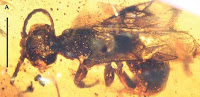
http://sciencythoughts.blogspot.co.uk/2016/04/holopsenella-primotica-new-species-of.htmlHolopsenella primotica: A new species of Bethylid Wasp from Early Cretaceous Lebanese Amber.                                      Bethylid Wasps are a diverse group of...
http://sciencythoughts.blogspot.co.uk/2016/04/trieces-etuokensis-new-species-of.htmlTrieces etuokensis: A new species of Ichneumon Wasp from Qinghai Province, China.                                                   Ichneumon Wasps are parasitoid Wasps (Wasps whose parasitic larvae grow within the body of a living host) that target a wide range of hosts, including Spiders, Beetles, Butterflies and Moths, and even other Wasps. Most species target the larvae of other...
http://sciencythoughts.blogspot.co.uk/2015/12/philoctetes-longiflagellis-philoctetes.htmlPhiloctetes longiflagellis & Philoctetes simulator, two new species of Cuckoo Wasps from China.                                                                    Cuckoo Wasps, Chrysididae, are brightly coloured and usually metallic Wasps found around the world, but most abundant in desert areas. They...
Follow Sciency Thoughts on Facebook.

Tuesday, 1 December 2015

Philoctetes longiflagellis & Philoctetes simulator, two new species of Cuckoo Wasps from China.


Cuckoo Wasps, Chrysididae, are brightly coloured and usually metallic Wasps found around the world, but most abundant in desert areas. They are kleptoparasites, laying their eggs in the nests of other solitary Wasps and Bees, where the larvae emerge and consume both the larvae of the nest-builder and the food with which it was provisioned.

In a paper published in the journal Zootaxa on 12 November 2015, Paolo Rosa of Bernareggio in Italy, Na-Sen Wei of the Department of Entomology at South China Agricultural University, David Notton of the Department of Entomology at the The Natural History Museum in London and Zai-Fu Xu, also of the Department of Entomology at South China Agricultural University, describe two new species of Cuckoo Wasps from China. Both are placed in the genus Philoctetes, which is known to target Crabronid Wasps, the group of Wasps from which Bees are thought to be derived.

The first new species is named Philoctetes longiflagellis, meaning ‘long-flagella’, in reference to the long antennae of the species. These are metallic-green Wasps a little under 4 mm in length with short white setae (hairs) on their bodies. The antennae of the males are notably longer than those of the females, which is unusual in Cuckoo Wasps and has never previously been recorded in members of the genus Philoctetes. The species was found in Inner Mongolia and Shanxi Provinces.

Philoctetes longiflagellis, male specimen form Inner Mongolia in lateral view. Rosa et al. (2015).

The second new species described is named Philoctetes simulator, meaning ‘swindler’, in reference to its close appearance to two other members of the genus, Philoctetes micans and Philoctetes friesei, which is potentially misleading. This species is described from a single female specimen 3.6 mm in length and metallic green in colour with metallif red, blue and black markings. The specimen was found in the city of Tianjin in northeast China.

Philoctetes simulator, female specimen from Tianjin. Rosa et al. (2015).

See also…

A new species of Ichneumon Wasp from Qinghai Province, China.                   Ichneumon Wasps of the genus Campoplex are parasitiods of Beetles and Moths (i.e. their larvae live inside Beetles and Moths, eating their living host as they mature) found predominantly in Europe and Western Asia, with species also recorded from East and...

A new species of Ichneumon Wasp from Liaoning Province, China.                  Ichneumon Wasps are a group of highly specialized solitary wasps that lay their eggs inside the bodies of...


Two new species of Helorid Wasps from the Middle Jurasic Jiulongshan Formation of Inner Mongolia.                                       Helorid Wasps are small, black, parasiotoid Wasps, with larvae that develop inside the bodies of the young of Green Lacewings. The group has a long fossil record, with the earliest known specimens being found in the...
Follow Sciency Thoughts on Facebook.