Showing posts with label Wasps. Show all posts

Saturday, 3 September 2022

Ctenostegus hansoni: A new species of Spider Wasp from Lord Howe Island.

Spider Wasps, Pompilidae, are a large and diverse group of (usually) solitary Wasps with a global distribution. They get their popular name from their habit of capturing live Spiders to bury with their young as a food source. Spider Wasps are generally strong flyers with large wings, fused thorax segments, and spiny legs. Each species of Spider Wasp tends to prey on a different species of Spider, or sometimes a few closely related species, with the targeted Spiders often being large species such as Tarantulas, Huntsmen, or Baboon Spiders.

Lord Howe Island is a volcanic island in the Tasman Sea, 600 km of the coast of New South Wales. It has a high proportion of endemic species, although in the 250 years since it was discovered it has been colonised by a wide range of Plants, Vertebrates, and Invertebrates brought in by Humans, either deliberately or by accident.

Despite's the island's high rate of endemism, and the threat presented by introduced species such as Rats, relatively few studies of Lord Howe Island's invertebrate fauna have been made, which presents serious problems for conservation efforts there.

Lord Howe Island is currently known to be home to 318 species of Wasps, 36% of which are endemic to the island. This includes two species of Spider Wasps: the endemic Sphictostethus insularis, and Ctenostegus murrumbidgee, a species widely distributed in Australia, although this species has been identified there on the basis of a single male specimen only. There are also four specimens of unidentified Spider Wasps from Lord Howe Island in the collection of the Australian Museum.

In a paper published in the journal Austral Entomology on 26 August 2022, Juanita Rodriguez and Olivia Evangelista of the Australian National Insect Collection, describe a new species of Spider Wasp from Lord Howe Island.

The new species is described on the basis of a two citizen science expeditions to Lord Howe Island organised by the Australian Geographic Society in October 2017 and October 2018. The new species is placed in the genus Ctenostegus, and given the specific name hansoni, in honour of Luke Hanson of the Australian Geographical Society, for his role in helping to put together the expeditions to Lord Howe Island. The male specimen previously assigned to Ctenostegus murrumbidgee is also considered to be a member of the new species, with the implication that that species should not be considered to be present on the island.

Distribution map of the species included in the Ctenostegus immitis species-group in Australia (left), and Ctenostegus hansoni in Lord Howe Island (right). Rodriguez & Evangelista (2022).

Females of Ctenostegus hansoni are 6.9-8.04 mm in length, while males are smaller at 4.53-6.28 mm, but otherwise vary little in general morphology. Both sexes are essentially black in colour, with some dark brown, white, and silver markings. Like all species of Ctenostegus, much of the body of Ctenostegus hansoni is covered by silvery hairs. However, in Ctenostegus hansoni these are much less dense than in other species, giving this Wasp a darker appearance.

Ctenostegus hansoni, holotype female (ANIC 32-111497) in (a) frontal, (b) lateral, and (c) dorsal view, (d) close-up of head in frontal view. Rodriguez & Evangelista (2022).

See also...

Follow Sciency Thoughts on Facebook.

Follow Sciency Thoughts on Twitter.


Thursday, 2 June 2022

Utrillabracon electropteron: A new species of Braconid Wasp from Early Cretaceous San Just Amber.

Braconid Wasps are the second largest group of extant Hymenopterans (the group that includes all Wasps, Ants, Bees, and Sawflies), and are the sister group to the Ichneumonidae, the largest Hymenopteran group, with the two forming the Superfamily Ichneumonoidea. Both groups are parasitoids (i.e. their larvae are parasites which grow inside the bodies of other Animals, generally killing the host as they grow, but their adult stages are free-living), targeting a wide range of terrestrial Arthropod species. The Ichneumonoids have been around since at least the Early Cretaceous, although Cretaceous fossils of these Insects are not particularly common. One noteworthy group of early Braconids is the Protorhyssalinae, which is known only from Albian (113-100.5 million years ago) to the Campanian (83.6-71.2 million years ago) deposits, chiefly as inclusions within amber.

In a paper published in the journal ZooKeys on 30 May 2022, Sergio Álvarez-Parra of the Departament de Dinàmica de la Terra i de l’Oceà and Institut de Recerca de la Biodiversitat at the Universitat de BarcelonaEnrique Peñalver of the  Instituto Geológico y Minero de EspañaXavier Delclòs, also of the Departament de Dinàmica de la Terra i de l’Oceà and Institut de Recerca de la Biodiversitat at the Universitat de Barcelona, and Michael Engel of the Division of Entomology at the Natural History Museum of the University of Kansas, the Department of Ecology and Evolutionary Biology at the University of Kansas, and the Division of Invertebrate Zoology at the American Museum of Natural History, describe a new species of Protorhyssaline Braconid Wasp from Early Cretaceous San Just Amber from the Maestrazgo Basin of eastern Spain.

The Maestrazgo Basin contains about 30 amber-producing outcrops, although amber with fossil inclusions is known from only four of these. The San Just outcrop produces amber clasts from a layer of organic-rich grey-black marls, which have been assigned to the Escucha Formation. This deposit is thought to have accumulated in a freshwater swamp plain, and has been dated to the upper Albian, based upon pollen inclusions in the amber. Twenty five species of Arthropod have previously been described from San Just Amber.

The new species is named Utrillabracon electropteron, where 'Utrillabracon' is a combination of Utrillas, the municipality in which the San Just outcrop is found, and '-bracon' for Braconid, while 'electropteron' means 'amber-wing'. The species is described from a single poorly preserved specimen, MAP-7819 (SJE2012 49-04), comprising the wings, head, and a single forelimb of the Wasp.

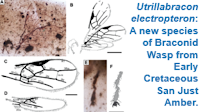
Utrillabracon electropteron (Braconidae, †Protorhyssalinae) from the upper Albian amber-bearing outcrop of San Just, specimen MAP-7819 (SJE2012 49-04). (A), (B) Photograph and drawing of preserved remains, both to the same scale. (C) Forewing venation. (D) Hindwing venation. (E), (F) Photograph and drawing of tarsus and pretarsus, both to the same scale. Abbreviation: pt, pterostigma. Scale bars: 0.5 mm (A), (B); 0.2 mm (C), (D); 0.1 mm (E), (F). Álvarez-Parra (2022).

While this material is very fragmentary, the wings of Insects are considered to be extremely useful taxonomically, with the veination typically unique at species level, but sufficiently similar within groups to allow the taxonomic placement of species. The veination of the wings of specimen MAP-7819 (SJE2012 49-04) is unlike that of any previously described species, but contains features which enable its confident placement within both the Protorhyssalinae and the Braconidae, notably the presence of veins Rs and M and absence of vein 2m-cu in the forewing, and the rs-m vein being proximal to the bifurcation of veins R1 and Rs in the hindwing, all traits diagnostic of Braconids, and the presence of a pentagonal (five-sided) second submarginal cell in the forewing and the presence of vein 2Cu in the hindwing, which are traits considered diagnostic of the Protorhyssalinae.

See also...

Online courses in Palaeontology

Follow Sciency Thoughts on Facebook.

Follow Sciency Thoughts on Twitter.


Sunday, 20 February 2022

Odontochrydium arabicum: A new species of Cuckoo Wasp from the Arabian Peninsula.

Cuckoo Wasps, Chrysididae, are a widespread and diverse group of Wasps, noted for their kleptoparasitic habits; that is to say that, like many Wasps they lay their eggs inside the paralized bodies of other Insects and Arachnids stored in nests, but unlike these Wasps they do not catch their own prey, but rather lay their eggs inside the victims of other parasitic Wasps, the Cuckoo Wasp larvae then eating both the prey and the larvae of the original Wasp. The genus Odontochrydium currently contains three species of Cuckoo Wasps, two from sub-Saharan Africa and one from southern India.

In a paper published in the journal Zootaxa on 18 February 2022, Ahmed Soliman of the Plant Protection Department at King Saud University and the Zoology Department at Al-Azhar University, Paolo Rosa of the Laboratoire de Zoologie at the Université de Mons, and Hathal Dhafer, also of the Plant Protection Department at King Saud University, describe a new species of Odontochrydium from the southern Arabian Peninsula.

The first reported example of a Wasp of the genus Odontochrydium was a female collected from the Asir region of Saudi Arabia in 2015, and identified as a member of the species Odontochrydium bicristatum, which is otherwise known only from East Africa. However, since this report other specimens collected in southern Saudi Arabia, Oman, and Yemen have come to light, including several males (which show greater differentiation between species than is seen in the females), leading Soliman et al. to conclude that the Arabian population is in fact a different species to the East African population.

The new species is named Odontochrydium arabicum, where the specific name 'arabicum' refers to the Arabian Peninsula. The species is described from ten specimens, four males and six females, collected from the Asir and Jazan regions of Saudi Arabia, the Dhofar Governate of Oman, and Yemen.

 
Odontochrydium arabicum, male, holotype. (A) Habitus, lateral view; (B) Habitus, dorsal view; (C) Habitus, ventral view. Scale bar is 1.0 mm. Soliman et al. (2022).

Males and females of Odontochrydium arabicum are bright green with copper shimmering when alive, but turn a dark metallic blue after death. Both sexes have covering of fine white hairs, and tiny pits. The eyes are also white. Adult Wasps reach about 5.2 mm in length.

 
Odontochrydium arabicum, female, paratype. (A) Habitus, lateral view; (B) Head, frontal view; (C) Mesosoma and T1, detail; (D) T2–T3. Scales is 1.0 mm. Soliman et al. (2022).

See also...


Follow Sciency Thoughts on Facebook.

Follow Sciency Thoughts on Twitter.


Thursday, 26 August 2021

Sakhalinencyrtus leleji: A new species of Encyrtid Wasp from Middle Eocene Sakhalinian Amber.

The Encyrtidae are a large family of parasitoid Chalcid Wasps, primarily targeting members of the Hemiptera (True Bugs), although some target of Ticks and others are hyperparasites, with their larvae growing inside the parasitic larvae of other Wasps. The first known fossil species assigned to the family, Encyrtus clavicornis, was described from an Oligocene shale from Rott in Germany in 1938. Since this time a further eighteen species have been discovered, Archencyrtus rasnitsyni, Sugonjaevia sakhalinica, Kotenkia platycera, and Encyrtoides pronotatus, from Middle Eocene Sakhalinian Amber, Eocencyrtus zerovae, Eocencnemus sugonjaeviEocencnemus vichrenkoi, Eocencnemus gedanicus, Glaesus gibsoni, Rovnosoma gracile, Sulia glaesaria, Protocopidosoma kononovae, Dencyrtus vilhelmseni, Archaeocercus schuvachinae, Trjapitzion cylindrocerus, Ektopicercus punctatus, and Efesus trufanovi, from Late Eocene Baltic Amber, and Copidosoma archeodominica, from Miocene Dominican Amber.

In a paper published in the Journal of Hymenoptera Research on 24 August 2021, Serguei Simutnik and Evgeny Perkovsky of the I.I. Schmalhausen Institute of Zoology of the National Academy of Sciences of Ukraine, and Dmitry Vasilenko of the Borissiak Paleontological Institute of the Russian Academy of Sciences, and the Cherepovets State University, describe a new species of Encyrtid Wasp from Middle Eocene Sakhalinian Amber.

Sakhalinian Amber is mainly collected on a beach near the village of Starodubskoye, close to the mouth of the Naiba River in Dolinsk District on Sakhalinian Island in the Sea of Okhotsk in the Russian Far East. For a long time the age of this amber was uncertain, but in 1999 it was found in situ in strata of the Naibuchi Formation, making it Middle Eocene in origin, and older than the Baltic and Rovno ambers.

The new species is named Sakhalinencyrtus leleji, where 'Sakhalinencyrtus' implies an Encyrtid Wasp from Sakhalinian Amber, and 'leleji' honours Arkady Stepanovich Lelej for his expertise on the Hymenoptera. The species is described from a single male specimen preserved within a piece of Sakhalinian Amber, which also contains an undescribed female Ant.

 
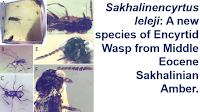
(A) Piece of Sakhalinian Amber containing inclusions (B), (C) syninclusion of Mymaridae, female (B) dorso-lateral (C) ventral (D)–(F) Sakhalinencyrtus leleji holotype male: (D) antennae, head, mesosoma, ventral (E) antennae, head, frontal (F) antennae, head, and anterior part of metasoma, dorso-lateral. Simutnik et al. (2021).

The specimen is 0.9 mm in length, and brownish black in colour. The lower jaw is longer than the upper, the head is wider than the thorax. The eyes are small and almost circular, although details of the face are unclear as this has been deformed during preservation. The sockets in which the antennae are fitted are half way between the lower margin of the eyes and the margin of the mouth. The first segment of the antannae is extended and flattened, being four times as long as it is wide. The mesosoma (middle section of the body) is shorter than the metasoma (final section), and is not flattened. The forewing is glassy in appearance, with a row of hairs on its basal margin. 

 
Sakhalinencyrtus leleji, holotype male (A) head and mesosoma, dorsal (B) venation of fore and hind wings, dorsal (C) venation of fore and hind wings, metasoma and part of genitalia, ventral, cs, covering setae. Simutnik et al. (2021).

See also...


Online courses in Palaeontology.  

Follow Sciency Thoughts on Facebook.

Follow Sciency Thoughts on Twitter


Saturday, 11 April 2020

Vipio spp.: Five new species of Braconid Wasps from Central and South America.

Braconid Wasps are small parasitoid wasps (Wasps whose larvae grow inside the bodies of a living animal host) targeting a variety of Insect and Spider species. They are unusual in that they will lay multiple eggs within the same host (most parasitoid Wasps lay a single egg on each host), thereby allowing multiple larvae to mature within a large host, which is not necessarily killed in the process. Braconid Wasps are often fearsome in appearance, but are other than to targeted host species as they lack stings. The braconid genus Vipio is most diverse in the Holarctic Region but has a significant representation in the Neotropical Region. However, little is known of these tropical species, only a very few of which are described, nor are there any host records for the species from this part of the world.

In a paper published in the journal ZooKeys on 8 April 2020, Donald Quicke of the Integrative Ecology Laboratory at Chulalongkorn University, Scott Shaw of the Department of Ecosystem Science and Management at the University of Wyoming, Mian Inayatullah of the Department of Entomology at the NWFP Agricultural University, and Buntika Butcher, also of the Integrative Ecology Laboratory at Chulalongkorn University, describe five new species of Vipio from Central and South America as part of a review of the genus in the Neotropical Region.

The first new species described is named Vipio boliviensis, meaning 'from Bolivia'. The species is described on the basis of three female specimens, one collected near the town of Comarapa in Santa Cruz Department, Bolivia, and two from Entre Ríos Province in north-eastern Argentina. This species reaches a length (excluding the ovipositor) of 5.4 mm with an ovipositor length of 6.4 mm, and a forewing length of 5.6 mm. It is yellowish red in colour, except for the head, antennae, palpi (segmented appendages near the mouth of an arthropod), prosternum (ventral plate of the prothorax of an insect) legs, and ovipositor, which are black, and the abdomen, which is yellow and black.

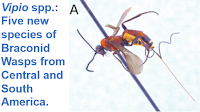
 Vipio boliviensis, female in lateral view. Quicke et al. (2020).

The second new species is named Vipio carinatus, for the presence of distinctive carinae (ridges) on the propodeum (first abdominal segment) of this species. The species is described from two female specimens from Santa Cruz Department, Bolivia, and a male from Chaco Province in Argentina. The females of this species reach 4.6-5.0 mm in length, excluding the ovipositor, with an ovipositor 2.5 mm in length and a forewing length of 4.6-5.0 mm. The male is 6.2-6.5 mm in length (the specimen was collected in 1948 and is dehydrated, preventing an accurate estimate). This species is predominantly yellowish-orange in colour, except for the head and antennae, which are black, and the sides of the face and mandibles, which are blackish red. The legs are blackish red and yellow, the wings brown with dark brown venation.

Vipio carinatus, female in lateral view. Quicke et al. (2020).

The third new species described is named Vipio godoyi, in honour of Carolina Godoy, of the Instituto Nacional de Biodiversidad, who assisted with collection of the holotype specimen. The species is described from two female and ten male specimens collected from Costa Rica, Honduras, Nicaragua, and Panama. Females of this species reach 7.1 mm in length with an ovipositor length of 3.8 mm and a forewing length of 7.1 mm. Males reach 7.5-7.9 mm in length. This species is reddish yellow in colour, apart from the except head, including mouthparts and antenna, legs, ovipositor sheath, and wings, which are black.

Vipio godoyi, female in lateral view. Quicke et al. (2020).

The fourth new species described is named Vipio hansoni, in honour of Paul Hanson, of the Universidad de Costa Rica, who collected the holotype specimen. The species is described from three female and two male specimens, all collected in Costa Rica. The females of this species reach 5.5 mm in length, with an ovipositor length of 2.9 mm and a forewing length of 5.5 mm. The males reach 3.3-3.5 mm in length. This species is reddish yellow except head, legs, propleuron, and ovipositor sheath, which are black, and the wings, which are brown.

Vipio hansoni, female in lateral view. Quicke et al. (2020).

The final new species is named Vipio lavignei, in honour of Robert Lavigne, for his diverse contributions to entomological research and his role in promoting the insect systematics program at the University of Wyoming. The species is described from four specimens, two females from Leoncio Prado Province in Peru and two males from Tucumán Province in Argentina. Females of this species reach 9.0-9.2 mm in length, with an ovipositor length of 3.3 mm, and a forewing length of 8.2-8.8 mm. Males reach 7.9 mm in length. This species is predominantly black, apart from some yellow markings around the eyes and the thorax, which is red with a black tinge.

Vipio lavignei, female in lateral view. Quicke et al. (2020).

See also...

https://sciencythoughts.blogspot.com/2020/02/brachyelatus-marthae-new-species-of.htmlhttps://sciencythoughts.blogspot.com/2020/01/cambodian-schoolgirl-killed-by-wasps.html
https://sciencythoughts.blogspot.com/2018/09/cassytha-filiformis-parasitic-plant.htmlhttps://sciencythoughts.blogspot.com/2018/04/cotesia-nuellorum-new-species-of.html
https://sciencythoughts.blogspot.com/2018/02/seneciobracon-novalatus-new-species-of.htmlhttps://sciencythoughts.blogspot.com/2017/03/three-new-species-of-fairy-wasp-from.html
Follow Sciency Thoughts on Facebook.

Monday, 24 February 2020

Brachyelatus marthae: A new species of Chrysolampine Wasp from Eocene Baltic Amber.

The highly diverse and economically important parasitoid Wasp superfamily Chalcidoidea is well known with approximately 20 000 extant species on six continents, but relatively few fossil species are known. However, a broad range of Chalcidoid fossils from the Eocene have been described. Two of these fossils, Perilampus pisticus and Palaeocharis rex represent the biologically derived Planidial group. This unique group of parasitoids is characterized by mobile and well sclerotized (thick skinned), but legless, first instar ‘planidial’ larva, which emerges from an egg laid some distance from the host instead of on or in the host. Later instars are of the sac-like type that is typical for Chalcidoidea.

In a paper published in the journal Insect Systematics and Diversity on 13 December 2019, Roger Burks of the Department of Entomology at the University of California, Riverside, Lars Krogmann of the Staatliches Museum für Naturkunde and the Institute of Zoology at the University of Hohenheim, and John Heraty, also of the Department of Entomology at the University of California, Riverside,describe a new species of Planidial Chrysolampine Wasp from Eocene Baltic Amber.

Baltic amber is the preserved resin of Eocene Coniferous Trees that formed huge forests covering much of Scandinavia and Northern Europe between about 56 and 34 million years ago. Since this amber floats, it is often found on beaches around the Baltic Sea, and sometimes further afield, making the precise dating of individual pieces difficult, though most Baltic Amber is thought to be about 46 million years old.

The new species is placed in the extant genus Brachyelatus, and given the specific name marthae, in honour of Roger Burks' mother, Martha. The species is described on the basis of five specimens, four females ranging from 1.3 to 1.9 mm in length and a male measuring 1.3 mm, and is assigned to the genus Brachyelatus on the basis of the pattern of veins in the wings (commonly used as a way to differentiate Insect species).

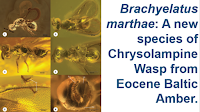
 Brachyelatus marthae. (1)–(5) Females, (1) Habitus (SMNS BB-2843). (2) Body in dorsal view (SMNS BB-2842). (3) Body in lateral view (SMNS BB-2844). (4) Body in ventral view (SMNS BB-2842). (5) Forewing venation (SMNS BB-2842); cs, uncal sensilla. (6) Male, head, anterior view (SMNS BB-2846); atp, anterior tentorial pit; Fu1, first funicular (second flagellomere); vp, ventral pores of scape. Burks et al. (2019).

The reproductive biology of modern Planidial Wasps is best known from studies of the genus Chrysolampus, which lays stalked eggs into seed pods within flower heads, which produce weakly sclerotized larvae search for their weevil host within the seed pods. Members of the genus Austrotoxeuma are potentially associated with Beetles in dead twigs, but otherwise, there is no other biological information for the subfamily. The genus Brachyelatus is known from three described and one undescribed species known from Europe, Transcaucasia, Australia, and Turkey, so the discovery of a species in Eocene Baltic Amber does not expand it's geographical range, but does increase the known temporal range of the genus and subfamily by an estimated 36 million years.

See also...

https://sciencythoughts.blogspot.com/2019/10/danatettix-hoffeinsorum-new-species-of.htmlhttps://sciencythoughts.blogspot.com/2019/10/danatettix-hoffeinsorum-new-species-of.html
https://sciencythoughts.blogspot.com/2018/09/cassytha-filiformis-parasitic-plant.htmlhttps://sciencythoughts.blogspot.com/2018/07/markus-karenae-new-species-of-silinine.html
https://sciencythoughts.blogspot.com/2018/04/cotesia-nuellorum-new-species-of.htmlhttps://sciencythoughts.blogspot.com/2018/04/acartophthalmites-willii-new-species-of.html
Follow Sciency Thoughts on Facebook.

Tuesday, 7 January 2020

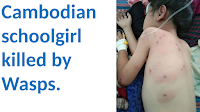
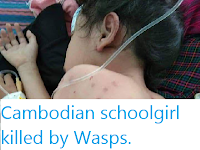
Cambodian schoolgirl killed by Wasps.

A six-year-old girl has died after being attacked by Wasps in Svay Rieng Province on Saturday 4 January 2020. Ream Lina of Sambour in Svay Teab District was attacked at about 11.00 am local time, after apparently disturbing the Insects by leaning her bicycle against a bush. She received about 30 stings, and was rushed to District Referral Hospital for treatment, before being sent on to a provincial hospital where she died. Her parents have raised concerns that doctors at the first hospital did not take their daughter's condition sufficiently seriously, and believe she may have survived if she had been moved to a larger hospital more promptly.

Ream Lina, 6. of Svey Rieng Province in Cambodia, died after being attacked by Wasps. Fresh News.

Deaths due to Wasp stings are not uncommon in Cambodia, due to the presence of the Asian Giant Hornet, Vespa mandarinia, a particularly large Wasp which injects a significant amount of venom with each stung and tends to attack in swarms. Such attacks can often lead to the victim going into anaphylaxic shock, a state in which the amount of toxin in the blood overwhelms the body's ability to cope causing a severe allergic reaction, which causes, among other symptoms, muscle spasms, not just in the muscles which control voluntary movements, but also those that control the heart and respiratory system, with potentially fatal consequences. However it is unclear if Giant Hornets were responsible for this attack, as smaller Wasps are also capable of causing anaphylaxic shock, particularly in small children.

An Asian Giant Hornet, Vespa mandariniaFilippo Turetta/Wikimedia Commons.

See also...

https://sciencythoughts.blogspot.com/2018/09/cassytha-filiformis-parasitic-plant.htmlhttps://sciencythoughts.blogspot.com/2018/04/cotesia-nuellorum-new-species-of.html
https://sciencythoughts.blogspot.com/2018/02/seneciobracon-novalatus-new-species-of.htmlhttps://sciencythoughts.blogspot.com/2017/03/three-new-species-of-fairy-wasp-from.html
https://sciencythoughts.blogspot.com/2017/02/poropoea-africana-new-species-of.htmlhttps://sciencythoughts.blogspot.com/2017/02/poemenia-quercusia-new-species-of.html
Follow Sciency Thoughts on Facebook.