Showing posts with label Hymenoptera. Show all posts

Wednesday, 15 October 2025

Apis (Apis) aibai: A new species of Honeybee from the Early Pleistocene of Japan.

Honeybees, Apis spp., are important pollinators in modern ecosystems and agricultural settings, with one species, Apis mellifera being the world's most abundant domesticated Insect. There are nine described species of extant Honeybees, split into three genera, Cavity-nesting Honeybees Apis (Apis), Small Honeybees Apis (Micrapis), and Giant Honeybees Apis (Magaapis), although the Domestic Honeybee does not appear to fit into any of these, and may be a hybrid. Apis mellifera is found over a wide area of Asia, Africa, and Europe, but other extant species of Honeybee are restricted to tropical and subtropical areas of South and Southeast Asia, with the exception of Apis cerana, which has a range extending into temperate parts of East Asia. 

A number of Fossil Honeybee species have been described from the Oligocene and Miocene of Europe, East Asia, and North America, most of which are assigned to extinct subgenera. These include Apis (Cascapis) nearctica, Miocene, from Nevada, Apis (Priorapisvetusta, Oligocene, Apis (Synapishenshawi, Oligo-Miocene, and Apis (Cascapis) armbrusteri, Miocene, from Germany, Apis (Synapispetrefacta, Oligocene, from Czechia, Apis (Synapismiocenica, and Apis (Synapis) dalica, both Miocene, from China, Apis (Synapislongtibia, and Apis (Megapis) lithohermaea, both Miocene, from Japan. Thus, of the three extant subgenera, only Apis (Megapis) has a fossil record, although phylogenetic reconstructions suggest that all three originated towards the end of the Eocene. A number of subfossil Honeybees are also known from Latest Pleistocene and Holocene deposits, all of which have been ascribed to living species.

In a paper published in the journal Zookeys on 13 October 2025, Yui Takahashi of the Keio Yochisha Elementary School, and Jun-ichi Takahashi of the Faculty of Life Sciences at Kyoto Sangyo University, describe a new species of Honeybee from the Early Pleistocene Teragi Group, of Hyogo Prefecture, Japan.

The Teragi Group comprises a series Late Pliocene and Early Pleistocene lake deposits outcropping across eastern Tottori and northwestern Hyogo prefectures in southwestern Japan. The sedimentary deposits are interspersed with volcanic deposits, mostly from pyroclasic flows, the whole being contained within a volcanic collapse basin called the Teragi Cauldron. Fossils within this sequence come from the Haruki Mud, a series of sandstones and siltstones, with volcanic tuff layers, laid down between 2.8 and 2.2 million years ago. These deposits produce abundant Plant and Insect fossils, and although well known to fossil collectors, have not been extensively studied by scientists. An analysis of leaf fossils from the Haruki Mud suggests that the ancient lake was surrounded by temperate woodland.

Locality of the studied specimen. (A) Map of the Japanese Islands; (B) Distribution of the Teragi Cauldron between Tottori and Hyogo prefectures. (C) Simplified geological map of the Teragi Cauldron, representing the fossil locality; (D) Photo of the riverside fossil locality (35°29'39.41"N, 134°26'24.53"E), with whitish tuffaceous siltstones. Takahashi & Takahashi  (2025).

As with many Insect groups, it is possible to classify Bees entirely upon the venation of their wings, which has been shown to be a good proxy for taxonomic relationships. Based upon this, Takahashi and Takahashi feel confident in assigning the new species to subgenus level, identifying it as Apis (Apis) aibai, where 'aibai' honours the Japanese palaeontologist Hiroaki Aiba, who has studied the Umigami site from which the new fossil comes, and described a species of Nymphalid Butterfly from that site, for his contributions to Earth science education through the use of fossil collection activities.

Photographs of Apis (Apis) aibai (SOU-002). (A) Fossil-bearing piece (38.3 mm × 67.1 mm × 9.8 mm);  (B) Studied fossil reflecting dorsal view of SOU-002. Takahashi & Takahashi  (2025).

Apis (Apisaibai is described from a single specimen, SOU-002, held in the collection of the Museum of  Unique Insect Fossils, in the town of Shin’onsen in Hyogo Prefecture. It is a middle-sized worker Honeybee preserved as a compression fossil with no counterpart. This specimen is 9.81 mm in length, but part of the head is missing, so it was probably about 10 mm long in life. 

Takahashi and Takahashi did not carry out a full phylogenetic analysis for Apis (Apisaibai, but based upon its wing venation, they suggest that its closest known relative is probably Apis (Apis) nigrocincta, an extant species found in the Philippines and Indonesia. This suggests that the two species form a single clade (group of species with shared ancestry) which once had a wider distribution, including temperate Japan as well as the tropical regions of the Philippines and Indonesia. It has also previously been suggested that Apis (Apisnigrocincta is the closest living relative of Apis cerana, the only native Honeybee species found in Japan today, suggesting that the three may form a single group.

See also...


Friday, 1 November 2024

Pheidole praehistorica: A new species of Spiny Ant from Oligo–Miocene Chiapas Amber.

The genus Pheidole is currently considered to be the most diverse genus of Ants, with 1160 living and six fossil species. Although global in distribution, the genus is at its most diverse in the Neotropics, and is presumed to have originated in this region. This is supported by the locations from which the known fossils in the genus have been recovered, with the oldest known species coming from the Eocene of Colorado, and other fossils known from the Miocene of the Dominican Republic (three species), and the Oligo-Miocene of Chiapas State, Mexico (2 species).

In a paper published in the European Journal of Taxonomy on 25 October 2024, Fernando Varela-Hernández & Franciso Riquelme of the Laboratorio de Sistemática Molecular at the Universidad Autónoma del Estado de Morelos, describe a third species of Pheidole from Chiapas Amber.

Chiapas Amber comes from the Simojovel, Totolapa, and Estrella de Belén localities in the Chiapas Highlands of southern Mexico, with the Simojovel site being the main centre of commercial amber extraction. The amber comes from a series of limestone, sandstone, siltstone, shale, and lignite beds of Late Oligocene to Early Miocene age, referred to as either the Simojovel Formation or the La Quinta Formation. The amber here is thought to have derived from a type of Leguminous tree of the genus Hymenaea; resin-producing trees belonging to this genus are also thought to have been responsible for Dominican Amber, which is of approximately the same age as Chiapas Amber, and are still found today across the Neotropics. 

The new species is named Pheidole praehistorica, where 'praehistorica' means 'prehistoric' in reference to the nature of the material from which it is described, five fossil Ants trapped within a single species of amber.

Pheidole praehistorica. (A)–(C) Holotype (CPAL.464). (A) Profile view. (B) Frontal view. (C) Closer lateral view of the head and mesosoma. (D) Paratype (CPAL.465), latero-frontal view of the head. (E) Paratype (CPAL.468), profile view. Abbreviations: acl, antennal club; an, antenna; cly, clypeus; ey, eyes; fl, foreleg; ga, gaster; ha, hairs on clypeus; hd, head; hl, hind  leg; mn,  mandible; nck, neck; p, petiole; pn, pronotum; pns, pronotal spine; pp, postpetiole; pps, propodeal spine; sc, scape. Varela-Hernández & Riquelme (2024).

Pheidole praehistorica is smaller than other species from Chiapas Amber, an average length of 2.3 mm, and has shorter pronotal spines (spines on the forward part of the thorax, immediately behind the head) and straight propodeal spines (spines on the rear part of the thorax, immediately before the abdomen. 

See also...

Saturday, 3 September 2022

Ctenostegus hansoni: A new species of Spider Wasp from Lord Howe Island.

Spider Wasps, Pompilidae, are a large and diverse group of (usually) solitary Wasps with a global distribution. They get their popular name from their habit of capturing live Spiders to bury with their young as a food source. Spider Wasps are generally strong flyers with large wings, fused thorax segments, and spiny legs. Each species of Spider Wasp tends to prey on a different species of Spider, or sometimes a few closely related species, with the targeted Spiders often being large species such as Tarantulas, Huntsmen, or Baboon Spiders.

Lord Howe Island is a volcanic island in the Tasman Sea, 600 km of the coast of New South Wales. It has a high proportion of endemic species, although in the 250 years since it was discovered it has been colonised by a wide range of Plants, Vertebrates, and Invertebrates brought in by Humans, either deliberately or by accident.

Despite's the island's high rate of endemism, and the threat presented by introduced species such as Rats, relatively few studies of Lord Howe Island's invertebrate fauna have been made, which presents serious problems for conservation efforts there.

Lord Howe Island is currently known to be home to 318 species of Wasps, 36% of which are endemic to the island. This includes two species of Spider Wasps: the endemic Sphictostethus insularis, and Ctenostegus murrumbidgee, a species widely distributed in Australia, although this species has been identified there on the basis of a single male specimen only. There are also four specimens of unidentified Spider Wasps from Lord Howe Island in the collection of the Australian Museum.

In a paper published in the journal Austral Entomology on 26 August 2022, Juanita Rodriguez and Olivia Evangelista of the Australian National Insect Collection, describe a new species of Spider Wasp from Lord Howe Island.

The new species is described on the basis of a two citizen science expeditions to Lord Howe Island organised by the Australian Geographic Society in October 2017 and October 2018. The new species is placed in the genus Ctenostegus, and given the specific name hansoni, in honour of Luke Hanson of the Australian Geographical Society, for his role in helping to put together the expeditions to Lord Howe Island. The male specimen previously assigned to Ctenostegus murrumbidgee is also considered to be a member of the new species, with the implication that that species should not be considered to be present on the island.

Distribution map of the species included in the Ctenostegus immitis species-group in Australia (left), and Ctenostegus hansoni in Lord Howe Island (right). Rodriguez & Evangelista (2022).

Females of Ctenostegus hansoni are 6.9-8.04 mm in length, while males are smaller at 4.53-6.28 mm, but otherwise vary little in general morphology. Both sexes are essentially black in colour, with some dark brown, white, and silver markings. Like all species of Ctenostegus, much of the body of Ctenostegus hansoni is covered by silvery hairs. However, in Ctenostegus hansoni these are much less dense than in other species, giving this Wasp a darker appearance.

Ctenostegus hansoni, holotype female (ANIC 32-111497) in (a) frontal, (b) lateral, and (c) dorsal view, (d) close-up of head in frontal view. Rodriguez & Evangelista (2022).

See also...

Follow Sciency Thoughts on Facebook.

Follow Sciency Thoughts on Twitter.


Thursday, 2 June 2022

Utrillabracon electropteron: A new species of Braconid Wasp from Early Cretaceous San Just Amber.

Braconid Wasps are the second largest group of extant Hymenopterans (the group that includes all Wasps, Ants, Bees, and Sawflies), and are the sister group to the Ichneumonidae, the largest Hymenopteran group, with the two forming the Superfamily Ichneumonoidea. Both groups are parasitoids (i.e. their larvae are parasites which grow inside the bodies of other Animals, generally killing the host as they grow, but their adult stages are free-living), targeting a wide range of terrestrial Arthropod species. The Ichneumonoids have been around since at least the Early Cretaceous, although Cretaceous fossils of these Insects are not particularly common. One noteworthy group of early Braconids is the Protorhyssalinae, which is known only from Albian (113-100.5 million years ago) to the Campanian (83.6-71.2 million years ago) deposits, chiefly as inclusions within amber.

In a paper published in the journal ZooKeys on 30 May 2022, Sergio Álvarez-Parra of the Departament de Dinàmica de la Terra i de l’Oceà and Institut de Recerca de la Biodiversitat at the Universitat de BarcelonaEnrique Peñalver of the  Instituto Geológico y Minero de EspañaXavier Delclòs, also of the Departament de Dinàmica de la Terra i de l’Oceà and Institut de Recerca de la Biodiversitat at the Universitat de Barcelona, and Michael Engel of the Division of Entomology at the Natural History Museum of the University of Kansas, the Department of Ecology and Evolutionary Biology at the University of Kansas, and the Division of Invertebrate Zoology at the American Museum of Natural History, describe a new species of Protorhyssaline Braconid Wasp from Early Cretaceous San Just Amber from the Maestrazgo Basin of eastern Spain.

The Maestrazgo Basin contains about 30 amber-producing outcrops, although amber with fossil inclusions is known from only four of these. The San Just outcrop produces amber clasts from a layer of organic-rich grey-black marls, which have been assigned to the Escucha Formation. This deposit is thought to have accumulated in a freshwater swamp plain, and has been dated to the upper Albian, based upon pollen inclusions in the amber. Twenty five species of Arthropod have previously been described from San Just Amber.

The new species is named Utrillabracon electropteron, where 'Utrillabracon' is a combination of Utrillas, the municipality in which the San Just outcrop is found, and '-bracon' for Braconid, while 'electropteron' means 'amber-wing'. The species is described from a single poorly preserved specimen, MAP-7819 (SJE2012 49-04), comprising the wings, head, and a single forelimb of the Wasp.

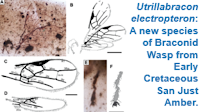
Utrillabracon electropteron (Braconidae, †Protorhyssalinae) from the upper Albian amber-bearing outcrop of San Just, specimen MAP-7819 (SJE2012 49-04). (A), (B) Photograph and drawing of preserved remains, both to the same scale. (C) Forewing venation. (D) Hindwing venation. (E), (F) Photograph and drawing of tarsus and pretarsus, both to the same scale. Abbreviation: pt, pterostigma. Scale bars: 0.5 mm (A), (B); 0.2 mm (C), (D); 0.1 mm (E), (F). Álvarez-Parra (2022).

While this material is very fragmentary, the wings of Insects are considered to be extremely useful taxonomically, with the veination typically unique at species level, but sufficiently similar within groups to allow the taxonomic placement of species. The veination of the wings of specimen MAP-7819 (SJE2012 49-04) is unlike that of any previously described species, but contains features which enable its confident placement within both the Protorhyssalinae and the Braconidae, notably the presence of veins Rs and M and absence of vein 2m-cu in the forewing, and the rs-m vein being proximal to the bifurcation of veins R1 and Rs in the hindwing, all traits diagnostic of Braconids, and the presence of a pentagonal (five-sided) second submarginal cell in the forewing and the presence of vein 2Cu in the hindwing, which are traits considered diagnostic of the Protorhyssalinae.

See also...

Online courses in Palaeontology

Follow Sciency Thoughts on Facebook.

Follow Sciency Thoughts on Twitter.


Sunday, 20 February 2022

Odontochrydium arabicum: A new species of Cuckoo Wasp from the Arabian Peninsula.

Cuckoo Wasps, Chrysididae, are a widespread and diverse group of Wasps, noted for their kleptoparasitic habits; that is to say that, like many Wasps they lay their eggs inside the paralized bodies of other Insects and Arachnids stored in nests, but unlike these Wasps they do not catch their own prey, but rather lay their eggs inside the victims of other parasitic Wasps, the Cuckoo Wasp larvae then eating both the prey and the larvae of the original Wasp. The genus Odontochrydium currently contains three species of Cuckoo Wasps, two from sub-Saharan Africa and one from southern India.

In a paper published in the journal Zootaxa on 18 February 2022, Ahmed Soliman of the Plant Protection Department at King Saud University and the Zoology Department at Al-Azhar University, Paolo Rosa of the Laboratoire de Zoologie at the Université de Mons, and Hathal Dhafer, also of the Plant Protection Department at King Saud University, describe a new species of Odontochrydium from the southern Arabian Peninsula.

The first reported example of a Wasp of the genus Odontochrydium was a female collected from the Asir region of Saudi Arabia in 2015, and identified as a member of the species Odontochrydium bicristatum, which is otherwise known only from East Africa. However, since this report other specimens collected in southern Saudi Arabia, Oman, and Yemen have come to light, including several males (which show greater differentiation between species than is seen in the females), leading Soliman et al. to conclude that the Arabian population is in fact a different species to the East African population.

The new species is named Odontochrydium arabicum, where the specific name 'arabicum' refers to the Arabian Peninsula. The species is described from ten specimens, four males and six females, collected from the Asir and Jazan regions of Saudi Arabia, the Dhofar Governate of Oman, and Yemen.

 
Odontochrydium arabicum, male, holotype. (A) Habitus, lateral view; (B) Habitus, dorsal view; (C) Habitus, ventral view. Scale bar is 1.0 mm. Soliman et al. (2022).

Males and females of Odontochrydium arabicum are bright green with copper shimmering when alive, but turn a dark metallic blue after death. Both sexes have covering of fine white hairs, and tiny pits. The eyes are also white. Adult Wasps reach about 5.2 mm in length.

 
Odontochrydium arabicum, female, paratype. (A) Habitus, lateral view; (B) Head, frontal view; (C) Mesosoma and T1, detail; (D) T2–T3. Scales is 1.0 mm. Soliman et al. (2022).

See also...


Follow Sciency Thoughts on Facebook.

Follow Sciency Thoughts on Twitter.


Saturday, 11 April 2020

Vipio spp.: Five new species of Braconid Wasps from Central and South America.

Braconid Wasps are small parasitoid wasps (Wasps whose larvae grow inside the bodies of a living animal host) targeting a variety of Insect and Spider species. They are unusual in that they will lay multiple eggs within the same host (most parasitoid Wasps lay a single egg on each host), thereby allowing multiple larvae to mature within a large host, which is not necessarily killed in the process. Braconid Wasps are often fearsome in appearance, but are other than to targeted host species as they lack stings. The braconid genus Vipio is most diverse in the Holarctic Region but has a significant representation in the Neotropical Region. However, little is known of these tropical species, only a very few of which are described, nor are there any host records for the species from this part of the world.

In a paper published in the journal ZooKeys on 8 April 2020, Donald Quicke of the Integrative Ecology Laboratory at Chulalongkorn University, Scott Shaw of the Department of Ecosystem Science and Management at the University of Wyoming, Mian Inayatullah of the Department of Entomology at the NWFP Agricultural University, and Buntika Butcher, also of the Integrative Ecology Laboratory at Chulalongkorn University, describe five new species of Vipio from Central and South America as part of a review of the genus in the Neotropical Region.

The first new species described is named Vipio boliviensis, meaning 'from Bolivia'. The species is described on the basis of three female specimens, one collected near the town of Comarapa in Santa Cruz Department, Bolivia, and two from Entre Ríos Province in north-eastern Argentina. This species reaches a length (excluding the ovipositor) of 5.4 mm with an ovipositor length of 6.4 mm, and a forewing length of 5.6 mm. It is yellowish red in colour, except for the head, antennae, palpi (segmented appendages near the mouth of an arthropod), prosternum (ventral plate of the prothorax of an insect) legs, and ovipositor, which are black, and the abdomen, which is yellow and black.

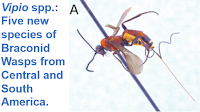
 Vipio boliviensis, female in lateral view. Quicke et al. (2020).

The second new species is named Vipio carinatus, for the presence of distinctive carinae (ridges) on the propodeum (first abdominal segment) of this species. The species is described from two female specimens from Santa Cruz Department, Bolivia, and a male from Chaco Province in Argentina. The females of this species reach 4.6-5.0 mm in length, excluding the ovipositor, with an ovipositor 2.5 mm in length and a forewing length of 4.6-5.0 mm. The male is 6.2-6.5 mm in length (the specimen was collected in 1948 and is dehydrated, preventing an accurate estimate). This species is predominantly yellowish-orange in colour, except for the head and antennae, which are black, and the sides of the face and mandibles, which are blackish red. The legs are blackish red and yellow, the wings brown with dark brown venation.

Vipio carinatus, female in lateral view. Quicke et al. (2020).

The third new species described is named Vipio godoyi, in honour of Carolina Godoy, of the Instituto Nacional de Biodiversidad, who assisted with collection of the holotype specimen. The species is described from two female and ten male specimens collected from Costa Rica, Honduras, Nicaragua, and Panama. Females of this species reach 7.1 mm in length with an ovipositor length of 3.8 mm and a forewing length of 7.1 mm. Males reach 7.5-7.9 mm in length. This species is reddish yellow in colour, apart from the except head, including mouthparts and antenna, legs, ovipositor sheath, and wings, which are black.

Vipio godoyi, female in lateral view. Quicke et al. (2020).

The fourth new species described is named Vipio hansoni, in honour of Paul Hanson, of the Universidad de Costa Rica, who collected the holotype specimen. The species is described from three female and two male specimens, all collected in Costa Rica. The females of this species reach 5.5 mm in length, with an ovipositor length of 2.9 mm and a forewing length of 5.5 mm. The males reach 3.3-3.5 mm in length. This species is reddish yellow except head, legs, propleuron, and ovipositor sheath, which are black, and the wings, which are brown.

Vipio hansoni, female in lateral view. Quicke et al. (2020).

The final new species is named Vipio lavignei, in honour of Robert Lavigne, for his diverse contributions to entomological research and his role in promoting the insect systematics program at the University of Wyoming. The species is described from four specimens, two females from Leoncio Prado Province in Peru and two males from Tucumán Province in Argentina. Females of this species reach 9.0-9.2 mm in length, with an ovipositor length of 3.3 mm, and a forewing length of 8.2-8.8 mm. Males reach 7.9 mm in length. This species is predominantly black, apart from some yellow markings around the eyes and the thorax, which is red with a black tinge.

Vipio lavignei, female in lateral view. Quicke et al. (2020).

See also...

https://sciencythoughts.blogspot.com/2020/02/brachyelatus-marthae-new-species-of.htmlhttps://sciencythoughts.blogspot.com/2020/01/cambodian-schoolgirl-killed-by-wasps.html
https://sciencythoughts.blogspot.com/2018/09/cassytha-filiformis-parasitic-plant.htmlhttps://sciencythoughts.blogspot.com/2018/04/cotesia-nuellorum-new-species-of.html
https://sciencythoughts.blogspot.com/2018/02/seneciobracon-novalatus-new-species-of.htmlhttps://sciencythoughts.blogspot.com/2017/03/three-new-species-of-fairy-wasp-from.html
Follow Sciency Thoughts on Facebook.