
J1407 (or
to give it its full name, 1SWASP J140747.93-394542.6), is a 16
million-year-old K-type orange dwarf star 420 light years from
Earth in the Scorpius-Centaurus OB association, in the constellation of Centaurus. In 2007 this star
underwent a series of complex eclipses over a period of 56 days,
which astronomers eventually concluded were most likely to have been
caused by a large planetary companion with an extended ring system
and an eccentric orbit, named J1407b, passing in front of the star.
Ring systems around planets are thought to be product of the way in
which the planets form. As a young planet grows in mass material is
pulled from the circumstellar disk (disk of material surrounding the
young star from which the planets form) into a circumplanetary disk
(disk around the planet). Most of this material eventually accretes
onto the planet of is lost back into space, but some can go on to
form a system of moons or rings around the planet, the most notable
example of this in our own Solar System being the ring system seen
around the planet Saturn).
In a
paper published on the arXiv database at Cornell University Library on 27 September 2016 and accepted for publication in the journal Astronomy & Astrophysics, Steven Rieder of the RIKEN Advanced Institute for Computational Science and Sterrewacht Leiden at Leiden University, and Matthew Kenworthy, also of Sterrewacht Leiden at
Leiden University, describe a series of models of the J1407 system
and the conclusions about the system drawn from these.
Rieder
and Kenworthy assumed that the ring system orbited the planet in the
same plane as the planet orbited the star, and that the planet had an
average distance from the star of 5AU (i.e. five times the distance
at which Earth orbits the Sun), giving it an orbital period of 11
years. The Star was given a mass equivalent to 0.9 times that of the
Sun, while the planet was modelled at a series of increments at 20,
40, 60, 80 and 100 times that of Jupiter. Since the planet has never
been directly detected it is assumed that the long access of the
orbit is directed towards the Earth (eccentric orbits are essentially
egg-shaped), which it the most likely explanation of a large
companion body escaping detection in the system, with the eclipses
occurring at or very close to the planetary perihelion (i.e. the
closest point on the orbit to the star, where the planet is moving
fastest). The obit of the planet was modelled at eccentricities of
between 0.6 and 0.7, meaning that at perihelion it would be between
1.5 and 2.0 AU from the star and moving at a rate of between 27 and
33 kilometers per second.
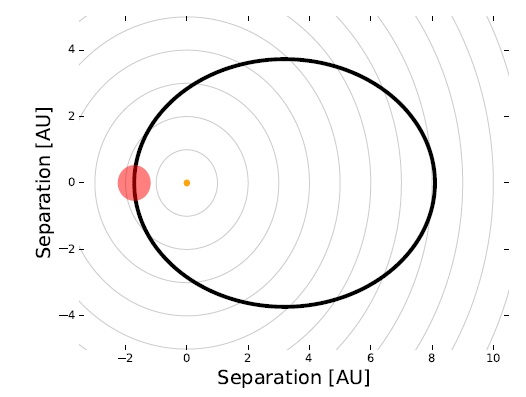
The
orbit of J1407b model B80, with J1407b located at pericentre. The
J1407b system (red) is shown to scale for the initial size of the
model. The size of the star (orange) is exaggerated by a factor 20.
Grey circles indicate the distance to the star in AU, while the black
ellipse shows the orbit. Rieder & Kenworthy (2016).
Each
model planet was surrounded by a series of 50 rings with an inner
edge ranging from 0.26 AU to 0.66 AU. Particles were assumed to start
equidistant from each other within each ring, but the radial distance
of each particle was then changed by a random amount. Each ring
system generated in this way was run through the simulation twice,
once with a prograde orbit (i.e. in the same direction as the orbit
of the planet) and once in a retrograde orbit (i.e.. in the opposite
direction to the orbit of the planer. Particles that travelled beyond
2AU from the planet were assumed to have been lost from the system.
The simulation was run for 9000 orbits, equivalent to 500 000 years.
Rieder
and Kenworthy found that rings with prograde orbits tended to be
disrupted easily in the simulations, with the largest surviving ring
system in a prograde orbit being capable of producing an eclipse
only 40 days long, far shorter than the observed phenomenon. Ring
systems with retrograde orbits, however, fared better, and several
simulations were capable of producing eclipses 56 days in length or
even longer. This suggests that the eclipses could well be caused by
a planet, J1407b surrounded by a series of rings with a retrograde
orbit. This is not an unreasonable requirement, as in our own Solar
System the panets Venus and Uranus have retrograde rotations, and
this has also been obeserved in exoplanet such as WASP-17b. The
simulations also suggest that the planet is likely to be large,
closer in size to 100 times as massive as Jupiter than 20 times as
massive. Such an object would be more likely to be a Brown Dwarf than
a planet (Brown Dwarfs are objects to large to be considered planets, but to small
to be considered stars; they are thought to be able to fuse deuterium
in their cores, but not hydrogen).
See also...
 Faint companions discovered to two planet-hosting stars. Almost all planets orbiting other stars have been discovered by one of
two planetary detection techniques: occlusion, on which the planet
passes in front of the star, causing the amount of light reaching us
from that star to dim ever so slightly on a regular timescale, or radial
velocity, in which the gravity of the planet causes the host star to
wobble back and...
Faint companions discovered to two planet-hosting stars. Almost all planets orbiting other stars have been discovered by one of
two planetary detection techniques: occlusion, on which the planet
passes in front of the star, causing the amount of light reaching us
from that star to dim ever so slightly on a regular timescale, or radial
velocity, in which the gravity of the planet causes the host star to
wobble back and... The possibility of an Earth-mass planet in the habitable zone of the Kepler-68 system. The Kepler Space Telescope has located many multi-planet systems since its inception,
which combined with discoveries made by other planet-hunting missions
has enabled scientists to begin to construct models of planetary
systems orbiting other stars. This is particularly complicated where
not all planets are visible to the space telescope, which is only...
The possibility of an Earth-mass planet in the habitable zone of the Kepler-68 system. The Kepler Space Telescope has located many multi-planet systems since its inception,
which combined with discoveries made by other planet-hunting missions
has enabled scientists to begin to construct models of planetary
systems orbiting other stars. This is particularly complicated where
not all planets are visible to the space telescope, which is only... Generating free oxygen in the atmosphere of exoplanets without the presence of life. In the past two decades
over a thousand planets have been found orbiting stars other than our
own, many of which appear to be small rocky planets in the habitable
zones of their stars (i.e. the zone in which such a...
Generating free oxygen in the atmosphere of exoplanets without the presence of life. In the past two decades
over a thousand planets have been found orbiting stars other than our
own, many of which appear to be small rocky planets in the habitable
zones of their stars (i.e. the zone in which such a...
Follow Sciency Thoughts on Facebook.


