
Tropical forests have come under unprecedented threat in recent decades, with wildlife populations threatened by both the felling of forests and hunting. To remedy this, many countries have introduced protected areas such as national parks within areas of tropical forests, within which the hunting or harvesting of wild animals and plants is strictly controlled or completely forbidden. Unfortunately, such schemes are typically imposed by central governments without any input from local communities that have lived in, and extracted resources from, these forests for centuries or more. This can mean that such communities suddenly find traditional sources of income and sustenance are suddenly forbidden, whereas any income from the new reserves typically goes into central government coffers, creating an sense of alienation, and a subsequent reluctance to cooperate with park schemes.
In a paper published in the Journal of Threatened Taxa on 26 February 2018, Edward Debrah Wiafe of the Department of Environmental and Natural Resources Management at the Presbyterian University College in Akropong-Akuapem, Ghana, presents the results of a 13 month study of poaching in the Kakum Conservation Area of southern Ghana.
The Kakum Conservation Area comprises the Kakum National Park, with an area of 210 square kilometres, and the Assin Attandanso Resource Reserve, covering 150 square kilometres. These were originally created during the colonial period (1931 and 1937 respectively), in order to protect the watershed that supplied the Cape Coast region, and to provide a source of timber. Establishing forest parks for the benefit of the timber industry might seem slightly contradictory, but in Britain, the colonial power in Ghana at the time, all natural forests vanished centuries ago, and with timber coming from managed and protected woodlands harvested on a rotational basis, with trees being left to grow for decades unmolested; unprotected areas tend to be rapidly converted to arable production, which produces a crop every year. The forests at Kakum were home to a number of local communities, which relied on the forests to provide them with resources through hunting and gathering, and occasionally some artisanal gold and clay mining, but little timber harvesting is thought to have occurred before the forest parks were created.

A raised walkway in the Kakum National Park; a popular attraction with tourists that provides a useful source of hard currency. Nicola Chiappi/Wikimedia Commons.
Today the area is protected by Wildlife Protection Rangers armed with G.P.S. units, compasses, grid maps and riffles, who enforce strict rules prohibiting anybody from hunting any animal or removing any plant from the reserve without express written permission, effectively making all hunting illegal. The reserve is home to a number of protected Mammals and Birds including African Elephant, Loxodonta africana, Maxwell’s Duiker, Philantomba maxwellii, Black Duiker, Cephalophus niger, Bongo, Tragelaphus eurycerus, Lowe’s Monkey, Cercopithecus lowei, Olive Colobus, Procolobus verus, Black and White Colobus, Colobus vellerosus, and Yellowbilled Turaco, Tauraco macrorhynchus. It is also home to 53 Human communities, who are now reliant on subsistance farming.
Wiafe collected data on arrests made by Wildlife Protection patrols between November 2012 and November 2013, including the number of arrests, the time of poaching equipment they were using and the numbers and types of animals they were caught with.
In November 2012 the patrols arrested two poachers, armed with snares and shotguns, and in possession of one Maxwell’s Duiker, 27 Rats and two live Pangolins. In December 2012 three poachers were arrested, armed with shotguns and in possession of ne Maxwell’s Duiker and two Pangolins.
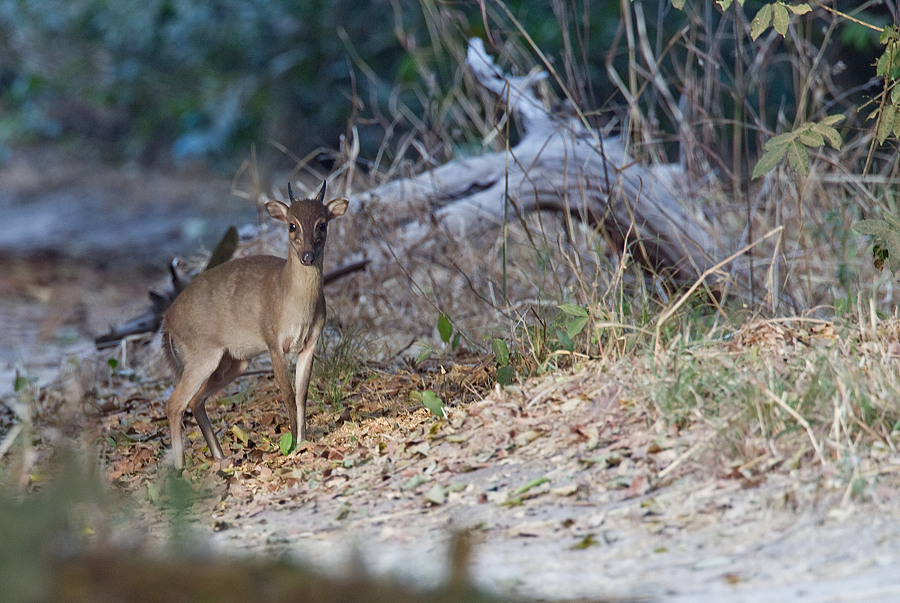
 A Maxwell’s Duiker, Philantomba maxwellii, considered to be Least Concern under the terms of the International Union for the Conservation of Nature's Red List of Threatened Species and hunted by poachers in the Kakum Conservation Area of Ghana. Paul Cools/iNaturalist/ICUN Red List.
In January 2013 the patrols arrested one poacher, armed with a shotgun, and in possession of two Maxwell's Duiker, one Lowe's Monkey, and one Spot-nosed Monkey. In February one poacher was arrested, in possession of snares and two Maxwell's Duiker, one Royal Antelope, one Tree Squirrel and a Potto. In march 2013 a single poacher was apprehended, armed with a shotgun and in possession of one Maxwell's Duiker and one Lowe's Monkey. In April 2013 no poachers were arrested.

In May 2013 four poachers were arrested, armed with shotguns and in possession of five Maxwell's Duiker, two Royal Antelope, two Lowe's Monkeys, and one Spot Nosed Monkey. In June no poachers were apprehended again, while in July 2013 three poachers were arrested, in possession of shotguns and having killed two Maxwell's Duiker, one Lowe's Monkey and one Elephant.
 In August 2013 the patrols arrested one poacher, armed with a shotgun and in possession of one Royal Antelope, one Flying Squirrel, one Lowe's Monkey, one Olive Colobus, and one live Pangolin. No poachers were apprehended in September or October 2013, while in November 2013 another single poacher was arrested, this time armed with a shotgun and and in possession of one Maxwell's Duiker, two Lowe's Monkeys and two live Pangolins.

During the time of the study 69 animals were recovered by Wildlife Protection Rangers in the Kakum National Park, including 29 Rodents, 19 Antelope, 13 Primates, seven Pangolins, and an Elephant. Of these eight belonged to species considered to be Vulnerable under the terms of the ICUN's Red List of Threatened Species (the Pangolins and the Elephant) one belonged to a species considered to be Near Threatened (the Olive Colebus), while the remainder belonged to species considered to be of Least Concern. This pattern did not vary notably from that in areas where hunting is not illegal.
The favoured weapon of the Poachers was clearly the shotgun, which Wiafe notes is the weapon most conservationists would prefer to see used, as it is a discriminating weapon which allows hunters to only take the animals they want, unlike snares which are more random. This is not always the case in protected reserves, as the sound of shotguns can attract the attention of patrols, however in this instance the hunters reported preferring shotguns as they enable them to target animals in the tree canopy. However the Wildlife Rangers also reported sometimes finding fencing around paths in the reserves, directing animals to snares outside the bounds of the protected area.
See also...
Wiafe collected data on arrests made by Wildlife Protection patrols between November 2012 and November 2013, including the number of arrests, the time of poaching equipment they were using and the numbers and types of animals they were caught with.
In November 2012 the patrols arrested two poachers, armed with snares and shotguns, and in possession of one Maxwell’s Duiker, 27 Rats and two live Pangolins. In December 2012 three poachers were arrested, armed with shotguns and in possession of ne Maxwell’s Duiker and two Pangolins.
In January 2013 the patrols arrested one poacher, armed with a shotgun, and in possession of two Maxwell's Duiker, one Lowe's Monkey, and one Spot-nosed Monkey. In February one poacher was arrested, in possession of snares and two Maxwell's Duiker, one Royal Antelope, one Tree Squirrel and a Potto. In march 2013 a single poacher was apprehended, armed with a shotgun and in possession of one Maxwell's Duiker and one Lowe's Monkey. In April 2013 no poachers were arrested.

A Lowe's Monkey, Cercopithecus lowei, in the Mole Game Reserve in Ghana. This species is again considered to be of Least concern under the terms of the ICUN's Red List, and is hunted in the Kakum Conservation Area of Ghana. Peter Strong/Wikimedia Commons.
In May 2013 four poachers were arrested, armed with shotguns and in possession of five Maxwell's Duiker, two Royal Antelope, two Lowe's Monkeys, and one Spot Nosed Monkey. In June no poachers were apprehended again, while in July 2013 three poachers were arrested, in possession of shotguns and having killed two Maxwell's Duiker, one Lowe's Monkey and one Elephant.

African Elephant, Loxodonta africana, in the Kakum National Park. The species is considered to be Vulnerable under the terms of the ICUN's Red List. Kakum National Park.

A Long-tailed Pangolin, Uromanis tetradactyla, in the Kakum National Park. One of three Pangolin species in the area, all of which are considered to be Vulnerable under the terms of the ICUN's Red List. Lars Peterson.
During the time of the study 69 animals were recovered by Wildlife Protection Rangers in the Kakum National Park, including 29 Rodents, 19 Antelope, 13 Primates, seven Pangolins, and an Elephant. Of these eight belonged to species considered to be Vulnerable under the terms of the ICUN's Red List of Threatened Species (the Pangolins and the Elephant) one belonged to a species considered to be Near Threatened (the Olive Colebus), while the remainder belonged to species considered to be of Least Concern. This pattern did not vary notably from that in areas where hunting is not illegal.
The favoured weapon of the Poachers was clearly the shotgun, which Wiafe notes is the weapon most conservationists would prefer to see used, as it is a discriminating weapon which allows hunters to only take the animals they want, unlike snares which are more random. This is not always the case in protected reserves, as the sound of shotguns can attract the attention of patrols, however in this instance the hunters reported preferring shotguns as they enable them to target animals in the tree canopy. However the Wildlife Rangers also reported sometimes finding fencing around paths in the reserves, directing animals to snares outside the bounds of the protected area.
See also...




Follow Sciency Thoughts on Facebook.


