Showing posts with label East Azerbaijan. Show all posts

Friday, 8 November 2019

Magnitude 5.9 Earthquake in East Azerbaijan Province, Iran, kills at least five.

The United States Geological Survey recorded a Magnitude 5.9 Earthquake at a depth of 10.0 km roughly 57 km to the northeast of the city of Hashtrud in East Azerbaijan Province, Iran, slightly after 2.15 am local time on Friday 8 November 2019 (slightly  after 10.45 pm on Thursday 7 November GMT). The Earthquake is reported to have killed at least five people, with more than 330 people having been injured. Three villages close to the epicentre of the event are described as having been 'completely destroyed' in local media reports, and the event was felt across northwest Iran.

A collapsed building covering a car in the village of Varankesh East Azerbaijan Province, Iran. CNN.

Iran is situated on the southern margin of the Eurasian Plate. Immediately to the south lies the Arabian Plate, which is being pushed northward by the impact of Africa from the south. This has created a zone of faulting and fold mountains along the southwest coast of the country, known as the Zagros Thrust Belt, while to the northeast of this the geology is dominated by three large tectonic blocks, the Central Iran, Lut and Helmand, which move separately in response to pressure from the south, stretching and compressing the rock layers close to the surface and creating frequent Earthquakes, some of which can be very large.

The location of the 8 November 2019 East Azerbaijan Province Earthquake. Contour lines show rates of movement during the quake, the red line is a boundary between two tectonic plates, in this case the Anatolia and Eurasian plates. USGS.

To the northeast of this the geology is dominated by three large tectonic blocks, the Central Iran, Lut and Helmand, which move separately in response to pressure from the south, stretching and compressing the rock layers close to the surface and again creating frequent Earthquakes.

The movement of the Arabian Plate and extent of the Zagros Thrust Belt. Rasoul Sorkhabi/Geo ExPro. 

The population of Iran is particularly at risk from Earthquakes as, unlike most other Earthquake-prone nations, very few buildings in the country are quake-resistant. The majority of residential buildings in Iran are made of mud-brick, a building material particularly vulnerable to Earthquakes as the bricks often liquefy, trapping people inside and quickly asphyxiating them with dust. This is particularly dangerous at night when the majority of people are inside sleeping.
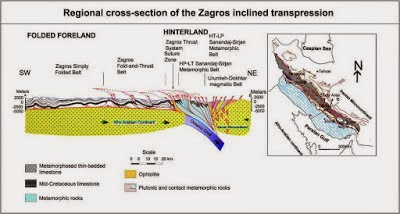
Section through the Zagros Fold Belt. Sarkarinejad & Azizi (2007).

See also...

https://sciencythoughts.blogspot.com/2019/10/magnitude-54-earthauke-in-hormozgan.htmlhttps://sciencythoughts.blogspot.com/2019/05/magnitude-41-earthquake-in-hormozgan.html
https://sciencythoughts.blogspot.com/2019/03/former-footballer-killed-by-landslide.htmlhttps://sciencythoughts.blogspot.com/2018/11/heavy-rains-bring-flooding-to-iran-iraq.html
https://sciencythoughts.blogspot.com/2018/10/flooding-kills-at-least-eight-in.htmlhttps://sciencythoughts.blogspot.com/2018/04/magnitude-55-earthquake-in-bushehr.html
Follow Sciency Thoughts on Facebook.

Saturday, 24 February 2018

Declining Ammanoid diversity before the End Permian Extinction in Tethyan limestones from Iran.

The End Permian Extinction is the most severe extinction event known in the fossil record, with something like 96% of all species found before the event dying out without any decedents. The cause of this event has long been mysterious, though it is now generally thought to be associated with environmental degradation caused by the eruption of flood basalts in the Siberian Traps Igneous Province. However some researchers in the field have suggested that the model of a sudden extinction at the End of the Permian is itself incorrect, and caused by over-reliance on sections which average fossils from too long a time interval to estimate diversity before the extinction event, leading to an overestimation of that diversity, and therefore the scale of the final extinction, arguing that there was a long term decline in biodiversity running up to the End of the Permian.

In a paper published in the journal Geology on 24 January 2018, Wolfgang Kiessling of the GeoZentrum Nordbayern at the Universität Erlangen−Nürnberg, Martin Schobben of the Museum für Naturkunde at the Leibniz Institute for Evolution and Biodiversity Science, and the School of Earth and Environment at the University of Leeds, Abbas Ghaderi of the Department of Geology at the Ferdowsi University of Mashhad, Vachik Hairapetian of the Department of Geology at the Isfahan (Khorasgan) Branch of the Islamic Azad University, and Lucyna Leda and Dieter Korn, also of the Museum für Naturkunde at the Leibniz Institute for Evolution and Biodiversity Science, examine the diversity of fossil Ammanoids in two deepwater limestone sections from the ancient Tethys Ocean, which today outcrop at Julfa in East Azerbaijan Province in northwest Iran and Baghuk Mountain in Isfahan Province in central Iran.

Ammanoids are an extinct group of Cephalopod Molluscs which appeared during the Devonian and had external shells superficially similar to the living Nautiloids, though they are in fact more closely related to Coleoids (Octopus, Squid and Cuttlefish). The most noted group of  Ammanoids were the often large and conspicuous Ammonites, which survived until the End Cretaceous extinction, but there were a number of other groups, several of which died out in the End Permian Extinction. Ammanoid species are typically fairly easy to tell apart by their shell ornamentation, and the group was prone to high rates of species turnover, making them useful to biostratigraphers (scientists that use fossils to date rocks).

Paratirolites kittli, an Ammanoid from the Late Permian of Iran. Leonova (2016).

Kiessling et al. examined the top 4 m of the limestone at both locations, which is thought to represent a time of steady deposition lasting about 700 000 years (earlier portions of the deposits are thought to have had less even sedimentation rates, and were therefore excluded from the study. They found that rather than a single extinction event at the end of the period, a number of separate pulses of extinction were recorded, suggesting a long term break-down in environmental conditions leading up to the End of the Permian, rather than a single extinction-triggering event at the end of the period. This was further supported by the nature of the Ammanoids closest to the End of the Permian, which were both smaller than earlier specimens, and had simpler ornamentation, resembling juveniles of the earlier species, something which is also likely to be a sign of environmental stress.

See also...

http://sciencythoughts.blogspot.co.uk/2017/11/chuvashiteuthis-aenigmatica.htmlhttp://sciencythoughts.blogspot.co.uk/2017/10/dozens-of-octopus-crawl-up-welsh-beach.html
http://sciencythoughts.blogspot.co.uk/2016/12/brooding-behaviour-in-deep-sea.htmlhttp://sciencythoughts.blogspot.co.uk/2016/05/dramatic-rise-in-cephalopod-populations.html
http://sciencythoughts.blogspot.co.uk/2015/12/determining-environments-favored-by.htmlhttp://sciencythoughts.blogspot.co.uk/2015/03/the-reaction-of-marine-invertebrates-to.html
Follow Sciency Thoughts on Facebook.