Showing posts with label Ephemeroptera. Show all posts

Saturday, 22 January 2022

Languidipes lithophagus: A rock-boring Mayfly from the Bago River system of Myanmar.

Rock-borings in marine environments have been extensively studied, both in modern and fossil environments, with the organisms which make these borings known to include Molluscs, Crustaceans, Polychaete and Sipunculid worms, Sea Urchins, Sponges, and Bryozoans. These organisms are considered to be major shapers of their environments, extensively modifying rocky marine substrates and playing an important role in coastal erosion and the evolution of coastal profiles. In contrast to this, freshwater rock-borers have been very little studied. Most known freshwater rock-borers are members of marine rock-boring groups which have adapted to the freshwater environment. For example, bioerosion in the shells of freshwater Molluscs in Southeast Asia, India, and Sri Lanka is known to be caused by Caobangiid Worms, which are Sabellid Polychaetes. Freshwater Mollusc shell borings are also known to be caused by endolithic Cyanobacteria in North America and Argentina, and shell borings of unknown origin have been reported in subfossil and recent freshwater Bivalve shells from North America. Macroborings in rocks from freshwater environments are well recorded in the fossil record, predominantly from calcareous hardground environments, although these are less well studied than their marine counterparts. 

The first modern Invertebrate boring into silicate rocks in a freshwater environment was not discovered until 2018, when the Pidock (rock boring Bivalve) Lignopholas fluminalis was discovered in the middle reaches of the Kaladan River in Myanmar. This species had previously been recorded from estuarine environments with variable salinities, but had not been recorded in a fully freshwater environment till this time. In 2019 a second Bivalve, the Shipworm Lithoredo abatanica, was found boring into limestone in the lower reaches of a small river on the Bohol Island, the Philippines. This species does appear to be found exclusively in freshwater environments, although its closest relatives are all marine. The larvae of a number of Insect species, including Mayflies, Ephemeroptera, Nonbiting Midges, Chironomidae, and Caddisflies, Trichoptera, have been reported burrowing into firmgrounds such as claystones, sandstones, shales, and marls.

In a paper published in the journal Materials Degradation on 20 January 2022, Ivan Bolotov and Alexander Kondakov of the Laverov Federal Center for Integrated Arctic Research oVasily Yapaskurtf the Ural Branch of the Russian Academy of Sciences a d the Northern Arctic Federal University, Grigory Potapov, also of the Laverov Federal Center for Integrated Arctic Research, Dmitry Palatov of the Severtsov Institute of Ecology and Evolution of the Russian Academy of Sciences, Nyein Chan of the Myanmar Programme of Fauna & Flora International, Zau Lunn, also of the Myanmar Programme of Fauna & Flora International, and of the Biology Department at the University of New Brunswick, Galina Bovykina, also of the Laverov Federal Center for Integrated Arctic Research and the Northern Arctic Federal University, Yulia Chapurina, Yulia Kolosova, Elizaveta Spitsyna, Vitaly Spitsyn, and Artyom Lyubas, again of the Alexander Kondakov of the Laverov Federal Center for Integrated Arctic Research, Mikhail Gofarov and Ilya Vikhrev, again of the Federal Center for Integrated Arctic Research and the Northern Arctic Federal University,  of the Faculty of Geology at the Lomonosov Moscow State University, Andrey Bychkov, also of the Faculty of Geology at the Lomonosov Moscow State University, and of Vernadsky Institute of Geochemistry and Analytical Chemistry at the Russian Academy of Sciences, and Oleg Pokrovsky of Geosciences and Environment Toulouse, and the BIO-GEO-CLIM Laboratory at Tomsk State University, describe a new species of Mayfly with rock-boring larvae from the Bago River basin of Myanmar.

Bioerosion was observed in siliceous rocks at two locations on the Bago River, one on the middle reaches and one on the upper part, and both where the water was freshwater and free from tidal influence. The site on the middle reaches of the river was about 40 m above sealevel, where the river crosses a continuous outcrop of Miocene siltstone. Borings can be seen on the right bank, and across the river bottom.

 
Study area and sampling localities. (a) Map of Myanmar with location of the study area. (b) Map of the Bago River basin (light red filling). The red stars indicate freshwater macrobioerosion sites. Bolotov et al. (2022).

The borings are elongate tunnel-like structures, penetrating 20-30 mm into the rock, oriented horizontally, sharing two circular end openings (apertures) at the outer surface. Many of the borings contained Mayfly larvae, others were empty, and often filled with clay. The borings were lined with a silky material. The rock surface was covered by elongate groves, apparently formed by the erosion of burrows. These groves extended onto the surface of the youngest river terrace, above the level of the present floodplain.

 
Examples of macrobioerosion in the Bago River, Myanmar. (a) Right shore with continuous siltstone outcrop at the middle reaches of the river. The red arrows show the location of submerged rocks with bioerosion traces. (b) Submerged part of the siltstone rock outcrop (indicated by the red arrows) at the middle reaches of the river. (c) Emerged siltstone rocks with bioerosion traces (indicated by the red arrows) at the upper reaches of the river. (d) Close-up view of siltstone outcrop with multiple bioerosion traces at the upstream section of the river. (e) Siltstone fragment densely covered by sub-recent bioerosion traces from the upper reaches of the river (plan view). The yellow arrows show crusts of a freshwater Sponge species. (f) Siltstone surface with a dense network of sub-recent bioerosion traces from the upper reaches of the river (plan view). The blue arrows show the macroborings filled with clay. The green arrow shows a pea clam in a bioerosion groove (Bivalvia: Sphaeriidae). Scale bars are 10 mm (e(, (f). Mikhail Gofarov & Ilya Vikhrev in Bolotov et al. (2022).

The upper section of the river is 195 m above sealevel, and cuts through Miocene clays, with outcrops of siltstone rock. These were exposed during the dry season, when the site was visited, but would have been covered in the rainy season when waters were higher. The surfaces of these rocky outcrops were completely covered by grooves and borings similar to those seen at the lower site. These burrows were mostly abandoned, although some contained dead Insect larvae, Eroded burrows had often been occupied by an unknown freshwater Sponge. Some burrow-bearing surfaces were covered by clay, suggesting the burrows on them were of some age.

 
Siltstone rock substrate with borings and living nymphs of the rock-boring Mayfly species Languidipes lithophagus from the middle reaches of the Bago River, Myanmar. (a) Rock fragment with borings (lateral view). (b) Rock fragment showing apertures (circular openings) and partly eroded borings (plan view). (c) Rock surface with apertures and partly eroded abandoned borings. (d) Living nymphs in their borings. (e) Living nymph in its boring. The white arrow shows a fragment of a silky substance covering the inner side of the boring. Scale bars are 10 mm (a), (c), 20 mm (b), and 5 mm (d), (e). Ilya Vikhrev in Bolotov et al. (2022).

Genetic analysis of the larvae confirmed that they belong to the genus Languidipes, but not within either of the two species currently assigned to that genus; Languidipes corporaali, which has wood boring nymphs and which has been recorded from Indonesia, Malaysia, and Thailand, and Languidipes taprobanes, which is known from India and Sri Lanka, and which also has wood-boring nymphs. A third, undescribed, species of Languidipes is also known from a single female specimen collected in Assam, India, over a century ago. The genus Languidipes was split from the African wood-boring genus Povilla in 1984, upon the basis of morphological features; Bolotov et al.'s genetic study confirmed that these genera are related, but clearly distinct.

 
Maximum likelihood phylogeny of boring and burrowing Mayflies (Ephemeroptera) based on the COI gene sequences. Bolotov et al. (2022).

The new species is named Languidipes lithophagus, where 'lithophagus' means 'rock-eater'. The description is based entirely upon mature nymphs, with the adults being unknown. These are 11.3–17.9 mm in length, with a head semicircular in shape when seen from above, with bristles on its labrum (upper lip) and mandibles. The abdomen is also covered in setae (bristles), and the limbs are biramous (branching), with the upper branches forming gills, as in many Crustaceans. The nymphs are pale yellow or white in colour, with two brown stripes on the upper part of the head, and black mandibles. 

 
Nymph of the rock-boring Mayfly species Languidipes lithophagus from Bago River, Myanmar. (a) Holotype RMBH N54_8 (dorsal view); (b) holotype (lateral view); (c) left and (d) right mandible (dorsal view). Scale bars are 5 mm (a), (b) and 1 mm (c), (d). Elizaveta Spitsyna in Bolotov et al. (2022).

The nymphs are filter feeders, obtaining food from water pumped through their burrows. The species is restricted to the Bago River Basin, which is impacted by a variety of anthropogenic loads arising from agricultural and urban land use, deforestation, sewage inputs, garbage littering, and general habitat degradation, causing Bolotov et al. to suggest that it may be Endangered under the terms of the International Union for the Conservation of Nature’s Red List of Threatened Species.
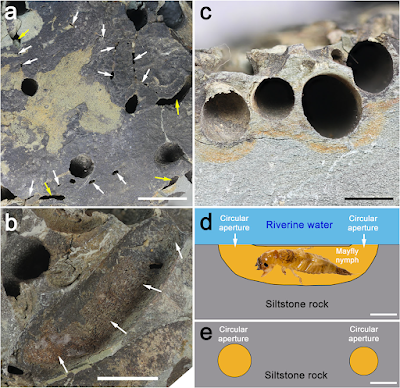
 
Morphological features and neoichnological model of the rock-boring Mayfly species Languidipes lithophagus traces from the middle section of the Bago River, Myanmar. (a) Close-up view of the apertures (plan view). The white arrows show minute fractures tracing the upper layer of the borings. The yellow arrows show larger fractures corresponding to the initial stage of rock erosion leading to the origin of grooves (i.e. borings, the upper layer of whose was lost). (b) Plan view of a groove with concave bottom originated via partial erosion of the boring. The groove bears fragments of a silky substance produced by the tracemaker (shown by white arrows). (c) Transverse cross-section of the borings showing their circular tunnel-like shape. Neoichnological model of the boring: lateral view of the longitudinal section (d) and plan view of the two apertures at the rock surface (e). Orange filling indicates the boring. Scale bars are 10 mm (a) and 5 mm (b)–(e). Artyom Lyubas and Ivan Bolotov in Bolotov et al. (2022).

As far as Bolotov et al. are aware, this is the first recorded instance of freshwater Insect larvae tunnelling into hardground substrates anywhere in the world; burrowing into firmground substrates has been recorded, but such substrates soften when wet, unlike to rocky siltstones of the Bago River Basin. Languidipes lithophagus also appears to be the first known rock-boring freshwater Animal not descended from a rock-boring marine Animal anywhere in the world, with both previously recorded species with this habit being Bivalves belonging to primarily marine groups. 

 
Siltstone outcrop at the midstream bioerosion site of the Bago River. The insert illustrates a rock surface with bioerosion traces of the rock-boring mayfly species Languidipes lithophagus  (indicated by the yellow arrow) at the youngest (sub-recent) river terrace. Mikhail Gofarov in Bolotov et al. (2022).

The relatives of Languidipes lithophagus do, however, do share some ecological similarities with the relatives of the two Bivalve species. The other members of the genus Languidipes bore into wood and bamboo, as do the closest relatives of Lignopholas fluminalis, which comes from a group of primarily wood-boring Piddocks (most Piddocks are rock-boring), and the Shipworm Lithoredo abatanica (almost all Shipworms are wood-boring). The shift from wood-boring, which requires considerable mechanical strength, to rock boring, which requires even more, is plausibly easier than switching directly from free-living to wood-boring.

See also...


Follow Sciency Thoughts on Facebook.

Follow Sciency Thoughts on Twitter.


Saturday, 15 May 2021

Paegniodes sapanensis: A new species of Mayfly from Nan Province in Thailand.

The Mayfly genus Paegniodes currently contains two species, Paegniodes cupulatus, from China, and Paegniodes dao, from Vietnam. Neither of these species is well known, and only Paegniodes cupulatus has been genetically sequenced, but they are considered to both be members of the same, unique, genus with some confidence, based upon unique characters of the imaginal and larval stages.

In a paper published in the journal ZooKeys on 10 May 2021, Boonsatien Boonsoong of the Animal Systematics and Ecology Speciality Research Unit at Kasetsart University, Chonlakran Auychinda of the Department of Biology and Health Science at Mahidol Wittayanusorn School, Michel Sartori of the Museum of Zoology at the Palais de Rumine, and the Department of Ecology and Evolution at the University of Lausanne, and Nuttakun Khanyom, also of the Animal Systematics and Ecology Speciality Research Unit at Kasetsart University,  describe a third species of Paegniodes from Nan Province in Thailand.

The new species is named Paegniodes sapanensis, meaning 'from Sapan', in reference to the Sapan waterfall, a popular tourist attraction in Bo Kluea District of Nan Province, where the species was discovered. 

The species is described from subimagos (a subimago is the penultimate stage in the development of a Mayfly, with the ability to fly but not reproduce) and larvae. A single female subimago is described, this having a body length of 12.8 mm, with cerci (paired appendages on the rear-most segments) 20.0 mm in length, a forewing measurement of 14.4 mm and a hindwing measurement of 2.6 mm. The head, thorax and abdomen are dorsally brown and ventrally light brown; the legs are yellow and the caudal filaments brown. The wings are semitransparent, with veins yellowish to brown, the sternum light brown, and a pair of dark dots is present on both the pronotum and mesonotum. A single male subimago described is coloured similarly to the female, but with a body length of only 8.5 mm, cerci of 17.5 mm, a forewing length of 10.9 mm, and a hindwing length of 1.5 mm. A described larval specimen is 16.2 mm in length, and dark brown in colour, with a whitish underside. 

 
Paegniodes sapanensis, habitus (live). (A) Immature larva, (B) male larva, (C) female larva, (D) closer view of female subimago, (E) male subimago, (F) female subimago. Boonsoong et al. (2021).

The species is known only from Nan Province in Thailand. The specimens were collected from tropical mountain streams which are slightly disturbed by tourist activities. The larvae of the new species were found in flowing areas and the littoral zone of the streams, underneath a mostly cobble substrate.

 
Habitats of larvae of Paegniodes sapanensis. (A) Tributary of a Sapan stream, (B) cobble substrate with bottom sand and gravel, (C) stream bank with cobble. Boonsoong et al. (2021).

See also...


Follow Sciency Thoughts on Facebook.

Follow Sciency Thoughts on Twitter.


Friday, 7 December 2018

Procloeon caspicum: A new species of Mayfly from Gilan Province in northwest Iran.

Mayflies, Ephemeroptera, are an ancient group of insects related to the Dragonflies and Damselflies. They have a long aquatic larval stage followed by a short flying adult phase, which typically does not feed, simply emerging from the water, mating, and laying eggs at a new site. This adult form, called the imago may survive from a few hour to a few days, depending on the species. The Mayfly fauna of Europe has been extensively studied, but that of the Middle East is much less well known, with most studies that have been carried out concentrating on Saudi Arabia, Syria, Jordan, Israel and Turkey, while other countries have been at best poorly investigated. Very little work has been carried out on the Mayflies of Iran, and what publications there are mostly list species found elsewhere that also occur in Iran, and do so mostly in Persian, a language inaccessible to most outside researchers.

In a paper published in the journal ZooKeys on 10 April 2018, Jindřiška Bojková of the Department of Botany and Zoology at Masaryk University, Pavel Sroka and Tomáš Soldán of the Institute of Entomology at the Czech Academy of Sciences, Javid Imanpour Namin of the Department of Fishery at the University of Gilan, Arnold Staniczek of the Department of Entomology at the State Museum of Natural History Stuttgart, Marek Polášek, also of the Department of Botany and Zoology at Masaryk University, Ľuboš Hrivniak, also of the Institute of Entomology at the Czech Academy of Sciences, and of the Faculty of Sciences at the University of South Bohemia, Ashgar Abdoli of the Department of Biodiversity and Ecosystem Management at Shahid Beheshti University, and Roman Godunko, also of the Institute of Entomology at the Czech Academy of Sciences, and of the State Museum of Natural History of the National Academy of Sciences of Ukraine, describe a new species of Mayfly from Gilan Province in northwest Iran.

The new species is placed in the genus Procloeon, and given the specific name caspicum, in reference to the proximity of the Caspian Sea to the area where it was discovered. The species is described from ten female and one male mature larvae, collected in the Chelvand, Sefidab, and Karganrud rivers, close to their outflows into the Caspian Sea, in May 2016; the adults of this species are unknown. These are 7-8 mm in length and yellowish in colour, with darker brownish markings.

Procloeon caspicum, mature female larvae in (2) dorsal, and (3) lateral views. Bojková et al. (2018).

See also...

https://sciencythoughts.blogspot.com/2017/11/teloganopsis-setosa-new-species-of.htmlhttps://sciencythoughts.blogspot.com/2016/05/baetis-alpinus-cryptic-diversity-in.html
https://sciencythoughts.blogspot.com/2014/01/interpreting-insect-trace-fossil-from.htmlhttps://sciencythoughts.blogspot.com/2013/01/insect-dispersal-in-miocene-springtail.html
https://sciencythoughts.blogspot.com/2012/11/a-new-species-of-mayfly-from-western.htmlhttp://sciencythoughts.blogspot.com/2012/10/insect-nymphs-from-carboniferous.html
Follow Sciency Thoughts on Facebook.

Saturday, 11 November 2017

Teloganopsis setosa: A new species of Spiny Crawler Mayfly from Hainan Island, China.

Mayflies, Ephemeroptera, are an ancient group of insects related to the Dragonflies and Damselflies. They have a long aquatic larval stage followed by a short flying adult phase, which typically does not feed, simply emerging from the water, mating, and laying eggs at a new site. This adult form, called the imago may survive from a few hour to a few days, depending on the species. Spiny Crawler Mayflies, Ephemerellidae, are a distinctive group of Mayflies found in North America and the UK. They have three tails (as opposed to two in most Mayflies), and the larvae have the habit of raising these up in a Scorpion-like posture when disturbed. These larvae are found in a wide variety of aquatic environments, and can often survive out of the water for some time.

In a paper published in the journal ZooKeys on 6 November 2017, Wei Zhang, Zhen-Xing Ma, Ze Hu, Juan-Yan Luo, and Chang-Fa Zhou, all of the Key Laboratory of Jiangsu Biodiversity and Biotechnology at Nanjing Normal University, describe a new species of Spiny Crawler Mayfly from Hainan Island in China.

The new species is placed in the genus Teloganopsis, which currently contains only a single species, from the eastern United States, and given the specific name setosa, meaning 'hairy'. It is describe from a number of both adult and larval specimens gathered in the Ba-Wang-Ling National Forest Park, in Chang-Jiang County, Hainan; the larvae were collected by hand-netting, while the adults were attracted with an ultra-violet lamp. Some of the larvae were subsequently raised in captivity, confirming they were the same species.

Teloganopsis setosa, male adult. Zhang et al. (2017).

Adults of Teloganopsis setosa measure 5.0-6.0 mm (males) or 6.5-7.0 mm (females). Adults of both sexes are pale in colour, the males have red markings on their eyes and wings, in the females these are smaller and a dull brown colour. The larvae are a dark, reddish brown.

Male nymph of Teloganopsis setosa. Zhang et al. (2017).

See also...

http://sciencythoughts.blogspot.co.uk/2016/05/baetis-alpinus-cryptic-diversity-in.htmlhttp://sciencythoughts.blogspot.co.uk/2014/01/interpreting-insect-trace-fossil-from.html
http://sciencythoughts.blogspot.co.uk/2013/01/insect-dispersal-in-miocene-springtail.htmlhttp://sciencythoughts.blogspot.co.uk/2012/11/a-new-species-of-mayfly-from-western.html
Follow Sciency Thoughts on Facebook.

Sunday, 1 May 2016

Baetis alpinus: Cryptic Diversity in Alpine Mayflies.

Alpine Mayflies, Baetis alpinus, are widespread around the headwaters of many European rivers, being found in swift-flowing stoney streams at altitudes of between 200 and 2600 m (possibly higher). Like other Mayflies they spend the majority of their lives as aquatic larvae, only emerging for two final, winged stages, the pre-reproductive subimago, which typically lasts for less than 24 hours, and the sexually reproductive imago stage. Male imagos form swarms over fast-flowing water, with females flying into these swarms to mate. Males die after mating, females live long enough to find a suitable egg laying site (typically an overhanging rock upstream of the mating site). This reproductive system leaves little oportunity for long distance dispersal, and a numer of other Mayfly species have been shown to be complexes of cryptic species, made up of morphologically distinct but reproductively isolated lineages thought to have become separatedduring the Pleistocene glaciations. Alpine Mayflies are considered to be highly variable, both in morphology, an in reproductive behavior, with populations varying in generation time from three generations per year to one generation every two years (though this variation is thought to be linked to altitude and temperature), making the species a prime candidate for the presence of cryptic lineages.

In a paper published in the journal BMC Evolutionary Biology on 12 April 2016, Marie Leys of the Department of Aquatic Ecology at the Swiss Federal Institute of Aquatic Science and Technology and the Institute of Integrative Biology in Zürich, Irene Keller of the Department of Clinical Research at he University of Bern and the Swiss Institute of Bioinformatics, Katja Räsänen, also of the Department of Aquatic Ecology at the Swiss Federal Institute of Aquatic Science and Technology and the Institute of Integrative Biology in Zürich, Jean-Luc Gattolliat of the Musée cantonal de Zoologie and Department of Ecology and Evolution at the University of Lausanne and Christopher Robinson, again of the Department of Aquatic Ecology at the Swiss Federal Institute of Aquatic Science and Technology, examine the genetic structures of Alpine Mayfly populations on the headwaters of several major European rivers in the Swiss Alps.

An Alpine Mayfly, Baetis alpinus. Evasion.

Leys et al. sampled 1591 Mayfly larvae from 24 sites in the upper parts of four major European river basins, the Rhine, Rhone, Danube and Po. Of these 112 specimens were found to bellong to Baetis melanonyx, a closely related species that resembles Baetis alpinus closely. The remaining 1479 specimens were found to belong to two separate lineages, identified as A and B. Of these 1001 were assigned to lineage A and 478 assigned to lineage B.

The specimens assigned to lineage B were found in all river basins except the Po, and were found most commonly in streams fed by groundwater, while those of lineage A were found most commonly in streams fed by glacial meltwater. Members of lineage A were also found to have on average a higher number of setae (hairs) at the apex of their maxilary palps (part of the mouth structure) and also more setae in the dorsal margins of their femora (third segments of the legs).

The two lineages appear to be reproductively isolated, but are more closely related to one-another than to any other species. However the Leys et al. do not formerly describe the lineages as separate species at this time, pending further study of the phylogeny of the species across its total range.

See also...

http://sciencythoughts.blogspot.co.uk/2012/11/a-new-species-of-mayfly-from-western.htmlA new species of Mayfly from western Ecuador.                                                  Mayflies are an ancient group of insects related to the Dragonflies and Damselflies. They have a long aquatic larval stage followed by a short flying adult phase, which typically does not feed, simply...
Follow Sciency Thoughts on Facebook.
 

Thursday, 9 January 2014

Interpreting an Insect trace fossil from the Late Carboniferous of Massachusetts.

In a paper published in the Proceedings of the National Academy of Sciences of the United States of America in April 2011, Richard Knecht of the Department of Geology at Tufts University, Michael Engel of the Division of Entomology (Paleoentomology) at the Natural History Museum and the Department of Ecology and Evolutionary Biology at the University of Kansas and Jacob Benner also of the Department of Geology at Tufts University described an Insect trace fossil from the Late Carboniferous Wamsutta Formation of Massachusetts, which they interpret as a landing trace left by a Mayfly (Ephemeropterida) in soft mud in a marginal freshwater habitat.

(A) Lower-facing side preserving trace fossil in concave epirelief. Two ripple mark crests are evident in this view running from left to right across the bedding plane. (B) Upper-facing side (in convex hyporelief). Possible incipient mud cracks are visible to the left of the trace fossil. Knecht et al. (2011).


In a paper published in the journal Evolution in January 2013, James Marden of the Department of Biology at Pennsylvania State University presents an alternative view of the Wamsutta Formation specimen, suggesting that it might be a trace left by a surface-skimming Stonefly (Plecoptera).

Knecht et al. had suggested that the insect was a Mayfly due to the absence of antennae and presence of traces left by two terminal filaments, furthermore ruling out a Stonefly as this group was not present in the Carboniferous. However Marden observes that a Carboniferous Stonefly was recorded from China in a paper published in August 2011 (after the publication of the Knecht et al. paper), implying that the group had arisen by this time, and that this group actually has two terminal filaments (unlike the Mayflies, which have three) and tend to hold their antennae aloft, where they do not make traces. Furthermore he shows a strong correlation between the morphology of the trace fossil and that of the underside of a modern Stonefly.

Ventral morphology of an extant neopteran insect (Plecoptera, Taeniopteryx) and the trace fossil (scale bars: A 5 mm; B 10 mm). Highlighted are sternal sclerites of Taeniopteryx, which, with minimal changes in size (primarily width) and relative position, match the fossil. Poststernum 1, basisternum 3, and furcasternum 3 are clearly defined in the fossil. Marden (2013).


Unlike Mayflies, Stoneflies are Neopteran Insects, meaning they can fold their wings along their bodies rather than keeping them stuck out at the sides at all times. Marden's examination of the Wamsutta Formation specimen shows marks alongside the body, which he interprets as traces made by the folded wings.

Evidence for marks made by the edges of folded neopteran wings. (A) Ventral view of a live Taeniopteryx stonefly. Arrows show the fore and hind wing leading edges, which sit flush against the ground when thewings are folded. Inset shows close-up of the paired wing edges. (B) Wing edge marks (at arrowheads) beside the abdomen of the trace fossil. Scale bars: A 5 mm (inset 0.1 mm); B 10 mm. Marden (2013).


The trace fossil also shows a number of faint marks outside the apparent reach of the leg-span of the tracemaker. Marden interprets these as wing-marks made by a Stonefly skimming across water by flapping its wings, prior to coming ashore on saturated sediment. Modern Stoneflies, which tend to be indifferent fliers, are known to move in this way, and similar marks were made by a Taeniopteryx beaching on wet kaolinite clay under experimental conditions.

Comparison of striations distal to the legs in the trace fossil with location of wingtips of a surface skimming stonefly. Left: Interpretation requiring lateral movement of the entire body to leave striations beyond the reach of the meso- and metathoracic legs while also moving forward to leave the linear marks parallel to the abdomen (i.e., two contradictory paths). Right: Dorsal view of a Taeniopteryx Stonefly skimming on the surface of water or wet sediment. Tips of the fore and hind wings contact the surface at locations consistent with the distal lateral marks in the trace fossil. Marden (2013).


Follow Sciency Thoughts on Facebook.

Thursday, 17 January 2013

Insect dispersal in a Miocene Springtail.

Springtails (Collembola) are wingless Insects (or not, some modern taxonomists classify them as non-Insect Hexapods), considered to be extremely ancient members of the group; unlike wingless Insects such as Ants of Fleas they are thought to have diverged from other Insects before the evolution of wings, not to have secondarily lost them. Springtails are found throughout the world, and are among the first organisms to colonize newly formed islands, though their dispersal methods are not properly understood.

In a paper published in the journal PLoS One on 17 October 2012, a team of scientists led by David Penney of the Faculty of Life Sciences at The University of Manchester describe a preserved Springtail attached to the wing of a Mayfly preserved in 16 million year old amber from the Miocene of the Dominican Republic.

The Springtail is attached to the Mayfly using its antennae, a form of behavior not known in modern Springtails. On its own this would not be considered very good evidence for such behavior, but a previous fossil has been described from Eocene Baltic amber, in which a number of Springtails are attached to the leg of a Harvestman. Penney et al. suggest that this implies the behavior is probably found in modern Springtails, but that it has yet to be recorded.

Light microscope images of (top) the entire Mayfly, and (bottom) detail showing the attached Springtail. Penney et al. (2012).

CT Scan images of (top left) the Springtail in lateral view, (top right) the Springtail on the wing of the Mayfly and (bottom) the Springtail in dorsal view. Penney et al. (2012).

See also Goblin Spiders from Cretaceous Amber, A new species of Scorpionfly from Baltic Amber, Miocene Quasimodo Flies in Dominican Amber, A fossil Cricket in Miocene amber and A new species of Mayfly from western Ecuador.

Follow Sciency Thoughts on Facebook.