Showing posts with label Stoneflies. Show all posts

Thursday, 30 December 2021

Isoperla popijaci: A new species of Yellew Sally from Croatia.

Stoneflies, Plecoptera, are an ancient (at least Permian) family of Insects with a global distribution. They are considered useful environmental indicators, as the adults tend to be large and conspicuously coloured, and the larvae live exclusively in well oxygenated fresh water. The genus Isoperla, commonly known as Yellow Sallys, comprises about 188 species found throughout Eurasia and North America, with the Balkan Peninsula being somewhat of a biodiversity hotspot for them; 21 of the 60 species recorded in Europe are found there, with 12 being endemic to the peninsula. Ten of these species have been recorded in Croatia, but it is thought likely that the country is home to more, undiscovered, species, due to its extensive karstic waterways, which make an excellent habitat for Stoneflies.

In a paper published in the journal ZooKeys on 16 December 2021, Dora Hlebec of the Department of Biology at the University of Zagreb, Ignac Sivec of the Slovenian Museum of Natural History, Martina Podnar of the Croatian Natural History Museum, and Josip Skejo and Mladen Kučinić, also of the Department of Biology at the University of Zagreb, describe a new species of Yellow Sally from Croatia.

The new species is described from specimens collected from karstic waters around the Ševerova Cave system. It is named Isoperla popijaci in honour of Aleksandar Popijač, for his work on the Plecoptera of Croatia. These Stoneflies are generally a light brown in colour, lighter on the belly and sides, and with yellowish markings. Adult males measure 17-19 mm in length, while females are 16.5-18 mm long.
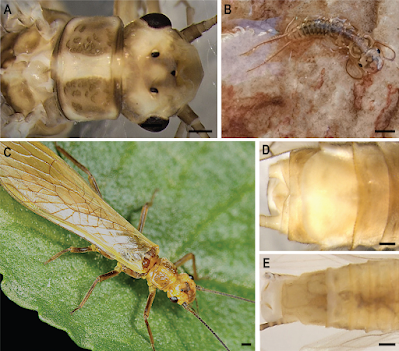
 
Morphology of Isoperla popijaci. (A) Head and pronotum in dorsal view (adult male). (B) Habitus (larval). (C) Habitus (adult male). (D) Female terminalia in ventral view. (E) Everted male copulatory organ. Scale bars 0.5 mm. Hlebec et al. (2021).

No truly trogloditic species of Stoneflies are known, but many species, like Isoperla popijaci, are known only from waters close to caves and cave systems, with the same waterways often lacking Stoneflies further downstream. This strongly suggests that when surveying areas such as the Dinaric Alps of Croatia, particular attention must be paid to caves and pits, and underground and temporary rivers and streams associated with them, which are likely to be the homes to highly endemic Stonefly species.
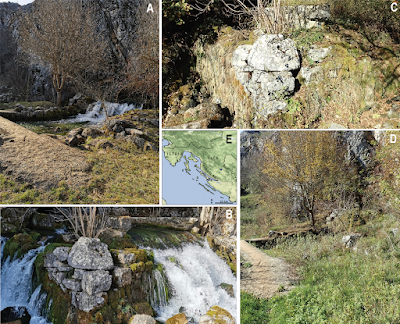
 
Type locality of the Popijač’s Yellow Sally, Isoperla popijaci: Ševerova Cave in Croatia; (A) and (B) photographs in wet phase, (C), (D) photographs in dry phase, (E) map (blue circle indicates type locality). Hlebec et al. (2021).

See also...


Follow Sciency Thoughts on Facebook.

Follow Sciency Thoughts on Twitter.


Monday, 28 March 2016

Haploperla triangulata: A new species of Stonefly from Qinghai Province, China.

Stoneflys, Plecoptera, are considered to be the most primitive group of Neopteran Insects (Insects capable of flexing their wings over their abdomens; essentially all winged Insects except Deagonflies, Damselflies, Mayflies and some extinct groups). They have a simple, generalized bodyplan compared to more 'advanced' Insects, and have aquatic larvae that retain external wings till their final metamorphosis, when they gain external wings and leave the water (some forms have been found with larvae that can survive in moist terrestrial habitats, or that remain in the water as adults). Members of the Plecoptera appeared in the Carboniferous, though the group gained its maximum diversity in the Cretaceous.

In a paper published in the journal ZooKeys on 15 March 2016, Zhi-Teng Chen and Yu-Zhou Du of the School of Horticulture and Plant Protection & Institute of Applied Entomology at Yangzhou University, describe a new species of Stinefly from the Huangzhong County in Qinghai Province, China.

The new species is placed in the genus Haploperla and given the specific name triangulata, in reference to the shape of the epiproct (plate above the anus). The species is described from one male and seven females. Both sexes are pale yellow in culture, with paler heads and brown markings. Females are slightly larger than the male, with forewings reaching 7.0-7.5 mm, compared to 6.5-7.0 mm.

Haploperla triangulata. (9) Male in dorsal view. (10) Female in dorsal view. Scale bars are 1 mm. Chen & Du (2016).

See also...

http://sciencythoughts.blogspot.co.uk/2014/01/interpreting-insect-trace-fossil-from.htmlInterpreting an Insect trace fossil from the Late Carboniferous of Massachusetts.           In a paper published in the Proceedings of the National Academy of Sciences of the United States of America in April 2011, Richard Knecht of the Department of Geology at Tufts University...
Follow Sciency Thoughts on Facebook.
 

Thursday, 9 January 2014

Interpreting an Insect trace fossil from the Late Carboniferous of Massachusetts.

In a paper published in the Proceedings of the National Academy of Sciences of the United States of America in April 2011, Richard Knecht of the Department of Geology at Tufts University, Michael Engel of the Division of Entomology (Paleoentomology) at the Natural History Museum and the Department of Ecology and Evolutionary Biology at the University of Kansas and Jacob Benner also of the Department of Geology at Tufts University described an Insect trace fossil from the Late Carboniferous Wamsutta Formation of Massachusetts, which they interpret as a landing trace left by a Mayfly (Ephemeropterida) in soft mud in a marginal freshwater habitat.

(A) Lower-facing side preserving trace fossil in concave epirelief. Two ripple mark crests are evident in this view running from left to right across the bedding plane. (B) Upper-facing side (in convex hyporelief). Possible incipient mud cracks are visible to the left of the trace fossil. Knecht et al. (2011).


In a paper published in the journal Evolution in January 2013, James Marden of the Department of Biology at Pennsylvania State University presents an alternative view of the Wamsutta Formation specimen, suggesting that it might be a trace left by a surface-skimming Stonefly (Plecoptera).

Knecht et al. had suggested that the insect was a Mayfly due to the absence of antennae and presence of traces left by two terminal filaments, furthermore ruling out a Stonefly as this group was not present in the Carboniferous. However Marden observes that a Carboniferous Stonefly was recorded from China in a paper published in August 2011 (after the publication of the Knecht et al. paper), implying that the group had arisen by this time, and that this group actually has two terminal filaments (unlike the Mayflies, which have three) and tend to hold their antennae aloft, where they do not make traces. Furthermore he shows a strong correlation between the morphology of the trace fossil and that of the underside of a modern Stonefly.

Ventral morphology of an extant neopteran insect (Plecoptera, Taeniopteryx) and the trace fossil (scale bars: A 5 mm; B 10 mm). Highlighted are sternal sclerites of Taeniopteryx, which, with minimal changes in size (primarily width) and relative position, match the fossil. Poststernum 1, basisternum 3, and furcasternum 3 are clearly defined in the fossil. Marden (2013).


Unlike Mayflies, Stoneflies are Neopteran Insects, meaning they can fold their wings along their bodies rather than keeping them stuck out at the sides at all times. Marden's examination of the Wamsutta Formation specimen shows marks alongside the body, which he interprets as traces made by the folded wings.

Evidence for marks made by the edges of folded neopteran wings. (A) Ventral view of a live Taeniopteryx stonefly. Arrows show the fore and hind wing leading edges, which sit flush against the ground when thewings are folded. Inset shows close-up of the paired wing edges. (B) Wing edge marks (at arrowheads) beside the abdomen of the trace fossil. Scale bars: A 5 mm (inset 0.1 mm); B 10 mm. Marden (2013).


The trace fossil also shows a number of faint marks outside the apparent reach of the leg-span of the tracemaker. Marden interprets these as wing-marks made by a Stonefly skimming across water by flapping its wings, prior to coming ashore on saturated sediment. Modern Stoneflies, which tend to be indifferent fliers, are known to move in this way, and similar marks were made by a Taeniopteryx beaching on wet kaolinite clay under experimental conditions.

Comparison of striations distal to the legs in the trace fossil with location of wingtips of a surface skimming stonefly. Left: Interpretation requiring lateral movement of the entire body to leave striations beyond the reach of the meso- and metathoracic legs while also moving forward to leave the linear marks parallel to the abdomen (i.e., two contradictory paths). Right: Dorsal view of a Taeniopteryx Stonefly skimming on the surface of water or wet sediment. Tips of the fore and hind wings contact the surface at locations consistent with the distal lateral marks in the trace fossil. Marden (2013).


Follow Sciency Thoughts on Facebook.