Showing posts with label Trace Fossils. Show all posts

Sunday, 12 January 2025

Ahvaytum bahndooiveche: A Sauropodomorph Dinosaur from the mid-late Carnian of Wyoming.

The Carnian (237 to 227 million years ago) is the first epoch of the Middle Triasssic, and is noted for the appearance and spread of the Dinosaurs and their close relatives, while other groups, such as the Rhynchosaurs, Dicynodonts, and Stereospondyl Amphibians, which had dominated Early and Middle Triassic assemblages, began to decline significantly. However, all known Carnian Dinosaurs to date come from the Southern Hemisphere, with the oldest known Dinosaur from the Northern Hemisphere, the Theropod Lepidus praecisio from the Otis Chalk of Texas, being at most 221 million years old.

Carnian-aged Dinosaurs are known from a number of Southern Hemisphere locations, including Brazil, Argentina, Zimbabwe, and India (today in the Northern Hemisphere, but during the Triassic in the Southern Hemisphere). All of these are from high latitude locations (i.e. they were from a long way from the equator), which has been suggested to indicate that a hostile climate probably stopped them from spreading into other areas, at least until the Carnian Pluvial episode, between 234 and 232 million years ago, during which the global climate shifted, becoming significantly more humid.

This has led palaeontologists to conclude that the first Dinosaurs appeared during the early Carnian (or possibly a little earlier) in the Southern Hemisphere. However, this hypothesis is based upon the absence of Dinosaur fossils from other areas, something which could equally be caused by poor sampling of early Carnian rocks from the Northern Hemisphere. This alternative merits serious consideration, as Carnian deposits are rare in the Northern Hemisphere, and often poorly dated. Furthermore, a number of rock formations in the Northern Hemisphere which have been dated to the early Carnian have produced trace fossils which are attributed to Dinosaurs, strongly indicating their presence in areas where body fossils have not been found.

In a paper published in the Zoological Journal of the Linnean Society on 8 January 2024, David Lovelace and Aaron Kufner of the Department of Geoscience and Geology Museum at the University of Wisconsin-Madison, Adam Fitch, also of the Geology Museum at the University of Wisconsin-Madison, Kristina Curry Rogers of the Biology and Geology departments at Macalester College, Mark Schmitz and Darin Schwartz of the Department of Geosciences at Boise State University, Amanda LeClair-Diaz and Lynette St.Clair of Fort Washakie Schools, Joshua Mann of the Eastern Shoshone Tribal Historic Preservation Office, and Reba Teran, a Shoshone Language Consultant  at Wind River Reservation, describe a Sauropodomorph Dinosaur, as  well as an indeterminate Silesaurid, from the mid-late Carnian Popo Agie Formation of Wyoming.

The Popo Agie Formation is a Carnian-aged deposit which outcrops across western Wyoming, western Colorado, and Utah. It was laid down in a series of lakes and rivers which are thought to have covered much of what is now the American Southwest at this time. Vertebrate fossils are rare in the Popo Agie Formation, though it has produced Metoposaurid Temnospondyls, Hyperodapedontine Rhynchosaurs, and Loricatan Archosaurs, and has two notable horizons with mass-death assemblages of Metoposaurid and Latiscopid Stereospondyls.

The fossils described by Lovelace et al. come from a site 1 km south of the confluence of the East Fork of the Wind River and Spear Creek called Garrett’s Surprise, in reference to its discoverer, Garrett Johnson, who found the site while working as an undergraduate field assistant on undergraduate field assistant. The discovery was surprising because the surrounding geology is dominated by the Eocene Wind River Formation, with the much older Popo Agie Formation exposed in an erosional gully. 

The Sauropodomorph Dinosaur is described from a single isolated left astragalus, with the proximal end of a left femur which shows o clear Saurischian affinities also referred to the same species. This femur fragment was found within 5 m of the original specimen, and both specimens are encrusted with a similar micritic carbonate. The new species is named Ahvaytum bahndooiveche, where 'Ahvaytum' means 'long ago' and 'bahndooiveche' means 'handsome young man', 'Salamander', or 'Dinosaur' in the Shoshone language.

Holotype left astragalus of Ahvaytum bahndooiveche. (UWGM 1975). 3D model in (A) medial, (B) lateral, (C) lateral transparent, (D) posterior transparent, (E) distal, (F) proximal, (I) anterior, and ( J) posterior orthographic views. Photographs in (G) proximal and (H) distal views. Abbreviations: amc, anteromedial corner; ap, ascending process of the astragalus; g, groove; f, foramen; ff, fibular facet; ldn, laterodistal notch (= lateroventral depression); mf, medial fossa; nf, non-articular fossa (= dorsal basin, = semi-elliptical fossa); p, platform; plp, posterolateral process; plr, posterolateral ridge; tf, tibial facet. Diagonal lines indicate broken surfaces. Arrows indicate anterior direction. Scale bar is 1 cm. Lovelace et al. (2025).

Lovelace et al. note that Western taxonomy has a history deeply rooted in colonialism, with taxa often given names that reflect geographic features, regions, or waterways named by colonizers who did not recognize or validate pre-existing Indigenous names. In recognition of this, the name 'Ahvaytum bahndooiveche' was chosen by a collaborative project involving the Fort Washakie Schools 7th grade cohort of 2022, along with educators, Eastern Shoshone Tribal Historic Preservation Office, and Tribal Elders.

A reconstruction of Ahvaytum bahndooiveche as a small Sauropodomoph Dinosaur, along with an audio-explanation of the origin of its name. Lovelace et al. (2025).

The specimens assigned to Ahvaytum bahndooiveche were recovered from the surface of the upper part of a sandstone layer within the Popo Agie known as the Purple Unit. Uranium/lead analysis of zircons from this layer have yielded ages of between 227.34 and 229.04 million years before the present, with the layer which produced Ahvaytum bahndooiveche no more than 228 million years old. This places the fossils in the early Carnian, only slightly after the Carnian Pluvial Event.  Zircon is a volcanic mineral that forms as liquid magma slowly cools to form solid rock. As zircon forms it can incorporate a variety of different elements into its crystal matrix, including uranium but not lead. This is useful as over time uranium decays to form lead, so any lead in a zircon mineral must be the result of the decay of uranium. Since the decay of uranium to lead occurs at a steady rate, it is possible to determine the age of zircons by measuring the ratio of uranium to lead within them.

Proximal end of a left femur UWGM 7549 (A)–(E) referred to Ahvaytum bahndooiveche. 3D model in (A) anteromedial, (B) posterolateral, (C) proximal, (D) anterolateral, and (E) posteromedial orthographic views. Abbreviations: alt, anterolateral tuber; amt, anteromedial tuber; ce, concave emargination; dlt, dorsolateral trochanter; ft, fossa trochanterica (= facies articularis antitrochanterica); gt, ‘greater trochanter’; pmt, posteromedial tuber; ve, ventral emargination. Arrows indicate anterior direction. Scale bar is 1 cm. Lovelace et al. (2025).

As well as the specimens assigned to Ahvaytum bahndooiveche, the Purple Unit yielded the distal end of a left humerus (UWGM 7550) and the proximal end of a right femur (UWGM 7407), which Lovelace et al. determined to belong to a Silesaurid Dinosauriform.

Photographs of Sulcimentisaurian Silesaurid elements from the Garrett’s Surprise locality. Distal end of a left humerus UWGM 7550 (A)–(E) in (A) anterior, (B) posterior, (C) medial, (D) lateral, (E) and distal views. Proximal end of a right femur UWGM 7407 (F)–(J) in (F) proximal, (G) anterolateral, (H) posteromedial, (I) posterolateral, and ( J) anteromedial views. Abbreviations: alt, anterolateral tuber; amt, anteromedial tuber; at, anterior trochanter; dlt, dorsolateral trochanter; ect, ectepicondyle; ent, entepicondyle; g, groove; gt, ‘greater trochanter;’ ipmt, incipient posteromedial tuber; n, notch; rc, radial condyle; uc, ulnar condyle. Arrows point in the anterior direction. Scale bar equals 1 cm. Lovelace et al. (2025).

Silosaurids have long been considered the sister group to the Dinosaurs. However, a number of recent phylogenetic analyses, including that of Lovelace et al. have been unable to demonstrate that they are a separate clade, less closely related to Saurischian Dinosaurs than Ornithopod Dinosaurs are. This raises the posibility that Silosaurids are Dinosaurs, either being an early diverging group of Ornithpods, a separate group more closely related to Saurischians, or a polyophyletic group, potentially including both plus some in the original Dinosaur-sister-group position (many Silosaurids are known from highly fragmentary remains, so this would not be surprising). If the Silodaurids are Dinosaurs, then they increase the age of the Dinosaurs as a group, as they are present in the Ladinian Epoch (between 241 and 237 million years ago), whereas the oldest known non-Silosaurid Dinosaur fossils all date from the Carnian. Either way, Silosaurids have previously only been known from Southern Hemisphere sights before the discovery of the Garrett's Surprise specimen.

Finally, Lovelace et al. describe a partial foot print from the upper Jelm Formation at Red Wall in Natrona County, Wyoming. This is small, roughly 8.0 x 5.6 cm, and comprises a partial hindlimb print with digits II–IV, with a very faint associated possibly forelimb trace. The pes digits are relatively straight, long, and slender with small acuminate claw impressions. Pads are observable, but not sharply defined. Lovelace et al. consider that this could be assigned to either of the ichnogenera Atreipus or Grallator. The trace is preserved on a slab which has fallen from the Red Wall (a cliff), but can confidently be sourced to a section 1-2 m thick, about 15 m beneath the top of the Jelm Formation, which stratigraphically underlies the Popo Agie Formation. 

UWGM 7435 (left) is an isolated slab containing a single tridactyl pes and possible manus impression attributed to an Atreipus–Grallator plexus tracemaker from the upper Jelm Formation, Natrona County, Wyoming, USA. (A) Digital surface-depth map (right) produced in METASHAPE (v.2.0.3; Agisoft) from surface light-scans demonstrates the depth and toe pad delineations of pes (p) digits II–IV. The manus impression may be present (m?); other than a very slight depression there are no morphological features to confidently identify it as such. Scale bar is in 1-cm increments. Lovelace et al. (2025).

See also...

Wednesday, 17 August 2022

Assessing the authenticity of Acheulean Porosphaera beads.

The appearance of symbolic thinking is considered to be one of the most important steps in the development of modern Human cognition, giving Humans the ability to pass on information by means of objects rather than direct communication, and thereby helping to build communities bound by common cultural traits rather than simple kinship. Evidence of this, however, is difficult to detect in the archaeological record, leading to intense debates as to when and where such behaviour first appeared.

The first shell beads appear over a hundred thousand years ago in Africa and the near east, at sites such as Skhul Cave in Israel, where beads have been dated to 135-100 000 years before the present, Qafzeh Cave, also in Israel, dated to 100-92 000 years ago, Blombos Cave in South Africa, 100-70 000 years ago, Sibudu Cave in South Africa, older than 70 000 to about 60 000 years ago, Border Cave, again in South Africa, 125-35 000 years ago,  Grotte des Pigeons in Morocco, 80 000 years ago, Bizmoune Cave in Morocco, at least 142 000 years old, Rhafas Cave, also in Morocco, 82 000 years ago, Contrabandiers Cave, once again in Morocco, 120-90 000 years ago, and Oued Djebbana in Algeria, 100-90 000 years ago. All of these sites are associated with early anatomically modern Humans, apparently confirming that beads were an innovation novel to this group. It has been suggested that symbolic thinking appeared in anatomically modern Humans, providing them with a cultural edge that enabled them to replace all other Hominins. However, recent evidence has suggested that some other Hominin species also used symbolism, which would indicate a far earlier origin within the genus Homo. This analysis has largely revolved around the use of personal ornaments, such as beads, pendants, bracelets and diadems, which are taken as evidence of symbolic thought.

One group particularly associated with bead-making are Neanderthals, something which ties into deeper questions about this group's abilities, and relationship to modern Humans. 

Neanderthals were for a long time (and often still are) classified as a separate Hominin species, Homo neanderthalensis, possibly the most advanced Human species other than ourselves, but nevertheless separate and inferior. However, more recent genetic studies have shown that many modern Humans, and probably all non-African Humans, carry some Neanderthal DNA, which challenges this view of separateness. 

This has led to differing views on the taxonomic status of Neanderthals; possibly they were still a separate species, Homo neandethalensis, but only recently diverged and still capable of interbreeding with us (which is tricky, because in biology populations are generally defined as different species when they are incapable of interbreeding). Alternatively, maybe they should be seen as a modern Humans, but belonging to a different subspecies, Homo sapiens neandethalensis (with all living Humans being classified as Homo sapiens sapiens), which acknowledges that they were different from us, but not that different. Finally, maybe they should be seen as completely modern Humans, but belonging to an ethnic group which has disappeared; making them no more different from living Humans than modern Europeans are from modern Africans.

Much of this debate revolves around the cognitive abilities of Neanderthals. As a group, Neanderthals are strongly associated with the Acheulean Palaeolithic technology. This technology first appeared in Africa about 1.76 million years ago (long before the appearance of Neanderthals), and spread across much of Africa and Eurasia, being used by a variety of Hominin groups. Neanderthals first appeared somewhere between 800 000 and 315 000 years ago, and used Acheulen technology throughout almost all of their history, although some later groups appear to have adopted different technologies learned from Modern Human neighbours. Thus, while Neaderthals are strongly associated with the Acheulean technology, particularly in Europe, not all Acheuleans were Neanderthals, and not all Neanderthals were Acheuleans. 

This long use of a single tool-making technology, apparently without any innovation, has been used to suggest that Neanderthals lacked the capacity for abstract imaginative thought; they were capable of copying what they had seen others make, but were quite incapable of coming up with new ideas for themselves. However, despite this apparent lack of innovation in tool-making, Neanderthals are also thought to have been capable of considerable artistic output, with material attributed to their output including pendants made from the claws of Birds of Prey, a bone flute, cave paintings, and numerous beads, some made from shells, but many of them made from fossils of the Cretaceous Sponge, Porosphaera globularis.

In a paper published in the journal Archaeological and Anthropological Sciences on 1 August 2022, Gabriele Luigi Francesco Berruti of the University of Ferrara, and of the Association 'P-Project Prehistory Piedmont', Dario Sigari, also of the University of Ferrara, and of the Geoscience Center of Coimbra University and the Archaeological Cooperative Society, Cristiana Zanasi of the Civic Museum of Modena,  Stefano Bertola and  Allison Ceresa, again of the University of Ferrara, and Marta Arzarello, once again of the University of Ferrara, and the Association 'P-Project Prehistory Piedmont', assess the authenticity of the Porosphaera globularis beads, and assess whether they were genuinely made by our Neanderthal forebears. 

Berruti et al.'s study concentrates on a collection of Porosphaera beads in the collection of the Civic Museums of Modena, which were obtained in 1891 from the French police commissioner and antiquarian  Charles Le Beuf, who collected them from Saint-Acheul in the Somme, the type locality for the Acheulian culture (i.e. the site from which that culture was named, and to which material from other locations is compared when deciding if it can be classified as 'Acheulian'.

Porosphaera beads were collected from Acheulian sites across northwest France and Southern England in the nineteenth century. They are clearly made from fossils of the Cretaceous calcareous Sponge Porosphaera globularis, which was naturally rounded, but have holes bored through them, which nineteenth century archaeologists interpreted as evidence of their use as beads. The problems with this are that the Sponge fossils are found in the same chalk layers that Acheuleans (and later people) excavated for flints from which to make tools (meaning that Acheuleans would have been digging them out whether they subsequently used them or not), and that about 9% of these fossils have 'natural' boreholes in them, made by Cretaceous Sipunculid Worms. 

Thus there could be three possible explanations for the 'beads' found by nineteenth century archaeologists. Firstly, they could be exactly what they were assumed to be; beads made by Acheuleans as personal ornamentation. Secondly, they could be Sponges with boreholes made by Cretaceous Worms, which were then collected and used as beads by the Acheuleans. Finally, it is possible that these Sponges were bored by Cretaceous Worms and overlooked by the Acheuleans, but collected by nineteenth century archaeologists, who had preconceived ideas about what beads looked like which the Acheuleans lacked.

Archaeological sites where Porosphaera globularis beads have been recovered. Berruti et al. (2022).

Whereas a modern site used as the type for an archaeological culture (or palaeontological species) would be recorded very precisely. The Saint Acheul 'site' actually refers to an entire region in the suburbs of Amiens, with several different locations producing material, some of them from several different layers. The earliest of these contains material dated to 670-650 000 years before the present, and marks the earliest spread of the Acheulian culture into northern Europe. Accurate recording of the level from which the Porosphaera beads  were obtained is lacking, but it is thought that they came from the same layers as flint tools recorded from the site.

In 1891 the then director of the Civic Museum of Modena, Carlo Boni, purchased a collection of beads and stone tools from Le Beuf for 400 Francs. The Porosphaera beads were assembled by Boni into four necklaces, three using raffia threads and one using metal wire, with each necklace having between 112 and 156 individual beads. These were then mounted on a cardboard panel for display purposes, using some red ribbon. The beads have remained on this mount to this day, with both the beads and the panel having gained a coating of dust and an organic crust derived from the breakdown of the cardboard.

One of the four Porosphaera globularis necklaces of the Modena collection assembled on the original twentieth-century support. Paolo Terzi in Berruti et al. (2022).

Berruti et al. disassembled Boni's necklaces, in order to obtain a specimen of 520 beads, which were then individually examined. The perforations in these beads were found to be larger than the 'natural' holes caused by Cretaceous Worm-borings, and the beads themselves were, on average more uniform in size and more rounded than a selection of random Porosphaera globularis fossils. This implies strongly that the beads in the Moderna collection have been subjected to Human selection, although whether this was by Acheuleans or nineteenth century archaeologists is unclear.

Next Berruti et al. examined wear traces on the beads, finding that they showed wear around their perforations (as would be caused by a string, whether ancient of modern), and on the surfaces where the perforations were found (i.e. on the surfaces where the beads would rub-together while suspended on a string), but not on other surfaces of the beads. Furthermore, many of the beads had developed a patina, which was not seen on the surfaces adjacent to the holes. All of these have been recorded on Porosphaera beads used in other studies, and taken as evidence of the beads having been worn on a string of some description, and having rubbed against one-another while being worn.

However, Berruti et al. consider that while these traces could have been made by the actions of fashion-conscious Acheuleans, it is also possible that they could have been caused by the actions of nineteenth century antiquarians, either intentionally, to increase the value of their finds, or inadvertently, while mounting the beads onto strings for display purposes.

Since this matter cannot be resolved by looking at wear on the beads caused by them rubbing against one-another on a string, or the friction of the string itself, Berruti et al. consider an alternative source of information, namely to what extent would the beads by modified by rubbing against the skin of their wearers? (Clothing has never been found in association with Acheulean archaeological sites, and these people are therefore assumed not to have worn clothing). If the beads had never been worn by Acheuleans, but rather collected and strung by antiquarians for the first time, then any markings left by such rubbing against skin should be absent.

To this end Berruti et al. obtained five non-perforated specimens of Porosphaera globularis (which, lacking perforations, could never have been worn as beads), and tested these by rubbing them against Pig skin (considered similar enough to Human skin to be used in a variety of trials) for a total of ten minutes each; three of the beads were rubbed against clean skin and two against dirty skin.

All of the beads showed signs of abrasion and rounding after ten minutes, suggesting that they would be unlikely to survive long-term wear as items of jewellery work against the skin. The beads rubbed against dirty skin developed distinctive striations within the ten minutes, a phenomenon absent in the Moderna beads.

(a) Photomicrographs of the specimen K126 from Hannover before and after the experimentation (rubbing for 10 min on dirty pig skin); (b) Photomicrographs of the specimen L844 from Logstor before and after the experimentation (rubbing for 10 min on pig skin); in the lower part of the image, two photomicrographs of the surfaces of two different specimens of the Modena collections. The surfaces of the samples K126 and L844 before the experimentation are similar to the surfaces of the samples from the Museum collection; after the experimentation, the surfaces are strongly smoothed. Berruti et al. (2022).

Close examination of the Moderna beads enabled them to be divided into three groups, based upon their geology. The first of these show signs of having been rolled on the seafloor before being buried, producing a unique set of scratches and markings. The second group have been partially or wholly remineralized after being buried. The third set show no signs of either mechanical abrasion or remineralization. 
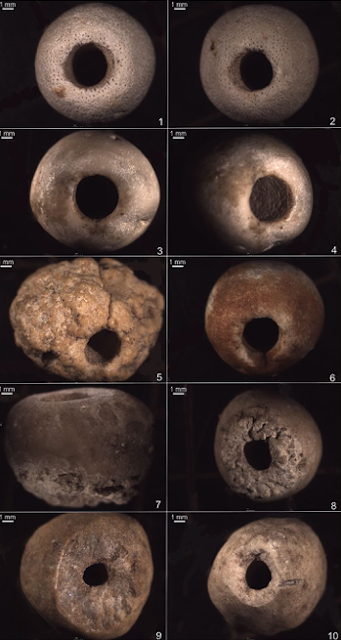
Specimens of the Modena collection. Specimens with microstructure very well preserved, the pattern of the cells forming the sponge skeleton is clearly readable (1)–(2); specimens with surfaces showing marked rounding, smoothing and erosion surfaces, caused by their rolling in water environments (3)–(4); specimens with almost uniform surface concretions, mainly yellowish (goethite, limonite) or reddish (haematite), due to the stay of the fossils into soils or karst wells with a clayish matrix rich in iron minerals (5)–(6); specimens with marked dissolution and recrystallization phenomena having an irregular distribution and due to rainwater circulation (vadose meteoric environment) (7)–(8). Indeed, there are clear phenomena of calcite mineralization, macrocrystalline as well, located only on lower fossil surface, the pending one. Berruti et al. (2022).

Berruti et al. looked for signs of intentional modification of the wholes through the beads, from which it might be possible to determine the nature of the tool being used, and therefore whether the person carrying out this action lived in the Palaeolithic or the nineteenth century. Several of the beads show signs of mechanical action around the hole, though it cannot safely be said whether this was a result of drilling by bead-maker, or abrasion by the string. In two cases the hole through the bead was hourglass shaped, which was most likely caused by drilling from each end, but is was not possible to tell what tool was used, not when this action occurred.

Specimens of the Modena collection. Specimens with preserved marl residuals in the through-hole (1)–(4); specimens with two opposite conical holes that converge in the shape of an hourglass towards the centre of the hole (5)–(10). Looking in detail at the through-hole surface, concentric striae can be identified (9)–(10); they affect the internal calcite wall of the sponge and they seemingly confirm the use of a bow drill. Berruti et al. (2022).

In the late nineteenth century the concept of symbolic thought, and its importance as a step in the development of achieving the cognitive abilities of modern Humans, was barely (if at all) understood. Even today, there are those who believe that this is a unique trait in anatomically modern Humans, and that any evidence for this in Europe prior to the arrival of anatomically modern Humans, about 40 000 years ago, must be erroneous. Many scholars in the field, however, support the idea that this, like other traits, must have evolved gradually, and therefore it is not unreasonable to expect to find evidence for some sort of symbolic thought in earlier groups.

The apparent use of personal ornamentation by Neanderthals has been seen as a clear piece of evidence in support of this idea, and the presence of beads in the classical Acheulean deposits as fairly strong evidence of the creative abilities of Neanderthals. However, the Saint Acheul beds are significantly older than any other deposits thought to have yielded material associated with personal ornamentation (made by Neanderthals, anatomically modern Humans, or anybody else), which should automatically raise questions about the reliability of these items.

Based upon this analysis, Berruti et al. conclude that the Acheulean  Porosphaera beads are entirely natural in their origin; possibly with a little bit of help by over-enthusiastic nineteenth century antiquarians, but definitely not produced by early Acheuleans.

Berruti et al. do not, however, extrapolate from this data to assume that all evidence of symbolic thought attributed to Neanderthals are false. There is a considerable body of evidence which suggests that Neandethals were capable of artistic representation, albeit later in their history than the Saint Acheul deposits. Even if this evidence is all erroneous, and our current ideas about Neanderthals are completely wrong, this will only be overturned by looking at the validity of each individual piece of evidence, with no single source of data being able to tell the whole story.

See also...


Follow Sciency Thoughts on Facebook.

Follow Sciency Thoughts on Twitter.


Thursday, 8 October 2020

Mammalian feeding traces on a Sauropod Dinosaur bone from the Late Jurassic of northwestern China.

For more than 160 million years, Mammals lived in the shadow of the Dinosaurs, remaining small and elusive with an average adult body size close to 100 g. Nonetheless, recent discoveries demonstrate that Mesozoic Mammals were ecologically diverse and occupied various ecological niches. They ranged from ground-dwelling generalists to specialists with semi-aquatic, fossorial, arboreal and even gliding habits. This ecological diversity suggests an equally varied diet, probably encompassing herbivory, insectivory, carnivory and omnivory. The reconstruction of the diet and feeding behaviour of Mesozoic Mammals is, however, largely based on circumstantial evidence such as tooth morphology. Direct evidence for feeding behaviour is scarce and so far limited to a stomach content from the Early Cretaceous, and four instances of feeding traces on bones from the Late Cretaceous. 

In a paper published in the journal The Science of Nature on 19 July 2020 Felix Augustin and Andreas Matzke of the Institut für Geowissenschaften at Eberhard Karls Universität Tübingen, Michael Maisch of Albstadt in Germany, and Juliane Hinz and Hans-Ulrich Pfretzschner, also of the Institut für Geowissenschaften at Eberhard Karls Universität Tübingen, describe bioerosional traces preserved on Dinosaur bone from the early Late Jurassic Qigu Formation (Oxfordian, approximately 160 million years old) of the southern Junggar Basin, northwestern China, and argue that they represent the oldest direct evidence of Mammalian feeding behaviour. This predates the hitherto oldest feeding traces ascribed to Mammals from the Late Cretaceous by more than 60 million years. Thus, these findings significantly expand our understanding of the ecology and behaviour of early Mammals.

The bioerosional traces were discovered on a bone fragment of a Sauropod Dinosaur at the northern flank of Liuhuanggou Gorge in the southern Junggar Basin of Xinjiang Province, northwestern China, approximately 40 km southwest of Urumqi. The locality was discovered during the Sino-German-Project in 2000, a joint expedition by the University of Tübingen, the Nanjing Institute for Geology and Palaeontology and the Geological Survey No. 1 of Xinjiang. The trace-bearing bone was associated with other fragmentary bones of a large-sized Mamenchisaurid Sauropod Dinosaur in a bone-bed horizon in the lower part of the Qigu Formation, approximately 50 m above the boundary with the underlying Toutunhe Formation. The Sauropod Dinosaur total length was estimated to be more than 20 m. Theropod teeth were found interspersed between the Sauropod remains and belong to a large-sized Carnosaur and a smaller Theropod of unknown affinities.

 
Map and stratigraphy of Liuhuanggou gorge. (a) Inset shows the position of the Junggar Basin (rectangle) within Xinjiang Province in northwestern China. (b) Geographic map of the Junggar Basin (Xinjiang Province, northwest China) and the position of Liuhuanggou gorge (asterisk). (c) 
Stratigraphy and sedimentology of the Toutunhe and Qigu Formation at the northern flank of Liuhuanggou gorge. The arrow marks the position of the Dinosaur bone-bed from which the bite marked bone was recovered. Augustin et al. (2020).

The Qigu Formation is early Late Jurassic in age and has a thickness of 680 m at Liuhuanggou Gorge. It consists of massive reddish mudstones and siltstones interbedded with fine-grained sandstone horizons. The sediments of the Qigu Formation were probably deposited on a low-gradient alluvial plain, composed of extensive floodplain areas, adjacent to braided river systems and slowflowing meandering rivers. Environmental conditions during the time of deposition have been interpreted as arid and highly seasonal. The diverse vertebrate fauna of the Qigu Formation thus far comprises Hybodont Sharks, Actinopterygian Fish, Temnospondyl Amphibians, Mammals, Xinjiangchelyid Turtles, Squamates and Choristoderes, Crocodylomorphs, Pterosaurs, as well as Sauropods, small and large Theropods, Stegosaurs and Ankylosaurs among Dinosaurs. The Mammal assemblage is particularly rich and comprises five different taxa: the Haramiyid Sineleutherus; two Docodonts, Tegotherium and Dsungarodon; the stem Zatherian Nanolestes; and an indeterminate Amphilestid Triconodont. All of these Mammals were found in a microvertebrate-bearing bone-bed at Liuhuanggou gorge close (300 m) to the Dinosaur bone-bed site. Stratigraphically, the Mammal site occurred only slightly higher (70 m) in the section, indicating that the Dinosaur and the Mammals lived more or less coeval in the same ecosystem.

The bioerosional traces are preserved on a fragmentary cervical rib of an indeterminate Mamenchisaurid Sauropod Dinosaur (SGP 2000/16). Although dozens of cervical rib fragments have been recovered from the Dinosaur site at Liuhuanggou, small bioerosional traces were only found on one bone fragment. Interestingly, the traces are limited to small ridges on the bone and do not occur on the more level or concave surfaces in between. They appear as elongated, shallow depressions that are restricted to the cortical bone and are principally arranged in parallel pairs. The traces are usually aligned opposite to each other, with one set of traces visible on one side of the ridge and the other set on the opposite side. The traces have a length of approximately 0.5–1.5 mm and a width of 30–250 μm.

 
Cervical rib of a Mamenchisaurid Sauropod (SGP 2000/16) from the lower Qigu Formation (Oxfordian, Late Jurassic) of Liuhuanggou gorge, northwestern China. (a) Overview photograph of the specimen (SGP 2000/16) displaying bioerosional traces. (b) Detail photograph of the bioerosional traces from a slightly different angle than in (a) for better visibility of the traces. (c) Detail photograph of the bioerosional traces from a slightly different angle than in (a) for better visibility of the traces. Augustin et al. (2020).

Small and elongated traces on bones have been linked to the following causes: trampling by large Vertebrates, feeding by Insects, and feeding by Vertebrates. Augustin et al. discuss all the possible trace-makers for the bioerosional traces and conclude that they were most likely produced by early Mesozoic Mammals. 

Trampling by large Vertebrates has often been inferred by the presence of small micro-striations on bone surfaces in fossil and sub-fossil settings. These micro-striations are much smaller, parallel and more uniform to one another, and are therefore different from the traces described by Augustin et al.

Insect traces are widespread in the fossil record and range in morphology from cavities and tunnels to star-shaped pits. Elongated grooves have also been ascribed to Insects, particularly Dermestid Beetles and Termites. The well-preserved traces from the Qigu Formation differ from these Insect feeding traces in having a teardrop shape, with one pointed and one blunt end. When several scratches occur as opposed parallel pairs, the blunt ends face each other. In these traces, the deepest part of the scratches is near the blunt end and not near the mid-length as it is the case in Termite traces. Additionally, Termite feeding traces often comprise star-shaped pits and are usually superimposed on one another, resulting in heavily bioeroded surfaces lacking most of the compact bone layer. Therefore, Augustin et al. conclude that Insects are not responsible for the traces.

Vertebrate feeding traces are frequently preserved on bones and usually come in the form of punctures, scores and grooves. The only Vertebrates from the Qigu Formation that fall within the size range of the traces described above are Mammals, as well as Squamates and one possible Choristoderan; however, the dentition pattern of Squamates and Choristoderans is incompatible with the arrangement of the bite marks described. Both possess a homodont dentitionwith closely packed and irregularly spaced teeth in the upper and lower jaw, and therefore, they cannot be the producer of these traces.

Mammals are the only Vertebrates that possess two sets of procumbent, paired incisors in the upper and lower jaw and can produce bite marks of the kind described. The Mammalian teeth recovered from Liuhuanggou mostly comprise molars and premolars that range in size from 0.5 to 1.5 mm. So far, only one incisor belonging to Sineleutherus uyguricus is known that has a cusp width of 200 μm and thus matches the size of the larger bite marks very well. For the other four taxa from this locality, unfortunately, incisors are unknown, but their estimated size lies well within the range expected from the traces. Moreover, the traces here described show all the characteristics of feeding traces ascribed to Mammals from the Late Cretaceous. 

Feeding traces by extant insectivorous Mammals described in the catalogue of vertebrate taphonomic identifications by Yolanda Fernández-Jalvo and Peter Andrews are almost identical to the ones described by Augustin et al., lending further support to the interpretation of Mammals as trace-makers. Interestingly, the bite marks of insectivorous Mammals more closely resemble the traces from Liuhuanggou than those of Rodents. This is expected because of the similarity of the dentition pattern and the reconstructed diet between extant insectivorous Mammals and the Mammals described from Liuhuanggou. Therefore, Augustin et al. contend that the feeding traces can be confidently assigned to Mammals based on the small size of the traces and their characteristic, paired arrangement with an opposing pair of bite marks preserved on the opposite side of ridges or protuberances.

Although the traces described herein are overall similar to bioerosional traces of insects, a thorough comparison with extant insectivore bite marks and accounts from the fossil record clearly indicates a Mammalian origin of the traces. In general, the interpretation of trace fossils, especially bioerosional traces, is often contentious and a matter of debate. However, Augustin et al. are confident that the most likely explanation of the bioerosional traces presented in their study is feeding activity by Mammals based on the typical arrangement in opposed pairs of some of the traces.

Due to the extreme size discrepancy of predator and prey, the bite marks clearly represent scavenging behaviour. Scavenging behaviour is expected in early Mammals because of their moderate dental complexity that allowed a generalized diet. Additionally, animal tissue provides a source for proteins, lipids and minerals that are otherwise hard to obtain for such small Animals with an estimated adult size of less than 100 g. Since the feeding traces are only superficially preserved on the bone  surface, they most likely were inflicted unintentionally during feeding. The arrangement of the bite marks along small ridges and the 'gnawed' appearance of the bone surface, points to selective feeding on the remaining soft tissues of the Dinosaur carcass that were still attached to the bones.

The Mammalian bite marks described by Augustin et al. represent the oldest direct evidence for a carnivorous diet in early Mammals. They also represent the oldest record of scavenging behaviour. Augustin et al.'s findings expand the known range of the early Mammalian feeding repertoire significantly and shed light on the palaeobiology and palaeoecology of early Mammals, a field that has been poorly known for a long time. Until now, there was a significant gap between the earliest known Mammals with a generalized heterodont dentition from the Late Triassic (220 million years ago) and the oldest feeding traces from the Late Cretaceous (100 million years ago). This study considerably reduces this gap.

See also...


Online courses in Palaeontology. 

Follow Sciency Thoughts on Facebook.

Follow Sciency Thoughts on Twitter. 


Sunday, 6 January 2019

Ediacaran trace fossils suggest that scavenging predated predation in the evolution of animals.

Predation is a highly efficient way for animals to obtain nutrition, and both the seeking of prey and the avoidance of predators are thought to have been major drivers of animal evolution from the Cambrian Explosion onwards. However, several adaptations have to be in place before such a diet can be adopted, including a digestive system capable of processing animals as food and a sensory system sophisticated enough to detect prey. Unicellular Eukaryotes may have begun feeding on one another around two billion years ago, but the first direct fossil evidence of this dates from the 780-740 million year old (Tonian) Chaur Group of Arizona and Utah, and the first evidence of predation by macroscopic animals comes from the very end of the Ediacaran, when boreholes have been found in the mineralised tubes of Cloudinia in Shaanxi Province, China.

In a paper published in the journal Emerging Topics in Life Sciences on 28 September 2018, James Gehling of the South Australian Museum and Sprigg Geobiology Centre at the University of Adelaide and Mary Droser of the Department of Earth Sciences at the University of California, Riverside, describe a series of trace fossils from the Ediacara Member of the Adelaide Rift Complex, which they interpret as evidence of scavenging behaviour by the trace-maker.

The Adelaide Rift Complex is a succession of sedimentary and volcanic rocks of Cryogenian to Cambrian age which outcrop across the Flinders and Mount Lofty ranges of South Australia. Within this group, the Ediacara Member of the Rawsley Quartzite Formation produces numerous Ediacaran fossils (which take their name from this strata), laid down in a deep, outer shelf environment, below the influence surface waves, but where they were regularly buried by turbidites, submarine landslips likely to have been caused by storms further up the slope.

Gehling and Droser record frequent examples of the trace fossil Helminthoidichnites, a meandering furrow1-3 mm wide, found both as an indentation on the top of layers of thins sandstone beds, and as in negative relief on the bottom of higher layers. These deposits also include body fossils of Ediacaran organisms such as Dickinsonia, Beltanelliformis, Aspidella, and Funisia. The usual path of the Helminthoidichnites furrows is aparently random, but where they come close to a macrofossil they frequently turn towards this, crossing the border of the external boundaries and internal structures of these megascopic organisms.

(A) Dickinsonia costata body segments cross-cut by Helminthoidichnites on bed-sole of excavation. (B) Inset of body segments cross-cut by the Helminthoidichnites trace-maker. (C) Helminthoidichnites cutting through clustered pedal surfaces of Beltanelliformis on the base of a 13 mm thick bed. (D) and (E) Helminthoidichnites cutting pedal casts of Aspidella on bed-soles. (F) Helminthoidichnites associated with a tubular body fossil; directionality of burrowing organisms, inferred from scalloping of levees and denoted by arrow. (G) Casts of Funisia dorothea cut by Helminthoidichnites on sole of a 10–13 mm thick bed. All specimens from the Ediacara Member, Rawnsley Quartzite, Flinders Ranges South Australia. Scale bars 10 mm. Gehling & Droser (2018).

Gehling and Droser interpret this as evidence of a unknown trace making animal which normally inhabited algal mats at the sediment-water interface, but capable of burrowing if these mats were overlain by thin layer of sand (probably not more than about 15 mm). Where these trace-makers encountered buried corpses of soft-bodied Ediacaran macro-organisms, they were apparently capable of recognising them as a rich source of nutrition and responding accordingly, 

 (A) Dickinsonia costata on microbial mat, burrowed by small scavenging metazoans leaving bed top grooves and levees in sand below the mat. Only mat–sand interface traces are preserved; intra-mat burrowing is not preserved. (B) Partial smothering of seafloor assemblage below fair-weather wave-base by storm-deposited sand transported from the shore face. (C) A small bilaterian scavenger penetrates the interface between the burial sands and the partially smothered, feeding on the mat and decaying organisms buried below a thin (less than15 mm) veneer of sand, and avoiding the lower levels of the mat and thicker sand cover where the ambient oxygen was too low for vital activity. (D) Bed-sole external mold of mat-mediated TOS and groove traces made where a scavenging organism moved between the mat and smothering sand, cutting through decaying bodies. Gehling & Droser (2018).

The nature of the trace-maker is unclear, as no known fossil from the Ediacara Member is a likely candidate. Gehling and Droser note that modern marine algal mats typically have oxygen levels higher than the surrounding environment, and that such an environment in the Ediacaran might have supported more active animals with higher energy requirements than was possible elsewhere, possibly leading to the evolution of organisms that would play an important role in the later Cambrian Explosion.

See also...

https://sciencythoughts.blogspot.com/2019/01/understanding-deep-marine-origin-of.htmlhttps://sciencythoughts.blogspot.com/2019/01/hylaecullulus-fordi-new-species-of.html
https://sciencythoughts.blogspot.com/2017/12/vittatusivermis-annularius-worm-like.htmlhttps://sciencythoughts.blogspot.com/2017/09/looking-for-animals-in-wengan-biota.html
https://sciencythoughts.blogspot.com/2016/05/multicellular-eukaryotic-organisms-from.htmlhttps://sciencythoughts.blogspot.com/2015/12/eokinorhynchus-rarus-kinorhynch-from.html
Follow Sciency Thoughts on Facebook.

Monday, 5 March 2018

Giraffe tracks from the Late Pleistocene of Western Cape Province, South Africa.

Giraffes, Giraffa camelopardalis, are iconic African Mammals associated with rich savanna grasslands. Because of their highly distinctive morphology and specific environmental requirements, these animals have the potential to serve as good environmental indicators in the fossil record. Unfortunately, dead animals exposed in the open in savanna environments are unlikely to enter the fossil record, as skeletons are rapidly destroyed by a combination of scavenging and weathering, with almost all fossils found in these environments coming from rock shelters, enclosed spaces where Humans, Hyenas or other predators took prey animals to prevent them being stolen. However the large size of Giraffes means that few predators will attempt to tackle them, generally only Human populations with advanced hunting technologies, and that even when killed these animals are almost impossible to transport to a rock shelter for safe consumption.

In a paper published in the South African Journal of Science on 30 January 2018, Charles Helm of the Peace Region Palaeontology Research Centre and the Centre for Coastal Palaeoscience at Nelson Mandela University, Hayley Cawthra, also of the Centre for Coastal Palaeoscience at Nelson Mandela University, and of Geophysics Competency at the Council for Geoscience, Richard Cowling and Jan De Vynck, again of the Centre for Coastal Palaeoscience at Nelson Mandela University, Curtis Marean, once again of the Centre for Coastal Palaeoscience at Nelson Mandela University, and of the Institute of Human Origins at the Arizona State University Richard McCrea also of the Peace Region Palaeontology Research Centre, and Renee Rust of the Evolutionary Studies Institute at the University of the Witwatersrand, describe a series of preserved Giraffe footprints from a coastal cliff east of Still Bay, in Western Cape Province.

The footprints are preserved in a detached block of aeolian sandstone (i.e. sands that were laid down by the action of the wind rather than water) roughly 3.9 by 7.9 m, which is estimated to be between 133 100 and 114 500 years old, and probably between 126 000 and 121 000 years old. A total of twelve tracks are preserved, with the best preserved tracks being found at the southern end of the block. The block is located in the uppermost part of the tidal zone, making it vulnerable to erosion both by wave action, and by Nodilittorina africana knysnaensis, a coastal Gastropod found in the area which burrows into soft rocks. The slab is believed to have become exposed at some time since 2011, when the area was last surveyed, and is in danger of sliding further into the sea, or being damaged irreparably by the action of the sea and Gastropods. However it is two large to be removed from the location where it is currently perched, making long term preservation impossible. Helm et al.  suggest that instead it may be possible to make moulds of the tracks.

Giraffe tracks on rock surface perched above the Indian Ocean. Helm et al. (2018).

The large size and distinctive nature of the tracks makes it almost certain that the track-maker was a Giraffe, though Helm et al. did consider the possibility of other track-makers. Southern Africa is home to a number of Bovid species, which are often hard to identify from their tracks, so that such markings are generally referred to simply as 'large Bovid', 'medium Bovid' or 'small Bovid', however even the tracks of even the largest of these animals are difficult to mistake for those of the much larger Giraffe. 

One possible extinct track maker is the Sivathere, or Short-necked Giraffe, Sivatherium maurusium, a large animal closely related to the Giraffe, and therefore presumably capable of making similar sized tracks (no tracks directly attributed to a Sivathere have ever been found). However Helm et al. reject the idea of a Sivathere as the track-maker for a number of reasons. Firstly, while the exact date of extinction of the Sivathere is unclear, the youngest known fossils of the species date to about 400 000 years ago, making it likely that they had vanished by the time the Still Bay tracks were laid down. Secondly, all known Sivathere remains are found much further to the north, with the most southerly specimens known coming from around Bloemfontein, making it unlikely that one made tracks at Still Bay (although Giraffes are not known from much further south). Finally, while similar in general proportion to Giraffes, Sivatheres were much more robust, had had a wider gait, which means that their tracks were unlikely to have closely resembled those of Giraffes.

Detail of four Giraffe tracks. The best preserved adult track is left of centre, and the best preserved purported juvenile track appears below it, above the top right corner of the 10 cm scale bar. Helm et al. (2018).

Giraffes are known in Western Cape Province, but are not usually found south of the Orange River, with the most southerly recorded sighting being made at Spoeg River in Namaqualand, by Danish explorer Pieter Van Meerhoff in 1663; this is about 700 km to the north of Still Bay, and in a completely different climatic zone, dominated by Vachellia karroo woodlands (thornscrub) on deep sandy soils. 

Representations of Giraffes have been found in rock art paintings in the Hex River Valley, about 250 km to the northwest of Still Bay, which indicates that the animals were familiar to the people there about 2000-1600 years ago when these images were made. However the rock art makers are believed to have been nomadic in nature, ranging over a wide area of the Western Cape in response to the changing seasons, and there is no reason to believe that they actually observed Giraffes in the Hex River Valley. 

There are also some fossil Giraffe remains in the South African Museum in Cape Town which were originally identified as having come from Darling’, about 350 km to the northwest of Still Bay and 450 km south of Namaqualand, but precise details of how and where these specimens were obtained is lacking, and they are now thought unlikely to have come originally from Darling'.

Tracings of giraffe rock art from Buffelshoekkloof, Kanetvlei, Hex River Valley. Helm et al. (2018).

The Still Bay area today has a wet temperate climate and coastal fynboss vegetation dominated by Proteas and Wild Olives, quite unsuitable for Giraffes. However this climate is known to have varied considerably during the Pleistocene, as has the position of the coastline in the area, which would have retreated away from the area during periods of glacial maximum, including the period when the tracks were laid down. 

Glacial periods are generally associated with cooler, drier climates, even in areas unaffected directly by glaciation. However the Late Pleistocene fauna of the Palaeo-Agulhas Plain, as represented by fossil assemblages from Nelson Bay Cave and Klasies River, includes many species found further north in the Cape today, such as Grysbok, Raphicerus melanotis, Grey Duiker, Sylvicapra grimmia, and Bushbuck, Tragelaphus sylvaticus (these assemblages contain predominantly small animals as they are primarily Human hunting remains), suggestive of a warmer climate, possibly with a seasonal climate with large grazers visiting the area during a local wet season, presumably driven more by the loss of a maritime influence on the climate than by global cooling. 

The presence of Giraffes in this environment adds further support to the idea of a subtropical grassland biome extending southwards into an area with a temperate climate today during periods of glacial cooling, as these animals are found exclusively in subtropical grasslands in Southern Africa today.

(a) Locality of the study area in the context of the south coast of South Africa. The continental shelf which borders this coastline reaches the broadest extent in South Africa, and the 120 m isobath lies up to 100 km offshore. The relatively shallow and low-gradient Agulhas Bank sweeps from Cape Agulhas in the southwest to Robberg in the east. (b) The dominant geological units at the study site, which are formations of the Bredasdorp Group and were deposited in the Neogene and Pleistocene. Helm et al. (2018).

See also...

http://sciencythoughts.blogspot.co.uk/2018/01/calculating-role-of-pleistocene-refugia.htmlhttp://sciencythoughts.blogspot.co.uk/2016/10/understanding-ancestry-of-european-bison.html
http://sciencythoughts.blogspot.co.uk/2016/01/ammotragus-lervia-diet-of-barbary-sheep.htmlhttp://sciencythoughts.blogspot.co.uk/2016/01/mapping-distribution-of-southern-pudu.html
http://sciencythoughts.blogspot.co.uk/2015/12/capreolus-constantini-roe-deer-from.htmlhttp://sciencythoughts.blogspot.co.uk/2015/02/the-genetic-diversity-and-distribution.html
Follow Sciency Thoughts on Facebook.