
Understanding meteoroid bombardment of the Earth system is an issue of both great scientific interest and practical importance because impacts are potentially hazardous to the Earth. Since the 541 million year ago Cambrian biodiversity explosion, mass extinction events have occurred at least five times (the so-called Big five events), and extra-terrestrial impacts are considered a potential cause of some of them (e.g., Late Triassic and Cretaceous-Palaeogene extinctions), competing with the flood basalt eruption-related hypotheses. After the first discovery of fossil L-chondrites in Ordovician limestones in Sweden, abundant L-chondrites (low iron stony meteorites), meteorite-tracing chromite grains and iridium enrichment have been found in Sweden, England, Scotland, China, and Russia in rocks whose stratigraphic ages are 470-480 million years. Moreover, several large terrestrial craters in the Northern Hemisphere have been found to have radiometric ages of approximately 430-470 million years. Further, approximately two-thirds of ordinary L-chondrites are known to be heavily shocked and degassed, with Argon³⁹-Argon⁴⁰ ages near 470 million years (Argon-Argon dating relies on determining the ratio of radioactive Argon⁴⁰ to non-radioactive Argon³⁹ within minerals from igneous or metamorphic rock to determine how long ago the mineral cooled sufficiently to crystallise). Therefore, it is generally considered that the L-chondrite parent body suffered a major impact approximately 470 million years ago and was catastrophically disrupted, causing a very large meteoroid shower on Earth for several million years. A recent study suggested that the extraordinary amounts of dust during an interval of over 2 million years cooled the Earth and triggered Ordovician icehouse conditions, sea-level fall, and major faunal turnovers related to the Great Ordovician Biodiversification Event. However, to date, other ancient meteoroid impacts and their relations to environmental changes have not been well understood because of erosion and/or resurfacing processes on Earth.
In a paper published in the journal Nature Communications on 21 July 2020, Kentaro Terada of the Department of Earth and Space Science at Osaka University, Tomokatsu Morota of the Department of Earth and Planetary Science at the University of Tokyo, and the Department of Earth and Planetary Sciences at Nagoya University, and Mami Kato, also of the Department of Earth and Planetary Sciences at Nagoya University, and of the Meisei Electric Co, present the results of a study in which they investigate the lunar crater record in order to reveal ancient meteoroid impacts on Earth, because there is less weathering and erosion on the Moon.
The lunar orbiter, Kaguya provides a new insight that disruption of asteroid had occurred and formed the several craters larger than 20 km simultaneously on the Moon approximately 800 million years ago. Based on crater scaling laws and collision probabilities with the Earth and Moon, at least 40-50 million megatonnes of meteoroids, approximately 30–60 times more than the Chicxulub impact, must have struck the Earth, immediately before the Cryogenian, which was an era of great environmental and biological changes.
Crater size-frequency distribution measurement is a well-established technique to derive relative and absolute ages of planetary surfaces; thus, the density of 0.1–1 km-diameter craters in the ejecta of a large crater (more than 20 km) potentially gives the formation age of the large crater itself. In this study, we investigate the formation age distribution of 59 lunar craters with fresh morphology and diameters larger than approximately 20 km using the software tool craterstats. Terada et al. select and investigate the regions where there is no pond (impact melt region) to avoid the target property effects that may cause craters formed in impact melts to be smaller than those in ejecta.

First, Terada et al. estimate the formation ages of individual craters using the conventional constant flux model over 3 billion years. Eight of 59 craters, including Copernicus, are concentrated at approximately 660 million years, and the weighted mean is 658 million years. The spatial distribution of these craters seems to be slightly concentrated in the equatorial plane, but there is no significant difference between the far and near sides.

To evaluate the probability of the observed concentration of crater ages, Terada et al. performed a simple test using a Monte Carlo simulation (a technique used to understand the impact of risk and uncertainty in financial, project management, cost, and other forecasting models). They assumed that craters are created with uniform probability within an age range from 3.0 billion years to 0 billion years and compute the ages of the 59 craters using a uniformly distributed pseudorandom number. The procedure is iterated 100 000 times. The results show that the possibility that seven of the 59 craters formed at the same time (for 50 million years from 630 to 680 million years ago) by chance is 0.69%, where the 54S161E crater (747 million years old) is masked because it is an obvious outlier with large uncertainties (if the 4S161E crater is included, the possibility that eight of the 59 craters formed during a 100 million year interval by chance is 7%). From these considerations, Terada et al. conclude that sporadic meteorite bombardment occurred across the whole Moon, possibly due to the disruption of asteroids, analogous to the Ordovician meteorite shower.
Theoretically, the mass of an impactor can be estimated from the density of the impactor, the density of the crust, the velocity of the impactor and the diameter of the crater. Assuming a density of near-Earth asteroids (1.29 grams per centimetre cubed for C-type asteroid Ryugu, 1.9 grams per centimetre cubed for S-type asteroid Itokawa, and 2.7 grams per centimetre cubed for S-type asteroid Eros) and a relative velocity of 20 km per second of Earth-crossing asteroids to the Moon, the masses and sizes of the impactors for eight lunar craters formed at 660 million years ago are calibrated. As a result, the total mass of the asteroid shower on the Moon is estimated to be 1.3-1.6 million megatonnes, corresponding to an impactor 10–13 km in diameter.
To date, the lunar impact history has been well investigated based on lunar impact glasses collected by the Apollo/Luna missions and/or lunar meteorites. The age of Copernicus crater is generally taken as about 800 million years based on both crater chronology and the radiometric dating of 12033 brecciated soil, which is considered to consist of ejecta from Copernicus crater. The discrepancy in crater age between 800 and 660 million years ago in Terada et al.'s study is due to the difference in the selected area to be counted. Terada et al. obtained an age of 797 million years, whereas an earlier study reported ages of 678 million years for the area observed by KAGUYA CE1 and 678 million years for the Copernicus ray. In addition, Terada et al. investigated other areas around Copernicus crater (floor, ejecta area and melt region near central peak), giving about 660 million years. All of these results mean that there is no discrepancy in counting and calibration between previous work, and Terada et al.'s study. Terada et al also realize that the selected area with an age of 800 million years is close to the centre of Copernicus crater and tends to be affected by secondary craters, so a counting method yielding a younger age of 660 million years is correct for Copernicus crater. Note that the most important of the new findings is that eight craters, including Copernicus, show identical relative ages based on a constant flux model.
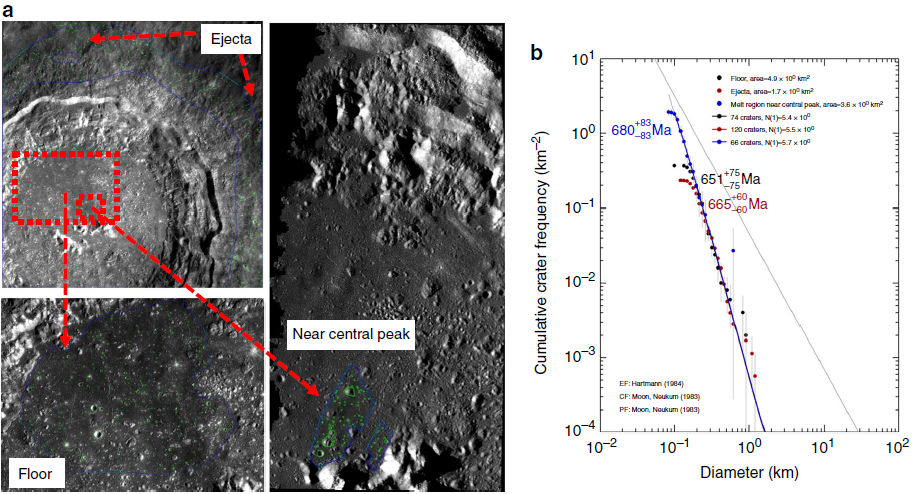
On the other hand, the absolute age of Copernicus crater is considered to be 800 million years based on the radiometric ages of 12033 brecciated soil collected from the ejecta of Copernicus crater. In addition, a 2015 study reported that Argon⁴⁰/Argon³⁹ data for impact spherules from Apollo 12, 14, 16, and 17 samples show an 800 million years ago spike, similar to that of the 12033 breccia, and concluded that there must have been a transient increase in the global lunar impact flux at 800 million years ago other than Copernicus crater, in the context of diverse compositional ranges and sample locations of impact glass spherules. Such geochemical observations of simultaneous global lunar impacts recorded in Apollo samples well match the coincidence of (at least) eight crater formations derived from our observations, of which the probability is 0.69%. From these considerations, Terada et al. infer that these two observations must be related to each other and newly propose a constant with a spike model of about 800 million years ago instead of a conventional constant model.
This scenario in which sporadic asteroid showers did not occur at 660 million years ago but at 800 million years ago is also supported by recent Lunar Reconnaissance Orbiter observations and/or numerical simulations of the asteroid families. Based on the temperature of large impact ejecta with crater sizes larger than 10 km in diameter, a recent study concluded that there is no evidence of a sporadic peak at approximately 660 million years ago, although that study found that the production rate of lunar craters with diameters of at least 10 km was 2–3 times higher over the last 290 million years. However, the age of 800 million years is very close to the limit of resolution for that study, so there is no contradiction with the 800 million years ago spike model. Furthermore, numerical simulation of the orbits of asteroid families also provides crucial chronological information about the impact flux to the inner solar system. A recent investigation of the dynamics of the asteroid family and the best available Yarkovsky measurements (the measurment of the mechanism by which asteroids are torn apart by their own spin) suggest that the breakup of the parent bodies of Agnia Family of asteroids (669–1003 million years ago) and/or Hansa Family of asteroids (763–950 million years ago) was related to the sporadic asteroid shower at 660 million years ago. However, it is known that these families are not sizable enough and/or not well enough positioned to produce the sporadic asteroid shower, including Copernicus crater with a diameter of 93 km, for which impactor is expected to be 10 km in diameter. Moreover, the Agnia Family is located near the 5:2 resonance, where the probability of a projectile hitting the Moon is very low. The Hansa Family also has difficulty producing an impactor of 10 km for Copernicus because it is located at high inclinations near the 3:1 and 8:3 resonances. However, the Eulalia Family of asteroids, whose age is 830 million years old, could potentially have produced an impact spike at about 800 million years ago. A recent study suggested that when the parent body of Eulalia was disrupted, a large share of the sizable family was directly injected into the 3:1 resonance at low inclinations. This disruption certainly could have produced an impact spike on terrestrial planets and/or their satellites inside the asteroid belt. Interestingly, the Eulalia family is a carbonaceous chondrite family and is considered to be the parent body of near-Earth C-type asteroids, such as Bennu and Ryugu. Such an asteroid shower must have contaminated the lunar surface with volatile elements. This scenario is harmonized with (i) the observation of H₂O in Copernicus crater that may reflect retention of volatiles from hydrous impactors; (ii) the scenario that may have been formed by a cometary nucleus, 4 km in diameter based on geochemistry of the 12033 breccia; and (iii) recent KAGUYA remote-sensing observation of persistent positively charged carbon ions emitted from the whole Moon, which is significantly larger than influxes due to solar wind and/or current micrometeoroid accretion and suggests that the lunar surface might have been contaminated by volatile-rich impactors in the past.
It is obvious that the break-up of large asteroids increases not only the large (over 20 km) crater production rate but also the small (0.1–1 km) crater production rate. From these considerations, we propose the new simplest model: a constant flux with a spike between 830 and 800 million years ago for small craters (0.1–1 km). The basic idea is that the crater counting age of Copernicus crater must be identical to the radiometric age of 800 million years and that the fluxes before and after the sporadic spike at about 800 million years were constant. Although the duration time of the spike is slightly uncertain, Terada et al assume that this duration was 30 million years (from 830 to 800 million years ago), based on the break-up age of Eulalia and the radiometric age of Copernicus crater and/or the deviation of eight clustered ages (658 million years ago) for a constant model.The constant flux of the new spike model is 75% (663 million years/800 million years) of the conventional constant flux model, and the flux between 800 million years and 830 million years is 23 times higher than that in other eras to ensure that the total crater production over 3 billion years is identical for both models.
As a result, the modified age distribution shows that 16 of the 59 craters coincide with that of Copernicus crater within the analytical certainties although the large (over 20 km) crater production rate and the small (0.1–1 km) crater production rate might be coupled in this model. However, the estimated total masses are not significantly changed (1.3–1.6 million megatonnes for the constant flux model and 1.8–2.3 million megatonnes for the 800 million year spike model) because Copernicus crater is dominant among the eight coincident craters (by the constant model) and the 17 coincident craters (by the spike model). Therefore, the latter discussion on the total mass estimation of the impactor is not affected by the choice of a flux model with/without the spike. Moreover, it should also be noted that the slopes of the lines below 300 million years in both models are gentler than those of other eras, which is quite consistent with the previous study that the production rate of lunar craters (over 10 km) has been 2–3 times higher over the last approximetely 290 million years, which is derived from an independent approach based on the temperature of large impact ejecta.
Recent observations by the Chandrayaan-1 and LADEE lunar orbiters suggests that an active water cycle exists on the Moon and that hydrated soil is present under the desiccated soil layer of several centimetres over the Moon surface. One 2017 study observes that the Copernicus crater exhibits high water content that may reflect the retention of volatiles from hydrous impactors according to the Moon Mineralogy Mapper. In addition, Terada et al recently found that positive carbon ions are persistently emitted from the whole of the Moon as detected by the lunar orbiter KAGUYA and that this flux is significantly larger than the influx estimated from solar wind and/or current micrometeoroid accretion. These observations suggest that volatile elements are ubiquitous over the lunar surface and that the Moon is currently in the process of losing volatiles (water, carbon, etc.), although when and how the surface of the Moon attained and/or retained such volatiles has been enigmatic. Assuming a CI chondrite-like chemical composition (a few percent by weight of carbon and H₂O), Terada et al 's scenario predicts that a C-type asteroid shower at 800 million years ago must have supplied about 100 000 megatonnes of carbon and H₂O to the lunar surface. This new paradigm undoubtedly should place new constraints on the history of lunar volatiles.
Since the Earth–Moon system has been co-evolving over 4.5 billion years, this new finding provides crucial insight into the Earth–Moon system because asteroid showers must have occurred not only on the Moon but also on the Earth. Based on the probability ratio of collisions with the Earth and the Moon of 23:1, Terada et al. conclude that a mass of 40-50 million megatonnes (corresponding to a diameter of about 30–40 km and about 30–60 times greater in mass than the Chicxulub asteroid impactor must have collided successively on the Earth at about 800 million years ago, i.e. immediately before the Cryogenian (720–635 million years ago), which was an era of great environmental and biological changes. To date, however, no direct geological evidence of a large-scale impact in the Neoproterozoic has been found. Moreover, remarkable iridium concentrations as well as other platinum-group elements anomalies, such as those at the Cretaceous-Palaeocene boundary, have not been found, although only the Marinoan Glaciation (650–635 million years ago) is characterized by increased concentrations of iridium. The straightforward interpretation is that the following large-scale Neoproterozoic glaciations, the socalled Snowball Earth (that is, the Kaigas-Sturtian glaciation from 730 to 700 million years ago and the Marinoan Glaciation) and/or their deglaciation processes, might have erased a significant part of the earlier geological and/or geochemical history.
To date, the impact history and subsequent effects on the environment in the Neoproterozoic and Cryogenic have not been understood because terrestrial craters are not well preserved due to erosion. One recent study discussed the mechanical effects of one impact of an asteroid 5–10 km in diameter on the Snowball Earth environment, suggesting that the products of impact (mainly water vapour) could be quickly distributed over a substantial part of the globe, influencing the global circulation (e.g. facilitating cloud formation), because one impact cratering event (shock waves and impact crater formation) might produce much dust that entered the atmosphere and might have caused albedo changes. Another study noted that the Ordovician meteorite shower should have triggered the mid-Ordovician ice age based on the sizes of the remaining terrestrial craters. Thus, large asteroid showers should influence the global ecosphere in some ways, although mechanisms are not well realised because of the unknown characteristics of the dust, e.g. size, albedo, mineralogy, and chemical composition.
Interestingly, another study found that the average phosphorus content of late Tonian samples is more than four times greater than that of pre-Cryogenian samples and noted that a fundamental shift in the phosphorus cycle may have occurred during the late Proterozoic Eon after 800 million years ago (until 635 million years ago). Terada et al.'s new finding suggests that about 100 000 megatonnes of extra-terrestrial phosphorus should have accreted across the Earth assuming CI chondrite composition (0.1 percent by wieght phosphorus) at 800 million years ago, which is one order of magnitude higher than the total phosphorus amount of the modern sea (assuming that the volume of modern seas is 1350 million km³ and the concentration of phosphorus is about 3 μg/litre). In general, large-scale changes in marine biogeochemical cycles are undoubtedly forced by tectonic and magmatic processes and chemical weathering of the continental crust, but Terada et al.'s new finding suggests that the flux of extra terrestrial bioavailable elements might also have influenced marine biogeochemical cycles, marine redox states, severe perturbations to Earth’s climate system, and the emergence of Animals. Thus, lunar crater chronology provides new insight into external forcing from asteroids that might have driven ecosystems towards larger and increasingly complex organisms after 800 million years ago, although further quantitative discussion will be required.
See also...


Follow Sciency Thoughts on Facebook.


