Showing posts with label Cryogenian. Show all posts

Saturday, 20 April 2024

Assessing the importance of plate tectonic for the development of complex life.

Over the past three decades, research has shown that the overwhelming majority of stars in our galaxy have planets. Logically, a proportion of those planets will have the conditions for life, and life will actually arise on some proportion of the planets which can support it. Furthermore, a small proportion of the planets with life are likely to produce intelligent life, capable of radio communication and other activities which we might be able to detect. This works out at a very small proportion of stars hosting civilizations, but a very small proportion of hundreds of billions still works out at a very large number. We have, nevertheless, never detected any sign of intelligent life (of life at all) beyond our own planet, leaving us, as far as we know the only civilization in the universe, something referred to as the Fermi Paradox. A number of possible explanations have been offered for this paradox, most of which revolve around the idea that while life is probably quite common in the galaxy, complex life is probably much rarer. A variety of reasons why this might be the case have also been proposed, with a link to the other phenomenon also as far as well know unique to our planet, plate tectonics, frequently being proposed.

In a paper published in the journal Scientific Reports on 12 April 2024, Robert Stern of the Department of Sustainable Earth Systems Science at the University of Texas at Dallas, and Taras Gerya of the Department of Earth Sciences at ETH-Zurich, re-examine the biological and geological history of the Earth, looking for connections between key stages in the development of life on Earth and changes in the Earth's geological activity.

Life is generally accepted to have first appeared on Earth more than 3800 million years ago, but the first Animals did not appear until less than 1000 million years ago. Various possible explanations have been proposed for this, including lower oxygen levels on the early Earth and a possible lack of key biological innovations until more recent times. The fact that Animals, Plants, and even multicellular Algae did not appear until quite late in the Neoproterozoic suggests that some profound change in the Earth or its biology led to this development, and Stern and Gerva suggest that this change was a shift from single lid to plate tectonics, and the subsequent profound shifts in the Earth's atmospheric oxygen levels.

The timing of the onset of plate tectonics is still a matter of debate among Earth Scientists, with two broad camps, one which argues that plate tectonics began during the Archean, while the other argues that the current plate tectonic regime began in the Neoproterozoic (although there may-or-may-not have been earlier phases of plate tectonics on Earth). The processes of seafloor spreading, subduction, and continental collision lead to the formation of a distinctive set of minerals, rocks, and rock assemblages, some of which appear to be absent before the onset of the Neoproterozoic, although it has been argued that these differences are due to higher mantle temperatures on the early Earth. Similarly, it is possible to track the movements of continents over the Neoproterozoic and Phanerozoic through the traces of magnetic fields left in some types of rocks when they form, but in rocks older than about 1200 million years this method is not reliable, leaving us uncertain about the movement of the continents that long ago. 

In previous work, Robert Stern divided indicators of plate tectonics into three groups, (1) indicators of seafloor spreading and subduction initiation, (2) subduction indicators, and (3) plate collision indicators. All of these indicators are present in rocks from Neoproterozoic and Phanerozoic times, but their presence in older rocks is far less clear. 

In order for plate tectonics to operate, it is necessary for oceanic lithosphere to be subducted at plate margins, and it is likely that this oceanic lithosphere was not sufficiently strong and dense enough for this to happen in a coherent way until the upper mantle had cooled to between 100°C and 150°C above current temperatures, again something which is predicted to have happened in the Neoproterozoic.

If plate tectonics did indeed start, then it is unlikely to have started all over the world at once, but instead should have started in one place, then taken hundreds of millions of years to spread around the globe. This would result in a gradual increase in the presence of Stern's three indicators for the presence of plate tectonics, something which can again be seen in the Neoproterozoic rock record. The first ophiolites, which are indicators of subduction initiation, appear about 870 million years ago, with the first indicators of actual subduction zones appearing about 750 million years ago, and the first indicators of continental collision appearing about 600 million years ago. 

As far as we understand, an active silicate body can have either a single lid or plate tectonic system. This being the case, for plate tectonics to have initiated in the Neoproterozoic, the Earth must have had a single lid system in the Mesoproterozoic. Stern's previous work also identified three potential indicators for single lid systems. These are (1) an elevated thermal regime, (2) an abundance of unusual dry magmas such as A-type granites and anorthosites, and (3) a lack of new continental margins. The Mesoproterozoic shows an absence of Stern's indicators for plate tectonics, but is rich in the three indicators for single lid tectonics. Curiously, indicators for plate tectonics do appear to be present in the Palaeoproterozoic.

Evolution of Earth’s tectonic regime over the past 1.6 billion years; (a) single lid tectonic indicators, (b) plate tectonic indicators cumulative plot, (c) simplified climate history, (d) Simplified biological evolution. Stern & Gerva (2024).

There is a similar shift in the formation of mineral deposits between the Mesoproterozoic and Neoproterozoic, with orogenic gold and porphyry copper deposits, all associated with an active tectonic regime, being common in Neoproterozoic strata but absent in the Mesoproterozoic, while iron oxide copper gold  deposits and iron-titanium-vanadium-phosphorus deposits, both of which are associated with anorthosites are common in the Mesozoic but rare in the Neoproterozoic.

Finally, the palaeomagnetic record does not show any significant movement of continental landmasses during the Mesoproterozoic, while this is common in younger rocks. Particularly noteworthy is the supercontinent of Nuna (or Colombia), which assembled during the Palaeoproterozoic, then appears to have persisted relatively unchanged throughout the Mesoproterozoic.

Plate tectonics requires a global mosaic of plates, which it could be reasonably expected would take hundreds of millions of years to form a a single lid system. Theoretically, following the formation of an initial subduction zone with associated transform systems and divergent plate boundary margins, the system could slowly propagate to form a global mosaic. The rate at which such a system could form would be governed by the rate at which new subduction zones can form and lengthen. In Cretaceous and younger rocks, subductive trenches appear to be able to lengthen at rates of between 100 and 600 km per million years, which would require between 92 and 550 million years to develop a global network of about 55 000 km of convergent margins.

The last 1.6 billion years of Earth’s tectonic history. Stern & Gerva (2024).

The Neoproterozoic is also known to have had major carbon isotope excursions (changes in the proportions of different carbon isotopes laid down in sedimentary deposits) as well as several glacial interludes, major disruptions to the Earth's environment which we associate with plate tectonics. The most notable of these is the Neoproterozoic Snowball Earth, a prolonged phase of near-global glaciation, which may have been triggered by a huge increase in volcanic activity or true polar wander.  The first major carbon isotope event in the Neoproterozoic is the Bitter Springs Event, at about 811 million years before the present, while the youngest is the Shuram Event, about 570 million years ago. If these events bracket a change from a single lid to a plate tectonic system, then that change took about 241 million years, with the Neoproterozoic Snowball Earth, which started at about 720 million years ago and ended about 580 million years ago, in the middle. If the beginning and end of the Snowball Earth mark the transition period then it is shorter, at about 140 million years. The fact that both the carbon isotope excursions and the glaciation events were sporadic suggests that this process was not smooth, bur occurred in a series of episodes. The Palaeoproterozoic is also noted for several isotope excursions, as well as glacial events, and the Great Oxidation Event, during which the Earth first developed an oxygenated atmosphere. All of these events occurred between about 2.50 and 2.05 billion years ago, with a proposed interval of plate tectonics between 2.05 and 1.80 billion years ago, giving an apparent different relationship between these geochemical events and plate tectonics. This Palaeoproterozoic tectonic interval appears to have ended with the formation of the Supercontinent of Nuna, although these ancient events are not well understood and would merit significant further investigation.

Life first appeared on Earth more than 3.8 billion years ago, but appears to have remained fairly simple for the next three billion years, with all terrestrial ecosystems dominated by Prokaryotes (Bacteria and Archaea), simple organisms which lack cell nuclei organelles. All complex multicellular life on Earth is Eukaryotic (i.e. has cells with nuclei and organelles), so Eukaryotic life had to appear before multicellular life-forms. The fossil record shows what appear to be Eukaryotic single-celled organisms dating back to at least the Palaeoproterozoic, suggesting a link between the emergence of the first Eukaryotes and the Great Oxygenation Event, the first case of co-evolution between the evolution of the atmosphere and Eukaryotic life.

The Mesoproterozoic lacks any such major events, making it impossible to split it into any subdivisions, and making its beginning and end points somewhat arbitrary. The interval between 1800 and 800 million years ago (roughly the Mesoproterozoic) has been referred to as the 'Boring Billion' because of this lack of events, with oxygen levels staying roughly constant, geobiological systems apparently remaining unchanged, and constant carbon isotope ratios throughout. The period, which lasted for about 20% of Earth's history, also saw stability in the proportion of sulphur molybdenum, chromium, and strontium isotopes trapped in sediments throughout, and a prolonged low nutrient system.

In contrast, the Neoproterozoic is a period of both climatic instability and rapid biological evolution, during which the Snowball Earth occurred, as well as major shifts in the carbon cycle, the ocean's oxygen content, a major diversification in microscopic Eukaryotes, and the appearance of Metazoans. The era can be split into three periods based upon clear geological differences, the longer and somewhat uneventful Tonian, between 1000 and 720 million years before the present, the Snowball Earth Cryogenian, and the Ediacaran, which saw the first widespread Metazoan fossils. Molecular clocks suggest that the first multicellular organisms appeared during the Tonian, the bilaterian body plan appeared in the Cryogenian, and that the majority of Metazoan phyla diversified during the Late Ediacaran, between 560 and 540 million years ago. All known Animal phyla are believed to have arisen during the Neoproterozoic.

Five conditions are thought to have been needed for this biological shift to have occurred; an increased nutrient supply, increased oxygen levels in both the atmosphere and oceans, an improved climate, an increased rate of habitat formation and destruction, and a sustained evolutionary pressure caused by such shifting environments.

Summary diagram showing how plate tectonics stimulates life and evolution whereas a single lid tectonic style retards life and evolution. Stern & Gerva (2024).

Nutrients are essential for life, and in particular organic carbon (i.e. compounds with bio-available carbon - we cannot, for example, eat diamonds), ammonium (which provides bio-available nitrogen), ferrous iron (again, bio-available iron) and phosphates (bio-available phosphorus). Phosphorus, in particular, plays vital role in biogeochemistry and is considered a global limiting nutrient. A shortage of phosphorus is thought to have been one of the major restrictions on the Mesoproterozoic biosphere. Phosphorus typically becomes available through the erosion of rocks, and its subsequent delivery to the oceans via rivers. This makes it likely that rock weathering was much reduced during the Mesoproterozoic. In the modern world, fresh rocks are constantly exposed at the surface due to tectonic processes, providing new sources of phosphorus and other nutrients, while soil formation covers rocks, inhibiting this supply. The Earth has gone through phases of enhanced nutrient supply associated with major uplift events, such as the Pan-African Orogeny, the Transgondwanan Supermountain Orogeny, and the Circum-Gondwanan Orogens, which all occurred on convergent plate boundaries associated with tectonic transitions. These events greatly increased the rate of erosion, and therefore the delivery of phosphorus into the oceans, with the microbial enhancement of carbon and sulphate acid weathering being an important part of this delivery process. Rising oxygen levels in the atmosphere would have increased the role of microbes in weathering, which in turn would have increased the rates at which organic carbon was buried and phosphorus was delivered to the oceans, resulting in depleted phosphorus depletion in palaeosols (preserved terrestrial soils), something observed during both the Neoproterozoic Oxygenation Event and the Palaeoproterozoic Great Oxygenation Event.

Further evidence for a major onset of uplift, erosion, and weathering during the Ediacaran can be seen in a rise in the proportion of the isotope strontium⁸⁷ within marine sediments. Strontium⁸⁷ is radiogenic, formed by the decay of rubidium within rocks, and can enter the water column either by the erosion of rocks in which this decay has occurred, or by the erosion of older marine sediments. The proportion of this isotope began to rise during the Tonian, and continued to do so throughout the Neoproterozoic, with a significant increase during the Ediacaran, and the highest values recorded in Earth's rock record being found in the Early Palaeozoic. This Neoproterozoic increase in the proportion of strontium⁸⁷ is thought to have been associated with the Pan-African uplifts and the formation of the Transgondwanan Supermountains. These events were caused by continental collisions, with no similar events having apparently happened during the Mesoproterozoic. Thus the low strontium⁸⁷ levels seen in the Mesoproterozoic are another line of evidence supporting a phase of single lid tectonics during this era. The production of phosphorus, iron, and other nutrients by erosion broke the Mesoproterozoic nutrient drought, stimulating biological evolution. 

Free oxygen levels in both the atmosphere and oceans are likely to have been caused by a proliferation of photosynthetic Cyanobacteria, Prokaryotes which have been around since at least the Palaeoproterozoic, combined with a more efficient burial of organic carbon (which will tend to react with free oxygen). This increased oxygen availability enabled the evolution of larger more complicated organisms, such as Animals, something impossible under the low-oxygen conditions of the Mesoproterozoic. Larger, more complicated Animals need higher oxygen levels than smaller, simpler ones, with oxygen levels during the Cambrian thought to have been much lower than today, but Mesoproterozoic oxygen levels are thought to have been lower still, incapable of supporting even simple Animal life. A range of isotopic proxies indicate a significant oxygenation event during the Neoproterozoic, leading to oxygen levels capable of supporting Animal life in most marine ecosystems by the end of the Cryogenian. 

The most likely explanation for this increase in oxygen is that an increase in nutrient supply led to a boom in phytoplankton growth, converting more carbon dioxide into organic matter. This would have allowed the development of more sophisticated Algae with increased photosynthetic abilities, something thought to have happened in the Late Cryogenian. This in turn further boosted oxygen production, as well as transforming the base of the food chain and providing novel food sources for the first Animals. An alternative explanation is increased weathering on land, leading to more nutrients flowing into the oceans, provoking a surge in Cyanobacterial and Algal production, which caused oxygen levels to rise. The common element to all hypothesis is that more phytoplankton were dying and being buried, increasing the  amount of organic carbon sequestered at the same time as sedimentation rates increased in the new rift basins and continental margins of the changing world.

A stable climate is important for Metazoan life. Prokaryotes can thrive at temperatures between 0°C and about 120°C, but most Animal life needs a temperature between about 5°C and about 35°C. Single lid and plate tectonics will provide different climatic regimes. Under a plate tectonic system, the regular release of volcanic gasses can have either a warming or cooling effect; notably mid-ocean ridges produce large amounts of carbon dioxide, tending to warm the climate, while volcanoes on convergent margins produce lots of sulphur dioxide, tending to cool the environment. 

The presence of oceans on the Earth's surface tends to modulate the overall temperature, due to the thermal inertia of water (it takes a lot more energy to warm water than air). This means that the Earth has a more temperate climate when a higher proportion of its surface is covered by water, and a harsher climate when the proportion of the surface covered by water is lower. This means that during a plate tectonic regime, the climate will go through cycles, with a warm greenhouse phase typically arising about 100 million years after a continental breakup event as the oceans widen. It is unclear how the depth and extent of the oceans would have varied under a single lid tectonic system, but it is likely that any change would have been considerably less significant than under a plate tectonic regime.

The process of weathering silicate rocks uses carbon dioxide. This means that the continual exposure and weathering of new silicate rocks, as happens under a plate tectonic system, will consume more carbon dioxide, leading to a reduction in the proportion of this greenhouse gas in the atmosphere, cooling the climate. Thus the enhanced erosion and weathering under a plate tectonic regime will not only release more nutrients, leading to more photosynthesis in the oceans and a subsequent rise in the burial of organic carbon in marine sediments, it also directly removes carbon dioxide from the atmosphere. Under a single lid system, the amount of uplift occurring should be close to zero, leading to a much lower nutrient flux and a lower exposure of silicate rocks to weathering by carbon dioxide.

Plate tectonics also removes large amounts of marine carbonate rocks and buried organic carbon from the Earth's surface systems as they are drawn down into the Earth at subduction zones, further reducing the amount of carbon dioxide in the atmosphere, and leading to further cooling. 

The carbon cycle on planets with single lid tectonic cycles is not well understood, and that of the Mesoproterozoic Earth less so. Two planets in the modern Solar System have single lid tectonic systems, Venus and Mars, and both of these have atmospheres which are more than 95% carbon dioxide, suggesting a poor ability to cycle this gas. However, models of the early Earth suggest that it might have been possible to recycle carbon dioxide reasonably efficiently if volcanic activity was sufficiently high, through the weathering, burial, sinking and delamination of carbonated crust. This fits with the observation that the Mesoproterozoic Earth had a relatively warm climate without any glacial phases, despite the Sun being 5-20% dimmer than today, presumably due to the contribution of greenhouse gasses.

The constant formation and then destruction of new ecosystems is a feature of an active plate tectonic system. This is also something required for the efficient evolution of biological organisms, but is unclear to what extent this would happen under a single lid tectonic system, possibly leading to a system of biological stasis.

The continuous environmental change of a plate tectonic system should present a constant need for biological innovation, with constantly changing nutrient fluxes, topographies, climates, and habitats. This is particularly true along active plate margins, in shallow marine ecosystems which appear to have been hotspots for biological innovation throughout the Earth's recent history. In these environments plate tectonics produces shifting habitats with abundant nutrient and sediment supplies, as well as strong currents and tides, which will tend to distribute these nutrients. 

The switch a plate tectonic system appears to have stimulated the rapid diversification of life, something which may not have been possible at all under a single lid system. The most dramatic environmental shifts encountered under a single lid system are likely to have been mantle plumes, which would cause global warming when they first appeared, due to the production of carbon dioxide, followed by a period of cooling as weathering of basalts leads to carbon oxide levels lowering again. Under this system the oceans would also likely suffer from conditions of anoxia, acidification, and toxic metal-input.

Without the driving force of plate tectonics, the evolution of biological life appears to be an extremely slow process. Under a plate tectonic regime, the evolution and demise of new organisms, groups of organisms, and whole global ecosystems, appears to follow the opening and closing of oceans. This makes it extremely unlikely that complex life would have arisen on Earth without the development of a plate tectonic system.

We know that life appeared in Earth's oceans more than 3.8 billion years ago, and remained within the oceans for more than 3 billion years. Despite this, it is generally accepted that the presence of dry land on Earth was needed for both the origin and evolution of life, since without this all nutrients would eventually be lost from surface systems. It is possible that the first life originated in ancient palaeosols (or more accurately, regalith), but seawater appears to have been a vital environment for much of the history of life, providing a nutrient bath in which primitive organisms could absorb nutrients through their cell membranes, as well as protection from the Sun's harmful ultraviolet radiation. All complex life on Earth is Eukaryotic, and it is generally accepted that Eukaryotic cells first evolved in the sea, where water would provide structural support for these larger cells until they evolved it themselves. This structural support would also have been needed for the first Metazoans, which appear to have been the soft-bodied organisms recorded in the Ediacaran Biotas.

Stern and Gerva reason that while primitive life must evolve in the sea, advanced civilizations need to evolve on dry land. Changing terrestrial ecosystems provide even more varied habitats than the oceans, providing an additional stimulus for biological evolution, and areas around the margins of continental plates tend to produce particularly varied habitats, as can be seen in the circum-Mediterranean, Mesoamerica, Madagascar and Southeast Asia today. The harsher terrestrial environment also stimulates life to produce specialist water retention and gas exchange structures, reproduction by internal fertilization, and movement systems which do not rely on the support of water, all of which lead organisms to become increasingly sophisticated and complex. 

This biological complexity is one of the prerequisites to developing a system for organisms to transfer experiences and knowledge to one-another, which in turn has the potential to lead to abstract thinking, and the development of language, technology, and science.  In particular, an advanced civilization would require the organisms building it to develop a familiarity with both fire and electricity, something more-or-less impossible if they are restricted to water. Thus the development of an advanced civilization on a planet would require the presence of a plate tectonic system, which Stern and Gerva suggest should be added to the Drake Equation.

The Drake Equation, as envisaged by astrobiologist Frank Drake, proposed that the number of potentially detectable  advanced civilizations in the Galaxy would be equal to the average rate of star formation, multiplied by the fraction of stars which host planets, multiplied by the fraction of planets which hold the conditions for life, multiplied by the fraction of planets which hold the conditions for life which actuallt develop life, multiplied by the proportion of planets with life which develop civilizations, multiplied by the proportion of civilizations which produce detectable signals (such as radiowaves etc.), multiplied by the lifetime of such civilizations. 

Based upon this, Drake made an 'educated guess' that between 200 and 50 000 000 detectable civilizations might exist in the Galaxy, with subsequent estimates by other scientists producing figures from below a hundred to several million. Stern and Gerva suggest that the proportion of planets with life that go on to develop civilizations should be considerably lower than in most estimates, due to the additional requirement for these planets to develop plate tectonic systems which operate for several hundred million years.

See also...

Wednesday, 24 January 2024

Estimating the phosphorus content of the Ediacaran seas.

The availability of phosphorus is considered to be a major limiting factor on biological productivity, and its availability in the oceans over geological timescales is thought to have been a significant control on the evolution of life. Most phosphorus found in the modern oceans derives from the weathering of continental rocks, and needs to be constantly replenished as it is taken up by living organisms in the photic zone, sinks, and is buried, as well as to a lesser extent being absorbed by iron (oxyhydr)oxide minerals. 

Buried organisms typically break down releasing their phosphorus as they are degraded by microbes, and iron (oxyhydr)oxide minerals often dissolve in reducing subsurface environments, also releasing their phosphorus. This can be reabsorbed by other mineral phases at the sediment surface, including apatite and vivianite, as well as more iron (oxyhydr)oxide minerals, or may be recycled back into the water column, promoting further biological productivity. Such recycling of phosphorus into the water column is thought to be promoted by euxinic conditions (low oxygen, high sulphur) but inhibited by ferruginous conditions (low oxygen, high iron), due to the high capacity for iron mineral formation, although conditions in the sediment are probably more important than in the water column; sulphide generation in shallow sediments is likely to lead to the release of phosphorus.

Calculating the amount of bioavailable phosphorus in ancient oceans is notoriously difficult. One method that has produced results has been to compare the ration of phosphorus to iron in iron-rich sediments, which can give some idea of the proportion of phosphorus in the water column. However, this is complicated by a number of factors, such as the proportion of dissolved silica in the water, which is known to have an influence on the uptake of phosphorus by iron (oxyhydr)oxide minerals. Siliceous Phytoplankton appeared in the oceans in the Cambrian, and are presumed to have lowered the amount of silica in the water column. Thus the Precambrian oceans should have had higher silica contents that those of the Phanerozoic. However, the rock record suggests that the silica content of the Neoproterozoic oceans was probably lower than was the case for Palaeoproterozoic and Mesoproterozoic oceans. Despite these uncertainties, it is generally accepted that the phosphorus content of the world's oceans increased significantly during the global glaciations of the Cryogenian Period.

Iron formations are not ubiquitous in the geological record, and there are long periods of time for which no such deposits are known, making it difficult to reconstruct the phosphorus content of the oceans using this method. Notably, there are few useful iron formations available for the Ediacaran Period, leaving researchers unclear about phosphorus concentrations in the post-Cryogenian oceans in which multicellular Animals first began to diversify. The oceans of the Ediacaran are thought to have undergone some severe redox fluctuations, with oxygen reaching the deep ocean in the places where the distinctive Ediacaran fauna first appeared. Phosphorus can also be measured in siliclastic rocks, which have a nearly unbroken record dating back to the Palaeoproterozoic. However, while some studies of the phosphorus content of these rocks suggests that the amount of phosphorus being incorporated into shales increased between about 800 million years ago and 635 million years ago, as more studies have been carried out, they have produced a picture in which the average amount of phosphorus in shales varies little over the Neoproterozoic and early Palaeozoic.

Depite this, calculations have suggested that the phosphorus content of the oceans increased significantly during the Ediacaran, due to rising sulphate concentrations in sediments, and the release of phosphorus by sulphate-reducing Bacteria. It has been argued that for much of the Proterozoic primary production, and therefore oxygen production, was supressed by limited recycling and consequently high rates of burial of phosphorus, leading to the oxygen-poor oceans seen over much of this time. In the Neoproterozoic, rising sulphate levels are thought to have helped phosphorus recycling, leading to more fertile seas and a rise in marine oxygen levels, although direct evidence for this model has yet to be found.

In a paper published in the journal Communications Earth & Environment on 19 January 2024, Xiuqing Yang of the School of Earth Science and Resources at Chang’an University, and the School of Earth and Environment at the University of Leeds, Jingwen Mao, also of the School of Earth Science and Resources at Chang’an University, and of the Key Laboratory for Exploration Theory & Technology of Critical Mineral Resources at the China University of Geosciences,  Fred Bowyer of the School of GeoSciences at the University of Edinburgh, Changzhi Wu, Rongxi Li, Chao Zhao, and Guowei Yang, again of the School of Earth Science and Resources at Chang’an University, and Simon Poulton, also of the School of Earth and Environment at the University of Leeds, document a newly discovered Ediacaran iron formation within the North Qilian Orogenic Belt of northwest China.

Present distribution of Neoproterozoic iron formations. Yang et al. (2024).

The iron formations of the North Qilian Orogenic Belt have only been very lightly metamorphosed, and comprise largely haematite and jasper, giving it good potential for the study of phosphorus cycling. Yang et al. conducted high-resolution petrographic, mineralogical and geochemical studies on the North Qilian iron formations, and compared these to other datasets from around the world, in order to create a scheme of phosphorus bioavailability across the crucial Ediacaran interval in the evolution of Earth's life.

The Kawa, Jiapigou and Xiaoliugou iron formations of the lower Zhulongguan Group of the Qilian Orogenic Belt have been dated to about 600 million years ago. They comprise mostly haematite and jasper, with smaller amounts of clay minerals,  magnetite, carbonate minerals and apatite. Well-defined banding is rare, but where present comprises separate bands of haematite-rich and jasper-rich laminae, between 0.5 mm and 5 mm in width. All samples were taken from open pit mines, with care being taken to avoid collecting where there were signs of weathering or late-stage hydrothermal alteration.

(a) Schematic tectonic map of China. (b) Simplified geological map of the Qilian Orogen Belt. (c) Geological map of the western segment of the North Qilian area, China. Yang et al. (2024).

In places where banding could be found, phosphorus rich grains were present in both the haematite and jasper layers. Notably, the haematite layers were dusty or microplaty, suggesting that they have retained their original mineralogy. Some courser haematite grains are present, probably as a result of late-stage diagenesis or low-grade metamorphism. Phosphorus is primarily concentrated within apatite grains, which also have a high calcium content. Phosphorus and calcium levels also correlate in analysis of bulk samples. Energy dispersive spectroscopy analysis of apatite grains suggests that these are predominantly carbonate fluorapatite, mostly less than 5 μm in diameter, though some, rare, larger grains may reach 50 μm. Bulk samples were found to have high phosphorus/iron ratios, but low organic 

Photomicrographs of Ediacaran iron formations and carbonate fluorapatite. (a) Thin section of iron formations with a typical banded structure, where the red laminae are jasper and the grey laminae are hematite (sample JPG-30, Banded Iron Formation). (b) False-colour scanning electron microscope mineral map of (a), where the red-violet colour shows carbonate fluorapatite, which is mainly distributed in jasper-rich laminae. (c) Scanning electron microscope images of fine-grained haematite particles (sample KW-6, Iron Formation). (d) Disseminated carbonate fluorapatite grains with a subhedral shape (sample KW-33, Iron Formation). (e) Euhedral carbonate fluorapatite grains (sample JPG-30, Banded Iron Formation). (f) Rare coarse-grained carbonate fluorapatite (sample JPG-28, Banded Iron Formation). (g) Haematite inclusions in a carbonate fluorapatite particle (sample JPG-26, Banded Iron Formation). (h) Energy dispersive spectroscopy spectrum from an apatite particle shown in (e), using a gold-plated thin section. Peaks for carbon, oxygen, fluorine, phosphorus and calcium confirm the mineral is carbonate fluorapatite. Abbreviations: Hem, Haematite; Qtz, Quartz. Yang et al. (2024).

Howthe phosphorus cycle works under ferruginous conditions is poorly understood, as is how this relates to iron formation deposition. Ferruginous oceans were prevalent for much of the Precambrian, and phosphorus levels typically low. It has generally been assumed that these phenomena are connected, with the low phosphorus levels being due to an iron trap, in which phosphorus atoms are bound into iron minerals and taken out of ocean circulation.

If phosphorus was in fact largely being bound into carbonate fluorapatite minerals in Archaean-Mesoproterozoic iron formations and ironstones, then it is possible that much of this phosphorus was being remineralized from biological sources. However, this is difficult to reconcile with the low organic carbon content of these Precambrian iron deposits. An alternative is possibility would be that the early oceans in fact had mush higher phosphorus contents that has previously been supposed, and that the binding of phosphorus into carbonate fluorapatite is simply a consequence of iron silicate precipitation under these conditions.

Stratigraphic column of Ediacaran iron formations in the North Qilian area, China. Yang et al. (2024).

Yang et al.'s study demonstrates that carbonate fluorapatite was the main sink for phosphorus in the Ediacaran iron formations of North Qilian, China, but does not provide any information on the process by which the phosphorus was bound in this way. Nevertheless, Yang et al. do feel able to make some inferences from the data. The lack of an association between phosphorus and aluminium suggests that the phosphorus was not being deposited as detrital particles (i.e. bound to clay minerals, which have high aluminium contents), which in turn suggests that this phosphorus was not derived directly from a terrestrial source. This does not preclude the phosphorus having been originally derived from terrestrial weathering, simply that any such phosphorus must have been dissolved in the ocean, where it could be scavenged by iron minerals, rather than being deposited in a particulate form with aluminium minerals.

The remineralization of phosphorus from organic matter to carbonate fluorapatite cannot be ruled out, however this would have been likely to lead to the formation of the precipitation of iron minerals such as magnetite and siderite as the organic carbon was oxidised. The dominance of haematite in the North Qilian iron formations, combined with the rareness of magnetite, makes this scenario improbable. Thus, the high phosphorus content of the North Qilian deposits compared to earlier iron formations is unlikely to be related to the remineralization of organic material. 

Field and microphotographs of iron formations from North Qilian. (a) Iron formations with haematite-rich laminae and jasper-rich laminae. (b) Iron formations with a jasper lens. (c) and (d) Microphotographs of iron formations; (c) was taken under reflected light, and (d) is a scanning electron microscope image. Abbreviations: Hem, Haematite; Qtz, Quartz. Yang et al. (2024).

This does not, however, imply that the main reason for the high phosphorus levels seen in the North Qilian iron formations was drawdown by iron minerals. The dominance of haematite in these formations implies that iron was being precipitated from the water column as a form of hydrated ferric oxide, probably when ferruginous waters were oxygenated during upwellings. Phosphorus could potentially have been absorbed during this process, but would have been released within the sediment as the ferrihydrite remineralized into more stable haematite. In modern hydrothermal deposits a correlation can be seen between iron and phosphorus because phosphorus adsorbs onto iron (oxyhydr)oxides, but there is no evidence for this happening in the North Qilian deposits. This suggests that the concentration of phosphorus in porewaters was above the saturation point for carbonate fluorapatites, due to phosphorus being released by the remineralization of ferrihydrates into haematite, which would have led to carbonate fluorapatite deposition. This would also help to explain the presence of haematite inclusions within carbonate fluorapatite grains.

Yang et al. also note that where banding is present, carbonate fluorapatite grains are found in both haematite and jasper laminae, but are more common within jasper. This is also consistent with the release of phosphorus during the remineralization of ferrihydrates. Studies of Mesoproterozoic iron deposits suggest that phosphorus was precipitated into carbonate fluorapatite, despite the water being supersaturated for the iron phosphate mineral vivianite, because iron ions were being removed from the water by the formation of iron silicates. In the North Qilian deposits, these iron ions were probably only ever present within pore water, again favouring the deposition of carbonate fluorapatite.

Images of banded iron formation samples JPG-30 (a), (c), (e), (g), (i), (k) and JPG-28 (b), (d), (f), (h), (j), (l) from the Jiapigou section. (a), (b) Thin section photographs; (c), (d) Scanning electron microscope images. (e)–(j) False-colour scanning electron microscope mineral map of haematite, quartz and carbonate fluorapatite. (k), (l) Energy dispersive spectroscopy elemental map of phosphorus. Yang et al. (2024).

Despite the difficulties associated with the determination of ocean phosphorus concentrations from ancient iron formations, Yang et al. believe that they can detect a significant change in phosphorus levels in the Ediacaran compared to earlier deposits. Experiments have determined that no more than about 10% of phosphorus present in iron formations when they form is likely to be subsequently lost due to post-depositional processes; far lower than the determined difference between the Ediacaran and earlier deposits. Studies of the rock record have determined four phases with their own distinctive iron/phosphorus ratios (with some gaps). The oldest of these covers the Archaean and Palaeoprotorezoic, the next the Cryogenian, then the Cambrian to the Jurassic, and finally the Cretaceous to Quaternary. The phosphorus/iron ratio observed in the North Qilian Formation are consistent with those from Ediacaran iron formations in Iran, and much higher than those observed in Archaean to Palaeoprotorezoic, Tonian, or Cryogenian deposits, and indeed much higher than is observed in Cambrian to Jurassic iron formations, falling closest to the levels seen in Cretaceous to Quaternary strata.

This large jump in phosphorus levels in Ediacaran iron deposits seems highly suggestive of elevated phosphorus levels in the Ediacaran oceans, to the extent that phosphorus was probably being adsorbed onto iron (oxyhydr)oxide minerals in preference to ions such as calcium or magnesium. The North Qilian iron formations are interlayered with dolostones and sandstones, which implies that they were being laid down in a shallow marine setting, making it unlikely that the phosphorus levels recorded were something restricted to deep ocean basins. Although the levels of dissolved calcium and magnesium in the Ediacaran seas is poorly understood, the high levels of phosphorus recorded in Ediacaran iron formations compared to Palaeozoic and Mesozoic examples implies that dissolved phosphorus levels were high in the Ediacaran, despite the higher levels of dissolved silica likely to have been present.

If this is correct, then the increase in the proportion of phosphorus in the Ediacaran seas was one of the largest seen in Earth's history. This is consistent with the average proportion of phosphorus in Ediacaran shales (which are about 0.34 % phosphorus by weight) compared to Tonian (0.09 % phosphorus by weight) or Cryogenian (0.13 % phosphorus by weight) shales. Tonian iron formations also show very low levels of phosphorus, supporting the idea that Tonian seas had very low phosphorus levels. This, while the precise reasons for and timing of phosphorus increases in Neoproterozoic oceans is unclear, multiple lines of evidence suggest that this increase was not a phenomenon restricted to the Cryogenian glacial phases, but rather something which intensified during the following Ediacaran Period.

Schematic representation of the evolution of marine redox state through the Neoproterozoic to Cambrian based on compiled palaeoredox proxy records. Yang et al. (2024).

High levels of terrestrial erosion have been proposed as a mechanism for the increase in phosphorus in the Cryogenian, though why this would continue significantly into the Ediacaran is unclear. An alternative is that recycling of phosphorus back into the water column may have played a significant role in keeping phosphorus levels high. Yang et al.'s findings suggest phosphates were mobilized during the remineralization of iron (oxyhydr)oxide minerals to haematite close to the sediment-water interface suggests a degree of phosphorus recycling was likely, but iron formations were relatively rare in the Ediacaran, making it unlikely that this system was having a major impact on the global environment.

Both the Ediacaran and Cryogenian oceans are thought to have been redox-stratified. Ferruginous conditions were probably widespread, but increased sulphate levels in the oceans may have been more important for phosphorus recycling, as sulphate-reducing Bacteria would have increased the rate at which organic phosphorus was remineralized. This would have been a marked difference between Ediacaran and earlier Neoproterozoic oceans, where ferruginous conditions were prevalent, but sulphate levels low.

Most phosphorus entering shallow-marine waters today does so in upwelling zones, where currents bring water upwards from the deep ocean. This source brings about 60 times more phosphorus into shallow  marine waters than all of the world's river systems combined. If this was also the case in the Ediacaran seas, then upwelling currents would have been the major source of the phosphorus which fuelled primary production in these seas, and therefore the Ediacaran rise in oxygen content, as well as the nutrients which fed the diversifying Eucaryotes of the Period; the phosphate-rich iron formations of North Qilian have been dated to approximately 600 million years ago, slightly younger that the Lantian assemblage of South China, which at 602 million years old is the ealiest known example of the macroscopic Ediacaran Fauna.

See also...


Thursday, 3 September 2020

A possible asteroid shower at the onset of the Cryogenian Period.

Understanding meteoroid bombardment of the Earth system is an issue of both great scientific interest and practical importance because impacts are potentially hazardous to the Earth. Since the 541 million year ago Cambrian biodiversity explosion, mass extinction events have occurred at least five times (the so-called Big five events), and extra-terrestrial impacts are considered a potential cause of some of them (e.g., Late Triassic and Cretaceous-Palaeogene extinctions), competing with the flood basalt eruption-related hypotheses. After the first discovery of fossil L-chondrites in Ordovician limestones in Sweden, abundant L-chondrites (low iron stony meteorites), meteorite-tracing chromite grains and iridium enrichment have been found in Sweden, England, Scotland, China, and Russia in rocks whose stratigraphic ages are 470-480 million years. Moreover, several large terrestrial craters in the Northern Hemisphere have been found to have radiometric ages of approximately 430-470 million years. Further, approximately two-thirds of ordinary L-chondrites are known to be heavily shocked and degassed, with Argon³⁹-Argon⁴⁰ ages near 470 million years (Argon-Argon dating relies on determining the ratio of radioactive Argon⁴⁰ to non-radioactive Argon³⁹ within minerals from igneous or metamorphic rock to determine how long ago the mineral cooled sufficiently to crystallise). Therefore, it is generally considered that the L-chondrite parent body suffered a major impact approximately 470 million years ago and was catastrophically disrupted, causing a very large meteoroid shower on Earth for several million years. A recent study suggested that the extraordinary amounts of dust during an interval of over 2 million years cooled the Earth and triggered Ordovician icehouse conditions, sea-level fall, and major faunal turnovers related to the Great Ordovician Biodiversification Event. However, to date, other ancient meteoroid impacts and their relations to environmental changes have not been well understood because of erosion and/or resurfacing processes on Earth.

In a paper published in the journal Nature Communications on 21 July 2020, Kentaro Terada of the Department of Earth and Space Science at Osaka University, Tomokatsu Morota of the Department of Earth and Planetary Science at the University of Tokyo, and the Department of Earth and Planetary Sciences at Nagoya University, and Mami Kato, also of the Department of Earth and Planetary Sciences at Nagoya University, and of the Meisei Electric Co, present the results of a study in which they investigate the lunar crater record in order to reveal ancient meteoroid impacts on Earth, because there is less weathering and erosion on the Moon.

The lunar orbiter, Kaguya provides a new insight that disruption of asteroid had occurred and formed the several craters larger than 20 km simultaneously on the Moon approximately 800 million years ago. Based on crater scaling laws and collision probabilities with the Earth and Moon, at least 40-50 million megatonnes of meteoroids, approximately 30–60 times more than the Chicxulub impact, must have struck the Earth, immediately before the Cryogenian, which was an era of great environmental and biological changes.

Crater size-frequency distribution measurement is a well-established technique to derive relative and absolute ages of planetary surfaces; thus, the density of 0.1–1 km-diameter craters in the ejecta of a large crater (more than 20 km) potentially gives the formation age of the large crater itself. In this study, we investigate the formation age distribution of 59 lunar craters with fresh morphology and diameters larger than approximately 20 km using the software tool craterstats. Terada et al. select and investigate the regions where there is no pond (impact melt region) to avoid the target property effects that may cause craters formed in impact melts to be smaller than those in ejecta.

 
The locations of the 59 investigated lunar craters with fresh morphologies and diameters larger than approximately 20 km are shown. The craters with ages the same as that of Copernicus  are indicated by red circles. Terada et al. (2020).

First, Terada et al. estimate the formation ages of individual craters using the conventional constant flux model over 3 billion years. Eight of 59 craters, including Copernicus, are concentrated at approximately 660 million years, and the weighted mean is 658 million years. The spatial distribution of these craters seems to be slightly concentrated in the equatorial plane, but there is no significant difference between the far and near sides.

 
Mosaics of the Terrain Camera images of individual craters shown in simple cylindrical map projection. Terada et al. (2020).

To evaluate the probability of the observed concentration of crater ages, Terada et al. performed a simple test using a Monte Carlo simulation (a technique used to understand the impact of risk and uncertainty in financial, project management, cost, and other forecasting models). They assumed that craters are created with uniform probability within an age range from 3.0 billion years to 0 billion years and compute the ages of the 59 craters using a uniformly distributed pseudorandom number. The procedure is iterated 100 000 times. The results show that the possibility that seven of the 59 craters formed at the same time (for 50 million years from 630 to 680 million years ago) by chance is 0.69%, where the 54S161E crater (747 million years old) is masked because it is an obvious outlier with large uncertainties (if the 4S161E crater is included, the possibility that eight of the 59 craters formed during a 100 million year interval by chance is 7%). From these considerations, Terada et al. conclude that sporadic meteorite bombardment occurred across the whole Moon, possibly due to the disruption of asteroids, analogous to the Ordovician meteorite shower.

Theoretically, the mass of an impactor can be estimated from the density of the impactor, the density of the crust, the velocity of the impactor and the diameter of the crater. Assuming a density of near-Earth asteroids (1.29 grams per centimetre cubed for C-type asteroid Ryugu, 1.9 grams per centimetre cubed for S-type asteroid Itokawa, and 2.7 grams per centimetre cubed for S-type asteroid Eros) and a relative velocity of 20 km per second of Earth-crossing asteroids to the Moon, the masses and sizes of the impactors for eight lunar craters formed at 660 million years ago are calibrated. As a result, the total mass of the asteroid shower on the Moon is estimated to be 1.3-1.6 million megatonnes, corresponding to an impactor 10–13 km in diameter.

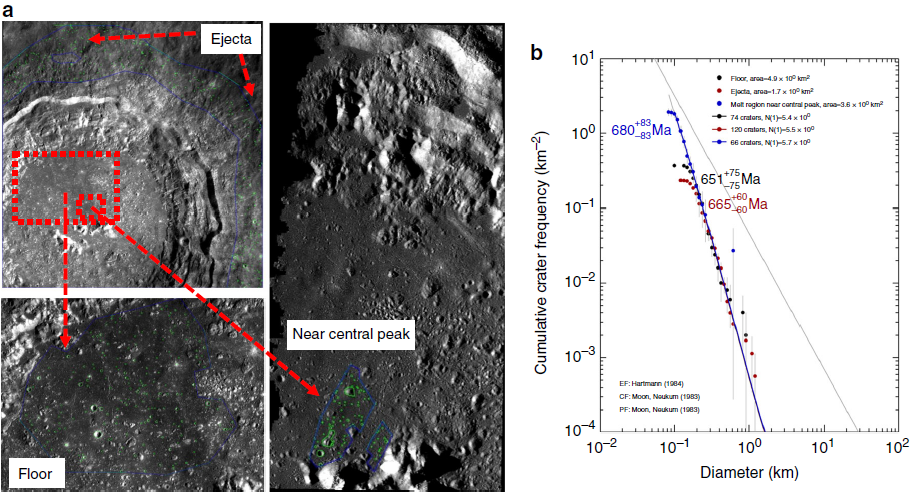
To date, the lunar impact history has been well investigated based on lunar impact glasses collected by the Apollo/Luna missions and/or lunar meteorites. The age of Copernicus crater is generally taken as about 800 million years based on both crater chronology and the radiometric dating of 12033 brecciated soil, which is considered to consist of ejecta from Copernicus crater. The discrepancy in crater age between 800 and 660 million years ago in Terada et al.'s study is due to the difference in the selected area to be counted. Terada et al. obtained an age of 797 million years, whereas an earlier study reported ages of 678 million years for the area observed by KAGUYA CE1 and 678 million years for the Copernicus ray. In addition, Terada et al. investigated other areas around Copernicus crater (floor, ejecta area and melt region near central peak), giving about 660 million years. All of these results mean that there is no discrepancy in counting and calibration between previous work, and Terada et al.'s study. Terada et al also realize that the selected area with an age of 800 million years is close to the centre of Copernicus crater and tends to be affected by secondary craters, so a counting method yielding a younger age of 660 million years is correct for Copernicus crater. Note that the most important of the new findings is that eight craters, including Copernicus, show identical relative ages based on a constant flux model.

 
The terrain camera images and their cumulative size-frequency distributions from the floor, ejecta area and melt region near the central peak of Copernicus crater. Terada et al. (2020).

On the other hand, the absolute age of Copernicus crater is considered to be 800 million years based on the radiometric ages of 12033 brecciated soil collected from the ejecta of Copernicus crater. In addition, a 2015 study reported that Argon⁴⁰/Argon³⁹ data for impact spherules from Apollo 12, 14, 16, and 17 samples show an 800 million years ago spike, similar to that of the 12033 breccia, and concluded that there must have been a transient increase in the global lunar impact flux at 800 million years ago other than Copernicus crater, in the context of diverse compositional ranges and sample locations of impact glass spherules. Such geochemical observations of simultaneous global lunar impacts recorded in Apollo samples well match the coincidence of (at least) eight crater formations derived from our observations, of which the probability is 0.69%. From these considerations, Terada et al. infer that these two observations must be related to each other and newly propose a constant with a spike model of about 800 million years ago instead of a conventional constant model.

This scenario in which sporadic asteroid showers did not occur at 660 million years ago but at 800 million years ago is also supported by recent Lunar Reconnaissance Orbiter observations and/or numerical simulations of the asteroid families. Based on the temperature of large impact ejecta with crater sizes larger than 10 km in diameter, a recent study concluded that there is no evidence of a sporadic peak at approximately 660 million years ago, although that study found that the production rate of lunar craters with diameters of at least 10 km was 2–3 times higher over the last 290 million years. However, the age of 800 million years is very close to the limit of resolution for that study, so there is no contradiction with the 800 million years ago spike model. Furthermore, numerical simulation of the orbits of asteroid families also provides crucial chronological information about the impact flux to the inner solar system. A recent investigation of the dynamics of the asteroid family and the best available Yarkovsky measurements (the measurment of the mechanism by which asteroids are torn apart by their own spin) suggest that the breakup of the parent bodies of Agnia Family of asteroids (669–1003 million years ago) and/or Hansa Family of asteroids (763–950 million years ago) was related to the sporadic asteroid shower at 660 million years ago. However, it is known that these families are not sizable enough and/or not well enough positioned to produce the sporadic asteroid shower, including Copernicus crater with a diameter of 93 km, for which impactor is expected to be 10 km in diameter. Moreover, the Agnia Family is located near the 5:2 resonance, where the probability of a projectile hitting the Moon is very low. The Hansa Family also has difficulty producing an impactor of 10 km for Copernicus because it is located at high inclinations near the 3:1 and 8:3 resonances. However, the Eulalia Family of asteroids, whose age is 830 million years old, could potentially have produced an impact spike at about 800 million years ago. A recent study suggested that when the parent body of Eulalia was disrupted, a large share of the sizable family was directly injected into the 3:1 resonance at low inclinations. This disruption certainly could have produced an impact spike on terrestrial planets and/or their satellites inside the asteroid belt. Interestingly, the Eulalia family is a carbonaceous chondrite family and is considered to be the parent body of near-Earth C-type asteroids, such as Bennu and Ryugu. Such an asteroid shower must have contaminated the lunar surface with volatile elements. This scenario is harmonized with (i) the observation of H₂O in Copernicus crater that may reflect retention of volatiles from hydrous impactors; (ii) the scenario that may have been formed by a cometary nucleus, 4 km in diameter based on geochemistry of the 12033 breccia; and (iii) recent KAGUYA remote-sensing observation of persistent positively charged carbon ions emitted from the whole Moon, which is significantly larger than influxes due to solar wind and/or current micrometeoroid accretion and suggests that the lunar surface might have been contaminated by volatile-rich impactors in the past.

It is obvious that the break-up of large asteroids increases not only the large (over 20 km) crater production rate but also the small (0.1–1 km) crater production rate. From these considerations, we propose the new simplest model: a constant flux with a spike between 830 and 800 million years ago for small craters (0.1–1 km). The basic idea is that the crater counting age of Copernicus crater must be identical to the radiometric age of 800 million years and that the fluxes before and after the sporadic spike at about 800 million years were constant. Although the duration time of the spike is slightly uncertain, Terada et al assume that this duration was 30 million years (from 830 to 800 million years ago), based on the break-up age of Eulalia and the radiometric age of Copernicus crater and/or the deviation of eight clustered ages (658 million years ago) for a constant model.The constant flux of the new spike model is 75% (663 million years/800 million years) of the conventional constant flux model, and the flux between 800 million years and 830 million years is 23 times higher than that in other eras to ensure that the total crater production over 3 billion years is identical for both models.

As a result, the modified age distribution shows that 16 of the 59 craters coincide with that of Copernicus crater within the analytical certainties although the large (over 20 km) crater production rate and the small (0.1–1 km) crater production rate might be coupled in this model. However, the estimated total masses are not significantly changed (1.3–1.6 million megatonnes for the constant flux model and 1.8–2.3 million megatonnes for the 800 million year spike model) because Copernicus crater is dominant among the eight coincident craters (by the constant model) and the 17 coincident craters (by the spike model). Therefore, the latter discussion on the total mass estimation of the impactor is not affected by the choice of a flux model with/without the spike. Moreover, it should also be noted that the slopes of the lines below 300 million years in both models are gentler than those of other eras, which is quite consistent with the previous study that the production rate of lunar craters (over 10 km) has been 2–3 times higher over the last approximetely 290 million years, which is derived from an independent approach based on the temperature of large impact ejecta.

Recent observations by the Chandrayaan-1 and LADEE lunar orbiters suggests that an active water cycle exists on the Moon and that hydrated soil is present under the desiccated soil layer of several centimetres over the Moon surface. One 2017 study observes that the Copernicus crater exhibits high water content that may reflect the retention of volatiles from hydrous impactors according to the Moon Mineralogy Mapper. In addition, Terada et al recently found that positive carbon ions are persistently emitted from the whole of the Moon as detected by the lunar orbiter KAGUYA and that this flux is significantly larger than the influx estimated from solar wind and/or current micrometeoroid accretion. These observations suggest that volatile elements are ubiquitous over the lunar surface and that the Moon is currently in the process of losing volatiles (water, carbon, etc.), although when and how the surface of the Moon attained and/or retained such volatiles has been enigmatic. Assuming a CI chondrite-like chemical composition (a few percent by weight of carbon and H₂O), Terada et al 's scenario predicts that a C-type asteroid shower at 800 million years ago must have supplied about 100 000 megatonnes of carbon and H₂O to the lunar surface. This new paradigm undoubtedly should place new constraints on the history of lunar volatiles.

Since the Earth–Moon system has been co-evolving over 4.5 billion years, this new finding provides crucial insight into the Earth–Moon system because asteroid showers must have occurred not only on the Moon but also on the Earth. Based on the probability ratio of collisions with the Earth and the Moon of 23:1, Terada et al. conclude that a mass of 40-50 million megatonnes (corresponding to a diameter of about 30–40 km and about 30–60 times greater in mass than the Chicxulub asteroid impactor must have collided successively on the Earth at about 800 million years ago, i.e. immediately before the Cryogenian (720–635 million years ago), which was an era of great environmental and biological changes. To date, however, no direct geological evidence of a large-scale impact in the Neoproterozoic has been found. Moreover, remarkable iridium concentrations as well as other platinum-group elements anomalies, such as those at the Cretaceous-Palaeocene boundary, have not been found, although only the Marinoan Glaciation (650–635 million years ago) is characterized by increased concentrations of iridium. The straightforward interpretation is that the following large-scale Neoproterozoic glaciations, the socalled Snowball Earth (that is, the Kaigas-Sturtian glaciation from 730 to 700 million years ago and the Marinoan Glaciation) and/or their deglaciation processes, might have erased a significant part of the earlier geological and/or geochemical history.

To date, the impact history and subsequent effects on the environment in the Neoproterozoic and Cryogenic have not been understood because terrestrial craters are not well preserved due to erosion. One recent study discussed the mechanical effects of one impact of an asteroid 5–10 km in diameter on the Snowball Earth environment, suggesting that the products of impact (mainly water vapour) could be quickly distributed over a substantial part of the globe, influencing the global circulation (e.g. facilitating cloud formation), because one impact cratering event (shock waves and impact crater formation) might produce much dust that entered the atmosphere and might have caused albedo changes. Another study noted that the Ordovician meteorite shower should have triggered the mid-Ordovician ice age based on the sizes of the remaining terrestrial craters. Thus, large asteroid showers should influence the global ecosphere in some ways, although mechanisms are not well realised because of the unknown characteristics of the dust, e.g. size, albedo, mineralogy, and chemical composition.

Interestingly, another study found that the average phosphorus content of late Tonian samples is more than four times greater than that of pre-Cryogenian samples and noted that a fundamental shift in the phosphorus cycle may have occurred during the late Proterozoic Eon after 800 million years ago (until 635 million years ago). Terada et al.'s new finding suggests that about 100 000 megatonnes of extra-terrestrial phosphorus should have accreted across the Earth assuming CI chondrite composition (0.1 percent by wieght phosphorus) at 800 million years ago, which is one order of magnitude higher than the total phosphorus amount of the modern sea (assuming that the volume of modern seas is 1350 million km³ and the concentration of phosphorus is about 3 μg/litre). In general, large-scale changes in marine biogeochemical cycles are undoubtedly forced by tectonic and magmatic processes and chemical weathering of the continental crust, but Terada et al.'s new finding suggests that the flux of extra terrestrial bioavailable elements might also have influenced marine biogeochemical cycles, marine redox states, severe perturbations to Earth’s climate system, and the emergence of Animals. Thus, lunar crater chronology provides new insight into external forcing from asteroids that might have driven ecosystems towards larger and increasingly complex organisms after 800 million years ago, although further quantitative discussion will be required.

See also...


Follow Sciency Thoughts on Facebook.