Asterozoans, whose most familiar members include Starfish and Brittle Stars, are the dominant group of extant Echinoderms based on their diversity, abundance and biogeographic distribution. Despite their ecological success and a fossil record spanning more than 480 million years, the origin and early evolution of Asterozoans, and those of crown-group Echinoderms more generally, remain uncertain given the difficulty of comparing the organisation of the calcified endoskeleton in diverse Lower Palaeozoic groups, such as the Edrioasteroids and Blastozoans. The extraxial–axial theory, which supports the homology of the biserial ambulacral ossicles of pentaradial and non-pentaradial Echinoderms based on embryonic and ontogenetic data, has been proposed as a developmentally informed model that facilitates comparisons among groups with disparate morphologies. Although the extraxial–axial theory can potentially clarify the early evolution of crown-group Echinodermata, the broad implications of this hypothesis have never been examined under a comprehensive quantitative phylogenetic framework. Consequently, the main phylogenetic predictions of the extraxial–axial theory, pertaining to the evolutionary relationships of Cambrian and Ordovician Echinoderms, such as the origin of the crown group from Edrioasteroid-like ancestors, although analysed with other homology schemes, have yet to be critically tested using the extraxial–axial theory.
In a paper published in the journal Biology Letters on 20 January 2021, Aaron Hunter of the Department of Earth Sciences at the University of Cambridge and the School of Earth Sciences, at the University of Western Australia, and Javier Ortega-Hernández of the Museum of Comparative Zoology and Department of Organismic and Evolutionary Biology at Harvard University, and the Department of Zoology at the University of Cambridge, describe a new Somasteroid Echinoderm from the Early Ordovician Fezouata Lagerstätte of Zagora, in thecentral Anti-Atlas of Morocco.
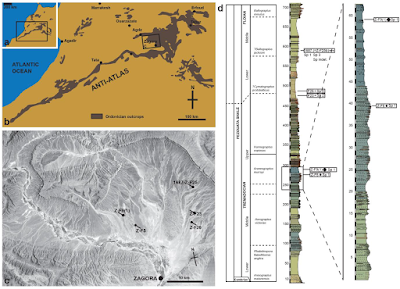
Locality and stratigraphic occurrence of Cantabrigiaster at Lower Ordovician Echinoderm sites from the Anti-Atlas, Morocco. (a) Location of the Anti-Atlas range in northwestern Africa. (b) Map of the Anti-Atlas showing the distribution of Ordovician outcrops and the location of the Zagora area. (c) Landsat view of the Zagora area showing the location of all main Early Ordovician echinoderm localities that contain Somasteroids photograph courtesy of the U.S. Geological Survey. (d) Synthetic, composite stratigraphic column showing the Lower Ordovician succession in the Zagora area, central Anti-Atlas, Morocco. With detailed, stratigraphic columns showing the late Tremadocian interval (Araneograptus murrayi Zone and part of the Hunnegraptus copiosus Zone) showing the position of the main Somasteroid fossils. Hunter & Ortega-Hernádez (2021). The exceptionally preserved morphology of the specimens reveals a unique plate organisation among Somasteroids, and allows us to test the phylogenetic implications of this taxon for the origin of total-group Asterozoa. Central to Hunter and Ortega-Hernádez's phylogenetic hypothesis is the presence of an imperforate extraxial body capsule on the aboral surface of the Somasteroids which is then lost in derived Asterozoans so that the aboral surface is entirely composed of perforate extraxial body wall, for example, carinals in Asteroids, and ventral, dorsal and lateral arm plates in Ophiuroids.
The new species is named Cantabrigiaster fezouataensis, where 'Cantabrigiaster' derives from Genus name derived from ‘Cantabrigia’, after the cities of Cambridge in the UK and USA, which were home to the influential Asterozoan workers John William Salter (University of Cambridge), Juliet Shackleton (neé Dean) (University of Cambridge) and Howard Barraclough ‘Barry’ Fell (Harvard University). No explanation is given for 'fezouataensis', although it appears to mean 'coming from Fezouata'.
Cantabrigiaster fezouataensis is a Somasteroid typified by biserial and offset ambulacrals with thin transverse bar, wide perradial groove, multiple interconnected virgal ossicles and aboral carinal region with network of spicule-like ossicles. Adambulacral ossicle series lacking along abaxial body margins (perpendiculars (virgals), structures 90° to the axial ambulacrals).
The designated holotype of the species (i.e. the specimen to which all other specimens are compared in order to determine whether they are the same species) is UCBL-FSL 424961, an articulated specimen and latex moulds deposited at the University of Lyon 1. This is derived from the primarily Stylophoran-dominated beds in the upper part of the Araneograptus murrayi Zone, late Tremadocian, Z-F2 (Jbel Tizagzaouine), Z-F4 (Bou Izargane) and Z-F9 (Bou Glef), in the lower part of the Fezouata Shale Formation, Lower Ordovician, Zagora area (central Anti-Atlas), Morocco. The 70 m thick interval yields assemblages typical of the Fezouata Biota at about 260–330 m above the base of the Ordovician.
Also referred to Cantabrigiaster fezouataensis are another 31 specimens, including: specimens housed at the Yale Peabody Museum, Yale University, Hotchkiss collection (YPM IP 535545–535559); the collections of Vizcaïno (UCBL-FSL 424962) and Lefebvre (UCBL-FSL 711938 and 711939) housed at the University of Lyon 1; and the Catto collection deposited in the Natural History Museum of Nantes (MHNN.P.045596).
 Cantabrigiaster fezouataensis from the Lower Ordovician (?late Tremadocian) of Morocco. All body fossils. (a) YPM 535547, oral view. (b) Detail of dashed area in a. (c) YPM IP 535557-535558, oral and aboral view. (d) YPM IP 535559, aboral view. (e) Detail of dashed area in d. (f) YPM 535552, aboral view. (g) Detail of dashed area in (f). Abbreviations: am, ambulacral ossicles; cr, carinal region ossicles (preserved on the aboral surface); mc, mouth cavity; pb, podial basins; vr, virgal ossicles. Hunter & Ortega-Hernádez (2021).
The arms of Cantabrigiaster fezouataensis are broad, petaloid and arranged in a pentagonal outline The aboral skeleton (carinal region) is composed of randomly scattered spicule-like ossicles arranged into an irregular network. On the oral side, the ambulacrals consist of flattened ossicles with a subquadrate outline. These ossicles abut each other following the orientation of the perradial axis. The perradial suture is straight, and the ambulacrals at either side are stepped out of phase by approximately half an ossicle. The abaxial organisation of the ambulacrals consists of an elevated perradial ridge, less than a quarter in width relative to the ambulacral, and bears a thin transverse bar that occupies a central position, conferring a T-shape in oral view. The perradial ridges of the ambulacral ossicles at either side of the perradial suture are substantially separated from each other, forming a wide oral groove. The podial basins are shared equally between adjacent ambulacrals. Abaxially, the following ossicle series consist of the perpendiculars, also known as virgals in Somasteroids. The perpendicular series is composed of interconnected and robust rod-like virgal ossicles without spines. These ossicles follow a perpendicular orientation relative to the perradial suture. The virgal ossicles close to the ambulacrals are the largest, becoming smaller in length and width towards the abaxial body margins. Likewise, adjacent perpendicular series are in direct contact with each other adaxially relative to the perradial suture, whereas it is possible to observe open gaps between them towards the abaxial body margins. Proximal (relative to the mouth) perpendicular series consist of up to nine virgal ossicles, which gradually decrease in number towards the tips of the arms. The circumoral ossicles are enlarged relative to ambulacral ossicles, and the first podial pore is shared equally with the small and sub-triangular mouth angle plates. The madreporite is not preserved.

Cantabrigiaster fezouataensis from the Lower Ordovician (Tremadocian) of Morocco. Holotype UCBL-FSL 424961 (Van Roy coll.). (a) Oral view (body fossil). (b) Interpretative diagram of (a). (c) Close-up of extended arm (latex mould). (d) Interpretative diagram of (c). (e) Close-up of oral region (latex mould). ( f ) Interpretative diagram of (e). am, ambulacral ossicles; co, circumoral ossicles; cr, carinal region ossicles (preserved on the aboral surface); map, mouth angle plates; mc, mouth cavity; pb, podial basins; ps, podial suture; vr, virgal ossicles. Hunter & Ortega-Hernádez (2021).
The presence of virgal ossicles in Cantabrigiaster strongly supports its affinities with Somasteroids. Cantabrigiaster bears the greatest similarity to the Tremadocian taxa Chinianaster, Thoralaster and Villebrunaster, but is unique among somasteroids in lacking ossicles along the abaxial lateral margins of the arms. The arm construction of Cantabrigiaster consists of flattened and offset biserial ambulacrals, each of which articulates with an abaxially oriented perpendicular series composed of simple virgal ossicles. In addition to these features, the arms of all other Somasteroids also possess a series of axially oriented ossicles along the lateral margins that vary from small and bead-like, albeit with occasional spikes, in Tremadocian taxa, to robust and block-like in the stratigraphically younger (Floian) Ophioxenikos and Darriwilian) Archegonaster. The absence of this key character and the results of Hunter and Ortega-Hernádez's phylogeny demonstrate that Cantabrigiaster embodies the ancestral condition by virtue of lacking ossicles defining the lateral arm margins, whereas other Somasteroids record the first appearance of these structures along the edges of the arms, and their subsequent changes in size and shape. Based on this sequence,we propose that the origin of new axially oriented ossicle series in early Asterozoans required their formation on the abaxial edges of the arms. Our hypothesis implies that the proximity of axially oriented ossicle series relative to the perradial axis reflects the order of their evolutionary appearance since virgals are abaxially oriented, they are not directly comparable with any of the axially oriented ossicle series observed in Palaeozoic Asterozoans. In this context, Cantabrigiaster specifically lacks the adambulacral ossicle series present in more derived Somasteroids, Ophiuroids, Asteroids and Stenuroids (a group considered intermediate between Somasteroids and Ophiuroids/Asteroids), highlighting its profound significance for understanding the evolution of the Asterozoan body plan.

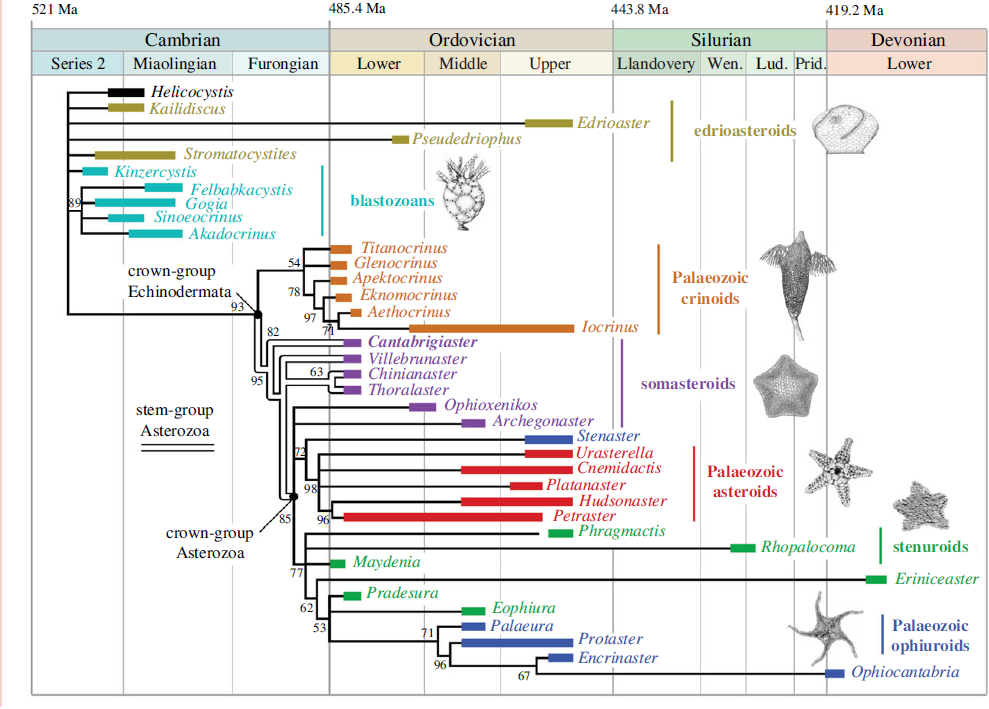
Phylogeny of total-group Echinodermata. Strict consensus topology based on the Bayesian-inference analysis of 38 taxa and 74 morphological characters informed by the extraxial–axial theory. The Asterozoan/Crinoid clade represented does not imply a sister group relationship; Echinozoan/Asterozoan monophyly has been established using molecular data. Wen., Wenlock; Lud., Ludlow; Prid., Přídolí. Hunter & Ortega-Hernádez (2021).
The extraxial–axial theory supports the homology of the ambulacrals across pentaradial total-group Echinoderms based on their developmental origin and postembryonic ontogeny, and allows comparison of the skeletal organization of Cantabrigiaster on a broader phylogenetic scale. Outside Asterozoa, the absence of adambulacrals in Cantabrigiaster draws parallels with Tremadocian Crinoids (e.g. Protocrinoids, Apektocrinus, Eknomocrinus), whose arm construction incorporates flattened and offset biserial ambulacrals articulated to an abaxially oriented (perpendicular) series of simple ossicles, here expressed as the cover plates. A similar axial skeletal organisation is also observed among Cambrian forms, most notably Edrioasteroids, which also possess flattened and offset biserial ambulacrals but lack feeding appendages, and to a lesser extent Blastozoans, which have feeding appendages formed by modified ambulacrals known as brachioles. The widespread occurrence of these characters among non-asterozoan groups suggests that their presence in Cantabrigiaster is symplesiomorphic.
 Cantabrigiaster fezouataensis from the Lower Ordovician (Tremadocian) of Morocco. All latex molds. (a) Holotype UCBL-FSL 424961 (Van Roy coll.), oral view. (b) UCBL-FSL 711938 (Lefebvre coll.), oral view. (c) UCBL-FSL 424961 (Van Roy coll.), oral view. (d) UCBL-FSL 711939 (Lefebvre coll.), aboral view. (e) MHNN.P.045596 (Catto coll.), oral view. (f) UCBL-FSL 424962a (Vizcaïno coll.), aboral view. (g) UCBL-FSL 424962b (Vizcaïno coll.). Abbreviations: am, ambulacral ossicles; co, circumoral ossicles; cr, carinal region ossicles (preserved on the aboral surface); map, mouth angle plates; mc, mouth cavity; tb, transverse bar; pb, podial basins; pr, perradial ridge; ps, perradial suture; vr, virgal ossicles. Hunter & Ortega-Hernádez (2021).
Hunter and Ortega-Hernádez's phylogenetic analysis of representative Lower Palaeozoic total-group Echinoderms tests the significance of Cantabrigiaster for the origin of Asterozoa. The dataset reflects the ambulacral homology proposed by the extraxial–axial theory, the oral symmetry model proposed by Universal Element Homology and Hunter and Ortega-Hernádez's hypothesis for the correspondence of axially oriented ossicle series in early Asterozoans. Bayesian and parsimony-based analyses recover practically identical topologies, despite a loss in tree resolution in the earliest divergent representatives that can be expected from the former methodology, indicating a robust phylogenetic signal within Asterozoa. Cantabrigiaster occupies the earliest diverging position within total-group Asterozoa, supporting our hypothesis that the absence of adambulacrals is an ancestral condition, rather than a case of secondary reduction. Tremadocian Somasteroids are resolved as a paraphyletic grade of stem-group Asterozoans, whereas the Floian Ophioxenikos and Darriwilian Archegonaster consistently occupy a more derived position as members of crown-group Asterozoa. The analyses argue against the monophyly of Stenuroids, but corroborate their close phylogenetic relationship to Ophiuroids, specifically as their earliest diverging stem-group representatives. These findings indicate that the evolution of a well-developed adambulacral ossicle series constitutes a critical step in the origin of crown-group Asterozoa, and suggest that the abaxially oriented virgals of Somasteroids became independently reduced, and ultimately lost, within the stem lineages of Ophiuroidea and Asteroidea.

Morphological reconstruction of Cantabrigiaster fezouataensis. (a) Aboral view. (b) Oral view. (c) Cross section of isolated arm in oblique view. (d) Cross section of main body cavity lateral view. (e) Isolated virgal ossicle series and ambulacrals in oral view. (f) Life reconstruction of Cantabrigiaster fezouataensis. Abbreviations: am, ambulacral ossicles; cr, carinal region ossicles (preserved on the aboral surface); map, mouth angle plates; pr, perradial ridge; ps, podial suture; tb, transverse bar; vr, virgal ossicles. Marguerite Lardanchet in Hunter & Ortega-Hernádez (2021).
See also...


Online courses in Palaeontology.
Follow Sciency Thoughts on Facebook.
Follow Sciency Thoughts on Twitter.


%20(1).png)