Showing posts with label Foxes. Show all posts

Tuesday, 30 August 2022

Fishing observed in a Red Fox for the first time.

Red Foxes, Vulpes vulpes, are small mesocarnivorous  found across Eurasia and North America, and introduced to Australia. They are extremely flexible hunters, able to adapt their behaviour to a wide range of prey species. Fish remains have occasionally been found associated with Foxes, but they have never been observed fishing, despite living in close proximity to Humans in many parts of the world, which has led to speculation that they are scavenging Fish rather than actively hunting them.

In a paper published in the journal Ecology on 18 August 2022, Jorge Tobajas of the Departamento de Botánica, Ecología y Fisiología Vegetal at the Universidad de Córdoba, the Instituto de Investigación en Recursos Cinegéticos, and the Biodiversity Research Institute at the University of Oviedo, and Francisco Díaz-Ruiz of the Biogeography, Diversity, and Conservation Research Team at the Universidad de Málaga, describe witnessing a male Red Fox hunting Fish.

The observation was made while Tobajas and Díaz-Ruiz were carrying out fieldwork near the Valuengo reservoir in southern Extremadura, on 24 March 2016. Here, a male Red Fox was observed capturing European Carp, Cyprinus carpio, while they were mating close to the water's edge.

Male Red Fox, Vulpes vulpes, capturing a European Carp, Cyprinus carpio, at the Valuengo reservoir in southern Extremadura, in March 2016. Tobajas & Díaz-Ruiz (2022).

The Fox was observed catching Carp between 1.18 and 2.51 pm, at which point it noticed it was being observed and fled. During this time it made 12 hunting attempts, capturing 10 Fish with an estimated average mass of about 1 kg. This represents a capture success rate of 83%. The Fox was hunting while the Carp were in a reproductive frenzy, and paying little head to the danger present. Fish were captured by simply jumping into the water and grabbing them. After each successful hunt the Fish was carried to a site 20-30 m from the water's edge and buried, hidden, or simply left, presumably for later consumption. The Fox was never observed to eat any substantial part of the Fish, although small parts (possibly eggs?) were consumed on several occasions. At one point a female Fox was observed removing one of the Carp that the male had captured. The male Fox did not challenge this behaviour, suggesting that she was his mate, and that the male was capturing the Fish for the benefit of the female and a litter of pups (unobserved).

Female Red Fox recovering a Fish previously hunted by the male. Tobajas & Díaz-Ruiz (2022).

This observation adds significantly to our understanding of the ecology of the Red Fox, a familiar species generally thought to be well understood, and about which new discoveries would not be expected. It clearly demonstrates that Foxes are highly able hunters of Fish; such a high success rate is unlikely to represent an opportunistic action by a single animal, but is more likely to represent hunting by a Fox with an instinct for such behaviour, which has been further honed through experience.
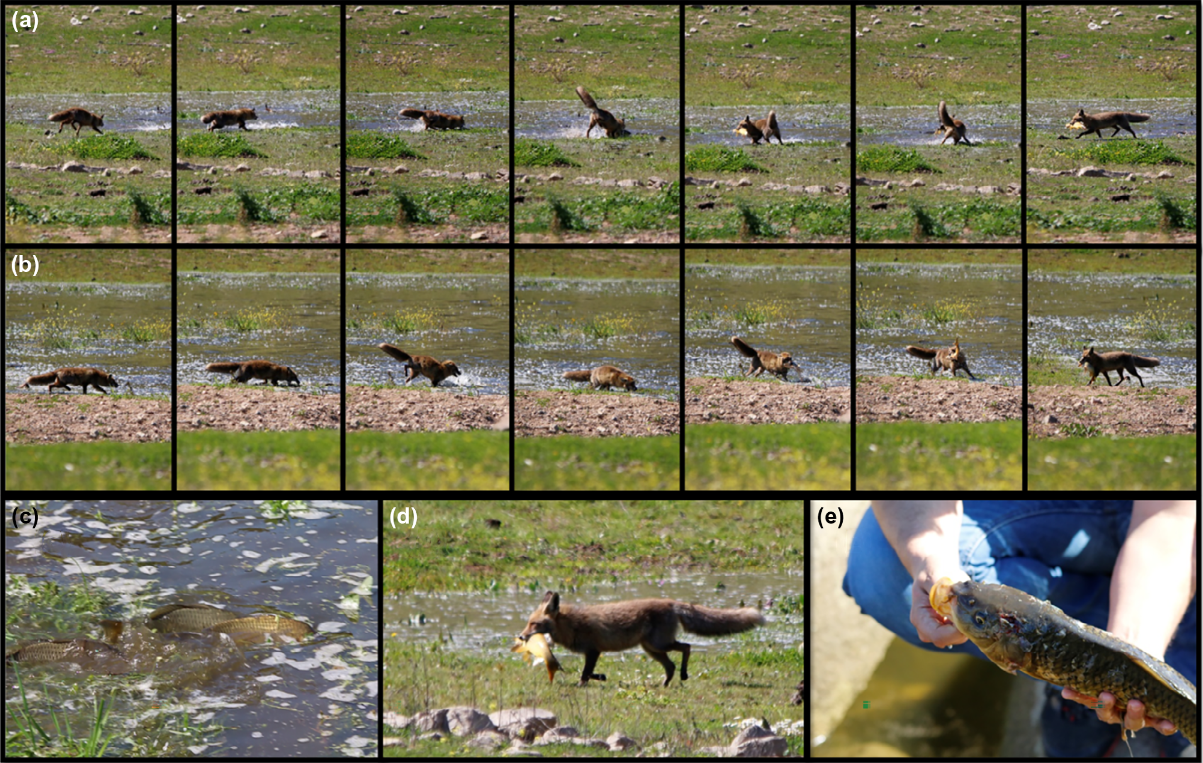
(a), (b) Two sequences showing the Red Fox, Vulpes vulpes, hunting European Carp, Cyprinus carpio, on the shore of the Valuengo reservoir (southern Extremadura; Spain) during the Carp spawning period, March 2016. (c) European Carp spawning eggs and distracted by the frenzy of reproduction in the shallow reservoir shore. (d) Red Fox carrying a large European Carp far to the shore.(e) European Carp hunted by the Red Fox with the fatal incisions on the head. Tobajas & Díaz-Ruiz (2022).

At first site this observation appeared to represent an incident of 'overkill' by the Fox, i.e. a case of a Fox being presented with an overabundance of easy prey and killing more than it needs to consume out of some sort of misfiring instinct (an explanation often used to justify the hunting of Foxes). However, an animal killing prey which are then consumed by other members of its social unit (such as, in this case, its mate and presumed young) is far from maladaptive. Instead, this appears to be a good use of a seasonally available food resource which coincides with the Fox's own breeding cycle. Similar behaviour has been observed among Arctic Foxes, Vulpes lagopus, which cache large numbers of Bird's eggs in order to feed their young.

See also...
Follow Sciency Thoughts on Facebook.

Follow Sciency Thoughts on Twitter.


Saturday, 16 January 2016

Animal remains from Middle Neolithic deposits at the Pena d’Água Rock-shelter of Portugal.

Middle Neolithic remains are known from a number of archaeological sites across Portugal, and have been studied since the nineteenth century. However historically almost all studies of this material have concentrated on funerary behavior rather than the lifestyles of the living people. The Pena d’Água Rock-shelter is located on the eastern rim of the Estremadura Limestone Massif to the northeast of Lisbon. The site was excavated in 1992-2000, yielding remains dating from the end of the Pleistocene to the Roman era. A variety of animal bones and teeth were recovered from a layer identified as being of Middle Neolithic origin, with Rabbit, Sheep and/or Goat (the two are hard to tell apart from skeletal remains) and Fox remains being identified at the time, though these have not subsequently been the subject of any published studies.

In a paper published in the journal Estudos do Quaternário in December 2015, Fransisco Rosa Corriera and the Sofia Luís of the Universidade do Algarve, Pedro Valente Fernandes of the Universidade do Algarve and the Núcleo de Alunos de Arqueologia e Paleoecologia, and Maria João Valente and António Faustino Carvalho, also of the Universidade do Algarve re-examine the Middle Neolithic animal remains from the Pena d’Água Rock-shelter in order to determine the animals present and the implications of this for the lifestyles of the people.

(A) Location of Estremadura and the Tagus Valley in western Iberia. (B) Location of the mentioned archaeological sites (1 - Pena d’Água Rock-shelter; 2 - Costa do Pereiro; 3 - Cadaval Cave). (C) A view of the Pena d’Água Rock-shelter (arrow) in Google Earth showing the Arrife clearly separating the two contrast-ing landscapes, the limestone mountain (right) and the Tagus plain (left). (D) Detail image of the Arrife showing the Pena d’Água Rock-shelter (arrow indicates the sector of the deposit where excavations took place). Corriera et al. (2015).

All of the remains assessed to be Middle Neolithic come from a single layer, Db, which also contains pottery fragments, stone tools and charcoal. The pottery fragments showed simpler decoration and were less varied than earlier layers assessed to be Early Neolithic in age, though the stone tools were more sophisticated and include large, complex flint blades. The charcoal was found to be derived from Olive wood, and yielded a radiocarbon age of 5180 years, though with a wide margin of error, leading Corriera et al, to conclude that the layer was laid down between 4522 and 3515 BC.
 

Stratigraphy of the Pena d’Água Rock-shelter (“West Cut”), with indication of layer Db (greyish layer) within the sequence. Z0=630 cm is the local datum used during excavations. Corriera et al. (2015).

The most abundant bones in the layer are those of Rabbits, Oryctolagus cuniculus. Identifying Rabbits in archaeological sites can be problematic. as they are burrowing animals which can place tunnel into site long after they were abandoned by their Human residents. However all of the remains at Pena d’Água are aof adult specimens, and in addition all are disarticulated and fragmentary, and many are charred, suggesting strongly that the remains are the result of Human activity.

The site also yielded several teeth from Fox, Vulpes vulpes, and an uncertain Deer (possibly a Red Deer, Cervus elaphus). Both of these are though to be the result of hunting by Humans, possibly with only partial remains being transported to the site. Red Deer are prized for their meat today, and are likely to have been hunted for food in the Neolithic. Foxes on the other hand are not typically eaten, today, and probably weren't considered particularly palatable in the Neolithic. On the other hand their fur has been prized through much of recorded history, and this may have been the case at Pena d’Água.

Sheep and/or Goat remains are also abundant at the site. These are interpreted as being more probably the remains of domestic animals than wild ones. Domestication is known to have been in practice in the area at the time, with other sites having yielded the remains of Cattle and Pigs. However the methods used to keep these animals is quite different. Cattle and Pigs can be kept in corals and fed with a reasonable level of success, while Sheep and Goats need to be able to forage for themselves, requiring herders to move with the flock, so this discovery adds to the known range of survival skills being employed in Middle Neolithic Portugal.

See also...

http://sciencythoughts.blogspot.co.uk/2015/08/evidence-of-cereal-cultivation-by-sea.htmlEvidence of Cereal cultivation by the Sea of Galilee during the last Glacial Maximum, 23 000 years ago.                                                           The domestication of agricultural plants is thought to have begun in the Middle East around the onset of the Holocene, about 11 700 years ago, with agriculture rapidly spreading across Europe, Asia and northern...
http://sciencythoughts.blogspot.co.uk/2015/06/interpreting-life-history-of-egtved-girl.htmlInterpreting the life history of the Egtved Girl.                                                                                   The ‘Egtved Girl’ was excavated near Egtved...
http://sciencythoughts.blogspot.co.uk/2014/08/the-first-dairy-farmers-in-finland.htmlThe first dairy farmers in Finland.              Dairy farming (keeping Mammals in order to consume their milk or products derived from it) spread through Europe as part of the ‘Neolithic Package’ of technologies, which originated in the Middle East...
 
 
Follow Sciency Thoughts on Facebook.
 

Saturday, 28 December 2013

A new species of Fox from the Pleisticene of Gauteng Province, SouthAfrica.

Foxes (Vulpini) are a subgroup of the Dog Family, Canidae, found in North America, Eurasia and Africa (South American Foxes are a separate group, more closely related to True Dogs than to other Foxes). The group first appear in the fossil record in the Late Miocene (about 10.5 million years ago) in North America, where they are thought to have originated. The oldest known Foxes from outside North America appear in Central Africa in deposits about 7 million years in age, suggesting that the group must have spread across Eurasia and the Middle East by this time, though the earliest known Eurasian Foxes are much younger.

In a paper published in the Transactions of the Royal Society of South Africa on 16 January 2013, a team of scientists led by Adam Hartstone-Rose of the Pennsylvania State University Altoona, descibe a new species of Fox from the Early Pleistocene Malapa Cave locality in Gauteng Province, South Africa.

The new species is named Vulpes skinneri, in honour of the late John Dawson Skinner, long-time director of the University of Pretoria Mammal Research Institute and author of many seminal works on African mammals.The specimens referred to the new species were initially refered to the species Vulpes chama when they were first recorded in 2011, but closer examination suggests that they are from a separate species.

Left mandible of Vulpes skinneri in (A) superior, (B) lateral, (C) medial and (D) posterior views. Hartstone-Rose et al. (2013).


Follow Sciency Thoughts on Facebook.