Showing posts with label Canids. Show all posts

Tuesday, 30 August 2022

Fishing observed in a Red Fox for the first time.

Red Foxes, Vulpes vulpes, are small mesocarnivorous  found across Eurasia and North America, and introduced to Australia. They are extremely flexible hunters, able to adapt their behaviour to a wide range of prey species. Fish remains have occasionally been found associated with Foxes, but they have never been observed fishing, despite living in close proximity to Humans in many parts of the world, which has led to speculation that they are scavenging Fish rather than actively hunting them.

In a paper published in the journal Ecology on 18 August 2022, Jorge Tobajas of the Departamento de Botánica, Ecología y Fisiología Vegetal at the Universidad de Córdoba, the Instituto de Investigación en Recursos Cinegéticos, and the Biodiversity Research Institute at the University of Oviedo, and Francisco Díaz-Ruiz of the Biogeography, Diversity, and Conservation Research Team at the Universidad de Málaga, describe witnessing a male Red Fox hunting Fish.

The observation was made while Tobajas and Díaz-Ruiz were carrying out fieldwork near the Valuengo reservoir in southern Extremadura, on 24 March 2016. Here, a male Red Fox was observed capturing European Carp, Cyprinus carpio, while they were mating close to the water's edge.

Male Red Fox, Vulpes vulpes, capturing a European Carp, Cyprinus carpio, at the Valuengo reservoir in southern Extremadura, in March 2016. Tobajas & Díaz-Ruiz (2022).

The Fox was observed catching Carp between 1.18 and 2.51 pm, at which point it noticed it was being observed and fled. During this time it made 12 hunting attempts, capturing 10 Fish with an estimated average mass of about 1 kg. This represents a capture success rate of 83%. The Fox was hunting while the Carp were in a reproductive frenzy, and paying little head to the danger present. Fish were captured by simply jumping into the water and grabbing them. After each successful hunt the Fish was carried to a site 20-30 m from the water's edge and buried, hidden, or simply left, presumably for later consumption. The Fox was never observed to eat any substantial part of the Fish, although small parts (possibly eggs?) were consumed on several occasions. At one point a female Fox was observed removing one of the Carp that the male had captured. The male Fox did not challenge this behaviour, suggesting that she was his mate, and that the male was capturing the Fish for the benefit of the female and a litter of pups (unobserved).

Female Red Fox recovering a Fish previously hunted by the male. Tobajas & Díaz-Ruiz (2022).

This observation adds significantly to our understanding of the ecology of the Red Fox, a familiar species generally thought to be well understood, and about which new discoveries would not be expected. It clearly demonstrates that Foxes are highly able hunters of Fish; such a high success rate is unlikely to represent an opportunistic action by a single animal, but is more likely to represent hunting by a Fox with an instinct for such behaviour, which has been further honed through experience.
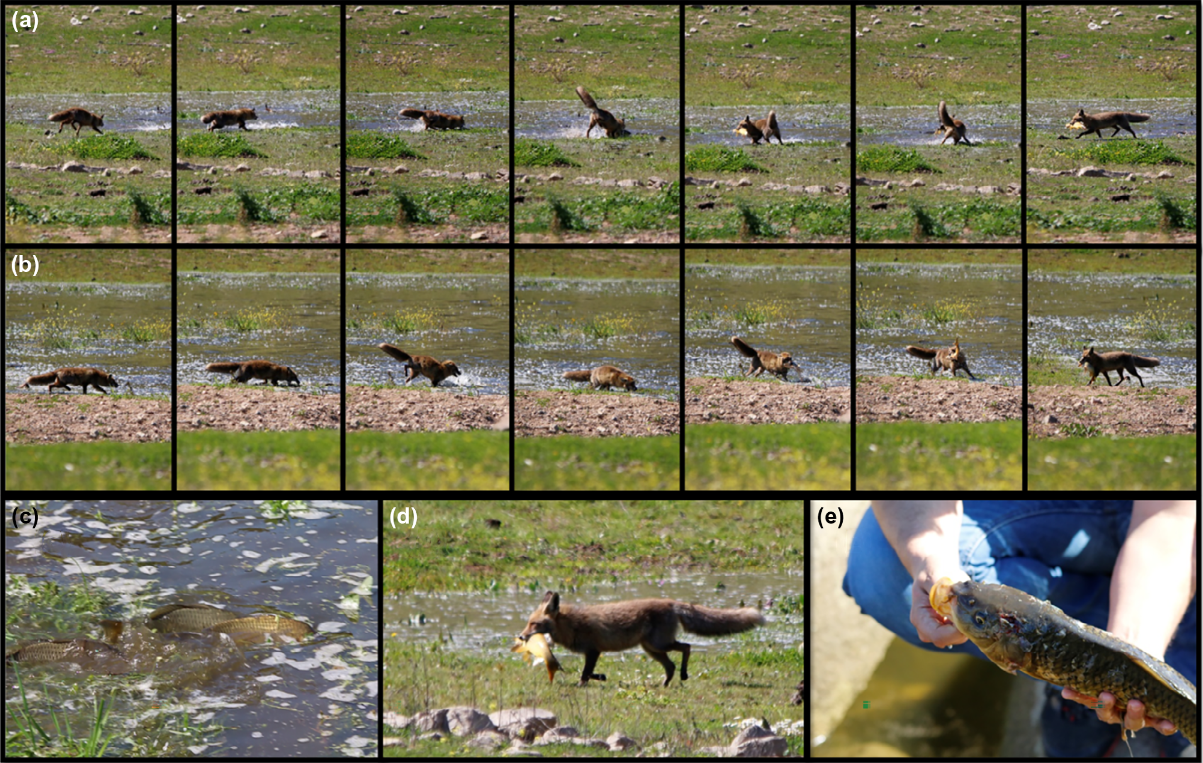
(a), (b) Two sequences showing the Red Fox, Vulpes vulpes, hunting European Carp, Cyprinus carpio, on the shore of the Valuengo reservoir (southern Extremadura; Spain) during the Carp spawning period, March 2016. (c) European Carp spawning eggs and distracted by the frenzy of reproduction in the shallow reservoir shore. (d) Red Fox carrying a large European Carp far to the shore.(e) European Carp hunted by the Red Fox with the fatal incisions on the head. Tobajas & Díaz-Ruiz (2022).

At first site this observation appeared to represent an incident of 'overkill' by the Fox, i.e. a case of a Fox being presented with an overabundance of easy prey and killing more than it needs to consume out of some sort of misfiring instinct (an explanation often used to justify the hunting of Foxes). However, an animal killing prey which are then consumed by other members of its social unit (such as, in this case, its mate and presumed young) is far from maladaptive. Instead, this appears to be a good use of a seasonally available food resource which coincides with the Fox's own breeding cycle. Similar behaviour has been observed among Arctic Foxes, Vulpes lagopus, which cache large numbers of Bird's eggs in order to feed their young.

See also...
Follow Sciency Thoughts on Facebook.

Follow Sciency Thoughts on Twitter.


Wednesday, 29 December 2021

Tracking the feeding habits of Dholes in the Ujung Kulon National Park, southwestern Java.

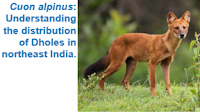
Dholes, or Asian Wild Dogs, Cuon alpinus, were once found across a wide swath of South, Central, East, and Southeast Asia, from Bangladesh, Bhutan, India, Nepal, and Pakistan north to Kazakhstan, and east to China, the Korean Peninsula, and the Russian Far East, and south to Cambodia, Laos, Malaysia, Myanmar, Thailand, Vietnam, and the Indonesian islands of Java and Sumatra. However, habitat fragmentation across this range has badly impacted the species, and Dholes are now thought to occupy less than 25% of their former range, and are considered to be Endangered under the terms of the International Union for the Conservation of Nature’s Red List of Threatened Species.

In Indonesia Dholes are protected by law, and are thought to have a widespread but fragmented distribution. A limited number of studies have been carried out on the distribution and habits of Dholes, and while potential prey species have been identified in two national parks where they are known to occur (Baluran National Park and Ujung Kulon National Park, both on the island of Java), but direct evidence of prey selection or feeding has been sparse.

In a paper published in the Journal of Threatened Taxa on 26 December 2021, Dede Aulia Rahman of the Department of Forest Resources Conservation and Ecotourism at Bogor Agricultural University, and Mochamad Syamsudin, Asep Yayus Firdaus, Herry Trisna Afriandi, and Anggodo of the Ujung Kulon National Park, present the results of a camera-trap experiment intended to reveal the hunting preferences of Dholes in the Ujung Kulon National Park.

Rahman et al. divided the park into 329 one kilometre square grid sections, and placed camera traps in 108 of these, positioned so that each was at least 300-500 m from the next. These were left in place from January to December 2013, being checked every 28-30 days to ensure they were functioning, and repositioning if they had sighted no Animals after two or three checks.

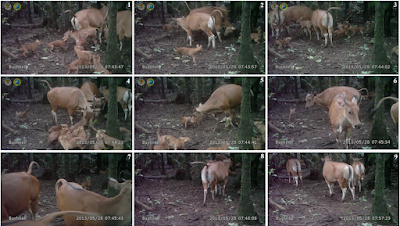
The first Dhole predation event was recorded on 28 May 2013, when a pack of 15 adult Dholes was seen to attack a Banteng, Bos javanicus, calf, which was accompanied by three adult females, between 7.43 and 7.57 am. 

 
Photographs of predation on a young Banteng by a pack of Dholes on 28 May 2013: (1) A Dhole bites the neck of a young Banteng. (2)–(4) An adult female Banteng tries to protect the young Banteng. (5) Several members of the Dhole pack try to separate the young Banteng from an adult female Banteng. (6)–(7) Dholes kill a young Banteng on the far side of picture. (8) Adult female Bantengs come back to try and save the young Banteng. (9) The process of predation by Dholes is complete which is marked by several pack members resting. Rahman et al. (2021).

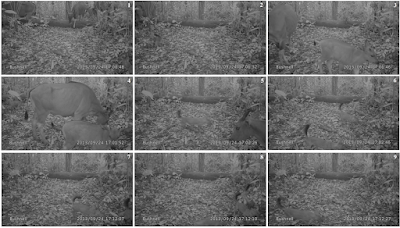
A second predation attempt was recorded on 24 September 2013, between 5.00 and 5.12 pm, when a group of six adult Dholes attempted to predate another young Banteng, again accompanied by three adult females.

 
Photographs of predation on a young Banteng by a pack of Dholes on 24 September 2013: (1) Young Banteng accompanied by three adult females. (2) One individual Dhole starts attacking the Banteng. (3)–(5) An adult female Banteng tries to protect the young Banteng. (6)–(8) Three Dholes are moving forward and attacking Banteng on the far side of picture. (9) Another individual Dhole running moving forward on the same side. Rahman et al. (2021).

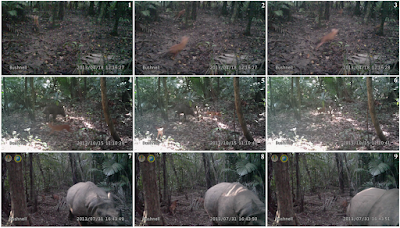
In addition to these attacks on Bateng, five adult Dhole were observed chasing a Java Mouse-deer, Tragulus javanicus, on 18 April 2013, two adult Dholes were seen attacking a Wild Pig on 15 October 2013, and three adult Dholes were observed following an adult male Javan Rhinoceros, Rhinoceros sondaicus, on 31 July 2013.

 
(1)–(3) a Java Mouse-deer being chased by five adult Dholes. (4)–(6) Wild Pig attacked by two adult Dholes. (7)–(9) An adult male Javan Rhinoceros followed by three Dholes. Rahman et al. (2021).

The captured images show clear evidence of Dholes targeting Banteng, a type of wild Cattle, in the Ujung Kulon National Park. Although they appear to specialise in taking young members of the herd, Bateng might at first seem like quite a large prey item for a small Canid, but this is not out of keeping with the prey preferences observed for the species elsewhere. In India Dholes have been shown to mostly predate Chital Deer, Axis axis, and Sambar Deer, Rusa unicolor, both medium sized Deer, but will occasionaly hunt Gaur, Bos gaurus, the largest extant Bovid species. In Cambodia, Dholes primarily hunt Muntjac Deer, Muntiacus spp., but alto hunt Banteng, which make up about 18% of their diet. Finally, analysis of droppings left by Dholes in the Baluran National Park, East Java, has suggested that their diet there included Banteng and Water Buffalo, Bubalus bubalis.

Dholes are variable in their approach to hunting, and will hunt on their own, in pairs, or in packs of varying size, with larger groups tending to tackle larger prey. This is roughly in line with Rahman et al.'s findings, with one attack on a Bantang being carried out by 15 Dholes. However, observed hunts by Dholes on Cattle and other large prey in other areas have typically involved the pack attempting to spook and then chase the herd, separating calves from the adults in the confusion, whereas both attacks observed in the Ujung Kulon National Park began with a direct attack on calves that were close to adults.

Rahman et al. do not believe that the Dholes observed following a Rhinoceros were engaged in a hunting attmept, reasoning that at 1000-2000 kg such an Animal is likely to be considerably outside of their range, and that a group of three is probably to small would be too small for the attmept if they were to make it. Rather, they suggest, the Dholes may have been escorting the Rhinoceros away from a den site in order to ensure the safety of their young.

See also...


Follow Sciency Thoughts on Facebook.

Follow Sciency Thoughts on Twitter.


Tuesday, 7 April 2020

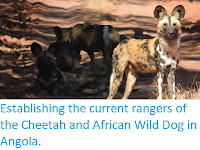
Establishing the current rangers of the Cheetah and African Wild Dog in Angola.

Despite Angola’s high biodiversity, the political unrest during the period 1975-2002 took a heavy toll on its wildlife, which suffered from widespread poaching and bushmeat hunting. Although little is currently known about the status and trend of most Angolan wildlife populations, iconic and threatened species such as the Cheetah, Acinonyx jubatus, and African Wild Dog, Lycaon pictus, are presumed to have suffered drastic declines and range contractions. However, the Angolan government has recently shown signs of political will to improve knowledge of the country’s biodiversity, including for the large carnivore species.

In a paper published in the journal Orynx on 12 February 2020, Pedro Monteroso of the Centro de Investigação em Biodiversidade e Recursos Genéticos at the Universidade do Porto, Filipe Rocha, also of the Centro de Investigação em Biodiversidade e Recursos Genéticos, and of the Departamento de Biologia at the Universidade do Porto,  Stefan van Wyk of the Cuatir Private Reserve, Telmo António and Milcíades Chicomo of the Instituto Superior de Ciências da Educação da Huíla, Selma Kosmas, again of the Centro de Investigação em Biodiversidade e Recursos Genéticos at the Universidade do Porto, and of the Department of Wildlife Management and Ecotourism at the University of Namibia, Fernanda Lages, also of the Instituto Superior de Ciências da Educação da Huíla, Ezequiel Fabiano, also of the Department of Wildlife Management and Ecotourism at the University of Namibia, and Raquel Godhino, once again of the Centro de Investigação em Biodiversidade e Recursos Genéticos, and of the Departamento de Biologia at the Universidade do Porto, and of the Department of Zoology at the University of Johannesburg, present the results of a study which used camera traps to assess the status of these two species in two areas of southern Angola.

Globally, the African Wild Dog and Cheetah are categorized as Endangered and Vulnerable, respectively, on the  International Union for the Conservation of Nature's Red List of Threatened Species because of population declines, range loss and the fragmentation of populations. Although historical records indicate that both species formerly occurred widely in Angola, the majority of the country is currently classified as unknown range for both species. Updated knowledge about the distribution, abundance and population dynamics of both species, and any threats, is required for conservation planning.

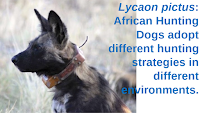
Group of African Wild Dogs, Lycaon pictus, detected through direct observation, in June 2018.  Milcíades Chicomo/Orynx.

Under the scope of ongoing institutional research and advanced training programmes, Monterosa et al. surveyed around 360 km² in Bicuar National Park, which lies in the transition between the Angolan Miombo Woodlands and Zambezian Baikiaea Woodlands ecoregions in the province of Huíla, and abou  300 km² in Cuatir Private Reserve in western Cuando Cubango province, along the Cuatir river, one of the main tributaries of the Cubango (Okavango) river on its Angolan side, also in the Zambezian Baikiaea Woodlands ecoregion. 

Monterosa et al. deployed camera-trapping stations uniformly spaced at about 2 km in the core of each study area). Fifty-one camera traps were deployed in Bicuar National Park during July 2017–June 2018 and 43 traps in Cuatir Private Reserve during June–December 2018. Cameras were inspected every 2 months. Additional records were obtained in Cuatir Private Reserve from unstructured surveys with six camera traps during August 2013–December 2018. Additional recent records of the Cheetah and African Wild Dog in Angola were obtained by reviewing surveys reports and the Global Biodiversity Information Facility database. Monterosa et al. considered as independent any camera-trapping detections within 30 minutes, unless animals were unambiguously identified.

Locations of camera traps in Bicuar National Park, Angola), with 2015 land cover at 100 m resolution. Monterosa et al. (2020).

In Bicuar National Park Monterosa et al. recorded 16 independent detections of two African Wild Dog groups over a total of 14 232 trapping-days. They were able to assign 15 individuals to one group and three to the other. African Wild Dogs were detected consistently throughout the sampling period at a mean detected group size of 3.6 individuals. No Cheetahs were detected.

Locations of camera traps in Cuatir Private Reserve, Angola, with 2015 land cover at 100 m resolution. Monterosa et al. (2020).

In Cuatir Private Reserve Monterosa et al. obtained 13 independent detections of at least two Cheetah individuals and no detections of African Wild Dogs over a total of 5173 trapping-days of systematic surveying. Unstructured camera trapping provided records of an individual cheetah in July 2014, and a coalition of two male Cheetahs in October 2017. They were not able to match any of these Cheetahs with those of the 2018 survey. A group with at least four African Wild Dog individuals was detected in July, August and October 2014, and another of at least five individuals in October 2016.

Monterosa et al.'s findings build on recent surveys that indicate the occurrence of cheetahs and African Wild Dogs in Luengue-Luiana and Mavinga national parks, and in the Cuanavale and Cuito river catchments. African wild dogs have also been observed in Bicuar National Park, and in Mupa National Park, and Mucusso Reserve, and Cheetahs in and around Iona and Cameia national parks. Monterosa et al. found no records of Cheetahs or African Wild Dogs for 2008-2018 in Angola in the Global Biodiveristy Information Facility.

Wild Cheetah, Acinonyx jubatus, detected through unstructured camera trapping in Cuatir Private Reserve, in July 2014. Stefan van Wyk/Orynx.

Monterosa et al.'s findings indicate that the African Wild Dog’s range as currently delimited should be extended about 750 km further west-north-west from the Angolan/Namibian border, beyond the Cunene river and including Bicuar National Park. As the species has been regularly detected in the Park since at least 2015, this complies with International Union for the Conservation of Nature's Canid Specialist Group criteria as an area of African Wild Dog residency, with groups of over 10 individuals and breeding confirmed through multiple observations of groups with pups, made by park rangers in 2016. It is likely that other large extents of good quality habitat in Angola also harbour resident populations, and further monitoring to assess presence and residency status are required. 
 
 Distribution status of the the African Wild Dog, Lycaon pictus, in Angola, Namibia, Zambia, Zimbabwe, and Botswana and recent (2008-2018) records in Angola. Study sites: BNP, Bicuar National Park; CPR, Cuatir Private Reserve. Monterosa et al. (2020).
 
Cheetahs have been observed regularly in the lower Angolan range of the Cubango River, and also in south-eastern, south-western and central-eastern Angola in the provinces of Namibe, Cuando Cubango and Moxico. These reports suggest that International Union for the Conservation of Nature's classification of the south-western Angolan range for the Cheetah should be changed from Possibly Extant to Extant.

Distribution status of the Cheetah, Acinonyx jubatus, in Angola, Namibia, Zambia, Zimbabwe, and Botswana, and of recent (2008-2018) records in Angola. Monterosa et al. (2020).

Monterosa et al.'s findings will support the new political willingnessin Angola to invest in wildlife conservation strategies and will help to unlock conservation funding for the Cheetah, African Wild Dog and other Carnivores. Given that the majority of the distribution of these two species potentially falls outside protected areas where they are more susceptible to anthropogenic threats, Monterosa et al. emphasize the urgency of identifying remnant populations in Angola and quantifying any threats to the species.

See also...

https://sciencythoughts.blogspot.com/2020/02/populations-of-small-carnivores-are.htmlhttps://sciencythoughts.blogspot.com/2019/08/aonyx-capensis-genetic-diversity-of.html
https://sciencythoughts.blogspot.com/2019/06/leopard-kills-two-year-old-boy-in.htmlhttps://sciencythoughts.blogspot.com/2018/04/tchadailurus-adei-new-species-of-sabre.html
https://sciencythoughts.blogspot.com/2018/04/german-tourist-attacked-by-leopard-in.htmlhttps://sciencythoughts.blogspot.com/2018/04/eleven-lions-poisoned-in-ugandan.html
Follow Sciency Thoughts on Facebook.