Showing posts with label Canidae. Show all posts

Tuesday, 30 August 2022

Fishing observed in a Red Fox for the first time.

Red Foxes, Vulpes vulpes, are small mesocarnivorous  found across Eurasia and North America, and introduced to Australia. They are extremely flexible hunters, able to adapt their behaviour to a wide range of prey species. Fish remains have occasionally been found associated with Foxes, but they have never been observed fishing, despite living in close proximity to Humans in many parts of the world, which has led to speculation that they are scavenging Fish rather than actively hunting them.

In a paper published in the journal Ecology on 18 August 2022, Jorge Tobajas of the Departamento de Botánica, Ecología y Fisiología Vegetal at the Universidad de Córdoba, the Instituto de Investigación en Recursos Cinegéticos, and the Biodiversity Research Institute at the University of Oviedo, and Francisco Díaz-Ruiz of the Biogeography, Diversity, and Conservation Research Team at the Universidad de Málaga, describe witnessing a male Red Fox hunting Fish.

The observation was made while Tobajas and Díaz-Ruiz were carrying out fieldwork near the Valuengo reservoir in southern Extremadura, on 24 March 2016. Here, a male Red Fox was observed capturing European Carp, Cyprinus carpio, while they were mating close to the water's edge.

Male Red Fox, Vulpes vulpes, capturing a European Carp, Cyprinus carpio, at the Valuengo reservoir in southern Extremadura, in March 2016. Tobajas & Díaz-Ruiz (2022).

The Fox was observed catching Carp between 1.18 and 2.51 pm, at which point it noticed it was being observed and fled. During this time it made 12 hunting attempts, capturing 10 Fish with an estimated average mass of about 1 kg. This represents a capture success rate of 83%. The Fox was hunting while the Carp were in a reproductive frenzy, and paying little head to the danger present. Fish were captured by simply jumping into the water and grabbing them. After each successful hunt the Fish was carried to a site 20-30 m from the water's edge and buried, hidden, or simply left, presumably for later consumption. The Fox was never observed to eat any substantial part of the Fish, although small parts (possibly eggs?) were consumed on several occasions. At one point a female Fox was observed removing one of the Carp that the male had captured. The male Fox did not challenge this behaviour, suggesting that she was his mate, and that the male was capturing the Fish for the benefit of the female and a litter of pups (unobserved).

Female Red Fox recovering a Fish previously hunted by the male. Tobajas & Díaz-Ruiz (2022).

This observation adds significantly to our understanding of the ecology of the Red Fox, a familiar species generally thought to be well understood, and about which new discoveries would not be expected. It clearly demonstrates that Foxes are highly able hunters of Fish; such a high success rate is unlikely to represent an opportunistic action by a single animal, but is more likely to represent hunting by a Fox with an instinct for such behaviour, which has been further honed through experience.
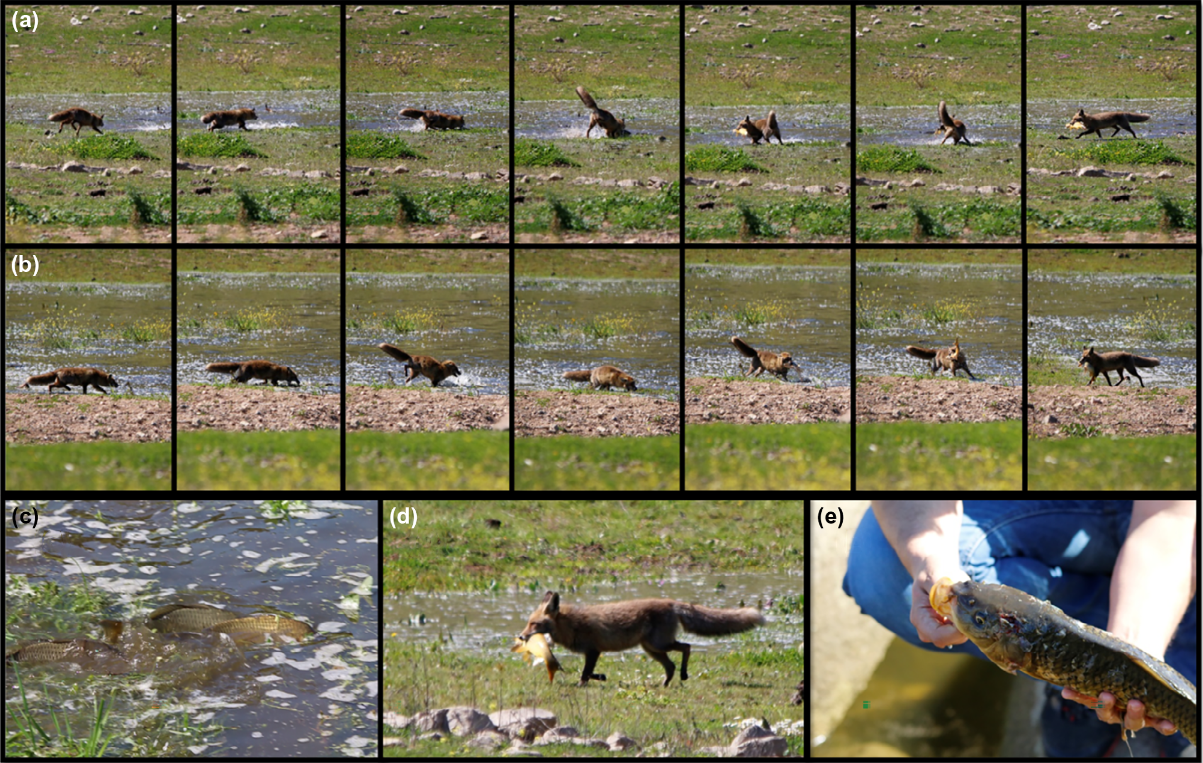
(a), (b) Two sequences showing the Red Fox, Vulpes vulpes, hunting European Carp, Cyprinus carpio, on the shore of the Valuengo reservoir (southern Extremadura; Spain) during the Carp spawning period, March 2016. (c) European Carp spawning eggs and distracted by the frenzy of reproduction in the shallow reservoir shore. (d) Red Fox carrying a large European Carp far to the shore.(e) European Carp hunted by the Red Fox with the fatal incisions on the head. Tobajas & Díaz-Ruiz (2022).

At first site this observation appeared to represent an incident of 'overkill' by the Fox, i.e. a case of a Fox being presented with an overabundance of easy prey and killing more than it needs to consume out of some sort of misfiring instinct (an explanation often used to justify the hunting of Foxes). However, an animal killing prey which are then consumed by other members of its social unit (such as, in this case, its mate and presumed young) is far from maladaptive. Instead, this appears to be a good use of a seasonally available food resource which coincides with the Fox's own breeding cycle. Similar behaviour has been observed among Arctic Foxes, Vulpes lagopus, which cache large numbers of Bird's eggs in order to feed their young.

See also...
Follow Sciency Thoughts on Facebook.

Follow Sciency Thoughts on Twitter.


Wednesday, 29 December 2021

Tracking the feeding habits of Dholes in the Ujung Kulon National Park, southwestern Java.

Dholes, or Asian Wild Dogs, Cuon alpinus, were once found across a wide swath of South, Central, East, and Southeast Asia, from Bangladesh, Bhutan, India, Nepal, and Pakistan north to Kazakhstan, and east to China, the Korean Peninsula, and the Russian Far East, and south to Cambodia, Laos, Malaysia, Myanmar, Thailand, Vietnam, and the Indonesian islands of Java and Sumatra. However, habitat fragmentation across this range has badly impacted the species, and Dholes are now thought to occupy less than 25% of their former range, and are considered to be Endangered under the terms of the International Union for the Conservation of Nature’s Red List of Threatened Species.

In Indonesia Dholes are protected by law, and are thought to have a widespread but fragmented distribution. A limited number of studies have been carried out on the distribution and habits of Dholes, and while potential prey species have been identified in two national parks where they are known to occur (Baluran National Park and Ujung Kulon National Park, both on the island of Java), but direct evidence of prey selection or feeding has been sparse.

In a paper published in the Journal of Threatened Taxa on 26 December 2021, Dede Aulia Rahman of the Department of Forest Resources Conservation and Ecotourism at Bogor Agricultural University, and Mochamad Syamsudin, Asep Yayus Firdaus, Herry Trisna Afriandi, and Anggodo of the Ujung Kulon National Park, present the results of a camera-trap experiment intended to reveal the hunting preferences of Dholes in the Ujung Kulon National Park.

Rahman et al. divided the park into 329 one kilometre square grid sections, and placed camera traps in 108 of these, positioned so that each was at least 300-500 m from the next. These were left in place from January to December 2013, being checked every 28-30 days to ensure they were functioning, and repositioning if they had sighted no Animals after two or three checks.

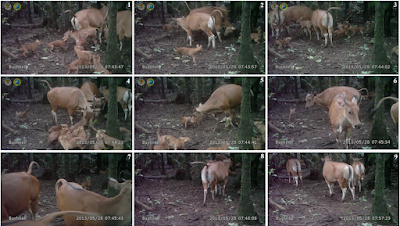
The first Dhole predation event was recorded on 28 May 2013, when a pack of 15 adult Dholes was seen to attack a Banteng, Bos javanicus, calf, which was accompanied by three adult females, between 7.43 and 7.57 am. 

 
Photographs of predation on a young Banteng by a pack of Dholes on 28 May 2013: (1) A Dhole bites the neck of a young Banteng. (2)–(4) An adult female Banteng tries to protect the young Banteng. (5) Several members of the Dhole pack try to separate the young Banteng from an adult female Banteng. (6)–(7) Dholes kill a young Banteng on the far side of picture. (8) Adult female Bantengs come back to try and save the young Banteng. (9) The process of predation by Dholes is complete which is marked by several pack members resting. Rahman et al. (2021).

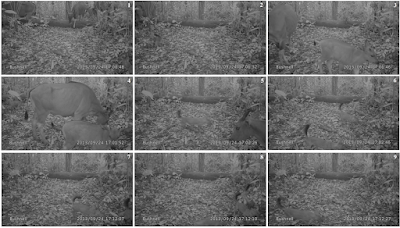
A second predation attempt was recorded on 24 September 2013, between 5.00 and 5.12 pm, when a group of six adult Dholes attempted to predate another young Banteng, again accompanied by three adult females.

 
Photographs of predation on a young Banteng by a pack of Dholes on 24 September 2013: (1) Young Banteng accompanied by three adult females. (2) One individual Dhole starts attacking the Banteng. (3)–(5) An adult female Banteng tries to protect the young Banteng. (6)–(8) Three Dholes are moving forward and attacking Banteng on the far side of picture. (9) Another individual Dhole running moving forward on the same side. Rahman et al. (2021).

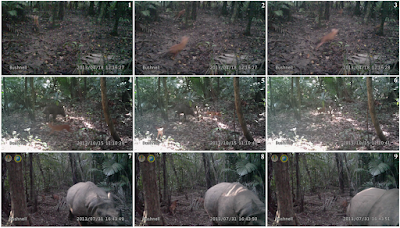
In addition to these attacks on Bateng, five adult Dhole were observed chasing a Java Mouse-deer, Tragulus javanicus, on 18 April 2013, two adult Dholes were seen attacking a Wild Pig on 15 October 2013, and three adult Dholes were observed following an adult male Javan Rhinoceros, Rhinoceros sondaicus, on 31 July 2013.

 
(1)–(3) a Java Mouse-deer being chased by five adult Dholes. (4)–(6) Wild Pig attacked by two adult Dholes. (7)–(9) An adult male Javan Rhinoceros followed by three Dholes. Rahman et al. (2021).

The captured images show clear evidence of Dholes targeting Banteng, a type of wild Cattle, in the Ujung Kulon National Park. Although they appear to specialise in taking young members of the herd, Bateng might at first seem like quite a large prey item for a small Canid, but this is not out of keeping with the prey preferences observed for the species elsewhere. In India Dholes have been shown to mostly predate Chital Deer, Axis axis, and Sambar Deer, Rusa unicolor, both medium sized Deer, but will occasionaly hunt Gaur, Bos gaurus, the largest extant Bovid species. In Cambodia, Dholes primarily hunt Muntjac Deer, Muntiacus spp., but alto hunt Banteng, which make up about 18% of their diet. Finally, analysis of droppings left by Dholes in the Baluran National Park, East Java, has suggested that their diet there included Banteng and Water Buffalo, Bubalus bubalis.

Dholes are variable in their approach to hunting, and will hunt on their own, in pairs, or in packs of varying size, with larger groups tending to tackle larger prey. This is roughly in line with Rahman et al.'s findings, with one attack on a Bantang being carried out by 15 Dholes. However, observed hunts by Dholes on Cattle and other large prey in other areas have typically involved the pack attempting to spook and then chase the herd, separating calves from the adults in the confusion, whereas both attacks observed in the Ujung Kulon National Park began with a direct attack on calves that were close to adults.

Rahman et al. do not believe that the Dholes observed following a Rhinoceros were engaged in a hunting attmept, reasoning that at 1000-2000 kg such an Animal is likely to be considerably outside of their range, and that a group of three is probably to small would be too small for the attmept if they were to make it. Rather, they suggest, the Dholes may have been escorting the Rhinoceros away from a den site in order to ensure the safety of their young.

See also...


Follow Sciency Thoughts on Facebook.

Follow Sciency Thoughts on Twitter.


Saturday, 14 August 2021

State of Wisconsin plans the hunting of 300 Wolves, against scientific advice.

The Wisconsin Natural Resources Board has announced plans to allow the hunting of up to 300 Gray Wolves, Canis lupus, in November this year. This follows a hunt in February in which 216 Wolves were killed (about 20% of the total population), in the first hunt in the state after the removal of the species from the federal Endangered Species Act announced by outgoing President Donald Trump in October 2020 came into force in January. In that hunt, the Board initially set a kill limit of 200 Animals, but the state's indigenous Chippewa (or Ojibwe) people claimed 81 of these, citing a treaty from the 1800s which enables them to claim up to half of any hunt quota, reducing the total to 119; the Chippewa do not usually hunt Wolves as they are considered sacred, so that any Wolf claimed is effectively taken off the hunt's total. However, in the event what was supposed to be a week-long hunting season had to be stopped after three days, due to the large number of hunters that took part in the event; despite the low quota the state sold a total of 1547 hunting permits.


The Wolf population of Wisconsin is thought to have hit a high of 1126 Animals in 2020, but, in addition to the legally hunted Wolves, about a hundred are thought to have been killed by poachers between April 2020 and April 2021. The Wisconsin Department of Natural Resources has a population target of 350 Wolves, viewed as being far too low by many environmental groups. Current legislation in Wisconsin requires that the Department of Natural Resources organises a Wolf hunt in any year in which the Animals are not protected by federal legislation; this law was signed into effect by then State Governor Scott Walker in 2012, following the removal of the species from the Endangered Species Act by President Barrack Obama, although the protected status of Wolves was returned by a federal court in 2014.

The Wisconsin Wolf Harvest Advisory Committee had recommended that the quota for the November hunt was set at 130 Animals, but this was set aside by the Natural Resources Board in favour of the higher figure of 300. If the Chippewa people claim half of this (as seems likely), then that figure would be reduced to 150, but the difficulties experienced by the Department of Natural Resources in managing the February hunt makes it likely that a much larger number had will be taken. Pro-hunt activists in the state had called for the higher figure of 500 Wolves, citing fears that President Joe Biden will restore the species protection under the Endangered Species Act. Biden has asked the US Fish and Wildlife Service to review a number of recent policy changes, including the removal of Wolves' protected status, but, as yet, the leadership of the organisation, appointed by the previous legislature, have refused to do so. This raises serious concerns about the extent to which environmental policy in the US has become a partisan issue, driven by the loyalty of officials to particular political camps rather than based upon the best available science.

See also...


Follow Sciency Thoughts on Facebook.

Follow Sciency Thoughts on Twitter


Sunday, 17 May 2020

Leopard attacks man in Hyderabad, India.

A man has been attacked by a Leopard in the Katedan area of the city of Hyderabad in Telangana State, India. The incident happened on Thursday 14 May 2020, after a number of people started to take the pictures of the animal, which had been loitering in the area for about two days. This apparently annoyed the Big Cat which charged them, and then a truck driver and another man who were nearby. The truck driver managed to climb back into his vehicle, but the second man was bitten on the foot by the Leopard, which attempted to drag him away, before being attacked in turn by a pack of Dogs and fleeing. Officials from the Indian Forest Service have been attempting to locate the animal, but it has not been seen since the incident.

Man being attacked by a Leopard in Hyderabad on Thursday 16 May 2020. Forests and Wildlife Protection Society/Twitter.

Leopards are considered to be Vulnerable under the terms of the International Union for the Conservation of Nature's Red List of Threatened Species, with the Indian subspecies, Panthera pardus fusca, considered to be particularly vulnerable due to India's rapidly rising Human population, which has resulted in agriculture and other Human activities expanding into many former wilderness areas. For this reason, the Indian Forest Service usually try to relocate Leopards that come into conflict with Humans to more remote areas, preferably within national parks, though the extent to which local people co-operate is variable.

 The Leopard breaks of its attack after being confronted by a pack of Dogs. Forests and Wildlife Protection Society/Twitter.

See also...

https://sciencythoughts.blogspot.com/2020/04/police-arrest-four-men-for-killing.htmlhttps://sciencythoughts.blogspot.com/2020/03/leopard-claims-fourth-victim-in.html
https://sciencythoughts.blogspot.com/2019/12/leopard-kills-five-year-old-boy-in.htmlhttps://sciencythoughts.blogspot.com/2019/09/assessing-how-wildlife-attacks-upon.html
https://sciencythoughts.blogspot.com/2019/09/leopard-killed-by-villagers-near-town.htmlhttps://sciencythoughts.blogspot.com/2019/08/leopard-attack-thwarted-by-dog-in.html
Follow Sciency Thoughts on Facebook.

Monday, 13 January 2020

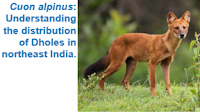
Cuon alpinus: Understanding the distribution of Dholes in northeast India.

The Dhole, or Asian Wild Dog, Cuon alpinus, is an Endangered social carnivore found in forested landscapes of South and Southeast Asia. Historically widespread across Asia, the species’ range has contracted by about 80%. The current distribution extends across most of South and Southeast Asia and parts of China but is largely restricted to protected areas. The protected forest landscapes south of the River Ganges in India are a stronghold for the species, with the largest Dhole population. However, the species has undergone local extirpation across parts of its former range as a result of declines of prey species, loss of habitat and, potentially, disease. Information on Dholes in northeast India in particular is limited, despite the fact that this landscape shares continuous forest with Myanmar and Southeast Asia, forming an important part of the species' global range.

A Dhole, or Asian Wild Dog, Cuon alpinus. David Raju/Wikimedia Commons.

In a paper published in the journal Orynx on 23 October 2019, Priya Singh of Researchers for Wildlife Conservation at the National Centre for Biological Sciences, and the School of Natural Resources and Environment at the University of Florida, Arjun Srivastha of the Department of Wildlife Ecology and Conservation at the University of Florida, and David Macdonald of the Wildlife Conservation Research Unit at the University of Oxford, provide a compilation of dhole presence records from across northeast India using data extracted from multiple sources.

Current knowledge of Dholes in north-east India is restricted to landscapes north of the River Brahmaputra. This is primarily because of the paucity of baseline ecological data from the region, given its undulating terrain, difficulty of access, wet climatic conditions, and socio-political insurgencies.

Using data from camera-trap surveys Singh et al. examine factors influencing fine-scale site-use by Dholes in Dampa Tiger Reserve in Mizoram State. They discuss the implications of their results for Dhole conservation in northeast India, where the focus of wildlife managers is directed mainly towards population recoveries of and local recolonisation by the Tiger, Panthera tigris. They further provide recommendations for management interventions that could facilitate conservation of Dholes in this hitherto neglected landscape.

Dampa Tiger Reserve lies in the Indo-Myanmar Biodiversity Hotspot. The reserve is contiguous with the Chittagong Hill Tract region of Bangladesh to the west. The core area of the Reserve covers 500 km², and the multi-use buffer covers an area of 488 km². The Lushai Hills traverse the reserve, with altitudes of 250-1100 m. Mean annual rainfall is 2000-2500 mm. The Reserve supports a high diversity of Carnivores, including, in addition to the Dhole, four species of Felids and two species of Ursids. In the course of the study Singh et al. also recorded the Elephant, Elephas maximus, Gaur, Bos gaurus, Sambar, Rusa unicolor, Red Serow, Capricornis rubidus, Muntjac, Muntiacus muntjak, and Wild Pig, Sus scrofa.

Northeast India, with the Dampa Tiger Reserve in Mizoram and locations where the Dhole, Cuon alpinus, has been recorded, with corresponding reliability scores. Singh et al. (2019).

Singh et al. compiled Dhole presence records for nine northeastern states: Arunachal Pradesh, Assam, Manipur, Meghalaya, Mizoram, Nagaland, Sikkim, Tripura, and West Bengal. They searched for records from 1990 onwards in newspaper reports, scientific articles, grey literature (including species checklists), and reports by Forest Department personnel, local informants and naturalists working in the region. For each record they noted the type of evidence (direct/indirect), the date of the sighting, the administrative status of location (protected/non-protected), and the source person or reference. They assigned reliability scores for each record, from 1 to 5, with 1 being most reliable, and 5 least reliable.

From December 2014 to March 2015, Singh et al. deployed 79 pairs of Cuddeback Ambush IR camera traps across 80 km² in the northeast of Dampa Tiger Reserve’s core area. At each station they placed two cameras facing each other, about 30 cm above the ground, on either side of forest trails or on riverbeds. Mean inter-trap distance was 1.02 km, with traps remaining active for an average of 64 days. Although the stations were intended to photograph wild Felids, they also photographed other Carnivores. Dholes generally use forest trails and riverbeds for movement, marking territories and hunting, and our sampling design therefore incorporated areas used by the species.

Singh et al. obtained presence records from 80 locations for 1990-2018, of which we considered 41 records from 2010–2018 with reliability scores of 1-3. In the case of multiple records for the same site, they considered the most recent record with the highest reliability score. Most records were from Arunachal Pradesh (14) and Assam (8), with five records from Mizoram and Nagaland, four from West Bengal, three from Meghalaya and two from Sikkim. There were no recent records of Dholes from Manipur and Tripura. A total of 5033 camera trap-days in Dampa Tiger Reserve generated 500 photoencounters of Dholes, comprising 92 detections (one per 24 hour duration) across 33 sites. 

Singh et al. found photo-capture frequencies of key prey species: Sambar (236), Muntjac (145), Wild Pig (92); to be positive influences, as were the distance to reserve boundary, and photo-capture frequencies of Forest Department personnel, while photo-capture frequencies of other humans were  negative influences on site-use by Dholes.

There are records of Dholes across several areas of northeast India, including in unprotected areas. Previous global assessments indicated that the species faced near or complete local extirpation to the south of the River Brahmaputra, something refuted by Sigh et al.'s findings from Dampa Tiger Reserve. Corroborating current knowledge from other landscapes, showed a positive relationship between Dhole site-use and Sambar presence. Across their extant distribution, the range of Dholes overlaps with that of Tigers and Leopards, Panthera pardus. Wildlife managers in this region and elsewhere subscribe to unsubstantiated notions that dhole presence impedes colonisation by Tigers, and consequently treat Dholes as a problem species. On the contrary, Tigers, Leopards and Dholes can co-exist provided protected areas support adequate densities of medium- to large-sized prey species.

Dampa Tiger Reserve is an important refuge for Dholes in northeast India. It supports large tracts of inviolate protected spaces, and habitat connectivity with forested landscapes of the Chittagong Hill Tract region to the west, Mamit Forest Division to the north and Thorangtlang Wildlife Sanctuary to the south. Singh et al's camera-trap data indicate the presence of a guild of large herbivores in the Reserve, with at least five prey species of medium and large ungulate herbivores, facilitating the long-term persistence of dholes there. The findings re-emphasise the importance of protected areas, which can serve as source sites for sustaining Dhole populations across the region.

In areas with low prey densities, carnivores may have significant dependence on livestock, and are consequently stigmatised. There is a strong negative relationship between Dholes and livestock owners in Arunachal Pradesh and other locations in the region. Given that Dholes also occur outside protected areas in this region, they are potentially vulnerable to retributory killing. Negative interactions between people and Dholes necessitate interventions to reduce poaching and facilitate recovery of prey, especially for species such as Sambar that are impacted by low recovery rates following prolonged poaching. Singh et al.'s findings need to be augmented with a systematic survey across the locations they identified, specifically in the states of Mizoram and Nagaland, to facilitate a pan-northeast India strategy for Dhole conservation.

See also...

https://sciencythoughts.blogspot.com/2019/08/leopard-attack-thwarted-by-dog-in.htmlhttps://sciencythoughts.blogspot.com/2019/08/camper-attacked-by-wolf-in-banff.html
https://sciencythoughts.blogspot.com/2018/07/worker-at-western-australian-gold-mine.htmlhttps://sciencythoughts.blogspot.com/2016/08/cynarctus-wangi-new-species-of.html
https://sciencythoughts.blogspot.com/2016/07/photogrammetry-as-tool-in-morphometric.htmlhttps://sciencythoughts.blogspot.com/2016/04/lycaon-pictus-african-hunting-dogs.html
Follow Sciency Thoughts on Facebook.

Saturday, 17 August 2019

Leopard attack thwarted by Dog in Darjeeling.

A Dog has thwarted a Leopard attack on its owner in the town of Sonada in Darjeeling District, West Bengal State, India. The incident happened on Wednesday 14 August 2019, when Aruna Lama, 58, heard a disturbance in a storage area beneath her kitchen, where the family kept some live Chickens. She went to investigate the noise, and when she opened the door, was pounced on by a Leopard, which seized her by the head and trying to drag her away. The Leopard quickly abandoned the attack when it was set upon by the family Dog, a four-year-old Tibetan Mastiff Cross called, Tiger, who was adopted by the family in 2017 after being found in a half-starved state. Confronted with the angry Dog the Leopard fled the scene, with Dog in pursuit, and has not been seen since, though officials from the Indian Forest Service are attempting to capture it for relocation.

Aruna Lama, 58, of Sonada in Darjeeling, saved from a Leopard attack by her Dog on 14 August 2019. Times of India.

Leopards are considered to be Vulnerable under the terms of the International Union for the Conservation of Nature's Red List of Threatened Species, with the Indian subspecies, Panthera pardus fusca, considered to be particularly vulnerable due to India's rapidly rising Human population, which has resulted in agriculture and other Human activities expanding into many former wilderness areas. For this reason the Indian Forest Service usually try to relocate Leopards that come into conflict with Humans to more remote areas, preferably within national parks, though the extent to which local people co-operate is variable.

Tiger, a four-year-old Tibetan Mastiff cross that saved his owner from a Leopard attack in Darjeeling on 14 August 2019. Times of India.

See also...

https://sciencythoughts.blogspot.com/2019/07/villagers-kill-tiger-in-uttar-pradesh.htmlhttps://sciencythoughts.blogspot.com/2019/07/leopard-kills-sleeping-man-in-rajastan.html
https://sciencythoughts.blogspot.com/2019/06/leopard-kills-two-year-old-boy-in.htmlhttps://sciencythoughts.blogspot.com/2019/06/infant-consumed-by-leopard-in.html
https://sciencythoughts.blogspot.com/2019/05/gujarat-woman-killed-by-leopard.htmlhttps://sciencythoughts.blogspot.com/2019/05/himachal-pradesh-man-arrested-with-two.html
Follow Sciency Thoughts on Facebook.

Thursday, 15 August 2019

Camper attacked by Wolf in Banff National Park.

A New Jersey man is recovering after being attacked by a Wolf in Banff National Park in Alberta Province, Canada. Matthew Rispoli was sleeping in a tent with his wife and two sons at about 1.00 am on Friday 9 August 2019, when a solitary adult male Grey Wolf, Canis lupis, ripped through the side of the tent and seized Mr Rispoli by the arm, initiating a struggle lasting several minutes, during which Mr Rispoli was unable to dislodge the Wolf, but the Wolf was unable to drag him away. This struggle ended abruptly when a neighbouring camper kicked the Wolf, causing it to flee. The Wolf was later shot by trackers from Parks Canada, who were able to confirm its identity using DNA swabbed from Mr Rispoli's wounds.

American tourist Matthew Rispoli, attacked by a Wolf in the Banff National Park. CNN.

Wolf attacks on Humans are exceptionally rare, as we are difficult prey for them, and hard to subdue, with Parks Canada only having recorded two previous incidents, one in British Columbia and one in Ontario. The Wolf in the Banf Park attack is reported to have been severely underweight, at about 35 kg, compared to a typical healthy adult bodyweight of 45-70 kg, and was presumably having trouble feeding by itself; Wolves are pack animals and often have trouble capturing prey on their own.

See also...

https://sciencythoughts.blogspot.com/2018/07/worker-at-western-australian-gold-mine.htmlhttps://sciencythoughts.blogspot.com/2016/08/cynarctus-wangi-new-species-of.html
https://sciencythoughts.blogspot.com/2016/07/photogrammetry-as-tool-in-morphometric.htmlhttps://sciencythoughts.blogspot.com/2016/04/lycaon-pictus-african-hunting-dogs.html
https://sciencythoughts.blogspot.com/2015/08/cryptic-diversity-new-species-of-wolf.htmlhttps://sciencythoughts.blogspot.com/2014/11/using-morphometric-analysis-to.html


Follow Sciency Thoughts on Facebook.