Showing posts with label Palaeobotany. Show all posts

Friday, 17 January 2025

Zosterophyllum baoyangense: A new species of Zosterophyllopsid Plant from the Early Devonian of Guizhou Province, China.

The first Vascular Plants appeared and underwent a dramatic radiation similar to that seem in Animals in the Cambrian, during the Late Silurian and Early Devonian. During this time both vegetative and sexual reproduction appeared, with some of the earliest Plants able to cover large areas through clonal growth, while at the same time producing spores which enabled them to distribute to new areas. During the Early Devonian structures such as leaves, roots, megaspores and secondary xylem also appeared. The Zosterophyllopsids formed a characteristic part of many Early Devonian floras, with species reported from China, North America, Europe and Australia. These Plants lacked leaves, and had a characteristic 'K'; or 'H' branching pattern, combined with lateral spike sporangia.

In a paper published in the journal Proceedings of the Royal Society B on 15 January 2025, Pu Huang of the Nanjing Institute of Geology and Palaeontology, Jia-Shu Wang of the Geological Museum of China and the Key Laboratory of Orogenic Belts and Crustal Evolution at Peking University, Yi-Ling Wang, also of the Key Laboratory of Orogenic Belts and Crustal Evolution at Peking University, Lu Liu of the National Natural History Museum of China, Jing-Yu Zhao of the School of Resources and Civil Engineering at Suzhou University, and Jin-Zhuang Xue also of the Key Laboratory of Orogenic Belts and Crustal Evolution at Peking University, describe a new species of Zosterophyllopsid Plant from the Early Devonian of Guizhou Province, China.

The new species is described upon the basis of two compression fossils from the Plant-bearing beds from the lower part of the Early Devonian Mangshan Group at Baoyang in Duyun City in Guizhou Province. These beds have been determined to be Pragian in age (410.8-407.6 million years old) on the basis of fossils which are also found in the Posongchong Formation of Yunnan Province, which in turn has been dated on the basis of spore assemblages, Plants and stratigraphic correlation It is placed in the genus Zosterophyllum, and given the specific name baoyangense, meaning 'from Baoyang'.

Zosterophyllum baoyangense  (a), (b) PB203562, part and counterpart, showing a fertile axis with K-shaped branching and a terminal spike. Arrows highlight branching points. The parts indicated by arrows (c) and (d) are enlarged in (c), (d), respectively; (c) K-shaped branching; (d) branching point showing a nearby protuberance (arrow); (e), (f) Enlarged view of the terminal spike in (a) and (b); (g) enlarged view of the basal part of the spike in (e). Arrow points to the margin of the basal sporangium. (h) Enlargement of the distal sporangia in (f) (arrow h), showing dehiscence line (white arrow) and peripheral rim along the convex distal margin (the area between two black arrows). Scale bars: (a), (b) 10 mm; (c)–(f), 1 mm; (g), (h), 0.5 mm. Huang et al. (2025).

Zosterophyllum baoyangense comprises a rhizome system with K-shaped branching and upright sporangia-bearing spikes 5.8-10.8 mm high. Each of these spikes has 5-10 sporangia, arranged in a spiral pattern. The sporangia are oval to semicircular, 1.6−2.0 mm high and 0.9−1.4 mm wide, departing from axis at an acute angle by a short stalk.

The Zosterophyllopsids are a distinctive group of Plants found worldwide from the Late Silurian to the Late Devonian. There are currently 37 described genera in the group, although it is not completely certain they form a monophyletic group. The earliest members of the group appear in the Ludlow (427.4-423.0 million years ago), with the group reaching its maximum diversity during the Pragian, then declining during the Emsian (410.62-393.47 million years ago), and eventually disappearing during the Frasnian (382.7-372.2 million years ago.

Zosterophyllum baoyangense is notably smaller that other members of same genus, with a complete specimen measuring 45.4 mm in length and 0,5-1.3 mm in width, with a spike 10.8 mm high. For comparison, the contemporary Zosterophyllum confertum from western Germany can reach 5.1 mm in width with a preserved length of 440 mm. Silurian members of the genus were typically smaller, though they grew over time, while Emsian species, while rarer, show a wider range of sizes. 

All species of Zosterophyllum lack any form of spikes, leaves, or leafy structures. However, they are presumed to have been able to photosynthesize due to the presence of stomata. With such a simple bodyplan, the only way that these plants would have been able to increase their photosynthetic surface would have been to get larger, a trend observed from their origin in the Late Silurian and through the Early Devonian. 

Zosterophyllum baoyangense, however, does not comply with this trend, being much smaller than known contemporary species, and even most Silurian specimens. Huang et al. suggest that this may be a sign of a much shorter life-cycle than other species. This in turn could be an adaptation to an unstable environment, or one with very limited resources, showing that early Vascular Plants had begun to show adaptation to different environments by the Early Devonian. 

Artist’s restoration of part of the Early Devonian Mangshan Flora, with Plant communities of Zosterophyllum baoyangense at the front, and Teyoua antrorsa, Zosterophyllum australianum and an unnamed zosterophyllopsid to the back. Huang et al. (2025).

The history of Vascular Plants can be divided into five evolutionary floras, the Rhyniophytic Flora, dominated by Rhyniophytes and Cryptospore producers, the Eophytic Flora, dominated by Zosterophyllopsids, followed by the Palaeophytic Flora,  the Mesophytic Flora and the (modern0 Cainophytic Flora. The Plants of the Rhyniophytic Flora were typically very small, and it is thought that the (first) terrestrial habitats that they inhabited were probably very ephemeral. The Plants of the Eophytic Flora, while still very simple, are generally much larger, which has been interpreted as a sign of more stable environments developing. In South China, however, a strongly seasonal wet-dry climate is known to have developed in the Early Devonian, which may have made it harder for early Plants to stabilize environments, producing dwarfed species such as Zosterophyllum baoyangense, which could have completed their entire life-cycles in a shorter period of time.

See also...

Sunday, 15 December 2024

Florissantia sp.: A fossil flower from the Early Eocene of Rajasthan.

The Malvaceae first appeared in the Cretaceous in North America, and have achieved a global distribution today, most notably as a significant component of almost all tropical forests. The genus Florissantia shows a number of features associated with different extant subfamilies of the Malvaceae, and is known from the Middle Eocene till the Miocene of western North America, with specimens known from British Colombia, Colorado, Montana, Oregon, and Washington, as well as a single specimen being known from the Sikhote Alin mountains of the Russian Far East.

In a paper published in the journal Botany Letters on 21 October 2024, Ashif Ali and Mahasin Ali Khan of the Palaeobotany, Palynology, and Plant Evolution Laboratory at Sidho-Kanho-Birsha University, and Raman Patel and Rajendra Singh Rana of the Department of Geology at Rauthan Hemvati Nandan Bahuguna Garhwal University, describe a specimen of Florissantia from the Early Eocene Palana Formation of Rajasthan, India.

The specimen comes from the Laminate Maroon Shale Bed of the Palana Formation, which is exposed at the Gurha Open-cast Lignite Mine at Bikaner in northwest Rajasthan. It is preserved as part and counterpart on a piece of a piece of split- laminated shale, which has been further exposed by micro excavation of successive layers of the rock with fine needles under a dissection microscope. 

(a) Map of Rajasthan showing the location of the Gurha opencast lignite mine (red star) Bikaner Rajasthan, India; (b) view of the fossil locality. Ali et al. (2024).

The preserved fossil is a star-shaped flower about 13 mm in diameter (sgnificantly smaller than any other member of the genus), with a calyx made up of five fused and rounded sepals of roughly equal length; the petals are missing. Importantly, the sepals each show numerous prominent veins, the pattern of which is used by Ali et al. as a diagnostic tool to place the specimen in the genus Florissantia.

(a) Transversely impressed, radially symmetric, pentamerous fossil flower of Florissantia sp. (SKBU/PPL/R/F/01A, part); (b) magnified image of the specimen showing thick filaments (marked by red arrows) surrounding the compressed, carbonaceous central area; (c) enlarged view of a single calyx lobe showing prominent parallel (marked by blue arrows) and radiating reticulate (marked by white arrows) venation; (d) counterpart of fossil flower of Florissantia sp. (SKBU/PPL/R/F/01B); (e) central area of figured in higher magnification; (f) line drawing of (c) showing parallel (marked by blue arrows) and reticulate (marked by red arrows) venation, Scale bars are 2.5 mm for (a), (b), (d), and (e) and 500 μm for (c) and (f). Ali et al. (2024).

The Palana Formation of Rajasthan has been dated to between about 55 and 52 million years before the present on the basis of palynological data (fossil pollen). This Early Eocene date makes the Bikanar specimen the oldest representative of the genus Florissantia, which together with its unexpected location, potentially makes the specimen highly significant. 

Line drawings of the Bikanar specimen and earlier reported extinct fossil flower species: (a) Bikanar fossil flower of Florissantia sp.; (b )fossil flower of Florissantia ashwillii from the Oligocene of Oregon; (c) fossil flower of Chaneya membranosa from the Miocene of Poland; this appears similar to Florissantia spp, but has unequal sepals. Scale bars are 5 mm. Ali et al. (2024).

The Palana Formation was laid down on the shores of an ancient lake, which is consistent with other locations where members of the genus Florissantia have been found. Other members of the genus are known from lake-associated Floras in tropical, subtropical, and temperate environments, often with some volcanic input; although the presence of volcanic ashes helps to preserve fine structures such as flowers, so it is possible that this connection with volcanic input reflects preservation bias rather than an environmental preference of the living plants.

See also...

Saturday, 28 September 2024

Fossil pinnate Palm leaves from the Island Lagoon Flora, in the arid zone of South Australia.

Palms are an important part of the flora of the wet tropical and subtropical forests of eastern Australia, but are almost absent from the drier areas of the Australian interior, with only two species known from this area today, Livistona mariae from central Australia, and Livistona alfredii from the Pilbara region of Western Australia. Despite its large area, Australia is relatively species-poor in Palms compared with nearby landmasses, with only 54 species in 17 genera, compared to about 250 species on the island of New Guinea. 

The Palm flora of Australia contains a mixture of groups with different biogeographical regions, including Gondwanan groups, such as the Archontophoenicinae, Calamoideae, and Nypoideae, with fossil records in Australai which pre-date the Miocene, and Laurasian groups, such as Livistona spp., thought to have migrated from Southeast Asia since the Miocene, when monsoonal climates became prevalent across the region. Although of Gondwanan origin, the Archontophoenicinae are thought to have reached Australia from New Guinea in the Eocene, and subsequently dispersed from Australia to New Guinea in the Miocene. Beyond this, however, our understanding of the biogeographical origins of modern Australian Palms is severely limited by a paucity of fossils, particularly compared to the numerous fossil Palms of the Northern Hemisphere.

In a paper published in the journal Historical Biology on 25 September 2024, David Greenwood of the Department of Biology at Brandon University, and John Conran of rhe Environment Institute at the University of Adelaide, describe a new Palm species from fossil pinnate leaves from the Island Lagoon Flora for South Australia.

The Island Lagoon Flora is one of a number of ‘silcrete floras’ known the arid zone of South Australia, which produce a Plant fossils, which appear to have been species adapted to arid environments, with a smaller proportion of broad-leaved and Coniferous tree fossils. Age estimates for these floras have varied considerably since they were first recorded in the 1890s, with current estimates suggesting that different localities may reflect Eocene, Miocene, and Miocene-Pliocene assemblages. The Island Lagoon Flora is thought most likely to be of Miocene origin, probably contemporaneous with the Stuart Creek Silcrete Macroflora, though it is possible that it is older, possibly Eocene or Late Oligocene-Early Miocene.

The new Palm species is placed in the genus Phoenicites and given the specific name insula-lacuna, which is a Latin translation of 'Island Lagoon'. The species is described from two specimens, P14209 and P14467, both in the collection of the South Australian Museum. Both are incomplete portions of pinnate leaves, P14209 measuring 29.5 cm long and 27.7 cm wide, and P14467 measuring  23.9 cm long and 9.8 cm wide, with both showing at least 11 pinnae per side.

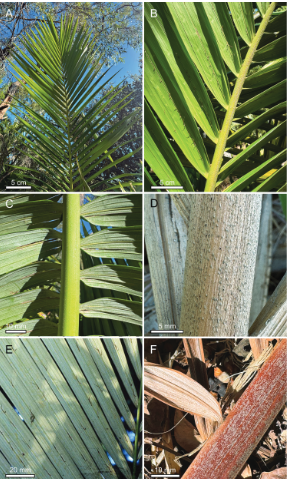
Phoenicites insula-lacuna. (A) Holotype P14209 showing whole specimen. (B) Paratype (P14467) with midvein at arrow. (C) Detail showing asymmetry of pinnae base (P14209). (D), (E) Detail of mid-pinnae showing midvein and secondary veins (P14209). (F) Rachis (P14209) showing patterned surface corresponding to ‘brown spots’ similar to those of extant Archontophoenix spp. (G) Detail of mid-pinnae with arrow showing midvein (P14467). John Conran in Greenwood & Conran (2024).

Greenwood and Conran note that there is little to differentiate the fossil genus Phoenicites from the living genus Archontophoenix, although they have chosen to use Phoenicites as the limited material available does not contain all of the diagnostic features for inclusion in the extant genus. This is a common situation in palaeontology, where all fossil species are morphospecies (species defined by their morphological appearance) rather than true biological species (which are defined by their ability to breed with other members of the species - something which fossils are incapable of doing).

(A)–(F) Extant Archontophoenix in the Adelaide Botanical Gardens and Waite Arboretum, University of Adelaide, or in habitat ((E) only). (A), (C) Archontophoenix alexandrae, whole leaf (A) and partial view of abaxial side (B) showing pinnae with prominent veins and pinnae rachis attachment. (B), (D) Archontophoenix cunninghamiana, partial view of abaxial side showing pinnae venation and rachis attachment, and (D) rachis showing brown spots that dry as ‘tuberculae’. (E) Archontophoenix purpurea and (F) Archontophoenix tuckerii showing pinnae venation and rachis attachment. John Conran and John Dowe in Greenwood & Conran (2024).

Modern members of the genus Archontophoenix are found in wet environments, such as freshwater swamps, rainforests, under monsoonal to seasonally dry climates. This is different from the drier climate generally recorded in the silcrete floras of South Australia. However, Greenwood and Conran note that one of the environments in which these Palms are found is rainforest gullies within (dry) tall Eucalypt forests, possibly providing a setting for the other more moisture-loving Plants found in these floras.

Map of Australia showing the Island Lagoon fossil locality, other South Australian Silcrete Flora sites, the arid zone (where the annual rainfall is less than 250 mm), the extant distribution of Archontophoenix (green circles) and the two extant species of Palm endemic in the arid zone (orange squares; Livistona alfredii in Western Australia and Livistona mariae in the Northern Territory).Abbreviations: NSW, New South Wales; NT, Northern Territory; Qld, Queensland; SA, South Australia; Tas, Tasmania; Vic, Victoria; WA, Western Australia. Greenwood & Conran (2024).

See also...

Saturday, 10 August 2024

Jantungspermum gunnellii: A giant Australian Legume from the Eocene of South Kalimantan, Borneo.

The forests of Southeast Asia form one of the world's greatest biodiversity hotspots, having a far higher species-to-area ratio than the tropical forests of Africa or the Americas. Surprisingly, unlike these areas, biodiversity in Southeast Asia does not have deep roots going back to the earliest Cainozoic, but rather has been assembled over this period, as new diversity was added by first the collision of India with Eurasia and then that of Sahul (the continental plate underlying Australia and New Guinea) with Sunda (the plate underlying Southeast Asia).

Theoretically, if organisms were able to spread from Sahul to Sunda as the two blocks collided, then the same should be true in reverse; organisms should also have spread from Sunda to Sahul. There is, however, little evidence for this at the current time. This disparity between the two regions may be due to variations in sampling. In Australia, the macro-fossil record has been studied extensively by palaeontologists from museums and universities dedicated to reconstructing the continents history, whereas the palaeontological record of many areas of Southeast Asia is largely known from the efforts of palynologists (palaeontologists who study fossil pollen and spores) establishing stratigraphic sequences for the benefit of the mining or construction industries. 

In a paper published in the International Journal of Plant Sciences on 25 July 2024, Edward Spagnuolo of the Department of Geosciences and Earth and Environmental Systems Institute and the Millennium Scholars Program at Pennsylvania State UniversityPeter Wilf, also of the Department of Geosciences and Earth and Environmental Systems Institute at Pennsylvania State University, John-Paul Zonneveld of the Department of Earth and Atmospheric Sciences at the University of Alberta, David Shaw of Biostratigraphic Associates, Aswan, Yan Rizal, and Yahdi Zaim of the Paleontology and Quaternary Geology Research Group at the Institut Teknologi BandungJonathan Bloch of the Florida Museum of Natural History at University of Florida, and Russell Ciochon of the Department of Anthropology and Museum of Natural History at the University of Iowa, describe a new species of fossil Legume from South Kalimantan, Borneo, which they interpret as the only known fossil relative of the Australian Morton Bay Chestnut Tree.

Legumes, Fabaceae, play an important part of all modern tropical forest ecosystems, largely due to their ability to fix nitrogen. They are found variously as trees, shrubs, lianas and herbs, in both old-growth and disturbed forests, and produce large seed-bearing pods which serve as an important food-source for many Animals. While Legumes are an extremely diverse group in the forests of Southeast Asia, they are less dominant here than they are in  Africa or the Americas. Instead, the Southeast Asian tropical forests tend to be dominated by Diptocarps and Euphorbias, with Legumes playing a smaller role in forest composition. Nor do the group have a notable fossil record in the region, with only a few pieces of fossil wood known.

In 2014 Spagnuolo et al. collected Plant fossils from spoil heaps associated with the Wahana Baratama Coal Mine, located in the Satui Regency of South Kalimantan, Indonesia, which targets coals from the Tambak Member of the Eocene Tanjung Formation, the oldest unit of the sedimentary succession that fills the Barito and Asem Asem Basins of southern Borneo. The Tambak Member has been constrained to the Late Eocene, with a minimum age of 33.9-37.7 million years, and records a flora which pollen analysis has suggested was dominated by Palms, with Cycads, Ferns, Podocarps, Sapotaceaens, Anacoloseaens, Bombacoideaens, Knotweeds, and Blumeodendrons also present.

The new species is named Jantungspermum gunnellii, where 'Jantungspermum' is a combination of 'jantung', an Indonesian word meaning 'heart' and 'spermum', the Latin term for a seed, while 'gunnellii' honours the late vertebrate palaeontologist Gregg Gunnell. It is described from a series of large seeds measuring over 70 mm in length and over 50 mm in width, with a long suture wrapping around the seed longitudinally, and a long linear hilum (attachment scar) overlaying this.

Jantungspermum gunnellii. (A) Seed coat compression of holotype (ht) specimen (LabPal.ITB/033/BIJI/1408a; inner view of dorsal side) and seed cast of embedded first paratype (pt1) specimen (LabPal.ITB/034/BIJI/1408a) in dorsal view, showing the hilum (h) and the suture (s). (B) Seed coat compressions of holotype (LabPal.ITB/033/BIJI/1408b; inner view of ventral side) and embedded paratype (LabPal.ITB/034/BIJI/1408b; inner view of dorsal side) specimens on the counterpart block. (C) Lateral view of the holotype cast specimen (LabPal.ITB/033/BIJI/1408c) to show preserved three-dimensional seed thickness. (D) Lateral view of embedded paratype cast specimen (LabPal.ITB/034/BIJI/1408a) to show three-dimensional seed thickness. (E) Natural cast of holotype specimen (LabPal.ITB/033/BIJI/1408c) restored to the position found, fitting its seed coat, in ventral view (compare with (A) and (B)). (F), (G) Ventral (F) and dorsal (G) views of the seed cast shown in (E) (LabPal.ITB/033/BIJI/1408c). Spagnuolo et al. (2024).

Very large seeds are known in a number of Plant groups, including Palms, Laurels, Mahoganies, Soapberries, Sapotaceaens, Cashews, and Mallows. However, in shape the seeds of Jantungspermum gunnellii are quite distinctive, and can only belong to a Legume. Large seeds are also quite widespread within thee legumes, being found within the Fabaceae,  but an elongated linear hilum is only known in a single living species, the Morton Bay Chestnut, Castanospermum australe, leading Spagnuolo et al. to conclude there is a relationship between the two. However, the seeds of Jantungspermum gunnellii are significantly larger than those of Castanospermum australe, while the hilum is even more extended in Castanospermum australe than it is in Jantungspermum gunnellii, leading to the conclusion that the two should be placed in separate genera.

Second paratype specimen of Jantungspermum gunnellii (LabPal.ITB/036/BIJI/1408a, LabPal.ITB/036/BIJI/1408b). (A) Seed coat compression of specimen (LabPal.ITB/036/BIJI/1408a; inner view of ventral side), showing the hilum (h). Dorsal (B) and ventral (C) views of the seed cast (LabPal.ITB/036/BIJI/1408b), showing the suture (s). (D), (E) Side views of the seed cast. (F) Apical view of the seed cast, showing the embryonic axis (ea). (G) Basal view of the seed cast, showing the suture. Spagnuolo et al. (2024).

A large number of leaf fossils have been recovered from the Wahana Baratama spoils, all of which are interpretted as having come from Dicots. Seven different morphologies are present, with the most abundant thought likely to be from Leguminous Plants, although they do not resemble the leaves of the Morton Bay Chestnut.

Samples of rock from the Wahana Baratama spoils were analysed for palynomorphs (pollen and spores), yielding an assemblage dominated by Fungal spores, along with representatives of nine Fern families, three Monocot families, the Gymnospermous Podocarp family, and nine Dicot families, but no representatives of the Papilionoidea.(the subfamily of the Fabaceae in which Castanospermum australe is placed), nor of the Dipterocarpaceae, the family which dominates modern forests in the region. 

The palynological reconstruction suggests a swampy freshwater environment, dominated by Palms and Ferns. This is consistent with the morphology of both Jantungspermum gunnellii and Castanospermum australe; almost all modern Plants with large seeds have these dispersed by either water or Animals, and Castanospermum australe is generally interpreted as a Sea Bean (a type of Legume with water distributed seeds), although it is today found in a variety of environments across eastern Australia, having been artificially planted by Humans for much of the Holocene. This is consistent with the ancestor of Castanospermum australe having migrated from Sunda to Australia, two landmasses which have never been connected by a land-bridge, although the distance between the two in the Eocene was likely to great for the seeds of Jantungspermum gunnellii to have made the journey, making it likely that the migration was accomplished by an intermediate species.

See also...

Sunday, 4 February 2024

Sanfordiacaulis densifolia: A tree with a preserved crown from the Early Carboniferous of New Brunswick, Canada.

The first trees appear in the fossil record during the Middle Devonian, about 393 million years ago, with the first woody trees appearing by about 385 million years ago. The evidence for these early trees is somewhat limited, comprising a variety of impressions in mud- and sandstones, as well as a few mineralized stumps and root-systems. Preserved fossils with root and crown structure attached to trunks are extremely rare. More common are preserved trunks, lacking their roots or crown structures, often in assemblages in which a few dozen trunks would accumulate over tens of millions of years, which give us a reasonable understanding of the early evolution of xylem systems and wood.

Intact trees become more common in the Early Carboniferous, from about 350 million years ago, when peat-forming forests first appeared, often leading to trees 5-7 m in height being preserved with attached rooting structures and sometimes also canopy branches. These trees often retain sufficient architecture to assign them to groups such as the Lycophytes, Pteridophytes, Equisetaleans, and seed-bearing Gymnosperms, even when the reproductive structures which define the groups are absent. This has enabled palaeobotanists to develop an idea of the diversity present in Late Palaeozoic forests, although our understanding of the ecological structure of these forests is much more restricted. 

In a paper published in the journal Current Biology on 2 February 2024, Robert Gastaldo of the Department of Geology at Colby College, and the Department of Paleobiology at the Smithsonian National Museum of Natural HistoryPatricia Gensel of the Department of Biology at the University of North Carolina, Ian Glasspool, again of the Department of Geology at Colby College, and of the Field Museum of Natural HistorySteven Hinds of the Geological Surveys Branch at the New Brunswick Department of Natural Resources and Energy Development, Olivia King of the New Brunswick Museum and the Department of Geology at Saint Mary’s University, Duncan McLean of MB Stratigraphy LtdAdrian Park, also of the Geological Surveys Branch at the New Brunswick Department of Natural Resources and Energy Development, Matthew Stimson, also of the New Brunswick Museum and the Deptartment of Geology at Saint Mary’s University, and Timothy Stonesifer, again of the Department of Geology at Colby College, describe a new species of tree from the Early Carboniferous of New Brunswick, Canada, with several specimens preserving a three-dimensional crown structure.

The new species is named Sanfordiacaulis densifolia, where 'Sanfordiacaulis' is a combination of 'Sanford' which is the name of both the quarry where the specimens from which the new species is described where found, and the name of the owners of that quarry, and 'caulis' means stalk, while 'densifolia' refers to the dense foliage of the specimens. The species is described from five trees preserved in close proximity, within a block roughly 2.3 m long and 2 m wide; one of these trunks still remains in situ at the quarry, although there are plans to excavate it and place it in the New Brunswick Museum, where the other four specimens already reside.

Sanford Quarry locality, New Brunswick, Canada (A) Geologic map of Upper Devonian-Lower Carboniferous strata exposed around Norton (red dot) and the Sanford Quarry (yellow star; N 45.627786, W 65.691610). Scale in km. Inset: Canadian Maritime Provinces. (B) August 2023 quarry exposure where white arrow shows the location of primary tree crown. Matthew Stimson (yellow ellipse) for scale. Gastaldo et al. (2024).

The largest trunk is 2.25 m in length and 12-16 cm wide, lacking either a base or an apex, but a second specimen, with a trunk 7-8 cm in diameter, retains a crown. This is comprised of leaves which depart from the trunk at an acute angle, curve outward for about 5–6 cm, and then project up to 1.75 m in length distal to the trunk, being cut off by the edge of the block; the tips are not present. Leaves and leaf scars are arranged in a tight spiral about the stem.

Trunk and petiole features. NBM 22403/1 (A) An approximately 40 cm interval showing helically arranged, mudcast petiole bases in an estimated 1/13 phyllotaxy with coalified and mudcast petioles departing side of the trunk. Scale in cm and mm. (B) Finely striated and adaxially grooved petioles diverge at about 90° to the trunk (white arrows) beneath the apex; petioles are without secondaries. Scale in cm/mm. (C) Petioles diverge from trunk at about a 90° angle. Scale in cm and mm. (D) Divergence of petioles in dimensions reflecting their spiral arrangement. Strong longitudinal ridges mirror the petiole cross-sectional geometry, and striated petioles may exhibit transverse markings, similar to coal cleat, from tectonism. Scale in cm and mm. Gastaldo et al. (2024).

It was not possible to assign Sanfordiacaulis densifolia to any particular group of Plants; the general morphology with tightly packed leaves/leaf stems around a single trunk is a common one, found in numerous fossil extant and extinct Plant groups. However, it is possible to make some assumptions about the ecological role of the living tree. It is calculated to have stood about 2.65 m in height, in a forest that contained Pteridophyte and Pteridosperm trees which reached in excess of 20 m in height. This implies that it was an understory tree, growing beneath much taller trees. Modern trees with this habit often have dense crowns similar to that seen in Sanfordiacaulis densifolia, which enables them to capture as much light as possible in the darker, understory environment.

Actual and reconstructed tree heights and biostratigraphic ranges of Middle Devonian to Pennsylvanian trees Plants depicted based on fossils preserved with either trunks, trunks with attached crowns, or forest elements buried in growth position. Plant reconstructions are Cladoxylales: CalamophytonPseudosporochnus, and Eospermatopteris/Wattieza; Progymnosperms: Callixylon, Pitus, and Protopitys; Ferns: Megaphyton and Psaronius; Gymnosperms: Elkinsia, Medullosa, and Alethopteris zeilleri; Lycophytes: Lepidodendron sp., Lepidodendron lycopodioides, and Lepidophloios hallii; and Equisetales: Arthropitys bistrata. Horizontal scale in meters; log₁₀ vertical scale. Plants arranged in chronostratigraphic order according to geologic intervals in which they are reported. Trees that colonised landscapes at two successive geologic intervals are shown as overlapping the time scale. Hence, Callixylon and Pitus are known from both the Late Devonian and Early Mississippian; Medullosa, Alethopteris, and Psaronius are reported first in the middle Mississippian (Visean) and continue into the Pennsylvanian. Horizontal scale in 0.5 m; vertical log scale. Gastaldo et al. (2024).

The development of a stratified forest structure with a layer of understory trees would have had a profound impact on the Early Carboniferous environment. Stratified forests utilise light much more efficiently than non-stratified forests, absorbing more carbon dioxide, and creating a greater range of microhabitats and microclimates. This in turn allows for the existence of a much wider range of smaller organisms to inhabit these new environments. The development of an understory may also have helped the propagation of forest fires, as the understory can act as a ladder, helping fire to ascend from the ground into the canopy, further changing the emerging forest environment.

See also...