Showing posts with label Swords. Show all posts

Saturday, 1 November 2025

Archaeologists uncover seventh century iron sabre at tomb in Hungary.

Archaeologists from the Hungarian National Museum in Budapest and the Szent István Király Museum in Székesfehérvár have uncovered a rare seventh century iron cavalry sabre, among other grave goods, while excavating what is believed to be the tomb of an Avar warrior. The tomb, which is near Székesfehérvár, was detected in satellite images by the 'Cemeteries from Space' program, a collaboration between several Hungarian museums which uses satellite and other remote sensing images to look for signs of ancient activity in croplands and other areas where they might not be obvious to people standing on the ground.

A seventh century cavalry sabre unearthed at a tomb in Hungary. The sword is corroded, but still intact. Szent István Király Museum.

The tomb is thought to have dated to between 670 and 690, and had been partially looted, but still contained grave goods including the sword, some silver belt fittings, gilded metal ornaments for braiding into hair, earrings made from glass beads, a long knife, and arrowheads. Other artefacts likely to have been present, such as the shafts of the arrows, and a leather belt for the silver fittings, and probably a leather quiver for the arrows, had decayed away. The skeleton of the warrior appears to have been damaged during the looting process, particularly around the chest area.

The remains of a Avar warrior unearthed in a seventh century tomb near Székesfehérvár in Hungary. Szent István Király Museum.

The Pannonian Avars occupied a large area of Central Europe during the sixth to ninth centuries, forming a state known as the Avar Khaganate, which at its peak stretched from Czechia to eastern Ukraine. Unfortunately, most of what we know about the Avars today comes from Byzantine sources, a civilisation with which their relations were not always good. Byzantine records suggest that they had migrated from Central Asia, and were probably related to the nomadic Avars of that region. They may have had a Turkic or Mongolian ruling class, or have fled Central Asia to avoid domination by such a group. Genetic studies of remains from Avar graves in Europe have confirmed a genetic relationship to the Avars of Central Asia, with both groups originating in northeast Asia. However, they were not related to the Avars of the Caucasus Region, who appear to have been a separate group. Such studies have also suggested that women left their parents households to join those of their husbands, which would imply a patrilineal society.  From the middle of the eighth century the Pannonian Avars began to lose territory in the west to the expanding Frankish Kingdom, with chiefdoms incorporated into that state being Christianised and losing their cultural distinctiveness. From the beginning of the ninth century, invading Bulgars from the east also began to seize territory from the Pannonians, eventually leading to the end of the Khaganate as a distinct political entity.

A piece of gilded metal, interpreted as an ornament which would have been worn on a hair braid, from the tomb of a seventh century Avar warrior near Székesfehérvár in Hungary. Szent István Király Museum.

See also...

Saturday, 28 December 2024

Archaeologists uncover Anglo Saxon sword in Kent.

Archaeologists working at an Anglo Saxon cemetery near Canterbury in Kent, England, (the exact location of which has not been revealed to protect it from looting) have uncovered an Anglo Saxon sword of exceptional quality. This sword has a decorative patterned hilt in silver and guilt, and a blade with a runic inscription, and has been compared to high-quality swords previously discovered at Sutton Hoo in Suffolk and Dover in Kent. Part of the scabbard was preserved along with the sword, this being made from leather and wood, and lined with Beaver fur.

An Anglo Saxon sword unearthed at a sixth century cemetery near Canterbury in Kent. Alice Roberts/BBC/Rare TV.

The grave is the twelfth of about two hundred at the cemetery, which is being excavated by a team of archaeologists led by Duncan Sayer of the University of Central Lancashire, and which contains both male and female burials. All of the male graves excavated at the site so far have contained weapons buried as grave goods, typically spears and sheilds, while all the female graves have contained knives, tools, and items of jewellery, a pattern typical of Anglo Saxon cemeteries.

Interestingly, the occupant of the grave which yielded the sword was also buried with a gold pendant with an inscribed image of a serpent or dragon, an item which would normally be associated with high-status women in Anglo Saxon cemeteries. Since the sword's owner is not thought to have been female, this may be a keepsake from a female relative or loved one. 

The excavation will be featured in the upcoming series of the BBC TV program 'Digging for Britain'.

See also...

Thursday, 30 May 2024

English museum aquires Bronze Age Hoard.

The Dorset Museum and Art Gallery in southern England has raised £17 000 needed to acquire a Bronze Age hoard discovered by a metal detectorist in 2020. The hoard, which comprises a sword, and axe head, and a bracelet, was found by metal detectorist John Belgrave during an organised event at a farm in the village of Stalbridge, near Sherborne in Dorset, during an organised event, when he became separated from the group and climbed a hill outside the planned area of the survey, where he made the discovery. The £17 000 will be divided between Belgrave and the owner of the land where the discovery was made.

Middle Bronze Age rapier, a bangle and palstave axe head. Portable Antiquities Scheme/British Museum/Surry County Council.

The sword from the Stalbridge Middle Bronze Age Hoard is a bronze rapier with a blade 535 mm in length, cast in one piece, but apparently deliberately broken into the sections, one of which is still attached to the hilt, before being buried. The hilt of the sword is made from a copper alloy, and has been cast in the form of the wooden sword hilts typical of the time. The blade is cross shaped in profile, 60 mm wide and 7.5 mm thick at the hilt. The longer of the two blade fragments is bent, and weighs 188 g, the smaller weighs 23.34 g. The hilt is 113 mm long, with an ovel pommel measuring 46.2 mm by 41.6 mm. The guard is c-shaped, with the bade of the blade still attached by four dome-headed rivets. Swords of this type have been referred to as Wandsworth-type rapiers, and are associated with the Middle Bronze Age Taunton Phase, between about 1400 and 1275 BC.

Metal detectorist John Belgrave with the sword he found in Stalbridge, Dorset, in 2020. Max Willcock/Bournemouth News & Picture Service.

The bronze axe-head is of a type called a South-western palstave, also associated with the Taunton Phase. These have a side-loop, a mid-rib, and side-flanges which would have been used to support a forked wooden handle. It is made from a copper-alloy, and is 159 mm in length with a maximum thickness of 31.5 mm. The cutting edge of the axe flares to give a rounded cutting edge, 51.7 mm wide.

A palstave axe-head found in Dorset in 2020. Portable Antiquities Scheme/British Museum/Surry County Council.

The bracelet is a copper-alloy ring-shaped bangle, of a type known as a Liss Bracelet, again associated with the Taunton Phase. It has an outer diameter of 75.6 mm, an inner diameter of 61.5 mm, a width of 16.3 mm, and a width that varies between 6.1 and 6.8mm. Its outer surface has an incised or engraved panels which with complex geometric decoration, which appears to be centred on a thickened lobe on one side. Liss Bracelets are known only from the Taunton Phase of the English Bronze Age, with most known examples coming from Hampshire, Wiltshire, Dorset, and West Sussex, though they have also been found in Norfolk and Suffolk. 

A Liss Bracelet from the Stalbridge Middle Bronze Age Hoard. Portable Antiquities Scheme/British Museum/Surry County Council.

See also...

Friday, 3 May 2024

'Excalibur of Valencia' found to date to the tenth century Andalusian Caliphate.

A sword known as the 'Excalibur of Valencia', which was discovered by archaeologists in the Seu District of the city in 1994 has been dated to the 10th century, according to a press release issued by the Archeaology Service of the City Council of Valencia on 22 April 2024. The sword was found in an upright position (similar to the way in which the legendary sword of King Arthur of England is commonly depicted, giving it its name) within a refuse pit within the grounds of an Islamic-era house in the Calle del Historiador Chabàs area. However, the style of the sword, which is 46 cm long and curves towards the tip, is typical if the earlier Visigoth Kingdom, which fell to Islamic invaders in 711 AD.

The 'Excalibur of Valencia' during cataloguing work. Archeaology Service of the City Council of Valencia

Now a metallurgical study of the sword has dated it to the tenth century, the same period as the dwelling it was associated with, when Valencia was called Balansiya, and formed part of the Andalusian Caliphate. Islamic era swords are extremely rare in Spain, and finding one in Valencia, where the soils tend to be unfavourable for the preservation of iron, is particularly significant. The style of the sword implies a degree of cultural continuity from the Visigoth period, which is often presumed not to have had a major influence on the succeeding Islamic Period.

See also...

Thursday, 1 February 2024

Medieval Ulfberht sword recovered from Polish river.

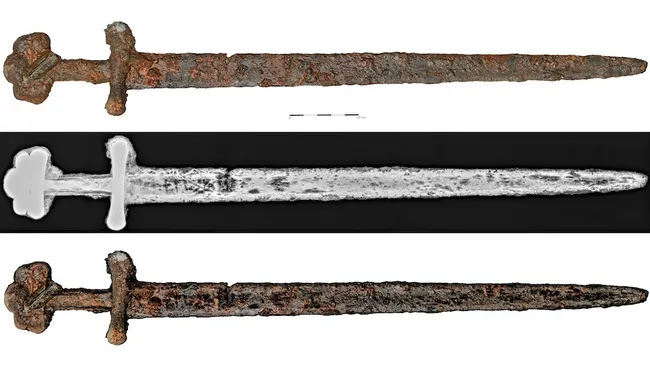
Workers carrying out a dredging operation in the River Wisła in Włocławek in central Poland in the second week of January 2024 recovered an example of a type of sword thought to be over a thousand years old along with a load of river silt. The sword is double-edged with a three-lobed pommel, which are distinctive features of these swords, and when viewed in x-ray could be seen to bear the inscription +VLFBERTH+, which have been found on about 170 similar swords from across Northern Europe and Scandinavia.

This is the eighth Ulfberht sword found in Poland; the country which has produced the largest number of these swords is Norway, with about 40 known to date. This has led to these swords sometimes being referred to as 'Viking' swords, although historians are fairly confident that they are of Frankish origin, and probably from the southern part of the Frankish realm, in southern Germany or possibly even France. These swords date from the ninth and tenth centuries, and are considered to be an intermediate stage between the earlier swords used across northern Europe and the knightly swords of Late Medieval Europe. They are typically made of superior steel to that used in earlier swords, which would have made them stronger and sharper.

The sword shortly after its discovery. Provincial Office for the Protection of Monuments in Toruń.

A ninth or tenth century date for the sword would suggest it was in use around the time of the founding of the modern state of Poland, by the Piast Dynasty, who, according to legend, unified the Slavic tribes of the region, fought for independence from the area's German rulers, defended against raiders from Scandinavia, and introduced Christianity to Poland.

See also...