Showing posts with label Singapore. Show all posts

Monday, 24 November 2025

Authorities in Singapore seize largest ever shipment of Rhinoceros horn.

A consignment of 20 Rhinoceros horns weighing 35.7 kg and with an estimated value of US$870 000 has been seized at Singapore Changi Airport, according to a press release issued by the Singapore National Parks on 18 November 2025. The consignment was discovered on 8 November by Vengadeswaran Letchumanan, an employee of air cargo handling company SATS, who noticed a strange smell coming from a package labelled 'furniture fittings' which was being shipped from South Africa to Laos.

Rhinoceros horns seized at Singapore Changi Airport on 8 November 2025. Singapore National Parks.

Concerned by the smell, Mr Vengadeswaran, contacted his line manager, who intern contacted SATS Security, who opened the package. Upon discovering the contents of the first package, three other packages from the same consignment were X-rayed, revealing similar contents. As well as the Rhinoceros horns, the packages contained 150 kg of other Animal parts, which have yet to be identified, including bones, teeth and claws.

Animal parts seized at Singapore Changi Airport on 8 November 2025. Singapore National Parks.

The Rhinoceros horns have been identified by the Centre for Wildlife Forensics as having originated from White Rhinoceros, Ceratotherium simum, a species currently listed as Near Threatened on the International Union for the Conservation of Nature's Red List of Threatened SpeciesThe international trade in Rhino horn was banned in 1977 under the terms of the Convention on International Trade in Endangered Species, to which Singapore is a signatory.

South Africa is home to more than half of the world's surviving Rhinoceros population, but has (like many other countries) faced significant problems from poaching of the Animals for their horns. This reached a peak between 2013 and 2017, with more than a thousand Rhinos being killed each year in South Africa, according to Save the Rhino, although the number fell each year from 2015 until 2020. During the COVID 19 pandemic there was an increase in poaching, with the number killed rising slowly each year until 2023. There was a drop of about 15% in 2024, although this still resulted in 420 known Rhinoceros poaching incidents. The majority of Rhino poaching is thought to be carried out by organised crime syndicates, rather than opportunistic local hunters. 

See also...


Sunday, 19 July 2020

Girl stung by Box Jellyfish off the coast of Sentosa Island, Singapore.

A girl has been stung by a Box Jellyfish while bathing on Tanjong Beach on Sentosa Island, Singapore, on Friday 17 July 2020. She was taken home immediately by her mother, and the stings treated with vinegar, which is effective against Box Jellyfish stings. Help was not sought from beach patrol officers in the area, who carry vinegar in case of such incidents, and the girl is thought to be recovering from what would have been a painful experience. Local authorities are warning people to be aware of the dangers of Box Jellyfish when bathing, as their stings are extremely painful and can be deadly.

A Box Jellyfish off the coast of Sentosa Island, Singapore, on 17 July 2020, and the injury it caused to a young girl who encountered it. Carolyn David/Marine Stewards Singapore/Facebook.

Most Box Jellyfish encountered in Southeast Asia belong to the species Chironex flecker, sometimes known as the Sea Wasp, which is endemic to shallow coastal waters and which has a particularly potent sting, with an adult of the species producing enough venom to kill around adult Humans, which makes them a common cause of fatalities from Southeast Asia to Australia. Box Jellyfish are particularly dangerous as they do not simply drift passively as other Jellyfish do, but posses well developed eyes, muscular and nervous systems, allowing them to actively hunt small prey, and sometimes (probably inadvertently) attack Humans.

However, members of the genus Morbakka, previously only known from Japan and Queensland, have recently been discovered breeding in Mangrove Swamps around Balik Pulau, an island off the west coast of Peninsula Malaysia, with at least one serious stinging incident, a twelve-year-old girl who required four days hospital treatment after being stung on 28 June this year.

See also...

https://sciencythoughts.blogspot.com/2020/05/copula-sivickisi-understanding-how.htmlhttps://sciencythoughts.blogspot.com/2019/11/ten-year-old-russian-boy-survives-being.html
https://sciencythoughts.blogspot.com/2018/12/carukia-barnesi-irukandji-jellyfish.htmlhttps://sciencythoughts.blogspot.com/2018/04/western-australian-beach-closed-after.html
https://sciencythoughts.blogspot.com/2018/04/western-australian-teenager-released.htmlhttps://sciencythoughts.blogspot.com/2018/03/warning-issued-to-tourists-after-box.html
Follow Sciency Thoughts on Facebook.

Thursday, 9 April 2020

Singapore court gaols South African man for unlawfully transporting Rhinoceros horn.

A South African man has been sentenced to 17 months imprisonment after being caught with eleven pieces of Rhinoceros horn at Singapore's Changi Airport on 5 January 2020. Thurman Shiraazudin Aiden Matthews, 45, of Johannesburg, was arrested after the horn was detected during a routine x-ray check of his luggage as he passed through the airport en route to Ho Chi Minh City in Vietnam. Mathews was unable to produce a valid export permit for the horn, which is covered by the Convention on International Trade in Endangered Species of Wild Fauna and Flora (CITES), and claims he was offered 20 000 Rand (about US$11 000) to transport the horn by an unidentified Chinese man he met in Johannesburg in October 2019. The Singapore National Parks Board estimate that at least five Southern White Rhinoceros, Ceratotherium simum simum, died to produce the horn recovered, and that the material would have had a black market value of about Singapore $760 000 (about US$534 000).

Rhinoceros horn recovered from the luggage of a South African man arrested at Singapore's Changi Airport on 5 January 2020. Singapore National Parks Board.

Park authorities and private game reserves across Africa and Asia have been struggling with the problem of Rhino poaching for decades, but the problem has become more acute in recent years, with over a thousand killed in South Africa alone in 2017, and over 5500 in the past five years. The country is home to about 20 000 Rhinos, about 80% of the entire African population. The crime is extremely profitable, and widely believed to be controlled by organised crime syndicates, which are thought to have considerable influence over police and court officials in many areas, which results in suspected poachers often being released before they are brought to trial, often with only nominal bail payments.

 Authorities in Singapore believe the horns came from at least five Southern White Rhinoceros, Ceratotherium simum simum. Singapore National Parks Board.

The Southern White Rhinoceros is currently the most common and widespread type of Rhinoceros, with a population estimated at between 17 212 and 18 915 individuals by the conservation organisation Save the Rhino. The species is also found in Botswana, Kenya, Namibia, Swaziland, Zambia, Zimbabwe, and Uganda, but around 90% of the population is located in South Africa, making efforts to protect the species there critical to its long term survival. The Southern White Rhinoceros is currently classified as Near Threatened on the Red List of Threatened Species.
 
See also...
 
https://sciencythoughts.blogspot.com/2019/11/dicerorhinus-sumatrensis-last-sumatran.htmlhttps://sciencythoughts.blogspot.com/2019/10/south-african-police-arrest-five.html
https://sciencythoughts.blogspot.com/2019/09/suspected-poacher-killed-in-shootout.htmlhttps://sciencythoughts.blogspot.com/2019/09/suspected-rhinoceros-poacher-arrested.html
https://sciencythoughts.blogspot.com/2018/11/poacher-sentenced-to-33-years.htmlhttps://sciencythoughts.blogspot.com/2018/09/south-african-directorate-for-priority.html
Follow Sciency Thoughts on Facebook.

Friday, 19 October 2018

Arcotheres placunicola: A new species of Pea Crab from Singapore.

Pea Crabs, Pinnotheridae, are very small Crabs that often live symbiotically within the shells of Bivalves or other organisms. Members of the genus Arcotheres are often associated with Indo-Pacific Window-pane Shells of the genus Placuna, with at least three species found within the wide ranging Placuna placenta. The Singapore Window-pane Shell, Placuna ephippium, was presumed to host the same species, but such interchangeability between hosts is now considered to be rare.

In a paper published in the journal Raffles Bulletin of Zoology on 23 August 2018, Peter Ng of the Lee Kong Chian Natural History Museum at the National University of Singapore, describes a new species of Arcotheres from the Singapore Window-pane Shell, based upon examination of specimens collected around Singapore.

The new species is named Arcotheres placunicola, which appears to mean ‘Placuna-dweller’ though the derivation of this name is not given. Females of this species are subcircular and distinctly wider than long, with adults typically being a little over 10 mm in width, males are smaller, reaching only a little over 5 mm in width, and have more circular carapaces. The females are variable on colour, ranging from yellow to orange, or off-white with brown patterns, the males are greenish brown.

Two specimens of Arcotheres placunicola in situ on Placuna ephippium. Ng (2018).

See also...

https://sciencythoughts.blogspot.com/2018/04/dardanus-balhibuon-new-species-of.htmlhttp://sciencythoughts.blogspot.co.uk/2017/12/pleistacantha-kannu-new-species-of.html
http://sciencythoughts.blogspot.co.uk/2017/11/coconut-crabs-observed-predating.htmlhttp://sciencythoughts.blogspot.co.uk/2017/11/salangathelphusa-peractio-new-species.html
http://sciencythoughts.blogspot.co.uk/2017/09/court-issues-28-220-in-fines-and.htmlhttp://sciencythoughts.blogspot.co.uk/2017/06/tomopaguropsis-rahayuae-deepwater.html
Follow Sciency Thoughts on Facebook.

Saturday, 19 November 2016

Determining the origin of the August 2016 Singapore Zika Virus outbreak.

Zika Virus was first recoded in 1947 in Rhesus Monkeys in Uganda, with a series of sporadic Human infections recorded in Africa and Equatorial Asia in the later part of the twentieth century. In 2007 a larger outbreak was recorded on the island of Yap in Micronesia, which was followed by a second outbreak in French Polynesia in 2014-15. This Polynesian outbreak was particularly worying as it was linked to a variety of congenital cerebral defects, including microcephaly (extreme underdevelopment of the brain in infants, leading to severe learning disabilities). This was followed by a larger outbreak in 2016 which originated in Brazil and spread to a number of other American nations, an outbreak which was again linked to a cerebral defects, including microcephaly.

In August 2016 a cluster of Zika cases was detected in Singapore, causing fears that the disease may have spread from Brazil, and might present a danger to pregnant women in the country. In a paper published in the journal Eurosurveillance on 22 September 2016, a team of scientists led by Sebastian Maurer-Stroh of the Bioinformatics Institute of the Agency for Science, Technology and Research in Singapore, the Department of Biological Sciences at National University of Singapore, the School of Biological Sciences at the Nanyang Technological University and the National Public Health Laboratory of the Singapore Ministry of Health, describe the results of a series of an investigation into the Singapore Zika Virus outbreak.

The Zika Virus. Getty Images.

The Zika Virus has been known to be split into two distinct lineages, the African and Asian lineages, with the Micronesian, Polynesian and Brazillian epidemics all being derived from the Asian strain. Importantly the Polynesian and Brazilian Zika Viruses are more closely related to one-another than to any other recorded strain of the Virus, implying that the cerebral defects that are associated with the Virus are probably the result of a mutation present only in these strains.

Maurer-Stroh et al. tested 153 patients showing Zika-like symptoms (rash, polyarthralgia and low grade fever, and in a number of cases had mild conjunctivitis) in Singapore on 27-28 August 2016. Of these 53 tested positive for the Virus. RNA sequencing of the Viruses (Zika is an RNA Virus which lacks DNA) revealed that the Singapore Virus belonged to the Asian strain, and though it was outside the Polynesia/Brazil cluster, it was more closely related to this cluster than any other tested strain.

Maximum likelihood phylogenetic tree of representatives from the African lineage coloured red and Asian lineage coloured blue or cyan. The tight cluster with strains from French Polynesia and the Americas is in blue and strains from south-east Asia are in cyan. Maurer-Stroh et al. (2016).

See also...

http://sciencythoughts.blogspot.co.uk/2016/08/florida-state-department-of-health.htmlhttp://sciencythoughts.blogspot.co.uk/2016/02/estimating-role-of-temperature-in-sea.html
http://sciencythoughts.blogspot.co.uk/2016/01/sierra-leone-reports-new-case-of-ebola.htmlhttp://sciencythoughts.blogspot.co.uk/2015/11/evidence-for-sexual-transmission-of.html
http://sciencythoughts.blogspot.co.uk/2015/09/heartland-virus-found-in-wild.htmlhttp://sciencythoughts.blogspot.co.uk/2015/03/a-new-species-of-tick-borne-virus-from.html


Follow Sciency Thoughts on Facebook.

Tuesday, 27 September 2016

Brachycoraebus aeneus & Metasambus circularis: Two new species of Jewel Beetles from Singapore and Sumatra.

The Tribe Coraebini is the largest subgroup within the Buprestidae (Jewel Beetles). These are small Beetles found within the forest canopy in both temperate and tropical regions, though both their biology and true diversity is poorly understood, due to the inaccessible nature of their prefered habitats.

In a paper published in the Raffles Bulletin of Zoology on 31 August 2016, Loong-Fah Cheong of the Lee Kong Chian Natural History Museum, describes two new Beetles from the Tribe Coraebini, both of which were found in Singapore, and one also on Sumatra.

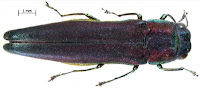
The first new Beetle described is placed in the genus Brachycoraebus and given the specific name aeneus, in reference to its brassy colouration. This species is described from two specimens, a female collected from the Nee Soon Swamp Forest on Singapore in September 2013, and a male collected from an unknown location on the island in April 1923. These are small Beetles, the male measuring 3.6 mm in length and 1.5 mm in width and the female 4.2 mm in length and 1.9 mm in width. They are dark brown in colour, and covered with short golden hairs, which gives them a brassy appearance; their undersides are black.

Brachycoraebus aeneus, female specimen in life. Loong-Fah Cheong (2016).

The second new species described is placed in the genus Metasambus, and given the specific name circularis, in reference to the circular pattern on the elytra (wing case) of the Beetles. The species is described from seven specimens, two from the Riffle Range Forest of Singapore and five from an unknown location on Sumatra. These are also small Beetles, measuring 3.8 mm in length and 1.3 mm in width, and are black in colour with a purplish tinge, and a covering of white hair on the elytra which forms two distinct bands, each with a circular pattern on each wing-case.

 Metasambus circularis, male specimen. Loong-Fah Cheong (2016).

 See also...

http://sciencythoughts.blogspot.co.uk/2014/01/two-new-species-of-jewel-beetle-from.htmlTwo new species of Jewel Beetle from Central America.                                                      Jewel Beetles (Buprestidae) are wood-boring Insects with distinctive bright, metallic elytra...
http://sciencythoughts.blogspot.co.uk/2012/12/six-new-species-of-jewel-beetle-from.htmlSix new species of Jewel Beetle from Southeast Asia.                                             Jewel Beetles (Buprestidae) are wood-boring Insects with distinctive bright, metallic elytra...
Follow Sciency Thoughts on Facebook.
 

Thursday, 21 April 2016

Three new species of Kinorhynchs from Singapore.

Kinorhynchs are tiny (generally less than 1 mm) worm like animals found in marine sediments. They appear to be ubiquitous members of the interstitial meiofuana (animals that live between sediment grains) in shallow marine habitats, but have been studied in relatively few locations. Kinorhynchs are thought to be related to Pripulid Worms (large unsegmented Worms with evertable pharyxes and Loriciferas (small unsegmented animals with cup-shaped rigid bodies and evertable pharynxes), and like these groups have evertable pharynxes, which is used not just in feeding, but in locomotion, being pushed ahead of the animal then anchored and used to pull it forwards.

In a paper published in the Raffles Bulletin of Zoology on 29 January 2016, Martin Sørensen, Ludwik Gąsiorowski and Phillip Randsø of the Section for GeoGenetics at the Natural History Museum of Denmark, Nuria Sánchez of the Department of Zoology and Anthropology at the Universidad Complutense de Madrid and Ricardo Neves of the Biozentrum of the University of Basel, describe three new species of Kinorhynches from Singapore, as part of a study of this group around the island; Kinorhynches have previously been recorded but not identified from the Malaysian Peninsula, while elsewhere in Asia the specimens have been identified from Borneo, Indian territories around the Bay of Bengal and Anderman Sea, and the coasts of Japan, Korea, China and the Russian Far East.

The first new species is placed in the genus Centroderes, which has previously been described from the Black Sea, the Mediterranean, the Caribean and the Atlantic Coast of North America, and given the specific name 'impurus' meaning 'unclean' or 'covered with dirt' in reference to the sediment which covered the specimens and which made examination of them very difficult.

 Light micrographs showing lateral overviews of Centroderes impurus. (A) Adult male stage-2. (B) Putative J6 or adult stage-1 specimen of unknown gender. Sørensen et al. (2016).

The species is described from two stage 2 adult males and four specimens of indeterminate sex that are either stage 6 juveniles or stage 1 adults (Kinorhynches have eight growth stages, the first six considered to be juvenile stages and the final two adult, though sexual characteristics are only manifest in the final stage), collected at a depth of nine meters between Bedok Jetty and Sungei Bedok in the southeast part of Singapore Island.

 Line art illustration of Centroderes impurus, male stage-2, lateral view. Abbreviations: ij, intersegmentary joint line; lass, lateral accessory sensory spot; ldss, laterodorsal sensory spot; ltas, lateral terminal accessory spine; lts, lateral terminal spine; lv, lateroventral spine; mdp, middorsal placid; mds, middorsal spine; mls, midlateral spine; mlss, midlateral sensory spot; mts, midterminal spine; mvp, midventral process; pdss, paradorsal sensory spot; pf, pectinate fringe; sdss, subdorsal sensory spot; sf, secondary fringe; vms, ventromedial spine; vmss, ventromedial sensory spot. Digits following labels refer to segment numbers. Sørensen et al. (2016).

The second species described is placed in the genus Echinoderes, and given the specific name annae, after Anna, the girlfriend of Phillip Randsø. The species is described from two males, two females and a juvenile collected from muddy Seagrass aggregations on the intertidal zone on Saringat Island, a small Singapore terretory to the south of the main island.

 Light micrographs showing overviews and details of neck and trunk morphology in female  and male specimes of Echinoderes annae. (A) Lateroventral overview. (B) Neck and segments 1–2, lateroventral view. (C) Neck and segments 1–2, laterodorsal view. (D) Segments 3–7, lateroventral view. (E) Segment 4, middorsal. F, segments 8–10, lateroventral view. (G) Segments 6–8, dorsal view. (H) Segments 10–11, dorsal view, showing male morphology. (I) Segment 11, ventral view, showing female morphology. (J) Segments 9, laterodorsal view. Abbreviations: gco1/2, glandular cell outlet type 1 or 2; ldt, laterodorsal tube; ltas, lateral terminal accessory spine; lts, lateral terminal spine; lvt, lateroventral tube; mds, middorsal spine; mlt, midlateral tube; mvp, midventral placid; pe1–3, penile spines; si, sieve plate; te, tergal extensions; trp, trichoscalid plate. Dashed circles mark glandular cell outlet type 1. Sørensen et al. (2016).

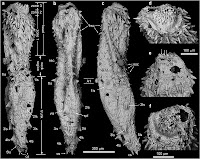
The final species described is placed in the genus Leiocanthus. and given the specific name nagini, which is the female version of Nāgá, a Sanskrit word implying a devine Serpent or Dragon, as well as being the name of Voldemort's Snake in JK Rowling's Harry Potter novels. The species is described from a single male collected from a depth of 52 m to the southeast of Singapore island, and a female collected at a depth of nine meters between Bedok Jetty and Sungei Bedok in the southeast part of Singapore Island.

 Scanning electron micrographs of female Leiocanthus nagini in (A) ventrolateral overview, and (B) ventral overview. Sørensen et al. (2016).

In addition to the new species described, Sørensen et al. also record several previously described species from Singaporean waters for the first time, notably Condyloderes paradoxus, a species previously recorded from the Bay if Bengal, Echinoderes tchefouensis, a species widespread in East Asia, and two unidentified species of Echinoderes.

See also...

http://sciencythoughts.blogspot.co.uk/2016/01/scathascolex-minor-palaeoscolecid-worm.htmlScathascolex minor: A Palaeoscolecid Worm from the Middle Cambrian Burgess Shale of British Colombia.                            Palaeoscolecids are a group of vermiform animals (worms) known from Cambrian to Silurian deposits. They had rings similar to...
http://sciencythoughts.blogspot.co.uk/2015/12/eokinorhynchus-rarus-kinorhynch-from.htmlEokinorhynchus rarus: A Kinorhynch from the Early Cambrian of Sichuan Province, China.                                                 Kinorhynches are tiny (at most 3 mm) worm like animals found in marine sediments, with segmented tube- or barrel-shaped bodies, separate head and neck regions and evertable pharynxes. They are related...
http://sciencythoughts.blogspot.co.uk/2015/05/priapulid-worms-from-middle-cambrian-of.htmlPriapulid Worms from the Middle Cambrian of Canada.                                                Priapulid Worms are a form of marine worms with denticle-covered pharynxes which can be everted to form proboscises. They are a minor element of..

 
Follow Sciency Thoughts on Facebook.