Showing posts with label Life. Show all posts

Wednesday, 10 April 2024

Assessing the habitability of the clouds of Venus.

The surface of Venus has long been considered to be unsuitable for life. The temperature here averages about 427°C, which is not only far to hot for liquid water to exist, but which would also cause the near instantaneous inactivation of any enzymes, the denaturing of any proteins, and the thermal decomposition of almost all biological organic molecules. This has not, however, prevented all speculation about the possibility of life existing on Venus, with some scientists suggesting that it might be possible for life to exist within the planet's cloud layer. One proposed theoretical dweller in the clouds of Venus is the spherical hydrogen gasbag isopyenic organism, which would keep its position within the cloud layer by means of a bag-like body containing the lighter-than-air gas hydrogen, although calculations suggest that such an organism would require a minimum diameter of 4 cm to stay aloft on Venus, which seems improbable.

The detection of phosphene gas in the clouds of Venus, which on Earth would  be considered a clear indicator of microbial activity, has led to renewed consideration of the possibility of life in the Venusian clouds, possibly in the form of microbes within fluid droplets, a habitat which would protect them from dehydration, otherwise a problem for small organisms floating in an atmosphere. However, living within floating droplets would present micro-organisms with another problem, due to the limited lifespan of droplets large enough to sustain such organisms, which would tend to settle out of the cloud layer and evaporate. 

In a paper published on the arXiv database at Cornell University on 8 April 2024, Jennifer Abreu of the Department of Physics and Astronomy at Lehman College at City University of New York, Alyxander Anchordoqui of the John F. Kennedy School in Somerville, Massachusetts, Nyamekye Fosu, Michael Kwakye, Danijela Kyriakakis, and Krystal Reynoso, also of the Department of Physics and Astronomy at Lehman College at City University of New York, and Luis Anchordoqui, again of the Department of Physics and Astronomy at Lehman College, and of the Department of Physics at the Graduate Center at City University of New York, and of the Department of Astrophysics at the American Museum of Natural History, present a potential scenario for the survival of microbes within the Venusian cloud layer. 

The cloud layer completely encircles Venus, giving it a planetary albedo of about 0.8 (i.e. causing it to reflect about 80% of the light it receives back into space). The base of the cloud layer is about 47 km above the surface, at which altitude the atmosphere has a temperature of about 100°C. The top of the cloud layer reaches about 74 km above the surface at the equator, decreasing to about 65 km at the poles. This cloud layer can further be divided into three zones, an upper layer, above 56.5 km, a middle layer between 50.5 km and 56. 5 km, and a lower layer less than 50.5 km above the ground. Droplets within the cloud layers can be divided into three types, based upon their size. Type 1 droplets have a diameter of about 0.2 µm, type 2 droplets have a diameter of 1-2 mm, and type 3 droplets have a diameter of about 4 mm. Types 1 and 2 are found in all three cloud layers, whereas type 3 droplets are only found in the middle and lower layers.

Within the cloud layer, the availability of carbon dioxide, sulphuric acid compounds, and ultraviolet light would provide any microbes with sources of food and energy. Optimum conditions for survival would probably be found about 50 km above the surface, where the temperature fluctuates between about 60°C and about 100°C, and the pressure is about one atmosphere.

On Earth, long lived aerosols, acidic clouds, and atmospheric temperatures consistently above the boiling point of water are not present. However, life, in the form of Bacteria, Pollen, and Algae, has been found in the atmosphere as far as 15 km above sealevel, and Bacteria have been found growing in droplets of moisture gathered from super-cooled clouds above the Alps. It has been proposed that microbes have been able to reach such heights via evaporation, storms, eruptions, or meteor impacts, all processes likely to have been found on an early Venus, where the surface is likely to have been more conducive to life. Unlike their Earthly counterparts, the clouds of Venus are not transient, but are a constant, global phenomenon, where individual aerosol particles can be sustained for a long period of time, rather than for a maximum of a few days, potentially providing a stable home for Venusian life.

Abreu et al. suggest that life may be present in the lower haze layers of the Venusian atmosphere as desiccated spores, ready to become activated when updrafts carry them into the habitable layer within the clouds. After reaching the habitable middle and lower cloud layers, the spores would act as condensation nuclei around which water droplets would form, allowing them to germinate and become metabolically active. Metabolically active microbes could grow by division (as with Prokaryotes on Earth) within the droplets, which would themselves grow further by coagulation. Eventually the droplets would grow so large that they would gravitationally settle out of the cloud layer into the hotter layers beneath, causing their liquid content to evaporate, and the micro-organisms to desiccate and re-enter the spore state. The desiccated spores would then be small and light enough to resist further downwards movement, remaining in the haze layer until a new updraft carries them back into the clouds and the process begins again.

Hypothetical life cycle of the Venusian microorganisms. Top panel: Cloud cover on Venus is permanent and continuous, with the middle and lower cloud layers at temperatures that are suitable for life. Bottom panel: Proposed life cycle for Venusian aerial microbial life. Abreu et al. (2024).

All living organisms have to be able to replicate, and in Bacteria, used as the model for Abreu et al.'s proposed Venusian microorganisms, this is achieved by binary fission; i.e. the division of one Bacterium into two. Thus, a population of Bacteria can double in size in a single generation, and the time which it takes for a population of Bacteria to double can be taken as a generation time. For many common Bacteria the generation time is less than an hour, for example in Escherichia coli it is typically about 20 minutes under ideal conditions (which assume an aerobic, nutrient-rich environment at an optimum temperature), which the marine Bacterium Vibrio natriegens can have a generation time as low as 7-10 minutes. 

If a Bacterium has a generation time of 20 minutes, then it would go through three generations in an hour (so that one Bacterium will become sixteen) and 36 in 12 hours (so that one Bacterium will become about 70 000 000 000, assuming a suitable source of nutrients).

Abreu et al. further calculate that a droplet with a diameter of about 0.1 µm would be effectively neutrally buoyant in Venus's cloud layer, and that a droplet would need to reach about 100 µm in diameter before it began to fall consistently at a velocity of 1 m per second, within a cloud layer that can be up to 27 km thick, enabling plenty of time for reproductive fission.

Unlike Earth, Venus lacks an intrinsic magnetic field which prevents cosmic radiation from reaching the atmosphere. This means that molecules in the upper atmosphere are ionized by ultraviolet radiation, forming an ionosphere, with interactions between this ionosphere and the solar winds producing a magnetic field within the outer atmosphere, capable of slowing down particles with energies of up to a few hundred kiloelectron volts and diverted them around the planet. More energetic particles are able to penetrate this weak magnetic field. Particles with energies of greater than one giga electron volt will provoke cascade reactions in the atmosphere, with nuclei scattered by interaction with the initial particle interacting to cause secondary, tertiary, and subsequent generations of particles, losing energy with each reaction. 

The terrestrial biosphere on Earth benefits from about 1033 g/cm² of protection against the harmful effects of cosmic rays, compared to about 200 g/cm² of shielding available to any Venusian organisms at the top of the cloud layer. However, this protection will have risen to about 1000 g/cm² in the middle cloud layer, comparable to conditions on Earth. Furthermore, cosmic rays are generally considered to be less harmful to Prokaryotic organisms than to multicellular organisms (an interaction with a charged particle may well kill an individual Bacterial cell - but this has no effect on any other cell, and the high rates of reproduction mean that lost Bacteria are replaced quickly, whereas a multicellular organism with many cells needs most of them to survive until the whole organism can reproduce).

Based upon these calculations, Abreu et al. calculate that micro-organisms with similar properties to those found on Earth could potentially exist within the clouds of Venus, reproducing exponentially within droplets in the clouds during the lifetime of those droplets.

See also...

Sunday, 26 December 2021

Evidence for life in the clouds of Venus.

Venus resembles the Earth in many ways; it is roughly the same size, giving it similar gravity, which in turn enables it to retain a thick atmosphere, something the other rocky planets of the Solar System (Mercury and Mars) lack. Unfortunately, the atmosphere of Venus is a little bit too dense for this model to carry any further; Venus is shrouded in a dense cloak of carbon dioxide, resulting in a runaway greenhouse effect and a surface temperature of about 700K (427°C). Despite this apparent hostility, scientists have long speculated that life might exist on Venus, not on its surface, but in the cloud layer between 48 and 60 km above, where Earth-like temperatures and pressures prevail.

 
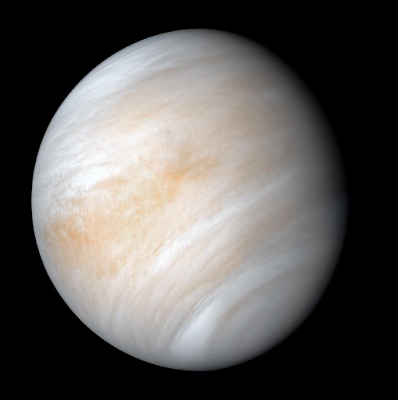
The planet Venus as imaged by the Mariner 10 space probe in 1974. NASA/JPL/Caltech.

Venus has a layer of clouds about 20 km thick, including the 12 km which have Earth-like, temperate conditions. Unfortunately, these clouds are thought to be made not of of water droplets, but concentrated sulphuric acid, with a very low water content, quite unsuitable for any form of life as we understand it. 

However, 50 years of spectrographic observations of Venus have left a number of unresolved mysteries about the planet's atmosphere. 

The most puzzling of these is the presence of water and sulphur dioxide in the atmosphere above the clouds. Water is present throughout the atmosphere of Venus, albeit at very low levels, while sulphur dioxide, which can be measured in parts per million below the clouds, can still be measured in parts per billion above the clouds. Both gasses are thought to be present in the atmosphere of Venus as a result of volcanic emissions, and should in theory be uniformly mixed throughout the atmosphere to an altitude of about 70 km, where they should be destroyed by ultraviolet photodissociation. However, the observed abundances do not support this, suggesting that sulphur dioxide is significantly depleted relative to oxygen in and above the cloud layers.

Previous models have suggested that sulphur dioxide could be photochemically oxidized to sulphur trioxide, which would in turn react with water droplets in the clouds to form sulphuric acid. However, sulphur dioxide is about five times as abundant as water, so if this were happening then all water should be eliminated in the cloud layer, while the sulphur dioxide level should only be reduced by about 20%.

Another persistent mystery is the presence of free oxygen in the clouds of Venus, the formation of which cannot be explained by any current model of the planet's atmosphere and processes. Furthermore, the atmosphere of Venus appears to be in a state of chemical disequilibrium (i.e. it contains gasses that should react with one-another till one or more is eliminated unless they are being constantly being topped up).

Another mystery is the apparent presence of ammonia in Venus's atmosphere. This was first detected by the Russian Venera 8 probe in 1972, although this was initially rejected as an anomaly, but later found again by NASA's Pioneer Venus probe. Pioneer Venus's long-term observation of the clouds of Venus also found further chemical disequilibrium within the cloud layers, as well suggesting that at least the lower layers contained substantial solid material, incompatible with a sulphuric acid composition. Other mysteries uncovered within the cloud layer were the presence of methane and phosphine, as well as an unknown ultraviolet-absorbing molecule.

In a paper published in the Planetary Science Journal on 23 July 2021, Paul Rimmer of the Department of Earth Sciences and Cavendish Laboratory at the University of Cambridge, and the MRC Laboratory of Molecular Biology, Sean Jordan and Tereza Constantinou of the Institute of Astronomy at the University of Cambridge, Peter Woitke of the School of Physics & Astronomy and Centre for Exoplanet Science at the University of St Andrews, Oliver Shorttle of the Department of Earth Sciences and Institute of Astronomy at the University of Cambridge, Richard Hobbs also of the Institute of Astronomy at the University of Cambridge, and Alessia Paschodimas of the Centre for Exoplanet Science and School of Earth and Environmental Sciences at the University of St Andrews, proposed a model in which a base molecule was present in the clouds of Venus, reacting with sulphur dioxide in the atmosphere to form sulphites, and thereby explaining the depletion of sulphur dioxide in the planet's atmosphere.

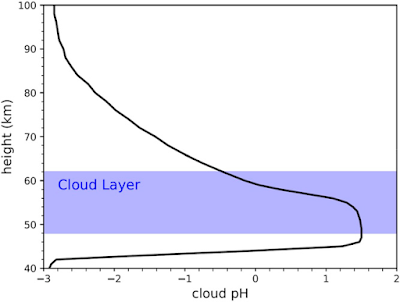
This reaction would also consume water, but this would be released again as the sulphites broke down in the lower atmosphere, providing a model that would account for the observed levels of water and sulphur dioxide in the atmosphere of Venus. The formation of sulphites would also have a profound impact on the composition, and pH, of the cloud layer. This has previously been assumed to more-or-less pure sulphuric acid, resulting in a pH of about -11, but Rimmer et al.'s model would raise this to somewhere between -1 and 1. This is within the tolerance range of extremophilic Bacteria and Archaeans on Earth, whereas -11 would be completely unsurvivable for any Earthlife-like organism.

In their initial paper, Rimmer et al. used sodium hydroxide as base in their model, not because they thought it was likely to be present, but simply as a standard base with predictable interactions. In a second paper published in the Proceedings of the National Academy of Sciences of the United States of America on 20 December 2021, William Bains of the Department of Earth, Atmospheric, and Planetary Sciences at the Massachusetts Institute of Technology and the School of Physics & Astronomy at Cardiff University, Janusz Petkowski, also of the Department of Earth, Atmospheric, and Planetary Sciences at the Massachusetts Institute of Technology, Paul Rimmer, lead author of the original study, and Sara Seager, again of the Department of Earth, Atmospheric, and Planetary Sciences, and of the Department of Physics and the Department of Aeronautics and Astronautics at the Massachusetts Institute of Technology, suggest that ammonia might be the base present in the clouds of Venus, discuss the implications of that.

The presence of ammonia in the clouds of Venus would result in the observed gas balance, with the upper atmosphere depleted in sulphur dioxide, but still containing water, as well as solid particles being formed in the clouds, and the presence of free oxygen.

In order for ammonia to form in the clouds of Venus, it would be necessary to reduce nitrogen by bonding it to hydrogen, which would require source of electrons as well as a source of hydrogen. Since there is almost no free hydrogen in the clouds, Bains et al. consider water to be the most likely candidate for the hydrogen doner, with electrons being obtained by the oxidation of carbon monoxide, carbonyl sulphide, sulphur dioxide, nitrogen, water, or hydrochloric acid.

Bains et al. reason that the most likely process would be the reaction of nitrogen with water to produce ammonium hydroxide and oxygen, as this requires less water and less energy than other potential reactions, and because it is the only reaction that would directly produce both ammonia and oxygen (which have been observed) without producing other oxidized species (which have not been observed) and would then require more energy to break down releasing oxygen.

The next question Bains et al. address is the rate at which the clouds must be depleting sulphur dioxide from the atmosphere in order to produce the observed levels, assuming that the sulphur dioxide rate is being topped up from below at a steady rate. This leads to the calculation that 100 billion tonnes of ammonia must be produced each year, roughly equivalent to the amount of free oxygen produced by photosynthesis each year. This would also result in about 100 billion tonnes of mass being lost from the bottom of the cloud layer through the precipitation of solid sulphite particles, which is in line with observations.

Any reaction producing ammonia on Venus would require considerable energetic input, leading Bains et al. to look for plausible sources of such energy. Lightning is present on Venus, and is capable of reducing nitrogen to ammonia, but the level of energy available from lightning would be far short of that needed to produce the observed gas ratios, and in any case unlikely to produce free oxygen. Ultraviolet-driven photochemistry can also produce ammonia, but again is most unlikely to do so at the observed levels (although how the presence of large amounts of sulphuric acid would have on this process has never been explored). Similarly, volcanoes can produce ammonia on Earth, but it is highly unlikely that Venusian volcanoes could be producing the observed levels of ammonia.

The ability to harvest chemical energy to reduce nitrogen to ammonia in an oxidising environment is a characteristic of life on Earth, where many Microorganisms live by doing just that, so Bains et al. posit that it is not unreasonable to suggest similar organisms might be carrying out this process in the clouds of Venus. The energy requirements of such a process would be high, and there would need to be clear benefits involved for any organism to do this, but Bains et al. suggest that creating a habitable environment by de-acidifying the cloud droplets would satisfy this requirement.

 
Predicted pH profile of cloud particles. The blue shaded region shows the altitude where clouds are present, from 48 km to 62 km. Note that the plot extends above and below the cloud tops because there are plausibly cloud particle populations that extend down to the altitude where sulphuric acid is sublimated, and up into the mesosphere where sulphuric acid aerosol evaporation may explain the anomalous sulphur dioxide inversion at 80 km to 100 km. This model provides no constraints on the composition of the mesospheric particles, which may well be composed of pure sulphuric acid. Bains et al. (2021).

Bains et al. suggest that the production of the levels of ammonia needed to drive this process is not beyond the plausible range of biological organisms living within the clouds. 100 billion tonnes of ammonia production per year equates to 3.10 billion grams of ammonia per second. On Earth, several species of Cyanobacteria can fix nitrogen into ammonia at rates of 0.000 000 041 g per gram of wet weight per second, which means that 8.1 billion tonnes, wet weight, of these organisms could produce 100 billion tonnes of ammonia per year. Any life in the clouds of Venus is unlikely to closely resemble Earthly Cyanobacteria, but assuming an organism with similar productivity was involved, then it would only represent about 1.5% of the mass of the lowest 5 km of the cloud layer.

Bains et al.'s model provides a better match for the observed abundances of gasses in the atmosphere of Venus, and in particular can account for; (1) the observed disequilibria in the clouds of Venus, (2) the observed presence of oxygen in the clouds, (3) the observed abundance of water in the clouds, (4) the detected ammonia in the clouds, and (5) the observed abundance profile of sulphur dioxide in and above the cloud layer.

Oxygen was detected in the clouds of Venus by the Pioneer Venus and Venera 14 probes, but this was rejected at the time due to the implied disequilibria that would have to exist in Venus's atmosphere. However, since that time is has become overwhelmingly clear that something is causing a disequilibrium in the atmosphere of Venus, and it is therefore reasonable to assume that oxygen is present. Bains et al.'s model predicts the presence of oxygen at levels at only one twentieth of the levels observed by Pioneer Venus and Venera 14 (although it does not rule out the production of further oxygen by other biological processes), but at a far higher level than any other model currently available.

Ammonia was also observed in the clouds of Venus by the Pioneer Venus and Venera 8, but this finding was also rejected at the time, as it was assumed the clouds were made up of droplets of concentrated sulphuric acid, and environment in which ammonia could not survive. Bains et al.'s model produces a much less acidic cloud layer, potentially with a pH above zero, within which ammonia could potentially exist.

Bains et al.'s model predicts the precipitation of ammonium sulphate and ammonium sulphite beneath the cloud layer, forming droplets that would fall until they are evaporated by the rising temperature of the atmosphere. This would result in the thermal decomposition of these molecules, which would release free ammonia, which would be oxidised to form nitrous oxides, something else detected by Pioneer Venus.

This model would also result in larger, probably non-spherical, droplets within the lower cloud layer, which would present a potential home for any biological organism. This is consistent with observations of the cloud layers on Venus, which again cannot easily be explained by any non-biological process.

Bain's et al.'s model can also explain the 'stagnant haze' that has been observed beneath the cloud layer on Venus. This haze extends downwards from the cloud base at 47 km above the ground, to an altitude of about 30 km, and its composition is unclear. The temperature of this haze layer is about 100°C at its upper extent and about 200°C at its base. This would be consistent with sulphate and sulphite salt particles falling from liquid droplets that evaporate at about 100°C, and which themselves decompose at temperatures of 200°C. This would also result in the formation of hydrogen sulphide in the layer beneath the clouds, something else which has been tentatively identified in the data from the Venera 14 and Pioneer Venus probes.

This study provides a new perspective on the habitability of the clouds of Venus. These clouds have previously been viewed as made up entirely of sulphuric acid, creating an extremely acidic and extremely dry environment, something deeply hostile to even the most tolerant forms of life. Bains et al.'s model shows how living organisms could inhabit a layer in the lower parts of these clouds, maintaining a much less acidic environment, with larger semisolid ammonium sulphite and sulphate particles through the production of ammonium.

The predicted pH within this layer, -1 to 1, is within the tolerance levels of some Extremophilic micro-organisms on Earth, and the temperature range, 60-80°C, is that which would be considered optimal for many such organisms. Furthermore, many micro-organisms which we would not considered extremophilic can produce ammonia as a defence against acidic conditions (including some pathogens, such as Mycobacterium tuberculosis and Candida albicans, which use this ability to neutralise the acids in phagosomes produced by our bodies as a defence against them).

Bains et al. note that there are still problems with their model. Most notably, the model only predicts a relative humidity of 0.02% in the lower cloud layer. This is 50 times drier than the lowest conditions that can be endured by the most drought-tolerant organisms on Earth (spores, and aestivating stages of Tardigrades and some micro-organisms can survive such conditions, but are not biochemically active). However, the levels of water reported in studies of the cloud layer is variable, which may mean that the distribution of water within these clouds is variable, with both arid and humid regions, allowing for the presence of active life.

The origin of life on Venus is an interesting question. Some models of Venus's history suggest that the young planet was much more hospitable, with a temperate climate and liquid water on its surface, with hostile conditions developing later due to a runaway greenhouse effect. Under such a model, life could have originated on the surface of Venus, and subsequently migrated into the clouds (this is not unreasonable as, although it is not obvious, there is quite a bit of life in the Earth's upper atmosphere).

See also...


Follow Sciency Thoughts on Facebook.

Follow Sciency Thoughts on Twitter.


Sunday, 4 May 2014

How alien moons could produce false signs of life.

In the past two decades over a thousand planets have been discovered orbiting stars other than our own, and significant progress has been made in understanding planetary systems and processes that do not occur in our own Solar System. One of the most fascinating fields in this new science is the search for life within other star systems, though as yet no hint of such life has been found, and all methods for searching for it are entirely theoretical in how they would interpret any results apparently indicative of life.

The search for life in other star systems holds a great deal of fascination not just for astronomers but for the movie-going public. James Cameron/Avatar/20th Century Fox.

Other than a direct and ambivalent message from an alien civilization, any life on another planet would have to be detected by subtle affects upon the planet’s detectable properties. It has often been suggested that the presence of liquid water would at least indicate life to be possible on another planet, though such water would not in itself be evidence of life, so additional data would be needed before the possibility of life could be asserted.

For example it is known that the Earth’s albedo (the light reflected by the Earth) is shifted into the infra-red by the presence of substantial plant cover on the planet. This is because plants tend to absorb visible light and emit infra-red light. In the event that another planet was found showing a similar shift in albedo into the infra-red part of the spectrum, compared to what would be predicted based upon other known properties of the planet, then it might be inferred that such a planet has an extensive coverage of a photosynthetic organism similar to plants.

The Earth viewed at infrared wavelengths. The planet radiates considerably more light at these wavelengths than would be expected, due to its extensive vegetation cover. European Space Agency/Rosetta.

Another potential method of detecting life would be the presence of ‘incompatible’ gasses in the atmosphere of a planet. For example the Earth’s atmosphere contains both substantial amounts of oxygen (O2) and trace methane (CH4). On Earth both of these have a biological origin, though both could potentially be produced by non-biological means. However the two gasses are unlikely to co-exist in the atmosphere of a planet for very long, since they react to form water (H2O) and carbon dioxide (CO2), so unless both were being constantly added to the atmosphere, one of these gasses would be quickly used up be the reaction. Since the most likely explanation (that we are aware of) for the constant adding of these gasses to the atmosphere would be the presence of life, then the presence of both together could be taken as evidence for the presence of life as well.


Rein et al. observe that at the current time we have no means of resolving moons about planets in other star systems, much less differentiating such bodies from their parent planets while carrying out spectral analyses of their atmospheres. While the Earth’s Moon lacks an atmosphere in any meaningful sense, this is not automatically the case, as we know that Saturn’s moon Titan has a methane based atmosphere denser than that of the Earth. They reason that were such a moon to be orbiting a planet in another star system being studied with current technology, we would have no means of differentiating the atmospheric signature of the moon from that of the planet, and that we might therefore misinterpret the data to infer the possibility of life where none exists. 

The Earth and the Moon would be impossible to differentiate from one-another in a different star system. NASA/Johns Hopkins University Applied Physics Laboratory/NEAR Spacecraft.

See also…


Follow Sciency Thoughts on Facebook.